Brian Wilson has released his solo, piano instrumental rendition of The Beach Boys‘ hit, “Wouldn’t It Be Nice”. The song release comes just two weeks after he announced “At My Piano”, a collection of 15 Beach Boys classics reimagined as solo piano instrumentals, due out November 19th via Decca Records,
Back in September, along with announcement of the album, Wilson shared the first single, “God Only Knows“. Much like the first single, the newly released “Wouldn’t It Be Nice” stays true to the song’s original structure and feel. While it has a slightly slower tempo, this solo rendition from Wilson captures the many different melodies and vocal tonalities present on the original recording from The Beach Boys’ 1966 album, “Pet Sounds”. Despite the absence of vocals, it’s hard to refrain from singing along with Wilson as he gracefully glides through the first chorus. As Wilson said in a statement alongside the album’s announcement, “We had an upright piano in our living room and from the time I was 12 years old I played it each and every day. I never had a lesson, I was completely self-taught.”
He continued, “I can’t express how much the piano has played such an important part in my life. It has bought me comfort, joy, and security. It has fuelled my creativity as well as my competitive nature. I play it when I’m happy or feeling sad. I love playing for people and I love playing alone when no one is listening. Honestly, the piano and the music I create on it has probably saved my life.”
These sentiments are ever-present on this recording, which allows the listener to tap into each and every emotion Wilson feels when playing.
Below, listen to Wilson’s solo piano rendition of “Wouldn’t It Be Nice”, set to appear on the forthcoming album At My Piano. Tour dates and tickets to Wilson’s ongoing tour, Brian Wilson: Greatest Hits Live!, with Al Jardine and Blondie Chaplin.
A Decca Records recording; ℗ 2021 Brimel, under exclusive licence to Universal Music Operations Released on: 2021-10-01
Reb Fountain is to be counted among our finest songwriters whose imagery is both personal and universal, and her command of a melody and a song transcends genre.
The namesake of her new album, which is out now, Reb Fountain says on the single, “’Iris’ is a love letter to my sisters and my many selves, an embrace that holds all the stories we never shared, a rainbow connection, a feminist arsenal, a space to rest, a prism for the heart. What’s in your heart that you dare not speak? If love be our currency, what stories we would tell?”
The perfect extension of her 2020 self-titled record, “Iris” elevates Reb Fountain’s music to new heights. Reb effortlessly combines pop elements with her trademark noir folk-punk sound; weaving authentic and anthemic tunes that create an instant and indelible impression. Written during lockdown in 202, Reb has said on the album “Writing a song a day to keep myself grounded and productive during lockdown, “Iris” provided me an opportunity to speak my unspoken, to reflect what I have seen and experienced from within and to bear witness.”
Diving into the deeper meaning of the album’s namesake, Reb says “Iris is in many ways an unsung hero, known as the goddess of the rainbow, sea and sky, she acts as bridge between the gods to humanity with little of her own story known. So many stories go unheard, so many aspects of our humanity are unsung; visibility is a contested and inequitable space where what is essential and of beauty is often ‘invisible’. I wanted and needed to give voice to this essential human spirit; to conjure and hold and commune with the very real, valid and invaluable voices within and around me.”
“Beastie” is my way of exploring and disrupting tales and tropes that separate ‘others’ from our ‘selves’. It’s easy to relegate evils to the ‘shameful past’; harder to confront our own current inhumanity, especially if one’s identity comes with benefits or losses. I wanted my eyes open and to speak in solidarity with resistance; to make a conscious choice for equity, justice, community, and love . . . and to give folks a chance to join in chorus . . . the band and I look forward to hearing you sing along in the near future.
The award-winning songwriter, Reb Fountain, is a consummate recording artist and performer; spell-bounding audiences with her music and artistry alike. Throughout 2020, Reb and her all-star band (Dave Khan, Karin Canzek and Earl Robertson) astounded audiences around the country on her sold out album release tour.
Reb was born in San Francisco and immigrated with her family from North America to Lyttelton — the quiet port town out of Christchurch that’s been fundamental to New Zealand’s alt-folk scene, raising artists like Marlon Williams, Aldous Harding, and Delaney Davidson.
“IRIS” is out via Flying Nun Records on the 1st of October, 2021 on both black and transparent turquoise vinyl, CD and digitally.
Released October 1st, 2021
All songs written by Reb Fountain except “Swim to the Star”, written by Peggy Seeger and Calum MacColl
Featuring classics like “Anything Could Happen” and “Point That Thing Somewhere Else,” The Clean’s“Boodle Boodle Boodle” EP arrived two months after the “Tally Ho!” single, peaking at #5 and staying in the New Zealand Top 20 for nearly six months. Recorded on four-track by The Clean’s childhood friends Chris Knox and Doug Hood, its five hugely influential songs provided a roadmap for the “Dunedin sound” that would soon follow. Boodle Boodle Boodle was awarded the Classic Record distinction by New Zealand’s Taite Music Prize in 2017.
Remastered by Tex Houston from the original tapes held at the Alexander Turnbull Library.
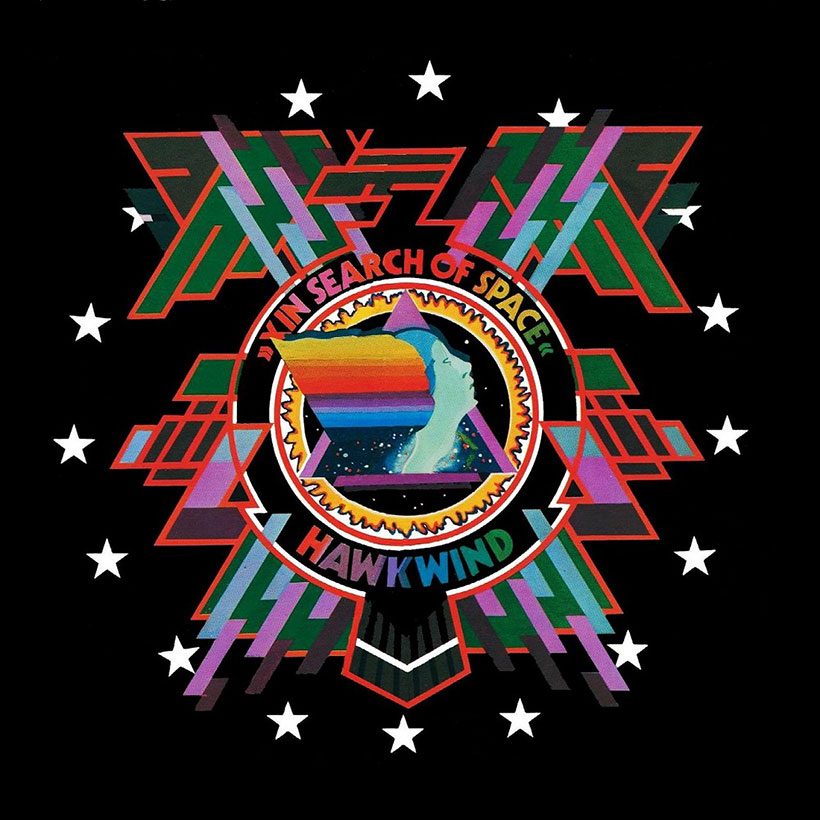
Happy 50th anniversary to “In Search of Space”, the first masterpiece of Hawkwind originally released on 8th October 1971. Hawkwind’s debut album is one of the first full length “Space Rock” albums, but they mastered that art by the time of this sophomore album. The band went on to release the classics like Doremi Fasol Latido (1972), Space Ritual (1973), Hall of the Mountain Grill (1974)
A bold step forward for Hawkwind, their second album, ‘In Search Of Space” laid the groundwork for the landmark track ‘Silver Machine.’ It’s hard to imagine the world of rock’n’roll without Hawkwind’s presence. The pioneering London space-rockers have now endured for five decades, and have a string of classic albums under their belt, among them “In Search Of Space” and “Warrior On The Edge Of Time“. While guitarist/vocalist Dave Brock has remained the only constant, legendary figures such as Ginger Baker, sci-fi/fantasy writer Michael Moorcock and Motörhead founder Lemmy have all passed through its ranks.
Even now, the band’s detractors still dismiss them as merely a “hippie” aberration, but while this seemingly invincible outfit will forever be associated with the UK’s free-festival circuit, in reality their music has embraced everything from prog-rock to psychedelia and heavy metal. Later LPs, such as 1992’s Electric Teepee, even flirted with genres as disparate as ambient and techno.
To date, Hawkwind has recorded almost 30 studio LPs for both major labels (Charisma, Bronze,Active/RCA) and independent imprints (Flicknife, EBS). Yet while the band remains a going concern, most long-term supporters would argue that their career-defining discs emerged from their fruitful tenure with their initial sponsors, Liberty/United Artists, between 1970 and 1975.
Released in August 1970 and co-produced by former Pretty Things guitarist Dick Taylor, Hawkwind’s eponymous debut was book-ended by two folk-flavoured tracks, “Hurry On Sundown” and “Hall Of Mirrors,” but it was dominated by a lengthy free-form, psych-prog jam which was edited down, in Can-like fashion, into shorter individual selections.
Hawkwind was a volatile outfit at the best of times and their initial line-up disintegrated soon after their debut. The original nucleus of Brock, sax/flute maestro Nik Turner, drummer Terry Ollis and synth player Dik Mik remained, but guitarist Hugh Lloyd Langton quit; ex-Amon Düül II bassist Dave Anderson replaced Thomas Crimble, and the band’s soundman, Del Dettmar, stepped in as an additional synth/electronics manipulator.
This line-up recorded the band’s celebrated sophomore release, In Search Of Space. First issued in October ’71 and compiled from sessions overseen by former Jimi Hendrix/Small Faces engineer George Chkiantz at London’s Olympic Studios, the album was a bold step forward from Hawkwind’s debut. Arguably, The album opens with the mind-numbing galactic haze of “You Shouldn’t Do That,” a spooky little 15-minute excursion that warps, throbs, and swirls with Dik Mik’s “audio generator” and the steady drum pace of Terry Ollis. Then comes the ominous whispering of the title, set to the pulsating waves of Dave Brock’s guitar and Turner’s alto sax, with Dettmar’s synth work laying the foundation. Wonderfully setting the tone, “You Shouldn’t Do That” improvisational looseness and rhythmic fusion smoothly open up the album into the realm of Hawkwind. The peculiarity never ceases, as but Brock and Co. also excelled on the intergalactic blues-rock of “You Know You’re Only Dreaming” and “We Took the Wrong Steps Years Ago” delves even deeper into obscurity, sometimes emanating with the familiar jangle of the guitar which then has its acquaintance overshadowed by the waft of the keyboard. Just as laced the succinct, acid-addled “Master Of The Universe’ with Nuggets-esque proto-punk energy,chugs and rolls with a foreboding rhythm, “Adjust Me” retaliates with its moaning verse and tonal fluctuations fading into oblivion. The ground breaking sound which Hawkwind achieved on “In Search of Space” helped to open up a whole new avenue of progressive rock. The track “You Shouldn’t Do That,” wherein the band locked into a super-hypnotic motorik groove.
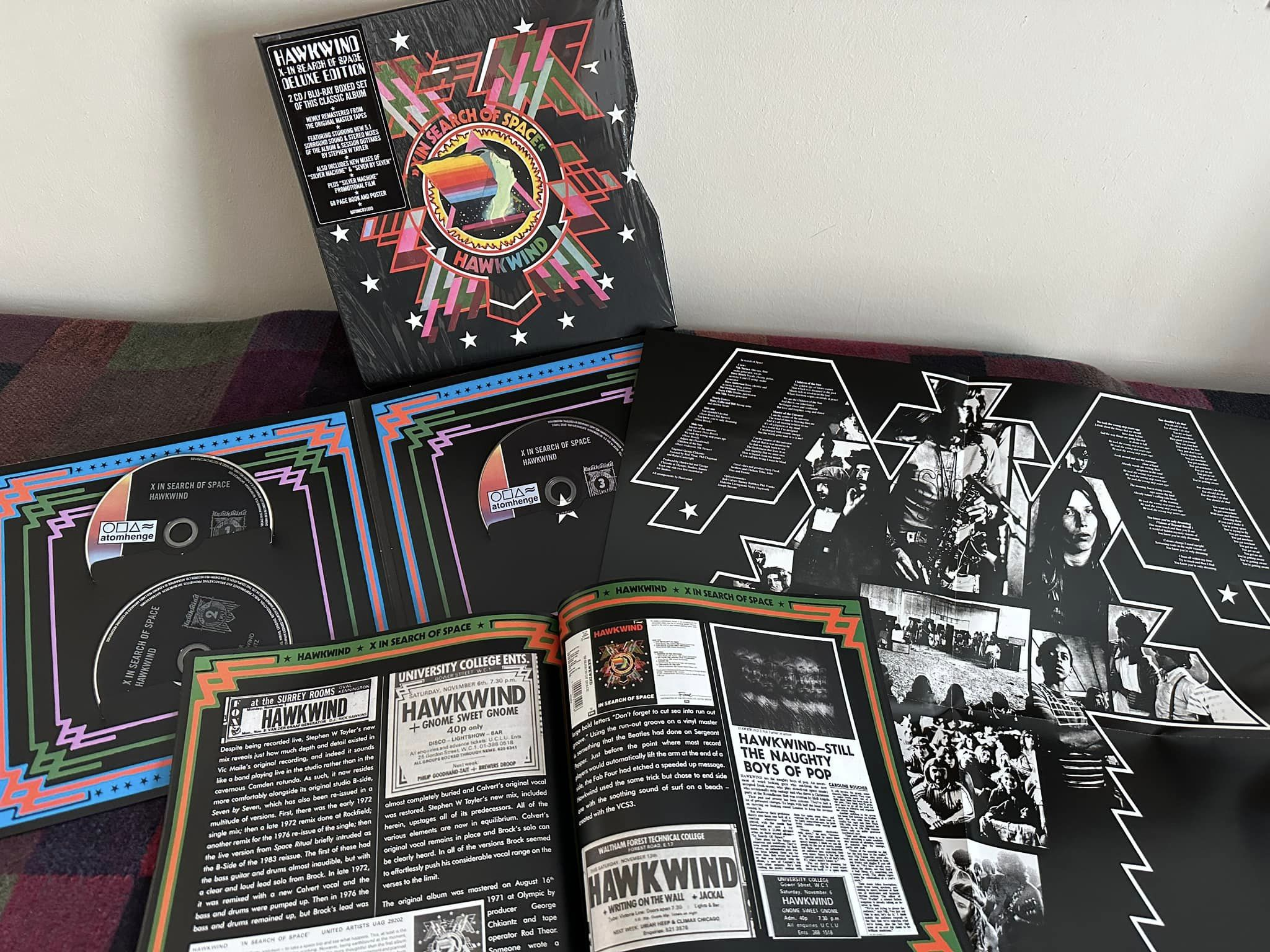
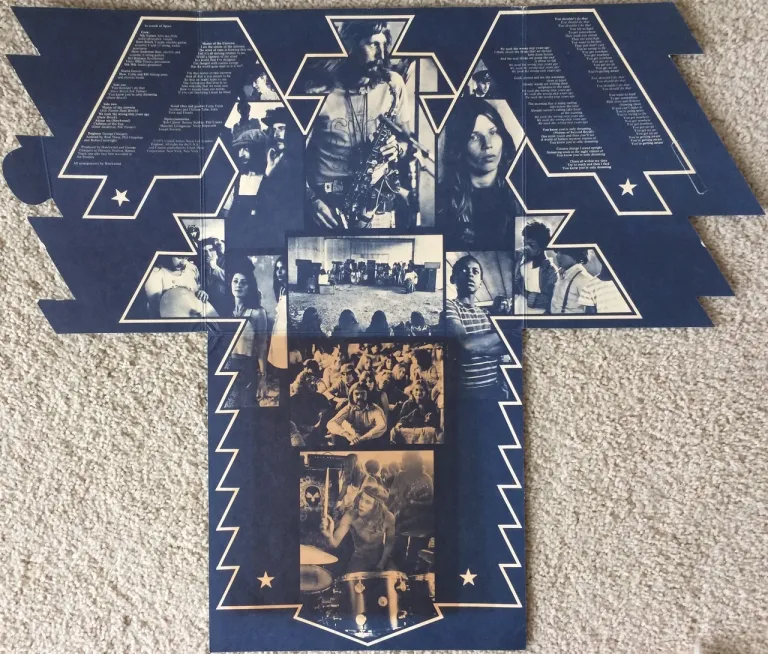
Designed by future Stiff Records/Elvis Costello artist Barney Bubbles, “In Search Of Space” came housed in a spectacular interlocking die-cut sleeve which unfolded into the shape of a hawk, and came accompanied by a 24-page book, the sci-fi-flavored The Hawkwind Log, conceived by the band’s long-term associate, poet Robert Calvert. Successfully feeding the era’s discerning heads, the LP climbed to No.18 in the UK, it won Hawkwind a gold disc, and laid the groundwork for their UK Top 10 hit, June ’72’s “Silver Machine,” which featured a commanding vocal from new recruit Lemmy.
In 2019, what are the chances of not one, but two new records, released in the same week, referencing mid-1970s variety series The Wheeltappers and Shunters Social Club? The show was one of those dimly remembered phenomena you could pull out in order to underline that the Britain of 45 years ago was barely recognisable as the country we currently live in now.
And yet, nearly half a century on, we find ourselves in an unexpected situation. Days after Noel Gallagher released a video for his new single cut with footage from the show to suggest his band is performing in the titular social club, Liverpool quartet Clinic release an album named after it, on which the first sound you hear is a fuzzy recording of its co-host Colin Crompton.
It’s a rare moment when what Clinic does intersects, albeit accidentally, with something happening in the mainstream. They’ve been nominated for a Grammy – for 2002’s Walking With Thee – and shortly afterwards, the American viewing public was treated to the sight of the band, resplendent in matching collarless Beatle suits and their trademark surgical masks, powering through its title track on the Late Show With David Letterman. But Clinic have spent most of the past 22 years in a world of their own, ploughing a peculiar furrow on the margins, offering up a grimy, very northern English take on psychedelia.
As well as the initial sample from The Wheeltappers and Shunters Social Club, the warped surf-rock guitars and distorted keyboards of opener “Laughing Cavalier” are overlaid with snatches of what sounds like an old advert for a coach trip to Blackpool, conjuring up an infinitely more sinister-sounding mystery tour than that once offered by some fellow Liverpudlians. In fact, Clinic’s most obvious antecedents, at least spiritually, might be the phantasmagorical, psilocybin-fuelled visions of the northwest offered up on the Fall’s early albums, or the work of the Blue Orchids, the band formed by former Fall members who boasted their music was “completed under extraneous influences working on the psyche”. But their sound stirs garage rock, primitive synthesiser experiments, dub and glam, among an array of other influences, into a fizzing, idiosyncratic mix: two tracks on Wheeltappers and Shunters are driven by the kind of antiquated drum machine pattern that powered Blondie’s Heart of Glass, while “Disciple” offers a fair imagining of what Suicide might have sounded like, had they come from Bootle.
Wheeltappers and Shunters arrives seven years after Clinic’s last album, “Free Reign“, on which they collaborated with Oneohtrix Point Never’s Daniel Lopatin (they later reworked the album, included more of Lopatin’s work, and released it as Free Reign II), and stretched their sound into lengthy, droning jams. By contrast, Wheeltappers and Shunters represents something of a return to core values. Its 12 tracks are done and dusted in under half an hour; nothing is allowed to linger much over three minutes.
What’s striking is how much Clinic can cram in to such a tight schedule. Despite their brevity, their songs tend to gradually reveal themselves over repeated listens: there’s a real complexity and depth lurking behind the initial distorted punch of their sound. The brilliant “Flying Fish” is a case in point. At first, it sounds like there’s almost nothing to it beyond a metronomic rhythmic pulse, a simple bass line and an echoing vocal, but on closer inspection, it’s packed with distant sounds subtly shifting in and out of view: whispering voices, ghostly shimmers, something that might be a harpsichord, little accents of guitar and keyboard. The overall effect is eerie and compelling. The closing “New Equations (at the Copacabana)”, meanwhile, shifts from sounding like a hotel lounge band playing underwater – overlaid with the clack of a typewriter – to an insistent garage-rock thud, to a dense, Sister Ray-ish climax.
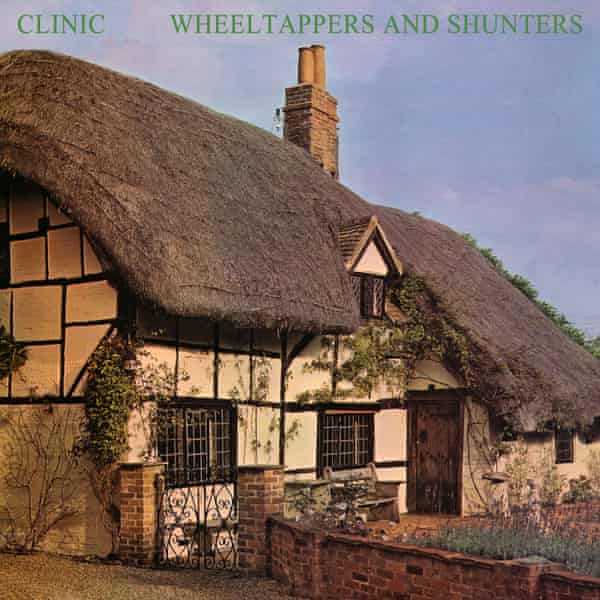
It’s music that manages to be both taut and immersive. The latter sensation is heightened by the enigmatic weirdness of the album’s lyrics, which conjure up a fragmented vision of Britain’s past, at odds with the cover image of a delightful thatched cottage: grubby fairgrounds and holiday camps rubbing shoulders with town criers – one of whom makes an appearance at the end of the disquieting Be Yourself/Year of the Sadist – and sinister evocations of rural life. “The good old days, the good old ways … flags are flying,” sings frontman Ade Blackburn on “Complex“, as if implying that the glorious, sunlit version of our country’s past regularly evoked in the age of Brexit is a myth and that the fag smoke, racist gags and manmade fibres of The Wheeltappers and Shunters Social Club might tell you more about UK history. But if there’s little to celebrate there, it’s still fascinating to explore: out on the margins, Clinic sound as enthralling as ever.
Meat Wave thought they’d spend most of 2020 touring and preparing for the release of their next, yet-to-be-titled album. As was the case for most in the world, the band’s plans wouldn’t come anywhere close to materializing. Determined to push forward, they’ve created “Volcano Park”, a six song EP, recorded at the end of everyone-in-the-world’s least favourite year.
Meat Wave, are made up of vocalist/guitarist Chris Sutter, drummer Ryan Wizniak and bassist/engineer Joe Gac, managed to stay connected as a band throughout the global lockdown, through occasional practices and writing sessions. Toward the end of the year, eager to keep things sharp and creative, the group went to their rehearsal space to record a single.
“Volcano Park” soon went from an intended single to a full-fledged six song EP, and the extra material began to surprise the band. They’d quickly put together a concise, intentional collection of songs. With much of the new material, it was “jam sessions” that found the band experimenting in more psychedelic and spaced-out territory, showcased in songs like “Truth Died” or “Nursing.” On the other hand, MeatWave’s stabs at post-hardcore melodies and riff-raging are all the more honed. “Tugboat,” the leading track on the EP, as well as it’s blistering follow-up “For Sale,” rival the same level of thoughtful intensity of their 2012 self-titled debut LP.
Taking its name from the book 1-800 Mice by graphic novelist Matthew Thurber, “Volcano Park” is the band’s first major output since 2017’s The Incessant and a series of proceeding singles in 2018. Much like the book, the music weaves in-and-out of fantasy and reality, a kaleidoscope of paranoia and existential dread. The EP also marks Meat Wave’s 10th year together. As was the case of writing and recording the material, the band additionally created the artwork, videos and managed the pressing of the EP.
The group’s identity remains clear and pronounced; it is steadfast in the stratospheric firmament of driving-yet-haunting riff-centric punk. But within that well-defined groove, an even more dependable factor is Meat Wave’s ability to continue to innovate and transcend the stock descriptions grounded in genre and influence. With every release, the band has made the task of categorizing their work more difficult and are steadily looking less like a rock band and more like an art collective. What’s become clear on Volcano Park is a draw of artistic vision that is not grounded in punk, rock, or even music at large. The release edges on the cinematic and, at times, feels more like a piece of installation art than a gritty Chicago rock record.
Volcano Park releases digitally June 11th, with a physical release out on October 6th via Big Scary Monsters.
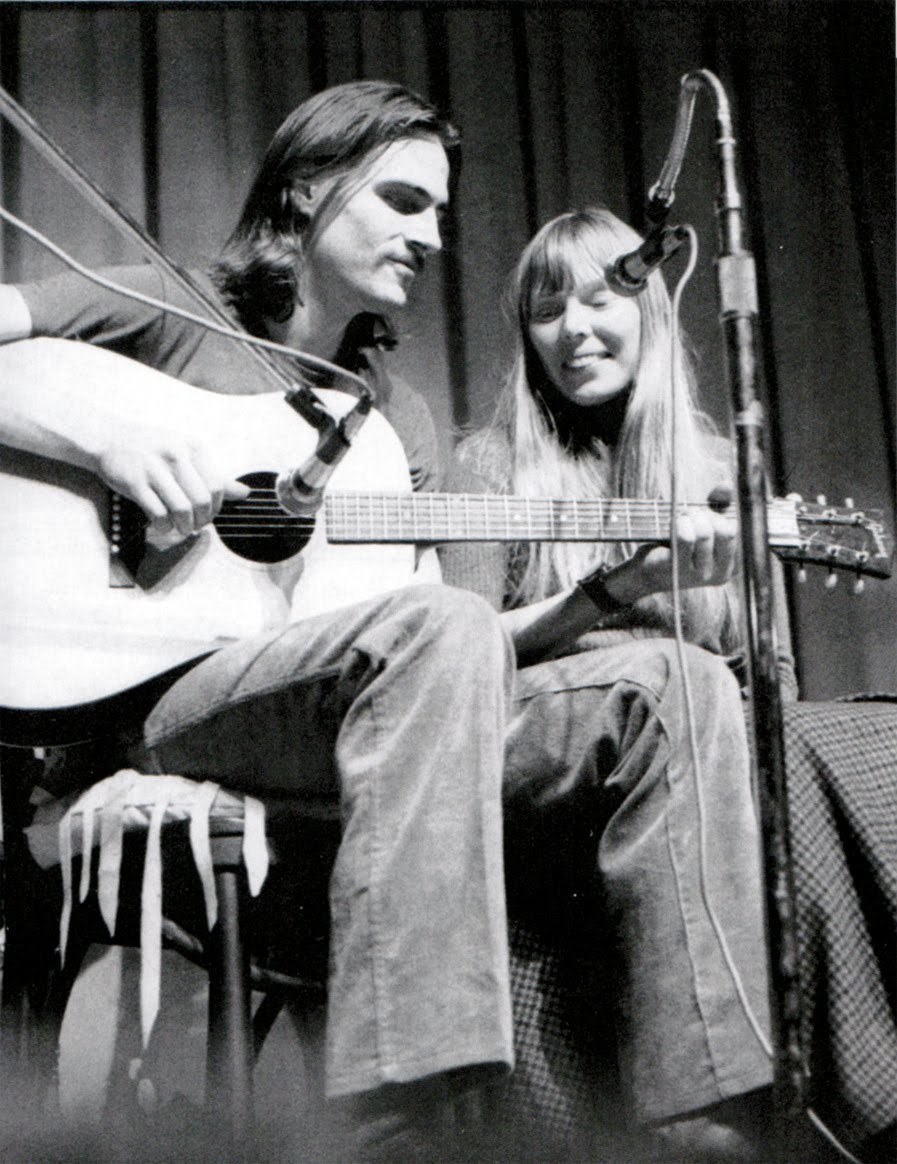
As we approach the release of Joni Mitchell’s “Archives Vol. 2: The Reprise Years (1968 To 1971)“, the songwriter has dropped an archival duet with James Taylor, With the track “You Can Close Your Eyes.”
Recorded on October 29th, 1970, the performance opens with intimate onstage banter from the couple, who were dating at the time. “This is a song that James wrote,” Mitchell tells the audience. “It’s a lullaby. It’s really beautiful.” They harmonize on the track, with Mitchell’s octaves climbing high above Taylor’s.
“We did the show in London together,” Mitchell told Cameron Crowe in the box set’s liner notes. “That’s when we were dating. He really locked up to my dulcimer, playing great with his guitar. Those two instruments together sound great. It sounded like one instrument. Musically, we were a great couple.”
“You Can Close Your Eyes” at the BBC “In Concert ” series follows a 1969 live take on “Chelsea Morning” at Carnegie Hall and a 1968 performance of “The Dawntreader” at Ontario’s Le Hibou Coffee House; the latter was recorded by Jimi Hendrix with his very own tape recorder and thought to be lost for decades.
“Archives Vol. 2” arrives on November 12th as a five-CD set or 10-LP collection
Robert Plant and Alison Krauss have shared another sliver of their highly anticipated LP “Raise the Roof,” out November 19th.
Robert Plant and Alison Krauss’s 2007 album “Raising Sand” swept the Grammys and left legions of fans asking for another set of songs revisited and reinterpreted by the unexpected pairing of the Led Zeppelin frontman and the bluegrass stalwart. But it took 14 years to get there again. The duo, along with the producer T Bone Burnett, are back later this month with “Raise the Roof,” making an album that yet again stands in contrast to so many of its contemporaries and captures a special kind of magic. “A funny thing happens with them,” Burnett said. “When the two of them sing, it creates a third voice, a third part in their harmonies when there are only two parts.”
“High And Lonesome” was written by Plant and T Bone Burnett, and (according to a feature via The Bluegrass Situation) Plant declares it as “a far cry from everything I’ve done before. I love the whole kaleidoscope of music that I’ve explored, but this is a place where you can think within the song, you can decide how to bring home an emotion. It’s another blend that we’ve got, and long may we have more of them.”
Added Krauss, “One of my favourite parts of this is the songs and songwriters that I had never heard of. Working with Robert, and with T Bone, is always a great education in music history.”
“Raise the Roof” marks Plant and Krauss’ first collaboration in over 14 years, following the success of their first collaboration, 2007’s “Raising Sand“, which earned multiple Grammy Awards including Album and Record of the Year.
The official audio for Robert Plant and Alison Krauss’ “High And Lonesome” from their forthcoming release, ‘Raise The Roof’, out November 19th.
Cat Power returns with “Covers”, Chan Marshall’s third album of her celebrated reinterpretations of songs by classic and contemporary artists.
Cat Power has announced a new album of cover songs. “Covers” is out January 14th via DominoRecordings. She’s shared her version of Frank Ocean’s “Channel Orange” single “Bad Religion,” plus a cover of the Pogues’ “A Pair of Brown Eyes” from the record. Power also performed “Bad Religion” last night on The Late Late Show With James Corden.
The album features covers of songs by Iggy Pop, Bob Seger, Dead Man’s Bones (Ryan Gosling’s band), Jackson Browne, the Replacements, Nick Cave, Billie Holiday, and more.
Cat Power’s cover of “Bad Religion” took shape when she started performing her song “In Your Face” from 2018’s Wanderer on tour, according to a press release. “That song was bringing me down,” Cat Power said. “So I started pulling out lyrics from ‘Bad Religion’ and singing those instead of getting super depressed. Performing covers is a very enjoyable way to do something that feels natural to me when it comes to making music.”
In the years since “Wanderer”, Cat Power has worked on music for the Echo in the Canyon documentary and the Sean Penn feature Flag Day. She also covered Cassius’ “Toop Toop” last year in tribute to the late Philippe Zdar. Power said in a statement that her cover of Billie Holiday’s “I’ll Be Seeing You” is a tribute to Zdar.
Cat Power – “A Pair Of Brown Eyes”, from the forthcoming album ‘Covers,’ out 14th January 2022 on Domino Record Co.
When the world shut down in March 2020, Charlotte Cornfield was in the middle of an artist residency in the Rocky Mountains, hunkered down in a hut with a baby grand piano, sketching ideas for a follow-up album to her Polaris-Longlisted 2019 LP The Shape of Your Name. In a matter of hours, she found herself back home in Toronto with months of touring cancelled and a wide swath of time ahead of her. She began to write feverishly, mining her memories and dreams and recounting them with vivid detail. When the songs were finished, she headed to Montreal to record with producer/engineer Howard Bilerman (Arcade Fire, Leonard Cohen), drummer Liam O’Neill (Suuns), bassist Alexandra Levy (Ada Lea), and guitarist Sam Gleason (Tim Baker).
The group tracked the album in 5 days, mostly live off the floor, seeking to capture the raw emotion of the songs. The result is Highs in the Minuses, a memoir in fragments. Here Cornfield fully embraces the role of narrator, moving from one vignette to another in a colourful collage. We see her at 21, heartbroken and lost, carrying a friend’s 3-legged cat back to her apartment in a box; then as a teenager, playing a new song for a group of friends on a trampoline. She sings of a magical first date, an ex with a mean streak, two skateboarders gliding in a lakeside parking lot. The brutal honesty in her lyrics brings to mind writers like David Berman and Adrianne Lenker, while musically she conjures a Zuma-era Neil Young, leaping from crunchy guitar rock to piano ballads with effortless grace. Highs in the Minuses is Charlotte Cornfield’s strongest offering to date, each song a gem in and of itself.
Charlotte Cornifeld has unveiled a new video off her upcoming album “Highs in the Minuses”. It’s called ‘Drunk For You’, and it arrives with an accompanying music video. “Sometimes desire betrays logic, and you end up at somebody’s door even after you’ve talked yourself out of it, in all of the ways,” Cornfield said of the new track in a statement. “And that feeling can be intoxicating. And it can be painful. I recorded this song after the rest of the band had left the studio. It was just me, in the big room at the grand piano, and Howard and Shae were in the control room behind the glass. I remember I felt truly alone, in a way that I needed to be to sing it properly. We did two takes and kept the first one, and if you listen closely you can hear the piano bench squeaking a little bit in the background.”
Of the video, she added: “We shot this video in Lake Ontario, my brother behind the camera and my Mom on the beach holding a reflector and cuing the song. There was something really special about it just being the three of us out there, in that magic blue hour light. We kept getting deeper and deeper in the water, and I didn’t even notice the rolling wave that came and swept me away at the end.”
‘Drunk For You’ is the third single lifted from “Highs in the Minuses“, following ‘Partner In Crime’ and ‘Headlines’. The album is out October 29th via Polyvinyl/Double Double Whammy.
Charlotte Cornfield – vocals, guitar, piano, bass, synth Liam O’Neill – drums, percussion Alexandra Levy – bass (1,3-5,10) Sam Gleason – guitar, synth (1, 2, 7-9, 11) Amy Millan – backing vocals (3) Howard Bilerman – noise (9)