If we thought Mitski’s “Working for the Knife” video provided a dramatic return for the songwriter, who took a brief hiatus following the release of 2018’s overwhelmingly acclaimed LP “Be the Cowboy“, nothing could have really prepared us for the level of drama compressed into the three-and-a-half minute visual for the follow-up single “The Only Heartbreaker.” In addition to arriving with the news of a new LP called “Laurel Hell” that’s slated for release in early 2022, and to introducing a heavy new wave vibe to the release, the “Heartbreaker” visual sees Mitski continuing to interpretive dance to her new music as the fantasy planet she inhabits—Laurel Hell?—goes up in flames.
According to Mitski, the song addresses “the person always messing up in the relationship, the designated Bad Guy who gets the blame. It could simply be about that, but I also wanted to depict something sadder beneath the surface, that maybe the reason you’re always the one making mistakes is because you’re the only one trying.”
“The worst pain I’ve experienced is when I’ve fully understood the pain I’ve caused another,” adds Maegan Houang, who co-directed the visual with Jeff Desom. “It’s one of the hardest parts of being human, that no matter our intentions, we’ll inevitably do something hurtful to our fellow man, if not someone we love. In this case, the harm Mitski enacts in the video is to the world. It’s unstoppable and destructive, but worst of all, she doesn’t even want it to happen. She’s a stand-in for humanity as we collectively do so little to save ourselves and our planet.”
“The Only Heartbreaker” the new song by Mitski from the forthcoming album ‘Laurel Hell’, out February 4th 2022 on Dead Oceans Records.
Sasami (aka Los Angeles-based musician Sasami Ashworth) has announced the release of a new album titled “Squeeze”. It will be out on February 25 via Domino Recordings. Ashworth also shared videos for two new singles: “The Greatest” and “Skin a Rat,” and announced a headlining U.S. tour for 2022. Jennifer Juniper Stratford directed the video for “The Greatest” and Andrew Thomas Huang (FKA twigs, Björk) shot the album’s cover art.
“The Greatest,” which is a bit more inline with Ashworth’s previous work, makes the main Top 10 list. The heavier “Skin a Rat” can be found further below. Regarding the new song, Ashworth states in a press release: “This song is about how often the greatest, heaviest feelings we have for someone are in the absence of the realization or reciprocation of that love. Like power born out of a black hole. All fantasy.”
The single was produced by Ashworth along with the rest of the album, which also features production from a handful of contributors, including Ty Segall, Hand Habits’ Meg Duffy, and King Tuff’s Kyle Thomas.
Sasami and her new full-length Squeeze, with both songs were produced by Ashworth and recorded at Ty Segall’s studio in Topanga, CA and Log Mansion in Mt. Washington. Squeeze was produced by SASAMI, with a handful of the tracks co-produced by Ty Segall. Other notable contributors include: Meg Duffy, King Tuff’s Kyle Thomas, Christian Lee Hutson, Barishi, Moaning’s Pascal Stevenson, Jay Bellerose and No Home.
Of the power ballad-inspired “The Greatest” Sasami Ashworth says “this song is about how often the greatest, heaviest feelings we have for someone are in the absence of the realization or reciprocation of that love. Like power born out of a black hole. All fantasy.”
Inspired by violent fantasy, “Skin A Rat” is “a soundtrack to cathartic release of anger and frustration with oppressive systems and humans. Very nu-metal influenced. Wrote and demoed the whole song on my ipad with midi drums and hired an epic drummer to perform it live to tape.” The song features Dirk Verbeuren of Megadeth on drums and gang vocals by Vagabon’s Laetitia Tamko and actress and comedian Patti Harrison.
“Squeeze” hammers home a sentiment of “anti-toxic positivity” and showcases Sasami’s vicious honesty and brutally uncompromising vision, partially inspired by the Japanese yōkai folk spirit called Nure-onna (translation: wet woman), a vampiric deity that has the head of a woman and the body of a snake.
Sasami is a descendent of the Zainichi people on her mother’s side, a diaspora of ethnic Koreans who lived in Japan during Japan’s occupation of Korea from 1910 to 1945. Though some Zainichi moved voluntarily and others were forcibly kidnapped, these people and their progeny continue to experience systemic discrimination and oppression in Japan to this day. While conducting a deep dive into her family’s mixed Korean and Japanese history and culture, Sasami stumbled upon stories of Nure-onna and was immediately drawn to the water creature’s multiplicitous nature. According to legend, the deity is feminine and noble, yet powerful and vicious enough to brutally destroy victims with her blood sucking tongue.
Ashworth’s self-titled debut album, Sasami, came out in 2019 via Domino Recordings. “The Greatest” and “Skin A Rat” from the forthcoming album ‘Squeeze’ out 25 February 2022 on Domino Record co.
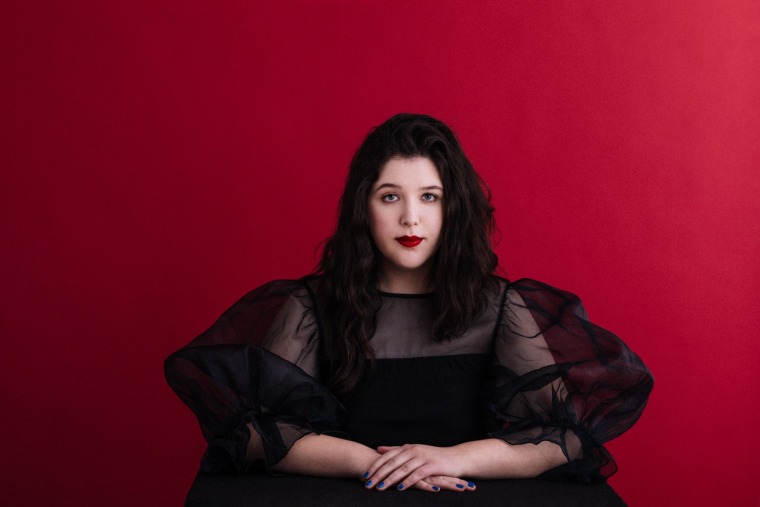
Lucy Dacus is heading on tour next year. The singer-songwriter, who shared her wonderful third album “Home Video” this summer, will embark on dates across the United States, Canada, the United Kingdom and Europe from early February to mid-April with Indigo De Souza and Fenne Lilly opening.
Along with the tour announcement, Dacus has shared a new full-band version of the Home Video song “Thumbs.” A fan favourite long before it was officially released, “Thumbs” in its original incarnation set Dacus’s heartbreaking description of familial trauma on top of plush synth chords. For “Thumbs Again,” Dacus adds a torrent of new instrumentation without overwhelming what made the stripped-down original special.
Listen to the new full-band version of the Lucy Dacus song “Thumbs” from the album ‘Home Video.’
Dacus spoke about the composition of “Thumbs”. “I think the last line of the song is like the whole purpose of the song. Just to say that like you don’t owe anybody shit, or anybody that feels entitled to your time or they own you is just wrong. Yeah. It’s ultimately a victorious, supportive type of song, but it’s just pretty bleak.”
Where most Tonstartssbandht albums come together slowly over years, recorded on the fly whenever the Whites have a few spare moments on the road, “Petunia” was largely written and recorded in their home city of Orlando in 2020. Many of the tracks had been played live, but in extremely rough form (“skeletons of songs,” as Andy puts it), and hadn’t yet developed into any kind of mature stage. With plenty of time on their hands thanks to the lockdown, and no shows to play, Andy and Edwin decided to pack some flesh onto those skeletons and bring them to life on their own. “Petunia” is the first Tonstartssbandht album to be created in a sustained manner and in a consistent environment, written and recorded in a single place over a focused period of time.
Many listeners find it overwhelming breaking into an artist’s back catalogue for the first time especially when they already have over 10 albums to their name. In the case of brother duo Tonstartssbandht, they’ve released nearly 20 different projects to date, their transfixing latest album Petunia, 2009’s “An When”, which reminds me of the vaguely folky noise music that characterized early Amen Dunes records—“Black Country” is the album currently blowing my mind, as is “Turkey Bones” from 2009’s “Dick Nights”.
While their earlier works rested on muffled psychedelic noise, they opt for a jammier, more expansive sound this time around. Their cleaner production choices and Byrdsian harmonies result in a more digestible sound, but their guitar noodling is as wonderfully spidery as ever. Pulling from the classic jam bands, the sun-drenched folk-rock of the ’60s and ’70s, contemporary left-field psych-folk and much more, Tonstartssbandht achieve pop accessibility without sacrificing their improvisational intrigue. And as someone who’s usually scared away when the “jammy” tag gets placed on an album, I can vouch for Petunia’s irresistible appeal.
Andy notes. While the album was recorded at the brothers’ home studio in Orlando between April and August of 2020, it was mixed by Joseph Santarpia and Roberto Pagano at The Idiot Room in San Francisco—“our old Florida buddies who have great ears,” as Andy puts it. With those ears attuned to the recordings, “Petunia” is brighter, punchier, and more direct than its predecessor, the direct result of Santarpia and Pagano’s confidence in the performances the album captures. “They were just there to help paint in the mixing,” Andy says, but “they’re so good at bringing up levels, levelling everything really well.”
Tonstartssbandht – from the upcoming album “Petunia” out October 22nd, on Mexican Summer Records.
Memory looms large on Horse Jumper of Love’s hypnotic sophomore album, ‘So Divine,’ but it remains elusive. Throughout the record, tiny snapshots from the past float to the surface, baring themselves for brief moments before diving back into the ether. Like abstract collages, the Boston-based three-piece’s songs jumble richly detailed scenes and vivid imagery, papering over one moment with the next until each string of seemingly unrelated thoughts coalesces into a breath taking work of art, one that reveals deep truths about ourselves and our psyches.
“A lot of these songs are about making small things into huge deals,” says guitarist/singer Dimitri Giannopoulos. “They all start with these very specific little memories that, for some reason or another, have stuck in my mind. Memories morph and change over time, though, and they become freighted with all these different meanings. We’re constantly adding to them.”
The same could be said of Horse Jumper of Love’s music. Giannopolous wrote much of what would become ‘So Divine’ as a teenager, carrying the tunes with him as skeletal demos for years before bringing them to his bandmates (bassist John Margaris and drummer Jamie Vadala-Doran) to flesh out in the studio. Even then, the songs continued to grow and mutate, with the group recording multiple iterations of the album as they experimented with tempo and technique.
“I’d dropped out of college and was living at home when I first started writing these songs,” Giannopolous remembers. “I was staying up all night recording in the basement because I didn’t feel like I had any other options. It was either make music or feel terrible about my life.”
Giannopolous found kindred spirits in Margaris and Vadala-Doran, and after moving out on his own, he officially launched Horse Jumper of Love in 2013, taking the group’s moniker from a Latin phrase that had gotten more than a little lost in translation. The band would spend the next three years refining their studio craft and live show, garnering a devoted following playing DIY gigs around New England as they climbed their way into what Pitchfork described as “the top tier of the Boston house show scene.” In 2016, they released their self-titled debut to rave reviews, with NPR praising the band’s “slow, syrupy rock songs” as “cautiously measured and patiently curious” and Stereogum hailing their “delightfully distorted mess of energy.” In 2017, the group released a vinyl and digital re-issue of the album along with a limited edition demo anthology.
When it was time begin work on ‘So Divine,’ Horse Jumper of Love headed south and set up shop at Big Nice, a riverside warehouse-turned studio in Lincoln, RI. While many of the tracks they planned to record dated back to Giannopolous’ youth, several were so new that they hadn’t even been demoed yet, offering up a blank slate for the band’s methodical sonic explorations.
“We decided to go in blind and just see what would happen,” explains Giannopoulos. “The studio was this really great and open environment with incredible gear, so everyone felt totally free to try whatever they wanted.”
The result is a record that breaks new ground even as it stays the course, emphasizing the band’s keen eye for detail and muscular arrangements. Songs develop at a glacial pace, progressing forward with almost imperceptible momentum as they carve deep canyons and valleys through walls of solid rock.
“My approach to song writing has always been really gentle,” says Giannopoulos. “Everything starts with an acoustic guitar, but then I bring the music to Jamie and John and they really beef it up. I love everything they do, so production is a joint effort between all three of us.”
The record opens with “Airport,” a mesmerizing tune that builds from a whisper to a roar as washed out cymbals and fuzzy electric guitars swirl into a frenzied maelstrom. The song proves to be an ideal entry point for an album all about the power of escalation, about the ways tiny, seemingly inconsequential moments can snowball into profound revelations in our mind. Spilled yogurt leads to an existential crisis on the driving “Volcano,” while a childhood day at the beach turns into an out of body experience on the hazy “Poison.”
“Who isn’t freaked out by life as a teenager?” Giannopoulos recalled in an interview with the popular Boston blog Allston Pudding. “I had a phase when I was sixteen or seventeen where I thought nothing was real. Like, I thought I was living in a constant dream…I needed a way to cope with that, so I wrote these songs.”
Giannopoulos’s lyrics are brief but dense, often without a rhyme in sight. Some songs gush with a beat poet’s stream of consciousness, others consist only of a single recurring line recited over and over like some sort of abstract prayer. With an unhurried, deliberate delivery, such phrases seem to gain new shades of meaning with each repetition, or at the very least, challenge us to create our own.
“There’s not [just] one message,” Giannopoulos told WRBB, suggesting that in the end, no matter what you think the band’s songs are about, you’re right.
Perhaps that’s ultimately the divinity to which the title refers. What’s more holy, after all, than drawing meaning from the mundane? The memories we carry with us are not fixed, but fluid, able to change shape and fill whatever purpose we assign to them. Horse Jumper of Love aims to do precisely that with their music, and it’s a divine thing indeed.
Aussie indie legends Gang Of Youths have announced their long-awaited third album – along with a massive nationwide tour to celebrate. Inspired by the passing of singer David Le’aupepe‘s father and his love of horticulture, “Angel In Realtime” is a love letter to family and the sacrifices people make along the way for the ones they love.
“My dad was a gifted and passionate gardener. It’s where he funnelled a lot of his energy and sensitivity, and despite our humble economic status, we were always surrounded by beauty,” the singer explained.
“The journey he made from Samoa to NZ to Australia was a difficult and inspiring one, but also fraught with mistakes, regret and terrible choices. I like to think he was building something beautiful, and pondering what life had given him in spite of his mistakes and concealment. We never knew his story until after he died, so this is the most poetic interpretation of his affinity for gardening that I could think of.”
Le’aupepe added, “I hope the record stands as a monument to the man my father was and remains long after I’m gone myself. He deserved it.”
“Angel In Realtime” is slated for release 25th February 2022, check out their new single Tend The Garden
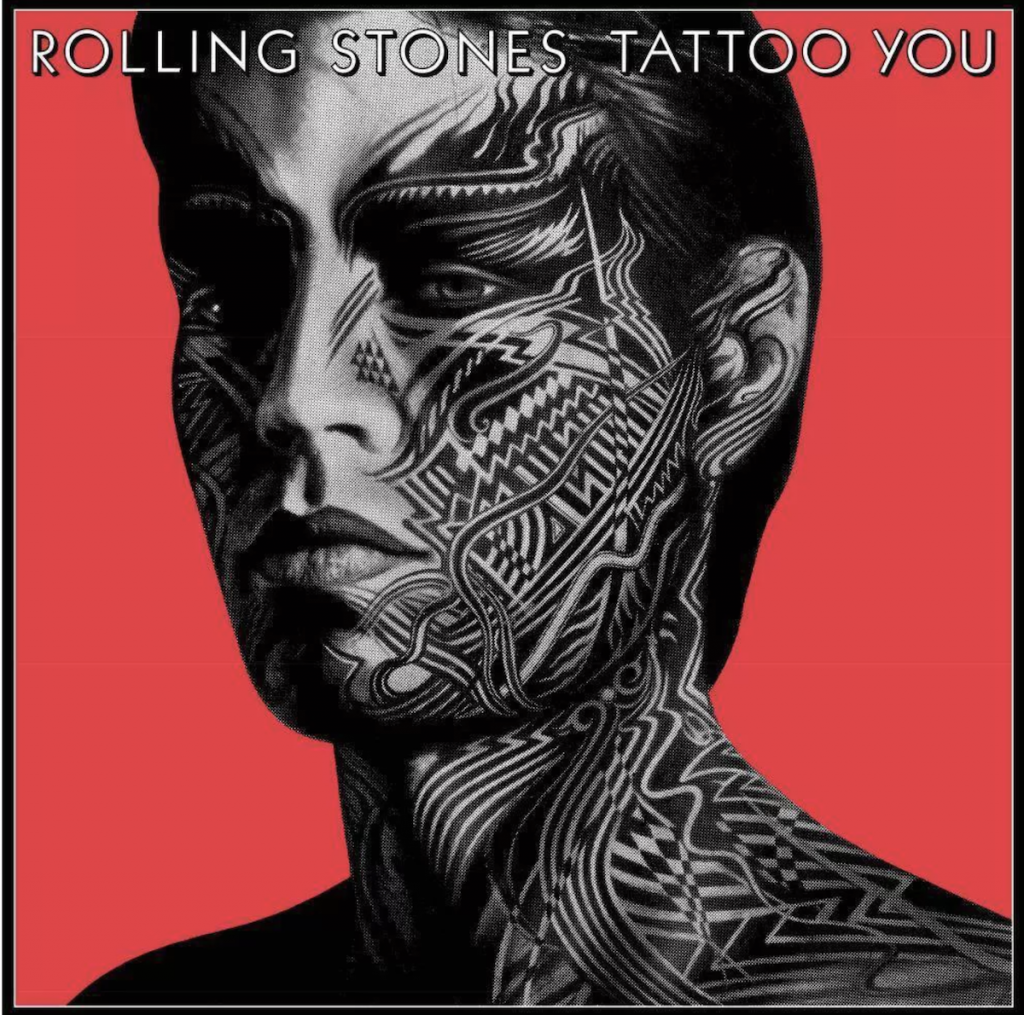
The Rolling Stones’ 1981 album, “Tattoo You”, is receiving expanded deluxe editions for its 40th anniversary. The newly remastered set, which came out on October 22nd, 2021, via Polydor/Interscope/UMe, in a variety of formats, includes nine previously unreleased tracks from the era. On September 30th, they released a lyric video for their cover of a Chi-lites song, “Troubles A’ Comin” It follows the video for the rocker “Living In the Heart of Love” that arrived on earlier and that features some vintage footage of the band.
The announcement for the expanded edition came 40 years to the week since the chart-topping, multi-platinum album was first released on August 24th, 1981, and as the Stones prepare to return to the road with 13 new dates on the “No Filter” tour in the U.S. The 40th anniversary remaster of the original 11-track album includes such enduring favourites as “Hang Fire,” “WaitingOn a Friend” (showcasing jazz saxophone giant Sonny Rollins) and of course “Start Me Up” the opening track that’s been a band signature ever since.
Given the way the Rolling Stones’ “Tattoo You” came together, this 1981 album could have easily ended up as a disjointed mess. The group needed a successor to 1980’s “Emotional Rescue” to fulfill contractual obligations and because they had a U.S. and European tour set to start in September of 1981. But time was short, and the band’s members were reportedly not getting along particularly well. As a result, “Tattoo You” wound up being patched together from recordings left over from earlier sessions. Some were outtakes from “Emotional Rescue” (which itself included leftovers) and its 1978 predecessor, “Some Girls“; others dated from as far back as 1972.
The deluxe formats will also include “Lost & Found: Rarities and Still Life”: Wembley Stadium 1982. The “Lost & Found” disc contains nine previously unreleased tracks from the period of the album’s original release, newly completed and enhanced with additional vocals and guitar by the band.
The video for “Living in the Heart of Love” shot in glorious black-and-white in Paris, was directed by Charles Mehling and stars Marguerite Thiam and Nailia Harzoune.
Those vault picks were well chosen, however, and the Stones improved them by going into the studio to enhance their vocals and instrumentation. As a result, “Tattoo You“—which on the original vinyl delivers six rockers on the A-side and five mellower numbers on the flip—turned out to be pretty darn good. No, it’s not quite as focused or as satisfying as the Stones’ 1960s and early 1970s classics. But the record—which topped charts in the U.S. in 1981 and spawned several hit singles—is understandably often cited as the group’s last great album (though this writer would give that distinction to Some Girls).
While many fans and critics consider the lead-off track, “Start Me Up,” to be a highlight of the album, it has never seemed like one to yours truly, its memorable opening Keith Richards guitar riff notwithstanding. More interesting are numbers like the funky, Jimmy Reed–influenced “Black Limousine”; the soulful “Worried about You” which incorporates Jagger’s falsetto; “Tops,” a “Goats Head Soup” reject from 1972; and “Slave” which features Billy Preston’s organ and jazz saxophonist SonnyRollins. (There are apparently also backing vocals by Pete Townshend, though you’d never know that without reading the credits.) And then there’s “Waiting on a Friend,” the album’s closer and best track, which features excellent vocal work by Mick Jagger, Nicky Hopkins on piano, and two terrific sax solos by Rollins.
Other highlights of “Lost & Found” include a killer version of “Shame, Shame, Shame,” first recorded in 1963 by one of the band’s blues heroes, Jimmy Reed; their reading of Dobie Gray’s soul gem “Drift Away” and a reggae-tinged version of “Start Me Up”
“Troubles A’ Comin” was originally recorded by the Stones in Paris in 1979. The guitar-driven track is an infectious cover of the Chi-Lites original and is one of the nine newly completed songs and rarities featured on “Tattoo You’s Lost & Found” disc.
The outtakes disc is consistently good, though there’s probably nothing here that many fans would consider essential to own. It includes a markedly different early version of “Start Me Up”; several other hard-rocking originals; a likable piano-based Jagger/Richards ballad called “Fast Talking, Slow Walking”;
The deluxe collection’s Still Life: Wembley Stadium 1982 is a memento of the band’s London show in June of that year on the “Tattoo You” tour. The 26-track set is packed with Stones mega-hits, including an opening “Under My Thumb” and classic rock greats such as “Let’s Spend the Night Together” “Honky Tonk Women” and “Brown Sugar”.
The Wembley concert on the final two discs delivers more thrills than the outtakes CD—and many more than Still Life (AmericanConcert 1981), a 1982 LP that draws on material from the same tour. For one thing, the Wembley recording is three times as long as the earlier 40-minute LP and, as such, it makes room for a much more expansive program, one that includes everything on “Still Life” plus another 15 numbers. And the performances suggest that months on the road left the Stones machine well-oiled.
The Wembley show has covers of the Temptations’ “Just My Imagination,” Eddie Cochran’s “Twenty Flight Rock,” the Miracles’ “Going To A Go Go” and early rock ‘n’ roller the Big Bopper’s “Chantilly Lace.” It also features early live workouts for tracks from the then-new Tattoo You such as “Start Me Up,” “Neighbours,” “Little T&A” and “Hang Fire”.
When first released, Tattoo You, produced by the Glimmer Twins with associate producer Chris Kimsey, topped the charts in the U.S. (where it went quadruple platinum), Canada, Australia and across much of Europe, with gold and platinum awards around the world.
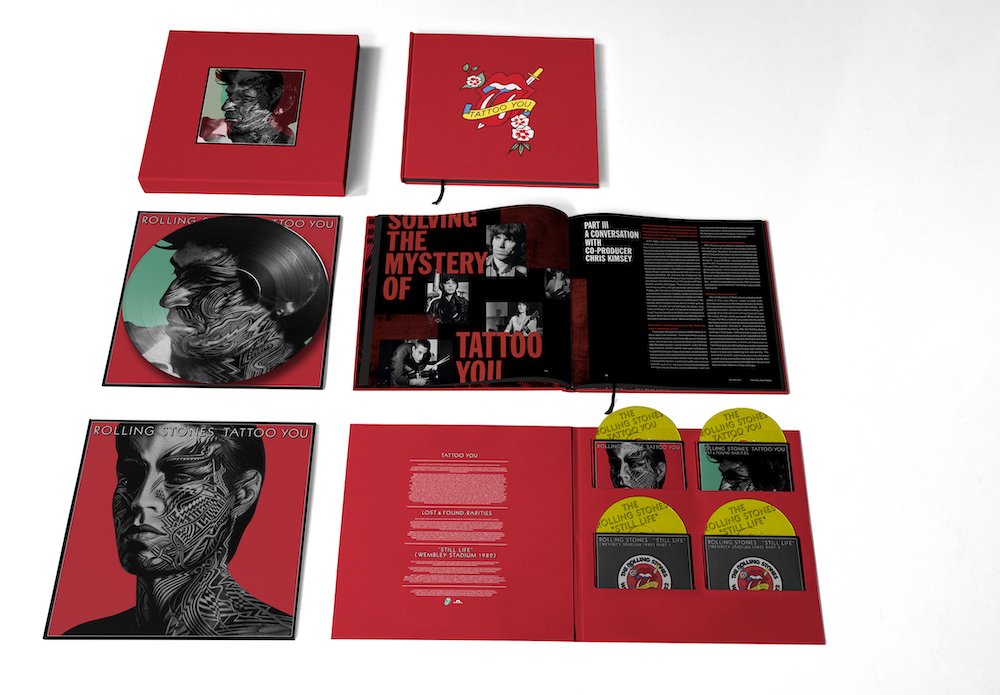
Tattoo You celebrates 40 years with the release of a brand new deluxe remastered edition of the chart topping, multi platinum album. The Super Deluxe 5LP Boxset includes the newly remastered version of Tattoo You, Lost & Found, Still Life: Wembley Stadium 1982 and a 124 Page Book featuring over 200 rare photos from recording sessions & world tour + interviews with producer Chris Kimsey & photographer Hubert Kretzscmar. The package includes a special lenticular sleeve.
The Lost & Found disc contains no fewer than nine previously unreleased songs from the period of the album’s original release, newly completed and enhanced with additional vocals and guitar by the band. Among these, ‘Living In The Heart Of Love’ is a quintessential Rolling Stones rock workout with all of the group on top form, complete with urgent guitar licks and fine piano detail.
Still Life: Wembley Stadium 1982 is an unmissable memento of the band’s London show in June of that year on the Tattoo You tour. The mighty 26-track set is packed with Stones mega-hits.
Keeping the jangly West Coast thing going, here’s a new single from L.A.’s Massage who are led by singer-guitarist Andrew Romano and former Pains of Being Pure at Heart bassist Alex Naidus. (The group are rounded out by keyboardist Gabrielle Ferrer, drummer Natalie de Almeida, and bassist David Rager.) If the first Pains album is your favourite, Massage are very much in that vein, but with a little more emphasis on ’80s British indie, from Mary Chain noise to Field Mice preciousness.
The band released their terrific second album, Still Life, back in June and they’ve already announced their next, an EP titled “Lane Lines” that’s out December 1st on Mt.St.Mtn. The lead track, “In Grey & Blue,” is a warm, melodic winner that draws from a very specific influence — the guitary half of New Order’s 1989 Ibiza-made album Technique.
This sparkling homage to New Order’s Ibiza period is the first single off Massage’s new ‘Lane Lines’ EP
“The original inspiration was actually the Go-Betweens — specifically their propulsive live version of ‘Bye Bye Pride’ — and I can still hear some Grant McLennan in the melody,” Romano says. “But then one night during the pandemic we were all doing a distanced hang in Gabi’s yard and New Order’s ‘Run’ came on some playlist and I suddenly realized that that was the sound I wanted: the crack of Stephen Morris’s drums, the fizz of Bernard Sumner’s guitar, the bounce of Peter Hook’s bass — just the whole vibe of leaving the plague behind and falling in love on some Spanish island.”
The video for “In Grey & Blue,” directed by the band’s Gabrielle Ferrer, makes its premiere in this post.
“In Gray & Blue (Single Version)” written by Massage, produced by Andrew Brassell and Massage, mastered by Mikey Young “Lane Lines” EP out December 2021 on Mt.St.Mtn.