On November. 8th, 1971, Led Zeppelin released their fourth album. There was no title printed on the album, so it is usually referred to as Led Zeppelin IV, following the naming sequence used by the band’s first three studio albums. The album has alternatively been referred to as , Four Symbols, The Fourth Album (those two titles each having been used in the Atlantic catalogue), Untitled, Runes, The Hermit, and ZoSo, the latter of which is derived from the symbol used by Jimmy Page for the album sleeve. Page often had the ZoSo symbol embroidered on his clothes.
The album contains many of the band’s most famous songs, including “Black Dog”, “Rock and Roll”, “Going toCalifornia” and the band’s signature song, “Stairway to Heaven”, Led Zeppelin IV was a commercial and critical success. The album is one of the best-selling albums worldwide
To celebrate its 46th birthday of Led Zeppelin‘s masterful fourth album, which of its songs are the best and worst,
there’s hardly a wasted track on the fourth album release. Is it the best rock ‘n’ roll record ever made and, at the same time, not even the best Zeppelin album, Its amazing, emblematic of the band, but not their best work.
Maybe the ultimate testament to Led Zeppelin’s greatness is that an album as colossal and widely worshiped as IV actually has three or four legitimate challengers for “Best Album” within their amazing catalog. But if IV is not their best for groundbreaking reasons, Its influential, mould-setting reasons then whichever of Led Zeppelin’s first seven albums is playing on your stereo right now is the best record that’s ever been made. But I’d give IV the silver medal and save the gold for Physical Graffiti, which has even more range, weight and sophistication.
The best song on the album?
It changes all the time. The opening rush of “Black Dog” is one hell of a way to kick off an album, and “Stairway to Heaven” is such an expertly structured song. But “When the Levee Breaks” is the one that most often has me turning up the volume. Those drums! “Stairway to Heaven.” has become synonymous with Led Zeppelin you’ll find it’s astounding. Also, like the album itself, it’s emblematic of the band. It shows off what they do best:: creepy, Celtic folk, cryptic lyrics paired with haunting vocals, a bombastic crescendo with evil blues guitar and drum fills that define perfection. That said, the first 10 seconds of “Four Sticks” is probably the best thing they’ve ever done. that said, the first minute of “When the Levee Breaks” is probably the best thing they’ve ever done. which closes the LP with so much power and atmosphere, and maybe the heaviest drum sound ever captured, from the bottom of that stairwell at HeadleyGrange. I suppose, too, because it’s fundamentally a blues, it can represent Led Zeppelin’s musical bedrock in its most epic form , “Black Dog.” So powerful, so sexy, so smart. We’ve all read about the hard work and creative genius that went into making the song work, but it’s impossible to think of it as anything but purely instinctual when it’s playing.
“Four Sticks” is the only song that consistently feels sub-par when I listen to IV. The fact its named that way because Bonham played it with a pair of drumsticks in each hand doesn’t say much about the lyrics, which I’ve heard described by Jimmy Page as being abstract, and to me that sounds like another way of saying, “This was filler and we couldn’t even be bothered to tidy up the lyrics, so yeah, it’s so abstract, man.”
The hipster record clerk at my favorite record store insisted on calling it Zoso. Atlantic Records had it listed as FourSymbols or Led Zeppelin IV. If they wanted to break the pattern established by the numerical naming of their first three albums, they should have given it an actual title. it’s perfectly acceptable to occasionally and judiciously refer to it as “Zep IV.”
“Jacky’s Only Happy When She’s Up on the Stage” is a politically charged song where in Morrissey shares his views on the UK leaving the EU through an analogy featuring the girl Jacky (as in the Union Jack).
From the forthcoming album ‘Low In High School’ out November 17th
I love the idea that this song is an analogy for Brexit. Jacky is the UK (Jacky as in the Union Jack), “since she lost you” is referring to the EU, “no audience telling her what to do” relates to independence and then of course the repetiton of “exit, exit” playing with the phrase “Brexit”. Don’t know if this is the intended meaning but the extra depth is fantastic! Edit: I am very aware Moz is pro-brexit, hence the “this country is making me sick” lyric 🙂
All Girl Summer Fun Band started because, well, Thermals bassist Kathy Foster and three pals had the idea for an “all girl summer fun band.” They followed it up with two albums and an EP, but this self-titled 2002 debut remains the purest expression of the effortlessly infectious indie-pop harmonies that fulfill the promise of the band’s name. If you were on board for last year’s that dog. revival, This All Girl Summer dance party will leave you breathless and sweaty – hook after hook, All Girl Summer Fun Band pull you into the closet to make out and tell you they love you. You’ll laugh, you’ll cry, you’ll dance, you’ll sigh. And when its over, you’ll dive to hit the play button on your stereo one more time.
Angel Olsen’s outtakes collection Phases is out at the end of the week, and today she’s giving us one last peak in the form of “Sans.” It’s a minimal, lo-fi demo, just Olsen’s impassioned voice and a single guitar echoing in the distance, but by now we should all realize that’s all this woman needs to make an impression. Here’s a statement from Olsen:
“Sans” was a song I wrote in between Burn Your Fire and My Woman, something short and simple but about a big thing in my life: travel and what it can do to the psyche. When you’re out there and you’re working and moving so fast it’s difficult to really imagine a time when you were fully realized and known. You know, it’s hard enough to be known when you’re around! But then there are those people in your life that know you and don’t need you around all the time to be or feel close — I suppose it’s about that too.
Angel Olsen – ‘Sans’ from Phases out November 10th, 2017 on Jagjaguwar Records
KCRW exclusive! Angel Olsen is a stunning singer-songwriter and she stopped by our studio to preview songs from her forthcoming album “Phases”, out on November 10th. Enjoy this live version of “Sans” and stay tuned for the full session airing on Morning Becomes Eclectic.
Black Rebel Motorcycle Club return to their trademark sound – scuzzy bass, slurry, heavily processed vocals and shrieking guitars – on “Little Thing Gone Wild,” the caustic first taste of their upcoming Wrong Creatures album. Each member battles for the listener’s attention in “Little Thing Gone Wild.” Leah Shapiro smacks out crushing drum patterns, Peter Hayes‘ guitar is rudely high in the mix, and Robert Levon Been’s bass playing is terse and pushy. The track was produced by Nick Launay, a veteran with four decades of recording experience, including stints behind the boards for Public Image Ltd, Gang of Four and the Yeah Yeah Yeahs.
“Little Thing Gone Wild” is slated to appear on Wrong Creatures, the band’s first new LP since 2013. “I find myself writing about death a lot,” said Hayes in a statement. “I find myself having a discussion with death, which sounds dark. For me, it’s dark humor.”
Other band members also chipped in with their own cryptic rock and roll pronouncements, hinting at the troubled headspace the band was in as they started to work on their new record. “It’s a crazy-making machine, it can chew you up good,” Been noted, presumably referring to the music business. “We literally toured till the wheels came off and Leah’s brain literally started leaking out of her head. I know I’ve battled on and off with mental depression, and Pete’s head never came with any proper instructions.”
Get “Little Thing Gone Wild” from the new album ‘Wrong Creatures’
“We are truly an island, come hell or high water, so it’s usually best to dress accordingly,” Been added in a seeming non sequitur. “Though I’m not sure what the proper attire is when drowning in fire. But leather usually goes with everything.” Following the album’s release on January 12th, Black Rebel Motorcycle Club will tour through the end of February.
London based singer/songwriter Nilüfer Yanya, accompanied by saxophonist Jazzi Bobbi, captivates you with her rich and golden tones in her performance of “Thanks For Nothing” .
The 22-year-old started writing music almost a decade ago; she has also been mentored on guitar by Dave Okumu from the Invisible. “When I’m writing it’s like a burning energy,” she says. “If I come up with something I like, it’s very instinctive, you’re not really thinking. It feels like something you have to do.”
Growing up listening to Nina Simone, Amy Winehouse and Pixies (she does a terrific cover of Hey), she was also exposed to a mix of diverse sounds thanks to her artist parents, who have Turkish, Irish and Bajan heritage. Her husky voice and sparse, lo-fi sound flit between soul, R&B and indie; she describes her music as “raw – even when it’s a finished track it’s still got that kind of unfinished, unpolished edge to it”.
Produced by Jarvis Cocker, who clearly has an eye for an unusual talent, this third album is by UK harpist/vocalist Serafina Steer. Cocker seems to have taken her under his wing, directing the video above and generally evangelizing her talents to the world and we’re glad he did, because this album is great. This record reminds us a great deal of a female harp-wielding Leonard Cohen (a comparison that others have also made), which is clearly not a bad thing at all.
Serafina Steer plays a harp and sings in a dew-fresh style that lends itself well to storytelling. Cue regular comparisons, then, to any and all women who play music that rightly or wrongly is defined as quirky folk pop.
So bewitched was Cocker by a sound that was part faeries-in-the-city psychedelic singer-songwriting and part library music electronica – a result of her harp being nicked , Steer’s other wingmen here include Capitol K, Pulp’s Steve Mackey and, excitingly for anyone fond of mad-as-a-hatter pop, The Flying Lizards’ David Cunningham.
Anne Briggs is an influence, if only because Steer’s voice is so nakedly itself. And there is a flash of Jackson C Frank’s My Name is Carnival in spartan opener, Night Before Mutiny.
But there’s nothing else mossy about this. In fact, like the droll yet odd tales weaved by David Thomas Broughton, Steer sings deliciously barbed songs about the city – and, you know, space abduction, skinny-dipping, that sort of thing.
The Byrds’ wingspan of influence stretched across three full decades and flew through the sounds made by some of the most important bands in the history of rock, including Big Star, the Jayhawks, R.E.M., Matthew Sweet, HüskerDü, Echo and the Bunnymen and countless others. For a time it was de rigueur – if not downright cliché – to see the Byrds name-checked in almost any band’s bio. They were part of the holy trinity of influential B-named bands: Beatles, Beach Boys, and Byrds.
But to everything there is a season, and an apparent decline in the band’s influence on popular music seemed to coincide with the deaths of two of its original members, Gene Clark (in 1991) and Michael Clarke (1993). Notwithstanding this decline, the Byrds have always flown high and commanded serious respect among certain pockets of fans and bands alike – folks in Northern England especially, for some reason. Since 1990, we’ve seen the likes of the La’s, the Stone Roses, the Coral and Shack flying the jangle-pop flag. Since 2007, Kontiki Suite, a talented sextet from England’s Lake District, has continued in this tradition, evidence of which can be readily found on their sophomore release, “The Greatest Show On Earth”.
Kontiki Suite proudly flies its Byrds banner via some obvious stylistic hat-tips to 1968’s “The Notorious Byrd Brothers”. This time out, the band boasts a batch of impressive new Rickenbacker-based janglers (mainly from the pen of guitarist Ben Singh) and a tougher sound from the rest of the band (Jonny Singh, lap steel guitar; MarcusDodds, guitar; Mario Renucci, bass; Chris Brown and Craig Bright on drums and percussion respectively). The result is a cohesive, 50-minute flight high above exquisitely atmospheric psych/country-rock/chamber pop soundscapes.
Ultimately, “The Greatest Show On Earth” reveals increased depth, both in Ben Singh’s writing and the band’s collective vision. Kontiki Suite has created much more than a simple paean to the legacy of the Byrds; they have taken vital steps in forging a legacy of their own.
How to stay relevant. It’s a question we all face at some point in life. Mick Jagger was thinking about staying relevant. It was 1983. Punk had come and gone. New Wave was still a thing. Electronica and the New Romantics were still fashionable. Where did a rock ‘n’ roll band like the Stones fit into the mix? Jagger was going through what Keith Richards called “Lead Vocalist Syndrome.” The point where a band’s singer thinks he/she is bigger, better, and more important than the rest of the group.
Richards had quit heroin. He was clean. After years of fucking around, Richards was back and wanted to take up his fair share of the burden After being busted in Toronto for heroin possession, the Stones guitarist luckily avoided jail time and cleaned himself up (for the most part). With his cookies relatively un-fazed, Richards soon realized the amount of control that Mick Jagger now had over the band. But Jagger had control of the Rolling Stones and wasn’t going to give Keith an inch. A great deal of the tension during the recording of the album stemmed from the fact that Richards had emerged (to an extent) from his destructive lifestyle of the previous decade, and thus sought a more active role in the creative direction of the band.
To keep relevant, Jagger was checking out the competition. He wanted to know what Bowie was doing, what RodStewart was doing, what was the latest tune played on the dancefloor at Studio 54, and which bands were snapping at their heels. Jagger and Richards had written their first song on a kitchen table. They didn’t care what other people thought or who they sounded like, it was their song—that was all that mattered. Now, the relationship between Jagger and Richards was fractious. It was falling apart. Jagger had control and he was taking the Stones where he wanted.
Yet, checking out the opposition, chasing the trends meant sometimes Jagger got it right. He was and still is a shrewd businessman—let’s not forget, he had been a student at the London School of Economics. He had also been very successful in taking the Stones in unlikely directions, like that time he pulled them into disco music with “MissYou.” But sometimes his ideas were not as popular, Jagger was always open to suggestions, always looking for something new, always wanting to be at the front of the crowd.
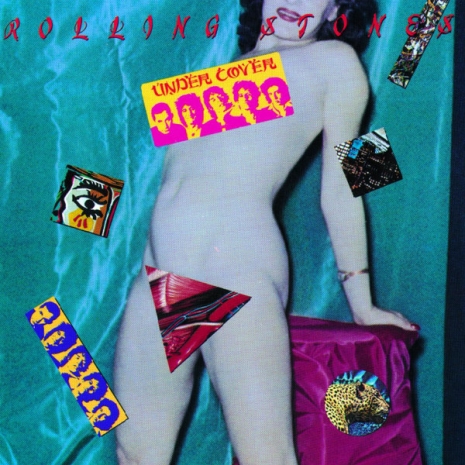
Undercover is the 17th British and 19th American studio album by The Rolling Stones, released in 1983. After their preceding studio album, Tattoo You (1981), which was mostly patched together from a selection of outtakes, Undercover was their first release of all new recordings in the 1980s. The making of Undercover was an arduous process, largely because Jagger and Richards’ famous mid-1980s row began during these sessions.
The lyrics on Undercover are among Jagger’s with much grisly imagery to be found in the lead single and top 10 hit “Undercover of the Night”, a rare political track about Central America, as well as “Tie You Up (The Pain of Love)” Though it’s meant as a critique of ‘80s culture, “Too Much Blood” contains the most convulsive imagery on the entire record; it’s also its highlight. Featuring another mutant disco beat from Watts and Dunbar, alongside a bed of rhythm guitars, Mick delivers a half-rap that references The Texas Chainsaw Massacre and details the horrifying true story of Issei Sagawa, a Japanese man who murdered his date, then devoured her body piece by piece. Over the oddly alluring horns and slick, reverb-ed overproduction, he yelps, “I can feel it in the air, feel it up above/Feel the tension everywhere, there’s too much blood!” (The single also featured a disturbing video, as Richards and Wood chase after Jagger with chainsaws.) It’s undoubtedly one of the strangest songs in the Stones’ catalouge, a warped look at a pop-culture landscape that’s only gotten more perverse as time drags on.
With Jagger’s attempt to incorporate contemporary trends in dance music. Musically, Undercover appears to duel between hard rock, reggae and new wave, reflecting the leadership tug of war between Jagger and Richards at the time. “Pretty Beat Up” is largely a Ronnie Wood composition, and Jagger and Richards were both reportedly reluctant to include it on the album.
Undercover continues to divide . Although it was largely praised on release, many fans came to regard it as among the Rolling Stones‘ weaker releases, a view echoed by Jagger himself in later interviews. While some critics tend to blame the then-contemporary production and eclecticism, a large part of the album was done in a hard-rock style (“She Was Hot”, “Too Tough”, “All The Way Down”, and “It Must Be Hell”), leading many to fault the generally inconsistent material.
Written and sung by Keith, “Wanna Hold You” the song takes the standard pop conceit of a poor man who can only promise his woman love, and creates a dazzling positivity, It’s a simple pop song, but it inverts the dour, blood-and-guts feeling that pervades the record, giving it a much-needed break.
Jagger had read William Burroughs’ book Cities of the Red Night. It was the book everyone was supposed to be reading. It had received, at that point, the best reviews of Burroughs’ career. Which shows weird only lasts as long as it’s something new.
Burroughs was the starting point for Jagger writing the song “Undercover of the Night” in Paris around late 1982. As he later explained in the liner notes for The Stones’ compilation Jump Back, “Undercover of the Night” was “heavily influenced by William Burroughs’ Cities Of The Red Night, a free-wheeling novel about political and sexual repression. It combines a number of different references to what was going down in Argentina and Chile.”
“Undercover of the Night” is a classic Stones’ track. A brilliant vocal, a great guitar riff, and a memorable hook. It was Jagger’s song, as Richards later recalled: “Mick had this one all mapped out, I just played on it. There were a lot more overlays on the track because there was a lot more separation in the way we were recording at the time.”
“Undercover Of The Night” was the album’s opener and first single. Listening to the fiery funk beat, it’s clear that this is mostly Jagger’s composition. Though the lyrics deal with the political corruption of South America, an important element from Jamaica drives the song: the rhythm section of Sly Dunbar and Robbie Shakespeare. Shakespeare replaces Bill Wyman here on bass, but his sporadic playing suits the paranoid feel. Among other percussionists, Watts’ driving backbeat is mixed with the dub-echo of Dunbar’s electronic drums, giving the track an interesting, though very period, soundscape.
When it came to making the promo for the song, the Stones approached Julien Temple who was the hip, young director with a fine resume of work with the Sex Pistols, the UK Subs (Punk Can Take It) and the promo for “Come on Eileen” by Dexy’s Midnight Runners. He had also famously directed the Pistols big screen adventure The Great Rock ‘n’ Roll Swindle. Temple soon discovered how difficult the relationship between Jagger and Richards had become:
“I wrote an extreme treatment about being in the middle of an urban revolution and dramatized the notion of Keith and Mick really not liking each other by having Keith kill Mick in the video. I never thought they would do it. Of course, they loved it. I went to Paris to meet with the band. Keith was looking particularly unhappy. He was glowering with menace and eventually said, ‘Come downstairs with me.’ My producer and I went down to the men’s room. Keith had a walking stick and suddenly he pulled it apart. The next thing I know he’s holding a swordstick to my throat. He said, ‘I want to be in the video more than I am.’ So we wrote up his part a bit more. That was Keith’s idea of collaboration!”
The promo opens on a hotel complex. American tourists are having a good time grooving to the Stones’ music while militiamen patrol the rooftops and streets. Jagger as the journalist (white knight in a Panama hat and very bad stick-on mustache) watches as Keith and his gang of masked vigilantes or maybe revolutionaries or maybe death squad or maybe just a rock ‘n’ roll group on the spur of some internal wranglings (take your pick) sneak into the hotel and kidnap one of the hotel guests or rather kidnap Mick Jagger watching Mick Jagger on TV. Journo Mick watches kidnapped Mick being spirited away by Keith and co. who all drive off in what looks like a military vehicle straight past a bunch of soldiers kicking the shit out of people down on their luck.
Journo Mick makes his way to kidnapped Mick’s hotel room where he finds a woman hiding under the bed covers (ya see what they did there?). Anyway, one thing leads to another, and journo Mick and his girl under the covers watch an execution and then go off (via the police department) to rescue kidnapped Mick. A shoot-out ensues in a candle-lit church—nothing worse than what any five-year-old could see on The A-Team—and kidnapped Mick is saved. Poor old journo Mick dies from a bullet wound.
What it’s saying, what it’s actually about, is none too clear. It’s a dilettante’s take on Burroughs and the criminal activities of government’s and hoodlums in South America. At worst, it might make a viewer go, “Wow, South America looks a fun place to have a party.” At best, it would get the kids talking about politics and shit.
Jagger has sometimes been accused of being a dilettante. Maybe. To be fair, he’s more, as Richards said in his autobiography, “a sponge” who soaks up whatever’s going on and filters it through his music. Just what every good artist does.
The subject matter of the song and its accompanying promo was a rare outing into politics for the Stones. It was over fifteen years since “Street Fighting Man” but “Undercover of the Night” chimed neatly with the edgy political songs released by bands like The Jam or specifically the Clash and their album Sandinista! from 1980, which similarly dealt with the political turmoil in Chile and Nicaragua. The promo was banned by the BBC or rather the Corporation said they weren’t going to screen it, while the Independent Broadcasting Authority (IBA) were nervous over its perceived violence. MTV was also angsty. It’s difficult to see why the sequences of so-called “violence” caused such concern, as both the BBC and the Independent Television Channels in the UK screened far worse with war films and westerns and TV detective series at peak times. It was more likely the political content—the suggestion that America was in some way sponsoring murderous dictatorships in South America—rather than any bang-bang, shoot-shoot, made “Undercover of the Night” unpalatable. But getting “banned” kept the Stones relevant in a wholly different way.
In 1983 Mick Jagger and director Julien Temple appeared via TV link-up on The Tube to promote the single and defend the video’s politics and violence. They were interviewed by a young presenter called Muriel Gray.
When you’ve got 28 studio albums under your belt – as Neil Young did when he released Chrome Dreams II ten years ago today – you’ve no doubt got a few leftover songs, and the Reprise collection kicks off with three great ones, most notably the 18-plus minute epic “Ordinary People.” And though Young is working here with longtime collaborators including guitarist, keyboardist, and steel guitar extraordinaire Ben Keith, bassist Rick Rosas and Crazy Horse drummer Ralph Molina, The crossing of his two primary rhythm sections is interesting. CrazyHorse fans may miss bassist Billy Talbot, and Horse detractors will long for drummer Chad Cromwell, but the trio has noticeable chemistry, and it is hard to argue with the results. Young himself of course contributes mightily on a multitude of instruments.
This isn’t just a journey through the past; the singer-songwriter also penned strong new material in a variety of styles ranging from country-folk (“Ever After”) to gospel (“Shining Light”) to electric rockers (the Grammy-nominated “No Hidden Path”) is probably the heaviest song, crunchy fuzzed out guitar solo’s are abundant.
While its title references a legendary unreleased album from 1977, All this matters little since Young of course no longer has anything to prove, meaning fans can enjoy the album and others will still not know what they miss. Since the masterwork and two of the better cuts (“Beautiful Bluebird” and “Boxcar”) were written between 20 and 30 years ago,
Chrome Dreams II doesn’t have a stylistic or thematic focus, and that’s kind of the point; it’s an album that revels in driving all over the map.