SONGS: OHIA – ” Didn’t It Rain “

Posted: September 15, 2026 in MUSIC

Alt-country songwriter Jason Molina is best known for his crowning work with Songs: Ohia, ‘Magnolia Electric Co.’, a cosmic alt-country record inspired by the ferocity of Steve Albini, its producer. ‘Didn’t It Rain’, though, is a different kind of masterpiece, reflecting Molina’s more commonly utilised slow-burning folk rock, always focused around quiet strumming and the vocal exchanges of him and singing partner Jennie Benford. Named after a classic folk gospel standard, ‘Didn’t It Rain’ is proof of a plaintive songwriter in thrall of music’s old lexicon.

‘Didn’t It Rain’ is a difficult record. Released a year before Jason Molina’s hippy earthquake masterpiece — the shocking, gruelling, soul-destroying, Steve Albini produced ‘Magnolia Electric Co.’ –– it never makes peace with itself. It toils with folk rock, wrestles with it, struggling through wearied eight-minute songs with one chord sequence on the same well-rusted guitar. If you only know Molina through his most famous record, this one will be a shock: with its quiet lethargy and resigned tone, it’s a far-cry from the country punk dude who looked up at the sky and screamed “must be the big star about to fall!”. There’s no such apocalypse this time, no stakes: it’s folk at the roots, and nothing more.

In spite of this, ‘Didn’t It Rain’ is a special record, and perhaps the most crucial snapshot of Molina there is. It tributes both Cleveland and Chicago, two cities that took him for a ride again and again, and trades in all of his standard lyrical hallmarks: four out of seven songs have the word “blue” in their title, one of them “bell”, another “moon”. Molina liked to use these words in every other song, as if presenting us with a hastily sketched atlas of the lonely world he lived in. In most of his songs, you got the feeling he was lost and tracing his way back home by looking for directions in the sky. Motifs aside, though, ‘Didn’t It Rain’ is most representative of how Molina spent the majority of his songwriting career: he wrote slowly and modestly, crestfallen by the world and reacting to it with strums. 

‘Didn’t It Rain’ is, as was common for Molina, a live cut. It was recorded with a band surrounding him to add sparse flourishes, as if articulating him when his stories got tied up in themselves or became too insular. Singing partner Jennie Benford offers some of her best vocal performances here, joining in on the wordless choruses of “Didn’t It Rain” as if she’s taking Molina’s hand. The backing vocals on “Steve Albini’s Blues” peek past the sharp strums to invoke the spirit of country twang, giving the black and white images Molina is producing a splash of colour. Not too much, though: this record exists in greyscale. The newly expanded version of the record, which offers Molina’s home recorded demos, actually retreats — it offers a version of the record in which he’s on his own, deserted by his empathetic backing band. The rawness of the recordings means you can hear the goings-on outside of his house, a world that feels a million miles away.

Like a generation Y kid watching a black and white movie, I found this record stupefying at first, too dark and impossibly paced to cope with. It is perhaps Molina’s steadiest work, his misery inflicted with none of the urgency found in later works away from the Songs: Ohia moniker. But once you clear the tree-line and listen to what Molina’s saying, ‘Didn’t It Rain’ becomes one of his most fascinating and heart-breaking works, full of lyricism that demands this strict, slow tempo. On “Blue Factory Flame”, he sings like he’s lived his whole life in a black hole: “Every mile for ten thousand miles / and every year for a thousand years / every night for a thousand more / I hear ‘em call”. It’s indicative of this classic career: for Molina, there was plenty of time, too much time, a cruel endless amount of time, to make music. So he played it slow. Be patient with your folk rock masterpieces: slow and steady breaks the hearts.

Album artwork for Florida Water Blues by Twisted Teens

Last month, Sub Pop announced the signing of the prolific and mythical Twisted Teens, the New Orleans band led by Caspian Halliwell and RJ Santos, with plans to release their new music throughout the known universe in 2026 and beyond.

A fearless blend of garage punk, country, folk, and proto-punk, powered by gritty guitars, pedal steel, and razor-sharp songwriting. Equal parts ragged, melodic, and exhilarating, it carves out a sound that’s unmistakably its own.

Twisted Teens are a New Orleans band making scrappy, hook-filled rock ‘n’ roll that lands somewhere between punk and country. Drawing loose comparisons to The Kinks, The Rolling Stones and Buzzcocks, they deliver rough-edged songs packed with big melodies and restless energy. Equal parts swagger, wit and chaos, their music blurs familiar influences into something entirely their own, proving that catchy tunes and anarchic spirit can happily coexist.

WEDNESDAY – ” Bleeds ” Deluxe

Posted: September 15, 2026 in MUSIC
May be an image of ‎text that says '‎BLEEDS DELUXES DELMXE? mmm is out "FRIDAY! m Ht's got remixes from လေတ် MOEBS JOE HARVEY- WH WHYTE YTE اك Sabrina The Teenage مم AVEY TARE AWAK FIRE-TO0L7 TOOLZ FIRE P@ MAWM SONG our TUNE SON SONG 2 عد TODAY الاي لمه‎'‎

Asheville, band Wednesday are releasing a deluxe version of their 2025 LP Bleeds to coincide with the album’s one-year anniversary. Out this Friday, September 18th, from Dead Oceans, the 20-track expanded edition includes a couple of previously unheard songs in demo form, as well as remixes from the original record. Among those, Avey Tare will rework “Carolina M urder Suicide”; Fire-Toolz will give her take on “Bitter Everyday”; and DJ Sabrina the Teenage DJ will do who-knows-what to “Elderberry Wine.”

Wednesday’s Bleeds saw the North Carolina group pulled tightly between the two poles that have defined their musical output for the better half of the 2020s—on one end, slow-talking and sweet-as-honey country; on the other, relentlessly thrashing doom and shoegaze. The lead single from “Bleeds’ collection of B-sides, titled “June 2,” falls into the former camp, getting most of its looks from “Elderberry Wine’s” side of the family (as opposed to, say, “Wasp’s“) while still getting a hard-earned cacophony of screams and sludge midway through. Still, Karly Hartzman’s warts-and-all lyricism maintains the signature Wednesday ugly-prettiness.

check out the full tracklist and listen to “June 2 (Early Version),” a new track produced by Kenneth Blume.

Sunsets and confetti colour the backdrop of her portraits of frozen burritos and snot crusted to someone’s sleeve, and both are rendered hypothetical at the final verse when the body gets revealed, swinging from the ceiling of a storage unit. All of it runs through the filter of Hartzman’s characteristically matter-of-fact delivery, an obituary told in omniscient second-person, strung along on Xandy Chelmis’ slide guitar until, without warning, the cord gets cut. 

Earlier this summer, Karly Hartzman duetted with Rivers Cuomo on “We Might as Well Be Strangers,” the Blume-produced lead single from Weezer’s new Gold Album. It was surprisingly good! Wednesday and Mannequin Pussy will kick off their joint Bitch Cabal Tour in late October.

Album artwork for Apples For Isaac by Echo and The Bunnymen

Ian McCulloch was the original Cosmic Scally, one foot on the Kop, howling on David Fairclough, the other in some Benelux brasserie, crooning along to Jacques Brel. The balance between the gutter and the stars was crucial, and their scratchy, psychedelic nonsense-funk was just as vital an ingredient in their potent scouse slumgullion as their keening, arctic intensity or their swooning sex shanties.

Maybe the stars have aligned, maybe the waning light has raised the stakes, but somehow this late in the day, approaching their 50th anniversary, on their 13th album, the Bunnymen have tapped back into that founding spirit. You’ll have heard “Brussels Is Haunted” by now, roaring out of the radio: equal parts Proust and Ian Rush, frites and mayonnaise. In his own mid-sixties, Mac’s pole star David Bowie formally introduced his final chapter with “Where Are We Now?”, haunting the Schöneberg strasse he once prowled. By contrast, Mac seems freshly intoxicated by the sense-memory of frozen Stolly, the rum and cassis of the Brussels nightclubs where the Bunnymen were greeted as post-punk conquistadors on their first trip abroad, in 1980.

And he seems to have slipped out a side-door from the wintry memory palace. “Apples For Isaac” is 11 brisk tracks, keen not to outstay their welcome, none breaking the four-minute barrier. Even as Will Sergeant is eclipsed in the band he founded, reduced to a hired hand supplying occasional lunar tremolo and skyscraping solo, McCulloch flying solo, writing, producing and playing almost everything himself, covers the waterfront of everything you want from a Bunnymen album: the desolate docks and the dreaming spires, the spooked sidestreets and the ecstatic stadiums.

“Take Me By The Hand” opens on the iconic A/G chords of “Silver”, then lurches into a nervy funk that reminds you what a crucial influence the Bunnymen were on the sublime shambles of early Happy Mondays. “The Honey” (“it feels like flying but there’s no sky/Feels like crying but the tears won’t cry“) slaloms gloriously like Stevie Heighway, reminding you of when the Bunnymen felt part of a fancy-dan British pop forward line alongside The Cure and New Order.

But elsewhere the album draws deep on Mac’s rich and strange memories of the 1970s, outside of the holy trinity of Bowie, Cohen and Reed. “The Light That Surrounds You” has an ecstatic, scarf-waving chorus that might have graced one of ABBA’s epic Scandi-Hispanic ballads (“Chiquitita”, “Fernando”), while “Lab Rats Run” is a delirious fantasia taking in Pelé, Henry VIII and Elvis on his throne, pondering his fifth Cornetto, driven by a sax fusillade .

At the heart of the record, Side Two, track one, is “The Unstoppable Force”, which, this late in the day, turns out to be one of the truly great Bunnymen ballads. It begins, quite naturally, at post-punk ground zero: the sound of the first Velvets album, Lou Reed’s guitar from “Heroin”, John Cale’s strings from “All Tomorrow’s Parties”. But Mac uses this as a launchpad. On an album keen not to outstay its welcome, you feel, quite reasonably, that this one should have run maybe three times as long.

“More and more diminishing time, you’re in sight of the finishing line…” Mac croons, quite beautifully, bringing some of the sly Leonard Cohen gravitas to the final curtain. Because the unstoppable force, as both Isaacs, Newton and Asimov, knew, is gravity: the slow, patient reducer that brings all fireworks and footballers, poets and pop stars, back down to the cold old earth eventually. Maybe it’s the presence of Blondie’s Clem Burke drumming throughout (and this is quite a swansong for that particular maverick), but it’s an album touched by mortality, emerging richer and stranger for it.

Almost 50 years ago on “Crocodiles”, the Bunnymen began their long, strange space odyssey with “Going Up”. If “Apples For Isaac” is the beginning of the descent, if it inaugurates the official start of the Bunnymen’s Late Style, this promises to be one of the great final seasons in British rock.

Angine de Poitrine Fallon 1

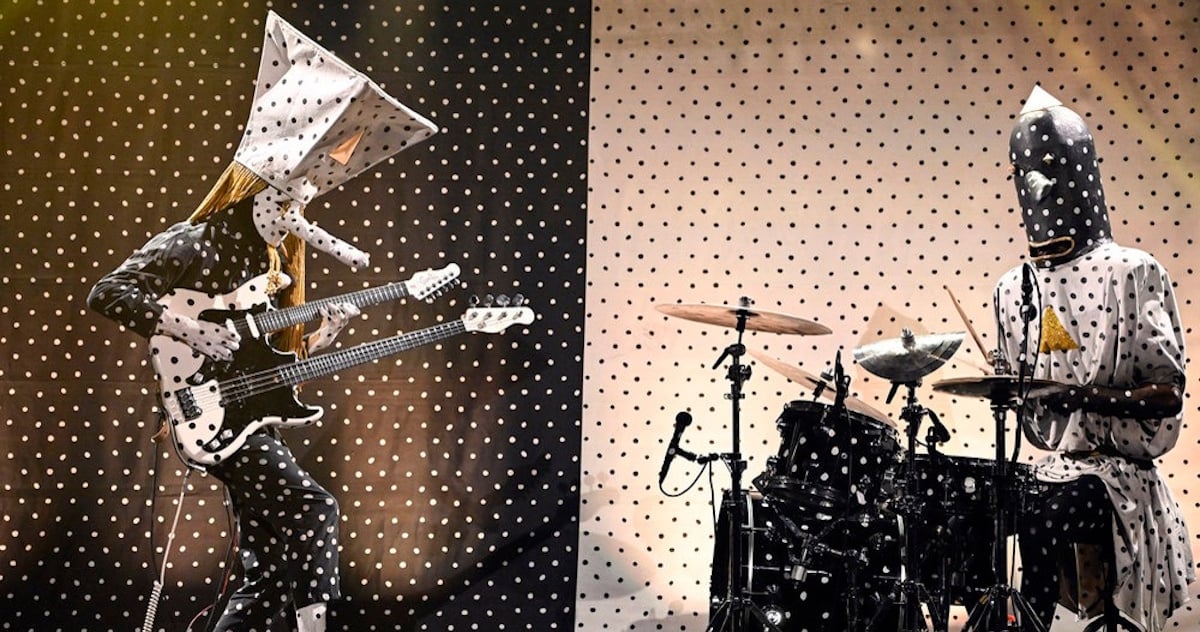
Angine de Poitrine introduced new music while reaching another milestone in their rapid rise. The anonymous Quebec duo made their U.S. television debut on Monday’s episode of The Tonight Show Starring Jimmy Fallon with the first public performance of the new original “Zugzegk.”

Microtonal guitarist Khn de Poitrine and drummer Klek de Poitrine opted for the previously unreleased instrumental rather than a song from “Vol. II”, their six-track sophomore album released in April. While soundchecked several times earlier this summer, “Zugzegk” does not appear on either of Angine de Poitrine’s two albums.

The Tonight Show appearance followed several other firsts for the duo in 2026. Angine de Poitrine made their British television debut on Later… With Jools Holland in June before presenting their first U.S. concert at the Newport Jazz Festival on July 31st. Primus bassist Les Claypool and Rush members Geddy Lee and Alex Lifeson have also recently shared their admiration for the group.

May be an image of guitar

Bob Dylan’s “The Rolling Thunder Revue: The 1976 Live Recordings” is released on November 6th by Columbia Records and Legacy Recordings, the catalog division of Sony Music Entertainment.

The 39 CD Deluxe set includes 381 tracks, 371 of which have never been released, plus a booklet with liner notes by Mikal Gilmore and rare photographs. A 22-track, 3LP set contains a complete show from May 16th, 1976 at Fort Worth.

Beginning on April 18th, 1976 in Lakeland, Florida, and concluding in Salt Lake City on May 25th, 1976, the tour spanned twenty-seven dates, almost all of which are represented in the 371 never-before-heard tracks. The tour’s tapes unveil how Dylan’s progressively furious performances all culminate in the complete Fort Collins recording on May 23rd, 1976, remixed from the original multi-track tapes, which yielded the special “Hard Rain“, broadcasted live only once before.

‘“Idiot Wind” in NBC’s “Hard Rain” is among the most rageful and brilliant performances Dylan ever committed before camera,” writes writer and music journalist Mikal Gilmore in his exclusive liner notes essay. “Yet again, it was for nought. […] One night, one hour only. It never saw any time in a theatre. It was never re-broadcast, never issued as a video tape or DVD. It’s gone. All that’s left of the Rolling Thunder movie that was never made but instead played out on stages for four-and-a-half weeks in the spring of 1976, is what you now hold in your hands.

The second leg of the legendary Rolling Thunder Revue tour saw Dylan welcome old friends and collaborators to his troupe. Dylan reunited with Joan Baez to perform a duets across many dates, including performances of “Blowin’ in the Wind” and “Railroad Boy”. Dylan’s band included bassist Rob Stoner, violinist Scarlet Rivera, drummer Howie Wyeth (who had all worked on “Desire“), guitarists Mick Ronson, Steven Soles, David Mansfield and T Bone Burnett.

You can listen to “Going, Going, Gone” from Forth Worth show.

“The Rolling Thunder Revue was the first national punk rock tour,” says Burnett. “It opened a door that led to a furious explosion of new music—The Clash, Elvis Costello, The Ramones, The Sex Pistols and on and on. Dylan had done it again. He is good at walking through doors that no one else even sees, doors that others think are walls.”

See the source image

Originally released in 2006, “The Road to Escondido” brought together J.J. Cale and Eric Clapton after years of admiring each other’s work to create their first album together. The resulting hybrid sound defies being labelled, finding influence across the spectrum of blues, rock, country, and folk.

Now, to celebrate its 20th anniversary, this new Enhanced Edition features three previously unreleased songs from the original recording sessions, three live tracks from Live in San Diego, and new liner notes. Available on 180G Rusty Red & Sky Blue vinyl and CD.

“People are unaware of how important he is in the tree of the musical history of [the U.S.] and the world, and the effect he’s had on people, in a very subtle way, in the way they sing, play guitar, and make records”

“Roll On,” a bonus track from the upcoming ‘The Road To Escondido: Enhanced Edition’ album – available to pre-order now (release date: November 20th, 2026).

No photo description available.

Hearing ‘Like A Hurricane’ again, reinterpreted here by by the Louisiana, Kentucky rock band My Morning Jacket, For this version of ‘Like A Hurricane’ My Morning Jacket have joined forces with the legendary Preservation Hall Jazz Band from New Orleans. The song will feature on the forthcoming albums “Heart of Gold: The Songs of Neil Young Volume 2: Out of the Blue and Volume 3: Into The Black” to benefit the Bridge School, a Californian organisation very close to Neil Young and his late wife Pegi Young’s hearts. The school is for children with severe speech and physical impairments.

My Morning Jacket’s Jim James says, “We were so honoured to get to be at several of the Bridge School Benefit concerts in the past, and are so honoured to once again be a part of raising funds for this amazing school, with these amazing songs of Neil Young. We felt like teaming up with Preservation Hall Jazz Band would add some magic to this track, so we all got together with producer Ross Hogarth down in New Orleans and recorded it live at Marigny Studios. We hope you enjoy listening to it as much as we enjoyed playing it!”

Following the introductory, more plaintive strains of the jazz band, at 1:47 the song explodes into life. In My Morning Jacket and the Preservation Jazz Band’s safe hands and half a century on down the line, ‘Like A Hurricane’ remains just as colossal and every bit as epic as it ever did.

ALUMINIUM – ” Killing Time “

Posted: September 14, 2026 in MUSIC
aluminum3_MAIN_credit_Tash de Valois.jpg

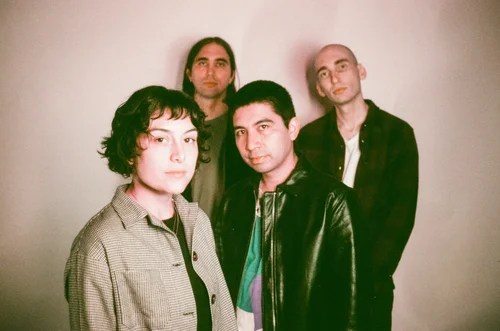
We love it; San Francisco four-piece Aluminum deliver the awesome ‘Killing Time‘, a fuzzy psych smudged noise-pop rocket, a barrage of distortion pedal guitars and cyclical rhythms are threaded by the sneer of Gonsalves’s refrain: “You want it all / And you want me / Packaged up so politely”. She explains, “This one comes from the frustration of living within a system that sets you up for failure, always ‘not being enough’ or ‘being too much’, and all the anger, exhaustion, and pressure to comply.”

Bursting into a hooky chorus that positively seethes at the frustration of 2026 with pummeling guitars and fuzz trailed riffing, it’s a undeniable earworm of massive proportions taking its influence from Swervedriver, Catherine Wheel and SST era Dinosaur Jr yet tapping into the vein of catchiness of the likes of Wishy or Lush.

Marc Leyda says of the video for ‘Killing Time’ “We wanted to visualize the commodification of the individual alongside the endless waste put out by American society.” Director Ryann Gonsalves says, “I clean a little beach off the Bay some mornings, picking up bits of Styrofoam, lost shoes, shotgun shells, Big Gulp cups, etc. I imagined everything I picked up going through a grocery store conveyor belt and became fixated on the cycles of waste.”

Lead vocalists and songwriters Marc Leyda and Ryann Gonsalves continue to strike a balance between pop catchiness and experimental abandon while infusing these songs with spontaneity, immediacy, and post-punk tenacity. “We intended for this to be a more guitar-forward album,” notes Leyda, “so we recorded through Marshall stacks to give it a heavier feel, and to get a faster, more punkish sound that will be massive and immersive in a live setting.”

Its lifted from Aluminum’s second album “Iconoclast HaHa” out 30th October on Felte Records. “Iconoclast HaHa” shows the band leaning into their heavier instincts for their new record. The first half of the record hits hard, rocking heavy indie rock and losing any of the indie-pop elements from their previous material. Halfway through, the band switches gears and shows off their experimental side, before returning at the end to rocking yr face off. Ryann and Marc’s vocal chemcity continue to shine with all the songs having effortless give and take and hooks galore.

Band Members::
Marc Leyda – vocals, guitar, sampler
Ryann Gonsalves – vocals, bass
Austin Montanari – guitar
Rick Altieri – drums

releases October 30th, 2026

No photo description available.

San Francisco Bay Area, USA – The Asteroid No.4 return in 2026 with “In Praise of Shadows”, their thirteenth full length album and a statement release that reaffirms the band’s enduring place within the modern psychedelic underground.

With our 13th record, “In Praise of Shadows”, we may have made our most ambitious album yet. The title comes from Jun’ichirō Tanizaki’s beautifully meditative book In Praise of Shadows, which reflects on the quiet collision between the deep shadows of traditional Japanese interiors and the dazzling light of the modern age. That tension really resonated with us.

This is a darker sounding effort musically and lyrically but it’s also about finding those special, almost hidden moments that exist in the shadows, and recognizing the beauty that can live inside darker times. In a political and social climate like the one we’re living through now, we wanted to search for the good things that still flicker underneath it all and relying on art and music to do so.

Swathed in multi layered guitars, dense reverb, and hypnotic melodic drift, the record reflects decades of refinement while retaining the immediacy and emotional pull that has defined the band since their earliest releases.

Formed in Philadelphia in the late 1990s and now based in the San Francisco Bay Area, The Asteroid No.4 have built a reputation for immersive live performances and a remarkably prolific catalogue. Across thirteen albums, numerous EPs and singles, the band has continually evolved while remaining deeply connected to the lineage of UK shoegaze and classic psychedelic music that first inspired them.

Sonically, the record draws from the classic shoegaze era and the late ’80s/’90s UK indie movement that’s always inspired us, while also leaning further into goth textures and electronic elements. For the first time on an Asteroid No. 4 record, we even experimented with processed drums, pushing our sound into new, shadowy territory while still holding onto the haze that’s always defined us.

From ‘In Praise of Shadows’ out May 9th, 2026 on Little Cloud Records