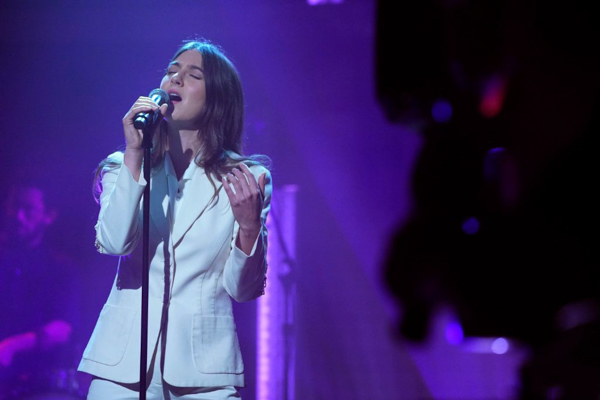
A beautiful masterpiece that takes in a range of influences: ’60s flower pop, ’70s easy listening, ’80s New Wave, ’90s alt-radio and ’00s indie rock. If you like Arthur Russell, Wild Nothing, Prefab Sprout or Clairo you’ll full in love with this instantly. On his sophomore album, “Full Hand”, Indiana musician Kevin Krauter tackles complicated emotional states and ideas through elliptical songwriting that is at once poetic and truthful. “A lot of the lyrics touch on how I was raised religiously, touch on me understanding my sexuality more and more in recent years,” Krauter says, “just growing up and becoming more confident in myself…that process of looking inward and taking stock of myself.”
It’s not especially uncommon for artists to probe deep into their own psyche to uncover what makes them tic, but Krauter’s light touch feels like something all his own. On the album’s first single, Pretty Boy, he sings, “Look ahead, say I see me now / Smiling at what used to stress me out / Cause it won’t be too long, but I’ll take my time with it / It won’t be too long till I come back home.” There’s a palpable sense of joy in Krauter’s acceptance of dire, stressful moments, and a liberation that comes from hearing him realize that the present will eventually be the past, and he’ll be able to look back and find peace.
All songs written by Kevin Paul Krauter
Performed by Kevin Krauter & Ben Lumsdaine
The National’s Matt Berninger has shared the title track of his debut solo album, “Serpentine Prison”, along with the single art. The record is out October 2nd via Book Records—a new imprint from Berninger and Booker T. Jones in conjunction with Concord.
The video was directed, shot, and edited by Tom Berninger and Chris Sgroi. Berninger announced Serpentine Prison last year, revealing it would be produced by the keys-playing leader of iconic Memphis soul outfit (and longtime Stax house band) Booker T. & the M.G.’s. In recent months, Berninger has teamed with Phoebe Bridgers for “Walking on a String” and “7 O’Clock News/ Silent Night.” He’s also covered Mercury Rev’s “Holes” and Big Thief’s “Not.”
The song Serpentine Prison was written in December 2018 about a week after recording The National’s I Am Easy to Find. For a long time I had been writing songs for movies and musicals and other projects where I needed to get inside someone else’s head and convey another person’s feelings. I liked doing that but I was ready to dig back into my own garbage and this was the first thing that came out.
The title is from a twisting sewer pipe that drains into the ocean near LAX. There’s a cage on the pipe to keep people from climbing out to sea. I worked on the song with Sean O’Brien and Harrison Whitford and recorded it about six months later with Booker T. Jones producing. It feels like an epilogue so I named the record after it and put it last.
The album features contributions from a wide array of notable artists, including Matt Barrick (The Walkmen, Jonathan Fire*Eater), Andrew Bird, Mike Brewer, Hayden Desser, Scott Devendorf (The National), Gail Ann Dorsey (David Bowie, Lenny Kravitz), Booker T. Jones, Teddy Jones, Brent Knopf (EL VY, Menomena), Ben Lanz (The National, Beirut), Walter Martin (The Walkmen, Jonathan Fire*Eater), Sean O’Brien, Mickey Raphael (Willie Nelson, Bob Dylan), Kyle Resnick (The National, Beirut), Matt Sheehy (EL VY, Lost Lander) and Harrison Whitford (Phoebe Bridgers).
The official music video for “Serpentine Prison”, the title track from Matt Berninger’s debut solo record. Produced by Booker T. Jones, the album will be released via Book Records in conjunction with Concord Records on October 2nd.
The American market wasn’t fully ready for The Who when they made their album debut with ‘My Generation’ at the end of 1965. Second time around, they cracked it, winning their first appearance on the US album chart 48 years ago today, on May 20th, 1967 — but only after a delayed release and a title change.
With the US release coming five months after the UK, The Who’s American label, Decca Records, decided that the band’s second LP ‘A Quick One’ should be renamed there for their song that was climbing the Hot 100 at the time. ‘Happy Jack’ had been a top three UK hit in January, but wasn’t included on the album ‘A Quick One.’ That wouldn’t do for Decca, who removed the album’s one cover a nod back to their soul and R&B roots with a cover of Martha Reeves & the Vandellas’ ‘Heat Wave’ — and replaced it with ‘Happy Jack,’ which would become The Who’s first US top 30 hit in early June. The song features Roger Daltrey on lead vocals with John Entwistle singing the first verse, making it one of the few songs composed by Pete Townshend to feature Entwistle on lead vocals. Author Mike Segretto describes Daltrey’s vocal as “imitating Burl Ives”. At the tail end of “Happy Jack”, Townshend can be heard shouting “I saw you!”; it is said that he had noticed drummer Keith Moon trying to join in surreptitiously to add his voice to the recording, something the rest of the band would try to prevent (Moon had a habit of making the other members laugh). critic Dave Marsh calls this line “the hippest thing” about the song.
According to some sources, Townshend reported the song is about a man who slept on the beach near where Townshend vacationed as a child. Children on the beach would laugh at the man and once buried him in the sand. However, the man never seemed to mind and only smiled in response. According to Marsh, “the lyric is basically a fairy tale, not surprisingly, given the links to Pete’s childhood”.
Daltrey reportedly thought the song sounded like a “German oompah song”. But Chris Charlesworth praised the “high quirky subject matter” and “fat bass and drums that suspend belief”. Charlesworth particularly praised Moon’s drumming for carrying not just the beat, but also the itself, in what he calls “startlingly original fashion”.
The album also featured one of John Entwistle’s best-loved songs, ‘Boris The Spider’ (a title that he and Rolling Stones bassist Bill Wyman came up with after a night out drinking); two Keith Moon compositions, ‘I Need You’ (his first-ever song for the band) and the highly percussive ‘Cobwebs and Strange’; and a mod favourite that the band are currently reviving on their ‘Who Hits 50’ anniversary tour, ‘So Sad About Us.’
After ‘A Quick One’ reached No. 4 in the UK in January, the ‘Happy Jack’ version opened on Billboard’s Top LPs at No. 184, in between albums by Jimmy Ruffin and Dean Martin. It climbed steadily for the next nine weeks, peaking at No. 67 in June.
The Struts launched their new “Sunday Service” live stream series on YouTube – complete with an impressive cover of the Spice Girls’ 1997 hit single ‘Stop’. Filmed from each of the band members’ individual homes in Los Angeles, the weekly live stream will be a regular series from The Struts while they are self-isolating, and will air on the band’s YouTube every Sunday at noon PST. In just a few years,
The Struts have found themselves massively embraced by some of the greatest icons in rock-and-roll history. Along with opening for The Rolling Stones, The Who, and Guns N’ Roses, the U.K.-bred four-piece was hand-picked by Mötley Crüe to serve as the supporting act for their last-ever performances, while Dave Grohl praised them as the best band to ever open for Foo Fighters. After making their full-length debut with 2016’s Everybody Wants, The Struts now return with asecond album “Young & Dangerous a sophomore album that cements their status as one of the most unstoppably passionate and endlessly thrilling bands making rock music today.
“As British boys, it will come as no surprise that we were all once enamoured with the Spice Girls”, shared frontman Luke Spiller in a statement about the song – which came off of the girl group’s sophomore album, Spiceworld. “This song still holds a lot of memories and is a true piece of pop perfection. Long live ‘Girl Power.’” Meanwhile, bassist Jed Elliot queued up the song on the live stream, saying “We wanted to pay homage to one of our musical heroes, somebody very close to our hearts. And this is a little something for you guys that are at home craving that little ‘human touch.’”
The band’s bouncy cover of ‘Stop’ would have made any of the Spice Girls proud. Elliot, who also manned the keyboards, sang sweet back-up vocal harmonies, while guitarist Adam Slack took a cue from the single’s original music video, offering his best dance moves.
This week is Episode 7 and a very special SundayService because we are celebrating our very own Jed Elliott who had a birthday on Friday and don’t miss Welsh lessons from Geth and a guitar rundown from Addo...The Struts present “Sunday Service” Episode 7.
SundayService Episode 6 coming in hot Featuring a long-lost solo piano version of One Night Only for all your pleasure. In addition to the performance, the inaugural edition of “Sunday Service” offered the Struts’ fans an intimate peek into the band members’ lives while in quarantine in Los Angeles,
THIS WEEK on SundayService: A look behind the scenes of recording “Somebody New”, a live performance of “In Love With A Camera”, and Adam and Gethin announce the cure for your quarantine blues.
The Struts and Sunday Service episode 4
The Struts Sunday Service Episode 3,
The Struts and their Sunday Service Episode 2
The Struts Sunday Service Episode 1,
Struts fans have plenty of content to enjoy while isolating amid the COVID-19 pandemic. In addition to weekly “Sunday Service” episodes, Luke Spiller has been streaming “Quarantine Radio” live from his home every Saturday, Monday, Wednesday and Thursday evening at 7:30 pm PST. Additional inspired content has also been popping up on the band’s various socials, including a recent guitar tutorial from Slack.
Band Members
Luke Spiller – Lead Vocals
Addo Slack – Guitar and Vocals
Jed Elliott – Bass and Vocals
Gethin Davies – Drums.
David Blue was born on 18th February 1941. He wasn’t born David Blue, of course, but Stuart David Cohen and he came from Providence, Rhode Island. At age 17, Blue left home, and joined the Navy, but was soon thrown out for his “Inability to adjust to a military way of life.” He moved to Greenwich Village in the early ‘60s and one day saw Bob Dylan writing the song that would become the great folk anthem ‘Blowin’ In The Wind’. Bob asked David to play the chords while he would create the verses. It was performed that night at Gerde’s Folk City.
Once Bob Dylan made it, record companies came looking around Greenwich Village for potential artists. However, there was already a Dave Cohen performing in the village, who later joined Country Joe and the Fish. Our Dave Cohen told folk singer Eric Andersen that he would have to change his name and Eric said, “You’ve got such blue eyes. You should be David Blue”. When Dylan heard of his new name, he started laughing and sang “It’s all over now, David Blue”.
“At the beginning, no one in the “in” crowd liked David, except for Phil Ochs. Phil thought he was a tremendous performer and songwriter. Later on, people started coming around to his music. David’s music was all romantic. Phil’s was all political. In fact, David. Phil and Dylan were an interesting threesome when it came to writing about women. David would write about women who most people didn’t know – the exotics; Dylan wrote about the universals; and Phil didn’t write about them at all …David’s first appearance on record was on the Elektra LP “The Singer / Songwriter Project” where he performed three songs under the name David Cohen. Around the same time he appeared as one of the Broadside Singers on “Broadside Ballads, Vol.3”
When Bob Dylan had his motor cycle accident in 1966, David Blue sent him a note “It’s been done already” – a reference to James Dean. While Bob was recovering, he was recording with the band and David can be seen on the cover of The Basement Tapes – he is sitting to the right of Mrs Henry. Blue joined Dylan’s Rolling Thunder Revue in 1975 and appeared in Renaldo and Clara, the 1978 movie that was filmed during that tour.
The Reprise album, “These 23 Days In September” was released in 1968. It was produced by Gabriel Mekler who was producing Steppenwolf. Gabriel played piano and Bob Rafkin, guitar.
His first album for the newly-formed Asylum label – “Stories” (1972) – had a self-portrait on its cover. The album featured some magical slide guitar from Ry Cooder. The musicians on the album include Rita Coolidge, Chris Ethridge, Milt Holland and Russ Kunkel, which is pretty much an A-Team.
In the album’s ballads, particularly “Grand Hotel,” but also “Midnight Through Morning” and “The Street,” he revealed a more lyrical style that was warmer and sadder than anything in Dylan’s repertoire. Those songs would point a direction for him to find more of his own sound on subsequent albums.
Graham Nash, then a superstar with Crosby, Stills and Nash, produced the album “Nice Baby And The Angel” in 1973. Background vocals included Graham Nash, Dave Mason, Glenn Frey and Jennifer Warren. Glenn Frey was so taken with the track ‘Outlaw Man’ that he took it to The Eagles and it was featured on their album “Desperado”.
“Cupid’s Arrow” released in 1976 was produced by Barry Goldberg and featured Jesse Ed Davis and the Liverpool musician Jackie Lomax. The title track was written about protest singer Phil Ochs and it was sung at his memorial concert.
Los Angeles indie rockers Wallows want you to come over and barbeque them. And by barbeque we mean ask them questions, not marinate them in garlic, soy cause, apple cider vinegar, olive oil, and chili overnight and then lay them on a smoking grill. Braeden Lemasters, Cole Preston and Dylan Minnette (the three young men who make up Wallows) are inviting a handful of lucky Australian fans to join them for an online hangout/Q&A session, and if you want to get in on that—click this bit and write a 5000-word essay about why you’d like to attend a virtual hang out with Wallows. There’s no essay, but you’ll have to submit some details, like what you intend to ask Wallows during the Q&A and whether you’re allergic to peanuts. Nothing major. Before you do that though, check out the single ‘Scrawny’ from Wallows’ 2019 debut, Nothing Happens.
10,000 Maniacs ~ In My Tribe from 1987 produced by Peter Asher. It’s a worry that I still consider it to be quite a recent album.
In My Tribe was the second and best major-label album by this American folk rock group. The bell-like voice and song writing talents of Natalie Merchant were their main assets from 1982-93, after which she pursued a solo career. And even if there’s nothing quite as immediate as ”Back O’ The Moon” the highlight of their previous album, The Wishing Chair, this is a more mature, consistent set, overall. This album introduced a lot of people (including myself) to the wonderful talents of Natalie Merchant.“Like the weather”, “Gun shy”, “Campfire song” (with a guest appearance from REM’s Michael Stipe) and especially the piano ballad “Verdi cries” are still among the best songs she’s ever written.
Though much has been made of the fact that their accessible, mostly mid-tempo songs often dealt with serious themes (such as child abuse on the opening ”What’s The Matter Here”, they’re hardly the only pop act to do so before or since. Their real legacy probably lies in the undeniable hummability of tunes such as the aforementioned, ”Hey Jack Kerouac” and the catchy, stumbling rhythm and nursery rhyme simplicity of ”Like The Weather”.
”A Campfire Song” features an unmistakeable vocal cameo from celebrity fan Michael Stipe of REM, and the chamber-folk calm of the closing ”Verdi Cries” makes it clear Merchant herself was a fan of Kate Bush. Not everything else is essential or memorable, and it’s a shame Bucks ringing mandolin isn’t higher in the mix. The only song that hasn’t dated well is ”My Sister Rose”, which over-indulges the bands occasional penchant for Afro/Latin world music flavours and now sounds rather clunky and dated.
The choice of ”Peace Train” as the only cover must have seemed inspired at the time, but when its author Cat Stephens (a.k.a. Yusuf Islam) declared his support for Ayatollah Khomeini’s fatwa on Salman Rushdie, Merchant insisted it be withdrawn from the US version of the album.
Weyes Blood’s Titanic Rising is one of the Best Albums of 2019.The closing track of Weyes Blood’s Titanic Rising also cites “Nearer, My God” in both name and mournful strings, but where the album vastly succeeds as a doomsday document is in its coverage of the joy, panic, resigned apathy, and beauty that comes with being alive as our planet is so obviously dying.
Natalie Mering’s previous three records as Weyes Blood drew from Laurel Canyon’s surrealist lineage to make psych folk that felt loosely tethered to earth, but Mering finds otherworldliness in straightforwardness on Titanic. Opener “A Lot’s Gonna Change” swells into a cinematic elegy to climate stability and youthful optimism, but one song later, Mering’s in interstellar love on the Flying Burrito Brothers–tinged space opera “Andromeda.” There’s no shortage of attentional leaps on Titanic Rising, whether Mering’s launching a musical-worthy inquiry into dependable love (“Everyday”), writing letters to dead friends (“Picture Me Better”), or disappearing into her favourite movies (fittingly, on “Movies”).
“Everyone knows you just did what you had to,” Mering reassures on “Wild Time,” its title an emotionally depleted answer to being alive amidst climate changes. It might as well serve as a quasi-pull quote for Titanic, an album that spans galaxies to consider whether it’s possible to give undivided attention to both our planet and our emotional sanity. Mering never really finds an answer to that question, but her record is all the more relatable for lack of one.
Weyes Blood made her TV debut on Late Night with Seth Meyers performing “Everyday” from Titanic Rising – which has been universally acclaimed and you can watch theJuly 16th performance right here
Unlike ‘Quadrophenia’ and ‘Tommy,‘ The Who’s other celebrated concept albums, ‘The Who Sell Out’ doesn’t tell a story. Instead, the album weaves together songs (like ‘I Can See for Miles’) with fake commercials (like for deodorant) so that the whole thing plays like 40 minutes of a pirate radio station. It’s pop-art filtered through the era’s psychedelic shadings.by The Who followed with its concept of a pirate radio broadcast. Within the record, joke commercials recorded by the band and actual jingles from recently outlawed pirate radio station Radio London were interspersed between the songs, ranging from pop songs to hard rock and psychedelic rock, culminating with a mini-opera titled “Rael.”
Their 1967 psychedelic statement ‘The Who Sell Out’. Complete with radio ads linking the songs this is as swinging as the 60s got, plus my favourite ever Who 45 was contained within the grooves… ‘I Can See For Miles’.
Original copies of the album, issued on the Track label, came in Mono and Stereo and if you were lucky enough there was a sticker on the sleeve promising a ‘Free Psychedelic Poster Inside’. If you have the complete item with unblemished poster you are sitting on a £500+ record!
The Zombies rode the British Invasion wave like many of the bands that weren’t the Beatles or the Rolling Stones: by having a couple of early hits and then fading into the corners of rock ‘n’ roll history. For the first time, the essential studio recordings of Britain’s legendary Zombies are assembled in one place on vinyl.
The set includes their two original US albums: “She’s Not There/Tell Her No” and “Odessey & Oracle”; two important compilations: “I Love You” and “R.I.P”.; as well as a bespoke collection of rare singles and UK-only album tracks: “Oddities & Extras”. The most comprehensive LP collection ever assembled for The Zombies, confirmed as inductees in the R&R Hall of Fame class of 2019.
After they recorded their second album Odessey & Oracle in 1967, the Zombies became discouraged by dwindling commercial success and called it quits. A few months later, the LP – earmarked as a permanently shelved record made by a band that nobody seemed to care about anymore – found a famous champion at the record company.
The five-LP The Complete Studio Recordings is set for release and includes their first U.S. album, She’s Not There/Tell Her No; its follow-up, Odessey and Oracle, an album called I Love You, which was released in the U.K. and Japan; R.I.P., which was supposed to come out after Odessey but was never released; and Oddities & Extras, a compilation of singles and U.K.-only album tracks.
The set is due a little more than a month before the British Invasion group were inducted into the Rock & Roll Hall of Fame last March . “There’s been lots of ups and downs in this 50-year career,”said singer Colin Blunstone “This is the pinnacle, to be inducted into the Rock & Roll Hall of Fame. What a reward for all of the ups and downs over the years.”
The Zombies originally formed in 1962 and scored their first hit two years later in their native U.K. and in the U.S. with “She’s Not There.” They placed a few more songs on the chart before splitting up in 1967. A project they were working on, Odessey and Oracle, was released a year later and a single from it, “Time of the Season,” eventually climbed into the Top 3.
Over the years, that album became one of rock’s most legendary cult records, influencing artists and entire genres in the decades since its release. The Zombies reunited several times, including a recent get-together that included tour dates and a new album, Still Got That Hunger. Singer Blunstone and keyboardist Rod Argent continue to lead the band.
“She’s Coming Home”
From: 1965 single
Three months after “Tell Her No” gave the Zombies their second consecutive Top 10 hit (following “She’s Not There,” their biggest hit), “She’s Coming Home” stalled at No. 58. It’s the last time they got that high on the singles chart until “Time of the Season” became a fluke Top 5 smash in 1969. Maybe it’s because “She’s Coming Home” is more Phil Spector than British Invasion.
“I Want You Back Again”
From: 1965 single
Unlike most of their contemporaries, the Zombies borrowed from jazz greats, incorporating rhythmically tricky melodies not usually heard on pop radio. Keyboardist Rod Argent often took the spotlight solo, riffing like Jimmy Smith or a Miles Davis sideman and giving the band a sophistication other groups – British and American – lacked. “I Want You Back Again” is the most jazz inspired of the early singles.
“Imagine the Swan” (1969)
From: 1969 single
After Odessey & Oraclebecame a belated hit a couple years after it was recorded, thanks to the Top 10 single “Time of the Season,” keyboardist Rod Argent and bassist Chris White were persuaded to put together a new Zombies album that featured older unreleased tracks and some new songs recorded by the new Argent-led lineup. “Imagine the Swan” couldn’t crack the Top 100, so the album was shelved for more than three decades. Argent then moved on to his own group. The song serves as a sweet coda to a too-brief career.
But one of its songs, “Time of the Season,” eventually climbed all the way to No. 3 in 1969 – more than a year and a half after it was recorded. And the album is now considered a cornerstone work of baroque pop, and one of rock’s greatest cult records.
Even though they were around for only a handful of years at first – the Zombies reunited in 2004 and still perform – and their catalog isn’t as deep as other Rock & Roll Hall of Fame inductees, the band’s influence is wide. And as you’ll see it’s not just Odessey & Oracle, though that classic album does show up several times.
“This Will Be Our Year”
From: Odessey & Oracle (1968)
The Zombies recorded their second album during the latter half of 1967 and then broke up before it was released. It almost never came out at all. Almost a year after Odessey & Oracle’s April 1968 release, one of its songs, “Time of the Season,” hit the Top 10, and the album became one of rock’s most heralded “lost” LPs. “This Will Be Our Year” is a highlight – all horns and Summer of Love pop swathed in one of Colin Blunstone’s warmest vocals and a centerpiece of the classic record. Like more than half of Odessey & Oracle, “Year” was written by Chris White.
“Tell Her No”
From: 1965 single
The band’s follow-up to the breakthrough “She’s Not There” runs barely two minutes, but it’s one of the breeziest two-minute singles of the ’60s. Rod Argent based the song on the hits of Burt Bacharach and Hal David from the era, which explains its almost hushed, soft-pop structure. “Tell Her No” became the Zombies’ second U.S. Top 10 hit, though it didn’t fare as well in their native England. Colin Blunstone’s breathy “whoa-oh-oh-oh” during the second verse remains one of pop’s great wordless breaks.
“A Rose for Emily”
From: Odessey & Oracle (1968)
One of Odessey & Oracle’s most melodically somber songs, and one of the best. The chamber-pop movement of the ’90s pretty much starts here. The LP split the Zombies, who were disappointed by reception to the album’s first single, “Care of Cell 44.” The record almost didn’t come out at all, until Al Kooper – a rock ‘n’ roll journeyman who played with Bob Dylan and was now a producer at the Zombies’ record company – pushed for its release. Odessey & Oraclestill wasn’t a hit, but its stature has grown over the years. “A Rose for Emily” is one of the reasons.
“Time of the Season”
From: Odessey & Oracle (1968)
The Zombies were broken up when “Time of the Season” unexpectedly climbed to No. 3 in 1969. But that didn’t stop record execs from pushing Rod Argent and Chris White – the architects behind “Season”‘s parent album, Odessey & Oracle – for more music. They never completed the project, save for a single and some songs that ended up on albums years later. “Time of the Season” is both timeless and of its time – which sorta explains why a song recorded during the Summer of Love became a hit in the way different musical climate of 1969.
“She’s Not There”
From: 1964 single
The Zombies’ first single came out just as Beatlemania ushered the British Invasion onto the U.S. charts, sending “She’s Not There” straight to No. 2. Two more Top 10 hits followed – including the late-blooming “Time of the Season” in early 1969 – before the group went dormant until the early ’90s. More than 50 years later, the song still sounds like a revolutionary record. Rod Argent, who wrote “She’s Not There,” fills the track with jazz-inspired electric piano that set the Zombies apart from their blues- and R&B-borrowing contemporaries.