‘Til I Start Speaking” charts this journey of empowerment across 10 gentle anthems of soul and self-realization, to be shared and leaned on in low times or late nights.
Katy Morley’s soft, swooning strain of storyteller pop has distilled across the past half decade into an increasingly hushed and heartfelt private language, as lived in as it is lyrical. ‘Til I Start Speaking“, her long awaited debut, took shape slowly during stints in Minneapolis, Los Angeles, and London, stripping back the melodies to their essence, driven by a yearning to “reach ‘the other side,’ to live in and be art and music.” The songs that emerged are time-worn, aching, and acoustically rich, like hymns or traditionals, traced in piano, voice, and percussion. She describes the creation process as almost a “subconscious exorcism,” casting out old ghosts and outgrown loves.
All songs written by Katy Morley and Christopher Stracey, with the exception of Wasted, co-written with Marcus Foster
The Parquet Courts boys are back, and with one of the most antcipated records for 2021. Brooklyn’s own indie-rock cult heroes have announced their first new album since 2018’s acclaimed “Wide Awake”,
“Sympathy for Life“, coming October 22nd on Rough Trade Records. Though the band say they completed their new record pre-pandemic, lead single “Walking at a Downtown Pace” could not be more on point in capturing the feelings of this fraught time period, from the yearning to recapture day-to-day joys (“I’m making plans for the day all of this is through / Seeing my path and hearing the song I’ll sing and / Food that I’ll taste and all the drinks that I’ll consume”) to the cabin fever and isolation (“Pick out a movie, a sandwich from a screen / How many days of life will I spend underground?“). It’s cathartic to hear those feelings rendered against Parquet Courts’ celebratory, animated dance-rock, which adopts its eponymous fast pace, yet never comes across as rushed or harried. The band drew inspiration from Screamadelica, knitting their new record together from self-samples, yet on “Walking at a Downtown Pace,” you’d be hard-pressed to spot a seam.
Parquet Courts announce new album ‘Sympathy for Life’ out on October 22nd and share the first video/single ‘Walking at a Downtown Pace’ direct by Daniel Arnold.
Ahead of the album, on October 20th ‘Feel Free – Sympathy for Life, Visualised’ will air – get a sneak peek experience of the full album with never-before-seen videos and extras. Early bird tickets will be $10 for the first 72 hours, then $15 after. Discounted Album + ticket bundles available on their store.
The band have also announced eleven(!) global pop-up events, go to parquet-courts.com and sign up for details.
*Pre-order from our Rough Trade store and receive a free Sympathy for Life, 11-card Tarot Set designed by Andrew Savage. New Album ‘Sympathy for Life’ out October 22nd,
Low have shared a new video for another track from their forthcoming album “Hey What”. The latest cut is called “More,” and Julie Casper Roth directed a video for it. The visual, according to a press release, “explores the Sisyphean task of dismantling structural oppression, through gender biases.” this bodes well for another great Low album.
Following the singles “Days Like These” and “Disappearing,” indie and experimental stalwarts Low have shared another cut from their forthcoming album “Hey What” (out September 10th on Sub Pop records), the epic and striking “More.” Once again finding the band merging elements of noise, static and sonic decay with bits of melodic simplicity, “More” feels like it’s trying to bear its own weight against increasingly heavy gravity. The noisy, thunderous guitar that serves as the track’s foundation guides the song into almost a distorted take on classical folk. Bolstered by Mimi Parker’s enchanting vocals and a subtle but impactful rhythm, the song is a convincing soundtrack to our current state of entropy.
Arriving on September 10th, Hey What follows the band’s 2018 record “Double Negative”. The group has already shared the LP’s “Day’s Like These” and “Disappearing” .
“More” from Low’s album ‘Hey What’ (Out September 10th, 2021)
Baltimore quartet Future Islands have released their first new music of 2021, a one-off single titled “Peach.” The track follows the 2020 release of the synth-pop veterans’ sixth album, “As Long As You Are”. “Peach” is slick and danceable, upbeat in instrumentation, but far heavier on a lyrical level. Frontman Samuel T. Herring is caught amidst conflicting forces larger than himself, like a man overboard struggling to stay afloat on stormy seas: “Death is in season / And it’s pushing me round,” he sings, evoking Alice in Wonderland (“This one makes you big / In a cruel world / And this one makes you small / In a lonely world”) and ultimately resolving to hold onto hope: “But I’m not giving up / Not today.”
‘Peach’ by Future Islands is out now on 4ADRecords,
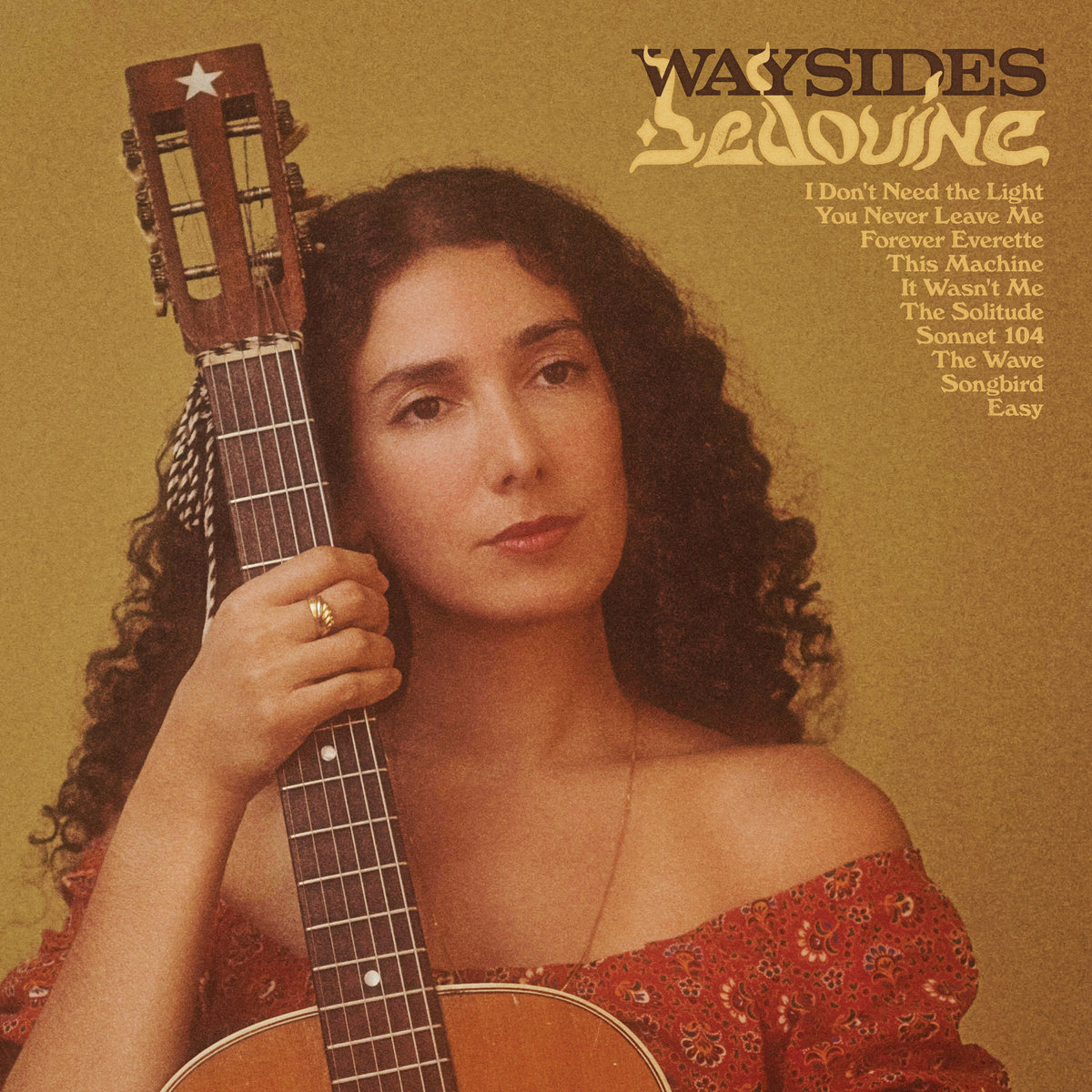
Los Angeles-based folk singer/songwriter Azniv Korkejian, who performs and records as Bedouine, has announced her third album, “Waysides”, set for an October 15th release via The Orchard. Tender and tranquil, “The Wave” is inspired by “the loss of a close friend, specifically the swell of emotion I try to resign myself to when thinking of her premature absence,” according to Korkejian. The song layers Korkejian’s wistful vocals over a fingerpicked acoustic guitar, minimalist percussion and subtle keys, which fill the negative spaces around her heartfelt emotion.
The singer/songwriter sounds overwhelmed, yet strangely at peace: “I cannot contain the way I feel for you / Or anything / I ride the wave,” she sings, making a friend of her own internal turbulence instead of fighting it.
Glasgow six-piece Fauves have gifted us with their new single “Ends of Me”on the 6th of August 2021.
With life rapidly changing from what we have experienced over the last eighteenth months, Ends of Me is a track which works perfectly to fuel our collective feelings of relief and excitement for the prospect of a brighter future.
At first listen, Ends of Me presents itself as a tight indie-rock track, however it is, in fact, a great deal more complex. A careful ear will pick up injections of shoegaze guitar, disco-style bass and light, pop vocals, altogether creating an idyllic melange of genres which hooks us from the first note.
The cinematic music video for the track was written, directed and edited by Kasparas Vidunas and Eric J. Liddle of Humble Film Productions. It shows Fauves’ frontman adopting the role of a lost wanderer who roams a picturesque forest whilst being repeatedly drawn towards a pyramid which sits prominently among the trees.
Our protagonist appears to drift in and out of consciousness as he comes face-to-face with several versions of himself and witnesses the pyramid morph from traditional Egyptian style to a colourful, Dark Side Of The Moon-esque apparition. It seems he is searching for a path, sign or meaning amidst chaos and confusion – an experience that many of us may be able relate to in one way or another, especially during recent times.
The track promises excellent things from Fauves’ upcoming debut album, which is scheduled for release early next year. For something sooner to look forward to, Fauves will be making their live return on the mainstage of Playground festival on the 23rd of September alongside the likes of The Libertines and Hot Chip. This will be an unmissable performance which will undoubtedly display the band’s talent and captivate existing and new fans.
Phoebe Bridgers has recruited Glitch Gum, Bartees Strange, and The Marias different remixes of her song “Kyoto.”
Phoebe Bridgers wrote her first song at age 11, spent her adolescence at open mic nights, and busked through her teenage years at farmers markets in her native Los Angeles. By age 20, she’d caught the ear of Ryan Adams, who listened to her perform her song “Killer” and invited her to record it in his studio the next day. The session grew into the three-song ‘Killer’ EP, and she hasn’t looked back since.
Kyoto” first appeared on Bridgers’ 2020 album “Punisher“. The Glitch Gum version of the song came about after the teen hyperpop producer covered the song last year and his version caught Bridgers’ attention. Bartees Strange and The Marias have more personal connections to the artist, with Strange set to support act on her forthcoming tour
Speaking about their take on the song, The Marias said in a statement: “I remember seeing Phoebe years ago at an open mic here in Los Angeles, and I knew right off the bat that she was really special. Working on this remix was a sort of full circle moment for us. ‘Kyoto’ is an amazing song as-is, so with the remix we were just curious to see what it would sound like with the vocal slowed down and adding some of our favourite synth sounds behind it.”.
Just when it seemed like the US had ceded garage rock – which we invented – to Scandinavia (and Australia), the White Stripes roared to life and proved Detroit still had the goods. After releasing several singles and three albums within the Detroit music scene, the White Stripes rose to prominence in 2002 as part of the garage rock scene.
The White Stripes released their first album in 1999 with their self-titled set. It introduced an eccentric but valid band with bluesy-styled and honest approaches to their original songs. Over time, the duo released six albums, their last being “Icky Thump” in 2007. Last year, the band celebrated the history of The White Stripes with a “Greatest Hits” package released a limited edition collectible vinyl. However, Legacy Recordings will re-release the Third Man RecordsWhite Stripes catalogue to brand the previous WB issues with the Legacy brand. There will be no added extras or anything.
The White Stripes used a low fidelity approach to writing and recording. Their music featured a melding of garage rock and blues influences and a raw simplicity of composition, arrangement, and performance. The duo were also noted for their fashion and design aesthetic which featured a simple colour scheme of red, white, and black—which was used on every album and single cover the band released.
Jack White aka (John Anthony Gillis), who first came to prominence as guitarist-vocalist with Detroit, Michigan garage rock revivalist duo, The Dude’s done so much stuff that it’s hard to keep track. After all, White is a musician, record label owner, sculptor, upholsterer, Raconteur, troubadour, (ill-advised) rapper, graphic designer and Lord knows what else. So like, statistically, he probably invented guitars as well.
But before he got into all that he was half of one of the greatest rock bands of all time. Jack played in The White Stripes alongside Meg White, his now ex-partner (though the rumour for a long time was that they were brother and sister).
Jack is obviously a creative whirlwind capable of doing anything he sets his mind to. This vital energy was ever present throughout The White Stripes’ career, but as his subsequent solo material has shown, creativity which is that unpredictable can benefit from being reigned in and focussed some.
This was where Meg came in. She was often mocked for the supposed simplicity of her drumming, but Meg was the guide rail which ensured that the band maintained their powerful minimalism. It was a drive which ran through six remarkably consistent albums that, even at their least good, still hold up better than Jack’s solo work.
The White Stripes
In 1999, the White Stripes signed with the California-based label Sympathy for the Record Industry. In March 1999, they released the single “The Big Three Killed My Baby”, followed by their debut album, “The White Stripes”, on June 15, 1999.
The self-titled debut was produced by Jack and engineered by Jim Diamond at his Ghetto Recorders studio in Detroit. The album was dedicated to the seminal Mississippi Delta Blues musician, Son House an artist who greatly influenced Jack.
The track “Cannon” from The White Stripes contains part of an acapella version, as performed by House, of the traditional American gospel Blues song “John The Revelator”. The White Stripes also covered House’s song “Death Letter” on their follow-up album “De Stijl.”
Looking back on their debut during a 2003 interview with guitar player, Jack said, “I still feel we’ve never topped our first album. It’s the most raw, the most powerful, and the most Detroit-sounding record we’ve made.
White’s voice is a singular, evocative combination of punk, metal, blues, and American backwoods while his guitar work is grand and banging with just enough lyrical touches of Slide and subtle solo work… Meg White balances out the fretwork and the fretting with methodical, spare, and booming cymbal bass drum, and snare.
De Stijl
While I have a lot of love for the band’s eponymous debut album (1999), it doesn’t quite feel like a proper White Stripes LP. While their debut established the template for the group’s blues/rock/punk hybrid, this was a record made by two musicians very much in the thrall of their influences and less willing to get as weird and varied as they did subsequently.
Second album ‘De Stijl’ (2000) is much more apiece with the rest of their discography. It still has loads of the garage-band bite that made their debut so exciting, but alongside vicious blues numbers such as ‘Hello Operator’ and ‘Jumble, Jumble’ The White Stripes started playing with the softer melodies in songs like ‘Apple Blossom’ and ‘Sister,Do You Know My Name’. Those more naive sounds would become a core part of their style as time went by.
The album ends with a sublime cover of Blind Willie McTell’s ‘Your Southern Can Is Mine’, a tune which is also noteworthy for being the first time you hear Meg singing on a White Stripes track. The band’s vocal dynamics more or less replicate the instrumental balance of power – opposite Jack’s squall, Meg’s controlled singing makes for something of a balm. Meg would sing on a few more songs before her and Jack went their separate ways, and each time she did it made for an album highlight. Only two LPs in, it was already possible to imagine The White Stripes taking over the world.
White Blood Cells
Across sixteen tracks and forty minutes, The White Stripes’ third album masterfully balances the band’s ear for melody with more leftfield impulses. As well as featuring relatively straightforward garage-rock forever-classics like ‘Fell In Love With A Girl’, it’s the weirder moments of ‘White Blood Cells’ that have really got their hooks into me. ‘The Union Forever’, for instance – built on open chords and a droning organ, this track sees Jack essentially reading out lines from ‘Citizen Kane’ verbatim. Or ‘Aluminium’, a cut which is just one ridiculously heavy metal (lol) riff repeated ad nauseum while Jack wails into some sort of effects pedal.
‘White Blood Cells’ has gone platinum in the UK and the USA, a fact which suggests that the listening public have a slightly higher tolerance for self-consciously strange music than they are often given credit for. That said, this was also the last time that The White Stripes would sound like a scrappy garage-rock outfit.
They recorded the whole thing in a single four-day blitz, and while it was the first time they had used a twenty-four-track recording studio Jack pointedly asked the engineer “not to make it sound too good.” It doesn’t, which conversely means that it does.
Elephant
As its name implies, ‘Elephant’ is the big one. I’m not sure I can think of a single other song that is as ubiquitous as this album’s runaway lead single ‘Seven Nation Army’ – it’s sung the world over at sport events and political rallies, and to this day it remains one of the tracks Jack White plays most at his own shows. ‘Seven Nation Army’ might be even more ubiquitous than anything by Queen or the Beatles, and I’m sure there are people who will readily sing it without knowing who made it or where it came from.
True, ‘Seven Nation Army’ is a banger, but don’t let it distract you from the rest of ‘Elephant’. For one thing, this album features some of my favourite guitar solos in rock music – I can sing them all in full. ‘Ball and Biscuit’ presents itself as a pretty standard White Stripes blues groove but stretches itself out across seven-and-a-half minutes by inserting these disgustingly opulent solos in between the verses. While neither the fastest or flashiest shredding you’ll ever hear, the way Jack plays these licks, as though he’s coaxing blood out of a stone, imbues them with this rawness and physicality that feels almost like he’s beating you up.
Part of the reason ‘Elephant’ hits like it does is because the production is that much meatier than on their previous outings. Recorded in the all-analogue (of course) Toe Rag Studios in London, The White Stripes sound stadium-ready here in a way they’d not done before – which is apt, because just two years later they’d be headlining Glastonbury.
Get Behind Me Satan
It wasn’t unheard of for The White Stripes to play a bit of piano on their records – it’s the only instrument on ‘White Blood Cells’ incredibly moving closer ‘This Protector’ for instance – but they were first and foremost a guitar band. It’s this fact that makes the keys-heavy ‘Get Behind Me Satan’ (2005) such an interesting outlier in their discography.
This LP does open with one of The White Stripes’ most straightforwardly thrilling garage-rock tracks in ‘Blue Orchid’, a tune whose killer riff Jack manages to turn completely lurid through the use of effects pedals. However, after this the guitars really do fade. ‘Blue Orchid’ is followed by the marimba-led ‘The Nurse’ and the euphoric single ‘My Doorbell’, a cut where Jack hammers out bold piano chords with the same vigour Meg had always played her drums. It’s a real joy, and while you could have a good go pogoing to their earlier material ‘My Doorbell’ is probably also the band’s first and best dance single.
It’s refreshing to hear a group, who by this point were being venerated as all-time greats, go out of their way to leave their comfort zone. No-one would ever mistake these songs for being made by anyone else, but by moving the instrument that defined them into the background The White Stripes were able to go places they might not have done otherwise – even if one of those places was being weirdly open about having a crush on Rita Hayworth.
Icky Thump
This was just a ridiculous album to go out on. 2007’s ‘Icky Thump’ takes its name from some Lancashire slang, the artwork sees the pair dressed as a pearly king and queen, and on top of guitars and drums the record features chintzy horns, droning bagpipes … and only a bloody synthesizer! Despite seeing the guitar return to the centre of the song writing, ‘Icky Thump’ feels meaningfully different from the rest of the group’s discography and in many ways stands as a warning about what Jack’s solo work would sound like.
From the artwork downwards this album is straight showing off, The White Stripes performing up to and at their very limit. Jack is well and truly on one here, laying down mean guitar solo after mean guitar solo, each as potent as the riffs themselves. And what riffs! So many beautiful, bold and brash riffs. ‘Little Cream Soda’, for example, sees The White Stripes trying out thrash metal to find out they like it very much indeed – the combination of guitar and Meg’s fatal drumming is just obscenely heavy.
But yes, the fact that ‘Icky Thump’ is a little … eccentric suggests Meg’s hold on Jack’s reigns was starting to slip. Fun as it is, ‘Rag and Bone’ is irredeemably cheesy and Meg sounds embarrassed to be contributing to it. It’s really no surprise that this would be their last album, the pair going their separate ways in 2011. Jack has put some of the blame on Meg’s lack of enthusiasm.
The White Stripes the group’s last three albums ‘Elephant’ (2003); ‘Get Behind Me Satan’ (2005) & ‘Icky Thump’ (2007) each won the Grammy award for ‘Best Alternative Music Album’; UK #1 ‘Elephant’ spent 46 weeks on the UK charts; Jack also formed side projects The Raconteurs & Dead Weather; he is one of the most admired guitarists of the early 21st century & head honcho of his own Nashville-based Third Man Records; after announcing the dissolution of The White Stripes in 2011, Jack released his debut solo album ‘Blunderbuss’ in 2012, followed by ‘Lazaretto’ in 2014 & ‘Boarding House Reach’ in 2018; for his various collaborations & solo work, Jack has won regional, national & international awards, including 12 Grammys; Nashville mayor Karl Dean awarded him the title of ‘Nashville Music City Ambassador’ in 2011; in 2016, he joined Nashville’s 45-member Gender Equality Council.
Legacy will re-release the six albums (The White Stripes – 1999, De Stijl – 2000, White Blood Cells – 2001, Elephant – 2003, Get Behind Me Satan – 2005, Icky Thump – 2007). The DD versions have already been re-released in 2020 so this will be a CD re-release campaign only.
Ty Segall has a new album titled “Harmonizer” that he has just foisted upon the world. The album, his first since 2019’s great “First Taste”, was made at Ty’s new Haronizer studios and co-produced by Cooper Crain. Members of Ty’sFreedom Band — Ben Boye, Mikal Cronin, Emmett Kelly, and Charles Moothart — all appear on the album, as does Ty’s wife, Denée Segall, who co-wrote two of the songs and sings lead on “Feel Good.” She also shot the album’s cover
The surprise new album Harmonizer which he has also released via Drag City Records. The album sees Segall’s sound continue to evolve into a new and unexpected territory. The album sees him lean further into synth production as well as bets, keyboard textures as well as of course guitars. It’s the first recording of Ty’s to be released from Ty’s newly-completed Harmonizer Studios . It’s his first album in forever (two years)! ty glides smoothly into a wild area with a synthtasm of production redesign, dialling up a wealth of new guitar and keyboard settings.
Again, Segall does what HE likes to do. This unexpected album just came out of the blue without any marketing promo. It’s a characteristic Segall record. Some Black Sabbath styled drones, some fuzzing and buzzing stompers, some hazy psycherazza and his partner Denée singing a track called ‘Feel Good’ (she also wrote the lyrics). Yep, it’s Ty by numbers, but his numbers are as usual pretty good.
A seething statement of emotional austerity, harmonizer enraptures the ear, while enabling ty to cut through dense undergrowth, making groove moves for the body, mind and soul. ty glides smoothly into unexpected territory, right where he likes to find himself! responding to the challenge his new songs gave him: a synthtastic production redesign, Ty kicks back with bottom-heavy creativity, dialling up a wealth of guitar and keyboard settings to do the deed. “Harmonizer” is a glossy, barely-precedented sound for him, and truth, it enraptures the ear — but in Ty’s hands, the sound is also a tool that allows him to cut through dense undergrowth, making for some of his cleanest songs and starkest ideas to date. Harmonizer’s production model couches tightly-controlled beats in thick keyboard textures, with direct-input guitar signal whining and buzzing purposefully from left to right. the Freedom band appear all over the record, but often one at a time, their contributions leaving a distinctive footprint on the proceedings wherever they appear.
Operating in this airtight environment with an eye towards precision, feel, and explosive mass, Ty’s crafted a formidable listening encounter — and once you get between the lines, the need to know more grows more compelling with every song. the thing about closed doors is they need opening again, no matter what happens. you open them and then you can pass through them. and there’s light on the other side. that’s what this album is about. the first recording to be released from Ty’s just-completed Harmonizer studios, Harmonizer benefits from a collaboration with Cooper Crain, who co-produced the album with Ty. the venn diagram of these guys unites them in diy/punk dyed-in-the-wooldom; Ty’s propers you know, but cooper’s own unique journey in rhythm, minimalism and diy (as heard on his productions with cave, bitchin bajas and jackie lynn) mines the depths around Ty’s peerless vocal attack and aid in the latest chapter of his never-ending search for unfathomably corrosive guitar sounds. spoiler alert: they found some more! bursting with transcendent energy, harmonizer is an extension of the classic style of emotional mugger and sleeper, revisiting the lonely days and loathsome nights of the alienated, grown-up-wrong soul, to make it all right in the end.
Ty Segall will take The Freedom Band on a USA West Coast tour, and has dates with his proto-metal-inspired trio Fuzz in 2022.
At the end of July, www.godisinthetvzine.co.uk celebrated R.E.M.’s fortieth anniversary as a band with a week of coverage, we were thrilled the band’s social media got involved in sharing our content, and the participation from fans was awesome!
To round off the celebrations, on the 20th of August we are releasing a compilation entitled “A Carnival of Sorts: A compilation of R.E.M. covers” by various artists. Featuring talented artists from independent labels, self-releasing, and musicians who are just fans of the band.
The entire album is now available to purchase for a very reasonable £6 on Bandcamp and all profits will go to Help Musicians (www.helpmusicians.org.uk) who have done great work
Especially over the last few years funding musicians when they couldn’t tour due to the pandemic. If you pre-order now you will get four tracks to download instantly, including awesome covers by Desperate Journalist, Taffy, Body in the Thames, and Celestial North.
The eclectic 40 strong tracklist was mostly recorded for this project, featuring artists from across the globe, from Wales, Athens, London, Edinburgh, Sweden, Japan, Australia and beyond – each act taking on R.E.M. in their own distinct styles, affectionately paying tribute to one of the most important alternative rock bands of our era.
I am astounded and really pleased at the outcome, there are superb versions of classic R.E.M. songs here, in really unique styles. It also includes covers by The Darling Buds, Mark Morriss, Bugeye, Ritual Cloak, Bandicoot, I,Doris,Aderyn, Quivers and many more.
We would like to thank each and every act who have specially recorded a version of a R.E.M. track for our compilation album and the producers who lent their time to mix them. Plus the labels such as Libertino, Reckless Yes, Fierce Panda,Bubble Wrap recordings, and Mike Turner at Happy Birthday To Me Records plus Samantha Chamberlaine and Chris from the Waiting Room podcast, who have helped and worked with us and or allowed their artists to appear on the release! Also to artist Kevin Alvir who is a big R.E.M. fan and worked with us to create this beautiful artwork for the release.
Leading up to the release we will feature each participating artist and their reasons why they chose the song they covered. Thank you to all of the acts and labels and of course Stipe, Buck, Berry and Mills for their songs.
R.E.M. endorse this covers compilation: “All of these renditions are noteworthy— enthusiastic thumbs up! So proud that younger groups got what we were goin’ for. Thanks” — Bill Berry
“Tell em its cool. I’m in the studio” — Peter Buck
“I’m listening now, and I’m blown away by the energy and voices that are coming through this project—what an honor!” — Michael Stipe










 The Fat Angel Sings