Before expanding into a trio with Ben Cruz on guitar and Emerson Hunton on drums, Moontype was the solo project of singer-songwriter Margaret McCarthy, and a handful of songs on their remarkable debut album, “Bodies of Water”, are reworkings from 2018’s spare Bass Tunes, Year 5. Throughout the album, the group’s diverse musical sensibilities and palpable chemistry elevate McCarthy’s intimate song writing, which largely reflects on the changing nature of friendships; how susceptible they are to forces beyond our control, and how the need for them never really goes away.
She makes interesting connections between people and landscape: “I’m thinking about the world as being alive, like, geologically, but I’m also thinking about people and relationships and emotional change. And I think that those two things kind of melded inside me somewhere,” she explained in our interview. In a similar way, the band’s fusion of styles evokes a yearning for connection through transcendent choruses that wash over you like a tide, but they’re equally capable of crafting a sticky hook as they are jumping into jazzy, math-rock territory. Whichever direction they move towards, Moontype retain an earnestness that’s echoed in their quietly unassuming yet powerfully evocative music.
Moontype is Ben Cruz, Emerson Hunton, and Margaret McCarthy.
Born Yesterday Records, 2021 released April 2nd, 2021
Sam Fender’s debut album Hypersonic Missiles is made up of 13 songs with lasting impressions. The shooting star writes with a mixture of observation and anger at the modern day world, creating genius lyrics and game changing music that will stay relevant for many years to come.
Amid last year’s initial lockdown and being forced off the road, Sam Fender used his time shielding to address personal problems he’d bandaged over for a decade. The result was “Seventeen Going Under“, on which the 27-year-old stakes his claim for being an essential voice in modern Britain.
A towering step up from his debut, “Hypersonic Missiles”, Fender ditched the social commentary impetus of his first album and switched the microscope on himself for the reflective sophomore effort. On “Seventeen Going Under“, the North Shields singer delivers a brutally honest recount of his formative years while carving out euphoric rock from the darkest of subject matters.
‘The Dying Light’ offers up the album’s most poignant moment as Fender’s vulnerability showcases him at his most defenceless, as he weeps, “But I’m alone here, Even though I’m physically not, And those dead boys are always there, There’s more every year,” before later adding, “I must repel thе dying light, For Mam and Dad and all my pals, For all the ones who didn’t make the night.”
Sam Fender performs ‘The Borders’ live, exclusively for Vevo LIFT.
Though Sam Fender’s origins are deeply rooted in northern England, his sound is more heartland rock, as evinced on his debut album, Hypersonic Missiles, which hit No.1 in the UK. Like his patron saint Bruce Springsteen, the 22-year-old singer-songwriter infuses working-class tales with emotional intelligence and eschews typical lovelorn ballads for decidedly woke pub rock hits.
With nary an acoustic guitar in sight, Fender’s anthemic tunes tackle everything from toxic masculinity (‘Dead Boys’) to politics (‘Hypersonic Missiles’) and one-night stands (‘Will We Talk)’. Having cut his teeth on the pub circuit for seven years, his success is anything but overnight, while his DIY approach sets him apart from the latest wave of everyman troubadours
Turnstile’s surprise four-track EP “Turnstile Love Connection” is already becoming a release that will enjoy longevity well into the fall when folded-up beanies and cuffed jeans return once again. The Baltimore-based poptimistic hardcore mainstays have finally struck the perfect balance of chant-worthy lyrics and a sparkly atmosphere that works in the pit or in your favourite pair of headphones. “Holiday,” the EP’s commanding opener, has all the elements or a perfect Turnstile track, including fuzzy guitars and frontman Brendan Yates’ energetic yelp. The infectious hook, oozing with early-’00s pop-punk nostalgia, shows that Turnstile have only improved since 2018’s “Time & Space”.
Over the summer, genre-bending hardcore band TURNSTILE surprise-released their “Turnstile Love Connection” EP, featuring four tracks and stretching only eight minutes. Featuring May’s “Mystery,” the new EP finds the Baltimore rockers further experimenting with dazzling electronic textures, ambient space and brutally catchy hooks. The addition of this beauty is not at the expense of their biting, punk energy, with the band sounding more explosive than ever on the EP’s title track, shortened down to just “T.L.C.” Striking this balance between the severe and the serene makes the “Turnstile Love Connection” EP feel alive and invigorating.
The compressed, febrile sound of 80s punk rock is resurrected for this terrifically entertaining record, where the jams are not just kicked out but also sent off the nearest cliff. The monstrous chug of cock-rock rhythm guitar underpins lead lines made for whipping a mane of hair around to, and Brendan Yates’s vocals have something of Perry Farrell’s yelled pronouncements to them. But there’s a dream-pop softness, too – not least in two songs with Blood Orange guesting – that adds emotional range.
“TURNSTILE LOVE CONNECTION” by TURNSTILE HOLIDAY – 0:00 NO SURPRISE – 3:13 MYSTERY – 3:58 T.L.C. (TURNSTILE LOVE CONNECTION) – 6:40
The Band: Vocals: Brendan Yates Bass: Franz Lyons Guitar: Brady Ebert Drums: Daniel Fang Guitar: Pat McCrory
Bay Area bedroom-rock trio Sour Widows (Maia Sinaiko, Susanna Thomson and Max Edelman) released their debut self-titled EP in 2020, earning acclaim for their dynamic blend of sharp rock riffs and hushed vocal melodies (think Adrianne Lenker fronting Duster), which they control with the ease and ambition of a much more established band. They planned to keep touring, then start work on recording their first full-length album live in a studio … until COVID rendered all of that impossible. “2020 was going to be a big year for us and we had a lot of new material we were lining up to record in the studio,” Sinaiko said in March. “There was a period of devastation we went through that a lot of bands have felt and continue to feel. But we decided to pare down our initial vision and focus on material we felt we could confidently record ourselves from our various homes, which was exactly the right choice.”
The result was the band’s second EP, “Crossing Over“, out now on Exploding in Sound Records. Sour Widows rose to the occasion and then some—each of the EP’s four tracks is an emotional and instrumental journey, sweeping, yet carefully crafted for maximum resonance. It might as well be called Arriving. With “Crossing Over”, Sour Widows discover a new intensity by turning inward. The second EP from this Bay Area band dials back some of the volume that drove their self-titled 2020 debut to make space for themes of self-reflection and painful change that cut through with sharpened clarity. The luminous vocal harmonies, complex guitar interplay, and understated drumming that have been at the core of the band’s sound remain foundational; but these four songs reach deeper, all the more stirring in their subtlety.
“Crossing Over” by Sour Widows from their EP ‘Crossing over’ released April 23rd, 2021 on Exploding in Sound Records.
Militarie Gun is the new project by Ian Shelton of Regional Justice Center. Both exist within the realm of hardcore, but take on vastly different influences, with the former being heavily influenced by the abrasion of ’80s and ’90s hardcore bands, and the latter taking pages from grunge and alternative rock of the same eras (plus a sprinkle of Fugazi). On their EP “All Roads Lead To The Gun II”, Militarie Gun expand upon their reinvention of the expectations of hardcore to create something euphoric and brilliantly innovative. Threads of simple, melancholic guitar riffs unravel into a gorgeous blend of bass plucks and Shelton’s vocals that ooze of desperation and anger.
Militarie Gun relish the uncomfortable in a time that makes it difficult to ignore, zeroing in on the strangeness of human nature with their truthful, refreshing aggression
With 2019’s “Patience”, Philadelphia based band, Mannequin Pussy graduated from scrappy and sincere hardcore firebrands into a band capable of producing glowering rock anthems a la “Drunk II.” Perfect, their first release since then, has them alternating between the two extremes. Opener “Control” is another entry in their punk-pop anthem canon, and there’s also gleaming torch songs like “To Lose You” and ACAB-core quick blasts like “Pig Is Pigs.” Perhaps most striking is the stark closer “Darling,” which sounds like Marisa Dabice bringing forth some country star’s maudlin ghost.
Mannequin Pussy returned with their new EP “Perfect” in May. Toeing a similar line between punk and anthemic rock, “Perfect” edges the band closer to stadium-rock territory while sacrificing none of the lyrical and emotional potency they’ve delivered in the past. If anything, “Perfect” finds the band doubling down on the intensity, the passion and the ambition they’ve demonstrated previously, further cementing them as a titanic voice in modern rock.
Released May 21st, 2021
“Perfect” was recorded in sessions from august 2020 to February 2021. it marks the end of one era and the beginning of a new one. thank you to everyone who listens. The ep name says it all This group shows an incredible amount of range in just five tracks
control, perfect, to lose you and pigs is pigs was performed by: Marisa “missy” Dabice – rhythm & lead guitars & vocal, synths Colins “bear” Regisford – bass & vocals Kaleen Reading – drums & percussion Thanasi Paul – rhythm & lead guitar, piano
Desiree Dabice sings harmonies on control, to lose you, and darling
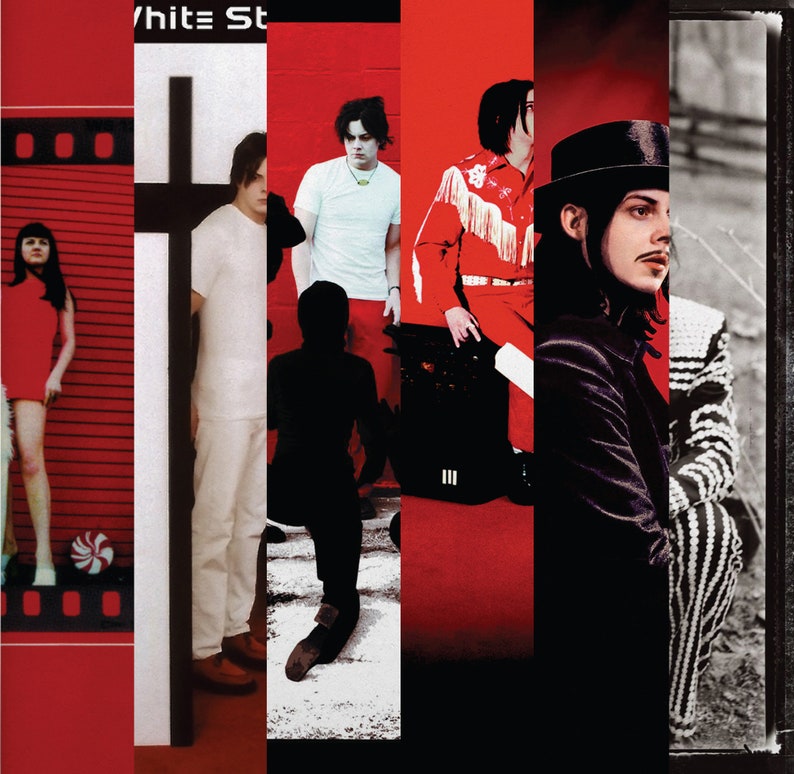
Meg and Jack produced whipped up blues-rock waves around the globe as The White Stripes between 1997-2011 with 6 top notch albums, searing gigs (I know, I was there) and some glorious video clips for singles. The White Stripes were a band that spilt opinion. For many music fans, they were a thrilling two piece rock band who were able to update the blues tradition for a modern audience. To others they were a gimmicky and derivative act with a drummer of limited ability who were little more than a vehicle for the frontman’s blues fantasies. Regardless of your opinion though, it’s impossible to view them as anything less than one of the key rock acts of the 21st Century.
Jack and Meg White they have been releasing albums since 1999. But what is the most raw and authentic sounding of all their albums, their self titled debut has a rough and untamed feel to it, yet that is much of its appeal. At the time of recording this the band were unknowns, yet they had already put in place most of what would make them one of the most discussed bands of the next decade. The basic guitar and drums sound, the black, white and red colour scheme, a sound influenced by – but not restricted to – the blues.
Even at the start of their career it was obvious that the White Stripes were a vehicle for the man who called himself Jack White. Drummer Meg was there to provide the most simple and unfussy of rhythms for Jack to build upon with his thrillingly untutored guitar playing and his rock yelp. The sound is derivative of so many bands that had gone before, be they Led Zeppelin, The Who, The Stooges or the blues masters, but that’s the point. There were many retro-rock bands about at the time that this album was released, but few were so open and enthusiastic about updating the blues for the modern era. The White Stripes weren’t particularly interested in emulating their heroes, they were more interested in encouraging younger generations to investigate the acts that had influenced them.
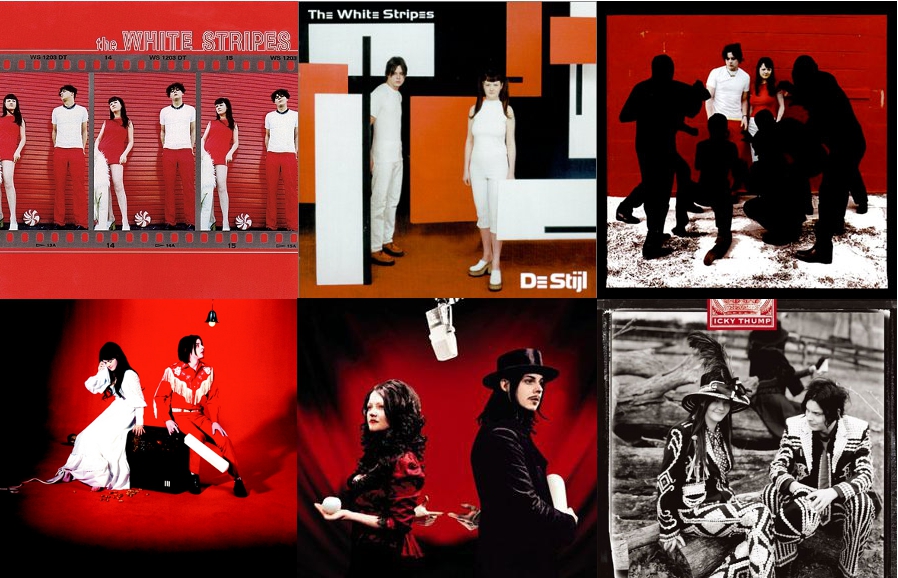
The White Stripes, were more than just one of those “The” bands (see The Datsuns, The Vines, The Hives et al) who proliferated around the turn of the century. Those others were good, but The White Stripes were exceptional. In the “official” cannon I make it 6 studio albums, a live album and 24 singles. They are all in print in vinyl (except “Get Behind Me Satan” which for some reason never got an official vinyl release).
Their six studio albums are easy to track down and each one has it’s own distinct character. Their “Under Blackpool Lights” concert DVD is a celebration of the band at the apex of their fame following the successful promotion of “Elephant“.
1999
The White Stripes
Although perhaps a little uneven, The White Stripes can boast a fine selection of great tunes. First and foremost of these is the opener “Jimmy The Exploder”, a glorious statement of intent which starts with Meg’s booming drums, continues with Jack’s gargantuan riffing and loads of whooping and hollering. It’s one hell of an entrance for any band, let alone one with only two members. Further into the album, the run of songs beginning with “Cannon” and ending with “When I Hear My Name” almost matches the opener’s ebullience. Another highlight is the cover of “One More Cup Of Coffee” which they handle better than you may expect.
The rest of the album is solid enough, but can get a little bit samey with with some blues licks and lyrical lifts being too obvious to actually be interesting. You get the sense that Jack White was only just getting into his stride, but he had enough faith in the enthusiastic sound of the album to realise that it needed minimal production, leaving it sounding endearingly scruffy and oddly loveable.
Minimal to the point of sounding monumental, this Detroit guitar-drums-voice duo makes the most of its aesthetic choices and the spaces between riffage and the big beat. In fact, the White Stripes sound like arena rock as hand-crafted in the attic. Singer/guitarist Jack White’s voice is a singular, evocative combination of punk, metal, blues, and backwoods while his guitar work is grand and banging with just enough lyrical touches of slide and subtle solo work to let you know he means to use the metal-blues riff collisions just so. Drummer Meg White balances out the fretwork and the fretting with methodical, spare, and booming cymbal, bass drum, and snare cracks. In a word, economy (and that goes for both of the players). The Whites’ choice of covers is inspired, too. J. White’s voice is equally suited to the task of tackling both the desperation of Robert Johnson’s “Stop Breakin’ Down” and the loneliness of Bob Dylan’s “One More Cup of Coffee.” Neither are equal to the originals, but they take a distinctive, haunting spin around the turntable nevertheless. All D.I.Y. punk-country-blues-metal singer/song-writing duos should sound this good.
2000
De Stijl
Despite their reputation as garage rock revivalists, the White Stripes display an impressive range of styles on their second album, De Stijl, which is Dutch for “the style.” Perhaps the album’s diversity — which incorporates elements of bubblegum, cabaret, blues, and classic rock — shouldn’t come as a surprise from a band that dedicates its album to bluesman Blind Willie McTell and Dutch artist Gerrit Rietveld. Nevertheless, it’s refreshing to hear the band go from the Tommy James-style pop of “You’re Pretty Good Looking” to the garagey stomp of “Hello Operator” then shows that the band were starting to take their blues influences very seriously indeed, even if all they were doing was merely taking old classics and making them louder and potentially more accessible to a modern audience. “I’m Bound To Pack It Up” makes a better fist of things and is one of the strongest tunes on the album, as it indicates that Jack White was getting increasingly comfortable with acoustic tunes. .
It’s even more impressive that the theatrical, piano-driven ballad “Apple Blossom” and a cover of Son House’s “Death Letter” go so well together on the same album. It is a slightly more mature work though and opener “You’re Pretty Good Looking (For A Girl)’ definitely starts things off on the right foot.
Jack White’s understated production work and versatile guitar playing and vocals also stand out on the languid, fuzzy “Sister, Do You Know My Name?” as well as insistent rockers like “Little Bird” and “Why Can’t You Be Nicer to Me?” As distinctive as it is diverse, “De Stijl” blends the Stripes‘ arty leanings with enough rock muscle to back up the band’s ambitions.
“De Stijl” is the preferred White Stripes album for those that maintain The White Stripes sold out when “Seven Nation Army” charted. This may be due to the fact that it’s probably their most serious album and the one with the least obvious commercial appeal.
“De Stijl” deserves its cult status, catching the duo at the tipping point before everything went batshit crazy. Dedicated to Blind Willie McTell, this second album was recorded to eight-track in White’s living room, but that rudimentary production belied a track-listing that runs the gamut.
2001
White Blood Cells
White Blood Cells is The White Stripes strongest album, the one where they left behind the limitations of their deconstructed blues format and made something which stood entirely on its own merits. The slide guitar which had been all over the previous two albums had been dispensed with, which had the unusual benefit of improving Jack White’s guitar skills. The album combined the energy of their debut with the maturity and skill of De Stijl. Even Meg’s drumming seemed to have improved considerably, though she endearingly stuck to her none-more-basic technique.
The straight-blues direction and slavish covers of the band’s earliest work were ditched for 16 White-penned compositions the bandleader insisted on analogue grit and impulse tracking, rattling through the songs at whip-cracking pace (they didn’t even bother with a bass track).
Despite the seemingly instant attention surrounding them — glowing write-ups in glossy magazines like Rolling Stone and Mojo, guest lists boasting names like Kate Hudson and Chris Robinson, and appearances on national TV — the White Stripes have stayed true to the approach that brought them this success in the first place. White Blood Cells, Jack and Meg White’s third effort for Sympathy for the Record Industry, wraps their powerful, deceptively simple style around meditations on fame, love, and betrayal. As produced by Doug Easley, it sounds exactly how an underground sensation’s breakthrough album should: bigger and tighter than their earlier material, but not so polished that it will scare away longtime fans. Admittedly, White Blood Cells lacks some of the White Stripes’ blues influence and urgency, but it perfects the pop skills the duo honed on De Stijl and expands on them.
The country-tingedand joyous singalong of “Hotel Yorba” and immediate, crazed garage pop of “Fell in Love With a Girl” define the album’s immediacy, along with the folky, McCartney-esque “We’re Going to Be Friends,” a charming, school-days love song that’s among Jack White’s finest work. However, White’s growth as a songwriter shines through on virtually every track, from the cocky opener “Dead Leaves and the Dirty Ground” to vicious indictments like “The Union Forever” and “I Think I Smell a Rat.” “Same Boy You’ve Always Known” and “Offend in Every Way” are two more quintessential tracks, offering up more of the group’s stomping riffs and rhythms and us-against-the-world attitude. Few garage rock groups would name one of their most driving numbers “I’m Finding It Harder to Be a Gentleman,” and fewer still would pen lyrics like “I’m so tired of acting tough/I’m gonna do what I please/Let’s get married,” but it’s precisely this mix of strength and sweetness, among other contrasts, that makes the White Stripes so intriguing the freaky “Aluminum” continue the strong showing and the piano led closer “This Protector” is one of the album highlights.. Likewise, White BloodCells’ ability to surprise old fans and win over new ones makes it the Stripes‘ finest work to date.
2003
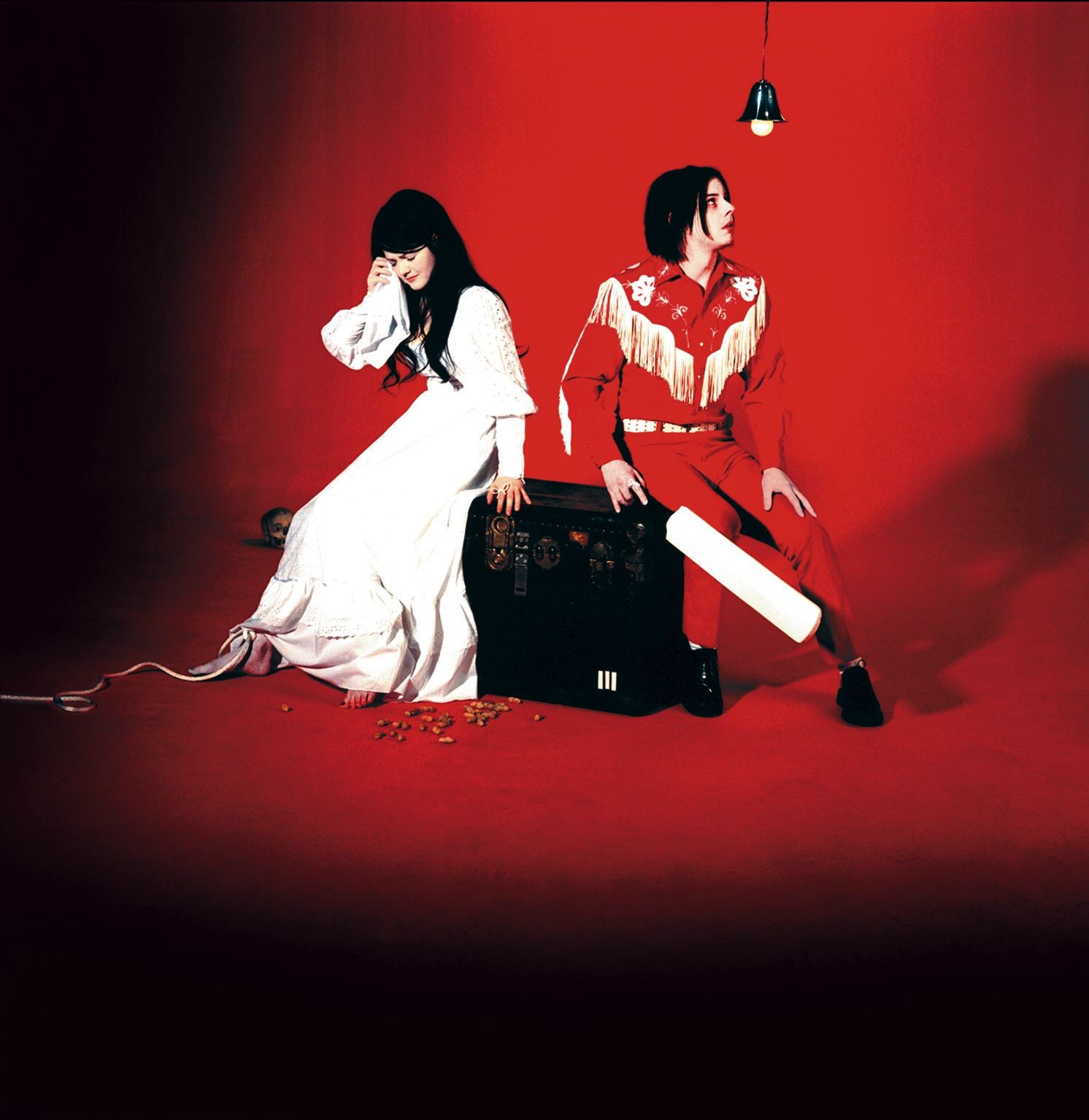
Elephant
White Blood Cells may have been a reaction to the amount of fame the White Stripes had received up to the point of its release, but, paradoxically, it made full-fledged rock stars out of Jack and Meg White and sold over half a million copies in the process Elephant is a great album, but it’s a great album that got overplayed, . Despite the White Stripes’ ambivalence, fame nevertheless seems to suit them: They just become more accomplished as the attention paid to them increases. Elephant captures this contradiction within the Stripes and their music; it’s the first album they’ve recorded for a major label, and it sounds even more pissed-off, paranoid, and stunning than its predecessor. Darker and more difficult than White Blood Cells, the album offers nothing as immediately crowd-pleasing or sweet as “Fell in Love With a Girl” or “We’re Going to Be Friends,” but it’s more consistent, exploring disillusionment and rejection with razor-sharp focus.
Chip-on-the-shoulder anthems like the breath taking opener, “Seven NationArmy,” remains the band’s signature tune and one of their biggest hit singles. Possessing an instantly recognisable bass line, a stupidly simple drum beat and one of the best riffs in years, it gained vast amounts of airplay. which is driven by Meg White’s explosively minimal drumming, and “The Hardest Button to Button,” in which Jack White snarls “Now we’re a family!” — one of the best oblique threats since Black Francis sneered “It’s educational!” all those years ago — deliver some of the fiercest blues-punk of the White Stripes’ career. “There’s No Home for You Here” sets a girl’s walking papers to a melody reminiscent of “Dead Leaves and the Dirty Ground” (though the result is more sequel than rehash), driving the point home with a wall of layered, Queen-ly harmonies and piercing guitars, while the inspired version of “I Just Don’t Know What to Do With Myself” goes from plaintive to angry in just over a minute, though the charging guitars at the end sound perversely triumphant.
At its bruised heart, Elephant portrays love as a power struggle, with chivalry and innocence usually losing out to the power of seduction. “I Want to Be the Boy” tries, unsuccessfully, to charm a girl’s mother; “You’ve Got Her in Your Pocket,” a deceptively gentle ballad, reveals the darker side of the Stripes’ vulnerability, blurring the line between caring for someone and owning them with some fittingly fluid song writing.
The battle for control reaches a fever pitch on the “Fell in Love With a Girl”-esque “Hypnotize,” which suggests some slightly underhanded ways of winning a girl over before settling for just holding her hand, and on the show-stopping “Ball and Biscuit,” seven flat-out seductive minutes of preening, boasting, and amazing guitar prowess that ranks as one the band’s most traditionally bluesy (not to mention sexy) songs. Interestingly, Meg’s star turn, “In the Cold, Cold Night,” is the closest Elephant comes to a truce in this struggle, her kitten-ish voice balancing the song’s slinky words and music. While the album is often dark, it’s never despairing; moments of wry humour pop up throughout, particularly toward the end. “Little Acorns” begins with a sound clip of Detroit newscaster Mort Crim’s Second Thoughts radio show, adding an authentic, if unusual, Motor City feel. It also suggests that Jack White is one of the few vocalists who could make a lyric like “Be like the squirrel” sound cool and even inspiring. Likewise, the showy “Girl, You Have No Faith in Medicine” — on which White resembles a garage rock snake-oil salesman — is probably the only song featuring the word “acetaminophen” in its chorus.
“It’s True That We Love One Another,” which features vocals from Holly Golightly as well as Meg White, continues the Stripes’ tradition of closing their albums on a light hearted note. Almost as much fun to analyze as it is to listen to, Elephant overflows with quality — it’s full of tight song writing, sharp, witty lyrics, and judiciously used basses and tumbling keyboard melodies that enhance the band’s powerful simplicity (and the excellent “The Air Near My Fingers” features all of these). Crucially, the White Stripes know the difference between fame and success; while they may not be entirely comfortable with their fame, they’ve succeeded at mixing blues, punk, and garage rock in an electrifying and unique way ever since they were strictly a Detroit phenomenon. On these terms, “Elephant” is a phenomenal success.
With “Elephant”, The White Stripes showed that their blend of influences could be shaped together to appeal to a mass audience and achieve sustained success. Sadly this meant that a lot of music fans that had been previously indifferent to them suddenly hated them. To combat this Jack White ensured that the next White Stripes album would be much more rootsy and authentic, thus alienating their fair-weather fans and attempting to regain some credibility with the hip indie-set. Regardless of this, while “Elephant” may not be the coolest White Stripes album to own, it’s still one of their best.
The mighty “Elephant” trampled all-comers in 2003, giving The White Stripes their first UK No.1 album and the rock scene a new poster-boy. Recorded at London’sToe Rag studio on equipment predating 1963, the record ram-raided the mainstream without compromising White’s vision one iota.
2005
Get Behind Me Satan
According to Jack White, Get Behind Me Satan deals with “characters and the ideal of truth,” but in truth, the album is just as much about what people expect from the White Stripes and what they themselves want to deliver. Get Behind Me Satan is an album that divided longstanding White Stripes’ fans, the music press and confused the hell out of those fans they picked up following the release of Elephant. Considerably more moody, downbeat and, lead single and first track “Blue Orchid” aside, a considerably less accessible album, it’s The White Stripes ‘difficult’ fifth album. Actually, maybe that’s a little unkind, as both “Mt Doorbell” and the duet “Little Ghost” are great little tunes,
Advance publicity for the album stated that it was written on piano, marimba, and acoustic guitar, suggesting that it was going to be a quiet retreat to the band’s little room after the big sound, and bigger success, of Elephant. Then “Blue Orchid,” Get Behind Me Satan’s lead single, arrived. A devilish slice of disco-metal with heavily processed, nearly robotic riffs, the song was thrilling, but also oddly perfunctory; it felt almost like a caricature of their stripped-down but hard-hitting rock. As the opening track for Get Behind Me Satan, “Blue Orchid” is more than a little perverse, as though the White Stripes are giving their audience the required rock single before getting back to that little room, locking the door behind them, and doing whatever the hell they want.
Even Jack White’s work on the Cold Mountain soundtrack and Loretta Lynn’s Van Lear Rose isn’t adequate preparation for how far-flung this album is: Get Behind Me Satan is a weird, compelling collection that touches on several albums’ worth of sounds, and its first four songs are so different from most of the White Stripes‘ previous music — as well as from each other – that, at first, they’re downright disorienting. As if the red herring that is “Blue Orchid” isn’t enough warning that Get Behind Me Satan is designed to defy expectations, “The Nurse’s” ironically perky marimbas and off-kilter stabs of drums and guitar — not to mention lyrics like “the nurse should not be the one who puts salt in your wounds” — make its domestic skulduggery one of the most perplexing and eerie songs the White Stripes have ever recorded (although Meg’s brief cameo, “Passive Manipulation,” which boasts the refrain “you need to know the difference between a father and a lover,” rivals it).
“My Doorbell,” on the other hand, is almost ridiculously immediate and catchy, and with its skipping beat and brightly bashed pianos, surprisingly funky. Meanwhile, “Forever for Her (Is Over for Me)” turns cleverly structured wordplay and those fluttering marimbas into a summery, affecting ballad.
Perhaps a factor in the mood of Get Behind Me Satan was the fact that Jack White was getting ever more involved in side-projects like The Raconteurs, a band he formed with Brendan Benson and back up by Patrick Keeler and Jack Lawrence, whose debut album was every bit as commercial as Get Behind Me Satan wasn’t.
A lot changed in the White Stripes‘ world between Get Behind Me Satan and Icky Thump: Meg White moved to L.A., while Jack White left Detroit for Nashville, married and had a daughter, and formed the Raconteurs, a side project that won so much praise that some fans worried that it meant the end of the Stripes. Those fears were as unfounded as the speculation that White’s new hometown meant that the band was going to “go country” (after all, Jack and Meg are wearing the costumes of London’s Pearly Kings and Queens, not Nudie suits, on Icky Thump’s cover). Though it was recorded at Nashville’s state-of-the-art Blackbird Studio and covers everything from bagpipes to metal, Icky Thump is unmistakably a White Stripes album. It’s a solid return to blues, guitar heroics, willfully unorthodox drumming and a sense of fun. It kicks off well with the title track and continues The White Stripes’ grand tradition of having a killer opening track which sets the bar for the rest of the album, but like some of their other albums, the rest of the album does it’s best to escape the shadow of its’ lead track. Jack and Meg do give it their best shot though and they do come close at points.
The eclectic feel of Get Behind Me Satan remains, but is less obvious; interestingly, out of all the band’s previous work, Icky Thump’s brash and confessional songs most closely resemble De Stijl. “300 MPH Torrential Outpour Blues”‘ acoustic blues and carefully crafted wordplay hark back to “Sister, Do You Know My Name.” Meanwhile, “Rag & Bone” is a cute, ragamuffin cousin of “Let’s Build a Home” that casts Jack and Meg as enterprising garbage-pickers; the sly grin in Jack’s voice as he says “we’ll give it a…home” is palpable. And, while Get Behind Me Satan was heavy on pianos, Icky Thump is just plain heavy, dominated by primal, stomping rock that feels like it’s been caged for a very long time and is just now being released. Jack White’s guitars are back in a big way; “Catch Hell Blues” is a particularly fine showcase for his playing. Once again, though, the Stripes defy expectations, and their “return to rock” isn’t necessarily a return to the kind of rock they mastered on Elephant.
Aside from the searing “Bone Broke,” which would fit on almost any White Stripes album (and in fact was partially written in 1998), on Icky Thump Jack and Meg push the boundaries of their louder side. Darker and slower than most Stripes singles, “Icky Thump” is their very own “Immigrant Song,” with guitars that chug menacingly and lyrics that run the gamut from fever dream meditations on redhead senoritas to pointed political statements (“Why don’t you kick yourself out/You’re an immigrant too”). “Little Cream Soda” is also outstanding, pairing ranting, spoken-word verses with grinding surf-metal guitars that make it one of the Stripes’ heaviest songs. However, the boldest excursion might be “Conquest,” which turns Patti Page’s ’50s-era battle of the sexes into a garage rock bullfight, complete with dramatic mariachi brass, flamenco rhythms, backing vocals that would do Ennio Morricone proud, and duelling guitar and trumpet solos that capture the band’s love of drama. As fantastic as Icky Thump’s rockers are, its breathers are just as important. Though the Celtic detour that makes up Thump’s heart feels out of place initially, “Prickly Thorn, But Sweetly Worn” is indeed a sweet and genuine sounding homage to Scottish folk, bagpipes and all (and could also be a nod to the Rolling Stones’ flirtation with British folk in the mid-’60s). And while its psychedelic counterpart “St. Andrews (This Battle Is in the Air)” doesn’t work quite as well, it feels like the kind of quirky tangent that pops up on plenty of vintage albums as a palate cleanser. The Stripes’ poppy and vulnerable sides get slightly short shrift on Icky Thump. “You Don’t KnowWhat Love Is” is so hooky it could just as easily be a Raconteurs song, though it boasts a guitar solo that stings like lemon juice in a paper cut. “I’m a Martyr for My Love for You” is the album’s lone ballad, and while its melody is beautiful, it may be the album’s weakest track. And though “Icky Thump’s” track listing might be slightly front-loaded, the Stripes uphold their tradition of ending their albums on a playful note with the wonderful “Effect and Cause,” which feels equally indebted to hillbilly wisdom and Mungo Jerry’s sly jug-band shuffle. With its fuller sound and relaxed flights of fancy, “Icky Thump” is a mature, but far from stodgy, album — and, as is usually the case, it’s just great fun to hear the band play.
Jack ‘n’ Meg bowed out with a glittering swansong that ensured their legacy was bulletproof. “Icky Thump” fused White’s restless experimentation to some of his most rock-solid tunes.
The pianos were gone, and we didn’t miss them: “Conquest” was a crazed spaghetti-western scorcher, and “Catch Hell Blues” a showcase for White’s stunning electric slide work, while “You Don’t Know WhatLove Is (You Just Do As You’re Told)” was a scream-it-back anthem. Always leave them hungry, runs the adage. After Icky Thump, we were ravenous but things changed.
it was getting pretty obvious that Jack White had outgrown the band with whom he had made his name. He continued to spread his creative energies over a wider area, with a new Raconteurs album, another new band called The Dead Weather, a pretty good live album for The White Stripes and even a theme tune to a James Bond film.
2010
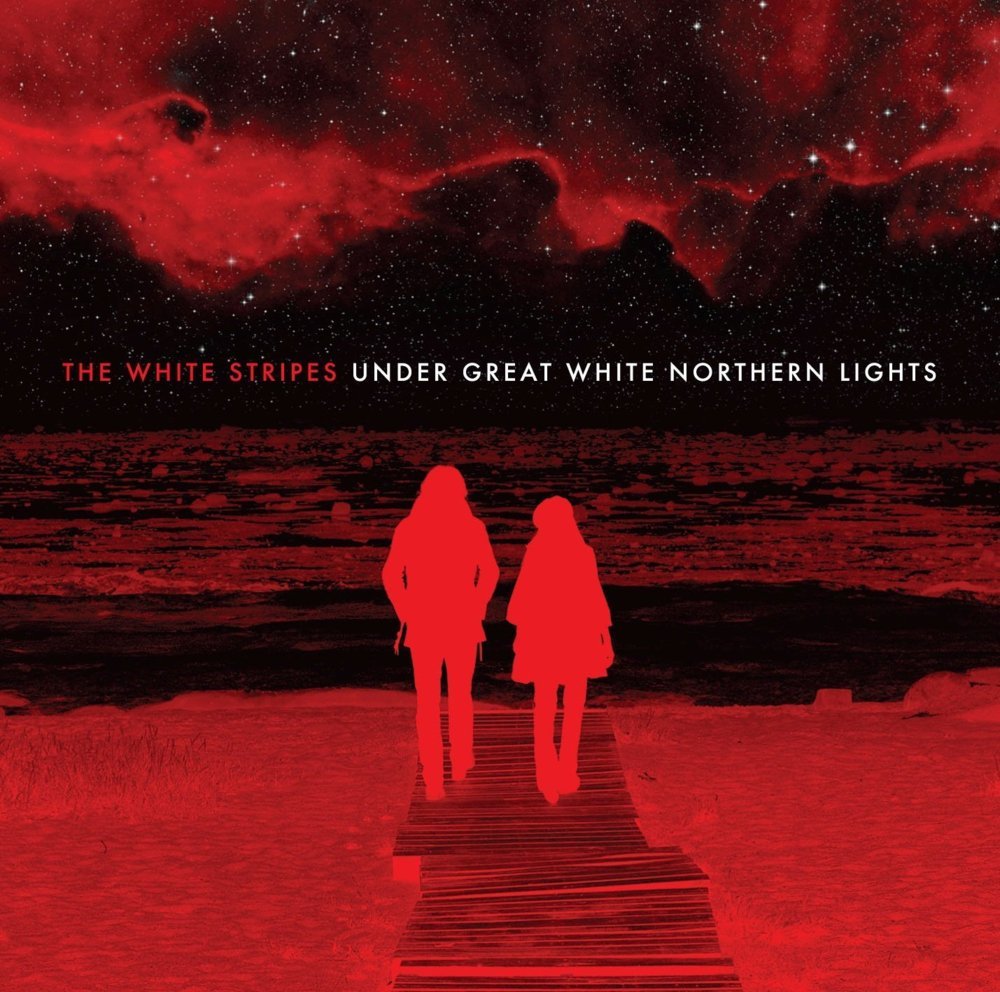
Under Great White Northern Lights
In early 2011 Jack White finally announced what his fans had figured out a while ago, The White Stripes were no more. It was no great shock, as their last studio album had been released four years previously and it was obvious that he had become ever more interested in other projects. A well received solo debut was released and Meg White quietly slipped away to lead a life away from the glare of the media.
Given the White Stripes’ reputation for powerful concerts, it’s a little surprising that they waited until more than a decade into their career to release a live album. However, “Under Great White Northern Lights” was worth the wait: While nothing can really replace seeing the band live, this set captures most of their riveting on-stage presence. The album was recorded during the Stripes’ 2007 Canadian tour, which was such a special experience for them that they chronicled it with a DVD as well. The band was touring in support of that year’s “Icky Thump“, and the Scottish and Celtic motifs that are woven throughout that album pop up here, too, from the bagpipes intro to a brisk version of “Little Ghost” that sounds almost like a reel.
Like most White Stripes concerts, “Under Great White Northern Lights” features an even handed mix of early songs and newer ones — Jack and Meg White go way back for incendiary takes on “Let’s Shake Hands” and “When I Hear My Name,” which sound right at home next to the lunging “Icky Thump” and “I’m Slowly Turning into You.” The album opens with four furious rockers that show just how primal the duo is live — on “Black Math” and a breathless “Blue Orchid” they sound like they can barely keep up with the energy flowing through them — but many of “Under Great White Northern Lights” brightest moments happen when they slow down. Jack and Meg settle into a groove on “300 M.P.H. TorrentialOutpour Blues” that makes the song fresher than it was on “Icky Thump”, while a particularly stunning version of “The Union Forever,” with extra-desperate vocals from Jack surrounded by a swelling, horror-movie organ, just might be the album’s standout.
The Stripes also include plenty of favourites, including “Jolene,” a bluesy “Fell in Love with a Girl,” a singalong “I Just Don’t Know What to Do With Myself,” and a bruising “Seven Nation Army” as the finale, all of which capture the kind of show the band puts on for its fans. Since a big part of the Stripes’ live show also rests on their visuals, the “Under Great White Northern Lights” DVD gives the complete experience, but this album is satisfying enough to make it a must for most fans.
Despite having split up in 2011, The White Stripes have released a new double live album this week. Marking the tenth anniversary of their magnum opus “Elephant”, the red and white vinyl album “Nine Miles From The White City” is a recording of a 2003 Chicago show. Released as part of Third ManRecords‘ The Vault series, which releases exclusive Third Man albums, singles and merchandise quarterly, it adds another glossy page to The White Stripes back catalogue.
The White Stripes Greatest Hits: My Sister Thanks You and I Thank You
The White Stripes always seemed to be a band that stood apart. Yeah, they were part of the garage-rock revival movement of the early 2000s, but unlike the other act from that scene that critics hyped beyond all comprehension at the time, The Strokes, Jack and Meg White didn’t fall foul of the weight of expectation heaped upon them, and they did not immediately enjoy a huge commercial mega-hit breakthrough either.
As soon as I saw them perform “Hotel Yorba” on the television in early 2001, I knew I had to check them out, and after an initial listen to White Blood Cells, I was a fan. The sonic universe they were creating, was unique enough to appeal to me, and I enjoyed their bare bones approach as they brought something a bit different to blues rock. Even at this stage, with their oddly charming yet pretentious stylistic restrictions like Jack’s ridiculously retro catalogue-origin Airline guitar, their red, white and black wardrobe, their insistence that Meg and Jack were siblings when they were actually a formerly married couple, and the hilariously lopsided character dynamic between the two of them, with Jack the ultra-confident frontman guitar hero in sharp contrast to the shy and retiring Meg walloping the drums in a gloriously unorthodox manner behind him.
So why release a Greatest Hits set in 2020 then? I must admit, I raised a smile when I first saw mention of this Greatest Hits set, partly because I could imagine Jack’s perverse thrill at putting out such an anachronistic release, After all these years, the first two albums are enjoyable stepping stones to bigger things, White Blood Cells and Elephant are the enduring gems and the last two are a contrary fit of pique, and an apology for the contrary fit of pique respectively. The main thing that leaps out at me though, is the fact that The White Stripes would have been considerably less interesting without Meg’s simplistic drumming. As much of a musical polymath as Jack continues to be, Meg and her drumming are what made The White Stripes special.
Listening to Greatest Hits is something of a nostalgia hit for me. Smartly sequenced non-chronologically, so the significant drop-off in form as their career progressed is minimised, there’s so much here that reminds me why I loved The White Stripes back in the day. “Fell in Love With a Girl”, “The Hardest Buttonto Button”, “Dead Leaves and the Dirty Ground”, “You’re Pretty Good Looking (For a Girl)” and (of course) “Seven Nation Army”, these are all great rock songs.
All in all, Greatest Hits is a fair summation of The White Stripes career. There’s great stuff, there’s not so great stuff, and there’s just some stuff that sounds like Jack White just wanted to draw attention to how much of an unapologetic hipster he was. Mainly though, it’s a reminder of just how much Meg White brought to the band, and although her bandmate took the lions share of the spotlight, she was actually the much more compelling and interesting individual.
In the years since that breakout, White hasn’t squandered his platform, raising sunken treasure with his Third Man Record label and pinballing between solo albums and side-projects of varying merit.
On February 2nd, 2011, after a lengthy hiatus from recording and performing (and roughly eleven years since Jack and Meg White divorced), The White Stripes officially announced they were calling it quits.Here’s what was posted on Jack White’s Third Man Records website: “The reason is not due to artistic differences or lack of wanting to continue,” the post reads. “Nor any health issues as both Meg and Jack are feeling fine and in good health. It is for a myriad of reasons, but mostly to preserve what is beautiful and special about the band and have it stay that way.”“ Both Meg and Jack hope this decision isn’t met with sorrow by their fans but that it is seen as a positive move done out of respect for the music that the band has created. It is also done with the utmost respect to those fans who’ve shared in those creations, with their feelings considered greatly.”“The White Stripes do not belong to Meg and Jack anymore,” the band wrote at the end of their statement. “The White Stripes belong to you now and you can do with it whatever you want. The beauty of art and music is that it can last forever if people want it to. Thank you for sharing this experience. Your involvement will never be lost on us and we are truly grateful.” The White Stripes last toured behind their 2007 disc “Icky Thump”, but it was cut short when drummer Meg White began suffering from acute anxiety problems. Since then the group performed “We’re Going To Be Friends” on the final episode of Late Night With Conan O’Brien on February 20th, 2009.
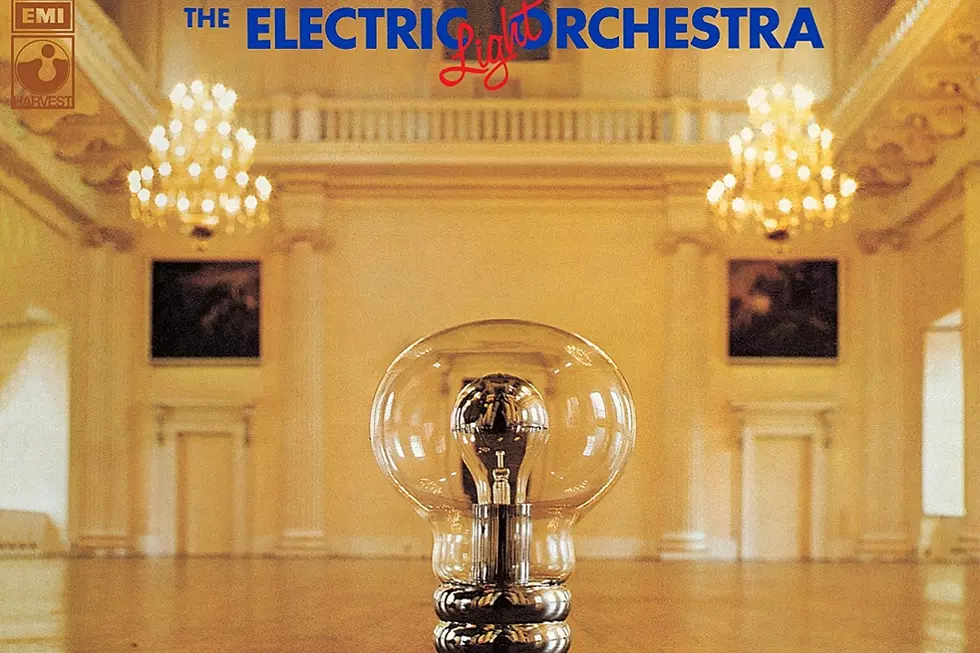
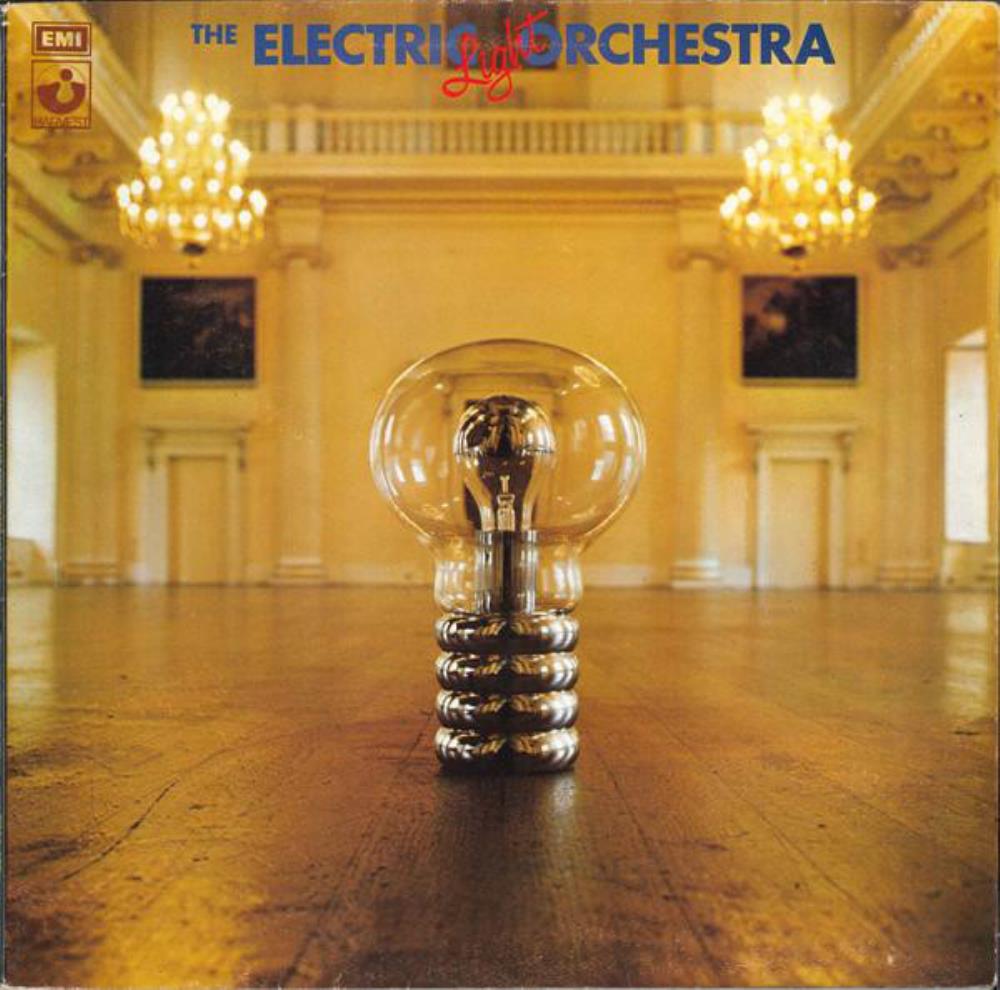
The first Electric Light Orchestra album was released in the UK on this date, 3rd December, in 1971 on EMI’sHarvest label. Melody Maker wrote: “Everything’s so interesting, so alive, you can’t help but love it. Jeff Lynne’s composition ‘10538 Overture’ rips open Side One.
When Electric Light Orchestra’s self-titled debut arrived in December 1971, the band’s core trio of Jeff Lynne, Roy Wood and drummer Bev Bevan were still in theMove. ELO would far surpass their predecessors in terms of sales, but at that point it was still intended as a side project to explore a new sound. Roy Wood guitarist, vocalist and songwriter of the Move had an idea to form a new band that would use violins, cellos, string basses, horns and woodwinds to give their music a classical sound,
“Roy and I would go to pubs and clubs in Birmingham and keep talking about having this group with strings,” Lynne told Uncut in 2013. “We finally figured out a way of doing it, and while we were making [the Move’s final LP] “Message From the Country” we started knocking out these little tunes, just the two of us, and [drummer Bev Bevan] putting the drums on afterwards.”
It’s delicious, almost over-produced (but in a great way) with loud sawing cellos, a pacing theme, swung-about vocals, and finally brass, french horns, and production that is so unmistakably in the hands of [Roy] Wood. It’s a monster of a track.”
The final days of the Move coincided with Electric Light Orchestra’s first steps largely because no one thought Wood and Lynne’s concept of an orchestral-minded rock band would pay off. Making theMove’s last album helped encourage the band’s U.K. label, Harvest Records, to take a chance on the new group. It also helped that, while making tracks for the Move, Lynne and Wood found the classical/rock balance they were looking for in one song.
“‘10538 Overture’ was an idea that Jeff brought along to the studio which was originally to be a Move track,” Wood recalled in the liner notes to the 2006 reissue. “At the time, I was very keen on collecting instruments, and had just acquired a cheap Chinese cello. After we had finished overdubbing the guitars, I sat in the control room trying out this cello and sort of messing around with Jimi Hendrix-type riffs. Jeff said, ‘That sounds great, why don’t we throw it on the track.’ I ended up recording around 15 of these, and as the instrumentation built up, it was beginning to sound like some monster heavy-metal orchestra.”
When Wood added multiple cellos to a Lynne-penned song intended to be a Move B-side, the new concept became a reality and “10538 Overture” became the first Electric Light Orchestra song. The original plan was to end The Move following the release of the “Looking On” album at the end of 1970, crossing over to the new unit in the new year, but to help finance the fledgling band, one further Move album, “Message from the Country”, was also recorded during the lengthy ELO recordings and released in mid-1971. The resulting debut album The Electric Light Orchestra was released in December 1971. Only the trio of Wood, Lynne and Bevan played on all songs, with Bill Hunt supplying the French Horn parts and Steve Woolam playing violin.
The song would become the centre piece of Electric Light Orchestra’s self-titled first album, which was largely an experimental affair – rawer and stranger than the glossy ELO records to come. Lynne and Wood shared song writing and vocal duties on the debut, with the latter pushing his notions for baroque rock, with cellos and woodwinds accompanying (or even replacing) traditional pop instruments.
With a concept to “pick up where the Beatles left off,” Wood went wild, playing almost every instrument on “The Battle of Marston Moor,” when drummer Bevan refused to collaborate on such a bizarre track. “It was a bit odd recording it, me and Roy playing it all ourselves with all these silly instruments: bassoons and stuff like that,” Lynne said. “It was fun and kind of wacky, a pseudo-classical pantomime horse.”
Electric Light Orchestra didn’t really take off until the release of the “10538 Overture” single (a No. 9 U.K. hit) the following summer, in June of 1972. In the meantime, ELO secured a U.S. release for the album in March, although the release bore another title – the result of an amusing accident.
United Artists phoned the band to ask the name of their debut, but no one from ELO picked up, so the caller wrote down “no answer” in a notebook. An executive misinterpreted the phrase as the title, and Electric Light Orchestra’s first U.S. album became known as “No Answer”.
During pre-production of his studio album in 1991, Richards released Live At The Hollywood Palladium, December 15, 1988, a live set recorded during the “Talk Is Cheap” Tour. Featuring performances with his band the X-Pensive Winos, the album includes a collection of songs from “Talk Is Cheap” and several of his Rolling Stones vocal highlights.
It features the solo hit Take It So Hard, Richards-led Stones classic Happy and previously unreleased performances ofYou Don’t Move Me, Little T&A and the Lennon / McCartney pennedI Wanna Be Your Man.
The Super Deluxe Box Set Includes: The remastered album on Double 180 Gram vinyl. 10″ vinyl of 3 unreleased bonus tracks (I Wanna Be YourMan, Little T&A, You Don’t Move Me) – Exclusive to this box set. Remastered CD of original album. DVD of original concert film. 40 page, hardback book with David Fricke essay featuring a new interview with Keith, plus extensive rare and unseen photos from Keith’s archives. Reproductions of archival materials from the tour including: Tour press release, Keith’s handwritten setlist, Hand-drawn band dressing room sign, Tour itinerary, Press photos, Ticket stub, VIP backstage passes, Keith’s custom Hollywood Palladium guitar pick, and Promotional wine label and bag given away at the show
Keith Richards & The X-Pensive Winos – “Live at the Hollywood Palladium“
I have a theory about R.E.M.’s tenth album, “New Adventures In Hi-Fi,” but who doesn’t? In the final seconds of the final song, “Electrolite,” the music falls away and leaves Michael Stipe to sing the final line a cappella: “I’m outta here.” But what if he’s actually saying, “I’m out to here”? What if the man known for mumble-singing on the band’s earliest albums was picking that technique back up and pointedly slurring his words to leave the song and the album open-ended? Rather than bowing out of something, that line becomes a way of measuring how far he and the band have come. It’s R.E.M. marking their place in the world, which at that very moment is high up Mulholland Drive overlooking Los Angeles. It’s not a farewell; it’s a greeting, an arrival.
I know it’s a stretch, purposefully muddying one of the clearest moments on this keystone album in their catalogue, but “New Adventures In Hi-Fi” is an album that welcomes odd interpretations, leftfield readings, and hare brained theories. It’s just specific enough to give you a story, even a setting — a band adrift in the American West — but it’s open-ended enough to accommodate anything that fans might bring to the music. Mark Blackwell notes as much in his liners for the new 25th anniversary of the album: “Actually, if you want my opinion, I think “New Adventures” is primarily about escape. On the first track, the canary dying in the mine is a warning to get out. Almost every song presents a character that needs to escape from some predicament.”
Blackwell’s theory makes more sense than mine. After all, these 14 songs were primarily recorded during their world tour for 1994’s “Monster“. They found time to work out parts and lay down tracks at soundchecks in Phoenix, Boston, Atlanta, or maybe in a dressing room or in a tour bus, with Stipe later adding vocals at Bad Animals studio in Seattle. It’s a new approach, one born of the circumstances of being one of the biggest rock bands in the world, and the songs capture a blur of momentum, the stomach drop of sudden motion.
After spending the ’80s as a self-consciously Southern band, their perspective fixed to Athens, Georgia, R.E.M. in the ’90s were expanding their scope, claiming new territory. “New Adventures” announces them as a global band, hopping flights from Spain and watching storms brewing over the Atlantic. It captures the hectic pace of life at that level, the busyness and the transience, touring the world without really seeing it, but they’re not complaining. What separates them from bands lamenting life on the road is R.E.M.’s curiosity about this state of constant travel, its effect on the body and the mind.
Perhaps because they were conceiving this album while on tour, “New Adventures” has an oddly retrospective feel, as though R.E.M. are taking stock of their catalogue and career. Every night they re-created the glittery glam stomp of “Monster”, but they’re also drawing from much deeper in their catalogue to fill out their sets. By extension or just by coincidence, the album revisits older sounds and settings, older chapters in the band’s story, which makes these new songs sound unexpectedly familiar. There are moments of contemplation that wouldn’t have sounded out of place on “Automatic For ThePeople“, darker dirges like the second side of “Document“, pop hooks from “Green“, even some updates on their early post-punk jangle. It’s a way of measuring how far they’ve come — a greatest hits with all new songs.
Not that you need to pick out every reference, but “New Adventures” perhaps makes more sense if you’ve been following the band for years, especially if you’ve invested some of yourself in the music. There’s a reason the album’s been a fan favourite since its release a quarter-century ago. When R.E.M. transform a letter Stipe wrote to Patti Smith into “E-Bow The Letter,” it’s almost as though he wrote that note specifically to you, or maybe to us collectively. “Look up, what do you see?” Stipe asks, cryptically. “All of you and all of me.” Smith herself chimes in with the promise: “I’ll take you over.”
The album looms large and weird in the band’s catalogue, partly because of what it has come to represent. It’s the final R.E.M. album with the original line-up of Bill Berry, Peter Buck, Mike Mills, and Michael Stipe, who since 1979 had comprised one of the most famous rock-and-roll democracies. After feeling ill for several days, Berry collapsed onstage at Laussanne, Switzerland, and doctors detected a ruptured brain aneurysm. He announced his departure from the band in October 1997. They had once proclaimed that the band would cease to exist if anyone left the group, yet they soldiered on without their original drummer for nearly 15 years. “New Adventures” was their last hurrah together, but the album wears that distinction lightly, and maybe — I’m just theorizing here — that’s because making this album on the road was a respite from all the pressures of fame, the frenzy of a world tour, and that crushing reminder of their own mortality.
Still sleepy from an all-night recording session, Stipe spoke to Stereogum from his home in Athens and entertained a few theories about non-lyric lyrics, dream songs, and his best friend’s least favourite R.E.M. track.
MICHAEL STIPE: If anything, it was advantageous. They were doing soundchecks, which we had chosen to do at every stop to make sure to make sure it was the best show possible. They would work on these new songs, and I was always in the background, you know, just listening. What happened was a kind of extension of what I would normally do with a record. I just listened and let the melodies — or my potential melodies — become part of my DNA, so that when the tour was over, I was able to sit down and really focusing on writing. And there were a few songs that popped out.
When we’re on tour, I can’t write. I’m completely focused on the performance and being the frontman — being the singer. It’s just a different energy, and it’s exhausting, as you can imagine. It’s a different focus. That’s not to diminish what everyone else does, but I had to really focus on keeping my poor body in shape and being able to sing. So those melodies were turning around in my head for the year, year and a half that we were on tour. So when it came time to record, I was able to sit down and get them out. I could focus on writing the words and the narrative arc and all the different characters that I people these songs with.
So you weren’t recording your vocals on the road, but you had started that writing process, in a way.
STIPE: There were songs that did come out, and they were… I’m not an autobiographical writer, but I do pull from real life. I’m just an observer, really. So I pulled from real life. I pulled from what I was observing. There were two songs that did happen while we were on tour, and they just fell into my lap. I recognized it a lightning in a bottle. One of those two was “Departure,” which was based on a real experience. The other was “E-Bow The Letter,” which is based on a letter that I wrote. I remember writing parts of them, but the whole experience was like a tornado. It was madness.
I also remember part of “The Wake-Up Bomb” writing itself. I’m not sure if it’s something we were working on before, because it’s a very “Monster” kind of track that’s playing off glam rock and that kind of ironic distance that we were playing with on that album. “New Adventures” turned out to have a much more heartfelt presentation. That’s true with the production, of course, but it’s also coming in and infusing itself into the lyric and the narrative arc and the characters.
There are a lot of moments that remind me of “Monster”, but I also hear a lot of moments that remind me of earlier albums, like the band is looking back or engaging with previous versions of itself.
STIPE: Is that more in the music or the lyrics?
A little bit of both. For example, you mentioned “E-Bow The Letter,” which I’ve always grouped with “Voice Of Harold” from “Dead Letter Office”. It’s a similar technique where you’re making lyrics out of something that wasn’t written to be lyrics.
STIPE: That’s interesting. It was unconscious, if that’s what was happening. We always were trying to forge ahead and go forward and never look back. That served us well for the most part. If we were pulling from past successes — and I wouldn’t necessarily call “Voice Of Harold” a success — it wasn’t intentional. But your observation is accurate. “Swan Swan H” is another song like that. It was pulled from written texts. What record is that on? Oh yeah, “Lifes Rich Pageant”. I went to the American Folk Museum and there was an exhibit there with a needlepoint or a piece of embroidery from the Civil War. The language sewn into the piece parked the arc of that particular song. A lot of that song — “What noisy cats are we!” — was taken directly from something someone wrote in 1860.
That technique certainly play into what you mentioned earlier, about being an observer.
STIPE: I’m also thinking about the song “Belong,” which is on… “Out Of Time?” That was written in ’89. I remember lifting that from the headline of a newspaper article I read while I was in Munich. It was referencing something about Tiananmen Square.
That makes me wonder if that’s why this record resonates with so many fans. It does seem to allow for these crazy theories or rabbit holes. It allows people to make these odd connections.
STIPE: I don’t know if it’s people who rediscovered it or didn’t really pay much attention at the time, or if it’s new fans that came in from a different generation. But that would be for the uberfans. That’s some pretty deep-cut stuff we’re talking about. I don’t want to diminish our work, but it might reference our limited abilities or maybe how we were just working with what we had.
Well, I wanted to ask something that goes even deeper. You’ve mentioned that some of your songs inhabit the same post-apocalyptic dreamworld, and I wondered if there were any of those songs on “New Adventures”. Did this album enlarge that world or reveal new corners of it?
STIPE: I call them dream songs. I could write an album around those. That’s sorta what “Accelerate” was, especially the song “Accelerate” and “Sing For The Submarine.” And “Electron Blue” on “Around The Sun”. There’s a boatload of songs set in that kind of post-apocalyptic dreamscape. Let me check the tracklist and see if there were any dream songs on New Adventures. Our good friend Wikipedia suggests to me — and I’m going from the top — no, no, no no, “Undertow” maybe. “E-Bow The Letter” no. “Leave” yes. “Departure” no. There’s always a lot of water in the dream songs, and “Undertow” and “Leave” are both very suggestive of water. Where was I? “Bittersweet Me” no. “Be Mine” no. “Binky” no. The instrumental no. No, no, no.
So the only two songs that might connect the album to that world are “Undertow” and “Leave.” Someone pointed something out to me — and actually it might have been Mark Blackwell, who wrote the essay for the liner notes. We were able to have some really deep conversations about the intention behind a lot of the songs, which… I mean, it’s been 25 years. But it never occurred to me that in “Leave,” the guy actually walks into the sea at the end. It might have occurred to me when I wrote it, but I didn’t remember that. The drowning in “Undertow” is accidental. But this one is a more intentional drowning.
There are a lot of LA songs. “How The West Was Won” and “Low Desert” and “Electrolite.” “Wake-UpBomb” is very distinctly New York, at least from my perspective. Although you could argue there’s a little Rodney Bingenheimer in there. “Binky The Doormat” is my best friend’s least favourite R.E.M. song! I don’t think it’s that bad. It’s also pulling from that glam-rock swagger of “Monster”.
“Departure” was inspired by River Phoenix, right? That’s another connection to “Monster”.
STIPE: Well, it was inspired by a storm that I’d seen from an airplane. I can still picture it, and I can tell you what seat I was in. It was one of the most beautiful things I’ve ever seen. And I was really upset when I landed. I was also insanely jetlagged, but I was really upset that I couldn’t reach out to River and just tell him about it. That’s the kind of thing that he would have really dug. So the lyrics just fell out of me, from all that regret.
With that and the cover image, there’s a lot of beauty on this record. Even on “Electrolite” and the lights of Los Angeles viewed from up on Mulholland Drive.
STIPE: I’d throw “Low Desert” in there. It’s nature looking down on this poor guy who’s died in a car wreck. It’s a tragedy, but it’s also just nature. It’s the cloud and the mountains looking down and saying, “Well, that wasn’t us. We didn’t make that one happen.” Nature, I guess, enters into a lot of the imagery I use, and a lot of the images we used with the record. But it’s kind of got humankind’s footprint on it. The back of the record is the actual electrolyte image of Los Angeles looking like an electric blanket.
And then you’ve got “How The West Was Won,” about California trying to corral water and not doing a very good job of it.
STIPE: Not doing a good job at all. LA was where I went when I had grown weary of New York in the early ’90s. I followed my best friend, who I mentioned earlier as not liking “Binky The Doormat,” to Los Angeles and settled there for a while. It presented me with this whole new perspective on the American West — this whole mythology of how the West was won and where it got us. It’s pretty ripe material for sure, especially with those gumshoe detective novels of the 1940s. I was just following through from a writing perspective, but historically there’s a lot to reflect on and a lot to pull from.
Is “New Test Leper” related to that? Those lyrics are so embedded in those awful TV shows of the ’90s.
STIPE: The song was written in Seattle, but it was based in New York. But it could be anywhere. I wrote that character, who I’ll call Guy, at a very different time, and I’ll use a today term to describe them and how he or she might identify if we were talking about them 25 years on — but what a beautiful place we find ourselves in in the 21st century, when we have a greater understanding of gender fluidity and identity fluidity in terms of sexuality and desire. When “New Test Leper” was written, that wasn’t regarded as much as it is now — or at least not in the ways that it is now. In that lyric you find yourself inside their head acknowledging that they’re trapped in this moment of complete misunderstanding. It’s really sad.
When I wrote the lyric at the end, I wrote that line “What a sad parade” and repeated it. And I realized I had stolen it from Vic Chesnutt. So I called Vic up on the phone and said, I think I lifted a lyric of yours. And he’s like, “Well, tell me what it is.” I read it to him and he exclaims, “That’s not mine! That’s yours!” But it sounds like such a Vic line. I mean, it’s very clearly influenced by the vernacular that he was pulling from in his own work. So I guess I absorbed some of that into my own work.
Do you think about those characters much anymore? Do you ever wonder what they might be doing 25 years later?
STIPE: If that person in “New Test Leper” is alive today, they might feel justified for their actions on that talk show that day. Everyone else just looks clueless, staring at the floor. But there was such a pure beauty to what they were attempting to offer a bunch of people who didn’t understand. They needed some clarity and some guidance. There’s a camera move that a lot of directors use to indicate a moment of clarity, where they rack in: The camera pulls back as the lens racks forward. So you get this feeling of being sucked backwards while also recognizing what’s in front of you. If I close my eyes, that’s what a lot of these songs are doing — they’re wanting move forward and they’re wanting to leave these cathartic moments of realization. There are 14 little movies on this record, is how I see it. Great music for me has always been incredibly cinematic. I close my eyes and I see things more than I hear them. That’s very moving to me. I interpret everything through my emotions, which is a nice way to move through the world, I have to say.
Co-founding drummer Bill Berry left R.E.M. a year after the release of their 10th album, which was recorded on the road in 1995-96. They were never the same. This silver-anniversary edition of the 1996 LP includes B-sides and other tracks left over from the sessions, as well as a remastered version of the original album. Looking back now, “New Adventures in Hi-Fi” is a piece with other landmark ’90s releases“Out of Time” and “Automatic for the People“. An end of an era – but what a glorious end.
“New Adventures In Hi-Fi (25th Anniversary Edition)” is out 10/29 on Craft Recordings.



:format(jpeg):mode_rgb():quality(90)/discogs-images/R-3865497-1347381396-7279.jpeg.jpg)
:format(jpeg):mode_rgb():quality(90)/discogs-images/R-5038762-1382826346-9360.jpeg.jpg)

:format(jpeg):mode_rgb():quality(90)/discogs-images/R-1000092-1408981734-7102.jpeg.jpg)



 The Fat Angel Sings