London-based eight-piece Caroline have announced that their self-titled debut album will be out on February 25th via Rough Trade Records. Along with the announcement comes the release of single “IWR.”
The band was born in 2017 out of weekly improvisation sessions with band members bringing their shared influences to the table, including Midwestern emo, Appalachian folk, minimalist classical, and various forms of electronic music. It all merged together into something special and unique, as seen on “IWR.”
The UK eight-piece caroline’s eponymous debut album often cascades with force like an avalanche, squalling and rumbling on the edge of all-out collapse. At other points they slip back into impossibly fragile moments of quiet – a simple bassline or a rattle of snare the only sound amid a dark sea of silence. caroline know exactly the right balance between restraint and release. These songs are expansive and emotive pieces, their rich palette drawing on a mixture of choral singing, Midwestern emo and O’Malley and Llewellyn’s roots in Appalachian folk.
“Sometimes things sound much better when there’s empty space,” says Llewellyn. “Sometimes you might populate [a song] with too many things and forget that an element on its own is enough.” Elsewhere on the record the band have employed a collage-like technique, combining snippets of lo-fi recordings from a myriad of different locations – a barn in France, the members’ bedrooms and living rooms, the atmospheric swimming pool in which they also filmed sublime live sessions for ‘Dark blue’ and ‘Skydiving onto the library roof’ – with more traditional group sessions at the Total Refreshment Centre and their studio in Peckham.
The growth that began as a scrappy guitar band above a pub many years ago is still continuing. caroline’s astounding debut album is merely the first step.
Think the experimental 90s folk of Alex G with some of those gorgeous moments of acts like Fleet Foxes, with the post-punk atmosphere of Black Country, New Road.
Debut album ‘caroline’ will be released on 25th February.
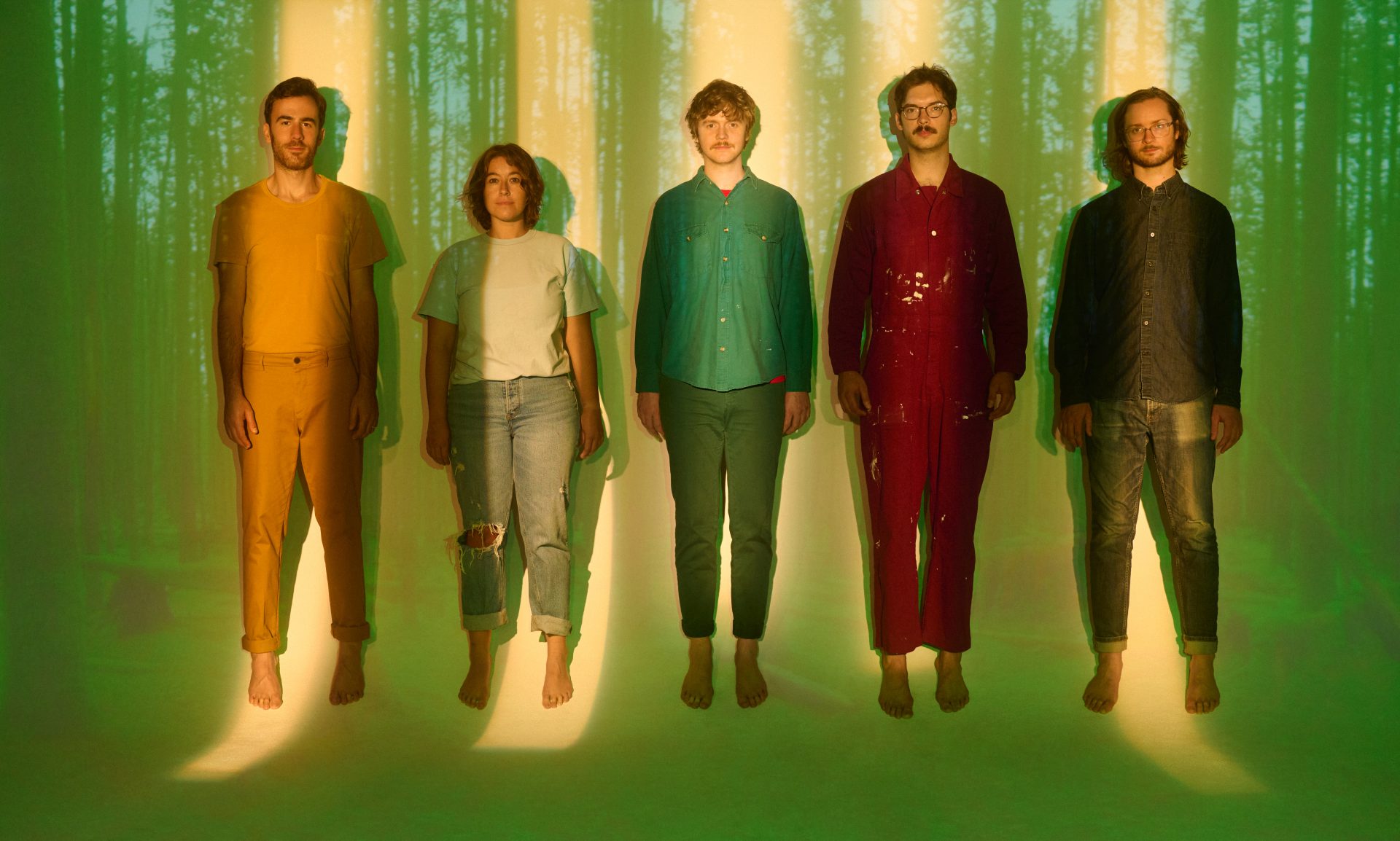
Pinegrove have announced that their new album “11:11” will be on January 28th through Rough TradeRecords. It’s their fifth album, which they self-produced it themselves with mixing by Chris Walla.
The album’s title could be taken in many different ways, with Pinegrove’s Evan Stephens Hall explaining:
“Calling the record “11:11” should be a heartening statement, though there’s certainly a range of emotion across the album,” said Hall. “There’s much to be angry about right now, and a lot of grief to metabolize. But hopefully, the loudest notes are of unity, collectivity, and community. I want to open a space for people to feel all these things.”
With the announcement comes the release of the album’s lead single “Alaska.” The track features a very 90s aesthetic and confident chugging anthemic kick that moves at a great pace and features hooks galore. Walla’s mixing presence is felt deeply here, with a bit of that early Death Cab kick definitely present.
Evan Stephens Hall is big on multiple meanings. The leader of Pinegrove titled their sixth album “11:11” because of its layered significance: the numerals gesturing to a row of trees, or striped corduroy; the cornfields of upstate New York, or people shoulder-to-shoulder. But it’s also a special time, a “wink from the universe,” as Hall says, for those who witness it on the clock to wish for something brighter. “Calling the record 11:11 should be a heartening statement, though there’s certainly a range of emotion across the album. There’s much to be angry about right now, and a lot of grief to metabolize. But hopefully, the loudest notes are of unity, collectivity, and community. I want to open a space for people to feel all these things.”
The album sees the band build on their poetic blend of indie rock, folk, and alt-country, along with Hall’s earnest, open-hearted vocals and his penchant for writing emotionally direct, literate, introspective lyrics. Here, political and socially conscious themes permeate, and as he evolves as an artist, his resolve has only grown stronger – and more purposeful. “I’m encouraged that so many people in my generation are now on board for a change that centres people over profit. And most urgently, I think, in order to durably solve the climate crisis we’ve got to address capitalism.” The band’s latest effort weaves these critiques through an accessible and sensitive work, which manages to be pointed without ever being didactic.
Noted producer and former Death Cab for Cutie member Chris Walla took on mixing duties, while Hall and Pinegrove multi-instrumentalist Sam Skinner co-produced the LP. Hall credits Walla’s impeccably placed arrangement ideas as a vital voice at the table, moving on from the “crisp and contained” production on 2020’s “Marigold“, to more of a “messier” feel for these new songs. The recording took place at two Hudson Valley facilities – the iconic Levon Helm Studios in Woodstock and The Building in Marlboro – with Skinner and Pinegrove drummer Zack Levine at Hall’s side for the process. Other collaborators in the band’s orbit – Megan Benavente (bass), Josh F. Marre (guitar) and Hall’s father Doug (piano and organ) – contributed in a combination of remote and calculated risk sessions.
The album is introduced with the mini-epic “Habitat.” A robust, textural masterpiece inspired by long drives around upstate New York. Hall says that the dilapidated houses covered in plantlife that spot the landscape have made an intense impression. “It’s hard to see that kind of recalibration, but at the same time, there’s a primal irony in seeing nature win against our decaying structures. I drew inspiration from that tension and those brambly textures with Habitat’s arrangement.” Hall continues to investigate the natural world on the equally disquieting “Flora” and later, on the elegiac waltz “Orange.” Centering on the climate crisis, the song spreads over the listener like a dream, with Hall’s impassioned, rising vocals producing a near-hallucinatory realization that we may now find ourselves at the end of history. It’s a call to affirm the community working towards a better world and to fight through the cynicism. “These politicians who forget they serve us, they think they’re celebrities,” he says. “It’s about the betrayal of the Democratic Party.”
Elsewhere, crushing ballad “Respirate,” urges us to look out for and love each other, while the achingly beautiful “Let” points towards the sad, repetitive loop many of us find ourselves in these days. “Time began to feel less linear, almost palindromic. Two steps forward, two steps back,” he says. On the thunderous “Swimming” Hall spins the scene of perseverance through a near death experience, while a pilot is asleep at the wheel on the brash two-minute banger “Alaska.” The gripping “Cyclone” battles with anguish, friction, and intrusive thoughts through biting guitars and rattling percussion, while Hall describes spaced-out-folk album closer “Eleventh Hour” as “a phone call with a friend that goes to abstract places.”
Pointing towards hope, love, grief, and anger, “11:11” seizes listeners with feelings of warmth, urgency, and soulful beauty – even as it asks some of life’s most difficult questions – through hook-filled songs that bury themselves in the senses and stay there. “The album spends equal time on optimism, community, reaffirming our human duty to look out for one another even in the absence of the people we expect to do those things,” says Hall. “What if we have to be our own salvation?”
The London four-piece Wolf Alice emerged from lockdown with a soaring triumph of pop rock, brimming with elegantly polished song writing and confident ambition
Wolf Alice singer Ellie Rowsell has called Blue Weekend her least autobiographical album: whatever the inspiration, it tells a convincingly lived-in story of embracing nihilism following the rupture of friendships and romantic relationships. “I take you back / Yeah, I know it seems surprising,” she thunders on Lipstick on the Glass. It’s here that Wolf Alice come into their own as adept musical shapeshifters, using their broad influences to explore the extremes of alienation: there are woozy fantasies, self-destructive ragers; stunning anthems of anxiety. Big, confident pop-rock albums are rare these days – and their demise hardly bemoaned – but there’s an undeniable pleasure in finding one adventurous, ambitious and human enough to remind you why they used to be so essential.
“Blue Weekend” is Wolf Alice’s biggest and most immediately satisfying album – cresting shoegaze, woozy classic rock, inventive acoustic song writing cohered by melodies that aren’t just sticky, but frequently moving. It’s also one that’s seldom as straightforward as it seems, deriving its greatest potency from Ellie Rowsell’s subtly layered song writing.
it tells a convincingly lived-in story of searching in dark places for answers to some indefinable question; of self-sabotage becoming a logical response to having your worst suspicions confirmed. Rowsell’s lyrics have never been stronger, telling of a breakup with friends (brooding opener The Beach), a litany of creeps, misogynists and a cheating lover: “I take you back / Yeah, I know it seems surprising,” she thunders on Lipstick on the Glass with a measure of ecstatic control, as if mirroring her prideful composure.
Similarly, at first pass, the woozy Delicious Things comes off as a classic fantasy of a wide-eyed newcomer seduced by life in Los Angeles. But Rowsell is well aware that “the vibes are kinda wrong” and that the man whose bed she’s in is “here for one thing”. Nevertheless, she sings, paradoxically, of feeling “alive, like Marilyn Monroe”, and the dreamy song billows skywards like the ill-fated bombshell’s skirts, a blissed-out wall of guitar steadily charring. Maybe certain annihilation is the fantasy, though some self-preservationist instinct kicks in: “Hey, is mum there?” Rowsell sings in a small voice at the end. “It’s just me / I felt like calling.”
“Blue Weekend” was released with Rowsell, Joff Oddie, Theo Ellis and Joel Amey all on the cusp of 30 – a time when youth’s reckless momentum slows and you’re forced to puzzle over what’s next, or at least to start being more honest with yourself. The album’s turning point, “How Can I Make It OK?“, plays out like an attempt at consolation, laced with their own doubts at being able to offer it: “How do we sell you the world?” Rowsell sings expansively. But they clearly understood the assignment: the song swells to a euphoric, girl-group-indebted sandstorm of a chorus that’s stirring to the point of confrontation. Similarly tender, but more barbed, is the gorgeous “The Last Man on Earth“, which wields opiate psychedelia a la Bowie or Floyd to slyly mock a blinkered character awaiting divine intervention instead of sorting their own life out. The music carries you off like a dream, but Rowsell’s lyrics are resolutely grounded.
Although written pre-pandemic, “How Can I Make It OK?” resonated eerily with these strange, transitional times. “A moment to change it all / Had life before been so slow?” Ellie Rowsell sings almost operatically, cautiously savouring the potential for change. Whatever may come next, happiness is paramount. “How can I make it OK?” the band sing in tender, nervous staccato, before the song cracks open to bolster their reassurances with volcanic swagger – showing this special band’s dynamic at its best.
There is a powerful magnetism between the scale of these songs and the detailed empathy and frustrations they contain. But Wolf Alice also trust when to pull back. Penultimate song “No Hard Feelings” is the inevitable, hard breakup moment, the defenceless conclusion to the earlier heartache. “It’s not hard to remember when it was tough to hear your name,” Rowsell sings gracefully, to just softly thrummed guitar and twinkling ambience: “Crying in the bathtub to Love Is a Losing Game.” This ending is a beginning, she knows, an idea threaded into closer “The Beach II“, a sweet dirge that marks the reconciliation of that broken friendship: “The tide comes in as it must go out.”
These are grand gestures wielded elegantly, and they make “Blue Weekend” a complete, moving piece of work. In a sense, it’s a record that feels very familiar – a big, confident pop-rock album – but then you remember what an anomaly those are these days, when the form is so diminished as to have been almost abandoned. Few are bemoaning its demise, but there’s an undeniable pleasure in finding one adventurous, ambitious and human enough to remind you why they used to be so essential.
After releasing not one, but two critically acclaimed albums back in 2020, Big Thief suddenly found themselves operating on an entirely different plane. The band went from relatively unknown indie-darlings to Grammy nominated superstars playing huge venues everywhere they went, and with a lot of eyes and ears watching out for their next move. That will come in February next year with the release of their ambitious new collection, the sprawling double-album, “Dragon New Warm Mountain I Believe In You”. With a number of tracks already shared from the record, this week the band added two more in the shape of “No Reason” and “Spud Infinity”.
“Dragon New Warm Mountain I Believe In You” was compiled over four different recording sessions in four different locations, and initially consisted of forty-five tracks, the band’s attempt to capture the variety of influences and sounds that inspire the various band members. Ultimately they whittled the collection down to a more manageable twenty, yet even with the brief glimpses they’ve offered, it seems to have done nothing to dampen their eclecticism. “No Reason“, recorded in the session in the Colorado Rockies, incorporates the flute playing of Richard Hardy, whom the band heard playing on a lookout tower in the distance, before approaching the 30-year music veteran to add his talents to the track, which the band describe as, “tearfully wholesome”.
The other track they’ve shared this week, “Spud Infinity”, starts like a classic country song, all fiddle and frog-like percussion before the drums add a certain driving quality, and Adrianne Lenker’s playful vocal enters, as she sings, “a dime a dozen aren’t we just, but a dozen dimes will buy a crust of garlic bread”, with the same playful-nod Esther Rose made her own on her recent album, How Many Times. What’s perhaps most impressive here is that neither track particularly sounds like anything Big Thief have done before, yet equally, they still sound exactly like Big Thief, a band who continue to explore and grow their music, without ever losing touch of the magic they always possessed. I don’t know much about a “Dragon New Warm Mountain“, whatever one of them is, but Big Thief, I definitely believe in you.
“Dragon New Warm Mountain I Believe In You” is out February 11th via 4AD Records.
Brighton based band 7-piece Keg recently released their debut 5-song EP “Assembly” that is set to catapult them into the conversation as one of the more interesting art-rock and post-punk bands emerging onto the scene.
“Farmhands” is one of the standout tracks from the EP that not only showcases a confident post-punk prowess with some bite and piercing observational lyricism, but an artful jazzy nature that helps separate them from the rest of the pack.
The band has shared an animated video for the single which is directed by Andrew Howarth and can be found available to watch below.
Hailing from towns around the UK, formed in Brighton. Keg have a propensity for complex, sweaty rhythms twinned with impish humour. This broth is ready to clog your arteries.
What is the Shadow Kingdom and how do you gain access to it? In Bob Dylan’s case, it may be found in the film noir classics of his birth like the 1941’s The Maltese Falcon onward – and it’s those noir settings, artfully condensed and reduced to a signature sauce, that dictate the tone of the dim-lit tableaux that decorate the settings for Dylan’s first foray into online streaming.
It’s something of an event, given the cessation of the Never Ending Tour as a result of pandemic – he last played here in August 2019, that now-bucolic, innocent summer before Covid, and his last stage performance anywhere to date was in December of that year at the Beacon Theatre in New York.
Early in 2020, he recorded the landmark “Rough and Rowdy Ways”, and in some ways, if not the rough and rowdy ones, this streamed Shadow Kingdom performance is its kissin’ cousin. Not that anything from that album was played. But in its mix of the staged and performed, and with a strong emphasis on a more delicate vocal style, freed of the arena-standard drumkit-driven dynamics of past decades, it drew deeply on the ethereal intensity and ambience that was all across Rough & Rowdy Ways.
The 50-minute “broadcast event,” as the singer’s team billed it, was more a carefully directed art film than a live gig with a camera replacing an audience. Shot in lush black and white, with multiple setups and costume changes, the show had Dylan performing 13 songs in a ramshackle roadhouse-like setting — checkerboard floor, busted Venetian blinds, a wall-unit A/C blowing reflective streamers — while backed by a small, drumless band of face-masked musicians on various stringed instruments.
Were those players — among them Buck Meek of Big Thief and the well-travelled sideman Shahzad Ismaily — actually playing as we watched? In keeping with Dylan’s longstanding trickster’s reputation, it wasn’t clear: Often their hands appeared out of sync with the music, as though they were miming to pre-recorded tracks. The same may have been true of the singer himself, whose mouth was usually obscured behind an old-fashioned crooner’s microphone. For several songs, the roadhouse filled up with a crowd of smokers and drinkers, and when they applauded you couldn’t hear them, which made you wonder if that microphone was even on.
But such concerns seem beside the point of the very “Twin Peaks”-ish “Shadow Kingdom,” which played to the strengths of its streaming-video format to create an eerie cinematic vibe instead of seeking to duplicate the feeling of being at a concert. (On Instagram, Meek wrote that he’d “made a movie with Bob Dylan.”).
As promised by an introductory title card, the set list drew on Dylan’s early material — tunes from the 1960s and ’70s such as “Just Like Tom Thumb’s Blues” and “Watching the River Flow” and “Most LikelyYou’ll Go Your Way and I’ll Go Mine” — though he also sang “What Was It You Wanted,” from 1989’s “Oh Mercy” album. He didn’t do anything from his most recent LP, “Rough and Rowdy Ways,” which earned rave reviews when it came out in June 2020.
Even so, the old songs’ vivid new arrangements, long on mandolin and accordion and bowed acoustic bass, felt of a piece with “Rough and Rowdy’s” pulpy cabaret-noir sound. And Dylan’s cracked, gulpy singing voice was as crisp (and evidently well-rested) as it’s been in years — ideal for those Bobologists eager to catalogue lyrical tweaks like the ones he made in “To Be Alone with You” and “When I Paint My Masterpiece.”
For “I’ll Be Your Baby Tonight,” which rode a rollicking folk-blues groove, Dylan stared down the camera with crinkly-eyed mischief as a pair of women stood silently on either side of him; “The Wicked Messenger” had trick closeups of an electric guitar that kept reminding you that the whole production had been choreographed in advance. (“Shadow Kingdom” was directed by Alma Har’el, who helmed 2019’s Shia LaBeouf-starring “Honey Boy.”)
Yet the most affecting moment may have been a relatively unadorned “Forever Young,” which Dylan sang with pleading tenderness, the band’s accompaniment gently cradling his words about growing up to be righteous and growing up to be true.
“Shadow Kingdom” is a 2021 concert film featuring American singer-songwriter Bob Dylan. Directed by Israeli-American filmmaker Alma Har’el, it was shot on a soundstage in Santa Monica, California over seven days in early 2021 while Dylan was side lined from his Never Ending Tour due to the COVID-19 pandemic. The film features Dylan and a group of masked musicians performing 13 songs from the first half of Dylan’s career in an intimate club-like setting.
“Shadow Kingdom” premiered via the livestream platform Veeps.com with little information about its contents having been revealed in pre-release publicity. Some viewers expected the event to be a live concert and were surprised when it turned out to be a stylized black-and-white art film featuring “pre-recorded set pieces” instead. “Shadow Kingdom” nonetheless earned rave reviews from critics, many of whom praised Dylan’s creative re-arrangements of his early songs as well as Har’el’s imaginative staging of the performances.
“Shadow Kingdom” showcases Bob Dylan in an intimate setting as he performs songs from his extensive body of work, created especially for this event. It marked his first concert performance since December 2019, and first performance since his universally acclaimed album “Rough and Rowdy Ways” album release. The earliest composition in the set list was “It’s All Over Now, Baby Blue” from the 1965 album “Bringing It All Back Home” and the most recent composition was “What Was It You Wanted” from 1989’s “Oh Mercy“.
In addition to Dylan, who plays guitar and harmonica and sings, most of the song arrangements consist of two additional guitars, a bass and an accordion. The performance of “Forever Young” also features a dolceola. Critic Sam Sodomsky, called “Shadow Kingdom” a “gorgeous…concert film” in which “the 80-year-old icon sings clearly, melodically, beautifully”, and noted that “Dylan seems at times to want to burst through the screen, gesturing passionately”.
Sodomsky also discussed director Alma Har’el’s “knack for visualizing the haunted barroom production that Dylan has favoured on his modern studio albums: As he sings in dusky rooms filled with cigarette smoke and lamplight, mannequins and Western characters, the whole thing takes on a surreal, ghostlike quality”
The Guardian, calling it “completely thrilling” and identifying the high point as Dylan’s “poignant drawl on a sensational ‘What Was It You Wanted’, a series of accusatory questions that stress how slippery knowledge is”. Empire also compared the Bon Bon club’s atmosphere to “the vibe of the sleeve art of last year’s “Rough and Rowdy Ways“.
Katherine Priddy’s debut album came out in the summer, and it’s remained a high point for the rest of the year as 2021 plays out to the sombre drums and drones of resurgent pandemic warnings, fresh lockdowns, closed venues, silenced auditoriums. Her last gig of the year was at St Pancras Old Church on 16th December.
The release titled “The Eternal Rocks Beneath”, astonished again at their maturity and insight, the memorability of the imagery, and the assurance and capability of her performances. Check out her new video for the song “Eurydice”, its stern message of Don’t Look Back flashing like a warning sign at the mouth of the darkest cave, the song stacked with big choruses and an epic, big-ballad reach as she finds and brings out the compelling human story embedded within the myth.
“Eurydice” is taken from the debut album, “The Eternal Rocks Beneath”, which is available now:
Over the past three years, Katherine Priddy has quietly been building a growing following, captivating audiences around the UK with her haunting vocals, rich harmonies, distinctive finger picking guitar style and enchanting songs whose lyrics celebrate her life-long love affair with literature and poetry. She has been championed by BBC Radio 2 and BBC 6 Music and her debut EP ‘Wolf’ was chosen by Richard Thompson as his ‘Best Thing I’ve Heard All Year’ in MOJO Magazine in 2018.
With the buzz around her building, Priddy is making her mark in 2021 with the release of an eagerly anticipated debut album, “The Eternal Rocks Beneath“, which is set to bring her to even wider notice. The 10 self-penned tracks are delivered with a maturity and depth that belie the fact that this is her first full length release. At times tender, at times carrying a darker edge, the stories she weaves are transporting. Not surprising then that Nick Drake, John Martyn, Tunng and Scott Matthews are amongst her many influences
The album was recorded over a 2-year period at Rebellious Jukebox studios, a little basement studio hidden beneath inner-city Birmingham and presided over by masterful producer Simon Weaver. The ensemble cast of musicians, including a sweeping string section, occasionally cut through by raw electric guitar and drums, as well as Richard March (Pop Will Eat Itself) on double bass and Mikey Kenny on fiddle, enhance Priddy’s command of melody and lyricism and provide the perfect backdrop for the feelings of nostalgia and timelessness that underpin the record.
Many of the songs were written during Priddy’s teenage years and early twenties and reference themes of childhood and distant memories. The charming bird song that begins the first track “Indigo” and closes the final track “The Summer Has Flown” harks back to the soundtrack to her own childhood, when days began and ended with the sound of a blackbird in the tree outside her window. In the same way, it now bookends this chapter of Priddy’s life and music career. The title “The Eternal Rocks Beneath” reflects this is Priddy’s first album; the culmination of her earlier life experiences and the bedrock for whatever follows next.
On 2018’s “Happy & Sad,” Kacey Musgraves innocently sings, “I never felt so high / And I’ve never been this far off the ground / And they say everything that goes up must come down,” as she absorbs the euphoria (and fears) of being a newlywed. In 2021, these lyrics feel like a haunting precursor to her latest project, “star-crossed“, which dissects the emotional rollercoaster she experienced following her divorce to country singer Ruston Kelly. Following the triumph of “Golden Hour“, which won the 2018 Album of the Year Grammy Award, Musgraves then went through a divorce and a long period of self-discovery and healing. “star-crossed” is the story of this chapter in her journey—a “modern tragedy” that takes listeners through the stages of complicated and conflicting emotions in ways that feel all too familiar for most of us.
Musgraves chronicles this journey in her version of a Shakespearean three-act structure, questioning the validity of their relationship in “good wife,” realizing she gave more than what she received on “breadwinner,” and ultimately touching base with reality on “what doesn’t kill me.” The delicate synths and laid-back production on this album gives space for listeners to submerge themselves in Musgraves’ comforting, twangy voice and pry intently on her inner psyche. In the aftermath, Musgraves has a full-circle moment on “keep lookin’ up” by revisiting her perspective on her aforementioned 2018 song, now singing, “But I keep looking up / Won’t let the world bring me down / Keep your head in thе clouds / And your feet on the ground.”
She’s teaching us that in the wake of your divorce, it’s all about maintaining balance—you can fantasize and yearn for love, but learn to be grounded and not lose sight of yourself.
Every stage of a breakup is sung in chronological order here: marital worries, hope for the relationship being good enough, worsening arguments, split, poignant staring at old photos, perspective gained, exciting/depressing ventures on to dating apps, eventual feeling of true freedom. Swerve a couple of tepid chillout-compilation moments and along the journey you alight at some of Musgraves’ prettiest song writing, nicely leavened with her straight-talking, wearily dismayed tone of voice.
Singer-songwriter Stevie Knipe has been making music for close to a decade, since they were a college student in upstate New York recording in a dorm room. But Knipe (who uses they/their pronouns) has really taken a leap forward in terms of both sonics and songcraft with the excellent “Driver”. While previous Adult Mom albums had a spare, bedroom-recording feel, “Driver” is more of a band album, with bright production and songs that carefully and vividly map out an early-twenties travelogue full of crisis, memory, hope, and the kind of intense moments that feel almost debilitatingly hard-hitting at that age — even if you’re just starting to become wise enough to know they’re ephemeral.
Adult Mom’s Stevie Knipe has been out here for years as one of indie rock’s great bedroom storytellers, with gems like “Sometimes Bad Happens” and “Momentary Lapse of Happily“. But “Driver” is a real breakthrough. As an obsessive fan of both R.E.M. and Taylor Swift, Knipe combines the best of both, as if hearing “Nightswimming” and “You Belong With Me” as part of the same queer-punk underdog story. The songs are full of tenderness and rage, even in lines like “The only thing I’ve done this month is drink beer and masturbate and ignore phone calls from you.” “Dancing” has the perfect credo for marching into next year with your head held high: “I’m dancing to the song I crashed my car to.”
“Berlin” is the new digital single from Adult Mom, available everywhere February 12th, 2020.




 The Fat Angel Sings