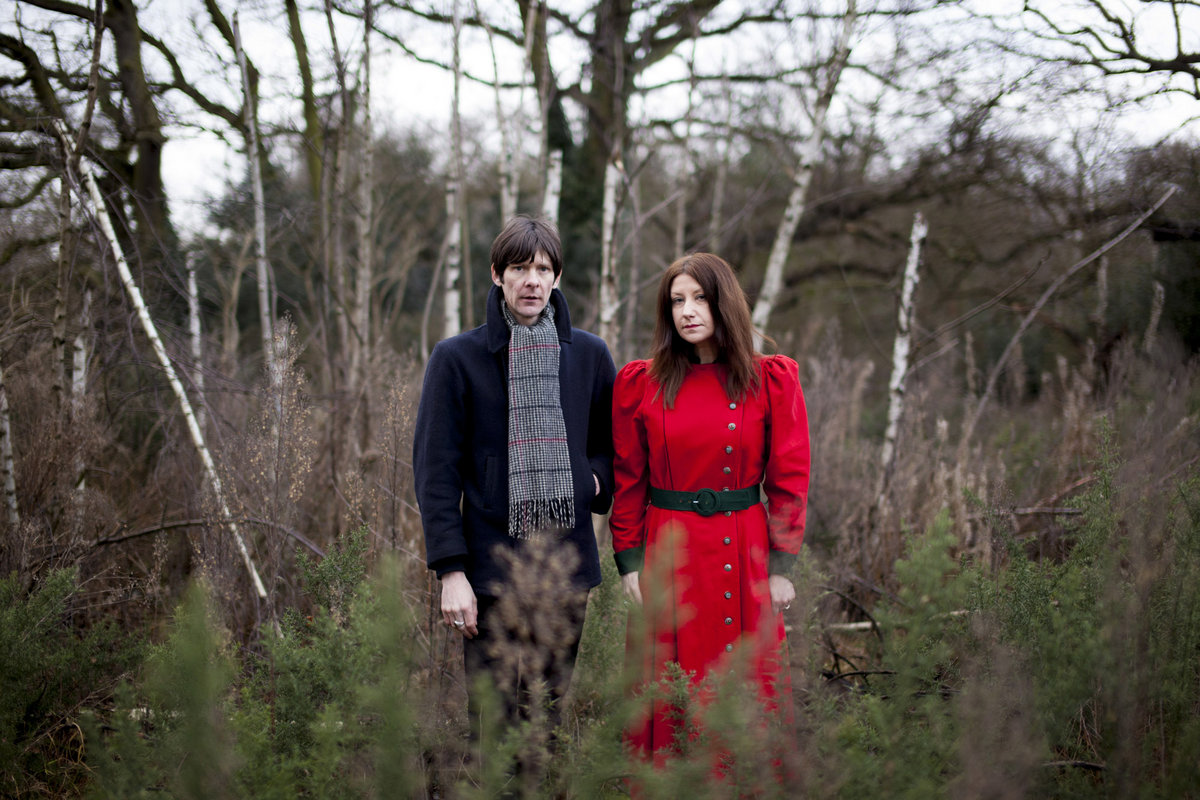
This week Haerts (the duo featuring romantic partners Nini Fabi and Benny Gebert) shared a new song,“For the Sky,” via a video for it. The song features guest vocals from Grizzly Bear’s EdDroste. Julian Klincewicz directed the video, which was filmed while Fabi was pregnant. Fabi had this to say about the song in a press release: “‘For the Sky’ came from a dream I had when I first found out that I was pregnant, which was the catalyst and beginning of writing the new music. When we finished the demo for the song I kept hearing Ed’s voice and just thought he would sound amazing on it.
We didn’t know him at the time, but were such fans. When we reached out we honestly thought we’d never hear from him. But we did and we went into the studio in LA, and ended up recording it just singing together in a room. Now that feels like such a nostalgic notion. But even then it was special. It was that feeling you get when you sing with somebody and something just clicks. And it’s especially crazy when you sing with a vocal force as Ed. I wish everybody could sing together more and feel that. “A few months later, we decided that we wanted to do a music video a week before I ended up giving birth. So it all came full circle when Julian came to NY and filmed me dancing at 9 months pregnant.”
Haerts’ last album, sophomore effort, came out in 2018 via Arts & Crafts. Haerts turned heads in 2012 with their fantastic debut single, Its documentary style video has over 1.8 million views on YouTube. That was followed by their 2013 Hemiplegia EP and their 2014-released self-titled debut album.
Montréal’s Helena Deland opened for Connan Mockasin at the 2019 Montréal Jazz Festival, where Deland’s deft lyricism and sonic edge left a lasting mark. For her debut album, she’s signed to Chris Cantallini’s (of timeless indie blog Gorilla vs. Bear) Luminelle Records, and her dreamy sound slots nicely next to label mates like Anemone, Hana Vu and Jackie Mendoza. On songs like “Someone New” and the spectacular “Truth Nugget,” Deland expands on themes of interpersonal dynamics and identity in powerful ways. She is undoubtedly one of the best new talents to emerge from the robust Montréal indie scene.
A unique transformation occurs the moment a lover lays eyes on your bedroom for the first time: the room is suddenly, involuntarily no longer your own. Your curated “you” is subject to the impressions of the other, and you try hard to adopt this filter yourself, wondering what information the objects and their position suggest about you. If, in moments like these, the new gaze seems to almost conjure the room, a desperate question arises: what remains of the room without the other? With no external sources of appraisal or affirmation, where does the stuff of the self reside, and how does it take shape?
These blood-deep paranoias set the stage for Helena Deland’s debut album,Someone New, an exploration of gender, power, time and the “self” that finds Deland in full control of her sound and style, even as she asks whether control is ever possible. The album was written and recorded over a period of two years, beginning with Deland’s guitar and expanding into a lavish sonic sphere that blends elements of hypnagogic pop and classic folk. Deland’s voice ties it all together, sometimes hushed in a whisper, sometimes shrouded in distortion, and sometimes full and clear
New song “Pale’ is about the little space left to the actual self in romantic relationships where idealization comes into play,” says Deland in a press release.
The song is accompanied by a simple visualizer featuring foaming water in a stream, which Deland says “represents the question of control when control is ultimately impossible.”
In July Deland also shared the album’s “Lylz.” Then when the album was announced in August she shared the album’s title track, “Someone New,” via a video that showed Deland posing for the portrait painting which graces the album’s cover. Then she shared another song from it, atmospheric slow-burner “Truth Nugget”,
Helena Deland’s debut album ‘Someone New’ out October 16th via Luminelle Recordings.
Loma are releasing a new album, “Don’t Shy Away”, on October 23rd via Sub Pop Records. This week they shared another song from it, “Elliptical Days,” via a video. Loma consists of Shearwater singer Jonathan Meiburg, alongside Emily Cross (of Cross Record) and Dan Duszynski. Cross and Duszynski directed the video (filming it in Dripping Springs, Texas). Cross had this to say about the song in a press release: “‘Elliptical Days’ was one of those songs that was pretty well fleshed out by Dan and Jonathan by the time I heard it. I loved how different it sounded from what we usually make together, but it was somehow still in the Loma realm and the horn arrangement made it really special for me.
Meiburg adds: “The horn session for Don’t Shy Away was one of the most exciting moments in making the record. They drove out to the studio one evening and blew their hearts out for three hours, without hearing any of the songs beforehand. I think they left feeling a bit confused about what kind of record this was, but they were really good sports about it.”
Duszynski also adds: “I started ‘Elliptical Days’ as a sketch in Ableton- an exercise to learn the software and dig through some synth sounds. Jonathan heard me messing with it and walked into the control room asking, ‘Can we use this?’ The song really came to life as he and our good friend (and touring Loman) Emily Lee started overdubbing piano and koto parts—and as usual, our collaboration transcended what any of us could do alone.”
Don’t Shy Away is the follow-up to the band’s self-titled debut album, released back in February 2018 via Sub Pop. One song from Don’t Shy Away, “Homing,” was produced by Brian Eno. The album features “Half Silences,” a new song the band shared in April 2019 via a music video. When the album was announced they shared another song from it, “Ocotillo,” via a lyric video. Then in September they shared two new songs from it, title track “Don’t Shy Away” and “I Fix My Gaze,”
“Don’t Shy Away” Release Date: 10/23/2020 on Sub Pop Records.
This week, Andy Bell, founding member of ’90s British shoegaze band Ride, released his debut solo album, “The View From Halfway Down”, and shared its first single, “Love Comes in Waves,” via a video for it. The album will be released October 9th on Sonic Cathedral. Bell began writing the album in 2016, but shortly after, Ride’s live reunion tour became a full time return, and the band released two albums and embarked on two world tours. When the pandemic hit, Bell decided it was finally time to work on and release his debut solo album, sharing the first single today on his 50th birthday.
“The View from Halfway Down” was engineered by Gem Archer and mastered by Heba Kadry. “Love Comes in Waves” is a heavily psychedelic song, with an accompanying video just as trippy.
Bell had this to say about the album in a press release: “I’ve always wanted to make a solo album, I’ve always said I would do it, although I never imagined it happening like, or sounding like, this one does. I’d been sitting on this pile of almost finished tracks, along with all the other hundreds of ideas that had fallen by the wayside since I’ve been making music. Lockdown gave me the opportunity to find a way to present it to the world.
“The album is not about song writing. There aren’t many verses or choruses, because this album is about sounds, a listening experience.”
Ride reformed in 2014 to do some touring and finally released their first new album in 21 years, Weather Diaries, in 2017 via Wichita. That was followed by the 2018 EP, Tomorrow’s Shore and then 2019’s This Is Not a Safe Place.
After the initial run in Ride, Bell formed the band Hurricane #1 in 1997 and then was in Oasis for 10 years (from 1999 to 2009), as well as in Beady Eye (a band that featured many of the later members of Oasis, including Liam Gallagher, but not Noel Gallagher, from 2009 to 2014).
Now that the album is out we can share one of our favourite album tracks from it, six-minute long “Skywalker.” We have no clue if the song has anything to with Star Wars, but musically it’s got a bit of a Krautrock vibe reminiscent of Working For a Nuclear Free City. Then he shared its second single, “I Was Alone,” via a video for it. In a press release Bell described “I Was Alone” as “a Spacemen 3-influenced song about dealing mentally with solitude”
“The album is not about song writing. There aren’t many verses or choruses, because this album is about sounds, a listening experience.”
Love comes in Waves, psychedelic raves, lost nights, found in days of volume, fuzz and delays. If you’re searching for meaning, or a secret worth revealing, and you’re missing the feeling of connection, a reflection back from above, you’re ready to ride the first wave of love. Love comes in Waves, give us a wave, I’m one step away, lost in the maze. If you’re searching for meaning, or a secret worth revealing, temptation is calling and your self control is falling, if your friends started stopping, but for you there’s no dropping off at all, and you’re missing the feeling of connection, a reflection back from above, you’re ready to ride the first wave of love.
The first single from Andy Bell’s debut solo album ‘The View From Halfway Down’, released on Sonic Cathedral on 9th October, 2020.
Ride guitarist / singer Andy Bell releases his debut solo album “The View From Halfway Down”. The product of a gradual, four-year process and finished during lockdown, the album was entirely written and recorded by Andy, Back in 2016, Andy was inspired by David Bowie’s death to be more proactive about finishing his songs, more confident about sharing them and to channel all of this into finally making a solo album. He laid down some tracks in former Beady Eye and Oasis bandmate Gem’s studio, but got diverted when Ride’s live reunion blossomed into a full return. A run of two albums, an EP and two world tours later, it would take a pandemic to give Andy the space to complete The View From Halfway Down.
Honing in on Andy Bell’s exacting song writing skills, ‘The View From Halfway Down’ packs eight songs into a mere 42 minute run time. ‘Cherry Cola’ is a fizzing delight, while opener ‘Love Comes In Waves’ is the sound of pure abandon.
‘Ghost Tones’ is playfully melancholy, with Andy Bell conjuring opaque ambient tones on spaced out closer ‘Heat Haze On Weyland Road’. A refined, contoured example of his song writing, he closed 2020 by releasing ‘Cherry Cola’ as a stand alone single, featuring a nimble acoustic take, and a typically searching Pye Corner Audio remix.
From the ecstatic psych pop of “Love Comes In Waves”, to the heady loops of “Indica” and deeply groove-led “Skywalker”, the eight tracks mix summery melodies with soundscapes and studio experimentation. The end result sits neatly between Ride’s widescreen shoegaze and GLOK’s textured electronics, variously inspired by The Stone Roses, Spacemen 3, The Beatles, The Byrds, The Beta Band, Stereolab, Neu!, Can, John Fahey, The Kinks, The La’s, The Who and the United States Of America.
Andy Bell of Ride (and Oasis and Beady Eye), a solo album, The View from Halfway Down. This is Bell’s first under his own name, rather than his pseudonym, Glok, the culmination of finishing songs he had been tinkering with on and off for years. This doesn’t mean that The View from Halfway Down sounds like a Bowie or Ride record. It sounds like who Bell is as a person: unfussy and understated, go-along and get-along. You would be forgiven in thinking The View from Halfway Down is just like another Ride album based on the powered-up shoegaze vibes of opener, “Love Comes in Waves” or the dreamy “I Was Alone.” That idea is soon extinguished with the psychedelic strains of “Indica” the Stone Roses-esque warbles of “Skywalker” and the slow, bass-based “Cherry Cola.” He includes three instrumentals: the spare and beautiful, guitar-based “Ghost Tones” the experimental, indie-prog rock “Aubrey Drylands Gladwell,” and the IDM-ish album closer, “Heat Haze on Weyland Road.” Bell packs a lot into the eight songs on The View from Halfway Down, touching on a lot of styles in the process, and all of it works.
So there you have it. The near death of a cartoon anti-hero and the actual death of a music legend, feeling the calm within a global pandemic and a musical turning point halfway through life all add up to one glorious, technicolour whole Released October 9th, 2020 All tracks written and performed by Andy Bell.
The Story of The Written Years starts here, Almost exactly 7 years ago, I moved into a little all-white-but-still-grungy Burnaby basement with one of my best friends Kane and started writing & demoing the songs that would be become our first (self-titled) album. The songs started out solely as a way for me to get things off of my chest, to help digest both the isolation and wonder I felt being in a new and much bigger city than I had grown up in. We were still green as hell (and I think that little album is a reflection of that) but we were lucky enough to have some people believe in us early on. Our producer Ryan Worsley helped make us sound larger and more grandiose than the 3 piece that we were (our good friend Kodie Krogh being that third). I can’t thank that record enough for what it did for me – if I didn’t have that outlet and if I didn’t put all those frustrations and anxieties on paper, I can guarantee that I would not be the same person that I am today. We were also fortunate enough that someone by the name of Brian Dyck witnessed our very very first show and was eager enough to fight for a spot in the project. It turns out that that couldn’t have been a better thing because Brian came to be someone who really helped take the project’s sound and live show to where it ended up last year. So many hours and late nights him and I spent pouring over..over a bright grey Ableton screen trying to dial in the perfect synth sounds for this record. Together (this time, our good friend Alex Richardson included), we worked for years on a release that we really believed in, despite some of my own voice loss issues and still learning the ropes. Alex also really stepped forward as a writing partner for me and helped me take my melodies to a place where I hadn’t been able to on my own.
The result was a record that we re-did a couple times over but ended up saying everything we felt like we really needed to say, lyrically and as musicians. We didn’t try to make a pop album, it’s dark at times but was its own catharsis for me. I talk so much about the frustrations I had with the type of lifestyle I was living and the shitty places I felt like I was relying on for emotional support. I wrote about how helpless it can feel to lose your voice – something I depended on so much as a form of expression.
I’m sure the amount of times we went back up to bat with this thing is a running joke in the Echoplant studio, it definitely is among ourselves. The reality is that those guys put a lot of time and hard work into it. Not only Ryan but also Matt DiPomponio, his assistant engineer, was an absolute source of energy and enthusiasm for us. He never complained once, despite the demanding schedule, and always had a way of making things feel effortless and fun, despite the immense stress that we were actually putting ourselves under.
Until now, I was admittedly scared of putting this 2nd record out. Maybe on some level because it means finally calling it “finished” after so long but also because we’ve continued to grow so much since then. It’s a tough part of my life to reflect on and I admit a lot in it to where such transparency and vulnerability can feel a bit unsettling for me.
But with this comes something positive. It means that it makes sense to finally put this record out that so many people worked so hard on. it’s a batch of songs about desperation, about a longing I had to change myself and reclaim parts of myself that I had lost. If there’s one feeling I think we always managed to capture well, I think that’s the one of nostalgia and these 10 songs are full of that. It felt appropriate to call it “A Cinematic Goodbye” as a send-off to the project as a whole. To boot, we all pretty much live in different cities now.
The 10th track was one of the last written and was where I felt I finally found some acceptance. The ending to this story never had to be a resolution, but it just needed to be a coming-to-terms with what I was fighting. That not-so-little 5 1/2 minute piece of music really summed up for us everything we wanted to do at the time. It doesn’t conform to any real expectations and really just says everything we felt we needed to. The bass line in there is honestly one of my favourite things ever and the drums go through like 10 different beats but I love every one of them. I remember the last vocal session we had, it was at about midnight the night before and I hadn’t finished these lyrics yet. I had a near panic attack and took a few-hour walk only to come back and hit Save on the final lyrics by 4:30am. Slightly delirious the morning after, Matt and I finished the vocal tracks and finally sat back after such a long week. I think I called my brother right after in some sort of exhausted victory lap.
Anyway, I’m sorry this whole thing has been so long but I wanted to give this record and project its proper due. There’s one other person that I would really like to thank here and that’s an incredibly thoughtful and motivational manager by the name of Jeff Ojeda. Jeff had only been on board in the final year but had brought such a level of care and expertise for the project that we never could have asked for. He also did such an amazing job of linking us up with more people that have helped us further our vision, including JVP who blew us away with his mix of Superficial Feeling. I guess I’m just kidding though because there really are so many other people that I should thank – people that helped us out with some beautiful additions on the record and during our live shows (Laura Genschorek, Benji Klassen, Siobhan Lauzon, AJ Buckley, Elliott McKerr, Julia Huggins, Michael Cumblidge, Kelsey Huggan, Emma Song-Carrillo, Sheena Truong, Mitch Walford, Jamie Smail, Ryan Morey, Ryan Eno, Matt Thomas, Cam Nicklaus, Richard Mitchell, Tyson Sulley) or lent us their advice & skills (Sebastian Galina, Murray Ash, Kevin Lim).
So for those following the story, hopefully this doesn’t end up being a total “goodbye” from us. Anyone who’s ever attended a show, bought a copy of our record, bought a tee shirt or just believed in us in any way: thank you so so much, we cannot express how much that stuff meant to us and really kept us working hard. We love you.
LOVE // Wade, Kane, Brian & Alex Written Years Released October 9, 2020 The Band:Wade Ouellet – Vocals, Words, Guitar, Keys Kane Enders – Drums, Percussion Brian Dyck – Bass, Keys Alex Richardson – Guitar, Vocals
The Left Outsides are: Mark Nicholas and Alison Cotton, a wife and husband duo based in London, England whose atmospheric, hypnotic songs echo Nico’s icy European folk, pastoral psychedelia and chilly English fields at dawn. Released October 9th, 2020 All songs by The Left Outsides (Alison Cotton / Mark Nicholas) Produced by Mark Nicholas. At last, a new studio album from superb London duo, The Left Outsides, to follow up on 2018’s amazing All That Remains.
The basic building blocks remain the same — half of the sound is Alison Cotton and her viola and keys, the other half is Mark Nicholas with a stunning array of guitars — but the structures they create this time are darker and more forbidding than their antecedents. This album feels very much a piece of the season in which it is being released, as the leaves strip themselves from trees and the sky grows colder, greyer by the hour. More than once while “Are You Sure I Was” There spun I was put in mind of the classic Rainy Day LP, masterminded by Kendra Smith back in 1984. The Left Outsides possess the same sure grasp of that place where sorrow, ecstasy and psychedelics meet in a shower of dying stars.
The tunes here are wonderful. Most are new, although a few have been heard before in different forms (if you knew where to listen.) “The Wind No Longer Stirs the Trees” (with its glorious blend of backwards and forward motion) was on a 7” lathe, backed with “As Night Falls” (a beautiful ode to the promise of winter.) The track “Seance” was first recorded as part of a celebration of Help the Witch, the debut novel by former music critic Tom Cox (whose words were used for most of the lyrics.) And “My Reflection Once Was Me” (which recalls The Trees’ epic tunes by combining massive blocks of raging guitar with Alison’s steady vocals) was featured on the live A Place to Hide LP.
The other compositions are all-new and utterly great. The tunes that Mark sings tend to evoke a certain ’60s whisp. Whether it’s the Floydian lilt of “Only Time Will Tell,” the freakbeat pop of “November on My Mind,” or “Pictures of You,” which stacks a dreamy ’60s overlay upon contempo pop structuring. Alison’s vocals often display a more folky essence. “The Stone Barn” has a vibe very similar to some of Sandy Denny’s later solo work, grounded by stately piano chords. “Things Can Never Be the Same” centers on a gorgeous mid-paced vocal performance, encased in spinning webs of very elegant guitar. And the conjoined vocals on “A Face in the Crowd,” sit atop a huge fuzz riff, sounding like the perfect anthem for the new Slow Music Movement. They wont back down!
And you shouldn’t either. I’m not exactly sure where anyone gets their records these days but wherever that is, you should march there tout de suite (even if only figuratively) and demand a copy of Are You Sure I Was There? today. And yes, I am sure. Today!
Flavor Crystals are a psychedelic shoegaze band from Minneapolis, Minnesota, Hi everybody, sorry we’ve been pretty quiet lately, but we’ve been busy working on something. It’s been quite a challenging year for most all of us, but we do have some good news in this crazy thing we call 2020…Flavor Crystals album number five has arrived!. After years of exploration and weirdness, they added bubbly liquid and jelloed into a real band, recording their debut album On Plastic as a document of the sleepy wobbly blurry dreamscape vibe they found together.
For alternative music fans, the college town of Athens, Georgia, means R.E.M. and the B-52’s . Through the 1980s, the city was synonymous with a kind of against-the-grain music epitomized by those two bands’ very different styles. In 1987, Rolling Stonenamed R.E.M. “America’s best rock ’n’ roll band.” Drummer Bill Berry denied it. The best band in America, he said, was Pylon.
In its original incarnation, Pylon only lasted for five years. But no single band did more to define what it means to be an Athens band than Pylon. Formed as a performance art project by four art students who mostly did not know how to play their instruments, Pylon created a startling, original sound by combining formal experimentation with a danceable beat. Beyond their music, band members’ commitment to making art in their small, Southern college town helped transform what had been a tiny network of art students and their friends into one of America’s most important and enduring music scenes. This is how in that period when what would become alternative was new, Pylon broadened the very idea of what a band could be.
In Athens, Georgia, people got into bands the way people everywhere get into most things—through their friends.
As a high school student in suburban Atlanta, future Pylon bassist Michael Lachowski had taught himself photography by reading the Time/Life photography series and building a darkroom in his parents’ house. He met Randy Bewley, future guitarist, in the photography studio at the University of Georgia where the sculpture major from suburban Atlanta had a work-study job. Outside class, Lachowski made drawings, prints, Super 8 films, and sculptures, as well as photographs. Bewley made photographs and other two-dimensional work and later switched his major to painting. As Lachowski remembered, this kind of experimenting with genre just seemed normal at UGA: “We had an exuberant group of people; creativity was prized above all else; everybody was just putting out work. It led to us going out of the boundaries of our disciplines. A lot of us in the art school were trying out different media with a punk rock message, which is just go in there and do it. You don’t need training, or authority or legitimacy. Just figure it out.”
At the UGA library and at Barnett’s News downtown, Lachowski and Bewley followed the art and music news in publications like the Village Voice. After the B-52’s started playing New York City regularly in 1978, Bewley and Lachowski read about people they actually knew. Bewley wanted to form a band, too. Lachowski resisted. His problem with the idea was not that they were not musicians. The fact that they had no experience playing instruments was no different from the fact that they had no experience making prints or installation art before they went to art school. They could learn. Instead, Lachowski hesitated because making music seemed unoriginal: “I thought it had been done already.” But then the friends had an idea. As the band’s singer Vanessa Briscoe Hay remembered, “They’d been reading New York Rocker, and it seemed like it would be an easy thing to have a band and go to New York and get some press and come back. And that would be it.” Once they got the press, they would quit. Instead of a band, they decided, they would create a kind of performance art.
Bewley bought Lachowski a bass at a pawnshop and found a guitar for cheap at a flea market. Sometime that winter, the two friends started practicing regularly in Lachowski’s off-campus studio, a second-floor space on College Avenue right across from the university. Lachowski worked from a bass instruction book. Bewley played his guitar with an alternate tuning because he did not know the standard one. Plugged into little Pignose amps, they practiced by alternating positions, with one holding the groove and repeating a phrase while the other experimented.
In the future, these long jams would give birth to a remarkable independence between the bass and the guitar parts. At the time, they sounded like “endless riffs.” Curtis Crowe, their landlord, who lived upstairs, remembered hearing “a never-ending series of hooks—no bridges or chorus, just hooks” echoing and vibrating right up through the floor. One day Crowe reached his breaking point: “So I kinda went ahead and knocked on the door lookin’ real timid and said, ‘Hey, mind if I drag these drums in here for a little bit?’ ” The band’s future drummer “had every song memorized before I ever went down.”
When Bewley and Lachowski decided to find a singer, it made sense to them to ask art students whose work they liked. Bewley’s friend Vanessa Briscoe Hay—then Vanessa Ellison—had started out in arts education before switching her major to drawing and painting without telling her parents. After she graduated, she got a job at the local DuPont nylon factory, through word of mouth at the art school. Bewley was still in school, but Lachowski got a job there too after he graduated. Bewley told her about a performance art project he, Lachowski, and Crowe had created that involved making music. Bewley wanted Briscoe Hay to try out for the role of singer. She told him she wasn’t really a musician. Bewley insisted they were all amateurs. What mattered was they respected her as an artist.
The audition at Lachowski’s studio turned out to be oddly formal. On a music stand, her future bandmates had placed an orange vinyl notebook full of typed lyrics. They would play a song, and she would try to make the lyrics fit, sometimes cracking up in the attempt. “They couldn’t really hear what I was doing,” she remembered, but “they liked the fact that I put forth some honest effort and they liked the way I looked, and they liked me as a human being.”
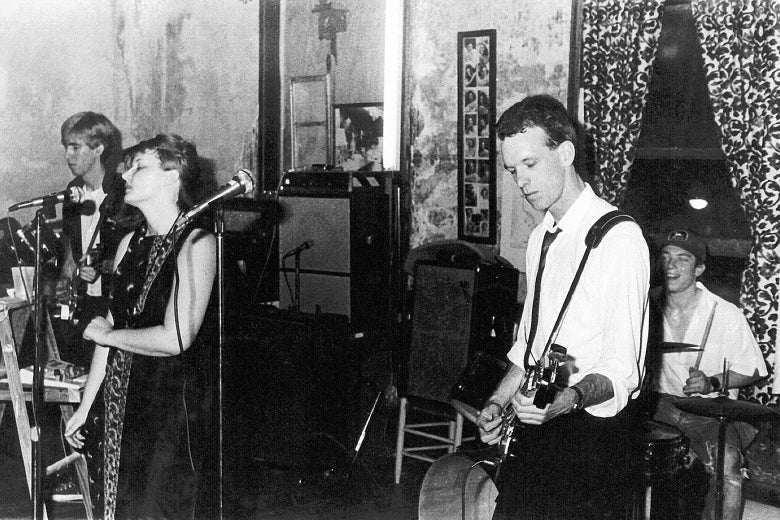
When the band debuted on March 9th, 1979, in the second-floor space downtown above Chapter Three Records, it was hard to imagine its members would soon be local stars. All the songs they played were originals, except the theme song from Batman. Briscoe Hay stood on a mirror with her back to the big windows that looked out on old campus and concentrated on the words. Bewley and Lachowski looked at their hands. Only Crowe seemed at ease. In Athens, everyone danced at parties, and yet the audience at that first Pylon show and a second at Crowe’s loft stood strangely still. As Crowe told a critic in 1981, “Nobody knew what to do, so they were real polite.” In a letter to a former professor, Lachowski added a list of comments he had heard after their first few gigs: “too art oriented,” “conceptual,” “they sound like a bunch of artists who got together and decided to have a band,” “Michael, your music sounds just like your art,” and “they’ll like what you’re doing in New York (as if to imply that they don’t really in Athens).
At their third gig, though, at a house in the country, everything changed. As Briscoe Hay recalled, “The B-52’s showed up at that party, and they started dancing and running around like crazy and everybody else did too.” After the show, Briscoe Hay said, Fred Schneider and Kate Pierson “were very supportive.” They said, “You’ve got to play New York.”
To get that date, Pylon had to make a demo. Someone bought some Kmart cassette tapes, and the four art students recorded themselves playing a few songs at Lachowski’s studio. Then Schneider gave a tape to Jim Fouratt at Hurrah, a punk dance club where the B-52’s had been playing lately. The timing was perfect. “Rock Lobster” was a New York hit, and the B-52’s reached the peak of their underground fame in the weeks before the release of their first album that July. Fouratt actually called the members of Pylon in Athens, read through a list of coming bands, and asked them who they wanted to open for. Bewley and Lachowski picked Gang of Four.
In New York, a huge crowd filled with other musicians turned out at Hurrah to see Gang of Four. Briscoe Hay borrowed a whistle from the doorman and blew it during the song “Danger.” People in the front shook Bewley’s hand after the set and badgered him with questions about how he came up with his strange tunings and original chords. After they got back home, the September 1979 issue of Interview arrived with Glenn O’Brien’s review that gave as much space to Pylon as to the Gang of Four:
Pylon, the first Athens band to hit the town since the B-52s. A tough act to follow—but Pylon is also a credit to their community. There’s not much resemblance to the Bs. Although the guitarist has real classy taste in licks that is sometimes reminiscent of Ricky Wilson’s. Pylon has a charming chanteuse up-front—sort of Georgia Georgie Girl who manages to carry off several difficult postures, including kooky, endearing, sincere and wry. And not all the songs sound the same. These kids listen to dub for breakfast. Recommended.
Interview was not New York Rocker, but O’Brien’s coverage was better than the band members’ dreams, even if they had to look up the meaning of the word dub. Their project was a success, but they did not want to quit. They were having too much fun.
In making their performance art rock, the four members of Pylon drew on what they had learned in art school about the ways that tensions between materials, mediums, and expectations could animate art. Middle-class kids holding down working-class jobs, they turned the factory into a style. Posters featuring orange safety cones and music full of machinelike repetition punctured by whistles and screams contradicted audience assumptions that small Southern towns produced only county and folk sounds and handmade things.
Their name referred to “the kind in the road, not the architectural one or the ones that hold up electricity,” as Lachowski wrote a former professor. “We chose Pylon because it is severe, industrial, monolithic, functional. We subscribe to a modern techno-industrial aesthetic. Our message is ‘Go for it!, but be careful.’ ” Working the contrast between flat, machinelike minimalism and ragged, Southern-accented amateurism, their songs used a four-on-the-floor disco beat to mash together punk’s emotional excess and industrial repetition and detachment. The bass throbbed and the drums boomed as guitar licks cut across the rhythm section without being leads. The vocals varied from deadpan recitations of short phrases to howls, and Briscoe Hay rarely flirted with the audience. Instead, she belted out vocals while bouncing up and down and shaking her head like a dancer in a Charlie Brown television special. Sometimes, she blew a shrill whistle midsong, like a referee or a cop.
Live, Pylon’s act could be shocking or jolting or heavy. It could also be deep. In fusing pop and rock forms with an avant-garde sensibility, the band members asked what art could mean in the midst of industrial decline, production-line mass culture, and rising political conservatism. And they tentatively offered an answer. “Be careful, be cautious, be prepared,” the lyrics of their song “Danger” warned. But be creative, too. “Everything is cool.” “Turn up the volume.” “Turn off the TV.” “Now, rock and roll, now.” “Read a book, don’t be afraid.” “Function precedes form. Things happen.” Pylon pushed people to think as well as dance, to put their minds and bodies back together. Playing live, the four art students could pound their awkwardness and their amateurism and their artistic vision into something transcendent. If people in Athens revived on a local scale that old dream that music could make a new world, it was because they were living it.
Pylon nurtured the creativity the B-52’s had helped spark in Athens before they left for New York. Pylon’s performances, shows by other bands, and art installations by Lachowski and others transformed the open space behind the Victorian house at 265 Barber Street where Lachowski lived into Pylon Park, one of the emerging scene’s important gathering places. The band also played the club Curtis Crowe started, the 40 Watt Club. In the summer of 1980, Briscoe Hay had to quit her job at DuPont when the B-52’s invited Pylon to open for them in New York’s Central Park. By the end of the year, band members found they could live two or three months in Athens on their New York City guarantees. Pylon became their job.
Over the next three years, Pylon toured the Midwest and Canada with the Gang of Four and played a string of dates in England. In January 1982, they sold out the large Memorial Hall ballroom on the University of Georgia campus. In April, when the 40 Watt moved from Clayton Street to a bigger venue on Broad Street, they headlined the back-to-back closing and then opening shows and packed both rooms. In Athens, Pylon ruled the scene that the band’s members had done so much to create.
If Pylon seemed wildly successful from an underground perspective, outside Athens, New York, and a few other cities, audiences often did not seem to know what to make of the group. Band members made enough money to live cheaply in Athens, but they weren’t exactly comfortable. To reach the next level, they hired a professional booking agent. He landed them a gig most bands would have been giddy to get: the opening slot for U2’s U.S. tour in support of their recently released album War. When they took the stage, crowds impatient to see the Irish band ignored them. As Briscoe Hay recalled, “People were heckling … ‘Where’s U2?’ and ‘Get off the stage.’ ” What everyone said was great felt instead like failure. It certainly was not fun. Maybe they did not really want this kind of success. Maybe their performance art–turned-band was exactly what they said it was, “temporary rock.”
At the beginning of 1983, Briscoe Hay told a local Athens paper, “I think if it ever became miserable, we would just disband,” and in retrospect she was hinting at what was to come. Band members decided around this time to break up at the end of the year, after they fulfilled their bookings, but they kept their decision secret. In Athens, most people found out when posters went up for “Pylon’s Last Show” with opening act Love Tractor.
A recording of that farewell show released in 2016 finally gave those of us who missed it a chance to listen in on this essential moment in Athens history. From the opening note of the first song, “Working Is No Problem,”Pylon played 22 songs with hair-on-fire intensity that did not let up until the five-song encore finished. Over the course of approximately an hour and a quarter of music, the crowd roared out its encouragement. Sometimes the fans sang along to lyrics like “Everything is cool” and even occasionally to guitar hooks, like the woo-woo of “M-Train.” At other times, they just yelled. No one wanted the evening to stop.
Interviewed afterward about the breakup, band members reflected on why they had started making music “as another form of artistic expression.” “We accomplished what we set out to do,” Lachowski said. “It’s not that we are miserable, it’s just that we’ve seen all we’re going to see and don’t want to put any more time into it.” “What was frustrating was not trying to live like other bands, but trying to convince everybody that we didn’t want to do it that way,” he explained. “We were the only ones that understood why we were not out there with the other bands trying to make it big.”
A critics’ darling, repeatedly named the best band in Athens, Pylon carried its art piece so far that it broke up on the cusp of stardom. “We’ll become a cult band now,” Bewley predicted on the eve of Pylon’s last show. “This is a type of suicide that’ll make us more popular in the long run.” And he was right
Randy Bewley, Vanessa Briscoe Hay, Michael Lachowski, and Curtis Crowe of Pylon
Box Set Includes:
The studio albums Gyrate and Chomp – newly remastered from the original tapes
Extra – a collection of singles, B-sides, rarities and live recordings
Razz Tape – the first-ever Pylon recording, a 13-song unreleased session that predates their 1979 debut single, “Cool”/”Dub”
Plus a 216 page, full-color, hardbound book featuring a treasure trove of never before seen images and artifacts from the band’s personal archives, and writings by R.E.M., Kate Pierson of The B-52’s, Corin Tucker & Carrie Brownstein of Sleater-Kinney, Steve Albini, Jon King & Hugo Burnham of Gang of Four, and many more
47 tracks in all, including 18 unreleased recordings
The Shins put out Heartworms, their first new album in five years, earlier this year and a video for “Half A Million” has been released.
Filmed on a white backdrop, edited, then printed out. “Half A Million” was created with 5,566 stickers, hand cut from the 4,868 frames and animated by sticking them down on top of each other at each of the 40+ locations.
The Worms Heart is a complete re-work of The Shins critically acclaimed March, 2017 album ‘Heartworms’. The album offers new reworked versions of the ‘Heartworms’ album original tracks, and the sequence is flipped as well. The album is available digitally, on all formats.
When James Mercer wrote, produced, and recorded the Heartworms album, he had this desire for an alternate version, an opposite version. The album’s slow songs would be flipped and re-recorded as fast songs, and vice versa. The reasoning was to showcase the versatility and strength of his songwriting, and the result is The Worm’s Heart. This ‘flipped’ collection is produced by Yuuki Matthews, Jon Sortland, & James Mercer; and is a must for any fan of The Shins


 The Story of The Written Years starts here, Almost exactly 7 years ago, I moved into a little all-white-but-still-grungy Burnaby basement with one of my best friends Kane and started writing & demoing the songs that would be become our first (self-titled) album. The songs started out solely as a way for me to get things off of my chest, to help digest both the isolation and wonder I felt being in a new and much bigger city than I had grown up in. We were still green as hell (and I think that little album is a reflection of that) but we were lucky enough to have some people believe in us early on. Our producer Ryan Worsley helped make us sound larger and more grandiose than the 3 piece that we were (our good friend Kodie Krogh being that third). I can’t thank that record enough for what it did for me – if I didn’t have that outlet and if I didn’t put all those frustrations and anxieties on paper, I can guarantee that I would not be the same person that I am today. We were also fortunate enough that someone by the name of Brian Dyck witnessed our very very first show and was eager enough to fight for a spot in the project. It turns out that that couldn’t have been a better thing because Brian came to be someone who really helped take the project’s sound and live show to where it ended up last year. So many hours and late nights him and I spent pouring over..over a bright grey Ableton screen trying to dial in the perfect synth sounds for this record. Together (this time, our good friend Alex Richardson included), we worked for years on a release that we really believed in, despite some of my own voice loss issues and still learning the ropes. Alex also really stepped forward as a writing partner for me and helped me take my melodies to a place where I hadn’t been able to on my own.




 The Fat Angel Sings