Former The Verve frontman Richard Ashcroft is releasing an album of acoustic versions of his songs, and he’s just shared this track which was originally released as part of his RPA & The United Nations of Sound side project. “Acoustic Hymns Vol. 1″ is out October 29th. The new cut is taken from the former Verve frontman’s upcoming acoustic greatest hits collection, ‘Acoustic Hymns Vol. 1’.
The original featured hip-hop star No I.D. and was released as part of Richard’s‘RPA & The UnitedNations Of Sound’ album.
A new music video for the track has also been shared alongside the anthemic song about overcoming challenges and includes archive footage of the 50-year-old rocker as a youngster. The upcoming LP boasts stripped-back renditions of Richard’s most popular songs from his revered solo career and his time in The Verve.
‘This Thing Called Life’ follows the release of a new version of ‘Bitter Sweet Symphony’.
Upon working on the new cut in 2019, Richard regained the rights to the Verve classic, which features a four-second sample of an Andrew Loog Oldham orchestral cover of The Rolling Stones song ‘The Last Time’. While permission for the recording was obtained, permission for use of the song was not, and so at the time of its release in 1997, Richard was forced to give up all the rights to the iconic track, including the total lyrical content.
However, he has since been able to earn royalties again after his team appealed to Sir Mick Jagger and Keith Richards directly. The 12-track LP also includes Richard’s close pal, Liam Gallagher, on ‘C’mon People (We’re Making It Now)’, which dates back to the late 90s, as he played the song to the 49-year-old former Oasis frontman in Majorca in 1998.
The record is co-produced by Richard and Chris Potter and features his live band, plus string arrangements led by Will Malone recorded at the legendary Abbey Road Studios in London, with the addition of Chuck Leavell on piano, Roddy Bloomfield leading the brass section, and Steve Wyreman on acoustic guitar and backing vocal arrangements.
‘Acoustic Hymns Vol. 1’ is released on October 29th .
The Verve’s third studio album “Urban Hymns”, originally released September 29th, 1997. Mojo magazine’s recently published a revisionist assessment accompanying the album’s deluxe reissue’s, which curtly dismisses the album as “a flawed piece of wish fulfillment: Thus epic songs struggling to mend a broken heart.”
“I remember listening to “Urban Hymns” for the first time and I was completely enthralled with it,” I couldn’t stop listening to the album from beginning to end. It was pure brilliance. Each song could stand on its own and the album was flawless.
Although Urban Hymns represented my overdue introduction to The Verve’s songs, my education thankfully didn’t end there. The band’s excellent first two albums, 1993’s A Storm in Heaven and 1995’s A Northern Soul, the latter of which many still believe remains their greatest achievement on wax, both albums are remarkable in their own right.
Listening to all three albums also prompted me to seek out more information about the group’s genesis and career progression up to that point. Together with his schoolmates Simon Jones (bass guitar), Nick McCabe (lead guitar), and Peter Salisbury (drums), the Wigan, England born Richard Ashcroft formed The Verve in 1990 (guitarist/keyboardist Simon Tong joined the band in 1996 and remained until 1999). Three years later, the group released its critically acclaimed debut LP A Storm in Heaven, a hypnotic song suite defined by its sweeping arrangements awash in distortion, reverb, and vocal effects in abundance. Their follow-up effort, A Northern Soul, found the band balancing their more experimental proclivities with noticeably more accessible and melodic fare, including a trio of singles (“This is Music,” “On Your Own,” and “History”) that rank among the finest songs to emerge during the British Rock resurgence of the mid ‘90s.
Though the band briefly split a few months after A Northern Soul’s release, the fracture thankfully proved ephemeral and they soon returned to the studio to record once again. Initially propelled by the ubiquity of lead single “Bitter Sweet Symphony,” but also owing to the fact that the album as a whole is a masterpiece of exquisite musical vision and expertly executed songcraft, Urban Hymns became one of the biggest selling and most critically applauded British albums of all time upon its release.
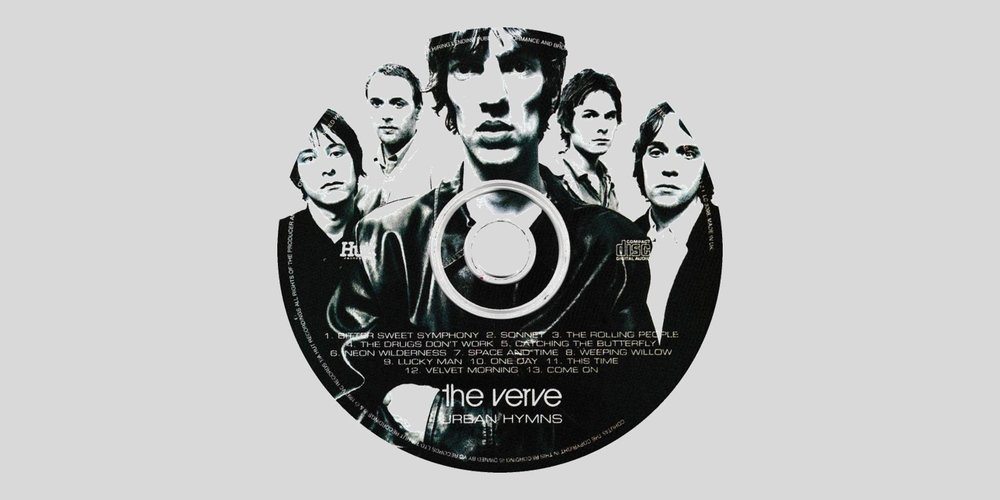
Co-produced by the band with Youth and Chris Potter roughly splitting duties across its thirteen songs, Urban Hymns is defined by its ambitious, anthemic compositions that sound like the natural expansion from its two precursors. It’s immediately apparent, upon even cursory listens, that this was The Verve’s bold attempt to fulfill their self-imposed destiny, which envisaged them morphing into a band capable of crafting a truly timeless suite of songs. A fully realized album that lodged itself firmly within the depths of listeners’ hearts, minds and souls. And I’d say mission accomplished, gents.
Urban Hymns’ legacy is not without its blemishes and distractions, particularly when it comes to the infamous legal rigmarole surrounding “Bitter Sweet Symphony” and more recently articulated conflicts regarding acknowledgement of the album’s creative influences. But these antagonisms have not diminished the album’s enduring power and resonance, with respect to what ultimately matters most: the music.
Though the album’s creation was indeed a family affair with contributions from each of the group’s five members, a compelling case can be made that McCabe and Ashcroft were the central driving forces most instrumental in executing the band’s vision. McCabe’s adventurous, at times counter-intuitive guitar work is the sonic glue that holds each of the songs together and solidifies their sweeping grandeur. Meanwhile, the songs’ existential weariness and angst, coupled with their whimsical innocence and palpable romanticism, are the product of Ashcroft’s lyrical prowess. There are plenty of moments that gravitate toward the darker, more sobering dimensions of early adulthood, but Ashcroft’s boyish optimism and joie de vivre do shine through from time to time.
Though listeners have inevitably attempted to decode the true meanings behind Ashcroft’s sometimes elusive verses, it may simply be the case that he penned his lyrics so as not to be immediately or singularly interpreted. “I don’t think the listener needs to know anything more than the song,” he explained to MTV back in 1997. “Because we always abuse our listeners’ imaginations by giving them too much, and telling them too much. We’re making music, we’re not making cheeseburgers. So I’m not about to give it to them on a plate and say what exactly it’s about. I think that’s important. I hate it when you see lead singers taking all the mystery away.”
The universally familiar album opener and lead single “Bitter Sweet Symphony” is one of the easier songs to discern, as Ashcroft sings the praises of self-agency as the means of triumphing over the thankless, soul-sapping grind of the material world, with music offering much-needed respite (“I let the melody shine, let it cleanse my mind, I feel free now”). “As for ‘Bitter Sweet Symphony,’ all those legal wrangles still don’t take away the hours I put into it in the studio to create an incredible piece of pop art,” Ashcroft reflected to Vogue magazine earlier this year. And incredible it still most definitely is. Having said that, and perhaps because of its prevalence, it’s not among the five or six songs that instantly come to mind for me when I think of Urban Hymns after so many years.
The lower profile songs with the album, beginning with the other three official singles that were released from the LP. On the inspired “Sonnet,”Ashcroft unleashes his yearning for the purer incarnations of love, without the embellishments of false or forced sentimentality, through a mixture of despair and hope, with lines like, “Sinking faster than a boat without a hull / My lord / Dreaming about the day when I can see you there / My side / By my side.”
An introspective, sombre ode to the fleeting comfort of drug-induced escapism, the profoundly stirring “The Drugs Don’t Work” can be construed as an examination of Ashcroft’s feelings about his own drug use and/or perhaps a nod to his father, who died of a brain hemorrhage when Richard was eleven years old. “When I heard ‘The Drugs Don’t Work,’ I stood there with a lump in my throat,” The Verve’s former manager Jazz Summers recalled in 1998. “At times like those, you know why you’re in the music business.”
“Lucky Man” is a notably more uplifting anthem of redemption and self-satisfaction, with Ashcroft overcoming personal adversity to find balance and contentment in life: “Happiness / More or less / It’s just a change in me / Something in my liberty / Oh, my, my / Happiness / Coming and going / I watch you look at me / Watch my fever growing / I know just where I am.”
Though it’s challenging to distinguish highlights when the entire album unfurls as one grand highlight reel, a handful of non-single tracks are bona fide standouts. “Catching the Butterfly” is a stirring ode to summoning youthful innocence as a way to cope with the harsher realities of adult life (“So you’re born / And so you thought / The future ours / To keep and hold / a child within / Has healing ways / It sees me through / My darkest days”). With McCabe’s insistent guitar play galvanizing the steady percussion, “Space and Time” is a moving exploration of a relationship that has been sapped of its passion, with Ashcroft doing all that he can to salvage the connection to assuage his fear of being alone.
The longest track at seven minutes and seemingly the antithesis of the more accessible, radio-friendly fare on offer throughout the album, the sprawling jam “The Rolling People” harkens back to the more free-form sonic footprint the band established on A Storm in Heaven. As does the considerably shorter, largely instrumental “Neon Wilderness” and the dissonant, reverb-laden “Come On,” which features a brief Liam Gallagher cameo.
Elsewhere, “Weeping Willow” is a melodic dirge that finds Ashcroft exploring the symbiotic connection between depression and addiction, with references to suicidal tendencies captured in the song’s outro (“Weeping willow / The pills under my pillow / Weeping willow / The gun under your pillow”). With allusions to The Velvet Underground in the song’s title and lyrics, not to mention the Lee Hazelwood and Nancy Sinatra’s classic 1967 duet “Some Velvet Morning,” the subdued come-down of “Velvet Morning” is an introspective portrait of loneliness and despondency, feelings that come into sharper focus as the remnant effects of last night’s pills fade away as a new day dawns.
Most people seldom cite “This Time” as among their favourite tracks from the album, but it has always been an exhilarating, standout moment for me. The coalescence of its propulsive momentum, Ashcroft’s vocal echoes, and the overarching message of acknowledging past regrets and moving on with life the best you can has always resonated, particularly as conveyed through memorable refrains such as “No time for sad lament / A wasted life is bitter spent” and “Into a light I pass / Another dream, another trance / This time, this time / This time I’m gonna rise.”
I’ve spoken to people who’ve got nothing to do with the critical side of this business,” Ashcroft shared with MTV shortly after Urban Hymns’ arrival. “I’ve spoken to people in pubs, I’ve spoken to people on the street who weren’t even aware of who The Verve were six months ago. But something connected with them with “Bitter Sweet Symphony” and “The Drugs Don’t Work” that they can’t explain. Sometimes music touches you and you can’t deny it. So I’m not too interested in what the critics say. I’m interested in how the music can still have a power, and can still affect people and still move people.”
Controversies, conflicts and commercial achievements notwithstanding, The Verve’s “Urban Hymns” remains their creative pinnacle and continues to move people twenty years on. For better or for worse, all of The Verve’s and Richard Ashcroft’s music that has followed since 1997 has been measured against “Urban Hymns”, an unfair but inevitable consequence of the album’s ubiquity and acclaim. And while I embrace it as my personal favourite album of all time, I also appreciate that “Urban Hymns” is just one component—albeit a vital one—of the much broader narratives of the band members’ careers, which are still evolving in exciting and unexpected ways.
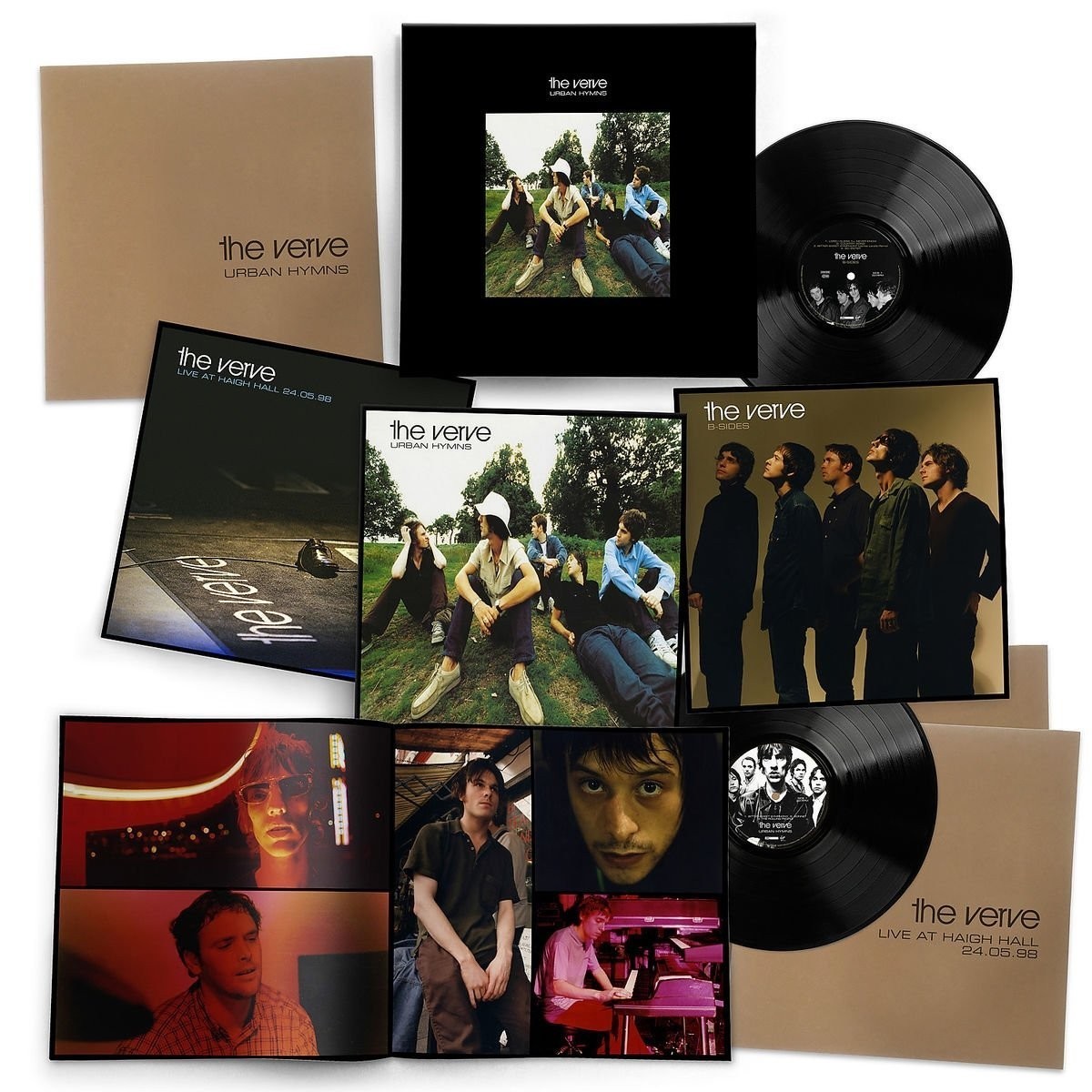
Expertly catching the mood of the late-‘90s upon its release in September 1997, The Verve’s third studio outing went on to become one of the all-time classic British albums. Eleven times platinum in the UK and with ten million copies sold worldwide to date, it also delivered four of the era’s most iconic singles – ‘Bitter Sweet Symphony’, ‘The Drugs Don’t Work’, ‘Lucky Man’ and ‘Sonnet’. Now, exactly twenty years on, comes this 3 double-LP box set version of ‘Urban Hymns’ containing a host of special features. Re-mastering was undertaken by original co-producer Chris Potter and the original album, spread over two vinyl discs, comes supplemented by a double album of B-sides and sessions, plus a further double set containing the previously unreleased concert at Haigh Hall. The box also comes with a 20-page booklet book including a selection of unseen photographs by Chris Floyd, who travelled with the band and was granted unprecedented backstage and offstage access. There is also a download card entitling the purchaser to all of the audio and the further music included on the 4CD Box Set edition.
The Verve’s third studio album “Urban Hymns”, originally released September 29th, 1997.
From their beginnings, Spiritualized and The Verve were celestial brethren. Both bands formed in 1990, undoubtedly with a mutual love for Pink Floyd’s The Piper At The Gates Of Dawn and an appetite for drug-taking: Jason “J Spaceman” Pierce founded Spiritualized from the ashes of his previous band, heroin-championing trance rockers Spacemen 3, while Verve (then without a “The”), led by the charismatic Richard Ashcroft, was a gang of teenagers that enjoyed trippin’ balls on LSD. They each jammed eternal, though with distinct styles: Pierce favoured extended, pedal-heavy drones, while Verve conceived loose, reverb-soaked grooves. Following the release of Spiritualized’s debut album, Lazer Guided Melodies, and Verve’s debut single, “All In The Mind,” in 1992, the two bands toured the UK together. For the next couple of years, the bands seemed to follow a similar path, on course for cult worship. Spiritualized has always been and forever will be Jason Pierce. The gaunt, straggly-haired Spaceman as he was called, formed the band in 1990 as Spacemen 3 was crumbling from the result of his acrimonious relationship with paper-thin bandmate Pete “Sonic Boom” Kember, a 24/7 shades wearer with a bowl cut. A lot of it had to do with two songwriters going in different directions and likely drugs, but the presence of Pierce’s then-girlfriend, the Calvin Klein-modelesque Kate Radley, was also to blame. According to Kember, Radley put a strain on band relations by following the band around wherever they played, be it the studio, rehearsal, or gigs. Once the band imploded, Pierce recruited the remaining S3 members, sans Kember, for his new band, Spiritualized. After the release of their debut single, “Anyway That You Want Me,” Radley joined the band on keyboards, adding a face to Pierce’s muse for songs like “I Want You” and “If I Were With Her Now.” After joining in 1991, Radley became as synonymous with Spiritualized as Pierce, appearing in all press photos, sometimes just the two of them. They appeared as a match made in the heaven he so often referred to in his music.
In 1995, Spiritualized added “Electric Mainline” to their name for some reason and released the magnificent Pure Phase, an album of transcendental, cosmic R&B designed to “play loud ‘n’ drive fast.” Verve, meanwhile, was forced to add “The” to their name, thanks to a lawsuit by the record label of the same name. Unlike Spiritualized Electric Mainline, The Verve would stick. They too released an album, A Northern Soul, which followed up their 1993 debut, A Storm In Heaven. Moving on from their early cavernous psych-rock, A Northern Soul was a game-changer. Led by Ashcroft’s emotive voice, Nick McCabe’s virtuosic guitar work, and Oasis producer Owen Morris’ larger-than-life production, The Verve moved into a whole new stratosphere: the mainstream. Although the album is carried by a spirit that is equal parts Floyd and Zeppelin (see the rumbling low-end vibes of “Life’s An Ocean” or the ecstatic rave-up “This Is Music”), it was the ballads, “On Your Own” and “History,” that helped them crack the Top 30 and reveal Ashcroft, now referred to by Noel Gallagher as “Captain Rock,” as one of the UK’s most compelling songwriters.
The Verve had surpassed Spiritualized and entered the big time, but their success was not what caused a rift between the two bands. Instead, it was due to a personal matter. That same month, The Verve released A Northern Soul, Richard Ashcroft married Kate Radley in secret. Yeah, you read that right: Ashcroft, not Pierce, married Radley. This bombshell was kept under wraps until 1997, but for two more years, Radley was still an active member of Spiritualized. In fact, just days after the wedding, Spiritualized headlined above The Verve at the Phoenix Festival in Stratford-Upon-Avon.
Neither camp has ever been forthcoming about whether Ashcroft was the cause of Pierce and Radley’s romance ending. Maybe that’s for the best, to let this dog lie and just enjoy all of the music that seemed to be a result of such an ordeal. But in these pre-social media times, this incredible love triangle story managed to transpire without details leaking to the press. Fifteen years after it happened, Ashcroft offered up a rare candid moment to Sirius XM, even accepting blame for her leaving Spiritualized. “I was supporting her band,” he said. “I saw this girl jump off the stage with these boots on, this beautiful little skirt. I’m like, ‘Wow! Who’s that? She’s gorgeous.’ And I’m just so lucky that she was intelligent as well. Such a bloody bonus, guys out there! You really should go for that. But I was very fortunate. People should check out her band, she doesn’t play with them anymore. I probably ruined that!”
The loss of Radley romantically seemed both devastating and inspirational for Pierce. Normally, he would let the songs just come to him, but when he sat down to begin writing Ladies and Gentleman in the summer of 1995, he amassed 14 songs in 11 days. According to then-bandmate Sean Cook, Pierce had been doing heroin, which he seems to corroborate on “Home Of The Brave”: “Sometimes I have my breakfast right off of a mirror.” Other lyrics like “There’s a hole in my arm where all the money goes” (“Cop Shoot Cop”) and “Just me, my spike in my arm, and my spoon” (“Think I’m In Love”) insinuate that he was consuming the brown stuff intravenously. Even for a guy who named an album, Taking Drugs To Make Music To Take Drugs To , this seemed like a pretty shocking admission.
Of course, in hindsight, it’s Pierce’s romantic anguish and this supposed inability to carry on that makes the album such a gut-punch to hear. The first voice you hear on Spiritualized’s Ladies and Gentlemen We Are Floating in Space isn’t his, but hers: Radley mutters the album’s titular words completely devoid of emotion. Rumour has it the line was left as a “kiss-off voicemail” for Pierce, though that has never been verified, and seems more like a thing of gossip. Lines like “I’m wasted all the time, I’ve got to drink you right out of my mind” (“Broken Heart”) and “All I want in life’s a little bit of love to take the pain away” (title track) painted a seemingly obvious picture of despair. But Pierce frequently denied that these songs were about his ex. He told MOJO, “If I hadn’t been doing interviews I wouldn’t even have come to that conclusion.” He also downplayed any kind of resentment over Radley leaving him for Ashcroft, telling NME, “I love her dearly and she loves me dearly. Simple fact.
Astonishingly, Radley was still in the band, and is credited with contributing organ, synths, and piano, as well as vocals to the album. However, when it came to gigs, Spiritualized’s PR team claimed she was suffering from a “mystery illness.”
Pierce has said that a lot of the album was recorded spontaneously, and most of what we hear are first takes. So the majority of his time was spent mixing the album, a total of 18 months all ce has said that a lot of the album was recorded spontaneously, and most of what we hear are first takes. So the majority of his time was spent mixing the album, a total of 18 months all together. Originally, he asked Brian Eno to take a crack at it, but he was too busy. And so Pierce began a quest on par with Kevin Shields‘ epic stab at refining My Bloody Valentine’s Loveless, to achieve perfection. Some might say he achieved it. Ladies and Gentlemen We Are Floating in Space might not receive the same godlike praise as Loveless, but it’s every bit warranted. This was one man’s singular vision: an orchestral space rock odyssey complete with blessed gospel choirs, bursts of free jazz noise, swampy blues, and garage rock freak-outs, divulging the pain he’s suffered.
When Ladies and Gentlemen We Are Floating in Space was released, the press was still unaware of Radley’s marriage to Ashcroft. Pierce was subjected to questioning about their relationship, considering the lyrical content, but no one caught on. And why would they? He was admittedly still living with Radley’s parents at the time. Months later, when the press found out, Radley and Ashcroft became tabloid fodder and their lives became a soap opera.
Pierce did everything he could to deflect any such attention in order to push his masterpiece. Despite no real hit single to boost it, the album was a commercial success, charting at number four in the UK and achieving a considerable breakthrough in the US. The novelty of packaging the CD in prescription pill form complete with a foil blister pack and dosage advice also helped shift a few copies. So did a performance 114 stories high at the top of Toronto’s CN Tower, which was recognised by the Guinness Book of World Records as the highest gig ever played.
The Verve, meanwhile, was on the verge of Oasis-level fame. After breaking up (for the first time) in 1995, Ashcroft began working on music he felt would be for his solo album. Instead, The Verve reformed and released the mammoth hit “Bitter Sweet Symphony” in June 1997. (To Pierce’s probable liking, the band was forced to pay 100 percent of the song’s royalties to Mick Jagger and Keith Richards for sampling an orchestral version of the Rolling Stones’ “The Last Time.”) These new, uplifting anthems – perhaps a sign of his domestic bliss with Radley – formed their third album, Urban Hymns.
The Verve may not have survived (they would reform again in 2007 to make a spectacularly shit fourth album, then break up for a third time), but Ashcroft ended up with both the girl and the glory. The drugs may not have worked for him, but selling out sure did. By appealing to the common denominator – which at this time was deemed Noelrock – rather than continue with their cathartic space rock, Urban Hymns became a number one album, selling over ten million copies worldwide and making Ashcroft a rock star in the process.
For the most part, Urban Hymns is still lauded as a modern day classic, but in retrospect, it likely should have been credited to “Richard Ashcroft & The Verve.” That’s certainly how the press treated it. Maybe in 1997, when Britpop was still being touted and Oasis was – in their words: the biggest band in the world – songs like “The Drugs Don’t Work” and “Lucky Man” were candidates for Single of the Week, but two decades later they sure don’t sound much different from this. Maybe finding true love wasn’t the best thing for Ashcroft’s songwriting after all, because things only got worse when The Verve returned in 2008 with Forth.
The same cannot be said about Spiritualized’s Ladies and Gentlemen We Are Floating in Space. What Pierce created was timeless; an engrossing, uncompromising, and outright masterpiece that critics have never needed to reassess. That might have something to do with the fact that Pierce, unlike Ashcroft, has never strayed far from his original template.
OK Computer that year may have won over the critics, and Urban Hymns may have sold a zillion copies, but Ladies and Gentlemen We Are Floating in Space is 1997’s true magnum opus. It’s the sound of a man detailing how he lost his heart, body, and soul over the span of 69 spellbinding minutes.
Remastered • Unheard live audio • B-sides & Remixes • DVD • Vinyl box
Universal will celebrate the 20th anniversary of The Verve’s “Urban Hymns” album in September with a reissue campaign that includes a 5CD+DVD super deluxe edition and a massive 6LP vinyl box set….
All formats feature a remastered version of the album (the work of Chris Potter and Metropolis’ Tony Cousins) and the super deluxe edition box set adds four further CDs offering B-sides, remixes, session tracks, BBC Sessions and two discs of unreleased live performance from the era, including the May 1998 hometown show in front of around 35,000 fans at Haigh Hall, Wigan.
That same show also features on a content-packed DVD, included within the super deluxe, which includes the 1999 documentary The Video 96-98(unreleased on DVD until now) and promo videos.
As with the Verve box sets from last year this super deluxe includes a 56-page hard cover book, a poster and five postcards. Whatis different about the reissue of this album is that there is a vinyl box set edition that is very extensive indeed and covers most (not all) of the audio in the CD box across six vinyl records(three gatefold packages). The remastered Urban Hymns is pressed on two LPs, and all the B-sides and remixes are included on two further vinyl records. All 15 tracks from the previously unreleased Live at Haigh Hallfill the final two vinyl records, completing this six-LP vinyl box.
The audio you don’t get in the vinyl box is the BBC Evening Session (CD3 of the box) and the 12 tracks of ‘Further live material’ on CD 5. However, the vinyl box does come with a 20-page booklet anda download card which entitles you to all audio from the super deluxe edition CD box set.
There is a 2Cd edition as well. The second disc is the Haigh Hall live performance, rather than the B-sides and remixes, although the eagle-eyed amongst you might notice that Universal haven’t just repeated CD 4 from the box set. Neon Wilderness is missing (along with the encores) and they’ve added three tracks from the aforementioned ‘further live material’ tracks. Putting this live audio on disc two is probably a good decision, since many fans will have CD singles from back in the day.
Multi-disc super deluxe edition box sets of The Verve’s first two albums A Storm In Heaven and A NorthernSoul are to be released…first two albums, 1993’s A Storm in Heaven and A Northern Soul from 1995 will both be reissued by Virgin/EMI in September as multi-disc super deluxe edition box sets…
Both albums are remastered by Chris Potter (co-producer of the band’s Urban Hymns) and both of the new box sets feature previously unreleased studio recordings, BBC sessions and various B-sides / extra tracks from the singles of the era.
The super deluxe of A Storm in Heaven is a 3CD+DVD set and includes all the pre-album E.P. tracks, associated B-sides and acoustic versions, as well as two previously unreleased BBC radio sessions and two unreleased studio tracks – South Pacific and Shoeshine Girl.
The DVD features a 1992 Camden Town Hall concert, the USA promo video for Blue, unseen footage of the band in New York in October 1992 and a video for the unreleased South Pacific, made up from footage of the Sawmills recording sessions as captured by producer John Leckie.
The super deluxe for A Northern Soul is ‘just’ a three-CD set with the audio content following a similar pattern to the aforementioned Storm in Heaven set. So it includes of all associated B-sides and two previously unreleased BBC radio sessions as well as offering an impressive seven unreleased studio tracks, including early versions of The Rolling People and Come On (later re-recorded for Urban Hymns) as well as Mover and Muhammad Ali (both of which would be revisited for the band’s 2008 reunion album, Forth).
Both of the super deluxe editions are in lift-off-lid boxes (presumably like Tears For Fears/Simple Minds) and contain posters and postcards. The booklets feature interviews with the band (but not Ashcroft). The Northern Soul box is covered with silver ‘mirri’ board as per the original 2LP vinyl
Both of these will be issued on 9th September 2016 along with gatefold vinyl editions..




 The Fat Angel Sings