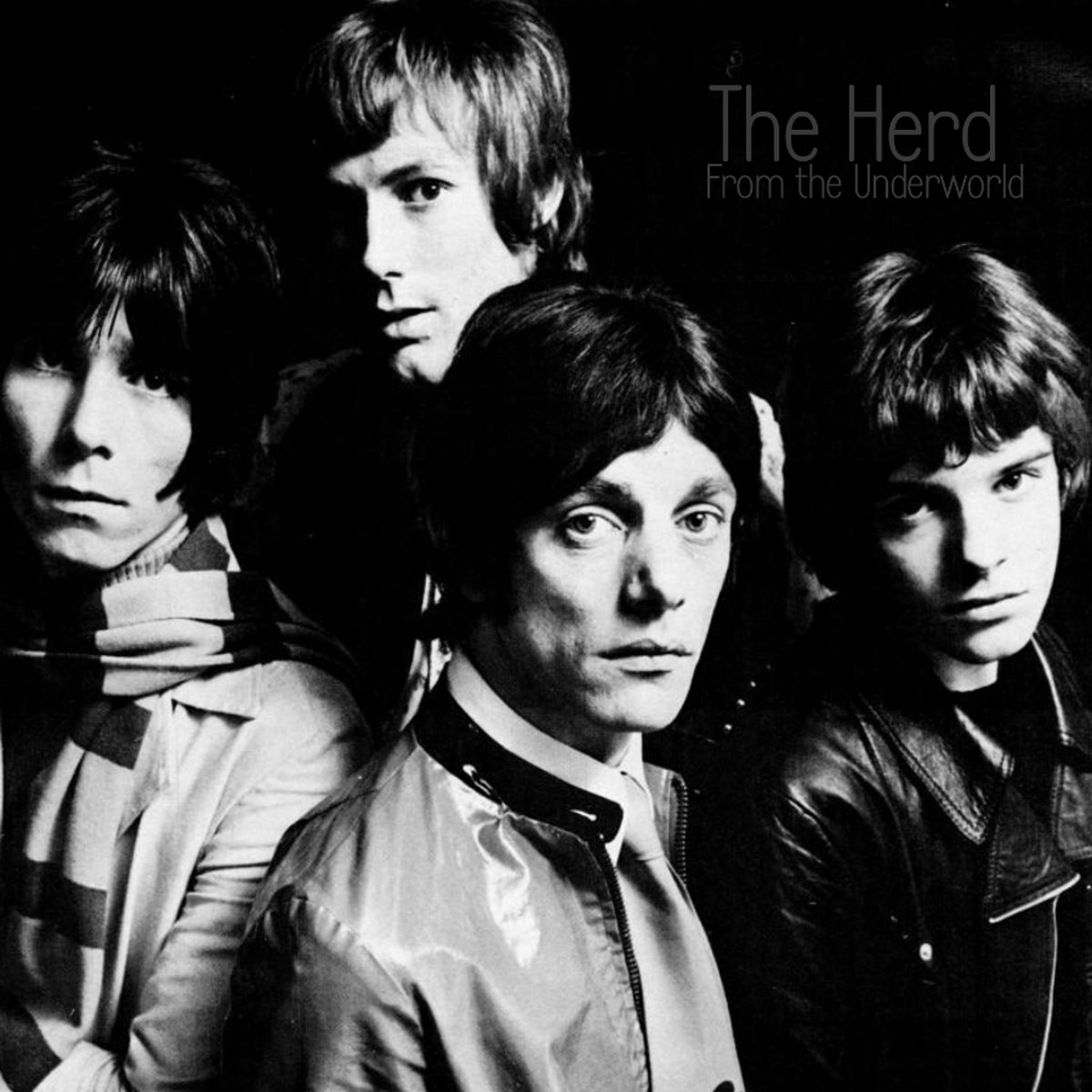
The Herd was founded in 1965 in south London and recorded three singles with Parlophone the most well known perhaps “I Don’t Want Our Loving to Die”. In 1966 three members in succession (Terry Clark, Louis Cennamo and Mick Underwood) quit the group, Parlophone did not want to go on with them, but Fontana Records was willing to give them a try. They also sent their manager Billy Gaff away and brought in the songwriters/producers Ken Howard and Alan Blaikley instead. This pair had been largely responsible for a string of hits by Dave Dee, Dozy, Beaky, Mick & Tich. Howard and Blaikley orchestrated for them a unique blend of pop and flower power pop.
and the group got the line-up that made it famous. Peter Frampton was 16 when he joined the group in 1966, a few years younger than the other members. After a UK Singles Chart near-miss with “I Can Fly” (April 1967), the haunting “From the Underworld”, (August 1967) based on the legend of Orpheus and Eurydice, reached Number 6 later that year with help from copious plays on pirate radio. Radio airplay was essential for success and the band recorded many unique versions of their hits, near misses and stage favourites for radio broadcast. It’s those recordings that comprise this album. The last months of 1968 were tempestuous times for the group. Steele left to be replaced by Henry Spinetti and dissatisfied with mere teen idol status, and disappointed with the failure of “Sunshine Cottage”, which he’d written, Their first and only album Paradise Lost most songs being written by Peter Frampton and Andy Bown, . Frampton left to form Humble Pie with Steve Marriott.
40 years ago today, Peter Frampton released “Frampton Comes Alive!” and it became the best-selling album of 1976.
Release on January. 6th, 1976, Peter Frampton released his LP “Frampton Comes Alive!”. The album was recorded in summer and fall 1975, primarily at Winterland in San Francisco and the Long Island Arena in Commack, New York, as well as a concert on the SUNY Plattsburgh campus in Plattsburgh, New York.
The live album was originally intended as a single LP disc, but at the suggestion of A&M Records additional shows were recorded and the album expanded to two LPs for release.
The double album was released in the US with a special reduced list price of most single-disc albums in 1976. The album was pressed in “automatic sequence”, with sides one and four on one record, followed by sides two and three on the other. This arrangement was intended to make it easier to listen through the whole album in sequence on automatic record changers.
We remember when you couldn’t go anywhere and not hear this playing. How many of you still give this record a listen every now and then? Happy 41st Birthday to “Frampton Comes Alive!”!!!
The ’70s were the era of the live album. the ’70s were the live album’s golden age.
The gauntlet was thrown down in May 1970 by a pair of future live classics released only a week apart.The Who‘sLive at Leeds and the triple live album “Woodstock” soundtrack brought the show into kids’ bedrooms better than anything that had come before, and both were rewarded with stellar sales and critical praise. A format that was once reserved for contractual filler or stopgap releases was suddenly fashionable. Before the year ended, the Rolling Stones released “Get Yer Ya-Ya’s Out!”; before the decade ended, we had live releases from the Beatles, LedZeppelin, Ted Nugent andAerosmith. It was a status symbol, an indicator of commercial clout: The bigger you were, the more likely your discography sported a live album.
In the middle of the decade, another pair of live albums changed the paradigm. Both featured artists whose recording careers were floundering but who did well on the road. With one last chance to catch on with the record buying public. The first was the September 1975 release of Kiss Alive! Three months later (and also sporting an exclamation point), A&M Records released former Humble Pie guitarist Peter Frampton‘s concert masterpiece, “Frampton Comes Alive!”
Frampton was a prodigy who counted David Bowie among his childhood friends. By age 18 he’d already tasted success with the Herd and had formed Humble Pie with Steve Marriott . Together they would record four studio albums before jumping on the ’70s live LP bandwagon with another classic live album “Performance Rockin’ the Fillmore” at the end of 1971. It would be Humble Pie’s most successful album, but the band’s hotshot guitarist was gone before it was even released.
At the tender age of 21, Frampton had two successful bands in his rear-view mirror and a limitless road ahead of him. His first solo album, 1972’s Wind of Change, eschewed the muscular boogie of Humble Pie for a more acoustic, singer-songwriter vibe . Songs like the album’s title cut introduced the new, mellow Frampton while “It’s a Plain Shame” and a cover of the Stones’ “Jumpin’ Jump Flash” seemed tailored for his established fan base. In other words, the album was neither fish nor fowl, and sales were disappointing.
40 years ago today, Peter Frampton released “Frampton Comes Alive!” and it became the best-selling album of 1976.
The ’70s were the era of the live album. the ’70s were the live album’s golden age.
The gauntlet was thrown down in May 1970 by a pair of future live classics released only a week apart.The Who‘sLive at Leeds and the triple live album Woodstock soundtrack brought the show into kids’ bedrooms better than anything that had come before, and both were rewarded with stellar sales and critical praise. A format that was once reserved for contractual filler or stopgap releases was suddenly fashionable. Before the year ended, the Rolling Stones released “Get Yer Ya-Ya’s Out!”; before the decade ended, we had live releases from the Beatles, LedZeppelin, Ted Nugent andAerosmith. It was a status symbol, an indicator of commercial clout: The bigger you were, the more likely your discography sported a live album.
In the middle of the decade, another pair of live albums changed the paradigm. Both featured artists whose recording careers were floundering but who did well on the road. With one last chance to catch on with the record buying public. The first was the September 1975 release of Kiss Alive! Three months later (and also sporting an exclamation point), A&M Records released former Humble Pie guitarist Peter Frampton‘s concert masterpiece, “Frampton Comes Alive!”
Frampton was a prodigy who counted David Bowie among his childhood friends. By age 18 he’d already tasted success with the Herd and had formed Humble Pie with Steve Marriott . Together they would record four studio albums before jumping on the ’70s live LP bandwagon with another classic live album “Performance Rockin’ the Fillmore” at the end of 1971. It would be Humble Pie’s most successful album, but the band’s hotshot guitarist was gone before it was even released.
At the tender age of 21, Frampton had two successful bands in his rear-view mirror and a limitless road ahead of him. His first solo album, 1972’s Wind of Change, eschewed the muscular boogie of Humble Pie for a more acoustic, singer-songwriter vibe . Songs like the album’s title cut introduced the new, mellow Frampton while “It’s a Plain Shame” and a cover of the Stones’ “Jumpin’ Jump Flash” seemed tailored for his established fan base. In other words, the album was neither fish nor fowl, and sales were disappointing.



 The Fat Angel Sings