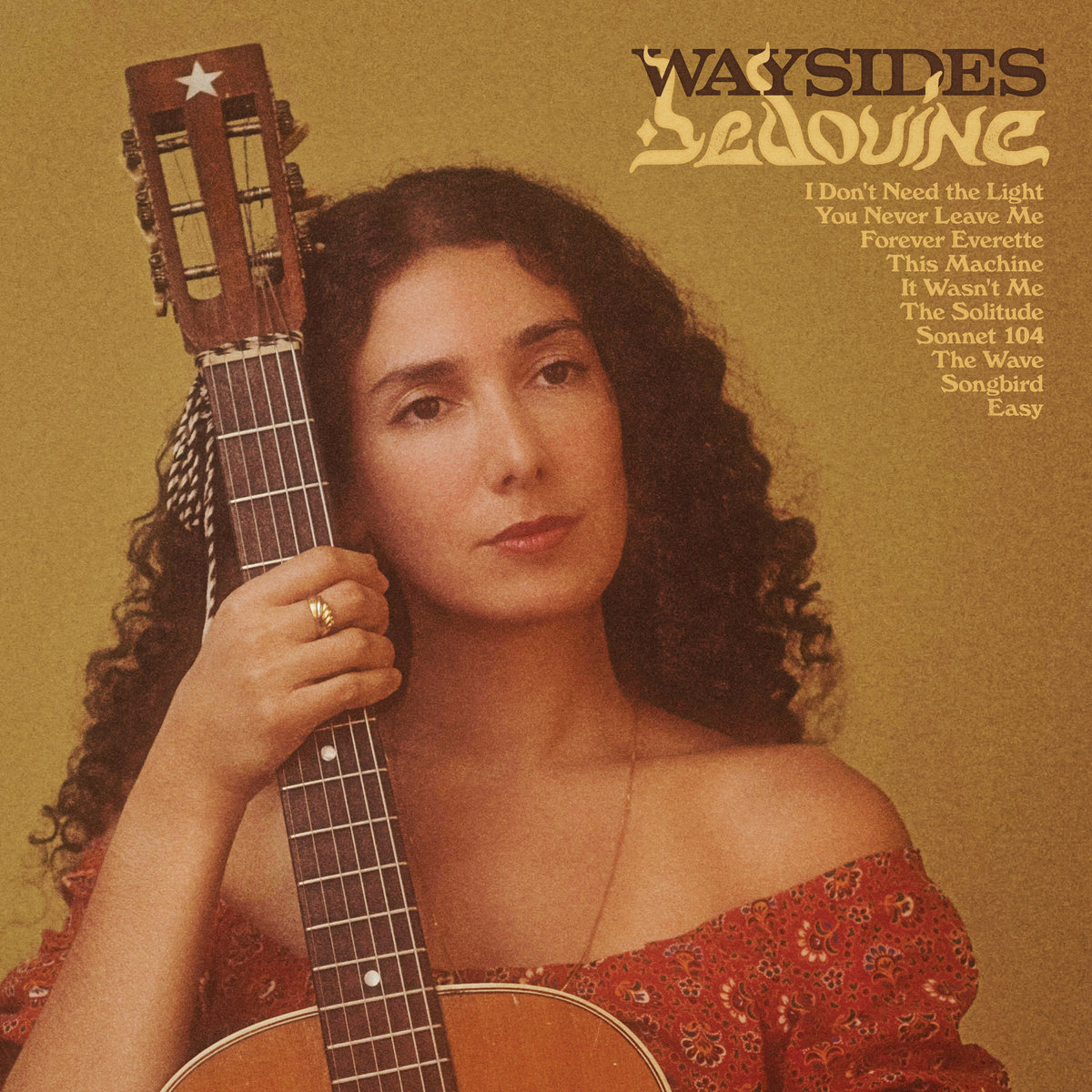
“Waysides” is not the typical album, but rather a hodgepodge of tracks cut from Bedouine’s previous records, threads of older material, scraps of the sounds and moments of her past. The album encapsulates the artist’s coming of age, grappling with emotions and experiences that come with gaining wisdom. Waysides is the kind of album that would back delicate daydreaming or frolicking through a field, as much as it would work for deep contemplation and nostalgia. Azniv Korkejian has a way of wrapping up rather heavy-hearted lyrics in a charming manner, so much so that the emotion at hand must often be extracted. Sometimes the emotional weight of the song is completely different from how the song sounds, as if one track can become two simultaneously. To use a phrase Korkejian herself sings in “You Never Leave Me,” her music is both “sweet and tough.”
Bedouine loves covers. In the past couple years, LA-based singer-songwriter Azniv Korkejian has recorded tunes by Margo Guryan, Ron Sexsmith, Big Star, and Bill Withers plus the folk traditional “All MyTrials.” And now she has put her own spin on Shaggy’s immortal 2001 chart-topper “It Wasn’t Me.” But Bedouine’s “It Wasn’t Me” is an original the latest single from her upcoming album “Waysides” following last month’s “The Wave.” Here’s a statement from Korkejian about the track: This song represents a special stage to me. I was just starting my habit of bedroom demoing. Locking myself in for hours at a time to put away a feeling was the most rewarding thing. If I felt that I captured what I was feeling, I’d send it to whomever it was about, like an elaborate letter. It was thrilling. That was 15 yrs ago and not much has changed. The song itself is about spending an evening with someone, thinking it was this incredibly romantic time, only to find out I was alone in that feeling. It’s a reflection of that bewilderment and the denial that can follow. It feels good to share after so long. It makes me nostalgic for bygone days, which is one of the threads that runs through Waysides.
The 2nd single from upcoming album, “Waysides” is out via The Orchard.
Nilufer Yanya’s new release ‘Inside Out’ is a compilation of her previous eps, ‘Small Crimes’, ‘Plant Feed’ and ‘Do You Like Pain?’. Londoner Yanya might just be one of the most interesting guitarists operating right now, her songs are technically impressive but never bypass the instant pleasures a good riff can bring. “Stabilise,” the first single from new album “Painless” (March 4th, 2022), is a dizzying experience built for repeat listens.
After picking up heaps of critical praise (including a Best Music Music designation from Pitchfork) with her debut, Nilufer Yanya looks to make good on the hype with her follow-up “Painless”. The UK singer/songwriter cuts through the fog of the first record for a piercing display of emotional vulnerability.
Recorded between a basement studio in Stoke Newington and Riverfish Music in Penzance, the record is a more sonically direct effort, narrowing her previously broad palette to a handful of robust ideas. Yanya’s debut album “Miss Universe” (2019) earned a Best New Music tag from Pitchfork and saw support tours with Sharon Van Etten, Mitski and The XX.
Nilufer is donating her release profits to the organization artists in transit, ait is a non-profit collaborative artists project bringing creative workshops to displaced communities and people in times of hardships.
Billie Marten has shared her new single for ‘Liquid Love’, taken from her third album “Flora Fauna”.
To coincide with the single’s release, Marten has also shared the music video for ‘Liquid Love’ which is another collaboration with the director of ‘Creature Of Mine’ and also ‘Human Replacement’s evocative video, Joe Wheatley.
Marten explains: “This is my favourite of the Joe Wheatley visual trio. Initially I wanted the video to match the swirling, translucent watery-ness of Liquid Love, something meandering and dreamlike. I’d pictured blues and pinks, ripples, skin, wet hair and a visceral picture of real life. In the end I think we (me and Joe) managed just that, through the sheer power of simplicity and understatement. It paints a natural tranquility, using the tokens of community, friendship, family, love and warmth. All those things I was craving and pining for at the time of writing. It feels incredibly real to me as the song does too, and we weren’t acting, we were living.”
Built on the minimalist acoustic folk foundations she made a name for herself with, Marten’s third album Flora Fauna is a more mature, embodied album fostered around a strong backbone of bass and rhythm. Shedding the timidity of previous work in favour of a more urgent sound, the songs mark a period of personal independence for Marten as she learned to nurture herself and break free from toxic relationships – and a big part of that was returning to nature.
“I wasn’t really treating myself very well, it was a bit of a disruptive time. All these songs are about getting myself out of that hole – they’re quite strong affirmations. The name Flora Fauna is like a green bath for my eyes. If the album was a painting, it would look like flora and fauna – it encompasses every organism, every corner of Earth, and a feeling of total abundance.
Marten will embark on a UK tour including September 26th Dot To Dot Festival, Nottingham,
Marissa Nadler is releasing a new album, “The Path Of Clouds” on October 29th via Sacred Bones and Bella Union. shared its second single, “If I Could Breathe Underwater” via a video for the song that fittingly features Nadler underwater. The song features harp playing from longtime friend Mary Lattimore of Nadler’s. Jenni Hensler directed the video, which was partially shot with 16mm film camera.
Nadler had this to say in a press release: “When I wrote ‘If I Could Breathe Underwater,’ I was contemplating the possibilities of possessing various superhuman powers: teleportation, shapeshifting, energy projection, aquatic breathing, extrasensory perception, and time travel to name a few. As a lyrical device, I married those powers with events in my life, wondering if and how they could change the past or predict the future. I loved working on the melody for this song and bringing the choruses to their climaxes. Mary’s layered, hallucinatory shimmers really echo the netherworld of the story.”
Hensler had this to say about the video: “This song took on many meanings to me and I love that about it. How beauty and tragedy collide. Dreaming of having supernatural powers to change reality and have the ability to live and breathe underwater. It could also speak to the duality of existence. That we all have inner personas or shadow selves, and how we envision those different masks we wear. I chose to make something that touched on the idea of duality and the inner persona. To connect to the two worlds.”
Previously Nadler had shared the album’s first single, “Bessie Did You Make It ?” via a video for it. Nadler wrote and recorded the album during the pandemic and was partially inspired by binging reruns of Unsolved Mysteries as she “began to notice parallels between many of its stories and her own life,” as a press release puts it. On The Path of theCloudsshe worked with various collaborators, including Mary Lattimore, Simon Raymonde (of Cocteau Twins and Lost Horizons and the head of Bella Union), multi-instrumentalist Milky Burgess, Jesse Chandler (Nadler’s piano teacher and a member of Mercury Rev and Midlake), Emma Ruth Rundle, and Black Mountain’s Amber Webber. Seth Manchester (Lingua Ignota, Battles, and Lightning Bolt) mixed the album.
If I Could Breathe Underwater, off of my upcoming album The Path of the Clouds. The album is out October 29th on Sacred Bones Records and Bella Union Records.
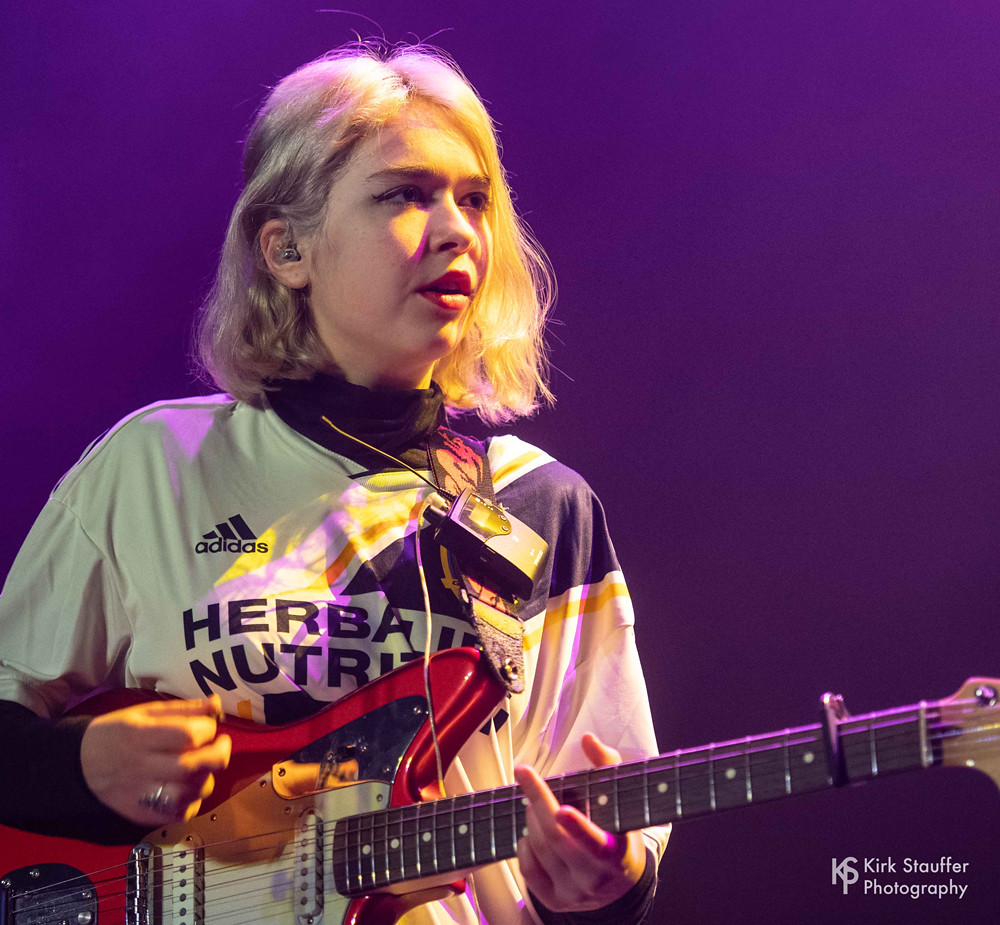
Three years after dropping her much-adored debut album “Lush”, Snail Mail has announced her new LP “Valentine”, out on October 5th. The project’s title track, out today, is a sunburst of unrequited love with one very scream-worthy hook that will find a special place in the heart of anyone with a soft spot for anthemic alt-rock. Josh Coll directs the music video, streaming below, and turns in a tale of aristocratic affection with buckets worth of blood.
Many young female musicians who were heralded as prodigies have made music this year revisiting the barbarity of that early renown, the powerlessness they felt as teenagers trapped in an all-consuming gaze. Lorde described having “nightmares from the camera flash”; Billie Eilish observed “a stalker walking up and down the street” Clairo spoke about being “just useless and a whore” but still getting cosigned by “your favourite one-man show” after being sexualized in the industry. To deal with the aftereffects of a “young life colliding with sudden fame,” Lindsey Jordan of Snail Mail who became an indie rock phenom after she released her debut album, “Lush” at 18—spent time at a recovery facility. There she charted out arrangements for what would be her upcoming second album, Valentine, later building on and refining those sketches in North Carolina with producer Brad Cook. Her intimate worlds, usually confined to a “you” and “I,” now face unwanted intruders: “Careful in that room,” she warns a lover on Valentine’s title track. “Those parasitic cameras, don’t they stop to stare at you?”
The most striking change on “Valentine” is Jordan’s voice, which is deeper, hoarser, and more mature than before. It cuts through foggy, cinematic synths as she lays out the unsteady dynamics of a relationship (“You’ve gotta live/And I gotta go”) while emphasizing the force of her devotion (“Fuck being remembered/I think I was made for you”). “Valentine” is accompanied by a gory, high-drama music video in which Jordan plays a chambermaid to a high-society woman with whom she has an illicit affair; crestfallen and crazed after seeing her lover with a man, she binge-drinks, stuffs her face with cake, and eventually murders him. The song ratchets up from slow-jam to power pop, souring in an instant as Jordan reels from betrayal: “So why’d you want to erase me?” she cries, speeding into the question with all of her might. Jordan is shattered yet hopeful, anticipating future envy upon seeing her lover with someone else and preparing for when, not if, they change their mind. Undergirding all these emotions is a simple truth: “I adore you.”
2/18 – Manchester, England – Manchester Academy 2 2/20 – Glasgow, Scotland – QMU 2/22 – Bristol, England – SWX 2/23 – London, England – O2 Forum Kentish Town
Valentine, the new album, is out on Matador Records
When you listen to the love songs of LA-based Bedouine, you will be reminded of Karen Dalton’s world-wise voice or the breathy seduction of Minnie Riperton’s vocals, the easy cool of French ye-ye singers, and the poetry of Joan Baez. Her folk is nomadic, wandering across time and space, and on the likes of new song Dizzy meander into danceable jams. On first discovery you may ask whether they’re dated to 2019, or whether you’ve uncovered some forgotten classic. It makes sense that singer-songwriter Azniv Korkejian’s arrival – both musically and personally – on her second record has been influenced by her own wanderlust, displacement, and curiosity.
The music is the farthest from curmudgeonly or depressive as could be. It’s a soundtrack to Spring blossom, to warm air on skin, to the concept of possibility. Amazingly, despite the successes since her debut release, “Bird Songs of a Killjoy” rejects any pressures to be some kind of grand evolution from before. When her self-titled debut came out in the summer of 2017, Azniv was entirely unknown, and wasn’t necessarily looking to change that. The album she wrote in her free time while dealing with some emotional trauma and locking herself away in her house, was an exercise in diarizing, in expression without expectations. Some of the songs on this sophomore effort were from that same time period of fruitful creativity. She continued her creative partnership with Gus Seyffert (Beck, Norah Jones) who produced them in his studio.
If I could play a song as many times as I wanted, over and over and over again and sing it at the top of my lungs without a care in the world. This would be my vocal lesson song, my affirmation. Singing it gives me so much joy. “He” in this song is “spirit” or “God” and sometimes I changed it to “She” depending on who I was calling in that day (angels, guides, guardian wise). I love this song so much- it’s grounding and permission giving and loving.
“When You’re Gone” continues the Aleppo-born, Saudi Arabia- and America-raised musician’s collaborative partnership with Gus Seyffert (Beck, Norah Jones, Michael Kiwanuka), who produced the single in his Los Angeles studio. “Drag my finger round the rim / drag around a phantom limb when you’re gone,” Bedouine sings, her delicate vocals and fingerpicked guitar flurries accompanied by orchestral flourishes that lend them a gentle grandeur befitting the video’s breath taking natural imagery. “When I started ‘When You’re Gone,’ I was just messing around with pretty chords. Then the lyrics spontaneously came to me much later when I read something on Instagram, which is kind of hilarious. It triggered a line that eventually rolled out the entire song,” Bedouine explains. “In retrospect I think it reflects on the time since I’ve released my first record; in nondescript hotel rooms alone or getting dropped off a cliff after tour is over, not exactly sure what to do with myself. It also touches on what that can mean when it comes to the people you’re closest to.”
Bedouine “When You’re Gone” out now on Spacebomb Records
Kristian Matsson, aka The Tallest Man On Earth, is a Dylan successor if there ever was one. In fact, some music writers and fans may even feel his voice is a little too reminiscent of Dylan’s. His tendency to write music that’s more raw and stripped-down paired with his strained, gruff vocals make the comparison almost too obvious. But, then again, Matsson’s music is still something singular. Across five LPs and three EPs, the Swedish singer/songwriter and fingerpicker extraordinaire has charmed his way through folk circles and indie rock strongholds alike, positioning himself as one of the finest roots musicians working. Last year, he veered away from the strictly rustic style of his first four LPs in exchange for a more elaborate setup on I Love You. It’s A Fever Dream.: horn sections, electronic blips, atmospheric effects. But at the core of all his music is Matsson’s introspective song-writing sensibilities and his banjo (or guitar, depending on the song). In honour of one of the best artists in the world of indie folk, Matsson has a broad fanbase, but The Wild Hunt in particular has steadily acquired new fans and has aged especially gracefully over the last decade. Here are 10 of our favourite songs from his catalogue.
“Sagres”
While 2015’s Dark Bird Is Home is by and large a bit of a dark spot on Matsson’s otherwise untarnished discography, there are a few moments of reprieve within it. One of those is “Sagres,” a jangly folk-pop number that pays respect to Cape Sagres, a headland in the southwest of Portugal that’s nicknamed the “end of the road.” In the song, however, Matsson toils in the end of a relationship and starts to question everything, lamenting “It’s just all this fucking doubt,” at one exasperated point in the song.
“It Will Follow The Rain”
Matsson leans fully into his folklorist side on this cut from his self-titled debut EP. Mentioning mountains, valleys and lightning strikes, this song was just the tip of iceberg when it comes to TheTallest Man On Earth’s obsession with the natural world. Some of his best work references our Mother Earth, and this song in particular contains a hopeful, pastoral energy as Matsson compares life to the fleeting nature of a rainstorm.
“Little River”
His 2010 EP Sometimes The Blues Is Just A Passing Bird contains some of Matsson’s best work, not least among it being “Little River.” If it weren’t for a rolling, quickened under-beat and a rather morose conclusion (“You just sing about your own death in your closet / You stumble out into the pitch-black hallway,” he sings at one point), it’d make the perfect lullaby.
“1904”
“1904” is undoubtedly one of the jammier songs across Matsson’s eight projects, benefitting greatly from an electric guitar groove. Apparently the song references a devastating earthquake that rocked Sweden and Norway in the titular year, but you needn’t have any knowledge of natural disasters to make sense of this pleasant folk-rock tune.
“Shallow Grave”
In all honesty, there isn’t much dispute among fans about which of the Tallest Man On Earth’s albums are best: 2008’s Shallow Grave and the proceeding The Wild Hunt (2010) are almost always going to come out on top. The title track from the former contains all the elements that make this pair of albums so interesting and listenable: a relentless banjo lick, existential ramblings and Matsson’s inimitable scratchy-throated cry. The narrator here is down-on-his-luck, and Matsson finds the most lyrically beautiful ways to convey this unrest: “I found the darkness in my neighbour / I found the fire in the frost / I found the season once claimed healthy / Oh, I need the guidance of the lost.” Following his debut album Shallow Grave in 2008, Matsson was invited to tour with indie-folk lord Bon Iver.
“Troubles Will Be Gone”
The human condition is one of constant searching and exhaustion. We have no assurance that things will be “OK,” as friends and family so often try to convince us. But, at the same time, their dedication to helping us believe everything will turn out alright is in itself proof that no matter what happens, life goes on, because we have loved ones around to see us through it. Matsson infuses a near-perfect banjo melody with this promise on “Troubles Will Be Gone”: “Well the day is never done / But there’s a light on where you’re sleeping / So I hope somewhere that troubles will be gone.” The Wild Hunt, his sophomore LP released on April 13th, 2010, Matsson makes the acoustic guitar sound like an orchestra on “You’re Going Back” and the banjo like a full-throttled band on “Troubles Will Be Gone,” a song about goodwill written in the verbal style of Robert Frost. The entire album is full of these tiny orchestras and miniature choirs—a sound few of Matsson’s contemporaries were able to recreate. But many folk artists who’ve arrived in years after The Wild Hunt have seemingly been taking notes. The like-minded Joan Shelley treats her acoustic guitar with a similar reverence, instrumental artist and former Silver Jews musician William Tyler probably learned a thing or two about pacing and rhythm from Matsson and Hiss Golden Messenger’s M.C. Taylor carries on the legacy of curving his sultry, lilting vocals into a style resembling Dylan, as do Kevin Morby and Waxahatchee, who share that same distinct vocal formula. The Wild Hunt gave proceeding indie-folk artists something to aspire to in terms of both authenticity and craft.
“I Won’t Be Found”
This is, technically speaking, a lovely display of Matsson’s talents. The cascade of banjo is enough to convince anyone to be on his side. But the lyrics, too, help you root for Matsson, as he projects plans for the future before realizing that, if he’s not focusing on the present, he might as well be asleep. “Well if I ever get that slumber / I’ll be that mole deep in the ground,” he sings. “And I won’t be found.”
“Burden of Tomorrow”
Who among us hasn’t fretted over what tomorrow will bring? Here, Matsson promises a partner he’ll be one less thing to worry about, while also acknowledging that while we can think about the future all we want, we truly have no clue what it will bring. We just have to meet it when it comes: “Oh but hell I’m just a blind man on the plains,” he sings over pristine guitar. “I drink my water when it rains / And live by chance among the lightning strikes.” Stylistically, The Wild Hunt isn’t all that different from the mystical, lean and perhaps even more lyrically forthright Shallow Grave. The Wild Hunt is only four minutes longer than Shallow Grave’s half-hour runtime, and like its predecessor, it only features a handful of instruments—never drums—and little to no production effects. Where Bon Iver may flirt with the occasional droning feedback and Marcus Mumford a thundering electric guitar solo, Matsson was strictly acoustic and, usually, strictly analogue. While he has a knack for layered wordplay in the vein of Dylan, rusticity was—and remains—his greatest strength. Kristian Matsson injected light and love into a form of music-making that was half-a-century old at this point, and he made it into something new, singular and sustainable. The Wild Hunt remains an aspirational album in that regard—few roots artists have managed to finesse such an act since.
“Love Is All”
“Love Is All” is The Tallest Man On Earth’s “hit”—and for good reason. It’s the perfect entry point into his catalogue and a damn good folk song in its own right. He recounts the dreadful end of a relationship, and, from the point of the listener, it sounds like he’s brusied beyond repair (“Love is all, from what I’ve heard, but my heart’s learned to kill”). But instead of dwelling on the lost “future” of this couplehood, he releases his regret: “Here come the tears / But like always, I let them go / Just let them go.” Further perfecting his tilted, Dylan-esque vocal delivery, Matsson (who, miraculously, learned English as his second language) spends the bulk of The Wild Hunt spitting out sturdy metaphors and basking in a pastoral wonderland. The album’s high points—including the back-to-back pair “King of Spain” and “Love is All,” easily two of his most popular singles to date—are the closest things you’ll ever hear to pop songs in The Tallest Man On Earth’s catalogue. The former expresses desire to pack up and start life over at a lover’s side on Spanish shores, while the latter is a kind of all-encompassing epic poem about the beauties and dangers of love. That may sound like a grandiose description, but Matsson has a way of making even the shortest folk song into something almost biblical. “Like a house made from spider webs and the clouds rolling in / I bet this mighty river’s both my saviour and my sin,” he sings on the spritely “Love is All.”
“The Gardener”
The Tallest Man on Earth’s “The Gardener” is a metaphorical story of hiding one’s ugliness to better be the apple of a lover’s eye. The verses are patterned a certain way, each a distinct scene recounting a figurative body buried, with the sort of subtle variations that keep you grasping always for the next lyric, imagining the garden you have made.
Hauntingly beautiful vocals paired with a minimal musical backdrop makes for a truly inspired selection of emotional and beguiling songs. Marissa Nadler announced a new album, “The Path of the Clouds” and shared its first single, “Bessie Did You Make It” via a video for it. The Path of the Cloudsis due out October 29th via Sacred Bones and BellaUnion.
Nadler wrote and recorded the album during the pandemic and was partially inspired by binging reruns of Unsolved Mysteries as she “began to notice parallels between many of its stories and her own life,” as a press release puts it. On The Path of the Cloudsshe worked with various collaborators, including Mary Lattimore, Simon Raymonde (of Cocteau Twins and Lost Horizons and the head of Bella Union), multi-instrumentalist Milky Burgess, Jesse Chandler (Nadler’s piano teacher and a member of Mercury Rev and Midlake), Emma Ruth Rundle, and Black Mountain’sAmber Webber. Seth Manchester (Lingua Ignota, Battles, and Lightning Bolt) mixed the album.
Thou’s Mitch Wells directed the “Bessie, Did You Make It?” video and had this to say in a press release: “When I first got the chance to hear Marissa’s new album, and was asked, ‘Which song would you like to do a video for?’ I sort of panicked because literally every song is SO good. It was like being at a buffet of all your favourite food and only being able to choose one thing to eat. I had a blast making the video, but there was always the pressure of ‘don’t let down the song.’ It’s such a beautiful opening track and I’m really lucky I was given the chance to be a part of it.”
Nadler’s last album was 2018’s “For My Crimes”.
So glad that Marissa releases all this extra material. I often like the demo versions better than the final thing, it’s so intimate and real. Like having a friend show you a song they are working on.
Bessie, Did You Make It? from the album “The Path of the Clouds” Out 10/29/21 on Sacred Bones Records and Bella Union Records
“The Path of the Clouds”, Marissa Nadler’s ninth solo album, is the most stylistically adventurous, lyrically transfixing, and melodically sophisticated collection of songs in her already rich discography. Gripped by wanderlust while suddenly housebound at the start of the pandemic in 2020, Nadler escaped into writing, and came back with a stunning set of songs about metamorphosis, love, mysticism, and murder. Blurring the line between reality and fantasy and moving freely between past and present, these 11 deeply personal, self-produced songs find Nadler exploring new landscapes, both sonic and emotional.
One of Nadler’s distractions during the 2020 quarantine was binging reruns of Unsolved Mysteries. As she watched, she began to notice parallels between many of its stories and her own life. What began as a writing exercise became the bedrock of her song writing process, as she came to inhabit the narratives that had so fascinated her. In “Bessie, Did You Make It?,” Nadler inverts the canon of the murder ballad, crafting a narrative of female empowerment and survival. “The Path of the Clouds” tells the story of the infamous hijacker D.B. Cooper, but the song isn’t just about jumping out of an airplane, faking your death, and making a grand exit. It’s a meditation on perseverance and transformation, a salute to mastering one’s fate. “Well, Sometimes You Just Can’t Stay” details the ingenious plans of the only successful escapees from Alcatraz, as well as the lingering enigma that surrounds their history. The lyrical twist on the chorus turns a tale about a prison break into a humorous, shoegazing country song.
While she’s always been a brilliant guitarist, Nadler challenged herself to expand her palette for The Path of the Clouds, experimenting with synthetic textures that make the album feel untethered from time and space. A majestic grandeur sweeps through songs such as “Elegy,” shooting the listener into the stratosphere as synths swirl and entwine with Nadler’s celestial mezzo-soprano. Nadler also learned to play piano during the pandemic’s isolation, and she composed many of the songs on the album on keys rather than guitar, which further contributed to their exploratory feel. These songs are unmistakably Marissa Nadler’s, but they sound free to go places she’s never gone before.
Nadler tracked the skeletons of the songs at home and then sent them to some choice collaborators, including experimental harpist Mary Lattimore and Simon Raymonde, the Cocteau Twins bassist and her Lost Horizons collaborator. Multi-instrumentalist Milky Burgess, having recently worked on the soundtrack to the film “Mandy“, adds intricate melodic power throughout the album. Jesse Chandler, Nadler’s piano teacher (as well as a member of Mercury Rev and Midlake), plays winding woodwinds and plaintive piano to luminous effect. Fellow singer-songwriter Emma Ruth Rundle contributes a slinky guitar solo on “Turned Into Air,” while Black Mountain’s Amber Webber steps in as a vocal foil to Nadler, a ghostly apparition in the distance of “Elegy.” Seth Manchester, known for his work with Lingua Ignota, Battles, and Lightning Bolt, mixed the album at Machines with Magnets in Pawtucket, Rhode Island. Manchester added dimension to the songs’ atmospheric beauty with screeching feedback and distorted guitars. Stripped of the ethereal reverb that often swaddles her resonant vocals, Nadler’s delivery now stings and pierces with newfound immediacy and confidence.
As a songwriter, Nadler is as direct and urgent as she has ever been. There’s no coded language amid the bleak lows and exalted highs of songs like “Elegy,” “Lemon Queen,” “Storm,” and “Tried Not to Look Back.” Memories are painted with highly detailed imagery, and Nadler, also a visual artist, uses that eye not only to tell a story but to transport the listener there.
The Path of the Clouds showcases the power of an artist at the peak of her powers nearly 20 years into an acclaimed career as a songwriter and singer. Coming a long way from the spare dream folk of her earlier work, she has remained inspired and continues to evolve, open to new ideas and directions. The proof is right here, in Nadler’s most ambitious and complex album yet
Los Angeles-based folk singer/songwriter Azniv Korkejian, who performs and records as Bedouine, has announced her third album, “Waysides”, set for an October 15th release via The Orchard. Tender and tranquil, “The Wave” is inspired by “the loss of a close friend, specifically the swell of emotion I try to resign myself to when thinking of her premature absence,” according to Korkejian. The song layers Korkejian’s wistful vocals over a fingerpicked acoustic guitar, minimalist percussion and subtle keys, which fill the negative spaces around her heartfelt emotion.
The singer/songwriter sounds overwhelmed, yet strangely at peace: “I cannot contain the way I feel for you / Or anything / I ride the wave,” she sings, making a friend of her own internal turbulence instead of fighting it.









 The Fat Angel Sings