Posts Tagged ‘John Bonham’

Image may contain: 4 people

Dazed and Confused” is a song written by American singer-songwriter Jake Holmes in 1967, It was described as “a stark, spooky folk-rock track with stinging reverbed lead guitar, Holmes‘ own pained vocals, and furiously strummed rhythm guitar that winds itself into an anguished climax. Holmes recorded the song for his debut album “The Above Ground Sound” of Jake Holmes and he performed it in the late 1960s and early 1970s on the New York City folk scene and the college coffee house circuit. The lyrics refer to the effects of a girl’s indecision on ending a relationship.  This version from Live Supershow 1969 .

In August 1967, Holmes opened for the Yardbirds at a Greenwich Village gig in New York According to Holmes, “That was the infamous moment of my life when ‘Dazed and Confused’ fell into the loving arms and hands of Jimmy Page.” When the track appeared on Led Zeppelin’s eponymous debut album in 1969, Holmes was aware of it at the time, but didn’t follow up on it: “In the early 1980s, I did write them a letter and I said basically: ‘I understand it’s a collaborative effort, but I think you should give me credit at least and some remuneration.’ But they never contacted me.

After hearing Holmes perform the song in 1967, English rock group the Yardbirds reworked it with a new arrangement. It became a centerpiece of the group’s tours in 1968, several recordings of which have been released. “Dazed and Confused” was further adapted later that year by Yardbirds guitarist Jimmy Page’s “New Yardbirds” group (soon to be rechristened Led Zeppelin) for their debut album, Led Zeppelin“Dazed and Confused” became a concert staple with solos that sometimes stretched the performances to 45 minutes.

When the Yardbirds disbanded in 1968, Page planned to record the song in the studio with the successor group he had assembled that summer. According to Zeppelin bassist John Paul Jones, the first time he heard the song was at the band’s first rehearsal session at Gerrard Street in London, in 1968: “Jimmy played us the riffs at the first rehearsal and said, ‘This is a number I want us to do’.” The future Led Zeppelin recorded their version in October 1968 at Olympic Studios, London, and the song was included on their debut album Led Zeppelin (1969). “Dazed and Confused” was the second song recorded at the Olympic sessions.

Page recorded the song in one take with a Telecaster and violin bow as he had performed it with the Yardbirds.  Singer Robert Plant wrote a new set of bluesier lyrics, according to Page though Plant is not credited on the album. Other sources say Page wrote the new lyrics himself. Whichever the case may be, Plant’s vocal is raw and powerful, delivered with “unrelenting passion.”Other than the lyrics and vocal, the song remained very similar to that performed by the Yardbirds earlier that year.

This bolt of lightning likewise illuminates the already thick and portentous soundscape further setting a tone for the impending sonic onslaught. John Bonham (drums) sneaks in with a rock solid downbeat beneath Plant’s opening line. During the bridge [Bonham] explodes front and centre with his trademark blend of keen rhythmic gymnastics and straight-ahead swinging percussive support. The band collectively combust throughout the remainder of the cut as they alternate between scintillating and scorching.”

Led Zep RSD 2018 cover

Limited Edition 7-Inch Single, Produced By Jimmy Page, To Be Released On Record Store Day Featuring Unreleased Versions Of “Rock And Roll” And “Friends”

Led Zeppelin are releasing something special for Record Store Day. Before the legendary band kicks off its 50th anniversary celebration this September, a special 7-inch vinyl single will arrive at independent record stores everywhere on April 21st from Atlantic Records and Rhino.  The single, pressed on yellow vinyl, will premiere two previously unreleased studio mixes: the Sunset Sound Mix of “Rock and Roll” b/w the Olympic Studios Mix of “Friends.”  Both of these tracks have been selected for this release by producer Jimmy Page.

“Rock and Roll” is only the third track released from the fabled Sunset Sound Mixes of Led Zeppelin IV.  The studio mix of “When the Levee Breaks” actually made the original album, while the mix of “Stairway to Heaven” was included on the 2014 Deluxe Edition.  The Olympic Studios Mix of “Friends” is described by the label as a “stripped-down version without the orchestration of the final mix, offering a true fly-on-the-wall feel from the band’s recording sessions for Led Zeppelin III at Headley Grange.”

This limited edition single will follow the release of the remastered How the West Was Won in multiple formats on March 23rd including the first ever vinyl and Blu-ray Audio editions (with the Blu-ray containing hi-res 5.1 surround sound). The live album features performances from Led Zeppelin’s landmark California concerts at the Los Angeles Forum and Long Beach Arena on June 25th and 27th, 1972, as sequenced to replicate one entire concert.

Day on the Green

Led Zeppelin’s eleventh—and final—American jaunt was in support of their seventh studio album, Presence ..

The 1977 tour was plagued by unfortunate incidents, with the most notorious occurrences taking place backstage at one of the last shows and a most tragic event bringing an end to the outing.

The vibes were bad before they even played a single gig. Large, menacing manager Peter Grant had recently gone through a nasty divorce, while guitarist Jimmy Page was incredibly thin, reportedly in the throes of heroin addiction. Throughout the tour, police had to be brought in to quell audience violence, culminating in a riot in Tampa; nineteen were arrested, 50 were injured. At multiple stops, a new crop of younger, wilder fans threw lit firecrackers on the stage, which would explode inches from the band members. During a Cincinnati show, a fan died after falling from the third level of the coliseum—the first tragic event of the tour. The trek was to run for three legs of dates from April through August. For the final leg, eleven stadium shows were scheduled. The band only played four of them.

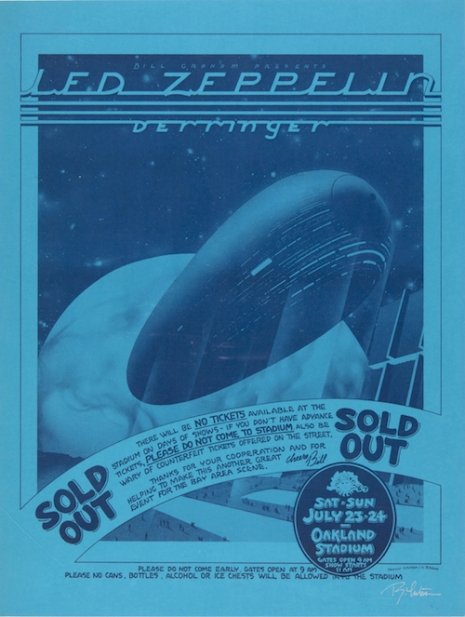
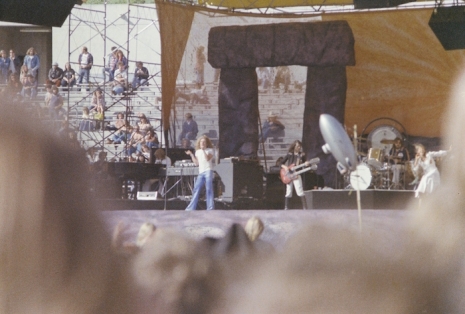
On July 23rd and 24th, Zeppelin performed in front of sell-out crowds at Oakland Coliseum. Rick Derringer and Judas Priest opened. The shows were part of the recurring “Day on the Green” concerts organized by Bill Graham. The stage set was constructed to resemble the Stonehenge monument, and was likely the main inspiration for one of the funniest moments in the brilliant mockumentary, This Is Spinal Tap    (and before you say, “But what about…,” we debunked the theory that Black Sabbath’s Stonehenge stage influenced the film).
Led Zeppelin

Two nasty backstage episodes took place on the 23rd. The first happened when Peter Grant was asked by a member of Graham’s crew if he needed help getting down some stairs, which Grant perceived as a slight on his weight. John Bindon, a London gangster brought on by Zep as their chief enforcer for the tour, stepped in and knocked out the stagehand, who banged his head on the concrete floor. Later, Grant’s teenage son was about to remove a temporary sign to keep as a souvenir, but was sternly rebuffed by a member of Graham’s security team. This prompted drummer John Bonham to kick the guy in the balls, and then Grant and Bindon beat the man so badly that a shocked Graham had him rushed to the hospital. Graham also claimed that his production manager was hit on the head with a lead pipe.

 On the 24th, Graham’s security were looking for revenge, yet the show concluded without further incident. The following day at the band’s hotel, the SWAT team showed up and arrested Bonham, Grant, Bindon and tour manager, Richard Cole, who were charged with assault. After they were bailed out, the Zep entourage flew to New Orleans for the next show. Once they were settled in, Plant received a call from his wife and learned that his young son, Karac, had died suddenly on the 24th. Plant immediately flew home to England. Led Zeppelin would never play stateside again.

Footage from the July 23rd gig is available online. This first video appears to be professionally filmed, and was perhaps meant as B-roll for a TV news piece. The first note of the Zeppelin show is heard at the 5:55 mark. At 6:10, the camera zooms in for a closer look at the band and the Stonehenge stage set.

thanks dangerousminds.net

Atlantic

On November. 8th, 1971, Led Zeppelin released their fourth album. There was no title printed on the album, so it is usually referred to as Led Zeppelin IV, following the naming sequence used by the band’s first three studio albums. The album has alternatively been referred to as , Four Symbols, The Fourth Album (those two titles each having been used in the Atlantic catalogue), Untitled, Runes, The Hermit, and ZoSo, the latter of which is derived from the symbol used by Jimmy Page for the album sleeve. Page often had the ZoSo symbol embroidered on his clothes.

The album contains many of the band’s most famous songs, including “Black Dog”, “Rock and Roll”, “Going to California” and the band’s signature song, “Stairway to Heaven”, Led Zeppelin IV was a commercial and critical success. The album is one of the best-selling albums worldwide

To celebrate its 46th birthday of Led Zeppelin‘s masterful fourth album, which of its songs are the best and worst,
there’s hardly a wasted track on the fourth album release. Is it the best rock ‘n’ roll record ever made and, at the same time, not even the best Zeppelin album, Its amazing, emblematic of the band, but not their best work.
Maybe the ultimate testament to Led Zeppelin’s greatness is that an album as colossal and widely worshiped as IV actually has three or four legitimate challengers for “Best Album” within their amazing catalog. But if IV is not their best for groundbreaking reasons, Its influential, mould-setting reasons then whichever of Led Zeppelin’s first seven albums is playing on your stereo right now is the best record that’s ever been made. But I’d give IV the silver medal and save the gold for Physical Graffiti, which has even more range, weight and sophistication.

The best song on the album?
It changes all the time. The opening rush of “Black Dog” is one hell of a way to kick off an album, and “Stairway to Heaven” is such an expertly structured song. But “When the Levee Breaks” is the one that most often has me turning up the volume. Those drums!
“Stairway to Heaven.” has become synonymous with Led Zeppelin you’ll find it’s astounding. Also, like the album itself, it’s emblematic of the band. It shows off what they do best:: creepy, Celtic folk, cryptic lyrics paired with haunting vocals, a bombastic crescendo with evil blues guitar and drum fills that define perfection. That said, the first 10 seconds of “Four Sticks” is probably the best thing they’ve ever done. that said, the first minute of “When the Levee Breaks” is probably the best thing they’ve ever done. which closes the LP with so much power and atmosphere, and maybe the heaviest drum sound ever captured, from the bottom of that stairwell at Headley Grange. I suppose, too, because it’s fundamentally a blues, it can represent Led Zeppelin’s musical bedrock in its most epic form , “Black Dog.” So powerful, so sexy, so smart. We’ve all read about the hard work and creative genius that went into making the song work, but it’s impossible to think of it as anything but purely instinctual when it’s playing.

“Four Sticks” is the only song that consistently feels sub-par when I listen to IV. The fact its named that way because Bonham played it with a pair of drumsticks in each hand doesn’t say much about the lyrics, which I’ve heard described by Jimmy Page as being abstract, and to me that sounds like another way of saying, “This was filler and we couldn’t even be bothered to tidy up the lyrics, so yeah, it’s so abstract, man.”

Led Zeppelin

The hipster record clerk at my favorite record store insisted on calling it Zoso. Atlantic Records had it listed as Four Symbols or Led Zeppelin IV. If they wanted to break the pattern established by the numerical naming of their first three albums, they should have given it an actual title. it’s perfectly acceptable to occasionally and judiciously refer to it as “Zep IV.”

'Led Zeppelin'

48 years ago today, on January. 12th, 1969, music changed for many people. It was on this day that Led Zeppelin released their debut LP . Of course, critics panned the record, but to the record buying public, well they never listened to critics anyway. It only takes the first two seconds of the first song on their first record for Led Zeppelin to make crystal clear exactly what they intend to do – and exactly what they intend to do to you. In the opening to “Good Times Bad Times,” the band drops a two-note attack that falls like a cartoon safe, clearing the air for John Bonham’s syncopated groove, Jimmy Page’s swift-sword guitar and Robert Plant’s high-end howling about sex so loud it gets the neighbors talking. “It really wasn’t a pretty thing,” Plant later said. “It wasn’t supposed to be a pretty thing. It was just an unleashing of energy.”

just a few weeks before their album’s release — opening for Vanilla Fudge and Spirit. Although booking agent Ron Terry had to beg promoter Barry Fey to add Led Zeppelin to the already-sold out show, the band did not disappoint. “You didn’t have to be a genius to know that Zeppelin was going to be a smash,” he later said. “Oh, my God. People were going crazy!” Rock station KLZ was so jammed with calls the next day that Fey had to run a copy of the unreleased self titled album to them, where it played for an entire day.

We could go on for days on the impact that this record had at the time and still has to this day, but you all know that. Just 3 of the songs “Your Time is Gonna Come”, “Good Times Bad Times” and “Communication Breakdown” were Led Zeppelin originals. When Led Zeppelin debut album was released in January 1969, it went to the Top 10 in the U.S. and the U.K. charts, despite lukewarm reviews. The enormity of Zeppelin’s innovation wasn’t entirely easy to recognize. In an era of spiritual transcendence and tales of brave Ulysses, they’d flipped teenage rock & roll’s sex-zonked mania into something huge and seething and mythic- bestial. Eastern mysticism and Mordor and prom-ruling radio gold would all come later.

Page’s vision for the album was so clear that they recorded the entire thing in just 30 hours. “I financed and completely recorded the first album before going to Atlantic,” he later said . “It wasn’t your typical story where you get an advance to make an album: We arrived at Atlantic with tapes in hand.” The result was a new, uncompromising sound and unabashed rock star lifestyle, paving the way for everything from prog-rock to heavy metal.

https://www.youtube.com/watch?v=XP6KbVoalAE

Led Zeppelin was born from the ashes of the Yardbirds. They had disintegrated in the summer of 1968, leaving guitarist Jimmy Page with the rights to the name — and a series of shows in Scandinavia he was contractually obligated to complete .So he recruited Robert Plant, John Paul Jones and John Bonham, and the four toured as the New Yardbirds. But by the time they entered Olympic Studios in London in late september 1968 , they had moved their sound away from English folk-rock, into the blues-influenced band Page had always wanted, and soon had a new name, Led Zeppelin, as well.

As with so many great records, when it first came out the critics didn’t care for it. Therefore many people knew it would be good.

On January. 12th, 1969, Led Zeppelin released their self-titled debut LP “Led Zeppelin” in the US. It wouldn’t be released in the UK until March 31st. The LP combined Blues and Rock and was very well received by music fans. A number of the songs were ‘borrowed’ from older Blues musicians who at first were not given any credit.

It was an incredible record that changed the way many looked at Rock music.

Robert Plant (vocals/production); Jimmy Page (guitar); John Paul Jones (bass); John Bonham (drums)

The Album Jimmy Page, Robert Plant, John Paul Jones and John Bonham Recorded Before 'Led Zeppelin'

all four members of Led ZeppelinJimmy Page, Robert Plant, John Paul Jones and John Bonham were recording together before there even was a Led Zeppelin. While still in  mode, the four pre-Zeps took part in the August 1968 recording sessions for P.J. Proby’s 1969 album, “Three Week Hero”.

Page and Jones were successful session musicians at this point, and when Jones got the Proby gig, he invited his fellow New Yardbirds along. Jones recollects “I was committed to doing all the arrangements for the album. As we were talking about rehearsing at the time, I thought it would be a handy source of income. I had to book a band anyway, so I thought I’d book everybody I knew.” The sessions started August 25th, 1968, and led to an album that didn’t cause much of a stir when it was released the following April.

“The boys told me they were going over to play in San Francisco and all that, and I said, ‘Look, from what I’ve heard and the way you boys played tonight, not only are you not going to be my backing band, I’m going to say goodbye right now, because I don’t think I’m ever going to see you again’,” Proby has said .

“‘That’s how successful you’re going to be. You’re exactly what they want, you play all that psychedelic stuff and everything.’ I said, ‘You’re going to go over there and go down so great I don’t think you’re ever going to come home.’ They didn’t ever come back until they changed their name to Led Zeppelin and stayed over there and came back huge huge stars. … I said goodbye that day when I cut that album, and I haven’t seen one of them since.”

Is there any doubt this is Led Zeppelin? This is part of the eight-minute medley that closed the album.

Here’s track two “The Day That Lorraine Came Down” from the PJ Proby album, which was released on CD in 1994. It’s easy to imagine Robert Plant on vocals—not that there’s anything wrong with Proby’s voice.


Image result for jimmy page and robert plant

Jimmy Page dug up several unheard gems for the recent batch Led Zeppelin reissues. But there’s one song that still remains unreleased “Swan Song”.

The fertile sessions for Led Zeppelin’s Physical Graffiti album produced a number of landmark songs, including In My Time Of Dying and Kashmir. And among them was another track that had the potential to be a Led Zeppelin classic. An ambitious, virtuoso instrumental titled Swan Song, it was sketched out and partially recorded during the album sessions but, frustratingly, never completed – even though, like many of his ideas, Jimmy Page would not quite let it rest.

The seeds of Swan Song were sown in early 1974 when Zeppelin reconvened to begin work on Physical Graffiti at Headley Grange, the 18th-century workhouse in Hampshire where they’d recorded their fourth album.

The band had endured a crisis the previous autumn when John Paul Jones announced that he was fed up with the relentless touring and was planning to quit the band. He even suggested, albeit with his tongue firmly in his cheek, that he was considering becoming choirmaster at Winchester Cathedral. It took all the efforts of manager Peter Grant to talk him out of it.

But by the time the four band members got back together they were once again firing on all cylinders. Reunited, they began pooling ideas. “Some of the tracks we assembled in our old-fashioned way of running through a track and realising before we knew it that we had stumbled on something completely different,” recalled Robert Plant.

By contrast, Page had grand plans for a lengthy new track he was calling Swan Song. The guitarist had already plotted out the instrumental piece at his home studio in Plumpton Place, East Sussex. Even at that early stage, his vision was clear. According to Page, it featured “a number of sections and orchestrated overdubs”.

The track was broken up into sections, two of which were recorded in late February 1974 (and which can be heard on various Zeppelin bootlegs and on YouTube). The first part opens with Page’s drifting acoustic guitar, before the John Paul Jones/John Bonham rhythm section kicks in with the sure-footed syncopation that characterised their greatest work. The second segment commences with Page again leading off, his descending riff hinting at the song’s majestic potential. Tantalisingly, he would later reveal that this epic-in-waiting would not necessarily have remained a purely instrumental track – there were plans to add other sections and even lyrics.

So why did they leave the piece unfinished? The simple truth is that Zeppelin’s creativity was at an all-time high during the Physical Graffiti sessions. At the same time, they had also been working on Ten Years Gone, another lengthy track that incorporated similar guitar orchestration. Faced with an abundance of quality material, they could afford to leave Swan Song for another time. Consequently, it was Ten Years Gone that ended up on Physical Graffiti.

But the Swan Song story didn’t end there. Zeppelin were planning to launch their own label and rumours abounded that it would be called Shag or Slut Records – a lewd reference to their notorious on-the-road antics. Instead, at a press reception in New York on May 7, 1974, it was announced that the new label would be called Swan Song, after their unfinished song. “I’d been recording this long instrumental and somebody shouted: ‘What’s the title?’” revealed Page. “I shouted back: ‘Swan Song’. And everybody stopped and said what a good name that would be for the album. From there it got carried over to being the name for our label.”

https://www.youtube.com/watch?v=q1qQAuIZ-lc

Never one to let go of a good idea, Page talked about returning to the incomplete song to finish it off. “I’ve spoken before about a long piece I’d written,” he said in 1976. “I wanted to orchestrate the guitar and put it through various treatments. The original idea was to have four sections coming back to the same theme each time. There would be four separate melody lines dealing with the seasons. Robert will do the lyrics. I know I can work the whole thing out from the trial runs I’ve laid down. It’s a really exciting prospect.”

Page continued to incorporate elements of Swan Song into his live improvisational piece White Summer/Black Mountain Side during Zeppelin’s 1977 tour. It would reappear again during the band’s Knebworth shows in 1979, and even as late as their final European tour, in 1980. Had Led Zeppelin not disbanded following the death of John Bonham on September 25,1980, there’s every chance that Page would have gone back to work on the song in the studio.

But even that wasn’t the end of his great lost opus. Page’s first major live appearance following the dissolution of Zeppelin was as part of an all-star nine-date US tour in 1983 in aid of the ARMS charity to help multiple sclerosis-stricken ex-Small Faces bassist Ronnie Lane. With Paul Rodgers on vocals, Page performed a lengthy song called Bird On A Wing, which featured some chord structures that clearly dated back to Swan Song.

By the time Page and Rodgers formed their blues-rock supergroup The Firm, it had been revisited once again. “It was reworked with Paul Rodgers, who supplied some inspired lyrics, and it became Midnight Moonlight,” said Page, referring to the song which closed The Firm’s self-titled album in 85.

Today, Swan Song has passed into Zep legend as one of the band’s great lost masterpieces – albeit one that has, tantalisingly, filtered into the ether in various incarnations. As with other unfinished Zep treasures such as Sugar Mama and Fire, it’s difficult not to wonder how significant Swan Song would have become had they actually finished it.

No photo description available.

On July 7th, 1980, the original members of Led Zeppelin performed together for the final time at Eissporthalle in Berlin, Germany. This is the latest in the Casino Records series of Led Zeppelin vinyl presentations. Previous releases have included This follows their excellent Berkeley Days Second Night package in a limited run of 400, “I Told You Baby Long Time Ago” Scandinavia March 1969 limited edition of 450 on clear splatter vinyl and “The Night Stalker” LA Forum 1975 issued last October in a run of 400 -1 to 200 on gold vinyl – 201 to 00 on clear vinyl. The first two had excellent content and packaging “the Night Stalker” was a little bit underwhelming in the presentation.

The concert was the last scheduled stop on a 14-date European tour in support of the group’s most recent (and ultimately final) studio album, 1979′s “In Through the Out Door”. Trouble had been circling the band in previous years, with John Bonham and Jimmy Page both struggling with alcohol and drug addictions.

Two weeks before the Berlin show, on June 27th in Nuremburg, Germany, Led Zeppelin were forced to stop their show after just three songs when John Bonham was rushed to the hospital after suffering what was reported as food poisoning but rumoured to be the result of a blackout.

On Monday July 7th 1980, Led Zeppelin took the stage for the final night of the tour and what would ultimately be the last ever Led Zeppelin performance with John Bonham.

The sound quality is excellent being the soundboard source used for the CD versions. Very pleasingly  and unlike the Night Stalker release, virtually all the in between chat is present and correct. I noticed a slight edit in the intro to “Trampled Underfoot”. To have lost the in between chat would have been a real shame as Plant’s very upbeat and humorous comments say a lot for the general atmosphere of this last night of the tour. He seems genuinely pleased at to how it has all gone – a fact Peter Grant noticed as on the flight back because he got the nod from Robert that a US tour was now viable. Sadly that was not to be. Aside from Jimmy’s usual intro to “Black Dog”, he also has a words to say as he tunes up for White Summer this spiel is also left intact. So it’s full marks for the actual presentation of the concert across these six sides.

Overall, it’s an upbeat and interesting swan song performance. Robert Plant is on excellent form and in a jovial mood. At times they do seem to rush proceedings and there are moments of sloppiness – there is also a bit too much reliance on the vocal harmoniser effect which sometimes clouds the clarity of Plant’s voice. However, there is much to enjoy about this final performance because when it’s good, it’s very good indeed.

Highlights here include the opening burst of Train Kept a Rollin and Nobody’s Fault But Mine, the stand alone Rain Song and All My Love with that gorgeous extended outro.

Despite Achilles Last Stand being strangely dropped from the set, this was still the longest performance of the tour notably due to some lengthy extended work outs – Trampled Underfoot is a prime example as Page, Jones and Bonham lock into an incessant groove.

Listening now to what would be there last moments together as a band is a moving experience, not least because of the striking content of the final performances of Stairway To Heaven and Whole Lotta Love -both of which are worth the price of admission alone –  because both are delivered in unique arrangements.

Stairway clocks in at over fourteen minutes, half of which is given over to a rambling and totally mesmerising Page solo. It was easily the longest on the tour. Similarly unusual is the version of Whole Lotta Love, somewhat appropriately the last ever song the original Led Zeppelin quartet performed live as a band.


A North American tour, which, like the European jaunt, was to see the band trimming some of the excess soloing and pageantry of previous expeditions, was scheduled to begin in October. But on Sept. 24th, after reportedly drinking 40 measures of vodka during a 12-hour period on a rehearsal day, Bonham went to bed at Page’s house and was found dead the following morning.

A few months later, on December. 4th, 1980, the group issued a statement declaring they would be breaking up as a result of Bonham’s passing. The surviving members have reunited only a few times since then, including short sets at Live Aid in 1985 and the 40th anniversary concert for Atlantic Records in 1988. Most recently, they performed a full-scale show on Dec. 10th, 2007, in London that was captured on the Celebration Day concert film that was released in 2012.

Although the photo above is taken from a show a few days prior, you can see photographs, the complete set list, ticket stubs and other memorabilia from Led Zeppein’s final show at their official website.


Robert Plant first came to the public eye in the late ’60s as a member of one of the biggest bands ever, Led Zeppelin. But long before the spotlight was on him, he was a member of The Crawling King Snakes which would prove to be pivotal as it put him in touch with John Bonham. Plant, like most aspiring musicians from England, was influenced by blues artists from America. In 1968 Jimmy Page was searching for a lead singer for the Yardbirds and after meeting Plant, he offered the gig to him on the spot. Collaborations between Page and Plant gave us some of the most memorable moments in rock history. With John Bonham on drums and session player John Paul Jones on bass, the band conquered the world with a mix of blues, folk and straight-ahead rock. Throughout the ’70s, the band released some of the most prominent records of all time. As a live act, they would often jam out songs 10 to 15 minutes beyond the originals as Plant would riff off Page and vice-versa. Robert Plant, like Roger Daltrey, had a golden mane, devastating good looks and incredible stage presence. Often performing in shirts that would show off his chest and arms, he became a rock god, and the band’s hotel stays while touring are legendary. In 1980, Bonham died after a night of hard partying, leaving the rest of the members no choice but to retire. Despite retirement, Plant has had an amazing solo career releasing ten studio albums. In 1984, he joined Jimmy Page and Jeff Beck in the super group the Honeydrippers who found success with such singles as “Sea of Love” and “Rockin’ at Midnight.” Plant would reunite with Page again on the 1994 project Unleaded which sparked a tour. Seemingly joined at the hip, the duo would release another album. No Quarter featured reworked versions of Zeppelin classics. To date, Jimmy, Jones and Plant received the Grammy Lifetime Achievement Award, and in 1995 Led Zeppelin was finally inducted into the Rock and Roll Hall of Fame.

led-zeppelin-trailer-770


News of the first Three Led Zeppelin albums to be reissued on the 2nd June 2014 has been revealed. the new versions of Led Zeppelin, Led Zeppelin II and Led zeppelin III, will feature unreleased tracks, Live gig, and outtakes and backing tracks. All taken from the Zepp archive the etras will be on a second disc for all three albums. At present it is all work in progress with Alternative versions, rough mixes and tracks recorde at the time of each album sessions.
Led Zeppelin will include a Nine-song live set from a gig in Paris in 1969.
Led Zepplein II has five alternative mixes, backing tracks to “Thank You” and “Living Loving Maid” and a new previously unheard La La,
Led Zepplin III has seven studio outtakes, alongside “Jennings Farm Blues”, and “Bathroom Sound” plus the blues standards “Keys to the Highway” and “Trouble in Mind”

thanks to Mojo………..


janglepophubhome.wordpress.com/

Dedicated to all jangly indie/guitar/jangle-pop

Stray Bullet

Show a little faith there's magic in the night

blackwings666

Horror, Science Fiction, Comic Books and More

hotfox63

IN MEMORY EVERYTHING SEEMS TO HAPPEN TO MUSIC - Tennessee Williams

All Things Thriller

A Celebration of Thrillers, Noire and Black Comedy by Pamela Lowe Saldana

The UK Number Ones Blog

Join me as I listen to every single #1 single!

Mike and Paul's Music Blog

Two Guys In Search of Great Music

A Unique Title For Me

Hoping to make the world more beautiful

A Sound Day

hear ye, hear ye!

Christian's Music Musings

Celebrating music craftsmanship

ECLECTIC MUSIC LOVER

Favorite song lists, reviews, featured indie artists, and music commentary.

Every record tells a story

A Blog About Music, Vinyl, More Music and (Sometimes) Music...

Make Your Own Taste

Eclectic reviews of ambient, psychedelic, post-rock, folk and progressive rock ... etc.!

Martin Crookall - Author For Sale

A transparent attempt to promote a writing career

Music Aficionado

Quality articles about the golden age of music

J. ERIC SMITH

Slow molasses drip under a tipped-up crescent moon.

THE PRESS | Music Reviews

Click Header to Return Home

Born To Listen

to Rock, Country, Blues & Jazz

Blabber 'n' Smoke

A Glasgow view of Americana and related music and writings.

The Music Files

Rewind the Review

If My Records Could Talk

A stroll down memory lane through my music collection

The Fat Angel Sings

the best music of yesterday today and the tomorrow, every era every genre