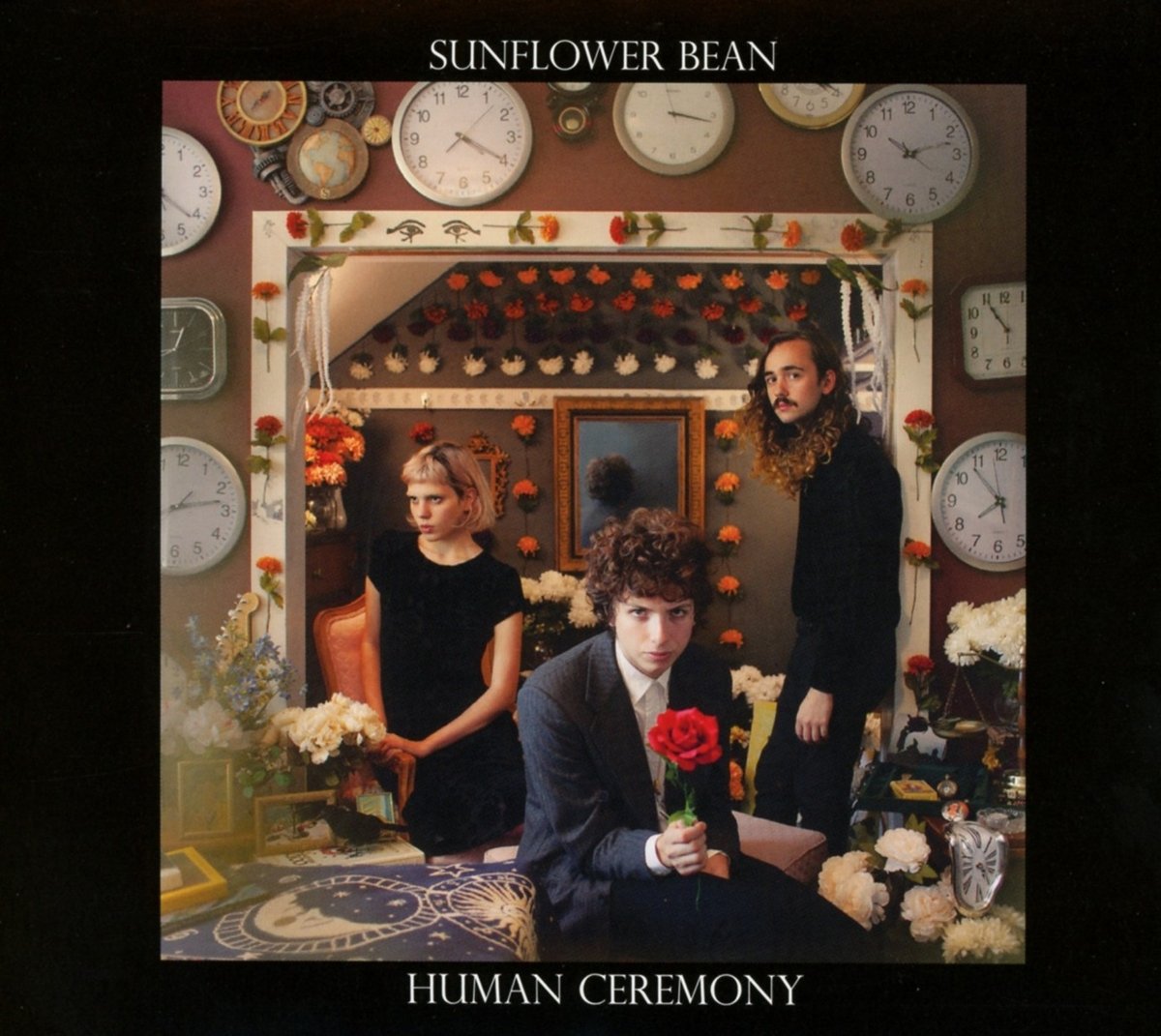
Listening to the debut album from Brooklyn trio Sunflower Bean is a bit like flipping through some smart stoner’s impeccably refined record collection. All the correct drone-rock references are present: the Velvet Underground at their beachiest, the Autobahn liftoff of vintage Seventies Kraut-rock, the Eighties drug-punk of Spaceman 3, recent garage-grind aesthetes like Ty Segall, and the entire college-jangle canon from early R.E.M. to the Smiths to Real Estate and beyond. Sunflower Bean take these influences and shape them like Silly Putty into sweet, ingenious psych-pop songs that are more economical and compact than you’d expect from a band whose hottest tune is called “Wall Watcher.” There’s New York dripping out of every pore of this record, its hip, it’s arty and oozes catchy melodies from start to finish.
Formed in Brooklyn in 2013, Sunflower Bean, the hardest working band in New York state, released last year an acclaimed EP, Show Me Your Seven Secrets.
This debut album, Human Ceremony, co-produced by the band and Matthew Molnar, delivers on that initial promise.
A heady mix of psychedelic harmonies, 80s tinged jangle pop, and straight ahead power pop, it features a host of great tunes, high quality instrumentation, and delicious vocals.
What marks them out as future stars, other than their striking physical appearance (singer and bassist JuliaCumming, 19, has modeled for Yves Saint Laurent, while 20 year old Nick Kivlen bears more than a passing resemblance to the young Bob Dylan), is the power and confidence in their delivery of the material.
The lyrics are winsome, and varied in their subject matter
Robert Pollard has recently announced that Guided By Voices were reforming with a largely new line-up, only drummer Kevin March having been in a previous incarnation. That announcement was accompanied by news that the new Guided By Voices album would be a totally solo affair by Pollard. He then springs a new solo album upon us that is the first for over a decade to not be recorded with Todd Tobias on instrument and production duties. In his place, handling all instruments and the recording desk, is Nick Mitchell, his Ricked Wicky side-man and newly announced guitarist in the live GBV line-up.
As typically muddled as this may be it is good news. Mitchell has proved to be a great foil for Pollard on the Ricked Wicky albums and is clearly a first-rate guitarist. It is also true that a degree of saminess had crept in to the albums that Pollard and Tobias were producing – these were good records but you knew largely what they would sound like.
What Mitchell immediately brings to the party is a harder rock edge, and this is immediately brought out on the opening track ‘My Daughter Yes She Knows’ which is riff heavy and unafraid of classic rock cliché. He brings more to the album than guitars though and the arrangements on this album are as adventurous as anything Pollard has produced with strings, horns and keyboards having a noticeable presence on a number of tracks.
Pollard has always been at his best when working with a like-minded instrumentalist and much like Tobin Sprout,Doug Gillard and Chris Slusarenko it looks like Mitchell is bringing the best out of Pollard’s song-writing as well as offering up his guitar skills. The songs on the album are all of a surprisingly high standard for someone who releases so many and there is a good mixture of styles on show across the 12 tracks. There is a slight bias towards the more rocking guitar songs but there is time for some sweet ballads and hook filled pop tunes as well.
The real thing that makes this album work so well though is the variety of arrangement, not just between but within the songs. Listen to the horns on ‘Little Pigs’ or the Love-esque horns/strings/guitar burst in ‘I Can Illustrate’ and you can imagine how much fun was had bringing these songs together.
Best of all is the album closer, and title track, which demonstrates Pollard’s unmistakable gift for crafting tunes that could have been recorded any time in the last five decades.
This is Pollard’s 22nd solo album and he shows no signs of slowing down any time soon. Expect number 23 to be announced any day. thanks for the review from Neonfiller,
Is it time for a Saddle Creek revival? Pinegrove thinks so. If you like your indie rock with a hint of twang, emo vocal-cord abuse, and Conor Oberst-worthy histrionics, this New Jersey group has the ideal record to quietly sob into your drink with. Songs like “Old Friends,” “Aphasia,” and “Waveform” tear at your heart with bleary-eyed tales of loss, betrayal, and regret. Play it for a friend who only listens to Wilco.
Pinegrove gave us something singular yet familiar, an album that breathes or, more accurately, sighs — as if it’s the most natural progression in the world. On Cardinal, Evan Stephens Hall applies basement DIY’s detail-oriented logorrhea to melancholy roots rock, artfully dissecting his quarter-life neuroses against a backdrop of banjo, pedal steel, and shimmering waves of electric guitar. The music expertly surges and soars in service of Hall’s every word, lending powerful emotional weight to his reflections on the value of personal connection. His complicated turns of phrase work surprisingly well as barroom sing-alongs, but moments of simple profundity like “I should call my parents when I think of them/ I should tell my friends when I love them” are what continually send tingles down the spine
Tween is billed not an album or mixtape but an amorphous project built from worthy outtakes. Wasner and bandmate Andy Stack formed Wye Oak ten years ago; that means, as an entity, they are now in their tweens. But she says that’s not why she named their latest record Tween — the title just seemed appropriate for an album out physically August 5th on on Merge Records whose tracks are outtakes. The songs presaged a transition for the band, between their 2011 breakout LP Civilian, and their most recent, 2014’s Shriek, on which they radically changed their sound.So what’s it doing on a best albums list? Well, just as Jenn Wasner and Andy Stack have managed to translate their swooning twilight indie-rock into many different sonic frameworks, so that no matter what instruments they use it still sounds like Wye Oak, apparently if you string enough of these songs together it will elicit that same epic melancholy sensation you get from one of their proper LPs. In other words, shut up Wye Oak this is an album, one that masterfully bridges Shriek’s baroque synthpop with the smoldering guitar music of their youth
Most of the time, lyric sheets to albums are utilitarian; you turn to them to make sure what you’re hearing is right. But the lyric sheet to Frankie Cosmos’ Next Thing reads like book of poems on its own. It runs seven pages long, comprising 15 stanzas (1 for each of its songs) and it totals 1570 words, all of which are slyly idiosyncratic, bordering on perfectly arranged. As I listened, I felt compelled to print them out, staple the pages together, and read along, fearful I would miss something important. As I did, I became thoroughly convinced that Greta Kline is quietly writing herself into a vaunted place, one where she will eventually deserve mention alongside poets like Lydia Davis, Wayne Koestenbaum, or Maggie Nelson—anyone who can puncture your heart in the span of a sentence.
The sound on her sophomore album is mature, fully-fleshed, but never loses the unique immediacy of her Bandcamp work. Like those albums, the music on Next Thing is mostly built on unvarnished synths and sweet, understated guitars. The difference is in the clarity of her vision: Two years ago when Lindsay Zoladz named Zentropy the year’s number one pop album in New York Magazine, she concluded that Kline penned a “melodic reminder that the wisest, wittiest person in the room is rarely the loudest one but instead that unassuming girl in the corner, grinning contentedly at her untied shoes.” In Next Thing, she’s looked up from her laces, meeting your eyes and delivering observations that are by turns strange, self-possessed, and dizzyingly multitudinous.
On these songs, those observational powers are at their height. Her greatest talent remains her ability to transform minute-long songs into experiences that resemble hours of intimate and impressionistic conversation. In the first minute of album opener “Floated In,” Kline sings: “Now it would be bedtime if/I could close off my mind/It just flops onto you/Wet and soppy glue…You know I’d love to/Rummage through your silky pink space cap.” It’s an uncanny description of two drowsy minds splattering thoughts on each other, hoping something sticks, but the words gently pass by before you’ve even internalized how weird and salient they are. Even when she paints scenes that ostensibly are filled with private meaning, something universal resonates. In “Fool” for example, when she sings “Your name is a triangle, your heart is a square,” the funky cubist formulation gets closer to the uncomfortable feeling of naming the one you love than straight description ever would.
As a singer, she’s perfected an inimitable vocal delivery that is willfully off-center, out-of-focus, and matter-of-fact. She uses enjambment in her writing and in the long pauses of her singing so well that it reminds me of an idea from Maggie Nelson, that some people who tend bonsai trees plant them askew or aslant to leave space for God. The gaps in Sappho’s poetry have been called “a free space of imaginal adventure,” and it is an apt description for Kline’s music: In the momentary disjunctions of Kline’s singing, the hiccup between words, a whole life passes by. On “Outside with the Cuties,” she savors the nanoseconds that come between words, asking ordinary-seeming questions (“I haven’t written this part yet/will you help me write it?”) that invite radical participation from a listener. Even though the song may end after two and a half minutes, it never really ends.
Her work has a continuity to it that invites deep diving, as if she is formulating and reformulating the same few thoughts, waiting for their perfect expressions. Many of the songs (“Embody,” “On the Lips,” “Too Dark” and “Sleep Song”) on the album have appeared in acoustic permutations in past work, and they make the leap seamlessly. Each are marvelously well-wrought trains of thought, cramming existential questions into the banality of everyday moments and finding something beatific even in the plainest of things. “Embody” finds Kline singing about a day where friendship is everything holy in the world, “It’s Sunday night/and my friends are friends with my friends/it shows me they embody all the grace and lightness.” It’s a feeling that helps her move past her self-perceived inability to access this feeling herself (“someday in bravery/I’ll embody all the grace and lightness). In Catholicism, past the fog of guilt, there’s an incredible idea that light, love, and all that’s holy can be transferable from one person to the next. It usually happens in ritual, the eating of a wafer of bread and a sip of wine. In Greta Kline’s pocket universe, all you need to get closer to heaven is a night with friends.
“Island,” a highlight from Fear Of Men’s new album Fall Forever, opens with a string of warped, looping sighs before fanning out into a string of swoonily propulsive pop choruses. At times, the effect is reminiscent of the early-’90s Britpop band The Sundays, albeit with a darker, more subtly discordant underbelly. “Island” is, after all, a song about independence and solitude — “Been dreaming of no one for so long,” Jessica Weiss sings at one point but the overall sound is distinctly inviting.
Fall Forever, is the English band’s second album and follow-up to 2014’s terrific Loom. Typically, the distancing manifests itself in Weiss‘ ambivalent words, while the arrangements that surround her billow and bloom. A song like “Island” ultimately feels both personal and universal, as it captures the way getting older pushes you to carve out your own identity even as internal and external forces push you toward others.
Elsewhere on Fall Forever, darkness and light fuse to form multifaceted gems like “Trauma,” a buzzing nugget of gloomy accusation that nevertheless shimmers with a strange kind of buoyancy. Like the rest of this brisk, moody collection, it pulls the listener in several directions at once, only to land on a sweet spot every time.
Fall Forever is out now! Nearly two years in the making, we are so excited for you to hear it. We have announced tour dates in support of the album, including a very special album release launch Friday at St Pancras Old Church, London. Many more cities and countries announced – including upcoming UK date with Wild Nothing, a large US tour with Puro Instinct, and early fall tour dates announced for Germany, Sweden, Austria, Belgium and more to come!
Kevin Morby (Woods, Babies) recalls singer/songwriters of the ’60s and ’70s in his solo work, particularly Bob Dylan and Leonard Cohen, and Singing Saw is his strongest album release to date.
Kevin speaks the language of records. His spare acoustic sound pulls from the late ’60s and early ’70s, Morby’s earlier work refracted meaning through the lens of his record collection. His debut album, Harlem River, featured one song about a slow train, another about walking on the wild side, and a third with a line about going down to the station with a ticket in your hand, as if were still possible to buy paper tickets ahead of time. His music comes from another place, one where you try and piece together meaning by tapping into a kind of collective unconscious, using whatever tools you have at your disposal. And his references add up to something more than their parts and when paired with his unerring feel for arrangement and style.
Morby’s own albums keep getting better, and some of this we can chalk up to experience. Though he’s not yet 30, he’s been involved with a lot of records—two in his band the Babies with Cassie Ramone from Vivian Girls, A further four as a bass player in the Brooklyn band Woods (Morby is to Woods what Kurt Vile is to War on Drugs: a kindred spirit musically whose quirky vision needed more room than a band could provide), and now three as a solo artist. Singing Saw is his strongest album because it shows a process of refinement, and because Morby’s songwriting has become less referential and more grounded. The basic ingredients haven’t changed, but Morby is figuring out how to retain and amplify his strongest points—his weary and wise voice, his understanding of how the musical pieces fit together—and leave everything else behind.
Singing Saw finds him cool and controlled at every turn, fully aware of his limitations but confident in what he can accomplish within them. His singing is simultaneously intimate and distant, part conversation and part stylized monologue. He’s got a nasally diction with a tendency to stretch vowels that didn’t exist in the world until Dylan first gazed at the Nashville skyline and a fondness for short, direct statements that could have been written a century ago. The songs feature gardens and earth and shadows and fire and tears whose prevailing downward trajectory, yes, brings to mind rain. Single lines don’t really stand out, but Morby’s commitment to such elemental concerns has a cumulative effect, and the album’s lack of specificity becomes a strength.
That confidence extends to musical choices, including Morby’s tendency to let the small details of the sound do the work—he would never play five notes if four could get the meaning across. And while the core elements of his aesthetic—his deep voice with just the right halo of reverb, gently plucked acoustic guitar— are a constant, subtle instrumental variety abounds, which Morby sometimes takes great joy in pointing out. On “Dorothy,” he sings “I could hear that piano play, it’d go like…” and the buzzing uptempo arrangement falls away leaving a beautiful tumble of keyboard notes, and he follows it a bar later with a paean to a trumpet player that a horn player answers. “Singing Saw” seems to say something about how a single tool can be used either creatively or destructively, and features the titular instrument prominently (and very beautifully).
For Morby, any day-to-day situation or mundane observation could spark something for his next album, and sometimes being that tuned-in can be a curse. “Got a song book in my head,” he sings on the album’s title track, and he climbs a hill past the houses to find somewhere quiet where he can leave them behind. He claims in press notes that he wrote the song about his neighborhood in Los Angeles.
Kevin Morby – “I Have Been To The Mountain” from Singing Saw out April 15, 2016 on Dead Oceans
Without even listening to this record, Sam Beam and Jesca Hoop are perfect complements for each other.
“Neither of us had written a song with anyone else, so we both were like, ‘How do we do this?’” Beam says. “Because our own styles are fixed things, it was kind of like, ‘What’s that going to be like when you put those two together?’”
“It was like walking around a forest in the dark,” adds Hoop. “A nice healthy forest.” “With one leg,” adds Beam.
Both Sam Beam, under his stage name Iron & Wine, and Hoop have found success in the past decade as idiosyncratic solo artists in a region of the musical universe somewhere close to Americana and folk, but often experimenting with rock, country, pop and even electronic music, and always penning interesting, ear-catching lyrics.
“There’s a song of hers called ‘Moon Rock Needle’ that I discovered,” says Beam. “The first line is, ‘There’s food at your house, let’s go to your house.’ After that I was hooked! And I just got enamored with her voice and her songwriting.
“For a while I had this seed of an idea for a project of duets,” he continues. “I like duets. I like the conversation element of it; you can have a monologue song that you’ve written for yourself, have two people sing it and it becomes a very different song. I thought we might sound really great together, so I asked her to come on tour.”
Jesca Hoop accepted, going on tour with Iron & Wine, performing as the opening act. But it was Hoop who made the first move to record music together. “I took a chance and asked him,” she says. “When we started singing together, it was just the most natural thing. It didn’t take much trying to find common ground.”
To join them on that common ground, they enlisted musicians, Wilco drummer Glenn Kotche, multi-instrumentalist Rob Burger (John Zorn, Lucinda Williams), violist Eyvind Kang and former Soul Coughing bassist Sebastian Steinberg. Together these musicians helped to create a nocturnal, lazy river for Beam and Hoop’s vocals to swim around and harmonize in.
“It’s all acoustic, but there are some songs that sound straight-up synthetic in a strange way,” Beam says. “There are some musical flourishes, but it’s more of a melodic, vocal record.”
The finished product, “Love Letter for Fire”, puts Hoop and Beam’s vocals and lyrics front and center for the listener to decipher.
“The recording process was a fluid joy,” says Hoop, “but the writing process was a lot of stumbling around in the dark. But you know when you’re in the dark and your eyes eventually adjust, then you can see? That’s what it was like.”
“It was a lot of emailing back and forth,” says Beam. “We would send poems, trade lines, just do things to get things started, and just have fun. Then we would get together and do tours, and hash things out across the table, because there’s a lot of nuances that don’t get translated over emails.”
On many of the songs, Beam and Hoop seem to be addressing each other as lovers. When asked about the possible discomfort of writing and singing a love song as platonic friends, Hoop quickly replies, “Have you ever been in love? Yes? Then let’s write a song about it right now. I’m sure there’s something you could say about it, because it’s something we can all relate to, and there’s endless material to draw from. From our own experiences, to the experiences of our parents, brothers and sisters, our friends and family.”
“We’ve both written love songs,” adds Beam, “but to have someone else’s experiences and thoughts come into play in your own songwriting. … I’d send her a line, and then she’d send me a line and I’d be like, ‘Oh, I never thought about that.’ I had to adjust. As a writer it’s fun, and when you have a man and woman singing together you automatically have a sexual tension whether you’re talking about love or not.”
“We still have different opinions on what [the songs] mean,” says Hoop. “I mean, every time you sing them, they say something different to you.”
“That’s kind of like a conversation though, isn’t it?” says Beam. “Most of the times you have a conversation with someone and you sort of think you know what they’re trying to say.” “Exactly,” says Hoop.
From the new album released on 15th April 2016 Sam Beam and Jesca Hoop album “Love Letter for Fire”
Since Will Toledo’s 2015 breakthrough, Teens of Style, he’s been playing to growing crowds (including at Hype Hotel) and prepping a proper follow-up LP, titled Teens Of Denial from which comes this new single. “Both gutsily-honest and damned catchy,” . in a few weeks, Matador will release Car Seat Headrest’s new album, and expectations loom large and heavy. I was really writing full songs, or before I knew how to play any musical instruments, I was writing lyrics and coming up with fake tracklists for albums.” He got his first guitar in junior high, and by the time he got to high school he’d filled a journal and half with song ideas. Next, it was a laptop and a drum kit with which he started making albums, giving them to his friends when they were completed. “It wasn’t really making an impact, and people weren’t listening to it,” he says. “So I started Car Seat Headrest just as a purely online thing.”
How’s this for a generational statement: Will Toledo is a depressed, directionless fuck-up with nothing to show for himself besides his good taste and incisive wit, both of which he liberally applies to the mountainous terrain that is guitar-driven indie-rock history until he’s chiseled his own dour visage into the landscape, Mount Rushmore style. Even though Car Seat Headrest’sBandcamp page is more than a dozen releases deep, the momentous Teens Of Denial feels like a coming-out party for slacker music’s latest poet laureate. Just when his genre seemed to have fizzled out, Toledo has grabbed the torch from his heroes and set it ablaze again.
It’s the stuff of legend. Kevin Morby (Woods, The Babies) moves to a quaint little Los Angeles apartment in 2014 and finds an upright piano that was left behind by the previous tenants. Equipped with the piano is an intro guide to basic piano chords. As if blessed by the gods themselves, Morby began to construct the songs for his third full-length, Singing Saw, on this reverent upright and thus changed his sound and songwriting style in the process.
Fans of Woods’ With Life and With Love will immediately take to Morby’s use of syrupy Sly Stoned drum machines, but if Singing Saw‘s album trailer is any indication, this will be a much moodier affair than any Woods output. Like the Leonard Cohen songs of old, there is a respect for space embedded in the layers, and the results have a wintery melancholic feel.
Dead Oceans has a bundle offer if you want the limited green wax. You’ll get a CD (or a beer coaster in my house), an 11×17 poster that will indeed be folded, and a set of 5 postcards featuring photographs taken by Kevin Morby. Perhaps it’s time to write your congressman and tell them that we, the collectors, aren’t into folded posters? It’s time for a revolution.
CUT ME DOWN
I remember writing this song while in a conversation with my girlfriend. I was doing that thing where I stumbled upon the riff, and was just pacing back and fourth playing it over and over while my she was trying to talk to me.
Sometimes I write like this – while doing something else – so the song can sort of come freely and I don’t give it too much attention – I don’t kill it. Its like multi-tasking. I don’t know how or why – but the first few lines just fell out of my mouth.
The song structure is pretty basic, but I was playing my guitar in a weird tuning which made the chord progression seem fun and interesting – though if played in standard tuning its really pretty simple one. Thus is the magic of different tunings – making the old seem new, and letting me feel young again.
I HAVE BEEN TO THE MOUNTAIN
Every time I read the news – theres another horrific race-related police brutality headline.
And if it’s not that – then it’s something else – another act of senseless violence that I can’t wrap my head around. Especially handled by the way our media handles things – everything feels overwhelmingly Orwellian and creepy most of the time.
And from that – one of the most disturbing things I’ve ever seen is the video of Eric Garners death – knowing that the man who killed him was not brought any sense of justice when any and all evidence of murder is there for the whole world to see. This song came out of that.
SINGING SAW
I was taking a lot of walks around the time I was demoing and writing this album. This is the last one I wrote, a day before flying to New York to record.
I had just gotten home from a walk and decided I needed a song to represent the environment that was the backdrop to all of these songs. I just sort of put my hands on the guitar and started playing those two chords and very literally began describing the walk I had just taken: “up the hill, past the houses…” and then I started singing about a Singing Saw, and I wasn’t sure exactly why – but it became clear to me later.
DRUNK AND ON A STAR
Its about getting drunk and walking around by yourself at night. I know that sounds creepy – but don’t let it! Inspired by the Elliott Smith song ‘St. Ides Heaven’ – which carries a similar sentiment. There’s a freedom in being drunk – this we all know – but it can’t last, for like most everything else – being drunk is very fleeting.
There’s this point in getting drunk for me, that music begins to come very naturally. Lyrics start to make their way through me and i’m sort of free to just grab whatever I want. But this doesn’t last long – and usually at that point i’m a stones throw away from beginning to feel sick.
DOROTHY
Named after my guitar as a metaphor for all the people, places, and things I’ve come across in the past almost-decade via being a musician.
Sometimes it takes being away from it all, in your own solitude, to look back on everything and everyone you’ve encountered and suddenly your life looks exactly like some fairy tale. What a beautiful and enchanted life.
FERRIS WHEEL
The previous owner of my piano left many different songbooks behind with it, and one day I opened one up to a children’s song book and its first song was called ‘Ferris Wheel’, so I made a game with myself – to write a song with the same title but much different lyrics. This is what came out.
DESTROYER
This is the first song I wrote on the piano. I don’t know how when or where exactly, but I do remember thinking it was incredibly difficult at first, which is funny now – as its very very simple, basically just two chords the whole time.
But it will forever remain sacred to me – it being my first piano song and all. For a while I was playing around with calling the album ‘Destroyer’, but was afraid to as there is a band of the same name on my record label.
In the end, I’m glad I went with Singing Saw but the word Destroyer was a huge influence on the song writing process. I thought to myself, I want to take a word that holds a lot of weight, and bring it light – make it something beautiful.
BLACK FLOWERS
I am in my first long term relationship and living with a partner for the first time ever – so I’m running into complicated situations that I haven’t had in the past, and this song speaks to that.
There are many characters in our life in our little paradise that we live in, and I tried to include them all in here. At the time I wrote this song I was sure we wouldn’t be together very much longer, but hey – we’re still kickin’.
WATER
Similar to Dorothy, this is a song of reflection. I sort of just let lyrics come in, with no real narrative. The moral of this song is no-things and all-things. I believe I wrote the chorus first, and given the lyrics I wasn’t sure where to go with it – so I just let my mouth and brain run wild.




 The Fat Angel Sings