We are generic local punk band The Battery Farm and we present to you our 2nd extended player Dirty Den’s March of Suffering, released on Blindside Records and out everywhere now. The North Manchester’s Battery Farm yet again hit our Top Twenty tracks list. It’s a piledriver of slow start grunge with hints of big hitters like Muse meets hardcore noise with shit loads of dark melody flowing throughout. A big stab at stadium punk if I’ve ever heard it. A support with the mighty Evil Blizzard beckons next February.
“When the Whip Goes Crack” is the 5th single by Manchester Gutter Punks The Battery Farm, released via Blindside Records. It’s a song about the disappointment, disenfranchisement and self-loathing that comes about through having grown up to perceive yourself as a failure. A song about the fear of all your demons, both internal and external coming crashing in on you. That, ferocious fear.
The Battery Farm are: Ben Corry, Dominic Corry, Paul Worrall, Sam Parkinson The new EP “Dirty Den’s March of Suffering” is out on all platforms via Blindside Records 15th October 2021.
Like the rest of The Beatles, Paul McCartney had fallen out of love with the idea of being in a band by the end of the 1960s. But one of the effects of making two excellent, essentially solo albums in the wake of their split in “McCartney” and “Ram” — albeit with the close involvement of his wife Linda — was to remind Paul that there was still much to be said for the collaborative approach.
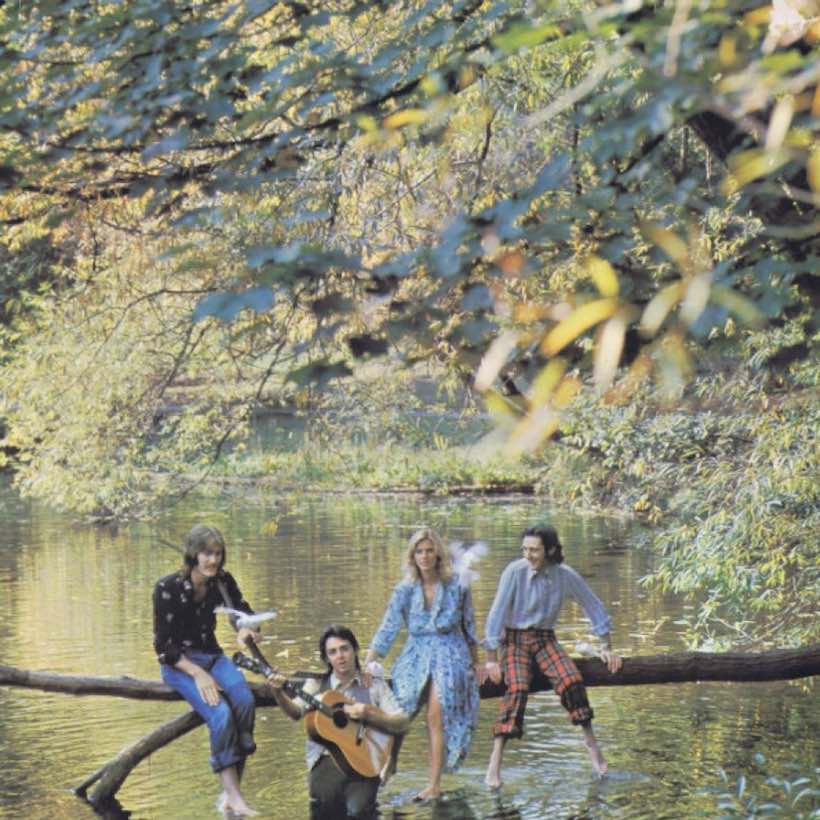
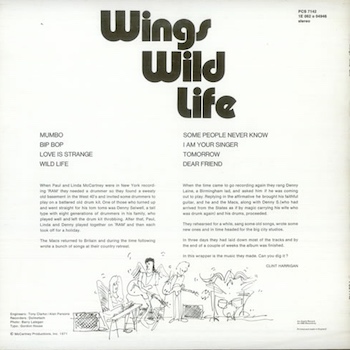
So it was that, less seven months after the release of “Ram”, McCartney was back in a band setting. In their first formation, with Paul and Linda joined by Denny Seiwell (the drummer who had played on Ram) and former Moody BlueDenny Laine, Wings made their UK chart debut on 18th December 1971 with the “Wild Life”album.
The quartet recorded the LP, with its notably live and stripped-down feel, in the summer, in Paul’s old stamping ground of Abbey Road Studios, with engineering by Tony Clark and Alan Parsons. This was a new type of album for the former Beatle, with no UK single releases nor any particular attempt to write for the charts. The name of the band wasn’t even on the front cover, nor was the album title.
Five of the eight tracks were recorded in one take, most of the record in three days, and the whole thing was completed inside a fortnight. There was one cover, a slowed-down version of Mickey & Sylvia’s early 1957 US hit ‘Love Is Strange.’ But, on an album of simple pleasures, there were also such underrated compositions as ‘Tomorrow’ and ‘Some People Never Know.’ and the hauntingly sparse “Dear Friend.”
What was also unusual for any McCartney project was that the relatively low-profile album never made the UK top ten. It peaked at its No.11 debut and was out of the chart, in its initial run, in just six weeks. It went gold and reached No. 10 in an 18-week run in the US, and was comfortably top ten in many European countries, and No. 3 in Australia. But the chart rankings were far less important than the new mood that “Wild Life” created for McCartney’s future.
On November 8th, McCartney launched the new project in light-hearted style with a ball for 800 invited guests at the Empire Ballroom in London’s Leicester Square. There was musical accompaniment by nostalgic dance band Ray McVay & his Band of the Day, and the dance formation outfit Frank & PeggySpencer Formation Team, as well as tracks from Wild Life itself.
Fat Possum Records celebrates the 10th Anniversary of Youth Lagoon’s debut album, “The Year of Hibernation” with a deluxe double vinyl edition which includes three bonus tracks on Side D – “Bobby”, “Ghost to Me,” and a live cover of John Denver’s “Goodbye Again” recorded in 2011. Upon it’s release in 2011, “The Year of Hibernation” was received to widespread critical acclaim, earning Best New Music from Pitchfork, which depicted the album as “compulsively listenable music that explodes at just the right moments”; while NPR described the songs as, “murmurs that bloom into powerful, otherworldly crescendos”. Now, a decade later, “The Year of Hibernation” continues to earn it’s initial praise.
The deluxe vinyl features artwork designed by Collin Fletcher whose practice is based on experimentation and collaboration with musicians and artists across a variety of fields.
‘The Year of Hibernation’ was the first of three albums Powers released under the Youth Lagoon moniker, along with 2013’s ‘Wondrous Bughouse’ and 2015’s ‘Savage Hills Ballroom’. “It is a space I no longer inhabit, nor want to inhabit. Youth Lagoon is complete. I’ve reached the top of a mountain, only to then be able to see a much larger one I want to ascend,” Powers wrote. “There is so much left to say, but it will not be through Youth Lagoon.”
Powers announced the end of Youth Lagoon in 2016, stating that “there is nothing left to say through Youth Lagoon. It will exist no more”. Two years later, the artist released the first album under his own name, ‘Mulberry Violence’. He followed up with his 2020 album, ‘Capricorn’.
Few songwriters hit the level of acclaim earned by Phoebe Bridgers right out of the box. But the California native captured the hearts and minds of critics and music fans alike with her 2017 debut album “Stranger in the Alps“, not to mention her work with side bands boygenius (with Julien Baker and alum Lucy Dacus) and Better Oblivion Community Center with another Conor Oberst. But it was 2020’s “Punisher” that catapulted her into the ring of stardom, thanks to singles “Kyoto,” “Garden Song” and “Savior Complex” and a raft of Grammy nominations.
Phoebe Bridgers did not release an album in 2021. Nonetheless, she was everywhere. Over the course of the last 12 months, everyone, seemed to want a Bridgers verse, harmony, or cover song. And Bridgers totally delivered. Bridgers has barely written a single song amid the COVID-19 pandemic.
The ‘Smoke Signals’ musician opened up to Olivia Rodrigo in an Instagram Live, where she admitted she has suffered from writer’s block during these unprecedented times. She told the ‘driver’s license’ hitmaker: “This is what I did for the pandemic.
“I probably wrote one half of a song.”
Probably the most impressive aspect to the Los Angeles singer-songwriter’s non-album work this year. Bridgers covered a wide range of artists (new acts, popular mainstays, and legends). She tried out numerous genres (rock, folk, pop, comedy, metal). She sang backup on the Lorde New album “Solar Power” record. She reunited — twice! — with her boygenius bandmates on their respective albums. She covered Metallica, Tom Waits, John Prine, and Bo Burnham.
She toured America, played Austin City Limits (the festival and the TV show), She was up for four Grammys, and made her Saturday Night Live debut (inadvertently igniting a debate around her guitar smashing). She visited James Corden, Jimmy Kimmel, Seth Meyers, and Ziwe. She ate Jackson Browne’s heart in a music video. She sang with Philip Glass and Matty Healy. She also wrote an essay for the 10th anniversary of Bon Iver’s sophomore album.
Collectively, we were all hoping for a little more from Lorde’s third album, which features backing vocals from Bridgers on not one, not two, but six tracks. (That’s more than half the album!).
Bridgers has covered the Killers on a number of occasions, including in 2019 with Better OblivionCommunity Center bandmate Conor Oberst (“Human”) and in 2018 with boygenius (“Read My Mind”). So it fits that she’d appear on the Killers’ 2021 album “Pressure Machine“, where she joins Brandon Flowers to spin a Western yarn about a “small town girl” who “loves Radiohead” and is “crazy about The Bends” but “puts her dreams on ice” to get married.
Bridgers’ mournful voice adds unexpected depth to an otherwise so-so song with major “Free Fallin’” vibes.
Being asked to reimagine a McCartney song is a huge honour, and Bridgers’ “Seize The Day” cover, appearing on the Beatle’s McCartney III Imagined, doesn’t disappoint. Under Bridgers’ ownership, “SeizeThe Day” loses its jaunty, trademark McCartney happy-go-lucky stamp, but the resulting folk ballad is memorable nonetheless.
Personally curated by Paul, ‘McCartney III’ Imagined features an A-List assortment of friends, fans and brand new acquaintances, each reimagining their favourite ‘McCartney III’ moments in their own signature styles. The result is a kaleidoscopic reinterpretation of an album Rolling Stone accurately tagged “an inspiration to us all”—one that serves as an extension of the instantly beloved ‘McCartney III’ while standing on its own as brilliant and adventurous milestone in the McCartney discography.
Bridgers’ self-described “sadder” version of the “Punisher” lead single “Kyoto” lives up to its description; on the Spotify Singles track, featuring all-time great Jackson Browne, Bridgers takes a jaunty track and strips it down to just acoustic guitar and keys. Browne’s voice provides only a soft backdrop — you might not even know it’s him were it not expressly advertised.
Technically, Bridgers started peddling her whispery cover of John Prine’s “Summer’s End” last year when the beloved country-folk performer passed. In 2021, though, she formally released it as a Spotify Single, with Azure Ray’s Maria Taylor also on vocals. Together, Taylor and Bridgers offer a loving tribute to the great songwriter Prine with their moving softly harmonized reimagining. The repeated phrase “come on home” becomes a lullaby, demonstrating Bridgers’ agility at making a cover song her own.
Though not a boygenius song, the lush, mid-tempo “Favor” does feature Julien Baker’s boygenius bandmates, with Bridgers and Lucy Dacus, who provide beautifully harmonized backup vocals. It’s a generous example of how Bridgers is equally capable of leading a song or stepping back to provide support. Isn’t that what good friends are for?
Ideally, becoming successful should mean leading by example and lighting the way for the younger generation. After seeing Charlie Hickey cover one of her songs at just 13 years old, Bridgers has acted as something of a mentor to the young, Pasadena-based performer, and even hopped on a couple of his tracks, including last year’s “No Good At Lying.” On the heartfelt “Ten Feet Tall,” Bridgers gives Hickey ample space to shine, providing a boost with backing harmonies on the chorus.
Based on Bridgers’ sleepy reimagining, it’s easy to forget that “That Funny Feeling” originally came from Bo Burnham’s “Inside” comedy special. Still, Bridgers covering Burnham shouldn’t come as much of a surprise: Though they specialize in different mediums, both artists tend to utilize music and comedy to express darker feelings around crippling anxiety and depression. Here, Bridgers does Burnham proud, gently recycling his contradictory lyrics about the world being at our fingertips and the ocean being at our door(s).
“What I’ve always loved about Metallica is that they don’t shy away from a great hook,” Bridgers told Apple Music while promoting her contribution to the all-covers Metallica Blacklist. This has to be Bridgers’ most adventurous rework, morphing one of metal’s classic power ballads into something baroque and bone-chilling.
Here’s Phoebe Bridgers amazing cover of “I’m On Fire” by the iconic Bruce Springsteen.
To celebrate being signed to Bridgers’ label, Saddest Factory, electropop outfit MUNA welcomed the singer on what is probably her poppiest feature of 2021. It’s also a proud celebration of queer make-outs, with the truly delightful music video satirizing gay conversion therapy à la But I’m a Cheerleader.
James Corden welcomes Late Late Show music guest MUNA to perform “Silk Chiffon” featuring PhoebeBridgers.
Taylor Swift and Phoebe Bridgers ascended via very different channels within the music industry: Swift through pop-via-country, Bridgers through indie rock. But their Venn diagrams fundamentally overlap as mega-talented singer-songwriters with penchants for diaristic song writing. On “Nothing New,” released on “Red” (Taylor’s Version), the two performers outline their anxieties around growing older in the industry, asking, “Lord, what will become of me/ Once I’ve lost my novelty?” and “Will you still want me when I’m nothing new?”.
Phoebe recently revealed she got “teary” recording her vocals on Taylor Swift’s ‘Nothing New’.
On Seth Meyers, Swift talked about how much she likes Bridgers, her duet partner on the song “NothingNew”: “Phoebe Bridgers is one of my favourite artists in the world. I just think she’s… If she sings it, I will listen to it. The star is featured on the re-record of the outtake from the Grammy-winner’s landmark 2012 album ‘Red’, and she shared how emotions were high when she laid down her part. Phoebe said of guesting on ‘Red (Taylor’s Version)’: “It’s just been a dream. “I just am so excited to have people take it at face value the day that it comes out, because I got teary recording it. I just couldn’t be more excited.”
Phoebe Bridgers performs the song “Moon Song” on Jimmy Kimmel Live, the musical guest on last night’s episode of JimmyKimmel Live! She and violinist Rob Moose performed Punisher ’s “Moon Song” while wearing spacesuits. Watch it happen below. Rob Moose—an arranger, string player, and co-founder of yMusic —contributed to several songs on “Punisher“.
“I Know The End” performed for SNL.Phoebe Bridgers concluded her Saturday Night Live performance on February 6th by attempting to smash her guitar onstage — a fitting finale for an apocalyptically intense folk-rock song called “I Know the End.” There was Bridgers doing her very own London Calling, attempting to smash her Danelectro Dano ’56 baritone guitar to bits as fog surrounded her feet and the skeleton pearls on her dress chaotically swayed back and forth. She proved that destroying a guitar is a lot harder than it looks, as she continuously banged the instrument on an amplifier before tossing it to the ground largely intact. It was dramatic, unexpected, and awesome.
Phoebe Bridgers performs “Savior Complex” on Austin city Limits. premieres December 4th, 2021,
She shares the episode with fellow sad girl Olivia Rodrigo, marking her own debut on the program. Though she ditched her famous skeleton onesie (her backing band kept the uniform, however), Bridgers’ live rendition of the “Punisher “ballad otherwise stayed true to the original, down to the quiet cry of violin and smoky trumpet solo. Her resigned tale of a doomed relationship fills the theatre with her trademark bitter sweetness, especially with its “All the bad dreams that you hide/ Show me yours, I’ll show you mine” refrain.
Seattle indie singer-songwriter Noah Gundersen’s “Atlantis” is not so much a song as it is a full experience. Like the water surroundings its fabled subject, “Atlantis” washes over you — first in small waves, then growing in scale with thudding drum machines and ruminative guitar and piano. Gundersen’s crisp voice aligns so well with Phoebe Bridgers as the two swap couplets and verses before coming together in perfect harmony on the chorus.
Noah Gundersen returns with his much anticipated new album,“A Pillar of Salt“. The project is a return to form for Gundersen, coupling heartfelt lyrics with his signature understated vocal performance. With over 100 Million career streams and 100k album sales, this album is sure to take Noah’s career to the next level. Featuring singles “Sleepless in Seattle” and the track “Atlantis,” a stunning duet with Phoebe Bridgers, fans old and new will be celebrating this triumphant piece of art.
Taken from the new album “A Pillar of Salt”, out now.
Phoebe Bridgers‘ music feels like it’s ripped straight from her head, the candid and well-thought lyrics tinged with a bit of blood from the pain she’s been reconciling. It’s also her heartfelt delivery that makes her one of the most recognizable rock acts—not to mention her unmistakable skeleton uniform. Earlier this year she’s shared a cover of Tom Waits‘ “Day After Tomorrow” with the same kind of affecting performance that makes it seem like the track’s lyrics were taken from that same part of her brain that gave us “Punisher”last year.
“Day After Tomorrow” takes the perspective of a soldier away at war who’s coming back home, wrestling with the acceptance of killing other people for a national agenda. “I still don’t know how I’m supposed to feel / About all the blood that’s been spilled with God on his throne,” she sings quietly. “You can’t deny, the other side don’t want to die anymore than we do / What I’m trying to say is, don’t they pray to the same God that we do?” Fuck.
You could consider “Day After Tomorrow” a Christmas song if you like; there’s a bit where a choir sings “Silent Night” over jingle bells. It follows Bridgers’ tradition of releasing a holiday song where the profits go to charity—this year, the proceeds for her Waits cover go to the International Institute of Los Angeles’ Local Integration & Family Empowerment Division, which provides refugees, immigrants, and survivors of human trafficking with the resources they need to become self-sufficient and start new lives in Southern California.
I like to stumble towards a band with no agenda, no purpose, uncovering sound almost on accident. This is how I first heard Wednesday. The band came to me and I don’t remember how, or why. They simply arrived, “I Was Trying To Describe You To Someone” soaked into summer of 2020, and in sound, in spirit, in central concerns and the execution of them, it took me back to an era before the current era, which I’d needed at the time.
Wednesday turn old memories into emotional kindling. Led by vocalist and lyricist Karly Hartzman, the Asheville five-piece takes ghostly imagistic echoes of small-town ennui and sets them ablaze in the searing flames of fuzzed-out shoegaze, watching them burn away oh so prettily. From the twangy Americana balladry of “How Can You Live If You Can’t Love How Can You If You Do” to the gnarled heaviness of the title track, these past traumas make for some remarkably present indie rock.
I love “Twin Plagues” first for its songs, plainly. If you, listening to Wednesday for the first time around or even the second time around, stumble onto this album, I promise you the songs will be what grab you first, beyond any of my foolish high-level emotional theorizing or projections. Every band that loves the pursuit of their craft the way this band does is one to follow, because getting to sit on the side lines and watch them level up is a real generosity. “Twin Plagues” is overflowing with hooks, but what most delighted me about the band from the start has taken a leap: they have managed, somehow, to get even better at structuring their noise from one movement of a song to the next.
The idea of the “song” itself is flexible in their hands, so much so that each song holds two, or three songs within. This, again, generosity. “Cody’s Only” is a ballad until it begins to threaten a storm of volume, and then, in its final act, it becomes something else altogether. “One More Last One” is a shoegaze-y trip that swells and swells until it overflows, but it doesn’t stop. It keeps offering and offering and offering. I say “noise,” and never in a dismissive sense. Everything has a place, and so much of its place is to serve the true heart of this album, and the true heart of Wednesday’s music, which is allowing cracks through which tenderness can enter and exit as needed.
“I feel all our songs, consciously or not, are about alienation.” These are the words of Brandon MacDonald, vocalist and lyricist for Home Is Where. And they ring true– despite the amiable, palpable chemistry between the musicians, and the folksy, organic warmth at the centre of their songs, the Palm Coast, Florida act perform a dizzying tightrope act, dancing between intimate melodies and gently progressive song writing flourishes with a dexterity that belies their sonic base of aggressive, throat-shredding emotive hardcore. The end result is the sound of a band beleaguered by chronic anxiety and acutely aware of their atomization under late capitalism; a glum cloud hangs over even the least subdued moments of vibrancy throughout their milieu. And yet, despite the disaffection, something about Home IsWhere demands communality, demands engagement, demands acknowledgment. Originally forming in 2017, Home Is Where at first consisted of MacDonald— a multi-instrumentalist who also contributes saw and harmonica– as well as guitarist Trace George and drummer Joe Gardella. It was this line-up of the band that initially played their first show without any music actually written; an audience member who was spontaneously chosen to play bass, Connor O’Brien, gelled so perfectly with the rest of the group that he was immediately asked to join permanently, an offer he enthusiastically accepted.
Brandon MacDonald is one of the more compelling voices to emerge this year no matter how you define voice, be it the blunt nasal singing that inevitably drew Jeff Mangum comparisons, a facility for punctuating heady lyrics with bracingly simple hooks (“Hey Samantha!”), or a creative vision that hybridizes and synthesizes umpteen subgenres from the emo and indie rock realm into startlingly original and unpredictable music. On debut album I Became Birds, MacDonald and her Home Is Where bandmates cram more wild ideas into 19 minutes than most bands muster in a decade.
Released March 5th, 2021 all music written by home is where / all lyrics written by BrandonMacDonald.
Over the past decade, Jenn Wasner seemed to have an unusually healthy relationship to her work. In 2011, she and fellow Baltimorean Andy Stack experienced a breakthrough with their third album as indie-rock duo Wye Oak, the ruminative and stormy “Civilian” rave reviews, syncs on The Walking Dead and One Tree Hill, 200 gigs in one year. Burned out by their moment in the sun, Wasner decided to abandon the pursuit of career growth to remain connected to her music and unencumbered by external expectations, following in the footsteps of her irreducible hero, Arthur Russell.
She formed a duo, Dungeonesse, with musician Jon Ehrens, and made one fantastic dance-pop album bizarrely reminiscent of UK garage’s Top 40 sweet spot. Wye Oak dropped guitars for synths (a mild outrage-stirring shift in early 2010s indie). Wasner released her solo debut as Flock of Dimes, and has played with artists not limited to Sharon Van Etten (whom Wasner met while waitressing during Van Etten’s set at a Baltimore cafe),
Most recently, Wasner joined Bon Iver, and was due to spend 2020 playing arenas with them. Then the start of the pandemic collided with the painful end of a relationship, becoming “the spark that lighted the tinder that blew up my entire life”. Stasis and a blank schedule compounded her devastation. “I had become incredibly adept at outrunning myself, and I had a whole slew of very high-functioning coping mechanisms in place. I had spent the better half of a decade always moving, always on tour, always working on something, distracted from being with myself.” She was horribly good at it, she says, covering up childhood trauma and “deep, deep grief” by creating “a life and a body of work [whereby] I could reverse-engineer a love and acceptance of myself without actually building it from the ground up”
Now she was stuck at home, knocked sideways. “I really thought that I knew myself really well, and I was a happy person,” she says. “It’s pretty astonishing to me that we can have such enormous blindspots about ourselves, and sometimes it takes a certain collision with another person or experience.”
Her stirring second album as Flock of Dimes, “Head of Roses“, blossoms from this tension. Wasner, a subtly profound lyricist, attempts to understand heartbreak from both sides, and her own habit of loving from what Joni Mitchell called “icy altitudes”. Amid muscular guitar, pulsing synths and her elegantly conversational vocals, shifting from forlorn haunting to sky-searching lament, she hides razorblades of self-admonishment and failure. “Making a sorry attempt at compersion,” she sings on the lovely country-tinged Awake for the Sunrise, referencing the polyamorous concept of celebrating a partner’s other relationships, “with a hand halfway down my throat.”
It’s easy to tell why all those musicians want Wasner around. A bright-eyed 34-year-old who bears a striking resemblance to actor Zoe Kazan, she is full of careful observations about the things that divide us from one another, and heart from mind. She is strikingly open and easy going, though she admits she doesn’t love the interview dynamic – uncomfortable with “receiving what I would consider a disproportionate amount of attention” and with attempting to articulate the message of the record. “It’s not just how I talk about it, it’s how it’s felt, how it’s received.”
The catastrophe of last spring meant Wasner couldn’t deal with her emotions in her usual “cerebral, intellectualised sort of way”. She had to address how that gap had opened up. “I’ve been at war with my body in a lot of ways,” she says. “It’s something that I’ve tried to dominate and control, and in many ways disconnect from, and I think that’s a natural reaction that we have to any painful experience that we’re trying to avoid. In so many cases, the avoidance of that difficult emotion is the cause of much worse consequences than learning how to be present with it and feel it.”
One potential source she considered was going on tour as a teenager – an earlier version of Wye Oak was called Monarch – “spending the bulk of my life in these largely male-dominated spaces when my sense of self was still developing”, she says. “My desire to accommodate whoever I happen to be around at any given moment has sometimes left me feeling like I’ve got a foot in a multitude of worlds and I don’t really have a strong sense of who I am.”
Another went back further. Wasner sensitively broaches growing up watching her parents struggle with addiction and mental illness, “and doing so with very little money, very little resources, and being at a point in the class system where you have to work constantly to keep your head above water”.
She had always told herself it hadn’t affected her: she got a scholarship to a local boarding school to get some distance, and felt grateful that she had built a life that is “good and easy”. Yet, she says, “having to sit with the reality of their suffering, which breaks my heart every day, made me feel as though I didn’t have a right to enjoy myself – that if they didn’t get to stop, I should never get to stop either. And that I had to earn my good life by working constantly. Turns out that doesn’t really do anything for them or anyone else, it just exhausts me and makes me a shittier version of myself.”
Wasner didn’t realise how hard she was on herself until other people pointed it out. “For the majority of my life, I’ve mistaken self-compassion for self-optimisation.” Although Head of Roses is peppered with bitter lyrics about deserving her fate, she says she’s made some progress in the year since. “I’ve been learning how shame and self-loathing are the very things that keep us going back to those same self-reinforcing negative behaviour patterns and spirals. It’s really forgiveness that is the way out, the way forward, and compassion for oneself.”
Among those self-lacerating lyrics, Wasner often sings about turning away from love: “I want the lightning,” she sings over the lovely, thumbed electric guitar of Lightning, “but I can’t live like that.” Distance has been another coping mechanism. Six years ago, she moved alone to North Carolina as a way to fully appreciate her community back in Baltimore, a strange move by anyone’s logic.
“I used to think I was just drawn to change,” she says. “And I think the influx of new experiences and places and people is definitely part of feeling alive and vital and connected. But there’s also fear.” Growing up “feeling heavily depended upon” prompted her to cultivate and fiercely protect her own stability. “I think in some ways I’ve made it too much of a priority,” she says. “I think there’s a way to balance it out and let other people into that world, but I haven’t quite figured out how.”
Wasner worried that “Head of Roses” might feel navel-gazing “at a time when there’s so much thought and energy being directed towards the collective sphere”. Then she saw the link between emotional denial and the state of the world. “That natural defensiveness, the hoop our brains jump through to help us avoid pain and suffering, is I think part of what got us into this predicament in the first place.”
Music, she says, has a way of softening those defences. While Wasner has a way with lyrics about shame and searching that stop you in your tracks, her trademark might be breath-taking melodic catharsis: the chorus of her new song One More Hour breaks open in a way that feels like watching your ribs crack and the night sky flood out. Making this album, she says, was “about feeling, for me to be able to override that disconnect between my brain and my heart and my body. I believe that music is one of the art forms that is most adept at making that transition for others, too.” For Wasner, the challenge is retaining her spiritual connection to her work (“it feels silly to say, but it’s real, it gives my life a sense of purpose and meaning”) while having to commodify it. “But showing up as your flawed human self, that’s what I want to do with my art.”
It’s a year since her life blew up. She’s rehearsing for live-streamed shows, but struggling to get back into the heartbroken headspace of Head of Roses. “When you write a song, you trace your own outline in the air and then you keep walking,” she says. “I’ve always had a little bit of friction in the experience of trying to get back into that old version of myself.”
She says she feels “wildly different” to that person: calmer, slower, “at ease in a way that I really can’t remember ever feeling before: I don’t feel like I’m reaching for something ahead of me, or dwelling in something that’s behind me, but that I’m fully fixed and satisfied where I am.” The trick now is to cultivate that feeling over the old instinct to control. “I’m hopeful that maybe my life can unfold in some directions that might surprise me.”
Tucked away inside Betty’s, a remote Chapel Hill recording studio owned and run by Sylvan Esso, songwriter and multi-instrumentalist Jenn Wasner (aka Flock of Dimes) enlists the talents of friends and local NC indie-electronic musicians for the live debut of “2 Heads.” As the first track on Wasner’s critically acclaimed ‘Head of Roses,’ released earlier this month, “2 Heads” is an evolving blend of Wasner’s undaunted vocals, fluttering synth arpeggios, and rich, sustaining bass lines by way of cello and Matriarch. Wasner, on lead vocals and at the helm of two Matriarch analog synthesizers, is joined for this performance by Andy Stack (Wye Oak, Joyero) on cello; Alexandra Sauser-Monnig (Daughter of Swords, Mountain Man), Molly Sarlé (Mountain Man), and Amelia Meath (Sylvan Esso, Mountain Man) on backing vocals; and Nick Sanborn (Sylvan Esso, Made of Oak) with an assortment of Eurorack effects modules. ‘Head of Roses’ is out now on Sub Pop.
Sunlight to blue … Blue to blackness” – This was one of the more upbeat title suggestions for the very bare, back to basics, reflective album from The Durutti Column. Originally released in June 2008, “Sunlightto Blue…” was a conscious response to the previous two polished and ‘studio-based’ releases. Here he created some sparse, simply beautiful ‘sketches’ as he once called them, more reminiscent of his work from the early eighties. Many of the pieces are instrumentals played on his Juan Montero flamenco guitar, and he returns to ‘Without Mercy’ for the last track ‘Grief’ whilst reinventing ‘Never Known’ from LC. Now, for the first time, the LP is available remastered and re-packaged as a gatefold double 12” 180gram vinyl release.
This album also saw the debut of the then talented young pianist and singer, Poppy Morgan, who co-wrote the melancholy Ananda as a duet with what Reilly dryly called ‘intrusive guitar’. For the uninitiated, Vini was the first artist signed to Manchester’s influential Factory Records, co-wrote and played on Morrissey’s first solo album ‘Viva Hate’, and was heavily featured in the Manchester music culture film, ’24 Hour Party People’. Vini Reilly has recorded under the name The Durutti Column since 1978 and has a rich portfolio of work, releasing over twenty albums in this time. Ever critical of Vini’s voice, but ever a fierce champion of his talent, the late Tony Wilson would surely appreciate this return of The Durutti Column.


![Youth Lagoon - The Year of Hibernation: 10th Anniversary Edition [LP]](https://s3.amazonaws.com/broadtime_thumbnails/724/418466252724/418466252724:1000.jpg)