Meat Wave thought they’d spend most of 2020 touring and preparing for the release of their next, yet-to-be-titled album. As was the case for most in the world, the band’s plans wouldn’t come anywhere close to materializing. Determined to push forward, they’ve created “Volcano Park”, a six song EP, recorded at the end of everyone-in-the-world’s least favourite year.
Meat Wave, are made up of vocalist/guitarist Chris Sutter, drummer Ryan Wizniak and bassist/engineer Joe Gac, managed to stay connected as a band throughout the global lockdown, through occasional practices and writing sessions. Toward the end of the year, eager to keep things sharp and creative, the group went to their rehearsal space to record a single.
“Volcano Park” soon went from an intended single to a full-fledged six song EP, and the extra material began to surprise the band. They’d quickly put together a concise, intentional collection of songs. With much of the new material, it was “jam sessions” that found the band experimenting in more psychedelic and spaced-out territory, showcased in songs like “Truth Died” or “Nursing.” On the other hand, MeatWave’s stabs at post-hardcore melodies and riff-raging are all the more honed. “Tugboat,” the leading track on the EP, as well as it’s blistering follow-up “For Sale,” rival the same level of thoughtful intensity of their 2012 self-titled debut LP.
Taking its name from the book 1-800 Mice by graphic novelist Matthew Thurber, “Volcano Park” is the band’s first major output since 2017’s The Incessant and a series of proceeding singles in 2018. Much like the book, the music weaves in-and-out of fantasy and reality, a kaleidoscope of paranoia and existential dread. The EP also marks Meat Wave’s 10th year together. As was the case of writing and recording the material, the band additionally created the artwork, videos and managed the pressing of the EP.
The group’s identity remains clear and pronounced; it is steadfast in the stratospheric firmament of driving-yet-haunting riff-centric punk. But within that well-defined groove, an even more dependable factor is Meat Wave’s ability to continue to innovate and transcend the stock descriptions grounded in genre and influence. With every release, the band has made the task of categorizing their work more difficult and are steadily looking less like a rock band and more like an art collective. What’s become clear on Volcano Park is a draw of artistic vision that is not grounded in punk, rock, or even music at large. The release edges on the cinematic and, at times, feels more like a piece of installation art than a gritty Chicago rock record.
Volcano Park releases digitally June 11th, with a physical release out on October 6th via Big Scary Monsters.
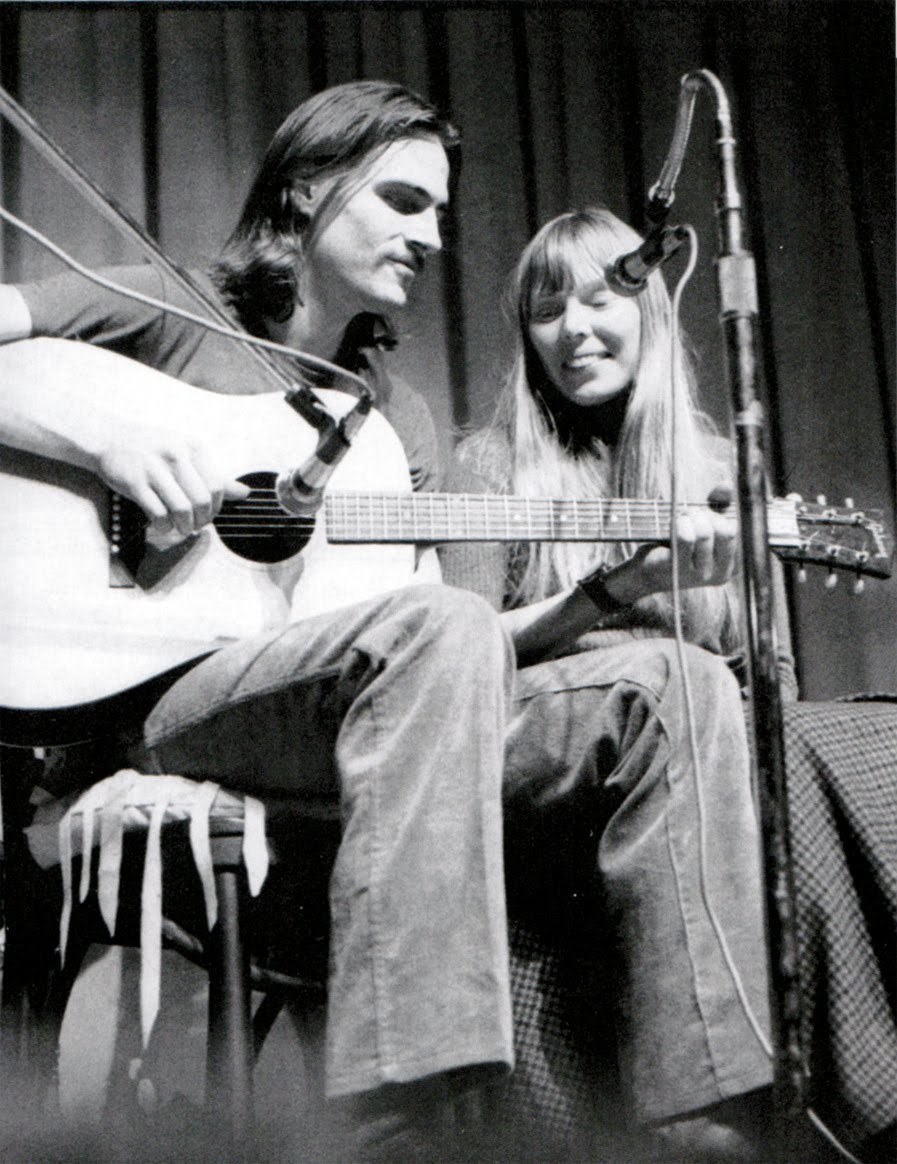
As we approach the release of Joni Mitchell’s “Archives Vol. 2: The Reprise Years (1968 To 1971)“, the songwriter has dropped an archival duet with James Taylor, With the track “You Can Close Your Eyes.”
Recorded on October 29th, 1970, the performance opens with intimate onstage banter from the couple, who were dating at the time. “This is a song that James wrote,” Mitchell tells the audience. “It’s a lullaby. It’s really beautiful.” They harmonize on the track, with Mitchell’s octaves climbing high above Taylor’s.
“We did the show in London together,” Mitchell told Cameron Crowe in the box set’s liner notes. “That’s when we were dating. He really locked up to my dulcimer, playing great with his guitar. Those two instruments together sound great. It sounded like one instrument. Musically, we were a great couple.”
“You Can Close Your Eyes” at the BBC “In Concert ” series follows a 1969 live take on “Chelsea Morning” at Carnegie Hall and a 1968 performance of “The Dawntreader” at Ontario’s Le Hibou Coffee House; the latter was recorded by Jimi Hendrix with his very own tape recorder and thought to be lost for decades.
“Archives Vol. 2” arrives on November 12th as a five-CD set or 10-LP collection
Robert Plant and Alison Krauss have shared another sliver of their highly anticipated LP “Raise the Roof,” out November 19th.
Robert Plant and Alison Krauss’s 2007 album “Raising Sand” swept the Grammys and left legions of fans asking for another set of songs revisited and reinterpreted by the unexpected pairing of the Led Zeppelin frontman and the bluegrass stalwart. But it took 14 years to get there again. The duo, along with the producer T Bone Burnett, are back later this month with “Raise the Roof,” making an album that yet again stands in contrast to so many of its contemporaries and captures a special kind of magic. “A funny thing happens with them,” Burnett said. “When the two of them sing, it creates a third voice, a third part in their harmonies when there are only two parts.”
“High And Lonesome” was written by Plant and T Bone Burnett, and (according to a feature via The Bluegrass Situation) Plant declares it as “a far cry from everything I’ve done before. I love the whole kaleidoscope of music that I’ve explored, but this is a place where you can think within the song, you can decide how to bring home an emotion. It’s another blend that we’ve got, and long may we have more of them.”
Added Krauss, “One of my favourite parts of this is the songs and songwriters that I had never heard of. Working with Robert, and with T Bone, is always a great education in music history.”
“Raise the Roof” marks Plant and Krauss’ first collaboration in over 14 years, following the success of their first collaboration, 2007’s “Raising Sand“, which earned multiple Grammy Awards including Album and Record of the Year.
The official audio for Robert Plant and Alison Krauss’ “High And Lonesome” from their forthcoming release, ‘Raise The Roof’, out November 19th.
Cat Power returns with “Covers”, Chan Marshall’s third album of her celebrated reinterpretations of songs by classic and contemporary artists.
Cat Power has announced a new album of cover songs. “Covers” is out January 14th via DominoRecordings. She’s shared her version of Frank Ocean’s “Channel Orange” single “Bad Religion,” plus a cover of the Pogues’ “A Pair of Brown Eyes” from the record. Power also performed “Bad Religion” last night on The Late Late Show With James Corden.
The album features covers of songs by Iggy Pop, Bob Seger, Dead Man’s Bones (Ryan Gosling’s band), Jackson Browne, the Replacements, Nick Cave, Billie Holiday, and more.
Cat Power’s cover of “Bad Religion” took shape when she started performing her song “In Your Face” from 2018’s Wanderer on tour, according to a press release. “That song was bringing me down,” Cat Power said. “So I started pulling out lyrics from ‘Bad Religion’ and singing those instead of getting super depressed. Performing covers is a very enjoyable way to do something that feels natural to me when it comes to making music.”
In the years since “Wanderer”, Cat Power has worked on music for the Echo in the Canyon documentary and the Sean Penn feature Flag Day. She also covered Cassius’ “Toop Toop” last year in tribute to the late Philippe Zdar. Power said in a statement that her cover of Billie Holiday’s “I’ll Be Seeing You” is a tribute to Zdar.
Cat Power – “A Pair Of Brown Eyes”, from the forthcoming album ‘Covers,’ out 14th January 2022 on Domino Record Co.
When the world shut down in March 2020, Charlotte Cornfield was in the middle of an artist residency in the Rocky Mountains, hunkered down in a hut with a baby grand piano, sketching ideas for a follow-up album to her Polaris-Longlisted 2019 LP The Shape of Your Name. In a matter of hours, she found herself back home in Toronto with months of touring cancelled and a wide swath of time ahead of her. She began to write feverishly, mining her memories and dreams and recounting them with vivid detail. When the songs were finished, she headed to Montreal to record with producer/engineer Howard Bilerman (Arcade Fire, Leonard Cohen), drummer Liam O’Neill (Suuns), bassist Alexandra Levy (Ada Lea), and guitarist Sam Gleason (Tim Baker).
The group tracked the album in 5 days, mostly live off the floor, seeking to capture the raw emotion of the songs. The result is Highs in the Minuses, a memoir in fragments. Here Cornfield fully embraces the role of narrator, moving from one vignette to another in a colourful collage. We see her at 21, heartbroken and lost, carrying a friend’s 3-legged cat back to her apartment in a box; then as a teenager, playing a new song for a group of friends on a trampoline. She sings of a magical first date, an ex with a mean streak, two skateboarders gliding in a lakeside parking lot. The brutal honesty in her lyrics brings to mind writers like David Berman and Adrianne Lenker, while musically she conjures a Zuma-era Neil Young, leaping from crunchy guitar rock to piano ballads with effortless grace. Highs in the Minuses is Charlotte Cornfield’s strongest offering to date, each song a gem in and of itself.
Charlotte Cornifeld has unveiled a new video off her upcoming album “Highs in the Minuses”. It’s called ‘Drunk For You’, and it arrives with an accompanying music video. “Sometimes desire betrays logic, and you end up at somebody’s door even after you’ve talked yourself out of it, in all of the ways,” Cornfield said of the new track in a statement. “And that feeling can be intoxicating. And it can be painful. I recorded this song after the rest of the band had left the studio. It was just me, in the big room at the grand piano, and Howard and Shae were in the control room behind the glass. I remember I felt truly alone, in a way that I needed to be to sing it properly. We did two takes and kept the first one, and if you listen closely you can hear the piano bench squeaking a little bit in the background.”
Of the video, she added: “We shot this video in Lake Ontario, my brother behind the camera and my Mom on the beach holding a reflector and cuing the song. There was something really special about it just being the three of us out there, in that magic blue hour light. We kept getting deeper and deeper in the water, and I didn’t even notice the rolling wave that came and swept me away at the end.”
‘Drunk For You’ is the third single lifted from “Highs in the Minuses“, following ‘Partner In Crime’ and ‘Headlines’. The album is out October 29th via Polyvinyl/Double Double Whammy.
Charlotte Cornfield – vocals, guitar, piano, bass, synth Liam O’Neill – drums, percussion Alexandra Levy – bass (1,3-5,10) Sam Gleason – guitar, synth (1, 2, 7-9, 11) Amy Millan – backing vocals (3) Howard Bilerman – noise (9)
Julia Jacklin thought she’d be a social worker. Growing up in the Blue Mountains to a family of teachers, Jacklin discovered an avenue to art at the age of 10, thanks to an unlikely source: Britney Spears.
Jacklin chanced upon a documentary about the pop star while on family holiday. “By the time Britney was 12 she’d achieved a lot,” says Jacklin.”I remember thinking, ‘Shit, what have I done with my life? I haven’t achieved anything.’ So I was like, ‘Mum, as soon as we get home from this holiday I need to go to singing lessons.’
Classical singing lessons were the only kind in the area, but Jacklin took to it. Voice control was crucial, and Jacklin flourished. But the lack of expression had the teen seeking substance, and she wound up in a high school band, “wearing surf clothing and doing a lot of high jumps” singing Avril Lavigne and Evanescence covers. It wasn’t much but she was hooked.
Jacklin’s second epiphany came after high school. Travelling in South America she reconnected with high school friend and future foil Liz Hughes. The two returned home to the Blue Mountains and started a band, bonding over a love of indie-Appalachian folk trio Mountain Man and the songs Hughes was writing.
“I would just sing,” says Jacklin. “But as I got my confidence I started playing guitar and writing songs. I wouldn’t be doing music now if it wasn’t for Liz or that band. I never knew it was something I could do. “
Now living in a garage in Glebe and working a day job on a factory production line making essential oils, the 25-year old found time to hone her craft – to examine her turns of phrase, to observe the stretching of her friendship circles, to wonder who she was and who she might become. That document is Jacklin’s masterful debut album, “Don’t Let The Kids Win” – an intimate examination of a life still being lived.
Recorded at New Zealand’s Sitting Room studios with Ben Edwards (Marlon Williams, Aldous Harding, Nadia Reid), Don’t Let The Kids Win courses with the aching current of alt-country and indie-folk, augmented by Jacklin’s undeniable calling cards: her rich, distinctive voice, and her playful, observational wit.
You can hear it in opener ‘Pool Party’, a gorgeous lilt bristling with Jacklin’s tale of substance abuse by the pool; in the sparse, ‘Elizabeth’, wrestling with both devotion and admonishment of a friend; in detailing the slow-motion banality of a relationship breakdown in the woozy ‘L.A Dreams’; and in her resolve to accept the passing of time on the snappy fuzz of ‘Coming Of Age’. The album hums with peripheral insights, minute in their moments but together proving an urge to stay curious.
“I thought it was going to be a heartbreak record,” says Jacklin of Don’t Let The Kids Win. “But in hindsight I see it’s about hitting 24 and thinking, ‘What the fuck am I doing?’ I was feeling very nostalgic for my youth. When I was growing up I was so ambitious: I’m going to be this amazing social worker, save the world, a great musician, fit, an amazing writer. Then you get to mid-20s and you realise you have to focus on one thing. Even if it doesn’t pay-off, or you feel embarrassed at family occasions because you’re the poor musician still, that’s the decision I made.”
In person Jacklin is funny, wry, quick to crack a joke. It makes the blunt honesty and prickly insight laced through her song writing disarming, a dissonance she delights in. “Especially coming from my family,” says Jacklin. “They don’t talk about feelings at all. I love writing songs about them and watching them listen and squirm. To me that’s great. I enjoy it.”
The title track was the last song Jacklin wrote for the album. “My sister’s getting married soon,” she says of the closer. “And it hit me – we used to be two young girls and now that part of our lives is over. Seeing her talking about wanting to have a baby and…it’s like, man I can’t believe we’re already here.”
Don’t mistake this awareness for nostalgia. “It’s not that I want to go back to that time at all,” says Jacklin. “It’s trying to figure out how to be responsible when you don’t identify with who you were anymore.”
“All my friends at this age are freaking out. Everyone’s constantly talking about being old. “Don’t Let The Kids Win” is saying yeah we’re getting older but it’s not so special. It’s not unique. Everyone has dealt with this and it’s going to keep feeling weird. So I’m freaking out about it too but that song is trying to convince myself: let’s live now and just be old when we’re old.”
The period of the Eighties widely regarded as the low point of Dylan’s musical career, a time when he struggled to find relevance in the MTV era and released a series of tacky, rudderless albums that were savaged by fans and critics. Even Dylan himself refuses to defend his output from the time. “[I was] pretty whitewashed and wasted out professionally,” he recalled in his 2004 memoir Chronicles: Volume One. “I’m in the bottomless pit of cultural oblivion. You name it. I can’t shake it.”
But the newest chapter of the bootleg series, Springtime In New York (1980-1985), forces us to re-evaluate this notion completely. The overwhelming amount of material in this set 54 unreleased songs total — proves that even at Dylan’s lowest point, he was still capable of writing great music, even if the best songs often didn’t wind up on his albums.
The five-disc collection focuses on 1983’s “Infidels”, while also shedding light on the records that bookend it: “Shot of Love”, the last of his born-again Christian albums, and the glitzy “Empire Burlesque“. The former showed Dylan continuing his divisive streak of born-again Christian albums while the latter is an excessive, shimmery affair that has more in common with She’s So Unusual than Highway 61 Revisited.
After the high bar he had set for himself in the ‘70s, courtesy of such albums as “Blood on the Tracks” and “Desire”, not to mention his groundbreaking Rolling Thunder Review tour, Bob Dylan had clearlyraised expectations when it came time to embark into the ‘80s. That said, his initial outing of the decade, “Shot of Love”, didn’t bode well for what might follow. Another of his so-called “Christian albums,” its songs were generally weak, and with the exception of “Lenny Bruce,” “Heart of Mine” and “The Groom’s Still Waiting at the Altar” (a rocker relegated to B side status), it was best forgotten.
Fortunately, Dylan quickly rebounded with his next two studio efforts, “Infidels“, produced a bonafide Dylan disciple Mark Knopfler of Dire Straits, and “Empire Burlesque”,which featured various members of Tom Petty’s Heartbreakers, Mick Taylor and Ron Wood offering support. Neither album was hailed as a triumph, but they did show Dylan was still capable of writing great songs even when nobody seemed to notice.
“Springtime In New York” takes a narrow focus on the first half of that otherwise obscured decade and manages to cull enough gems to justify a full five-disc box set. Of course, the Bootleg series has excelled and even accumulated honours for unearthing outtakes, live material, and other unreleased offerings, but this particular volume actually exceeds expectations, especially given that the basis for this compilation seemed rather slim, to begin with. Nevertheless, it manages to gather together some prime offerings, most of which outshines the initial work. For example, two tracks originally intended for “Empire Burlesque”—“New Danville Girl” and “Dark Eye”—offer reason to wonder why they weren’t included in that album originally. Each of them is that good. Alternate takes of “Jokerman” and “Don’t Fall Apart OnMe Tonight,” all songs that first appeared on “Infidels”, suggest Dylan had plenty of quality music to choose from. So too, “Angelina,” “Price of Love” and “I Wish It Would Rain,” recorded during the “Shot of Love” sessions, are actually far better than anything on the finished release.
There are curiosities of course—unlikely attempts at “Let It Be Me,” “Cold, Cold Heart,” “Abraham, Martin and John,” “Sweet Caroline,” and “Angels Flying Too Close to the Ground” reflect that fact that Dylan hadn’t tired of covering classics long after Self Portrait had again given way to original work. A live version of “License To Kill,” culled from an appearance on “Late Night With David Letterman” sounds frayed around the edges, but makes for an interesting entry regardless. Likewise, disc one is comprised almost entirely of rehearsals, giving a glimpse of Dylan’s creative process in motion.
Like the various Bootleg boxes that preceded it, “Springtime In New York” boasts an impressive hardcover book that provides essential facts about each album’s origins, rare photos, and extensive studio notes that detail the sessions in thorough detail. A new video for Bob Dylan’s “License to Kill” has been released, featuring a new remix version of the 1983 original along with previously unseen footage from the “Infidels” sessions. It’s tied to “Springtime in New York: The Bootleg Series Vol. 16 (1980-1985)“, a five-disc set that includes material recorded from 1981’s “Shot of Love”, 1983’s Infidels, and 1985’s “Empire Burlesque”.
The video was shot on April 30th, 1983 at the Power Station in New York City. This was near the end of the six-week Infidels sessions and footage includes the entire band, including guitarist/producer Mark Knopfler, guitarist Mick Taylor, keyboardist Alan Clark, bassist Robbie Shakespeare, and drummer Sly Dunbar.“License to Kill” contains one of the most baffling lines in Dylan’s Eighties catalogue: “Man has invented his doom/First step was touching the moon.” Dylan attempted to explain it. “What’s the purpose of going to the moon?” he asked. “To me, it doesn’t make any sense. Now they’re gonna put a space station up there, and it’s gonna cost, what — $600 billion, $700 billion? And who’s gonna benefit from it? Drug companies who are gonna be able to make better drugs. Does that make sense? Is that supposed to be something that a person is supposed to get excited about? Is that progress? I don’t think they’re gonna get better drugs. I think they’re gonna get more expensive drugs.”
Naturally, Dylan aficionados will likely view this once again as part of a holy grail, but even the casual collector may see the need to add this to their collection. “Springtime In New York” could be considered one of the richest seasons of all. Two weeks ago, a video for “Don’t Fell Apart on Me Tonight (Version 2)” was released that was shot around the same exact time as the “License to Kill” Video.
Springtime opens with rehearsals for Dylan’s Musical Retrospective Tour in the fall of 1980, where he was backed by the under-appreciated singer Clydie King. The shows were billed as a return to some of his older songs, following his strict gospel-only setlists, but instead of “Simple Twist of Fate” we get several wildcards: covers of hit songs at the time, like Bill LaBounty’s “This Night Won’t Last Forever” and Dave Mason’s “We Just Disagree” (he also reportedly covered “The Rainbow Connection,” but unfortunately it didn’t make the cut). Perhaps because Dylan never intended the public to hear them, these renditions are intimate, raw, and even joyous. Close your eyes to his take on “Sweet Caroline,” and you’ll forget someone else wrote it.
While the original “Infidels” demonstrated Dylan’s genius ability to assemble a band — Dire Straits’ Mark Knopfler (who produced the album) and Alan Clark, the Stones’ Mick Taylor, and the reggae duo Sly Dunbar and Robbie Shakespeare — he left many of the best songs off the album in favour of duds like “Union Sundown.” Gems like “Foot of Pride” and “Someone’s Got a Hold of My Heart,” later reworked as “Tight Connection to My Heart” on Empire Burlesque, would have made the album infinitely better.
And then there’s “Blind Willie McTell,” one of his finest songs of his career. A great version was released on the first chapter of the Bootleg Series back in 1991, but this one is even better, as Dylan wails “There’s a chain gang on the highway/I can hear them rebels yell” with sparkling clarity. There are two takes of “Don’t Fall Apart on Me Tonight,” and the first, a desperate, slow-burning plea, arrives like a gust of wind to the throat. How is it that we’ve gone nearly 40 years without hearing this?
On a different version of “Sweetheart Like You,” the sweetheart in question is no longer wearing a cute hat, but a pair of boots. This doesn’t change the misogynistic tone of the tune, where Dylan points out, “You know a woman like you should be at home, that’s where you belong.” (Reflecting on the ballad in an interview, he admitted, “That line didn’t come out exactly the way I wanted it to.”)
The “Empire Burlesque” material has been stripped of producer Arthur Baker’s synths and gated drums. What remains are the tracks in their purest form — like a sprawling “New Danville Girl” that clocks in at nearly 12 minutes. But the highlight is undoubtedly Dylan’s legendary 1984 performance on Late Night With David Letterman. In the same way that Neil Young grew fascinated with New Wave and linked up with Devo, Dylan recruited punk band the Plugz for his appearance. The energy he fed off the young musicians was so palpable that Letterman asked, “Is there any chance you guys can be here every Thursday night?”’
If Dylan had gone on tour with these guys, would he have had a more successful decade? If he had kept his best songs on the albums, would they now be regarded classics? It’s these kinds of what-ifs that make “Springtime” so gripping — and so essential.
With their ninth full-length album – the aptly titled ‘9’ – out in the world today, Jamie Terry from psych machines Pond unveils some of his favourite lyrics of all time. The band that keeps on giving, having pushed their self-proclaimed “polished psych-pop” to its outer reaches, reinvent themselves yet again.
Pond have become a psych-rock institution by holding their explorative instincts close to heart over the last decade. From the fuzzy squall of 2013’s breakthrough ‘Hobo Rocket’ to the refined, melodic pop tones heard on 2019’s ‘Tasmania’, the Perth gang have always moved forward on their own terms, unfazed by the endless links to world-beating sister band Tame Impala.
They hit upon an even more ruthless revelation going into their ninth album, though, with frontman Nick Allbrook explaining: “After three albums of polished psych-pop, we’ve earned our reward of doing something completely fucked.” They set out to achieve this by adopting methods of their heroes Can, recording jams to tape and then chopping them up to achieve creative anarchy. It’s their biggest leap into the unknown yet.
Finally, here it is. I knew this day would come. Seems like only yesterday we were bandying ideas around for some sort of hi-tempo hi-reznor Rez-wave new album, and now look at you. Heading out into the world on your own. Your fathers and I have watched you grow from just a glimmer of an idea of a hi-tempo rez-wave cluster-fuck into the grown up LP you are today, cover and all. I don’t care, yes i’m crying, but everything makes me cry these days. It’s such a miracle anything gets born and anyone sings a note in the Mad Max end-days, but here you are, the little light of our life. No matter where you go, know that we love you, and though your friends might call you 9, to us you’ll always be our little Full Reznor. – Nick Allbrook
First watch: As a thank you for being signed up to the mailing list, here’s an advance screening of The Making Of ‘9’. Shot, directed and edited by Duncan Wright.
Pond – “Take Me Avalon, I’m Young”
“Winnie-the-Pooh lying with his legs in the air, impotent, singing those were the days i was young and hungered for flesh like a bear. Now I’ve grown toy, on a turning display out of sight. An overgrown boy, lost in a world turning very very slowly to night”
Bass-heavy opener ‘Song For Agnes’ proves the band weren’t half-arsing their intentions. The operatic, grand track beams with positivity as Allbrook joyously sings: “There’ll be nothing but blue skies from now on, baby”. The pulsating electro anthem flows organically into a cosmic jazz outro, which offers the first glimpse of sonic experimentation on offer.
The dazzling mish-mash of sounds and influences rarely lets up. Party-ready anthem ‘Human Touch’ thrashes with taut energy and a dose of post-pandemic lyricism: “I need some human connection / I need some human touch / Been behind these screens so long.” That’s just before the lively and jubilant funk anchored ‘America’s Cup’ arrives with undercurrents of eighties ’80s synth-wave;a nother highlight comes with ‘Pink Lunettes’, which cuts in with a pounding modulated sequence that’s primed for strobe-lit dancefloors.
It’s a lot to take in, but the compact and well-executed transitions make sense of the chaos. There is some respite, though. ‘Take Me Avalon I’m Young’ packs an understated groove with orchestral backing, while ‘Toast’ shows a more sentimental side to the band; it’s a deeply romantic airing with the more lo-fi, melodic sound underneath starry-eyed lyricism: If the water dries / Like the morning dew / Life’s too short / To be away from you.”
It’s can be a risky game to thrown yourself into so many different styles on a record, let alone within individual songs. Yet – from Bowie to Kurt Cobain and William Burroughs – artists of all kinds have found joy in such surrealist methods of cutting up their work and putting it back together. Having perhaps taken their psych-pop to the edges of what’s possible, Pond deserve this moment. Hopefully, it proves a gateway to a new era for the band that keeps on giving.
Fremantle four-piece Spacey Jane have released their second single for the year, ‘Lunchtime’. Written at a time when frontman Caleb Harper was experiencing “severe hangover anxiety”, ‘Lunchtime’ is a quick-starting rock track that boasts in-your-face electric guitar riffs from Ashton Hardman-LeCornu. The single arrives with an accompanying music video from Matt Sav and Julia Jacklin collaborator Nick McKinlay. In the video, Harper leaves and returns to a formal lunch with his bandmates, getting battered and bruised in the process.
Following ‘Lots Of Nothing’, ‘Lunchtime’ is the band’s second new song since the June 2020 release of their debut album ‘Sunlight’. With four songs landing on triple j’s Hottest 100 last year – including ‘Booster Seat’ at Number Two – ‘Sunlight’ will be a hard act to follow. Spacey Jane haven’t let that put them off, though: their second album has already been recorded.
Speaking from his home in Fremantle, Harper explains the inspiration behind ‘Lunchtime’ and its music video, and how the track sits alongside Spacey Jane’s future musical plans.
‘Lunchtime’ is a very fun song for us. And it’s weird writing a really fast song. For me, I sort of do it intentionally, like: let’s do something fast and fun because it’s so good to play live. You really just get to rock around and the effect on the listener is quite immediate.
But the rest of the record is actually not really that fast, there’s a lot of slower stuff in there. This is definitely the most guitar-driven song on the album, I’d say. It feels like a more youthful, fun version of the kind of music that we make and we like it for that reason. We wanted to have it as a single just because we felt like it was like an outlier in some ways to what the rest of the record might end up being.
HALLOWEEN night at Hotel Vegas! Poster by Federico Moreno. Yep, we’re gonna have do do some black light inks on this one!
Frankie and the Witch Fingers + Christian Bland & The Revelators + Acid Dad + Hooveriii! With tributes to The 13th Floor Elevators, Spacemen 3, The Stooges, Jesus & Mary Chain and Hawkwind. Presented by The Reverberation Appreciation Society.




 The Fat Angel Sings