

Archive for the ‘MUSIC’ Category
SLY and the FAMILY STONE – ” There’s a Riot Goin’ On ” Released 50 Years Ago Today
Posted: November 28, 2021 in CLASSIC ALBUMS, MUSICTags: CLASSIC ALBUMS, Sly and the Family Stone, There’s a Riot Goin’ On
If one album summed up the mood of 1971 in 45 minutes, it was Sly & the Family Stone‘s There’s a Riot Goin’ On. Dark, druggy and depressing as hell, the fifth album by the San Francisco group led by multi-instrumentalist Sly Stone was the recorded equivalent of a gut punch to a nation already knocked senseless by war overseas and social unrest at home.
Almost exactly a year before “There’s a Riot Goin’ On‘s” release in November 1971, Sly & the Family Stone put out their massively popular “Greatest Hits” record, which collected singles and deep cuts from 1968 and 1969. The dozen tracks wrapped up the brief history of one of R&B’s best crossover bands, chronicling a dizzying couple of years that yielded some of the era’s most enduring songs.
But anyone expecting a second sunshine-kissed greatest-hits volume in a few years was most likely side-lined by the despairing tones crawling throughout “There’s a Riot Goin’ On“. Originally titled “Africa Talks to You“, and recorded partly in response to Marvin Gaye‘s sociopolitical “What’s Going On” (another era-defining album released in 1971), the album was a moody, murky indictment of the United States at the turn of the decade.
“There’s a Riot Goin’ On” is a striking example of a pathfinder taking a road, both musically and personally, that tests every relationship to the brink and beyond to a place and time where tumult is inevitable and damage is dealt harshest of all to the protagonist at the centre of it.
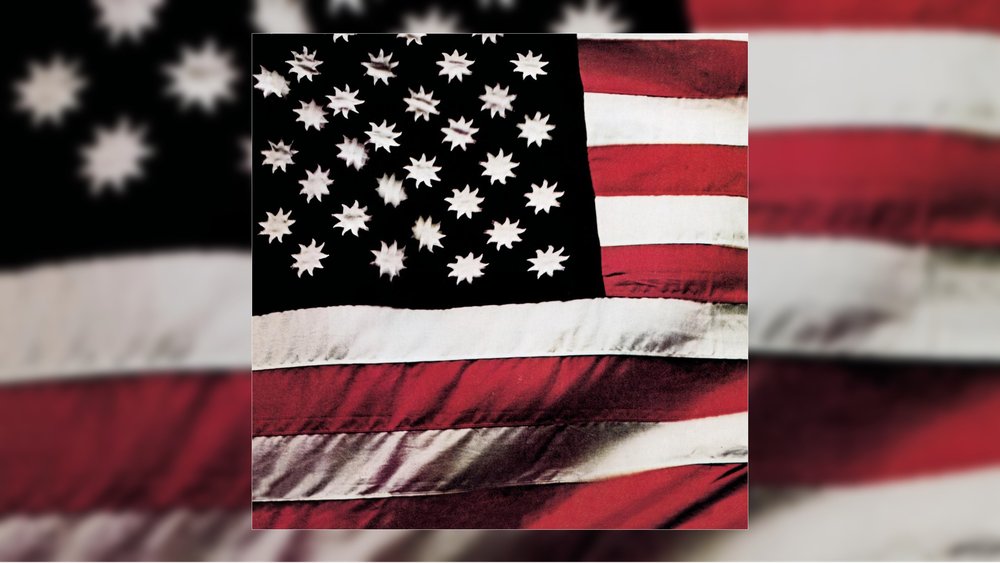
The cover art, featuring an American flag with suns replacing the familiar stars, says it all: Blood-red stripes offset the remaining black and white.
It wasn’t an easy record to listen to then, and it’s still tough to get through at times now. But Sly & the Family Stone never made a more significant album. It’s their masterpiece, but it’s also one of music’s most harrowing and desolate works, and one that reflected the turmoil going on within Sly Stone.
After Sly & the Family Stone’s rousing Woodstock performance, their leader became unreliable. He missed shows. He missed album deadlines (prompting the release of “Greatest Hits“). He became more and more paranoid. He moved to Los Angeles. He joined the Black Panthers, who urged him to drop the white members of his multi-racial group. And he started to take more and more drugs, which clouded his mind and, to an extent, his creativity.
When he was able to get it together, he didn’t like what he saw, particularly the end of civil-rights activism and the dark pall cast on the final years of the ’60s. So he made an album about it, replacing his band’s usual psychedelic pop and funk with a deeper, sleepier version muddled with gut-churning bass rumbles, mumbled lyrics and a sense that there was a violent revolution brewing, but only if its leader didn’t nod off first.
But the groundwork for this new blueprint of soul and funk lies in its predecessor “Stand” and, more importantly perhaps, the success it brought with it. Released in 1969 after three solid, if unspectacularly performing albums, it reached #12 Top 200, whereas none of the previous three albums had broken the top 100. Part of its success can be attributed to a moment that goes down as one of the most important in 20th Century musical history: the Woodstock Festival.
When Sly and the Family Stone took the stage at 3.30am on Sunday August 17th, 1969, their lives and careers changed forever. Almost knee deep in mud and worn low by the ravages of a weekend of intoxicating substances and little sleep, the crowd was revitalized by the surging, infectious performance the band gave—a lengthy, exultant “I Want To Take You Higher” lit the touch paper and the band never looked back. In fact, it was a palpable moment of realization for those involved, as well as those in the crowd. Larry Graham, the slap bass innovator, recounted in later years the fact that the band fully grasped their potential and realized what the awesome power of the fully operational group could attain.
But the savage irony of that realization is that the seeds were sown at that moment for the gradual dissolution of the group. For with success, came money and, somewhat inevitably, distractions. It may be a tale oft-told but it remains true—no one prepares you for success and all the trappings it brings. The distractions that afflicted Sly Stone in particular are well documented—for him it was cocaine and PCP that were his escape. Scanning through the interviews he gave to journalists in the early 1970s (which were few and far between), each and every single one of them makes mention of his cocaine habit.
Sly Stone missed 26 of the 80 planned shows, but things may not have been quite so straightforward. For all that the drugs would inevitably contribute to the problem, there was the idea that some form of scam was being run by those around the group. If Stone was waylaid by someone, resulting in a missed show, it was alleged that that person got a split of the resulting financial payoff Stone was obliged to produce. When he was interviewed by David Letterman in 1983, he addressed the issue head on: “There’s no way to make three gigs in one night, if you only know about one.”
Stone used The Plant Studios in Sausalito and the loft of his Bel-Air mansion but with one added curiosity. Sly also owned a Winnebago that was fitted out (somewhat chaotically) with recording equipment that added to the places Stone could hide himself away and create what would become Riot. It was a solitary endeavor for the most part though, something that was made possible by the advent of the most basic of drum machines.
The Maestro Rhythm King MRK2 had preset patterns that he would use in a new, exciting way as Greg Errico (a real human drummer!) grudgingly testifies in Kaliss’ book: “The machine. . . was a lounge instrument that the guy at the bar at the Holiday Inn might have used.
Stone worked on the album, mostly by himself, throughout 1970 and 1971. Many of his vocals were recorded in his bedroom, with a drum machine driving the beat. The other members of the group later overdubbed their parts. And Stone himself overdubbed even more on top of that. The result was a mix so thick and muddy that it perfectly suited the album’s themes of disillusionment and despair.
There were the internal band tensions that had been present since almost day one. Larry Graham and Sly tussled numerous times as the former challenged Stone’s authority. There were also rumours of Graham having affairs with Rose (Sly’s sister) and Sharon (Sly’s brother Freddie’s wife)—hardly a cocktail for healthy relationships and dynamic musical brotherhood. The upshot of all that was that Graham barely appeared on “There’s a Riot Goin’ On“, instead bass parts were played by either Stone himself or Rustee Alan who was more in line with James Jamerson’s luxuriously smooth bass playing than Graham’s newly minted slap bass techniques that had contributed so memorably to “Stand’s” success.
From the opening “Luv n’ Haight” — one of the few songs here that doesn’t sound like a 45 played at 33 1/3 — to the closing “Thank You for Talkin’ to Me Africa,” a gloomy, seven-minute reworking of Sly & the Family Stone’s 1969 No. 1 hit “Thank You (Falettinme Be Mice Elf Agin),” There’s a Riot Goin’ On plays out like a drug-induced nightmare that’s a simultaneous end to the ’60s and the start of an equally tumultuous decade. The title track, which closes out Side One, runs 0:00, erasing all time and space from the record.
It’s a fitting summation of the album, because nothing else sounded like it at the time. All these years later, it remains one of the most distinctive records ever made. It confused a lot of people then, and it still does. But the success of the single “Family Affair,” which hit No. 1, drove the LP to the top of the album chart.
It would be the group’s last No. 1s, though they did manage to make one more great album, 1973’s Fresh, before Stone couldn’t keep it together anymore. There’s a Riot Goin’ On touched just about everyone who heard it. Jazz got darker and funkier, funk got darker and deeper, R&B got weirder and druggier and rock ‘n’ roll got more adventurous and complicated (the Rolling Stones, for one, were influenced by the murky production enough to bury Exile on Main St. in a similar mix).
It seems almost beyond comprehension that the group’s biggest song would come from this album, but “Family Affair” hit #1 on the charts and stayed there for three weeks. Recorded with Billy Preston on electric piano and Bobby Womack on rhythm guitar, it buried Sly’s guitar in the mix and featured his singing in an entirely different register. Gone were the urgent gospel-like vocals of previous years and in its place came a guttural, underplayed vocal that mirrored the gloomy approach to recording and the overall feel of the album.
The other singles released from the album were “Runnin’ Away” and “(You Caught Me) Smilin’” both of which did pretty well
The music on “Riot” is funky, very funky, but it is of a totally different ilk to the funk others offered. Take James Brown’s work of the time with his new line-up that included Bootsy and Catfish Collins. Their brand of funk was expansive, punchy and dancing to it meant the chance to use huge movements—spins, pirouettes and leaping splits; arms and legs flung as extensively as possible. But it is hard to imagine those same movements in response to the deep, gloopy funk of “Riot“. Here the funk is wearing a strait jacket—the movements it provokes are limited in scope and scale, instead the neck bears the brunt of the groove.

“I’m kind of back,”said Rufus Wainwright, He could have been talking about any number of things — his return to the stage, post-pandemic; or his new album, “Rufus Wainwright and Amsterdam Sinfonietta Live“, But he was referring to his hometown. On the phone from his place in L.A., the beloved Montreal singer-songwriter spoke fondly of his recent return to our city, where he jumped on stage with sister Martha during her performance at the Outremont Theatre, and where he decided it was time to once again have a pied-à-terre. “I just got a little room in an apartment on Esplanade, and was setting it up,” Wainwright said. “I feel a need to be close to Montreal. I hadn’t seen my family in about three years. Over the pandemic, I definitely experienced a lot of yearning for Montreal — not to return there permanently, but to develop more of a foothold in that part of the world.
Wainwright is renting a room in an apartment belonging to some friends. And while he won’t be getting up here all the time, we should be seeing more of him. Perhaps he was inspired by Martha who has been living in L.A these last few years, even opening her own Mile End café and music venue, Ursa, where Rufus has participated in a few hot-ticket fundraising concerts.
Speaking of concerts, his new album was inspired by a 2017 mini-tour of the Netherlands with string ensemble the Amsterdam Sinfonietta. The shows found Wainwright revisiting his own repertoire and some of his favourite songs from across the musical spectrum. The collaboration came about serendipitously. “I had this amazing agent for years, David Chumbley, who was my first European agent,” Wainwright said. “Sadly, he passed from cancer (later in 2017). He always got me really interesting shows, and I have to say, he was a bit of a mobster as well — he could be really tough and scary, which is appreciated in an agent.
“At one point an offer came in to work with an orchestra, the Amsterdam Sinfonietta. I had never heard of them, but I trusted my agent and went in and we put together a set. I let them do all the arrangements. It was a real leap of faith. When I arrived and we started running through the songs with the orchestra, I was dumbstruck by how great the whole situation was — the musicians and the arrangements.”
Critics and audiences of the ten concerts were enraptured by the intimacy and intensity of the program curated by Wainwright. The concerts reflected the immense bandwidth of Wainwright’s musical influences and interests from Verdi Arias to Leonard Cohen and Joni Mitchell, from Rameau pieces to the American songbook and French chanson and from Wainwright’s beloved Berlioz to his family’s and his own songs, some of them written for this program. Emotional centre piece of the album is Wainwright’s almost 9 minute version of late Canadian singer songwriter Lhasa de Sela’s harrowing “I’m Going In”, a song she wrote about her own death from cancer at the age of 37. All arrangements were created specifically for the Amsterdam Sinfonietta and around Wainwright’s voice that is truly at the peak of its power. The artistic kinship between Wainwright and the Amsterdam Sinfonietta lead by Candida Thompson is astounding and make these live recordings into something utterly unique and breathtaking.
“Rufus Wainwright and Amsterdam Sinfonietta Live” is the document of that meeting, providing fresh perspective on the singer-songwriter’s broad musical range, as he covers everyone from Irving Berlin to Leonard Cohen, Kate and Anna McGarrigle, Hector Berlioz, Joni Mitchell and Lhasa de Sela, interspersed with an array of his own tunes.
“It’s a real potpourri of material,” Wainwright said. “I just felt this need to (showcase) the wide variety of material I’ve covered over the years, and have it all on record, all framed in a similar wood, shall we say, with a string section.
“I think — look, I wouldn’t say it’s a genius move, but in retrospect it’s a very solid proposition.”
Uniting the various styles is Wainwright’s distinct voice, remarkable for its range, power and technical prowess, yet altogether unconventional. As a singer, he makes himself at home wherever he goes, without ever losing the idiosyncratic qualities that make him Rufus.
“If anything, (this album) proves my voice has a strange, multi-faceted ability where it can morph into all these different areas but maintain its identity,” Wainwright said. “When I sing classical, I still sing like Rufus Wainwright. And the same with jazz or my own material; though I’m respectful of genre — I’m not tossing it off. I’m deeply embedded in the material. It’s a balance between keeping my personality and serving the music.”
And so a solemn rendition of Cohen’s “Who By Fire” is followed by a whirlwind version of Mitchell’s “All I Want“; while a heart-wrenching, nine-minute take on Lhasa de Sela’s death-acceptance ode I’m Going In gives way to a spirited tackling of Berlioz’s L’Île inconnue.
The Lhasa piece, which Wainwright calls “the one I’m most proud of,” holds special meaning for him, as singer died just weeks before his mother, Kate McGarrigle, in 2010.
“That song became a real anthem for me at that time,” he said. “It helped my understanding of what my mother was facing, without her having to tell it to me.” Over his two-decade-plus career, Wainwright has recorded pop albums, a Judy Garland tribute, an album of Shakespeare sonnets set to music, and he has composed a couple of operas. Thought it’s far from a compendium of all that activity, the new album is emblematic of it. “I don’t believe there should be any boundaries between music,” Wainwright said. “I very much believe in the autonomy of types of music, but they should all be scalable mountains for everyone.”
“Rufus Wainwright and Amsterdam Sinfonietta Live” came out Friday.
Asia were an English rock supergroup formed in London in 1981. The most commercially successful line-up was its original, which consisted of four members of different prog-rock bands that had enjoyed great success in the 1970s: lead vocalist and bassist John Wetton from King Crimson and U.K, guitarist Steve Howe of Yes, keyboardist Geoff Downes also of Yes and Buggles, plus drummer Carl Palmer of ELP. Their debut album “Asia“, released in 1982, remains their best selling album and went to number one in several countries. The well known single “Heat of the Moment” from the album, remains their top charting and best-known song.
The band underwent multiple line-up changes before the original four members reunited in 2006. In 2013, the original line-up was broken once again when Howe retired from the band and was replaced by guitarist Sam Coulson. After a few years of inactivity, Billy Sherwood (of Yes, World Trade) replaced an ailing Wetton (who died shortly thereafter).
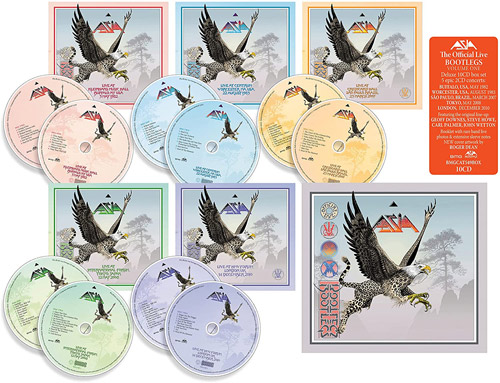
“The Official Bootlegs, Vol 1” is a 10CD Asia box set that features live performances from across the world between 1982 – 2010. We are promised “high quality original soundboard audio sources” for the performances, all of which are unheard. This comes as five two-CD sets in an outer slipcase with a 12-page booklet.
ASIA are a multi-platinum selling, global superstar English rock band formed in London 1981 and celebrate their 40th anniversary this year. The Official Bootlegs, Volume One 10 CD box set contains some of the rawest and most intimate of ASIA’s live shows from across the world from 1982 – 2010.
Including shows from Buffalo, USA, 1982; Worcester, USA, 1983; Sao Paulo, Brazil, 2007; Tokyo, Japan, 2008 and London, UK 2010.
These incredible live performances are housed within an open ended slipcase, with beautifully designed original artwork from the fantastic painter and artist Roger Dean. Audio for all 5 shows previously unheard, high quality, original concert soundboard audio sources for all performances.
Inside the box set there is also a 12-page booklet with rare band photos as well as liner notes from ASIA expert Dave Gallant.

When he’s not focused on his on-line tuition, or stuck in the back of his brothers van mixing his latest compositions, Gargalo (Bruno G. Roth) is to be found in and amongst the sound mirrors of Greatstone in Kent. The shoot for his latest video, to accompany his last single – “Out Of Sync“, took Spanish-Canadian Bruno to Romney Marsh and Dungeness in the Sam Kinsella directed film. The isolation that is inherent in Roth’s song is born out across the coastal landscape just a stone’s throw from the nuclear power station. The artist, now based in London, has been involved in numerous bands before (King Korea/Welcome Dynasty) but this is his first solo project and he can’t wait for you to hear his debut solo EP.
“King Of Dark Waters“, which contains both “Out Of Sync” and “Monroes”, will be released on November 26th via Frances House Records.

I’ve released a new solo song for the occasion and it’s a spooky one. “Silence of the Organs” was written and recorded in December 2020, during the most surreal holiday season of my lifetime; isolated from most of our friends and family for fear of accidentally killing each other. The song is a four-parter. I wrote the lyrics stream-of-consciousness style, combining some autobiography of my own experience as a sick person with some observations on how the world around me seemed to be reacting to the pandemic. I was really into making tape loops at the time – that’s the creepy ambient bed you can hear in the background. It’s a bit more on the experimental side of the Typhoon/Kyle Morton musical continuum, but you can still tap your foot to it. This song was originally released as part of the DePaul Humanties Center’s “Sickness and Solitude” project and owes a deep debt of gratitude to H. Peter Steeves and the DHC. Available only on Bandcamp for the time being. As always, thanks for listening. Yrs, Kyle
Released October 29th, 2021
Written, recorded and performed by Kyle Morton

The Janitors peddlers of heavy drones and fuzzed nightmares since 2004 from Sweden, based in Stockholm had their new album written and studio time booked in the north of Sweden – ready to unleash their latest shamanic fuzz meltdowns and follow up to the “Horn Ur Marken” album from 2017. Then corona hit and everything changed. The band figured they would go down into their own studio to work on those tunes some more until things passed over but instead they ended up recording other songs that turned into “Noisolation Sessions Vol. 1” released in 2020 including some of the best songs The Janitors ever produced. As corona kept a tight grip on us all the band didn’t really know what to do next. So they started to record again and the result is “Noisolation Sessions vol. 2″, a collection of eight dark and noisy songs that are not aimed at the faint of heart. Instead The Janitors display a hypnotic, monotone and evil drone that fuzzes in all the right places. “The Noisolation Sessions Vol. 2” LP is a co-release between Cardinal Fuzz and Little Cloud plus Bad Afro records.
This wasn’t our choice to be made. We really didn’t want to do this record. But this pest that fell upon us kept pushing. So after Volume 1, we started recording again. But without the confinement of the regulations we put up for the first volume. We allowed ourselves to think beyond just one night of creativity and this is what we came up with.
These songs really reflect us at this moment. Not sure if that means anything to anyone except us. But it’s important to us. This is a testimony of what we left behind and what we hope for the future. And no matter how much we try to scream through our instruments, everything gets captured in the delay. In the rhythm of the decay. In the reminiscence of the reverb. We are trapped in this sonic world.. All we said is trapped in the echo. And that echo is for you to find.
As always we leave you with a raised long finger to the right wing fascist death machine. Take care and remember, you need to know how to howl to give yourself an escape route.
Written, recorded, produced, mixed and artwork by The Janitors
Releases January 23rd, 2022


Across the album’s ten songs, The KVB masterfully pull together their trademark components; radiant guitars, textural synths and an ear for a moody, brooding melody all presented here with with a renewed dynamism.
The initial writing sessions for the album took place in Spain in early 2019, where the duo found influence from “half built luxury villas, still unfinished from the crash in 2008. There was something eerie and beautiful about the desolate landscapes and concrete in the sunshine . ” There has always been an element of dystopia through their sound, but now there is also more of a rapturous release.
Throughout the album lyrical themes combine double meanings and a sleight of hand is present; Le Corbousier’s brutalist ‘Unité d’habitation’ informs the title track and via the French-to-English translation ‘Unité ‘becomes‘ Unity ’– a rallying cry to totality on the dancefloor. ‘Unbound’ is informed by the classic shoegaze stylings of Slowdive and Ride but also late-modern poet Keston Sutherland and the idea of recreating a special moment lost to the past. Beginning with a blast of electronic drums, lead single ‘World on Fire’ instantly kicks in with a euphoric blend of guitars and synths beneath Nicholas Wood’s and Kat Day’s breathy-yet-powerful vocal duet. Second single ‘Unity’ is built around a pulsing synth arpeggio that wouldn’t sound out of place on Trans Europe Express, but is augmented by detached, deadpan vocals and dream-pop sonics.


Canadian singer-songwriter Julie Doiron is back with “I Thought of You”, her first album under her own name since 2012’s “So Many Days”. She shared “Darkness to Light” ahead of the upbeat, twang-tinged record, which features the French-language song “Et Mon Amour.” Doiron joined Phil Elverum for a collaborative album in 2019.
Everything is coming together in Julie Doiron’s world, from embracing her electric past, to embarking on a new and energetic phase of her solo career with some of the most upbeat and inspiring songs of her recording career. Julie Doiron is back with “I Thought Of You“, her first solo record since 2012’s “So Many Days“, emanating a radiative force with nothing more than her guitar and her unmistakably indomitable voice. In her time away from the solo spotlight she has remained deeply entwined with music, releasing a critically acclaimed record with members of Cancer Bats and Eamon McGrath as Julie and The Wrong Guys, translating some of her previous work for Spanish label Acuarela, and returning to her otherworldly collaboration with Mount Eerie for Lost Wisdom pt 2. On “I Thought Of You”, Julie enlists close and trusted friends: the uber-prolific and multi-talented Daniel Romano, superstar drummer Ian Romano, and Quebecois songwriter Dany Placard on bass. We live for these moments, when our dearest friends find their way back to the places they love, and we once again hear their voices rise back into our lives.
Released November 26th, 2021
Julie Dorion – Vocals, Guitar
Dany Placard – Bass
Daniel Romano – Guitars, Keys, Percussion
Ian Romano – Drums
Michael Feuerstack – Pedal Steel on Darkness To Light
 The Fat Angel Sings