In the music video for “Your Love Is Killing Me,” Sharon Van Etten paints a devastating portrait of unrequited love, one that ends with the same kind of quiet shock that has come to be a defining element of VanEtten’s music. As such, she has, over the course of four acclaimed albums, become one of our foremost documentarians of love and all its horrors (and, occasionally, its pleasures), a role she continues to inhabit on her most recent offering Are We There. Van Etten has grown increasingly more ambitious with each release, with “Are We There‘s” most startling growth manifesting itself in her preternatural confidence, one that previous releases hinted at but never quite fully realized. That degree of conviction renders Van Etten’s already powerful songwriting even more affecting, making “Are We There” a listening experience rare in both its vulnerability and its certainty, an experience not unlike the roller coaster relationships about which Van Etten so candidly sings.
The lyrics on Sharon Van Etten’s fourth album don’t always make for easy listening. “He can break me, with one hand,” she falsettos during one chorus, whereas Your Love Is Killing Me features broken legs, cut tongues and burned skin. As with her previous album “Tramp” these revelations feel intimate and shocking, and gain further power when Van Etten appears to fall back under her lover’s spell.”
If there’s one album this year that’s guaranteed to leave you emotionally devastated, it’s Sharon Van Etten’sAre We There. The singer-songwriter throws all her pain into her gorgeous fourth album, resulting in rousing musings on a crumbling relationship and the anguish of wondering whether it was all her fault. which mixed her folkier roots with more powerful dynamics, though here she branches out with synths and organs (see “Taking Chances” and “Our Love”). But the real soul-crusher comes with “Your Love Is Killing Me,” on which she repeats, “Burn my skin so I can’t feel you / Stab my eyes so I can’t see.” Despite all the pain and doubt, Van Etten sounds more confident than ever on Are We There, adding more strength to her vocals without sacrificing the delicate beauty that makes them so haunting. You might feel like a wreck after listening, but the roller coaster ride is worth the price of admission.
Bahamas is the alias of Afie Jurvanen, and his third album is called “Bahamas Is Afie”. That part is pretty self-explanatory. The connection between the Canadian folky and the Caribbean island chain is a little less so, but there’s no complaining about the results. Bahamas Is Afie is a triumph in soulful, roots music, and instead of just trying to sound old-timey, the record is full of personality. It takes quirky turns, sometimes settling into reserved, twangy ballads and other times strutting with groovy confidence. It’s idiosyncratic to underscore that this is Afie. But he also sounds like M. Ward pretty often. That is in no way a complaint. Ward and Jurvanen share a knack for soulful folk, and the bigger arrangements on Bahamas Is Afie pushes the similarities to the forefront. Bahamas has the songs, though. “All the Time” bounces along a big groove while being one of the more ornate songs in the Bahamas catalog. That’s followed by “Stronger Than That,” completing a one-two punch that’s well worth the price of admission alone.
The album won the Juno Award for Adult Alternative Album of the Year at the Juno Awards of 2015, and Jurvanen won Songwriter of the Year for “All the Time”, “Bitter Memories” and “Stronger Than That”.CBC Radio One’s arts and culture magazine show Q also named the album as the best album of 2014.
In October, Pearl Jam gave an unannounced full performance of their fourth studio album,” No Code”, during a concert in Moline, Illinois. It marked only the second time in the band’s entire career that they played an entire album in concert, and the first time with No Code.
Today, the band released a professional bootleg recording of the concert. It’s available on CD and digitally through the band’s concert archive website. The Moline concert also featured the live debut of a new song called “Moline”, which Eddie Vedder reportedly wrote 10 minutes before the show. Watch fan-shot footage of “Smile” from No Code
Setlist;
Elderly Woman Behind the Counter in a Small Town,Full performance of No Code Sometimes,
Hail Hail, Who You Are, In My Tree, Smile, Off He Goes, Habit, Red Mosquito, Lukin, Present Tense, Mankind (Tour debut),
I’m Open (Tour debut), Around the Bend, Given to Fly, Interstellar Overdrive (Pink Floyd cover), Corduroy, Mind Your Manners,
Brain of J., Infallible, Even Flow, Gone, Garden Porch,
Encore
Moline (New Song), Bee Girl, Imagine (John Lennon cover), In Hiding, Lightning Bolt, Do the Evolution, Jeremy, Why Go,
Encore 2
Eruption (Van Halen cover), Alive, Fuckin’ Up (Neil Young cover), Yellow Ledbetter,
For their first two albums, New Jersey indie rock act Real Estate built a following on breezy, airy rock songs that left the listener with the feeling of just having stepped out of the ocean on the perfect summer day. On Atlas, the atmosphere is still there, but the mood is decidedly less beachy. Lead single “Talking Backwards” sounds jubilant enough, with its swirling, reverb-drenched guitars, but when Martin Courtney sings, “Am I making any sense to you?” it’s quickly apparent this was a song written in a different state of mind than, say, “Pool Swimmers.” The rest of the album follows in the footsteps of “Talking Backwards,” making for a listening experience better suited to trying to forget that beach trip you took with an ex than actually relishing in the sand and surf. This is the sound of a band growing up, yes, but also the sound of one growing into itself, turning growing pains into beautifully crafted music in the process.
Real Estate’s first two LPs drifted along at a post-graduate pace, but Atlas is their most focused and professional effort yet. The addition of drummer Jackson Pollis and keyboardist Matt Kallman — who both became full-time members after 2011’s Days — has bolstered the band’s sound, and the lo-fi textures that Real Estate wore so well in the past have been washed away, giving each song even more room to breathe. The result is not a reinvention, but rather, a refinement. In its own self-effacing way, Atlas is a work of great confidence, a gorgeous testament to the kind of suspiciously casual understatement they’ve perfected, one that only comes with knowing oneself.
After the release of her 2011 album Tell Me, Jessica Lea Mayfield was ready to quit music altogether. Thankfully, one wedding and one baritone guitar later, Mayfield got back in the ring to record “Make My Head Sing”, which saw the singer-songwriter take one foot out of the country arena she previously dabbled in and step into the gritty world of grunge. Though some of Mayfield’s signature lyrical complexity was sacrificed to make room for distorted, overdriven guitar solos, the album never feels like it’s missing anything. Make My Head Sing is still equally as honest as Mayfield’s past releases. One of the album’s strongest cuts, “Party Drugs,” explores Mayfield’s days of doing drugs with a loved one: “Party drugs/ I got used to/ Without them I’m bored and tired/ You and me and all this nothing/ It’s sweet, you’ve seen if I’m still breathing
Jessica Lea Mayfield’s earlier albums were far more sedate affairs, which is odd considering that they were produced by the Black Keys’ Dan Auerbach, Nashville’s reigning king of garage-rock fuzz. Without Auerbach, Mayfield and her husband Jesse Newport went it alone, playing almost all the instruments and turning out a record that sounds a little bit country and more than a little bit like Nirvana and Mudhoney. We just admire her for having the gumption to challenge the audience she had already established. We also admire her for the fact that “Make My Head Sing …” shows her songwriting talent is too big to be locked inside of an individual genre or style.
James Bay,It’s been an amazing week for James Bay being nominated for the BRITs Critics’ Choice award, finishing up the tour and releasing this new video track In music, the phrase “one to watch” gets tossed around a lot. But these days, with so many new ways to consume songs and so many new songs to consume, what make an artist actually worth listening to?. We’re not concerned with labels or throwing out descriptive niceties just to convince you that these artists are “the next big thing.” It’s in their music and in their own words, and all you need to do is lend a curious ear. At first glance, James Bay seems unapproachable. Don’t get me wrong, he definitely has a kind face—but it’s hidden under his signature wide-brimmed Panama hat and shoulder length locks. Also playing into the intimidation is the fact that the buzz surrounding this up-and-comer has been positively deafening. While there’s no definitive debut album release date in sight, a whole lot has already been written about this tunesmith. They’ve said his voice is rare and raspy, all encompassing and authentic. (And it is.) They’ve also said that he’s got this Ray LaMontagne meets Damien Rice sound. (And he does.)
On November 19th, 1973, Emerson, Lake & Palmer released their fourth album “Brain Salad Surgery”. Greg Lake wrote the lyrics for the album with the assistance, on two tracks, “Karn Evil 9: 3rd Impression” and “Benny the Bouncer” of former King Crimson bandmate Peter Sinfield. This was the first Emerson, Lake & Palmer album to have no songwriting contributions from Carl Palmer. The cover art is by H. R. Giger.
After they released Trilogy, the band decided to make an album that they could perform live. Trilogy was recorded on the 24-track machines with a lot of overdubbing, and that made the music difficult to recreate the songs on stage. The band purchased a cinema and would perform the music “live” on the stage, then write, perform again, write, etc., resulting in a feeling of addressing the audience directly and a more Live feel to the production.
For ELP were huge, their every gesture enormous, their deliciously overblown muse utterly titanic and, my God, were we impressed?
Even the ever-cynical bubble-popping hacks of the NME saw their prose grow ever more purple as they snatched desperately for the requisite adjectives to describe just how ‘not worthy’ we all were. Carrying an Emerson Lake & Palmer album under your arm became the schoolboy equivalent of Mensa membership; it screamed to all who gazed upon you that: ‘He gets this: ergo he is old enough to shave, Here, then, was true sophistication, a vinyl passage-to-manhood in a cardboard sleeve.
Prog-rock behemoth Emerson Lake & Palmer unleashed their ultimate album: Brain Salad Surgery, the record that marked the pinnacle of their creative extravagance,
ELP had long since abandoned the constraints of the stultifying three-minute form. By introducing both classical and jazz elements to cutting-edge rock technology, ELP appeared to be nothing less than larger-than-life progenitors of a giant evolutionary leap forward; One day, we mused, all bands will be as unapologetically enormous as this. But, with our awe-stricken pre-punk appetites whetted for the unfeasibly massive, we craved something even more gargantuan from our three heroes, and like all true thrill-seekers were compelled to push the envelope yet further.
We wanted the hugest, most ear-boggling sounds from the furthest technological frontier available to modern man; we wanted the fastest and most intricate keyboard runs and percussive paradiddlings audible to the human ear; we wanted lyrics that we couldn’t possibly understand; and, most importantly of all, we wanted them in morbidly obese half-hour slabs.
Coming up to the recording of Brain Salad Surgery, Emerson Lake & Palmer seemed unassailable. They’d been voted, both collectively and individually, to the very top of every readers’ poll extant and had just set up their own Manticore label which ostensibly gave them greater artistic freedom than ever before.
“We’d had a long lay-off,” Keith Emerson recalled, “and were really unsure of what direction we should go in. All our previous stuff had gone gold, which we were very thrilled about, and we simply wanted to augment upon that. But it took me a long time because I never like to jam around and play indiscriminately whatever it is that comes into my head. But I do remember arriving at Advision Studios with this fugue design, Greg learning the notes and it being a pretty painless procedure. We were all inspired and one thing would lead to another. We’d all contribute and that’s what a band should be. Whether or not you regard yourself as a composer, it doesn’t really happen unless everybody else involved enjoys playing what you’ve written.”
“We quickly learned that whatever you put on a record you’d have to play live,” added Greg, “So we started preparing the records in the same way that you’d prepare a tour. Brain Salad Surgery was made by rehearsing live in a cinema. We bought a cinema – now that was an indulgence – and rehearsed it in there until we got it in a state where we thought it was good. Then we took it to the studio for an upgrade, but would essentially record live – which was one of Keith’s great abilities. That way, when we finally took it back on to the stage we knew how to play it.”
“It was recorded at a time when the band felt incredibly warm to each other,” said Carl, “and, while I think it marks the height of ELP’s creative powers, it came very quickly. I can’t remember having to labour over much of it, and I don’t think it took more than six weeks to make. “I just remember it as being a very lovable period really. Just so experimental; I was laying cymbals on the floor for overdubs to get a different sound, and we were putting keyboards into different rooms, putting a microphone into the street to get ambient noise and it was just fantastic. It was one of those things that just happened and you wish would happen every time you go into the studio.”
“Brain Salad Surgery” included extra lyrics from Pete Sinfield (Greg Lake: “I worked with him in King Crimson and while I’m not a bad lyricist, Pete’s better”), stunning cover art from the then relatively unknown HR ‘Alien’ Giger. “The working title was Whip Some Skull On Ya,” expounded Keith, “until our tour manager pointed out a Dr John lyric that features the line ‘give me some Brain Salad Surgery’ which, in the vernacular, means the same as Whip Some Skull On Ya: a blow-job, basically.”
Emerson Lake & Palmer toured tirelessly (not least in support of Brain Salad Surgery) and with their own proscenium arch, as well as every kind of revolving instrument that you ever thought possible, including some that you hadn’t, like a grand piano that flipped end-over-end while a strapped-in Emerson hammered manfully at the ivories like an unholy cross between Arthur Rubinstein and Biggles. But according to an ostensibly impenetrable party line the trio were usually far too pooped from on stage improvisation to reach for the proverbial mud shark.
Keith Emerson’s father played piano competently enough by ear, but when his young son started to mimic his decidedly amateur ivory-tinkling he insisted upon paying for some expert tuition for the boy. Lessons with Mrs Smith were “really boring to begin with”, but the benefits of his new-found skill soon began to pay dividends: “I became popular at school,” remembered Keith, “and avoided a lot of bullying simply by playing all the rock’n’roll tunes of the day.”
After making his first public appearance at the local rifle-club dinner and dance Emerson set about honing his own style: “I wasn’t into the genre of the day – The Beatles, Stones and Yardbirds – I fancied myself more as a jazz player. Then I got more into blues and – after hearing guys like Brother Jack McDuff on the Hammond organ.” In late summer 1965, Emerson joined established Brighton-based R&B group, Gary Farr & The T-Bones: “I found playing with them acceptable because Gary Farr, who was a pretty good blues singer, had jammed with Sonny Boy Williamson and when T-Bone Walker came over to play the clubs we’d back him.”
Following a brief spell with Island Records’ first non-Jamaican recording artists, The VIPs, Emerson formed The Nice, a band that rapidly developed a flamboyant style of virtuoso cross-generic experimentation, but started life as the relatively anonymous sidemen to PP Arnold: a former Ike & Tina Turner Ikette, hand-picked for stardom by Mick Jagger and summarily signed to Andrew Oldham’s Immediate label. “[Nice bassist] Lee Jackson was a late addition to the T-Bones,” Keith recalled, “and we’d often jam backstage at gigs. I’d play some Brubeck or Bach.
“I loved the guitar,” smiled Greg Lake, his reminiscences still characterised by the slightest suggestion of a lilting Dorset burr. “I loved playing, not only was it an open door to a career, there was also this mass adoration thing. It was the early days of The Beatles so it became the fashion to scream; I remember distinctly coming out of gigs and the van would be completely covered in lipstick. Following a couple of years spent gravitating through the ranks of The Time Checks and The ShameGreg ultimately relocated to London to join future Uriah Heep members Lee Kerslake and Ken Hensley in The Gods. Heavy duty gig rotation earned the band a deal with EMI, but on the eve of their first recording date The Gods fell apart.
“When we were boys,” said Lake, “Robert Fripp and I went to the same guitar teacher – a guy called Don Strike – and used to play duets together. Robert would come along and watch me before he was in a band, but he eventually formed a very strange outfit called Giles, Giles & Fripp. They’d made this album for Decca called The Insanity Of Giles, Giles & Fripp.
Robert gave me the call and said, ‘Hello, my dear’ in his West Country accent. ‘Would you be interested in being the lead singer for the band?’ he asked, and I said, ‘Yeah’ – because they had a record deal, which was fantastic. But then he said, ‘The only thing is, we don’t need two guitarists. Will you play bass?’ So that’s how that started.”
The Lake-augmented combo were re-named King Crimson. King Crimson, featuring the quintessentially English, choirboy clarity of Greg Lake’s vocals, had supported The Nice on a number of previous occasions but it wasn’t until this crucial juncture that Emerson really started to take notice of their singer’s not insubstantial melodic potential. And, when he was informed that not only could Lake double up on bass but also played lead guitar, offered the choice between remaining with Robert Fripp or accepting a fresh challenge with Keith Emerson, Lake ultimately opted for the latter. You’re probably comfortably ahead of me here, and primed for the inevitable arrival of pot-free zone Carl Palmer in the soon-to-be-revolving drum stool.
Upon answering a classified advertisement in The Birmingham Mail, young Carl Palmer found himself auditioning for local R&B chancers The King Bees at the Plaza Ballroom, Handsworth, conveniently situated at the top of his road. “I expected them to give me music and they didn’t,” remembered Palmer, “They gave me a bunch of forty-fives and said, ‘Learn those and come back tomorrow’. I thought that was kind of bizarre, so I dashed home, charted them out immediately and couldn’t believe how easy they were.”
Carl Palmer was a King Bee before the day was out. Eight months of gruelling all-nighters later and the tireless 16-year old caught the eye of Chris Farlowe who offered him a job on the spot. Carl’s transition from moonlighting Black Country schoolkid to scene-making London circuit pro was nothing if not swift: “I left school on the Friday, left home on the Sunday, did the audition on the Wednesday and was working in Chris Farlowe’s Thunderbirds by the following weekend. It was an exciting time, certainly, but Palmer remained uncommonly astute, and set about securing all the extracurricular session work he could find. Tireless networking paid off when star management team Kit Lambert and Chris Stamp called Carl in to record sessions with The Crazy World Of Arthur Brown, for when the band’s original drummer Drachen Theaker bailed for “some kind of religious sect” midway through an hallucinogen-fuelled American jaunt, it was Palmer who leapt into the breach.
The Crazy World were riding high after their hit single, Fire, but as the band endeavoured to snort Haight-Asbury whole, the drug experience began to take its toll and after a few months of sustained psychedelic fame Arthur disappeared and Carl formed Nice-styled, super-heavy power trio Atomic Rooster with keyboard player Vincent Crane. “I was only ever interested in playing in a three-piece group,” Palmer recalled, “but when Keith asked me if I was interested I was apprehensive because Atomic Rooster were doing incredibly well and I’d just bought a Mercedes van. I knew of The Nice, obviously, but I didn’t know who Greg Lake was. I knew of King Crimson but I didn’t know he was the singer, so I was a bit apprehensive.
ELP made their big-league debut at the 1970 Isle Of Wight festival,
Happy 41st Birthday to “Brain Salad Surgery”. Welcome back my friends,
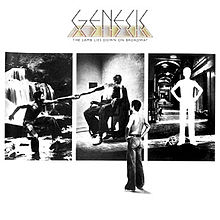
The Lamb Lies Down on Broadway is a double concept album recorded and released in 1974 by the British progressive rock band Genesis. It was their sixth studio album, and the last to feature original singer and frontman Peter Gabriel.It was only a matter of time before Genesis attempted a full-fledged concept album, and 1974’s The Lamb Lies Down on Broadway was a massive rock opera: the winding, wielding story of a Puerto Rican hustler name Rael making his way in New York City. Peter Gabriel made some tentative moves toward developing this story into a movie with William Friedkin but it never took off, perhaps it’s just as well; even with the lengthy libretto included with the album, the story never makes sense. But just because the story is rather impenetrable doesn’t mean that the album is as well, because it is a forceful, imaginative piece of work that showcases the original Genesis lineup at a peak. Even if the story is rather hard to piece together, the album is set up in a remarkable fashion, with the first LP being devoted to pop-oriented rock songs and the second being largely devoted to instrumentals. This means that The Lamb Lies Down on Broadway contains both Genesis’ most immediate music to date. Depending on a listener’s taste, they may gravitate toward the first LP with its tight collection of ten rock songs, or the nightmarish landscapes of the second, where Rael descends into darkness and ultimately redemption (or so it would seem), but there’s little question that the first album is far more direct than the second and it contains a number of masterpieces, from the opening fanfare of the title song to the surging “In the Cage,” from the frightening “Back in NYC” to the soothing conclusion “The Carpet Crawlers.” In retrospect, this first LP plays a bit more like the first Gabriel solo album than the final Genesis album, but there’s also little question that the band helps form and shape this music (with Brian Eno adding extra coloring on occasion), while Genesis shines as a group shines on the impressionistic second half. In every way, it’s a considerable, lasting achievement and it’s little wonder that Peter Gabriel had to leave the band after this record: they had gone as far as they could go together, and could never top this extraordinary Album.
Genesis
Tony Banks – Hammond T-102 organ, RMI 368x Electra piano, Mellotron M400, Elka Rhapsody synthesizer, ARP 2600 & ARP Pro Soloist synthesizers, acoustic piano
Phil Collins – drums, percussion, vibraphone, backing vocals
Peter Gabriel – lead vocals, flute, oboe, tambourine, experiments with foreign sounds
Steve Hackett – electric guitar, classical acoustic guitar
Mike Rutherford – bass guitar, 12-string guitar, bass pedals, fuzz bass