The Byrds have had bigger hit songs like their recording of Bob Dylan’s Mr. Tambourine Man which reached number one, as did their cover of Pete Seger’s Turn! Turn! Turn! but among the band’s self-penned tunes, none are more enduring, or as misunderstood, as Eight Miles High.
Released in 1966, “Eight Miles High” has been called the first psychedelic rock song. However, Roger McGuinn, who wrote the track with fellow Byrds members Gene Clark and David Crosby, disagrees. “It’s a unique song, sure,” he says, “but psychedelic wasn’t something we were trying for. It’s a big misunderstanding. If anything, I consider it to be the first jazz-rock song, or even jazz-fusion. But psychedelic? No, I wouldn’t call it that.”
McGuinn also dispels the widely held notion that “Eight Miles High” refers to drugs, the idea of which got the song banned on radio stations. In addition, he talks about the influence that Ravi Shankar and John Coltrane had on him during the writing of the track, along with how the version of the song that millions of listeners have heard over the years isn’t really the one the band intended to release. We Recorded it at RCA with Dave Hassinger as the engineer, but Columbia Records had a strict policy that they only used their house engineers, so we had to re-record it. It became a real sticking point between us and the label. So, in fact, we really did have kind of a demo—the RCA version is the demo. We went to the Columbia studios and redid it. Both versions are pretty good. I think the first one has more spontaneity, and the second one is better rehearsed.
We’d been doing pot and LSD at that point—everybody was experimenting with things. There wasn’t anything deliberate or intentional about that in the title. I didn’t really mean anything by it, except for the airplane trip to England that we’d been on. It was more about the trip than the drugs. The only drug reference is the word “high.”
We flew over to England—it was our first time there, our first concert tour—and a promoter had called us “America’s answer to the Beatles.” That’s a hard label to live up to. It’s all right for the studio, but it’s not so great on stage. The press was already out to get us, and we got bad reviews for the tour.
We did get to meet the Beatles—George, John and Paul. I don’t remember Ringo being around. Paul even drove us around to different gigs. I got to ride in his Aston Martin DB5, which was a thrill. Lennon asked me about my little glasses. He was interested in them because he wore prescription glasses, but he didn’t want to wear them on stage like Buddy Holly. From that standpoint, it was a great tour—well, except for myself getting the flu.
After coming home, Gene had some chord changes—the E minor, the G and the D. We started to write a song about the tour, but then I said, “Let’s make it about the airplane ride.” I’ve always been into airplanes and technology. Gene was kind of afraid of planes, but we decided to do that—make it about the plane ride. He asked me, “How high do you thing this plane flies?” And I said, “Maybe 39,000 feet”—that would be seven miles high.
At the time, the Beatles had a song called Eight Days a Week, so Gene thought eight was a cooler number than seven. I said, “Sure, let’s change it. Poetic license—who’s gonna care?” I didn’t think that the radio stations would do the math. The DJs said, “Commercial airlines don’t fly eight miles high. They must be talking about some other kind of high.”
1. Echoes
Having midwifed the more exhilarating variety of psychedelia as the co-writer of Eight Miles High, Gene Clark left the Byrds in early 1966 a move triggered, in a much noted irony, by a fear of flying. The following year came Gene Clark with the Gosdin Brothers, a glorious countrified psych-pop album, and more than distinctive and original enough to establish him as a major act in his own right. In a decision probably more clumsy than malicious, but one that prefigured the misfortunes of Clark’s entire subsequent career, Columbia Records timed its release in direct competition with his old band’s Younger Than Yesterday, on the same label, and it tanked. Its lambent, artfully scored opening track, taking a stately stroll through the twisting paths of inner space, was perfect for its moment. Alas, its moment never got to hear it.
2. So You Say You Lost Your Baby
Lost love was Clark’s creative engine; his former bandmates had always looked forward to his turbulent personal life going awry, because of the songs they’d get out of it. This hallucinatory stormer, also from his debut LP, is an urgent, pounding, organ-driven (in several senses) account of the tripped-out mind as much as the cracked-open heart. Clarke was a superb vocalist, one who merits consideration alongside Scott Walker and Nina Simone. As a lyricist, he needed to be heard rather than read; his ornate, often mystical and sometimes overwrought writing can fall flat on the page, but it soars on record.
3. Polly
Ever ahead of a game he somehow always ended up losing, Clark had included country and bluegrass on his first album, well before the Byrds recruited Gram Parsons and recorded Sweetheart of the Rodeo. Two years on, he teamed up with bluegrass banjo maestro Doug Dillard, and a band including future Eagle Bernie Leadon plus other leading sidemen of the new country-rock movement, for a splendid pair of rootsy albums, The Fantastic Expedition of Dillard & Clark and Through the Morning, Through the Night. Their quality and influence would later be acknowledged with the inclusion of two songs from the latter on Robert Plant and Alison Krauss’s 2007 Americana hit, Raising Sand. One was the title track, the other, this. Dillard and Clark’s haunted, gorgeous original is slow, clear, stark and heavy with longing – country music’s primary emotion, for which Clark, with his rich, tempered vibrato and yearning lyricism, had a particular affinity.
4. The Virgin
In 1971, Bob Dylan was the elephant in every singer-songwriter’s room, and he was bound to loom particularly large when the room belonged to a former Byrd. Clark was always too singular, too idiosyncratic, to be a straight-up Dylan imitator, which is perhaps why Dylan, who unjustly scoffed at Donovan, held him in such high regard. The plain, folky, largely acoustic album White Light was as close as Clark ever came to sincere flattery of Dylan – and while it wasn’t all that close, it stands among the finest of that era’s many records unmistakably beholden to the master. On opening track The Virgin, the measured, honeyed, philosophical tale of a girl in the big city, his inflection veers towards Dylan’s – but he never gives himself over to pastiche. Nor would he ever, even when it might have benefited him. Perhaps he genuinely didn’t know how.
5. She Don’t Care About Time Clark often reworked his own songs. His later versions of Feel a Whole Lot Better and Train Leaves Here This Morning are wonderful, but this is the ne plus ultra of his revisions. Still feeling his way around country rock on the recordings that would be collected on the Roadmaster album, in 1972 he turned to a classic he wrote for the Byrds, the epitome of all things jangly, and rendered it something else entirely. Baroque and suffused with tenderness and wonder, it is one of those overwhelming tracks devotional not only in a romantic but in a quasi-religious sense. The best known such number is, perhaps, the Beach Boys’ God Only Knows – and you wouldn’t want to live on the difference between that and this. It was also a foretaste of what Clark would do next.
6. Life’s Greatest Fool
What Clark did next was produce one of the greatest albums ever made. No Other (1974) eventually became synonymous with the phrase “lost masterpiece”. Initially celebrated for its obscurity – it was deleted by Asylum in 1976, reissued in 1991, then given the bells-and-whistles treatment in 2003 – it is now celebrated for its magnificence. It was in every way a magnum opus: epic, sprawling, poetic, choral, rococo. It cost a small fortune to record, and the already erratic Clark never got over its commercial failure. Its opening song is an exuberant, foot-tapping country-gospel anthem stuffed with counterculture folk wisdom, its downbeat lyric defied by its pure joie de vivre.
7. No Other Gram Parsons, in some ways a parallel figure to Clark, had a vision of a cosmic American music; Clark lived to fashion one of his own. The title track of his masterwork pulses, glows and rattles in a thrilling meld of country and funk, gospel and rock, with echoes of the Family Stone, Staple Singers, Gimme Shelter and Abbey Road (Anglophilia being a strain unacknowledged in Americana, but not by Clark). It’s unique not only in his own catalogue but perhaps in all of pop music.
8. Some Misunderstanding
Here it is: the centrepiece of the No Other album and indeed of Clark’s career: a slow, eight-minute cry from the heart, reflecting on the perils and pleasures of a life lived too extravagantly. For Clark, who would surely have recognised William Blake as a spiritual progenitor, the road of excess had at last brought him to the palace of wisdom – and what a palace his is. It is a song to be dwelt in, to walk about within, exploring its chambers, curlicues and turrets. It is in most ways the antithesis of his sharp, concise writing of a decade previously, yet what stayed with Clark throughout was soul and soulfulness.
9. All I Want
Come the 80s, Tom Petty and REM were making the Byrds’ 60s sound fashionable again. In 1982 Clark recorded what would be released two years later as the Firebyrd album (later expanded and issued in the UK as This ByrdHas Flown). Again, circumstances (and perhaps self-sabotage) conspired against him; even when blatantly courting the main chance and invoking his past at every turn, he couldn’t catch a break. All I Want sounds like a prototype for later, poppy hits by the Traveling Wilburys and former bandmate Roger McGuinn; an updated, 80s-style Byrds. It is, by Clark’s standards, facile, a plaintive courtship of radio play. Yet it illustrates how he was quite incapable of divesting what he did of resonance and beauty.
10. Gypsy Rider
In 1986, five years before his drug- and alcohol-hastened death at 46, Clark recorded his final studio album, So Rebellious a Lover, with the roots singer Carla Olson. It includes this lovely piece, in the traditions both of biker and rambling-man’s-gotta-be-free songs. Yet it’s a world away in spirit from Born to Be Wild or Free Bird. It is as sorrowful a motorcycle tune as you’ll ever hear, and it invokes an almost unbearable sadness at the prospect of leaving yet another love. “She should have known by now / You’re just a vagabond,” laments Clark. “You may never pass this way again.” It is easy to read too much into words in hindsight, but it truly does sound as if he is performing his own elegy.
When Gram Parsons’ name is mentioned, it is often done so in association with those more well-known artists he influenced, such as The Byrds, who took Parsons’ lead during his brief tenure in the band for their groundbreaking album “Sweetheart Of The Rodeo”, or The Rolling Stones, whose admiration for Parsons shined through in their own forays into country music in the early ’70s.
Yet the recorded evidence of Parsons’ genius is frustratingly finite. As Keith Richards wrote in a tribute for Rolling Stone about his buddy, “I think he was just getting into his stride when he died. His actual output — the number of records he made and sold — was pretty minimal. But his effect on country music is enormous. This is why we’re talking about him now. But we can’t know what his full impact could have been.”
Luckily, in addition to his work with the Flying Burrito Brothers, Parsons made a pair of stellar solo albums before he died in 1973 that make clear why he is so revered. From “Grievous Angel”, the second of those albums which was released posthumously in 1974, came “$1,000 Wedding,” which stands as one of the saddest songs in history even though nobody is quite sure what transpires in it. Enigmatic though it may be, it demonstrates Parsons’ ability to add idiosyncratic touches to traditional material and perform it in mesmerizing fashion.
With a solemn piano tiptoeing in to begin the arrangement, Parsons starts his tale about a groom left standing at the altar under mysterious circumstances. All the narrator offers is that “the young bride went away.” Parsons makes things even more difficult to parse by switching haphazardly from third-person to first-person narrative. He hints at the protagonist’s friends perhaps joining him in some deception (“And he felt so bad when he saw the traces/Of old lies still on their faces”), but he never lets us know just what.
Most confounding of all, the narrator seems at times to be at the scene of a wedding gone awry and at others to be in the midst of a funeral. Certainly Parsons is toying with our expectations here and the fact that the most celebratory day in one’s life is held in the same location as the saddest. Parsons also takes country clichés like the mean mother-in-law and the preacher spewing fire and brimstone and balances them with the honest and raw sadness of the narrator, evident in his woeful delivery of the song’s closing couplet: “Supposed to be a funeral/It’s been a bad, bad day.”
For the record, this writer’s opinion is that the events being described are two separate occasions which the narrator jumbles into a single song. She initially did leave him at the altar, likely due to some sort of indiscretion he committed, hence his regret and wish to be put to sleep like the beasts in the preacher’s sermon. He’s there also for the girl’s funeral, perhaps not as fully attended as the wedding, which explains his concern that there isn’t the proper fanfare to mourn her.
Of course, you can take that interpretation with a grain of salt and blow it all into the Hickory Wind. What’s so great about “$1,000 Wedding” is that you can feel it plenty even if you don’t fully understand it. And what’s great about is that he left us songs that are somehow as potent and vast as the shadow he cast on the music world.
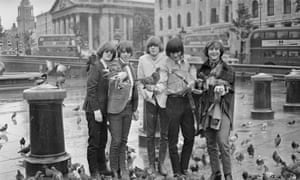
The original band “The Byrds” consisted of Jim McGuinn , Gene Clark, David Crosby , Chris Hillman , and Michael Clarke. Photo circa 1965 . They had a string of successful hits as they made the transformation from folk-rock to a more psychedelic outfit. We all loved their early stuff. “Mr. Tambourine Man” “Turn! Turn! Turn! along with the self-penned originals, like “I’ll Feel a Whole Lot Better”, & “Eight Miles High”, and this one from 1967… one of my favorites songs ever.
If you haven’t already, check out today’s “Poster From The Past” that the Byrd are headlining over at Professor Poster‘s page!
So you want to be a rock’n’roll star Then listen now to what I say Just get an electric guitar And take some time and learn how to play And when your hair’s combed right and your pants fit tight It’s gonna be all right Then it’s time to go down town Where the agent men won’t let you down Sell your soul to the company Who are waiting there to sell plastic ware And in a week or two if you make the charts The girls will tear you apart What you pay for your riches and fame Was it all a strange game You’re a little insane The money that came and the public acclaim Don’t forget what you are You’re a rock’n’roll star
A departure from the usual style of poster that the very talented artist, (and former wife of Bill Graham) Bonnie MacLean offers up for today’s “Poster From The Past”. The poster’s central image is of a human face with an American flag waving just in front of it. There is also part of a hand, a rooster and a figure playing a guitar. At the bottom, a small face peers out from behind a flower. There are birds as well as flowers also throughout this collage of pastel colors that smoothly blend together on a black background.
It was 46 years ago on this day back in 1967, an INCREDIBLE dance/concert took place with The Byrds, The ElectricFlag and BB King, playing at The Fillmore Auditorium.. what a line-up! The following two nights the venue switched over to the Winterland Arena just a couple of blocks away. Light show performed by Holy See! This is BG Fillmore poster number #96 in the old series and was printed just one time.
On this studio demo above of the song recorded by just Crosby and his Martin guitar its a softer acoustic demo of this song…recorded at a studio in Hollywood, he came in barefoot with a guitar straped across his back…and I set up 2 mics..one for him and one for his Martin, and he just did it .
Although the band did record “Triad” and perform it live during a September 1967 engagement at the Whisky a Go Go, it was eventually not included on the final release of “The Notorious Byrd Brothers” album. According to Crosby, Roger McGuinnand Chris Hillmanfelt that its subject-matter was too controversial with McGuinn allegedly deriding the song as a “freak-out orgy tune. However, this has since been denied by Hillman who has stated “I don’t think it was a moral decision. The song just didn’t work that well. David Crosby was drifting and bored and he wanted to do something else, and that song just added fuel to the fire. “Notorius Byrd Bros” would have broke big if they had kept this song and ditched that awful opening track “Artificial Energy” …..Triad was perfect for its time and would have put the Byrds right back at cutting edge status. I think the exclusion of this song from Notorious was the nail in the coffin for his days as a Byrd. And his behavior at Monterey didn’t help or his guesting with the Springield there didn’t help. Or his being adamant against ‘Goin’ Back’ being on Notorious. Regardless, David had emerged as a writer of great skill and his songs needed to be heard. They were and still are! – Although the decision to keep this song off the Notorious LP may have played a minor role, it was the power struggle between McGuinn and Crosby that led to David’s dispatch from the group.
There had been growing animosity between Crosby and the rest of the band throughout 1967. Tensions had arisen from several factors, including Crosby’s displeasure over the band’s wish to record the Goffin–King composition “Goin’ Back“, his fraternization with fellow L.A. musicians, and his controversial remarks to the audience during The Byrds’ performance at the Monterey Pop Festival. These factors, along with the discord over “Triad”, contributed to McGuinn and Hillman’s decision to fire Crosby in October 1967. Crosby then gave the song to Jefferson Airplane, who recorded it on their 1968 album, “Crown of Creation“. Airplane did it after the Byrds told Crosby they were not going to include it on their next album. He got pissed off and gave it to airplane.
David Crosby certainly shone more brightly as a solo artist with CSN; but the Byrds moved on to pioneer the genre of Country-Rock which, despite the insulting lack of recognition from the industry today, ultimately shaped the future of the Country music genre.
David Crosby has the distinction of being a founding member of both the Byrds and Crosby, Stills & Nash who has survived drug busts in Texas (nine months in state prison for possession of heroin and cocaine), a hit-and-run driving accident, possession of a concealed pistol and drug paraphernalia, an arrest for driving into a fence in Marin County, a transplanted liver, the ire of Graham Nash, and fathering two children by Melissa Etheridge. He is a bit of a lightning rod to be sure! Love him or hate him, Crosby, now 79 years old, has had a stellar career. A singer-songwriter and guitarist, he wrote or co-wrote “Wooden Ships,” “Deja Vu,” “Guinnevere,” and “Lady Friend,” among others.
He is also noted for his soaring high harmonies, a trademark of his songs. In addition to performing on the Byrds first five albums (their best in my opinion), he also played on eight Crosby Stills & Nash albums including three with Neil Young), he has made solo albums, and collaborated with Graham Nash on five long players. Croz is pretty prolific workhorse. He has been inducted into the Rock and Roll Hall of Fame twice with the Byrds and Crosby, Stills & Nash. He can be seen in an excellent 2019 documentary “Remember My Name,” in which he pulls no punches about his failed relationships, scrapes with the law, and regrets about years lost to drug abuse. Crosby is certainly a survivor.
David Crosby’s 1971 solo album “If I Could Only Remember My Name” was developed in a time of great emotional upheaval but also intense creativity for David Crosby and the contributing musicians. Many if not most of the finest San Francisco musician’s fingerprints can be found on this record. Often referred to as the ‘Planet Earth Rock and Roll Orchestra’ the combination of talents can also be discovered adding their unique abilities to other albums of that era. Jefferson Starship’s Blows Against the Empire, Graham Nash’s Songs for Beginners,Mickey Hart’s Rolling Thunder as well as Paul Kantner/Grace Slick’s solo excursions feature many of the same artists. David Freiberg, Neil Young, Michael Shrieve, Graham Nash, Joni Mitchell as well as the members of the Grateful Dead and Jefferson Airplane all make appearances in various combinations equaling some mind expanding and amazing music created in the early 1970’s. This amazing time in rock history will never be witnessed again, a time where wonderful collaborations and a shared love of musical discovery took precedent over record contracts, royalties and tour receipts.
David Crosby’s 1971 masterpiece “If I could Only Remember My Name”. Emotionally recovering from the loss of his lover Christine Hinton from a devistating car crash,
“If I Could Only Remember My Name” is the result of David Crosby’s escape from depression and his eventual refuge found through music and his friends. The collaborations featured on the recordings did not occur in a vacuum, the relationships were developed early on in the respective musicians careers. Paul Kantner, Crosby and StephenStills collaborated on the songwriting of the CSN track ‘Wooden Ships’, Jerry Garcia was a ‘spiritual advisor’/producer for the Jefferson Airplane’s Surrealistic Pillow album and David Freiberg, Kantner and Crosby often cross pollinated each others work in the early stages of their careers.
Crosby gathered a superb supporting cast, one that featured the communal contributions of friends and fellow travellers, among them, members of the Grateful Dead (Jerry Garcia, Phil Lesh, Bill Kreutzmann and Mickey Hart), Jefferson Airplane (Grace Slick, Paul Kantner. Jorma Kaukonen, Jack Casady), Santana (Gregg Rolie and Michael Shrieve) and Quicksilver Messenger Service (David Freiberg), along with faithful standbys Graham Nash, Neil Young and Joni Mitchell.
The LP opens fittingly opens with the aptly titled ‘Music Is Love’. The song features three of the four principals of Crosby, Stills, Nash and Young, with Stills the only member not appearing. The song encapsulates the pervading attitude of the record with the ‘Music Is Love’ mantra harmonized by Nash and Young while Crosby spreads a soaring free form vocal over the top. Young, Crosby and Nash interweave crystalline acoustic guitars with Young offering his personal rhythm section of bass and congas and a ghostly vibraphone. The campfire vibe song rises weightless like smoke, soaking into the glorious melodic sunshine.
The cinematic and epic ‘Cowboy Movie’ follows, spotlighting the rhythm section of the Grateful Dead with Hart, Kreutzman and Lesh in addition to featuring a Jerry Garcia and Neil Young in a dusty ten paces and turn guitar duel. The story line of the tail fictionalizes the CSNY break up through the premise of a spaghetti western and comments on some of the personal issues that haunted the band, like certain principals relationship with the ‘Raven’ (Rita Coolage). Garcia and Young go toe to toe through deft uses of moaning feedback and the perfect finishing of each other’s guitar phrases. The heavy footed groove slowly gains in intensity, Crosby shreds his vocals thrillingly eventually climaxing in an instrumental orgasm that fades out much too soon. (There is a thrilling and extended version of this track available on the David Crosby box set Voyage)
The cool night air of ‘Tamalpais High (At About 3)” settles in, again featuring the Grateful Dead’s Billy K. on drums and Phil Lesh on bass. Garcia and the Airplane’s Jorma Kaukonen hold the six strings while Nash and Crosby handle the delicate wordless melody. Crosby stated that this song was not really ‘received’ by ‘CSNY’ so it ended up on his solo record. A quintessential Crosby melody, circular and umbrageous in its design, lyrical content is not required due to the aural portrait conjured by the instrumental and vocal alchemy. The organic blending of Crosby and Nash’s melody lines slither over the morphing jazz groove driven by Lesh’s thumping Alembic bass and Kreutzman’s multiple arms. Garcia and Kaukonen trade virginal clean tone lines over the additively shifty composition.
One of Crosby’s most enduring melodies and enchanted compositions, ‘Laughing’ follows and closes the first side of the record. Opening like the birth of a vibrant sunrise, the songs design is again built around the Grateful Dead rhythm section featuring Lesh’s well timed and plump detonations. Crosby’s glistening twelve string strums sparkle like solar rays through rain drops. On top of all of the swirling magic Garcia lays a sleek and spectral pedal steel line that is extremely emotive, acting as its own independent star sailing melody line. The song lyrically is the search for answers and according to Crosby directed to George Harrison and expressed psychedelically through a collaborative chorus highlighted by the smooth styling of Joni Mitchell.
Flipping over the LP, the second side of the record begins with ‘What Are Their Names’ a still relevant song that still features in CSN and CSNY set lists , but now performed acapella. This original rendition is a full band performance constructed around a descending set of changes. Three crisp guitars wrap themselves around a central pole to open the song, Crosby, Garcia and Young gently caressing the songs internal melody. As the drums and bass enter (Shrieve and Casady) the song gains a slightly disturbing and dramatic edge, Young and Garcia’s guitars bite deep. The finger pointing lyrics are sung in huge super group choral fashion featuring but not limited to Crosby, Nash, Grace Slick, Paul Kantner, Laura Allen and possibly Crosby’s brother Ethan. A stunning start to side two and a commentary on the organic creation of the music contained on the record.
‘Traction in the Rain’ follows next and allows time for Crosby acoustic introspection. The drumless melody hangs weightless on woody strums and finds Crosby and Nash on shimmering acoustics and Laura Allen contributing on beautiful and cascading auto harp. Crosby’s vocals are some of the finest on the record and the song would become a highlight of future Crosby/Nash duo performances.
‘Song with No Words (Tree with No Leaves)’ is a prismatic meditation where in a role reversal, the music colours and supports the stunning wordless Crosby/Nash vocal melody. The supporting players act as one swirling instrument enveloped into each other through intent listening. The players cannot always be confirmed on these resulting tracks, but my ear hears, Garcia, Kaukonen, Shreive, Nash and possibly Young on piano. In the ‘rock room’s humble opinion one of the finest tracks on the record.
The final two songs of the LP are also wordless compositions. In many ways this increases the emotional effectiveness and melodic strength contained within the numbers. ‘Orleans’ is a traditional French children’s song that lists the cathedrals of France. Of course Crosby arranges it into a strange and weaving mood piece based around overdubbed acoustics and his perfectly stratified vocals.
The album closes with the exhilarating and supernatural ‘I’d Swear There Was Somebody Here’. A vocal only movement, Crosby is quoted as saying he was in a good place, high as a kite and experimenting with the echo chamber in Wally Heider’s studio. Crosby sang six different parts developed on the spot, vocally improvised and bringing into existence a masterful representation of his recently departed love. Crosby felt that the creation of this song was initiated by Christine visiting him and/or making her presence known to him during the song’s genesis. Something is definitely happening during the brief apparitional and aural experience. This song epitomizes what this music is all about, remembering, feeling, expressing and being in the moment. The track is a fitting conclusion to the record and inspiring statement of Crosby’s talent and the towering importance of the record in the pantheon of rock history.
David Crosby’s musical journey is a tale rife with contradictions. There’s the obvious brilliance he first shared while with the Byrds and then, later, his contributions to America’s first true supergroup, Crosby, Stills, Nash and (at times) Young. By having a hand in the writing of songs that helped define both bands—among them, such enduring classics as “Lady Friend,” “Why” and “Eight Miles High” for the former, and “Guinnevere,” “Wooden Ships,” “Almost Cut My Hair” and “Déjà Vu” for the latter—he played a major role in establishing a timeless template that reflected a freedom-first attitude of the ’60s that resonates even today. Likewise, his rich tenor and unmistakable jazz-like sensibilities imbued each group with a firm foundation for their exacting vocal harmonies. Crosby also helped establish a free-flowing communal kind of creativity, another distinctive element that led to a more synchronous sound.
Engineer Stephen Barncard had his reservations when he was assigned to do the record, referring to Crosby’s reputation as being that of an “asshole.” However in Crosby’s autobiography Long Time Gone, he describes the recording, which began in November 1970, as “the most exhilarating project I’ve ever done in my life…It was a loose setup…but I learned to relax with it and before we knew it we were ready to mix.”
Crosby and chief Byrd watcher Roger McGuinn clashed when Crosby insisted the group record his ode to hedonism, “Triad,” a song that celebrated the joys of a ménage à trois (they didn’t record it, but Jefferson Airplane happily included it on one of their albums). During 1967’s Monterey Pop Festival, Crosby broke ranks with a rant about a Kennedy assassination coverup, after which he famously took the stage with Buffalo Springfield, filling in for an absent Neil Young.
If I Could Only Remember My Name is not only a career defining statement for David Crosby it is also a commentary on the collaborative and communal environment surrounding music in the 1960’s and 1970’s. Friends created music on this record, credits or royalties did not matter. What mattered was sharing in the making of something bigger and better than its individual components. The songs contained on this record are inspired by the joy of giving and creating and the proof lies within the jagged grooves of its vinyl. The record is arguably David Crosby’s finest achievement and a photographic capture of some of the contributing musician’s finest moments ever committed to tape. The record is a standard of the rock room and a must have addition to any rock collection . (Note: an outtake from the sessions, “Kids and Dogs,” later included on Crosby’s Voyage anthology, would also have found a fit within that surreal setting.)(There are also a multitude of outtakes of the sessions available for those willing to search)
Gene Clark & Roger McGuinn – Full Concert Recorded Live: 3/4/1978 – Capitol Theatre (Passaic, NJ) This is a very fine set, good songs from Gene Clark and Roger McGuinn who also played together in The Byrds and some very fine covers, among them three Bob Dylan songs are included.
Setlist:
1 – Release Me Girl
2 – Silver Raven
3 – Don’t You Write Her Off
4 – Jolly Roger
5 – Chestnut Mare
6 – Crazy Ladies
7 – You Ain’t Goin’ Nowhere
8 – Lover Of The Bayou
9 – Train Leaves Here This Morning
10 – Mr. Tambourine Man
11 – Bag Full Of Money
12 – Turn! Turn! Turn! (To Everything There Is A Season)
13 – Knockin’ On Heaven’s Door
14 – So You Want To Be A Rock ‘N’ Roll Star
15 – Eight Miles High
16 – Band Exit
“Fifth Dimension” is the third album by the American folk rockbandThe Byrdsand was released in July 1966 on Columbia Records .On December 22, 1965, shortly after the release of their second albumTurn! Turn! Turn!, The Byrds entered RCA Studios in Los Angeles to record “Eight Miles High” and “Why“, the two new songs that they had recently composed. Both songs represented a creative leap forward for the band and were instrumental in developing the musical styles of psychedelic rock and raga rock.However, the band ran into trouble with their record company, Columbia Records, who refused to release either song because they had not been recorded at a Columbia owned studio. As a result, the band were forced to re-record both songs in their entirety at Columbia Studios, Hollywood and it was these re-recordings that would see release on the “Eight Miles High” single and the Fifth Dimension album.
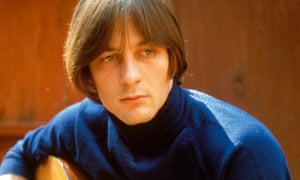
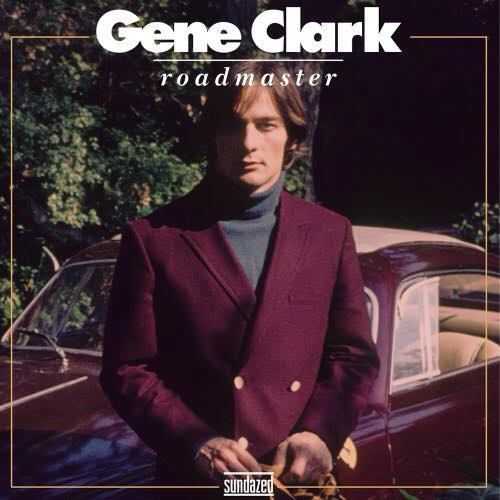
Harold Eugene “Gene” Clark was an American singer-songwriter and founding member of the folk rock band The Byrds. Clark was The Byrds’ dominant songwriter between 1964 and early 1966, penning most of the band’s best-known originals from this period, including “I’ll Feel a Whole Lot Better”, “She Don’t Care About Time”, “Set You Free This Time”, and “Eight Miles High”.He created a large catalogue of music in several genres, but failed to achieve solo commercial success. Clark assembled a backing group consisting of highly accomplished country rock musicians to accompany him on an album with A&M. Progress was slow and expensive and A&M terminated the project before completion.The resulting eight tracks, including “Full Circle Song” and “In a Misty Morning” were added to those recorded with The Byrds in 1970/71 (“She’s the Kind of Girl” and “One in a Hundred”) and with The Flying Burrito Brothers (“Here Tonight”), and released in 1973 as Roadmaster in the Netherlands only.early exponents of psychedelic rock, baroque pop, newgrass, country rock and alternative country




:format(jpeg):mode_rgb():quality(90)/discogs-images/R-4698673-1484915399-6061.jpeg.jpg)

 The Fat Angel Sings