

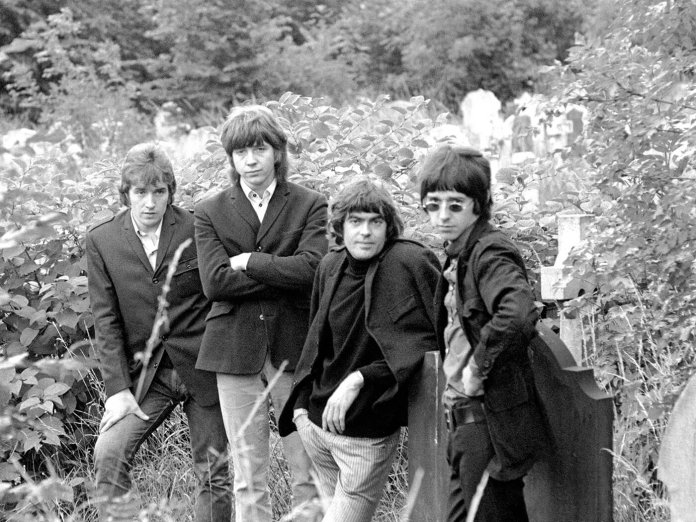
Celebrating a cult UK singles band who rode the wave of the mid-60s musical revolution just long enough to forge a handful of mercurial tracks and showcase the originality and fire of their unique guitarist, Eddie Phillips – a pioneer of the violin-bow guitar and feedback. The Creation are one of the UK’s great ‘should’ve beens’. Though they never entered a studio with the intention of creating an album (“We Are Paintermen” was the nearest thing to it, and it’s a series of singles, B sides and originals cobbled together with covers), their best tunes were visceral lightning strikes of creativity that echoed through the ages: they inspired Alan McGee to name his record label (and his indie band), and contributed to the DNA of bands like The Jam and Oasis, as well as being covered by artists as diverse as Sex Pistols, Television Personalities, Boney M and Ride and having a song used in the Wes Anderson movie Rushmore.
Eddie Phillips, among his many and varied talents, was likely the first guitar player to use a violin bow to excite the strings of his electric guitar. A trick that came to be most famously associated with Led Zep behemoth Jimmy Page and perhaps most memorably, Nigel Tufnel in his onstage guitar solo in This Is Spinal Tap, this gimmick wasn’t the only trick Phillips had up his sleeve.
In the chaotic onstage environments of the 60s, semi-acoustic guitars and amps cranked to the max made feedback a necessary evil for the new wave of electric-guitar players. Yet Phillips was one of the pioneering few who developed this technical obstacle into a strength, coaxing swathes of musical feedback out of his overdriven setup – he graduated from a Futurama and Vox’s to a Gibson ES-335 and a 200-watt Marshall with 8×10 cabinets – and incorporating the wild screams into his studio sound. Making Time and Painter Man both showcase a guitarist way ahead of his game.
He does have one regret, though: Phillips parted ways with his beloved cherry red ES-335 in the 70s and in 2007, put out a plaintive plea for its return. Its distinctive wear includes three hacksaw marks near the pickup selector switch from an experiment before settling on the bow for sustain.
“I was trying to figure out a way to play something on the E string to keep it going, like a drone, while I hammered on some kind of solo with my left hand on the other strings,” Phillips . First I tried a hacksaw – I took out the blade and put a guitar string in, tried sawing across the E string, but that only resulted in me wearing three or four massive grooves in the bottom horn of my 335 from the ends of the saw [laughs]. So that obviously wasn’t going to work.”
How Does It Feel To Feel (Yellow Vinyl)
The Creation was formed in 1966 from beat combo The Mark Four, and was quickly signed to a production deal with Shel Talmy, The Who’s producer. The first release was the urgent Making Time, which featured guitarist Eddie Phillips playing his guitar with a violin bow, two years before Jimmy Page started doing so. Alongside the We Are Paintermen LP, How Does It Feel To Feel rounds up the remainder of the recordings they made with Shel Talmy.
This LP features the 2016 stereo mixes of Creation classics How Does It Feel To Feel (both the UK and US versions), Life Is Just Beginning and Sylvette. The last 60s line- up of The Creation, which featured future Face and Rolling Stone Ron Wood, is represented by all four sides of their two single releases.
A rumour persists that Phillips’ contemporary Pete Townshend was so impressed that he asked the guitarist to join The Who as the second guitarist. Phillips himself demurs, telling journalist Chris Hunt: “If he asked me, I didn’t hear him! I think that was a bit of sharp press.” Alas, the mouthwatering prospect of having two of the wildest guitar pioneers of the 60s in one band was too good to be true. Still, at least we have Phillips’ Creation playing, presided over in the studio by Shel Talmy, the innovative producer behind early classics such as The Kinks’ You Really Got Me and The Who’s My Generation, and there’s a lot of excellent guitar action to uncover.
Pressed on 180 gram yellow vinyl, the inner sleeve features 60s photos of The Creation from the collection of designer Phil Smee.

We Are Paintermen (Blue Vinyl)
The Creation was formed in 1966 from beat combo The Mark Four, and was quickly signed to a production deal with Shel Talmy, The Who’s producer. The first release was the urgent Making Time, which featured guitarist Eddie Phillips playing his guitar with a violin bow, For a change of pace, Try And Stop Me eases off the scene-stealing guitar in favour of precisely intonated, ultra-clean chordal jangle, but the speeding stomp of Biff Bang Pow, propelled by its My Generation-esque riff, returns to the fray with a gloriously frantic guitar solo that quickly abandons the idea of chord melody in favour of angry bends and hammer-ons.
A final pre-split 60s single contains two essential Creation tracks outside of We Are Paintermen, How Does It Feel To Feel and Life Is Just Beginning, which feature swaggering, unhinged edge-of-feedback solo and plectrum-on-string scrapes and psychedelic strings, respectively. Issued in 1967, We Are Paintermen was the only Creation LP released during their original 60s incarnation, and then only in Germany. With the exception of Making Time and Try And Stop Me, this release features the 2016 stereo mixes of Creation classics Through My Eyes, Biff Bang Pow, Can I Join Your Band? and Painter Man (as later covered with huge success by Boney M).
Pressed on 180 gram blue vinyl, the inner sleeve features 60s photos of The Creation from the collection of designer Phil Smee.

Psychedelic Rose
The Creation was formed in 1966 from beat combo The Mark Four, and was quickly signed to a production deal with Shel Talmy, The Who’s producer. Painter Man, their only UK Top 40 hit, has a superb riff, a viciously strummed Townshend-esque chord interlude and a skrawking violin-bow coda; on Through My Eyes, Phillips anchors the song’s soporific, prowling backbeat with a mesmerising bend-based riff motif and unison-bend solo; Tom Tom taps into the same vein as The Beatles’ She Said She Said, adding an off-kilter double-tracked solo and even a section at 2:32 with a feedback-and-killswitch effect.
In January 1985, The Mark Four reformed for a one-off show in Cheshunt, and subsequently Eddie Phillips and original lead vocalist Kenny Pickett reunited to make some new Creation recordings. At the time, only two tracks – Spirit Called Love and a new version of Making Time – were issued as a single in 1987, before the record label went out of business. These two tracks plus the remainder of the recordings were finally issued as the album Psychedelic Rose in 2004. The album is pressed on 180 gram red vinyl.

Power Surge
Alan McGee was such a big fan of The Creation that he named his record label after the band, and named his own band after one of their songs – Biff Bang Pow. The Creation was formed in 1966 from beat combo The Mark Four, and was quickly signed to a production deal with Shel Talmy, The Who’s producer. This limited edition reissue is pressed on purple vinyl, and features the original inner sleeve. The first release was the urgent Making Time, which featured guitarist Eddie Phillips . Whilst very popular in Germany, UK success largely eluded the band, and after a number of non-charting singles and line-up changes, the band broke up in 1968 without ever having released an album. In 1995, following a reunion concert at Harlesden’s Mean Fiddler, Alan McGee and Joe Foster managed to persuade the original line-up of Eddie Phillips, lead singer Kenny Pickett, bassist Bob Garner and drummer Jack Jones to get into a studio and record a new album, for release on Creation Records!.

The Creation never achieved the recognition they deserved and after singer Kenny Pickett quit, Phillips followed suit later in 1967. The band continued, with Ron Wood in the lineup, until 1968, released some more soul-flavoured material, then dissipated, seemingly for good. They reactivated in the 1990s and despite reforming and playing with Phillips as the only original member and attempts to recapture the spark, such as 1996 album Power Surge, world-straddling success wasn’t to be theirs.
Instead, they’ll go down in rock history as a quintessential cult band, trapped in amber between the British Invasion and the birth of psychedelia, and hopefully, appreciated for the scything, exhilarating playing of their lead guitarist. A philospophical Phillips told Record Collector: “If we could go back and change the fortunes of The Creation, we may have been a really big band for a time but may not be remembered now like we are. I’m alright with things.”


 The Fat Angel Sings