Posts Tagged ‘Pink Floyd’

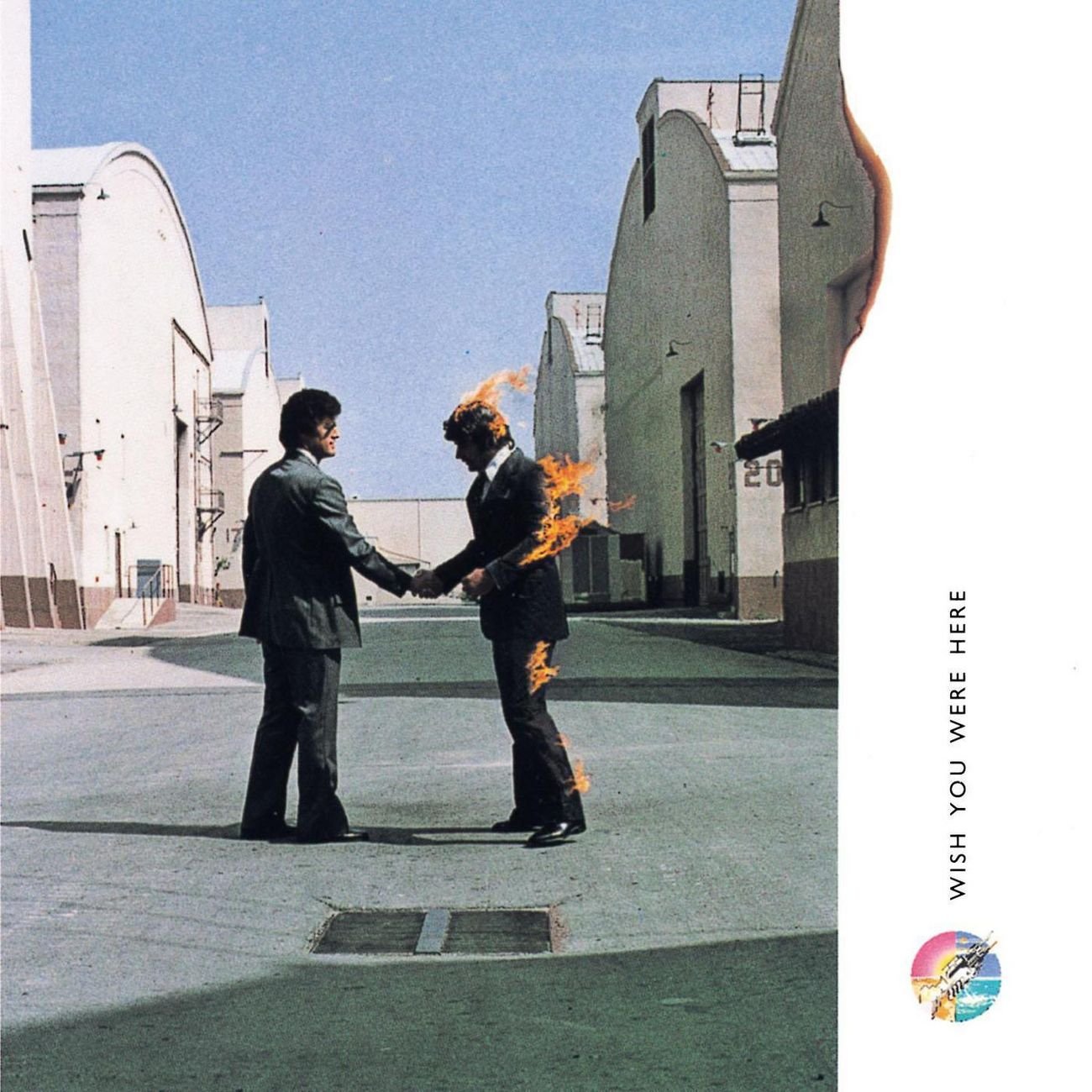
Wish You Were Here is the ninth studio album by English rock band Pink Floyd. It was first released on 12th September 1975 in the United Kingdom by Harvest Records.

It debuted at No. 1 on both sides of the Atlantic, and has been tabbed by both Gilmour and Wright as their favourite Pink Floyd album. Still, ‘Wish You Were Here’ was no ‘Dark Side of the Moon’; it never could be. And that – as much as anything seems to have relegated this 1975 follow-up to a life of perpetual underrated status. It’s a pity. There isn’t a more conceptually concise Pink Floyd album, nor one as musically inviting. Even as Dave Gilmour and, in particular, Richard Wright pushed the work into deeper, more progressive musical themes, they helped fashion the last truly collaborative studio project between Roger Waters and his increasingly disgruntled bandmates.

Inspired by material the group composed while performing in Europe, During 1974, Pink Floyd sketched out three new compositions, “Raving and Drooling”, “You Gotta Be Crazy” and “Shine On You Crazy Diamond”. These songs were performed during a series of concerts in France and England, the band’s first tour since 1973’s The Dark Side of the Moon.

The album was recorded in numerous sessions at Abbey Road Studios in London. Two of its songs criticise the music business, another expresses alienation, and the multi-part composition “Shine On You Crazy Diamond” is a tribute to Pink Floyd founder Syd Barrett, who had left seven years earlier due to mental health problems. The band used studio effects and synthesizers, and brought in guest singers: Roy Harper, who provided the lead vocals on “Have a Cigar”, and Venetta Fields, who added backing vocals to “Shine On You Crazy Diamond”. After several weeks, Waters began to visualise another concept. The three new compositions from 1974’s tour were at least a starting point for a new album, and “Shine On You Crazy Diamond” seemed a reasonable choice as a centrepiece for the new work. Mostly an instrumental twenty-minute-plus piece similar to “Echoes”, the opening four-note guitar phrase reminded Waters of the lingering ghost of former band-member Syd Barrett. Gilmour had composed the phrase entirely by accident, but was encouraged by Waters‘ positive response. Waters wanted to split “Shine On You Crazy Diamond”, and sandwich two new songs between its two halves.

The album begins with a long instrumental preamble and segues into the lyrics for “Shine On You Crazy Diamond”, a tribute to Syd Barrett, whose mental breakdown had forced him to leave the group seven years earlier. Barrett is fondly recalled with lines such as “Remember when you were young, you shone like the sun” and “You reached for the secret too soon, you cried for the moon”.

Wish You Were Here is also a critique of the music business. “Shine On” crosses seamlessly into “Welcome to the Machine”, a song that begins with an opening door (described by Waters as a symbol of musical discovery and progress betrayed by a music industry more interested in greed and success) and ends with a party, the latter epitomising “the lack of contact and real feelings between people”. Similarly, “Have a Cigar” scorns record industry “fat-cats” with the lyrics repeating a stream of cliches heard by rising new-comers in the industry, and including the question “by the way, which one’s Pink?” asked of the band on at least one occasion. The lyrics of the next song, “Wish You Were Here”, relate both to Barrett’s condition, and to the dichotomy of Waters’ character, with greed and ambition battling with compassion and idealism. The album closes with a reprise of “Shine On” and further instrumental excursions.

Wish You Were Here topped the charts in the United Kingdom and the United States, and Harvest Records‘ parent company EMI was unable to print enough copies to meet demand. Although it initially received mixed reviews from critics, the album went on to receive critical acclaim,

Everyone wanted a piece of Pink Floyd after ‘The Dark Side of the Moon’ sold a gazillion copies , especially the shady music-industry types Waters never trusted. ‘Have a Cigar’ is all about those clueless suits. “By the way, which one’s Pink?” sings guest Roy Harper, a British folkie, summing up the era.

‘Shine on You Crazy Diamond’ was originally released as a two-song, eight-part, 26-minute suite on the band’s follow-up to the mega-popular ‘The Dark Side of the Moon.’ And like several Floyd projects from the period, the song references former bandmate Syd Barrett’s descent into mental illness. It’s an epic piece, the bookends to one of the group’s most durable LPs.

The members of Pink Floyd were still friendly with Syd Barrett after he left the group in 1968. He even showed up in the studio, somewhat unrecognizable, while they were recording of their ninth album. ‘The Dark Side of the Moon’ touched on the mental illness that crippled Barrett, but ‘Wish You Were Here’ was an album-length tribute to both his genius and madness. The title track ties Barrett’s plight to Waters‘ own distancing from society.

The band played much of Wish You Were Here on 5th July 1975 at the Knebworth music festival. Roy Harper, was also performing at the same event, on discovering that his stage costume was missing, proceeded to destroy one of Pink Floyd’s vans, injuring himself in the process. This delayed the normal setup procedure of the band’s sound system. As a pair of World War II Spitfire aircraft had been booked to fly over the crowd during their entrance, the band were not able to delay their set. The result was that a power supply ssue pushed Wright’s keyboards completely out of tune, damaging the band’s performance. At one point he left the stage, but the band were able to continue with a less sensitive keyboard, a piano and a simpler light show. Following a brief intermission, they returned to perform The Dark Side of the Moon, but critics displeased about being denied access backstage savaged the performance

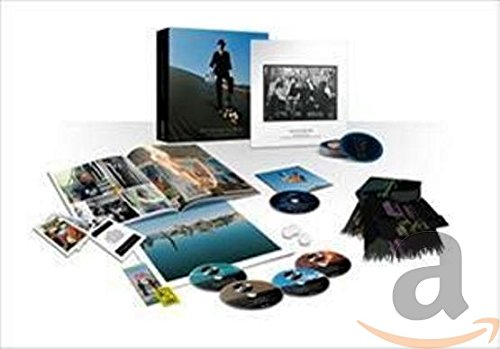
The Wish You Were Here – Immersion Box Set includes the new stereo digital remaster (2011) by James Guthrie on CD, an unreleased 5.1 Surround Mix (2009) by James Guthrie on DVD and Blu-ray, a Quad Mix (which had been released only on vinyl LP and 8-track tape) on DVD, as well as the original stereo mix (1975) on DVD and Blu-ray
Pink Floyd

  • David Gilmour – vocals, guitars, lap steel guitar, EMS Synthi AKS, tape effects, additional bass
  • Roger Waters – vocals, bass guitar, EMS VCS 3, guitar, tape effects
  • Nick Mason – drums, percussion, tape effects
  • Richard Wright – Hammond C-3 organ, ARP String Ensemble V, Minimoog, Steinway piano, EMS VCS 3, Hohner Clavinet D6, Wurlitzer EP-200 electric piano, backing vocals

Additional musicians

  • Dick Parry – tenor and baritone saxophone on “Shine On You Crazy Diamond”
  • Roy Harper – lead vocals on “Have a Cigar”
  • Venetta Fields – backing vocals on “Shine On You Crazy Diamond”
  • Carlena Williams – backing vocals on “Shine On You Crazy Diamond”

Fa73bbf5 f519 46a4 9be5 db02319122b7

Wooden Shjips  –  V

Wooden Shjips, long-time leaders of the contemporary psychedelic movement, expand their sound with V. On their fifth album the quartet of Ripley Johnson (Moon Duo), Omar Ahsanuddin, Dusty Jermier, and Nash Whalen augment their already rich sound with laid back, classic summer songs. Inspired by the tumult of the modern world, and the desire to offer a contrasting vision of peace, the band has created a record that lters their trademark hypnotic grooves through an optimistic lens, resulting in music that is bright and vital. Each song shimmers with a distinctly Wooden Shjips sound, a relaxed summer vibe. This was a conscious choice, an atmospheric goal that in uenced nearly every detail: the tones, the delay types and reverbs used, as well as the synthesizer elements that color the songs. The band’s members collectively share a love of classic rock from the Velvet Underground to Neil Young, as well as more overt love of the San Francisco scene of the 60’s. This commonality in their formative musical years binds them even as they live in different cities. Wooden Shjips has with V. created the most concise, laid back songs of their career. Their music is a balm of sorts, a respite from the insanity that, through its regenerative abilities, empowers continued, calm resistance. A reminder of the simple power of peace and beauty, V. is brimming with optimism and a peaceful energy, aptly timed for release at the height of spring.

Halomaudsmall

Halo Maud  –  ” Je Suis Une Île “

Halo Maud’s first release on Heavenly is a recap of the story so far ahead of an album release later this year – three tracks of this EP originally came out on a Canadian label last year, with the difference that Du Pouvoir now features some English lyrics, and À La Fin andDans La Nuit cropped up on a La Souterraine compilations in 2015 and 2016 respectively. Maud Nadal has been a member of both Moodoïd and Melody’s Echo Chamber’s live bands, and of course at times there are comparisons to be drawn with Melody’s Echo Chamber, with both teetering on a crystalline peak where extreme joy and despair meet. But if anything Nadal’s own melodies are even more indelible, and her voice turns them into vapour trails.

100000x100000 999

Gretchen Peters – Dancing With The Beast

Dancing with the Beast, the new album from Gretchen Peters, puts female characters at the fore, from teenage girls to old women. And intentionally so. With the 2017 Women’s March and the #MeToo Movement as bookends to her writing time, Peters knew that a feminist perspective would be the critical core of the record. She admits, “You can trace the feminist DNA in my songwriting back to ‘Independence Day’ and probably before. The thing that 2017 did is just put it front and center.” Though Peters doesn’t consider herself a political writer, she is politically minded and, therefore, knew she had to address the 2016 election and all that has happened since… but in her own way. There’s a bittersweet beauty to the passing of time – the changes it brings are just as often heartbreaking as they are heartwarming. The inevitable tension that arises from that sway is Gretchen Peters‘ most trusted muse. With melody supporting that melancholy, the songs on the new album combine to lift the effort over the high artistic bar set by her last outing, 2015’s award-winning Blackbirds.

Dc707 wand perfume mini

Wand  –  Perfume

If the emblem of Wand’s Plum was the stark blue cloud a condensation, a linking between longing molecules, data hungering for more data, a flotilla of vapor between eye and sky – then Wand’s new EP reeks of something more forceful, more seductive, more intoxicating, more insidious: this is Perfume. Here are six electric hues, shocks of light that flagrantly provoke the dark, a posy’s clutch of purple, fuchsia, green and snowy white that curl against a stench of plague. Recorded between tours and fire seasons in Grass Valley, CA by Tim Green, Perfume’s potent, expansive tunes were mixed in Woodstock, NY by Daniel James Goodwin. The band features Sofia Arreguin, Evan Burrows, Robbie Cody, Cory Hanson and Lee Landey. There’s a kind of return here, a haunting, the deja vu you only take in through a curious nose. Your nose invites the world inside your skull. A familiar fragrance finds you when you thought you’d let a lover go, but it won’t linger like a lover, flickering away with the breeze toward a yawning future.

081227931667

Judee Sill  –  Songs of Rapture and Redemption: Rarities and Live

Judee Sill may not have been commercially successful in her short recording stint, but her influence looms large with recording artists such as Warren Zevon, Andy Partridge, Liz Phair, Beth Orton, Bill Callahan, Bonnie Prince Billy and more having covered her songs. The Turtles recorded Lady-O in 1969, two years before Sill’s 1971 debut album on Asylum Records contained that song. This brand new collection includes demos and live recordings that are making their debut on the vinyl format and have never sounded better. With new artwork, liner notes and deluxe packaging, this limited ROG release should not be missed.

Nk201802

Cream –  BBC 1966 – 1967

Clapton, Bruce, and Baker are responsible for some of the most classic BBC live recordings of the 60s. Recorded for several different programs between November ’66 and October ’67 there are raw versions of classics likeStrange Brew, andTales Of Brave Ulysses, as well as great blues covers and a fascinating series of interviews with Clapton, these are essential live sets for any serious Cream collector. Limited edition splatter vinyl LP.

Smithereens covers 750 300x300

The Smithereens  –  Covers

The Smithereens – Pat DiNizio, Jim Babjak, Mike Mesaros and Dennis Diken dip deep into their archives to present Covers, a tribute to the songs and the artists that shaped their career. The album presents a heavy dose of British Invasion paying homage to the Kinks, the Beatles, the Who and T. Rex. The Smithereens were also influenced by a fair number of homegrown heroes too including Springsteen, Sinatra, Iggy Pop, The Beach Boys and more. The Smithereens are known for writing and playing catchy 1960s-influenced power pop. The group gained publicity when the single Blood and Roses from its first album was included on the soundtrack for Dangerously Close, and the music video got heavy rotation on MTV. During the course of their career the Smithereens racked up 2 platinum albums and 1 gold record.

Jenny hval

Jenny Hval  – The Long Sleep

The follow-up to Jenny Hval’s acclaimed 2016 album Blood Bitch is The Long Sleep, an adventurous new EP that sees the Norwegian multidisciplinary artist embracing an instinctive, even subconscious, approach to creating meaning. In contrast to Hval’s more explicitly conceptual work, The Long Sleep foregrounds the act of composition itself, letting the melodies and structures reveal the other elements of the songs. All of the songs on the EP recycle the same compositional motives, but manipulate them into very different shapes that take them further and further out of their original, “life-like” context. Hval recorded The Long Sleep with longtime collaborator Havard Volden and producer Lasse Marhaug, along with an ace new supporting cast of talented players from the jazz world — Kyrre Laastad on percussion, Anja Lauvdal on piano, Espen Reinertsen on saxophone, and Eivind Lønning on trumpet. Hval calls them some of her favorite contemporary musicians, and their musical background helps to give the songs on The Long Sleep their intuitive, improvised feel.

Getimage 1

The Heads  –  RKT

Timely reissue of the first 3 releases The Heads put out on the Rocket label, from their first split 7” release (with Lilydamwhite) in 1998 to their much lauded Sessions 2 freakout 12” from 2002… compiled here in their remastered glory, the Heads were quite prolific back in the late 90s / early 00’s, and in between the Everybody Knows We Got Nowherealbum andUndersided album they released their jams and raw rehearsals via the burgeoning Rocket Label. Compiled here with extensive sleeve notes from Rocket founder Simon Healey, this limited 3LP (1000 copies) and 2CD (1000 copies) set captures the band at their most laconic and free… psychedelic sprawling morass or sound and aural distortion grooves akin drawing from their wide influences…also from simply plugging in and letting go. LP and CD both come with booklet

Nk201801

Pink Floyd  –  BBC 1967 

Performing on 4 different dates in 1967, the year they released their first album, Piper At The Gates Of Dawn, this is Pink Floyd at their early, psychedelic, and raw best. Their showing in May of that year, for the program The Look Of The Week, was probably the earliest live video recording of the group and includes amazing versions of Pow R. Toc H. and Astronomy Domine. Two more recordings for the program Top Gear, which showcased the underground hipster scene of London, and one for Tomorrow’s World round out this amazing collection of early Floyd, including great versions of Set The Controls For The Heart Of The Sun, Flaming and Vegetable Man. Essential live recordings of Pink Floyd during their greatest era! Limited edition splatter vinyl LP.

Pulse-small.jpg

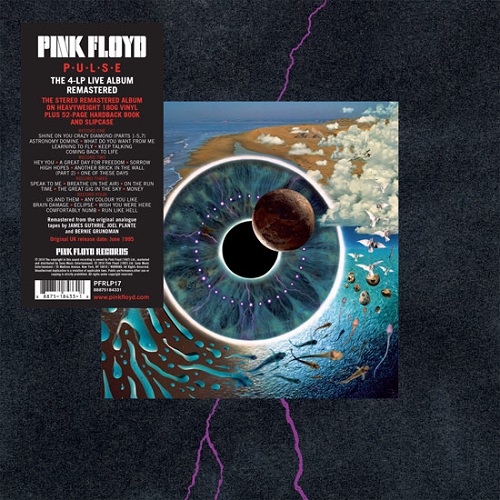
Pink Floyd ‘Pulse’ 180g 4LP vinyl box set reissue with 52-page hardback book, all encased in a thick card slipcase.

Pink Floyd will re-release their 1995 UK Number 1 live album ‘PULSE’, pressed on heavyweight 180-gram vinyl.

‘PULSE’ was compiled by James Guthrie, Originally released in 1995, Pulse was recorded as Floyd toured across the UK and Europe in support of their 14th studio album The Division Bell in 1994.using various performances from the band’s 1994 Division Bell tour across the UK and Europe featuring David Gilmour, Nick Mason and Richard Wright. The album includes ‘The Dark Side of the Moon’ performed in full, as well as a whole side dedicated to the show’s encore.

The 4-LP set includes four different inner sleeves, each inside individual outer sleeves, plus a 52-page hardback photo book, all encased in a thick card slipcase. It will also feature One Of These Days, which was only included on the LP and cassette version of Pulse upon its original release.

This 2018 release was remastered from the original tapes by James Guthrie, Joel Plante and Bernie Grundman. Aubrey Powell of Hipgnosis and Peter Curzon, who worked on the original art with the late Hipgnosis co-founder, Storm Thorgerson, recreated the art package.

Pink Floyd’s ‘P.U.L.S.E. Restored & Re-Edited’, will be released for the first time on Blu-ray on 18th February 2022. The P.U.L.S.E. concert film (helmed by esteemed director David Mallet) will be available as 2x Blu-ray and 2x DVD deluxe box sets, with the video footage having been expertly re-edited by Aubrey Powell/Hipgnosis from the original tape masters especially for The Later Years release in 2019. The cover design, originally created by Storm Thorgerson and Peter Curzon for the 2006 DVD release, has also been updated with photography by Aubrey Powell/Hipgnosis and Rupert Truman/StormStudios.

The packaging artwork is designed by Peter Curzon from StormStudios, under the direction of Aubrey Powell/Hignosis. This release also sees the reintroduction of the iconic pulsating light as per the original 1995 CD release, this time operated by 2 replaceable AA batteries. The deluxe packages include music videos, concert screen films, documentaries, Pulse Tour rehearsal footage & more, alongside a 60-page booklet. P.U.L.S.E., originally released as an album in 1995, was recorded on the European leg of the Division Bell tour and the DVD and Blu-Ray packages include the whole live performance of ‘The Dark Side Of The Moon’ – the only full live filmed recording of this seminal album. The concert, filmed on 20 October 1994 at Earls Court in London, saw Pink Floyd play some of their classic tracks as well as highlights from the recently released album ‘The Division Bell’. Standout tracks include ‘High Hopes’, ‘Keep Talking’, ‘Sorrow’, ‘Wish You Were Here’, ‘Comfortably Numb’ and ‘The Great Gig In The Sky’.

This 4LP set is released on Friday 18th May

No photo description available.

Related image

The Madcap Laughs, Syd Barrett’s first solo album, opens with this track, a deceptively spartan blues riff that bears no trace of the glittering psychedelia that colored Pink Floyd’s Barrett-led The Piper At The Gates of Dawn. Recorded in a single take by producer Malcolm Jones (who would never have it that easy again), “Terrapin” is so hushed that you can hear each scrape of Barrett’s pick against his acoustic guitar as an overdubbed electric languorously traces its melody line, both of them abruptly hanging here and there to throw the whole thing just slightly off-kilter. The lyrics start surprisingly straightforward for Barrett (“I really love you, yes I do”) but grow more densely surreal as “Terrapin” stretches on and on, with Barrett reinforcing the refrain “’Cause we’re the fishes and all we do / The move about is all we do” through undersea imagery and the song’s subtle, watery undulation. Barrett’s mental decline is one of rock’s great tragedies, and while his solo work is understandably uneven, tracks like “Terrapin” offer an accessible entry point to one of music’s most idiosyncratic minds.

Roger Waters’ pioneering Us + Them Tour will come the UK next summer. Waters is set to play in Glasgow, Liverpool, Manchester and Birmingham with his critically acclaimed show in summer 2018. In addition the rock icon is set to play London’s British Summer Time at Hyde Park on 6th July; the first headliner to be announced for the series of central London shows.

Currently touring the United States, Us + Them has received rave reviews for a spectacular setlist and the “eye-popping” production.

The show will feature tracks from Pink Floyd’s greatest albums The Dark Side of the Moon, The Wall, Animals, Wish You Were Here and more, plus new songs from his latest best-selling album Is This the Life We Really Want?. 

Waters’ first solo album in 25 years, Is This The Life We Really Want? is a full-on political rock album. The former Pink Floyd member recorded the 12-track album with the help of Radiohead-producer Nigel Godrich.

Us + Them marks Roger Waters’ first return to the UK since his sold-out world tour The Wall Live in 2010-2013, which was seen by more than four million fans globally.

Image may contain: one or more people and people standing

Following up a hit record is no mean feat for any band, and even under the best of circumstances, Pink Floyd might have found it all but impossible to come back from the massive success of Dark Side of the Moon.

Unfortunately, when the band returned to the studio in January 1975, conditions were far from favorable in the band for a variety of reasons — not the least of which was the fact that, as they adjusted to life after a worldwide smash record, the members of the band found themselves more disoriented than fulfilled. Compounding the problem was a growing disconnection between bassist Roger Waters and the rest of Pink Floyd, particularly guitarist David Gilmour.

“We were all having to assess what we were in this business for,” Gilmour said in the 2012 documentary The Story of Wish You Were Here. “Whether we were artists or businessmen. Having achieved the sort of success and money out of it all, it could fulfill anyone’s wildest teenage dreams, why we would still continue to want to do it? Roger has said he thinks we may have been finished at that point, and he may have been right.”


It also didn’t help that, as drummer Nick Mason said in a separate interview filmed for the movie, the band didn’t exactly have a ton of material stored up for their next album. After spending years rotating through the industry’s tour-and-record cycle, they hunkered down on their Dark Side follow-up basically bereft of material — and some of the songs they had written ended up being thrown out of the running order.

The songs in question, “Raving and Drooling” and “You Gotta Be Crazy,” were excised from the album after a fight between Waters and Gilmour, prompted because Waters felt the songs they had didn’t hold together as a cohesive whole. In his view, it was better to expand one particular track — titled “Shine On You Crazy Diamond” — into a bookend that essentially enveloped the rest of the record. As Waters later revealed, the piece was largely inspired by his heartbreak over the self-imposed exile of the band’s founding guitarist and first leader, Syd Barrett.
“I’ve never read an intelligent piece on Syd Barrett in any magazine, never,” Waters is quoted as saying in Mark Blake’s book Comfortably Numb: The Inside Story of Pink Floyd. “I wrote and rewrote and rewrote and rewrote that lyric because I wanted it to be as close as possible to what I felt. There’s a truthful feeling in that piece. That sort of indefinable, inevitable melancholy about the disappearance of Syd. He’s withdrawn so far away that he’s no longer there.”

Waters’ feelings regarding Barrett’s absence could have been applied, to some degree, to the rest of Pink Floyd. “No one was really looking anyone in the eye,” he complained. “It was all very mechanical.”

“It was disengagement,” concurred Gilmour. “It was not being willing to apply yourself sufficiently. Lots of moments when any one of us might have been much more interested in thinking about what we were doing that weekend […] The concentrated activity was rather diluted, and I’m sure for a very pushing, driving sort of person like Roger, it was more frustrating than it was for anyone else — although it was very frustrating for all of us, I suspect.”

Thus preoccupied by feelings of alienation and disillusionment, the members of the group — primarily pulled along by Waters — cobbled together a set of songs built around absence, starting with the withdrawal of their friend Barrett and spilling over into the creeping disappointment they’d found with one another and in the industry they’d enriched with Dark Side of the Moon. In the midst of the recording, Barrett himself made an unannounced appearance in the studio, looking so different that the members of the band initially failed to recognize him.

Drummer Nick Mason, for one, later remembered Barrett looking like a “large, fat bloke with a shaven head, wearing a decrepit old tan mac and carrying a plastic shopping bag,” while keyboard player Rick Wright recalled a sad denouement to their former leader’s surprise visit: “Syd stood up and said, ‘Right, when do I put the guitar on?’ And, of course, he didn’t have a guitar with him. We said, ‘Sorry, Syd, the guitar’s all done.’”

Such was the band’s disconnect that one song on the album, titled “Have a Cigar,” ultimately ended up being sung by someone outside the lineup. After Waters and Gilmour tried and failed to lend the requisite degree of vocal snark to their sarcastic ode to music business cynicism, they ended up turning to singer songwriter Roy Harper, who was sharing the studio with them and happened to be in the room one day while they struggled to find a solution.

Roger can write songs but he’s never going to be in the top one hundred as a rock singer,” observed Harper. “He tries hard, he’s a good lad. Anyway, neither of them could get up there. I just stood at the back, leaning against a machine and laughing. I said, ‘I’ll sing it for you,’ and someone said, ‘OK,’ and I said, ‘For a price.

Recording finally wrapped in the summer of 1975, and after settling on a typically evocative cover design from legendary artist Storm Thorgerson, the members of Pink Floyd sent their ninth studio LP — titled Wish You Were Here, after a particularly disaffected Gilmour-Waters cowrite — to their label. Scheduled for release on September. 12th, it immediately became one of the most highly anticipated albums of 1975.

Not that Pink Floyd necessarily acted like a band delivering a major piece of product. In fact, their only concession to the promotion machine was a single syndicated live show, recorded at the Los Angeles Sports Arena in the spring of 1975, which was broadcast in an array of major markets ahead of the tour booked to support Wish You Were Here. The sold-out set, which still included “Raving and Drooling” and “You Gotta Be Crazy,” also featured an extended “Shine On You Crazy Diamond” as well as “Have a Cigar,” “Echoes,” and “Dark Side of the Moon” — as well as an expanding roster of special effects that now included expensive and unpredictable pyrotechnics.

In spite of inevitably mixed reviews, Wish You Were Here went on to top the charts on both sides of the Atlantic, and although it couldn’t hope to match the gargantuan sales of Dark Side of the Moon, it enjoyed substantial success in its own right, selling more than six million copies in the U.S. alone. And while the Floyd machine would continue to churn out product on a regular basis in the near future — starting with 1977′s Animals, which included the jettisoned Wish tracks “”Raving and Drooling” and “You Gotta Be Crazy”  the writing was already on the wall for Waters eventual departure from the band. As he pointed out in The Inside Story of Pink Floyd, even the biggest sales figures can’t balance out creative dysfunction.

“The dream,” shrugged Waters, “is that when you are successful, when you’re a star, you’ll be fine, everything will go wonderfully well. That’s the dream — and everybody knows it’s an empty one.”

Pink Floyd 2

We here at Vinyl Me, Please thought it was super important to do something to honor the 50th year anniversary of Pink Floyd. As a testament to the greatness of Pink Floyd, this set list showcases just how influential their legendary 1973 album, “The Dark Side of the Moon” truly is to all genres of modern popular music. In this episode you will hear Dark Side of the Moon in its entirety, front to back. However, this version of multi-platinum album will only showcase covers of the ten iconic tracks included on the record, being played only by bands other than Pink Floyd. Lets get spinning,

Presented by www.vinylmeplease.com

http://

Setlist

  • The Flaming Lips with Henry Rollins and Peaches – Speak to Me
  • The Flaming Lips with Henry Rollins and Peaches – Breathe
  • The Sword – On the Run
  • Garry Green, Billy Sherwood, Robby Krieger, Alan White – Time
  • Rick Wakeman, Steve Howe, Billy Sherwood – The Great Gig in the Sky
  • Gov’t Mule – Money
  • Easy Star All Stars – Us and Them
  • The Flaming Lips with Henry Rollins and Peaches – Any Colour You Like
  • Geoff Downes & Robby Krieger – Brain Damage
  • Peter Banks, Tony Kaye, John Wetton – Eclipse

The album will come out as a 180-gram vinyl LP, on CD and digitally and is available for pre-order beginning Friday.

In addition to Waters, who sings, plays bass and acoustic guitar on the album, the musicians include Godrich (arrangement, sound collages, keyboards, guitar), Gus Seyffert (bass, guitar, keyboards), Jonathan Wilson (guitar, keyboards), Joey Waronker (drums), Roger Mannning (keyboards), Lee Pardini (keyboards) and Lucius (vocals) with Jess Wolfe and Holly Laessig.

At the moment Waters has been tight-lipped about the album’s contents, In February he said that he has drawn inspiration from the antipathy he feels toward the Trump administration, as well as a dramatic radio play he had been writing before working on the LP about a man and his granddaughter investigating why children were being killed in faraway lands. “Two or three of the songs from that idea are on this album,” he said. “Nigel Godrich persuaded me that for the purposes of a rock & roll record, which is what this is, he felt my theatrical idea – I’d written the whole thing as a radio play was less than ideal.”

They reworked some of Waters’ ideas, though the singer-songwriter also looked outward for inspiration. The Is This the Life tune “Wait for Her” was inspired by an English translation of “Lesson From the Kama Sutra (Wait for Her)” by the late Palestinian poet Mahmoud Darwish.

The album will come out shortly into Waters’ upcoming Us and Them Tour , which kicks off May 26th in Kansas City, Missouri. Gigs at arenas around the U.S. and Canada run through October 28th, when the tour wraps in Vancouver.

The tour’s concept will be built around his album title. “I will be making the point that we’re living the life that we don’t really want to live,” he said. But it also ties into the tour moniker, which comes from the Dark Side of the Moon track of the same name. “I like to think that people would still like to live in a world where we might address the problems of climate change, where we might understand that if we empathize with others, it makes us feel happier,” he said. “Maybe we should start looking at happiness indexes rather than if we win and lose. And if we do that, then we may start to understand that the idea of ‘us’ and ‘them’ is actually an illusion.”

Is This The Life We Really Want?

Track List

1. “When We Were Young”2. “Déjà Vu”
3. “The Last Refugee”
4. “Picture That”
5. “Broken Bones”
6. “Is This the Life We Really Want?”
7. “Bird in a Gale”
8. “The Most Beautiful Girl”
9. “Smell the Roses”
10. “Wait for Her”
11. “Oceans Apart”
12. “Part of Me Died”

Interstellar Overdrive” is an instrumental composition written and performed by Pink Floyd. The song was written in 1966, and is listed on their debut album, , released in 1967, clocking in at almost ten minutes in length.

With crazed musical mastermind Syd Barrett at the helm, Pink Floyd started the space race with this full tilt cosmic cacophony, and from there established an acid-soaked sound that would inspire generations of surreal psychedelic ensembles to come. Culled from their groundbreaking debut album The Piper at the Gates of Dawn, it created a wash of distortion, improvisation and sonics that set heads spinning and audiences spiralling skyward.

The song originated when guitarist Syd Barrett heard the band’s manager Peter Jenner humming a song, which Barrett tried to interpret by playing it on his guitar. Musically sharing the same theme with “Astronomy Somine”, the piece was recorded in several takes between March and April 1967. An earlier, longer recording of the song can be heard on the soundtrack to the film “Tonite Lets All Make Love In London” which was recorded at Sound Technique Studios in early 1967, and was released in the same year. In October 31st anotherr session yielded a demo version of “Interstellar Overdrive” that eventually served as the soundtrack for “San Francisco”, a 15-minute documentary by filmmaker and Syd Barrett’s acquaintance Anthony Stern. Aside from its inclusion in the film, this recording, indeed, has never been officially released.

Pink Floyd will release this special 12-inch single to mark Record Store Day 2017.

They’ll launch Interstellar Overdrive – a previously unheard mono instrumental recording of the 1966 track – on April 15th on heavyweight 180-gram vinyl. It’ll play at 33⅓ RPM and will come with a fold-out poster and an A6 postcard featuring a classic image of the band taken while they were recording their debut single “Arnold Layne”.

A statement reads: “Written and performed by Syd Barrett, Roger Waters, Richard Wright and Nick Mason, Interstellar Overdrive is an unheard recording from 1966, running at a hefty 14 minutes 57 seconds long.

“The original recording was done at the Thomson Studio in Hemel Hempstead, Hertfordshire, on November 31st, 1966, before the band were signed to EMI. “A different, shorter version of the track appears on the band’s debut album “The Piper at the Gates of Dawn.” Other versions of the track appear on various bootlegs.

The piece has been covered by acts such as T.Rex, Pearl Jam Hawkwind the Melvins, and Simon House.

Image may contain: text

Pink Floyd / Dark Side of the Moon / Immersions Box Set

Pink Floyd’s 1973 album “The Dark Side Of The Moon” is arguably the most recognizable album in rock and roll history. Spending a record-breaking 741 weeks on the US top albums Billboard charts, the release cemented Pink Floyd’s reputation as the premiere art rock band of a generation.

During the Dark Side of the Moon sessions, the band literally ran out of tracks on the 2″ 16-track machine they were working with. The drums had to be copied across and mixed down to a 24-track machine, so all issues of Dark Side of the Moon have had second generation drums until James Guthrie’s 2003 remaster where he laboriously tracked down the original 16-track tapes and sourced the drums from the original tapes.
• When recording the Dark Side of the Moon live concerts, their were various technical problems, including the kick-drum being mic’d up incorrectly, meaning that non of that drum was recorded on tape. However spill from other mics picked it up slightly, and engineers were able to accurately recreate the kick-drum for the remastered live recordings.
• During the research period for the reissues, the original tapes of the famous Dark Side of the Moon “interviews” were found including – amongst many others – Paul and Linda McCartney’s voices and Wings’ Guitarist Henry McCullough, whose “I don’t know; I was really drunk at the time” can be heard at the end of Money. Since the engineers now had access to the original isolated tapes we can apparently look forward to a DVD ‘Easter egg’ which will make use of some of this audio!
• The original working title for Dark Side of the Moon was Eclipse and The Great Gig in the Sky had the working title of  “the religious section”, while On The Run was known as “the travel section”. These fitted in with the ‘big’ themes of the album money, time etc.

While the album was released on March 1st, 1973, the music was remarkably written months before the album ever premiered. The band promoted DSOTM with two tours, one before the album release in 1972 and the other, after the release, in 1973. After technical difficulties halted Floyd’s first performance on January 20th, 1972, the group took the stage one night later and delivered the first-ever, full-length performance of “The Dark Side Of The Moon”.

Remarkably, the live set matches the album closely. With a handful of differences, including a spacey jam instead of “On The Run” and some church-like organ progressions instead of “The Great Gig In The Sky,” it’s interesting to see how this music evolved from a live performance in Portsmouth, UK to one of the most well-known albums of all time, just a little over a year later.

Also remarkable is that a full recording of the show exists! . Feast your ears on the first-ever live take on “The Dark Side Of The Moon”Pink Floyd – Portsmouth (Live Portsmouth, UK – January 21st, 1972)