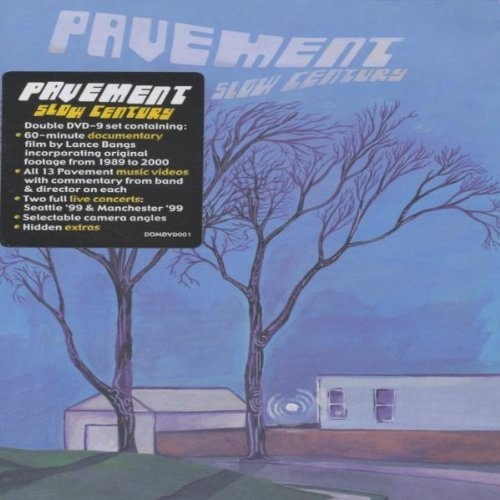
With a Pavement reunion tour going all over the place in 2022, it’s a good time to revisit Lance Bangs’ excellent “Slow Century” documentary. Originally released in 2002, it tracks the band from the scruffy early days as a “special new band” through their, er, slightly less scruffy time as indie rock darlings. Amidst intimate interviews and rehearsals, Bangs makes copious use of both pro and amateur concert footage, and in the process puts to bed the idea that Pavement were no good live. Loose and messy at times? Sure. But Stephen Malkmus and co. almost always delivered an exciting, unpredictable show, eschewing gloomy theatrics for something fresh and fun.
Documentary tracing the existence of noted rock band Pavement from 1989 to their final performance in late 1999. The DVD also compiles all of their music videos, rare live footage, audio commentary from the band and directors, and two live concerts available with multiple angles.
The complete Lance Bangs documentary/retrospective about Pavement circa 2002.
Four long years after their last release, the deliciously titled “Wig Out at Jagbags”, Stephen Malkmus and his balmy Jicks Band return with an equally delicious follow-up. Spread across 11 tracks, the former Pavement frontman meditates on a changing world by changing with it, leaning on newer toys like an Auto-Tune and Mellotron. He even gets political without all the gimmicky trappings that traditionally come with being an aging white rocker trying to stand on a soapbox.
Why It Rules:For all those reasons and more, Malkmus arrives in top form on Sparkle Hard, sounding like a bona fide bard of his generation. Make no mistake, he still knows how to get silly, but it’s the type of silly one might attribute to whimsically clever authors like Shel Silverstein or Dr. Seuss. Songs like “Bike Lane”, “Kite”, and especially “Shiggy” prove he still has his eye on the stage while deeper cuts like “Solid Silk” and “Middle America” hint that he’d just as happily stroll around the neighborhood. “Bike Lane” is a high point on one of Malkmus’ strongest albums, which puts it in rare company indeed.
Stephen Malkmus is known for an easygoing air on songs full of jangling guitars and wandering subject matter, a reputation he undercuts with savage social commentary on the tightly focused “Bike Lane.” The song, from Sparkle Hard, his latest with the Jicks, skewers misplaced cultural priorities as he juxtaposes an observational, mild-mannered refrain—“Another beautiful bike lane”—with a brutally casual recounting of how a young black man named Freddie Gray died at the hands of Baltimore police officers in 2015. It’s bracing, as Malkmus offers sarcastic sympathy for the cops, and also irresistibly catchy, with a propulsive beat, squiggles of keyboards and an off-kilter guitar workout.
“I will not be one of the watchers/I will not disappear,” Stephen Malkmus sings on “Middle America,” one the best songs from his seventh solo album. an ambling rumination on growing older, featuring a probable allusion to the #MeToo movement: “Men are scum, I won’t deny.” Malkmus continues to mix it up with spacey vocoder-enhanced vocals on prog-jam “Rattler” The elder indie statesman doesn’t have much to prove (as if he ever sang like someone who did) but he and his band aren’t resting on laurels here. Riffing on sunshiny pop, country balladry — with Kim Gordon in tow! — prog workouts, and extended jams equally indebted to the Dead and Neu!, Malkmus gets in where he fits in. Clever as ever but warmer, too.
I hear echoes of the Pavement song “Greenlander” in “Middle America” – not enough that they’re extremely similar on a structural level, but close enough in tone that they share a particular shade of melancholy and evoke a frigid and empty landscape. In lyrical terms they’re from very different ends of a lifespan. “Greenlander” confronts a very youthful sort of awkwardness and regret, with the line “everything I did was right, everything I said was wrong / now I’m waiting for the night to bring me dawn” standing out as one of the young Malkmus’ more straightforward and poignant moments. “Middle America” is more like a collection of wise thoughts and observations, but presented in a humble and low-key way. There’s some good advice in the song but the emotional power of it lies more in the bits where he seems far less certain of himself or anything else. There’s something in the way he sings the “in the winter time” hook that conveys a sweet vulnerability and vague doubt that actually makes him come across as a stronger and more reliable person.
As the frontman of Pavement, Stephen Malkmus recorded some of the most influential, indie genre–defining albums of the twentieth century. For better or worse, it’s work all of his subsequent productions will be measured against, even though he’s been recording solo for nearly twenty years now. Sparkle Hard, his seventh solo album, stands firmly with one foot in the past and the other in the present. An “if it ain’t broke, why fix it” mentality lends a well-worn familiarity, but that doesn’t mean he isn’t playing around with our expectations a little. Kim Gordon cameo on the stripped-down, twangy, tongue-in-cheek “Refute.” All the while, he retains his signature effortlessness, stepping back when things start to get too serious.
Maybe that’s why this album feels so aptly timed. We’re within the midst of a nostalgia boom for bands that defined the ’90s, while current mainstream rock seems to take itself more and more seriously, panicking that the genre is on the decline despite a new class of young, wry indie artists nipping at their heels (many of whom seem to have studied at the School of Malkmus Wit). We needed a new record from Stephen Malkmus to remind us that rock isn’t dead.
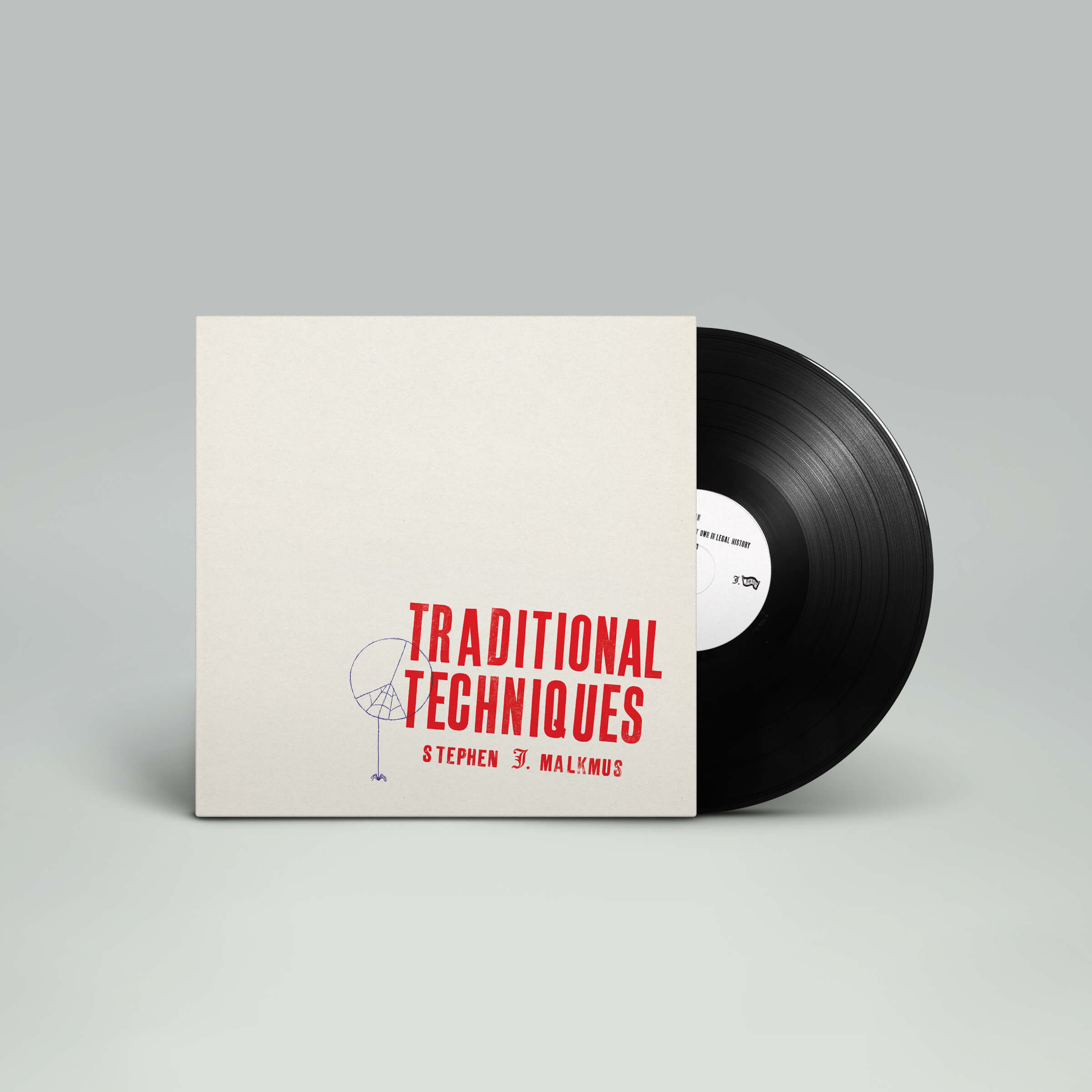
From the new album ‘Traditional Techniques’ by Stephen Malkmus
When Stephen Malkmus first arrived on the scene in the early Nineties, as frontman and prime creative force in Pavement, the area of music with which he was associated couldn’t really have been further from the techno-rave sounds of the day. Electronic dance music, then as now, was about posthuman precision, inorganic textures, and hyper-digital clarity. Whereas the lo-fi movement in underground rock championed a messthetic of sloppiness, rough edges, and raw warmth – a hundred exquisitely subtle shades of distortion and abrasion. “Imperfect sound forever” was the rallying cry for a micro-generation of slacker-minded dreamers and misfits.
For his third record in as many years, the sometimes Pavement frontman chills out, unplugs and delivers a record of stoner folk-inspired songs that are among his most direct, affecting to date. For a guy who’s been known for 30 years primarily as a musician who is, at times, too clever for his own good, Malkmus shows real heart here.
While associated with staunch indie rock snobbery, Stephen Malkmus has long dabbled in jam band territory, all the way back to Pavement’s final album, Terror Twilight. (Before? Maybe.) So when he announced Traditional Techniques, his third album in three years, as “stoner folk” it wasn’t really as much of a stretch as Matador may have wanted you to believe. At least not in that way. It is, however, his quietest, most introspective and straight-from-the-heart record he’s ever made.
To call Stephen Malkmus’ Traditional Techniques an “acoustic record” wouldn’t be inaccurate, but it doesn’t quite capture the sonic expanse of this midcareer gem. “ACC Kirtan,” “Xian Man,” and “Brainwashed” unfurl into psychedelic sprawl, while elsewhere Malkmus takes his 12-string toward country-rock, or classic folk, or surrounds it with woodwinds, drums, and string instruments from Africa and the Middle East. Traditional Techniques revels in the gray space between frank and enigmatic, whether exploring love and friendship, or in yarns about propane smugglers or the extremely online. “May the word be spread via cracked emoji,” Malkmus sings on “Shadowbanned” — it’s unclear what exactly that may mean, but like the best, inscrutable Malkmus lines, it rings true.
Stephen presents “Juliefuckingette,” an A-side-worthy B-side off of Traditional Techniques. Additionally, he announces a rescheduled North American tour (See below for the full dates).
As with Traditional Techniques, “Juliefuckingette” is new phase folk music for new phase folks. Malkmus’ wry lyricism unwinds over his 12-string acoustic guitar: “Abolish the fanfiction set // I don’t wanna clean up the logorrhea mess // It’s the last brand standing // You know you wanna kill it but you can’t kill that quite yet.”
Stephen Malkmus has shared the track “Shadowbanned” from his upcoming album “Traditional Techniques”. It’s a psych-folk jam about the the dark corners of the internet and tech industry and the video features Kim Gordon, Sharon Van Etten, Kurt Vile, Conor Oberst and more lip-synching the song while using the “Being Stephen Malkmus” Instagram filter (that you can try too).
Following lead single “Xian Man,” “Shadowbanned” bursts with flute-laced swagger and Malkmus as attuned as ever to the rhythms of the ever-evolving lingual slipstream as he sings of “Amazon wheatfields and rivers of Red Bull//drip gush drip//data driven skip//to the part where the left bros parody TED talks.” Its video, directed by Jan Lankisch, features friends and fans of Malkmus, such as Kim Gordon, Mac DeMarco, Sharon Van Etten and Jason Schwartzman, performing “Shadowbanned” as a cartoon version of Malkmus . Their footage is interwoven with clips from older videos by Malkmus and Pavement in which the singer has been blurred, pixelated, and algorithmically replaced in order to render him invisible.
“The video was inspired by reading about female singers and musicians who were photoshopped from their album covers by an Iranian music streaming site,” says Lankisch, who realized “Shadowbanned“with the help of Janosch Pugnaghi, Gesa Gadow, Lina Sieckmann and Miri Gossing. The video represents two polar opposites: the involuntary erasure of a person in visual imagery and one’s desire to perform as a persona, thereby leaving the constraints of one’s everyday identity behind. “Identity is a matter of design. People like to play with characters and pretend to be someone else.” For this reason, Lankisch and Pugnaghi developed a filter for Instagram called “Being Stephen Malkmus,” which operates via face detection. The face of the user is overlaid with a stylized version of Malkmus’ face. The “Being Stephen Malkmus”
From the new album ‘Traditional Techniques’ by Stephen Malkmus out March 6th, 2020.
Pavement disbanded before the turn of the millennium. Still, the impact of the Stockton, Californian. band’s music still echoes, due to its independent ethos, occasional disregard for melody, and progressive view of art rock and punk. Even setting aside all the bands clearly influenced by Pavement, the group’s five-LP output makes them one of the most important alternative rock bands of the ‘90s. Here then are the best songs from indie rock legends, Pavement second album Crooked Rain, Crooked Rain.
“Unfair”
This is one of the angriest sounding Pavement songs. It’s one of the band’s variations on a theme of “Northern California rules / Southern California drools,” which likely exacerbates that ferocious guitar riff. Malkmus first rallies to, “burn the hills of Beverly!” before howling at his state’s southern residents, “I’m not your neighbour, you Bakersfield trash!”
“Elevate Me Later” Malkmus is an amazing guitarist, but some songs just stick out above others. On top of that, though, this is also one of Malkmus’ best vocal performances. And here on Crooked Rain, Crooked Rain, there’s something in the way his voice sounds in “Elevate Me Later” that is perfectly in sync with the tone of the instrumentation.
“Silence Kid” “Silence Kid” kicks off Pavement’s second album Crooked Rain, Crooked Rain. The sound of Crooked Rain is more polished and lusher than Slanted and Enchanted, and this is clear right from the start of “Silence Kid.” It squeals strangely and slowly during its intro, but kicks into high gear by the time the vocals start. Also, note that cowbell.
“Cut Your Hair”
If you only know one Pavement song, it’s probably this one. The closest thing Pavement ever got to a hit appeared on 1994’s Crooked Rain, Crooked Rain, and was later featured in Beavis & Butthead and one of those campy Brady Bunch movies. The song seems to be about appearance mattering for musicians in terms of being popular and successful, but it’s Pavement so we can’t be entirely sure. The music video for Pavement’s “Cut Your Hair,” released in 1994, remains a ridiculous romp. In it, the gang pays a visit to the barbershop, each member costumed in their own low-budget getup—Scott Kannberg in a gorilla suit, Stephen Malkmus crowned a weepy king. It’s both utterly pointless and splendidly on-brand for the most chilled-out players in ’90s indie-rock. “Cut Your Hair” is a bad music video, but that’s why it’s so great. Pavement made indifference look impossibly cool.
“Gold Soundz”
The second single off Crooked Rain, Crooked Rain tops this list because it’s a rocker with a decidedly indie flavor. Although “Cut Your Hair” charted much better than “Gold Soundz,” the latter more fully encapsulates the essence of Pavement—messy but melodic, retro, yet still relevant. Plus, the lyrics include the phrase “quarantine the past,” which, of course, is the title of Pavement’s aforementioned greatest hits compilation. Therefore the song has to be great.
The album that elevated Pavement to a new level of slacker-rock stardom is turning 25 years old today. “Crooked Rain, Crooked Rain” arrived on February. 14th, 1994, and alternative rock arguably hasn’t been the same since. The band’s more jittery debut, Slanted & Enchanted, had dropped two years earlier in 1992, but it was Crooked Rain, Crooked Rain—a record they made in some guy’s NYC apartment-slash-studio that broke the band. MTV played their awful music videos; people fell hard for their affably effortless songs like the aforementioned “Cut Your Hair,” the mindlessly nostalgic “Gold Soundz” and the quasi-country banger “Range Life.” Pavement had arrived.
After the band’s eventual break-up, but before their 2010 reunion, Malkmus went out on his own and started making music with his other band, The Jicks, plus a few solo endeavors.