“Scream Thy Last Scream” is a song by Pink Floyd, written by frontman Syd Barrett and scheduled to be the band’s next single after “See Emily Play” , Its first official release was on The Early Years 1965-1972 box set in November 2016. The song features several changes in tempo, a sped-up double-tracked vocal part by Barrett, while drummer Nick Mason simultaneously sings the normal part (one of only 4 moments he ever sang on a Floyd record),a range of bells, crowd noises, an instrumental section that continually increases in speed featuring wah-wah guitar solos and keyboards, and surreal lyrics. Barrett is only clearly audible on one line in the song, “she’ll be scrubbing bubbles on all fours”
“Scream Thy Last Scream’ has lead vocals by Nick Mason,” noted David Gilmour in 2002. “We did actually perform that one a few times in my very early years with Pink Floyd. I don’t know if they ‘Scream Thy Last Scream’ and ‘Vegetable Man’ were ever finally mixed.
Nick Mason – lead vocals, drums
Syd Barrett – guitar, sped-up double-tracked vocals, vocals (one line)
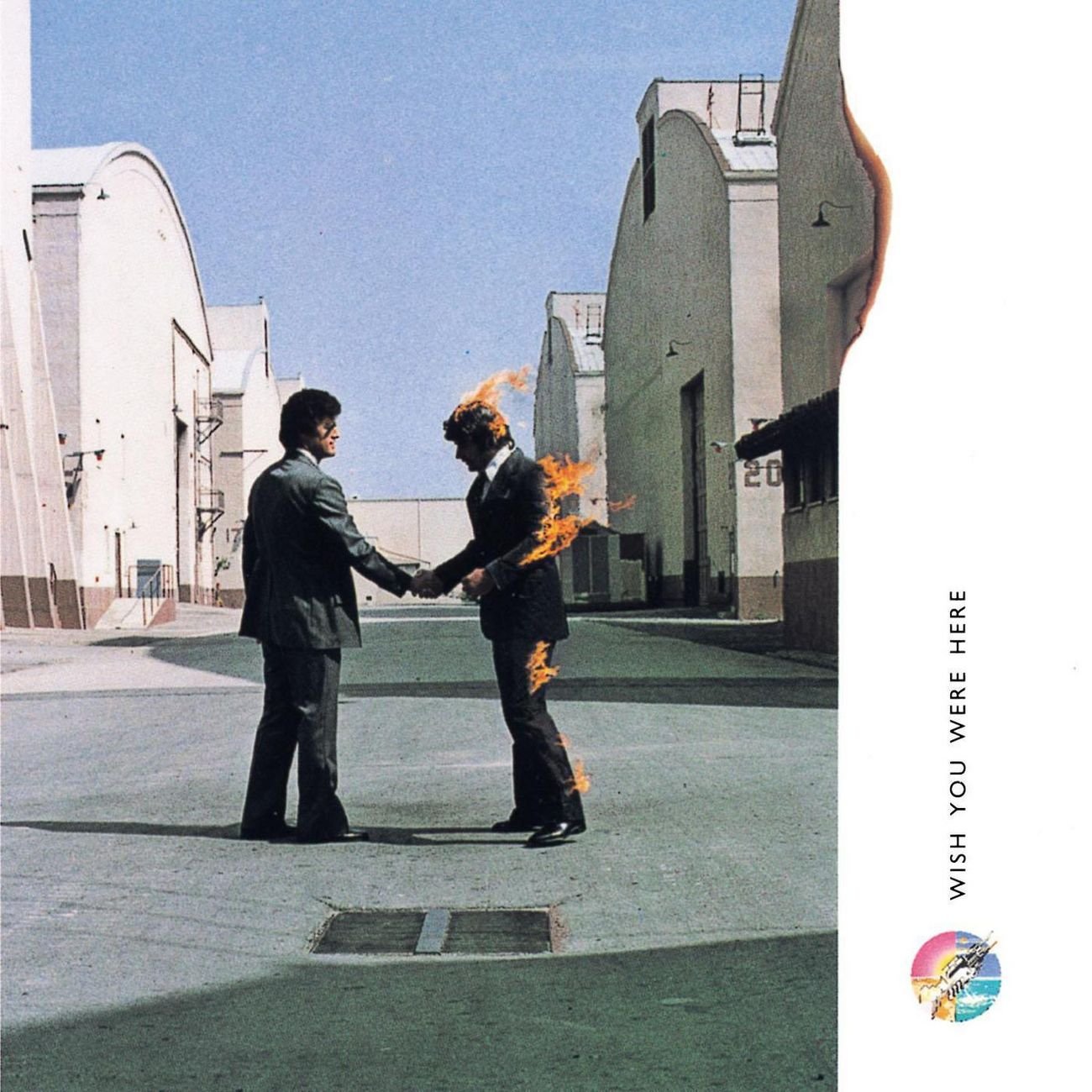
Wish You Were Here is the ninth studio album by English rock band Pink Floyd. It was first released on 12th September 1975 in the United Kingdom by Harvest Records.
It debuted at No. 1 on both sides of the Atlantic, and has been tabbed by both Gilmour and Wright as their favourite Pink Floyd album. Still, ‘Wish You Were Here’ was no ‘Dark Side of the Moon’; it never could be. And that – as much as anything seems to have relegated this 1975 follow-up to a life of perpetual underrated status. It’s a pity. There isn’t a more conceptually concise Pink Floyd album, nor one as musically inviting. Even as DaveGilmour and, in particular, Richard Wright pushed the work into deeper, more progressive musical themes, they helped fashion the last truly collaborative studio project between RogerWaters and his increasingly disgruntled bandmates.
Inspired by material the group composed while performing in Europe, During 1974, Pink Floyd sketched out three new compositions, “Raving and Drooling”, “You Gotta Be Crazy” and “Shine On You Crazy Diamond”. These songs were performed during a series of concerts in France and England, the band’s first tour since 1973’s The Dark Side of the Moon.
The album was recorded in numerous sessions at Abbey Road Studios in London. Two of its songs criticise the music business, another expresses alienation, and the multi-part composition “Shine On You Crazy Diamond” is a tribute to Pink Floyd founder Syd Barrett, who had left seven years earlier due to mental health problems. The band used studio effects and synthesizers, and brought in guest singers: Roy Harper, who provided the lead vocals on “Have a Cigar”, and Venetta Fields, who added backing vocals to “Shine On You Crazy Diamond”. After several weeks, Waters began to visualise another concept. The three new compositions from 1974’s tour were at least a starting point for a new album, and “Shine On You Crazy Diamond” seemed a reasonable choice as a centrepiece for the new work. Mostly an instrumental twenty-minute-plus piece similar to “Echoes”, the opening four-note guitar phrase reminded Waters of the lingering ghost of former band-member Syd Barrett.Gilmour had composed the phrase entirely by accident, but was encouraged by Waters‘ positive response.Waters wanted to split “Shine On You Crazy Diamond”, and sandwich two new songs between its two halves.
The album begins with a long instrumental preamble and segues into the lyrics for “Shine On You Crazy Diamond”, a tribute to Syd Barrett, whose mental breakdown had forced him to leave the group seven years earlier. Barrett is fondly recalled with lines such as “Remember when you were young, you shone like the sun” and “You reached for the secret too soon, you cried for the moon”.
Wish You Were Here is also a critique of the music business. “Shine On” crosses seamlessly into “Welcome to the Machine”, a song that begins with an opening door (described by Waters as a symbol of musical discovery and progress betrayed by a music industry more interested in greed and success) and ends with a party, the latter epitomising “the lack of contact and real feelings between people”. Similarly, “Have a Cigar” scorns record industry “fat-cats” with the lyrics repeating a stream of cliches heard by rising new-comers in the industry, and including the question “by the way, which one’s Pink?” asked of the band on at least one occasion. The lyrics of the next song, “Wish You Were Here”, relate both to Barrett’s condition, and to the dichotomy of Waters’ character, with greed and ambition battling with compassion and idealism. The album closes with a reprise of “Shine On” and further instrumental excursions.
Wish You Were Here topped the charts in the United Kingdom and the United States, and Harvest Records‘ parent company EMI was unable to print enough copies to meet demand. Although it initially received mixed reviews from critics, the album went on to receive critical acclaim,
Everyone wanted a piece of Pink Floyd after ‘The Dark Side of the Moon’ sold a gazillion copies , especially the shady music-industry types Waters never trusted. ‘Have a Cigar’ is all about those clueless suits. “By the way, which one’s Pink?” sings guest Roy Harper, a British folkie, summing up the era.
‘Shine on You Crazy Diamond’ was originally released as a two-song, eight-part, 26-minute suite on the band’s follow-up to the mega-popular ‘The Dark Side of the Moon.’ And like several Floyd projects from the period, the song references former bandmate Syd Barrett’s descent into mental illness. It’s an epic piece, the bookends to one of the group’s most durable LPs.
The members of Pink Floyd were still friendly with Syd Barrett after he left the group in 1968. He even showed up in the studio, somewhat unrecognizable, while they were recording of their ninth album. ‘The Dark Side of the Moon’ touched on the mental illness that crippled Barrett, but ‘Wish You Were Here’ was an album-length tribute to both his genius and madness. The title track ties Barrett’s plight to Waters‘ own distancing from society.
The band played much of Wish You Were Here on 5th July 1975 at the Knebworth music festival. Roy Harper, was also performing at the same event, on discovering that his stage costume was missing, proceeded to destroy one of Pink Floyd’s vans, injuring himself in the process. This delayed the normal setup procedure of the band’s sound system. As a pair of World War II Spitfire aircraft had been booked to fly over the crowd during their entrance, the band were not able to delay their set. The result was that a power supply ssue pushed Wright’s keyboards completely out of tune, damaging the band’s performance. At one point he left the stage, but the band were able to continue with a less sensitive keyboard, a piano and a simpler light show. Following a brief intermission, they returned to perform The Dark Side of the Moon, but critics displeased about being denied access backstage savaged the performance
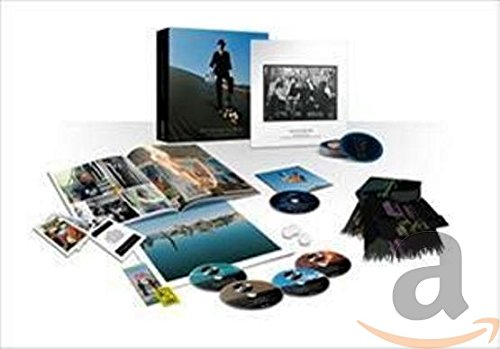
The Wish You Were Here – Immersion Box Set includes the new stereo digital remaster (2011) by James Guthrie on CD, an unreleased 5.1 Surround Mix (2009) by James Guthrie on DVD and Blu-ray, a Quad Mix (which had been released only on vinyl LP and 8-track tape) on DVD, as well as the original stereo mix (1975) on DVD and Blu-ray
Pink Floyd
David Gilmour – vocals, guitars, lap steel guitar, EMS Synthi AKS, tape effects, additional bass
Following up a hit record is no mean feat for any band, and even under the best of circumstances, Pink Floyd might have found it all but impossible to come back from the massive success of Dark Side of the Moon.
Unfortunately, when the band returned to the studio in January 1975, conditions were far from favorable in the band for a variety of reasons — not the least of which was the fact that, as they adjusted to life after a worldwide smash record, the members of the band found themselves more disoriented than fulfilled. Compounding the problem was a growing disconnection between bassist Roger Waters and the rest of Pink Floyd, particularly guitarist David Gilmour.
“We were all having to assess what we were in this business for,” Gilmour said in the 2012 documentary The Story of Wish You Were Here. “Whether we were artists or businessmen. Having achieved the sort of success and money out of it all, it could fulfill anyone’s wildest teenage dreams, why we would still continue to want to do it? Roger has said he thinks we may have been finished at that point, and he may have been right.”
It also didn’t help that, as drummer Nick Mason said in a separate interview filmed for the movie, the band didn’t exactly have a ton of material stored up for their next album. After spending years rotating through the industry’s tour-and-record cycle, they hunkered down on their Dark Side follow-up basically bereft of material — and some of the songs they had written ended up being thrown out of the running order.
The songs in question, “Raving and Drooling” and “You Gotta Be Crazy,” were excised from the album after a fight between Waters and Gilmour, prompted because Waters felt the songs they had didn’t hold together as a cohesive whole. In his view, it was better to expand one particular track — titled “Shine On You Crazy Diamond” — into a bookend that essentially enveloped the rest of the record. As Waters later revealed, the piece was largely inspired by his heartbreak over the self-imposed exile of the band’s founding guitarist and first leader, Syd Barrett.
“I’ve never read an intelligent piece on Syd Barrett in any magazine, never,” Waters is quoted as saying in Mark Blake’s book Comfortably Numb: The Inside Story of Pink Floyd. “I wrote and rewrote and rewrote and rewrote that lyric because I wanted it to be as close as possible to what I felt. There’s a truthful feeling in that piece. That sort of indefinable, inevitable melancholy about the disappearance of Syd. He’s withdrawn so far away that he’s no longer there.”
Waters’ feelings regarding Barrett’s absence could have been applied, to some degree, to the rest of Pink Floyd. “No one was really looking anyone in the eye,” he complained. “It was all very mechanical.”
“It was disengagement,” concurred Gilmour. “It was not being willing to apply yourself sufficiently. Lots of moments when any one of us might have been much more interested in thinking about what we were doing that weekend […] The concentrated activity was rather diluted, and I’m sure for a very pushing, driving sort of person like Roger, it was more frustrating than it was for anyone else — although it was very frustrating for all of us, I suspect.”
Thus preoccupied by feelings of alienation and disillusionment, the members of the group — primarily pulled along by Waters — cobbled together a set of songs built around absence, starting with the withdrawal of their friend Barrett and spilling over into the creeping disappointment they’d found with one another and in the industry they’d enriched with Dark Side of the Moon. In the midst of the recording, Barrett himself made an unannounced appearance in the studio, looking so different that the members of the band initially failed to recognize him.
Drummer Nick Mason, for one, later remembered Barrett looking like a “large, fat bloke with a shaven head, wearing a decrepit old tan mac and carrying a plastic shopping bag,” while keyboard player Rick Wright recalled a sad denouement to their former leader’s surprise visit: “Syd stood up and said, ‘Right, when do I put the guitar on?’ And, of course, he didn’t have a guitar with him. We said, ‘Sorry, Syd, the guitar’s all done.’”
Such was the band’s disconnect that one song on the album, titled “Have a Cigar,” ultimately ended up being sung by someone outside the lineup. After Waters and Gilmour tried and failed to lend the requisite degree of vocal snark to their sarcastic ode to music business cynicism, they ended up turning to singer songwriter Roy Harper, who was sharing the studio with them and happened to be in the room one day while they struggled to find a solution.
“Roger can write songs but he’s never going to be in the top one hundred as a rock singer,” observed Harper. “He tries hard, he’s a good lad. Anyway, neither of them could get up there. I just stood at the back, leaning against a machine and laughing. I said, ‘I’ll sing it for you,’ and someone said, ‘OK,’ and I said, ‘For a price.
Recording finally wrapped in the summer of 1975, and after settling on a typically evocative cover design from legendary artist Storm Thorgerson, the members of Pink Floyd sent their ninth studio LP — titled Wish You Were Here, after a particularly disaffected Gilmour-Waters cowrite — to their label. Scheduled for release on September. 12th, it immediately became one of the most highly anticipated albums of 1975.
Not that Pink Floyd necessarily acted like a band delivering a major piece of product. In fact, their only concession to the promotion machine was a single syndicated live show, recorded at the Los Angeles Sports Arena in the spring of 1975, which was broadcast in an array of major markets ahead of the tour booked to support Wish You Were Here. The sold-out set, which still included “Raving and Drooling” and “You Gotta Be Crazy,” also featured an extended “Shine On You Crazy Diamond” as well as “Have a Cigar,” “Echoes,” and “Dark Side of the Moon” — as well as an expanding roster of special effects that now included expensive and unpredictable pyrotechnics.
In spite of inevitably mixed reviews, Wish You Were Here went on to top the charts on both sides of the Atlantic, and although it couldn’t hope to match the gargantuan sales of Dark Side of the Moon, it enjoyed substantial success in its own right, selling more than six million copies in the U.S. alone. And while the Floyd machine would continue to churn out product on a regular basis in the near future — starting with 1977′s Animals, which included the jettisoned Wish tracks “”Raving and Drooling” and “You Gotta Be Crazy” the writing was already on the wall for Waters’ eventual departure from the band. As he pointed out in The Inside Story of Pink Floyd, even the biggest sales figures can’t balance out creative dysfunction.
“The dream,” shrugged Waters, “is that when you are successful, when you’re a star, you’ll be fine, everything will go wonderfully well. That’s the dream — and everybody knows it’s an empty one.”
The 1970’s saw a run of albums released by Pink Floyd containing songs whose invention, ambition and creativity continues to dazzle and resonate with a global audience by even today standards. The passage of time has done little to diminish the quality of these songs’ and their capacity to astonish, move and enthral.
As one of rock music’s most successful acts, Pink Floyd have sold more than 200 million albums worldwide. “Dark Side of the Moon” is third on the list of most albums ever sold, with more than 45 million copies; The Wall sold another 30 million to date—both hit Number 1 on the charts. In all, Pink Floyd have released 14 studio albums, three live albums, three box sets, 26 singles, and 10 music videos. Pink Floyd was inducted into the Rock and Roll Hall of Fame in 1996, the UK Music Hall of Fame in 2005, and awarded a Grammy in 1995.
Atom Heart Mother Suite (1970) Atom Heart Mother
Though collaborations between rock bands and orchestras were nothing even in 1970, Floyd’s willfully experimental and typically idiosyncratic approach put them in a field of their own. The title track for their fifth studio album finds Ron Geesin’s bold score for brass, strings and chorus enhancing the surreal and often dream-like quality that so characteristic of this side-long extravaganza.
Echoes (1971) Meddle
With their desire in developing long-form writing well established by 1971, Echoes showcases their refined, consummate grasp of textural detail. From the very first ‘sonar’ ping through to the exultant, radiant climax, via strange alien hinterlands, the piece ripples steadily outwards; a sustained masterclass in controlled tension and triumphant release.
One Of These Days (1971) Meddle
What might otherwise be a nondescript riff is collectively transformed into an elemental howl of rage on this opening track from Meddle. Transposing music concrete techniques onto an unstoppable head-shaking force, torrents of echo-enhanced bass, snarling guitar, propulsive beats and slashing keyboards coalesce into one of most formidable moments in the Pink Floyd canon.
Time (1973) Dark Side Of The Moon
As impressive a piece of musical engineering as the inner workings of the massed clocks which open it. This DarkSide Of The Moon staple sees Gilmour’s impassioned guitar effortlessly falling in slow motion slo-mo into a plangent bed of backing vocals, though it’s Rick Wright’s diffident and unvarnished vocal – ‘hanging on in quiet desperation’ – which deftly steals the show.
Money (1973) Dark Side Of The Moon Floyd’s affection for experimentation pays off as it seamlessly merges found-sound tape loops with quirky time signatures to fashion this unlikely hit. Dick Parry’s shrill, klaxon-like tenor sax adds another surprising dimension to their palette, but it’s Waters‘ barbed lyric and Gilmour’s exquisitely structured soloing that really hits the jackpot.
Shine On You Crazy Diamond Parts 1 – 5 (1975) Wish You Were Here Pink Floyd frequently prove dramatic music needn’t be all about fiery grandstanding, and never more so on this emotive two-part epic that bookends Wish You Were Here. Unfolding at a glacial pace, Waters’ meditative lamentation of Syd Barrett’s tragic arc from brilliance to illness smoulders with a fierce, heartfelt intensity. The emotional weight of the tolling four-note motif ushers in one of Gilmour’s more thoughtful excursions.
Wish You Were Here (1975) Wish You Were Here Pink Floyd’s intimate vulnerability remains startling, even at the height of their fame. On the title track of 1975’s Wish You Were, melancholic recognition that something and someone has been irrevocably lost is tempered by the acceptance that time has moved on. Neatly avoiding any showiness, sentimentality or self-pity, this is undoubtedly Pink Floyd at their most poignant.
Sheep (1977) Animals
Emerging from the cosseted glow of Wright’s electric piano, Pink Floyd go for the jugular with their most caustic cut from Animals. Underpinned by Waters‘ glowering bass, Gilmour’s strafing chords graze and bite through Mason’s driving pulse. As the pensive atmosphere bleeds out into the grotesque, distorted psalm, it’s genuinely chilling.
Comfortably Numb (1979) The Wall
Though Waters’ sombre account of an individual’s slide into personal dislocation and isolation is grim and unflinching, Gilmour’s anthemic solo magically transcends the bleak subject matter. Taking on a life of its own in concert, its sonorous tones rally the spirits, articulating the human need to connect with one another.
Waiting For The Worms (1979) The Wall
The unhinged fascistic whine of Roger Waters’ histrionic demagogue brings 1979’s The Wall hurtling towards its chaotic climax. More unsettling however, are the emollient tones voiced by Gilmour – reasonable on the surface, but beneath their respectable veneer just as vile. Juxtaposing sunny harmonies against darker, grinding riffs, Floyd’s brutal, uncompromising psychodrama remains ominously disconcerting.
Ahead of the release of their much-anticipated box set The Early Years 1965 – 1972, Pink Floyd have shared a video for “Grantchester Meadows,” a fingerpicked ode to the English countryside as penned by Roger Waters for the 1969 album Ummagummaa. Pairing old performance footage with contemporary pastoral scenes, the picturesque visual is the definition of bucolic bliss, not to mention the most perfect start to a misty morning.
This special group performance, taped for the BBC, with acoustic guitars and vocals from Roger Waters and DavidGilmour, plus additional piano from Richard Wright and taped songbirds, successfully evokes a summer’s day in Grantchester, a small village close to Cambridge, England. Grantchester’s famous former residents include the Edwardian poet Rupert Brooke, who moved there and subsequently wrote a poem of homesickness entitled ‘The Old Vicarage, Grantchester’. Taken from ‘The Early Years 1965 – 1972’.
The definitive Early Years box set, released 11th November 2016
27 DISC COLLECTION ON CD/DVD/BLU-RAY INCLUDES:
+ Many hours of rare and unreleased music & video
+ 14 Hours of video includes restored footage
+ original 4.0 Quad mixes / BBC sessions/live recordings
+ rare tracks including more than 20 previously unreleased
+ historic TV performances, live concerts and 3 feature films
+ Remixed 5.1 audio for ‘Live At Pompeii’ footage
+ collectable memorabilia
+100+ photos, most previously unseen
+ early singles + B sides on CD & vinyl
* 7 book-style packages, each with multiple discs. 6 are dedicated to a specific period and include related memorabilia and many unseen photos.
* Box bonus package includes collector’s audio and video. Box includes bonus larger replica memorabilia (posters, flyers, etc.) plus 5 x reissued replica 7″ singles, mastered from the original analogue tapes.
ALSO AVAILABLE ON 11TH NOVEMBER 2016:
+ 2-CD/Download/Streaming set – ‘The Early Years – CRE/ATION 1967-1972’
* The 6 year-specific packages will be made available in early 2017. The bonus package and larger memorabilia is exclusive to this box se
Pink Floyd released their historic LP “Dark Side Of The Moon” on March 10th, 1973. It would go on to become the 3rd biggest album ever with over 45 millions sold to date.
In 2013, The Dark Side of the Moon was selected for preservation in the United States National Recording Registry by the Library of Congress for being deemed “culturally, historically, or aesthetically significant”.
It set new standards for recorded music. Happy 43rd Birthday to . It was the Pink Floyd’s eighth studio album The Dark Side of The Moon It remained in the US charts for 741 discontinuous weeks from 1973 to 1988, longer than any other album in history. With an estimated 45 million copies sold, it is Pink Floyd’s most commercially successful album and one of the best-selling albums worldwide.
No-one in March 1973 could have imagined that an album released in that month would still be thrilling listeners 43 years later, but it’s true.
Pink Floyd, in conjunction with EMI, have undertaken an overhaul of their catalogue, and for the first time, allowed us to see part of their creative process, by compiling a 6-disc box set of ‘Dark Side’ including various multi-channel mixes, much memorabilia and restored screen films from their live show, but, most importantly, a newly-mixed live concert from 1974 and a disc of alternative versions and outtakes.
Generally regarded as Pink Floyd’s masterwork, the qualities of The Dark Side Of The Moon have perhaps been taken for granted in recent years, but a return to it with fresh ears reminds the listener of its strengths. Part of its enduring appeal is the quality of the material, there simply isn’t a bad track on it, with a listening experience greater even than the sum of the parts.
As to its subject matter, Roger Waters said in 2003 that it was “An expression of political, philosophical, humanitarian empathy that was desperate to get out.” He said it was about “all the pressures and difficulties and questions that crop up in one’s life and create anxiety, and the potential you have to solve them or choose the path that you?re going to walk.”
The band initially convened in December 1971 and January 1972 at Decca’s West Hampstead Studios in Broadhurst Gardens, London and then at a warehouse owned by The Rolling Stones at 47 Bermondsey Street, South London. One of the musical elements, to become “Us And Them”, already existed, having begun life as a rejected musical sequence by Richard Wright for Antonioni’s Zabriskie Point. Another, to become Brain Damage, was a piece of Roger Waters‘, created in the writing sessions of the Meddle album in January of that year.
In the pre-Internet age, it wasn’t too commercially suicidal to preview new material before its release, so Floyd were able to knock the album into shape over several months of road work. The first full-length performance was at the Guildhall in Portsmouth, England, on January 21st, 1972, after which almost the entire year was spent with the band performing Dark Side live, interspersed with visits to Abbey Road studios from May onwards to work on individual songs.
With Alan Parsons engineering, the first version of the Dark Side album was mixed in December 1972. On the box set, check out the first mix on CD 6 of The Dark Side Of The Moon, which is quite revealing about the gestation of the final version. Speak To Me as a track was a late addition, the album originally starting only with a backwards piano chord leading straight into Breathe (In The Air). The most obvious change is to The Great Gig In The Sky, which, before the addition of Clare Torry’s vocal performance in January 1973, was comprised mainly of Richard Wright’s organ accompanied by, in concert, taped religious incantations and in the first mix, voices of the Apollo 17 space mission. At the time, it was known as The Mortality Sequence or The Religious Sequence. It shows that all the band’s subsequent decisions on the album were creatively correct, including even the completely redone Travel Sequence, which was replaced by On The Run.
As much of a revelation as the newly-released material and the works in progress is the 1974 live album, compiled from performances at London’s Wembley Empire Pool in November 1974. As opposed to the then-live radio broadcast, mixed by the BBC in real time with an unflattering balance, this sourced the original multitrack tapes and, as mixed by Floyd engineers Andy Jackson and Damon Iddins, shows Floyd at the top of their game, rhythmic, swinging, emotive and punchy. If you can’t afford the box, it’s available as a 2-CD Experience edition alongside the remastered original album.
Perhaps you don’t need a reminder that the album is one of the biggest-selling albums of all time, but it’s not too late to rediscover it. I think you’ll agree that it’s also one of the best.
Of anyone in the band, David Gilmour had the most trepidation about creating an individual experimental piece for the studio disc of Ummagumma. And he ended up with the best thing on the project. The three-part suite repurposes an existing tune for the rustic opener, but Gilmour’s guitar steamrolls through the middle portion before landing on a George Harrison-ish bit of space-twang for the climax.
The official video for ‘Careful With That Axe, Eugene’ by Pink Floyd recorded live in Brighton and originally released on the ‘Ummagumma’ album.
From 1969, Ummagumma was the band’s first double album and has one of their most iconic cover images. Ummagumma is an eclectic mix of both live and studio recordings.
The album was re-mastered in 2011. Go to http://www.whypinkfloyd.com for more details. UMMAGUMMA, the 1969 album from Pink Floyd celebrates its 46th anniversary today.
Using a unique concept, the first disc is a live album taken from their set list at the time and the second contains solo compositions by each band member. A double album by the English progressive rock band Pink Floyd. It was released on 25 October 1969, through Harvest Records. The artwork was designed by regular Floyd collaborators Hipgnosis and features a number of pictures of the band combined to give a Droste effect.
Although the album was well received at the time of release, and was a top five hit in the UK album charts, it has since been looked upon unfavourably by the band, who have expressed negative opinions about it in interviews. Nevertheless, the album has been reissued on CD several times, along with the rest of their catalogue.
Although the sleeve notes say that the live material was recorded in June 1969, the live album of Ummagumma was recorded live at Mothers Club, Erdington Birmingham on 27th April 1969 and the following week at Manchester College of Commerce on 2nd May of the same year as part of The Man and The Journey Tour. The band had also recorded a live version of “Interstellar Overdrive” (from The Piper at the Gates of Dawn) intended for placement on side one of the live album, and “The Embryo”, which was recorded in the studio before it was decided that the band members each come up with their own material.
The studio album came as a result of Richard Wright wanting to make “real music”, where each of the four group members (in order: Wright, Roger Waters, David Gilmour and Nick Mason) had half an LP side each to create a solo work without involvement from the others.Wright’s contribution, “Sysyphus”, was named after a character in Greek mythology, usually spelled “Sisyphus”, and contained a combination of various keyboards, including piano and mellotron. Although initially enthusiastic about making a solo contribution, Wright later described it as “pretentious”. Waters’ “Several Species of Small Furry Animals Gathered Together in a Cave and Grooving with a Pict” contained a variety of vocal and percussion effects treated at various speeds, both forwards and backwards, and was influenced by Ron Geesin, who would later collaborate with both Waters and Pink Floyd. Waters’ other contribution Grantchester Meadows was a more pastoral acoustic offering and was usually played as an opening to concerts over 1969. Gilmour has since stated he was apprehensive about creating a solo work, and admits he “went into a studio and started waffling about, tacking bits and pieces together”,although part one of “The Narrow Way” had already been performed as “Baby Blue Shuffle in D Major” in a BBC radio session in December 1968. Gilmour said he “just bullshitted” through the piece. He asked Waters to write some lyrics for his compositions, but he refused to do so. Mason’s “The Grand Vizier’s Garden Party” featured his then wife, Lindy, playing flute, and Mason playing a seven-minute drum solo
The cover artwork shows a Droste effect featuring the group, with a picture hanging on the wall showing the same scene, except that the band members have switched positions.The cover of the original LP varies between the British, American/Canadian and Australian releases. The British version has the album Gigi leaning against the wall immediately above the “Pink Floyd” letters. At a talk given at Borders bookstore in Cambridge on 1st November 2008, as part of the “City Wakes” project, Storm Thorgerson explained that the album was introduced as a red herring to provoke debate, and that it has no intended meaning. On most copies of American and Canadian editions, the Gigi cover is airbrushed to a plain white sleeve, apparently because of copyright concerns; however, the earliest American copies do show the Gigi cover, and it was restored for the American remastered CD edition. On the Australian edition, the Gigi cover is completely airbrushed, not even leaving a white square behind. The house used as the location for the front cover of the album is located in Great Shelford, near Cambridge.
On the rear cover, roadies Alan Styles (who also appears in “Alan’s Psychedelic Breakfast”) and Peter Watts were shown with the band’s equipment laid out on a runway at Biggin Hill Airport. This concept was proposed by Mason, with the intention of replicating the “exploded” drawings of military aircraft and their payloads, which were popular at the time.
Song titles on the back are laid out slightly differently in British vs. North American editions; the most important difference being the inclusion of subtitles for the four sections of “A Saucerful of Secrets”. These subtitles only appeared on American and Canadian editions of this album, but not on the British edition; nor did they appear on original pressings of A Saucerful of Secrets.
The inner gatefold art shows separate black-and-white photos of the band members. Gilmour is seen standing in front of the Elfin Oak. Original vinyl editions showed Waters with his first wife, Judy Trim, but she has been cropped out of the picture on most CD editions (with the original photo’s caption “Roger Waters (and Jude)” accordingly changed to just “Roger Waters”). The uncropped picture was restored for the album’s inclusion in the box set
Pink Floyd David Gilmour – lead guitar, vocals, all instruments and vocals on “The Narrow Way” Nick Mason – percussion, all instruments (except flutes) on “The Grand Vizier’s Garden Party” Roger Waters – bass guitar, vocals, all instruments and vocals on “Grantchester Meadows” and all instruments on “Several Species of Small Furry Animals Gathered Together in a Cave and Grooving with a Pict” Richard Wright – organ, keyboards, vocals, all instruments and vocals on “Sysyphus”




 The Fat Angel Sings