Neil Young isn’t releasing his 10-disc collection Archives Volume 2: 1972-1976 until November 22nd, but paid subscribers of The Neil Young Archives website now have access to the previously unreleased song “Come Along and Say You Will.” The tune was recorded at Young’s Broken Arrow Ranch on December 15th, 1972 with drummer Kenny Buttrey, bassist Tim Drummond, and pedal steel guitarist Ben Keith.
Young’s group of musicians were known as The Stray Gators, and also played with on the faultless Harvest in 1972 and the Time Fades Away record from 1973.
‘Come Along and Say You Will’ begins with the pounding lyric “come along and say you will / be the one to change the meaning / of the writing on the wall.” Young later goes on to sing, “I’ll never understand / why walk around a sinner / with a nail through your hand.”
They were weeks away from launching an extensive North American tour where Young would debut several new songs that ultimately wound up on the 1973 live album “Time Fades Away”. “Come Along and Say You Will” didn’t make the cut for Time Fades Away, but it was played at least 11 times during the first month of the tour and live tapes have circulated for years. Nobody has ever heard the studio version prior to this. It’s one of many unheard songs that will appear on Archives Volume 2.
The package begins with material the Stray Gators cut in late 1972 and continues through the Time Fades Away tour, the Tonight’s the Night sessions and tour, the On theBeach and Zuma sessions, and songs he wrote for the Stills-Young Band LP before wrapping up with his 1976 world tour with Crazy Horse.
On November 6th, Young is releasing the live album and movie “Return to Greendale”. Also in the pipeline is a 50th-anniversary edition of After the Gold Rush, official bootlegs taped during a 1970 show at Carnegie Hall and a 1974 gig at the Bottom Line, a 1990 Crazy Horse club gig he’s calling Way Down in the Rust Bucket, and a 2019 European show with Crazy Horse he’s dubbed Noise and Flowers.
Exact dates for most of these releases have yet to be announced, but he hopes they will come at some point in 2021. Young hasn’t played to a live audience since Farm Aid on September 21st, 2019. Earlier this year, he announced plans to bring Crazy Horse to North American arenas. The pandemic forced him to indefinitely delay those plans and he’s largely been holed up at the Colorado home he shares with wife and actress Daryl Hannah. She’s filmed a series of Fireside Sessions acoustic shows on her iPad that show Young playing a series of tunes from throughout his career. The last one was released on July 1st and focused on political songs. It was later released as an EP titled The Times.
Neil Young has announced plans to remove all Facebook and Google logins from his Neil Young Archives website.
This announcement is nothing terribly new, as the 74-year-old politically-minded rocker has railed against Facebook since the aftermath of the 2016 election. He delayed initial plans to purge Facebook logins back in March on account of the pandemic, stating that “asking people to make a transition now, would just add another complication to their lives and tax our customer support.” However the reasons for his stance against Google are much less clear.
In an email sent out to Neil Young Archives subscribers, the singer-songwriter stated that the transition will be an easy one that will require “just a few extra clicks.” After that, users’ accounts will be switched to their email address and a password for the login. After thanking his subscribers for bearing with this change, Young sites the Neil Young Archives Times-Contrarian motto, “Quality whether you want it or not!”. As for why Young is making this change, the email directs users to a post on NYA from February 21st, 2020. The post states that while the estimated cost of purging Facebook and Google logins from the site is roughly $20,000, the price is worth it.
“Facebook knowingly allows untruths and lies in its political ads to circulate on the platform, while bots sow discord among users,” the post reads in part. “Sowing dissent and chaos in our country via political disinformation is something we cannot condone. Simply put, Facebook is screwing with our election.”
Yet the post, titled “After Facebook”, lays out what the goals of the Neil Young Archive are, and they seem eerily similar to that of the social media platform.
“NYA strives to be a place where music lovers can get all of my music at its highest quality, while keeping up on news and views from around the world that we wish to share.”
See the email from Neil Young Archives, obtained in part by Variety, as well as the original post announcing the reason for the split from Google and Facebook.
Alongside his official music video for “Lookin’ For A Leader 2020,”Neil Young has announced a new EP dubbed, The Times.
“I invite the President to play this song at his next rally,” Young wrote. “A song about the feelings many of us have about America today, it’s part of the The Times, and EP coming soon from Reprise Records – my home since 1968.” The original version of “Lookin’ For A Leader” appeared on Young’s 2006 album Living With War. According to a press release, “this timely 2020 update targets the problems we currently face.”
Young also recently announced that he has begun the process of removing social media log-ins from his Neil Young Archives website, now only allowing fans access with an email address.
David Crosby has the distinction of being a founding member of both the Byrds and Crosby, Stills & Nash who has survived drug busts in Texas, a hit-and-run driving accident, possession of a concealed pistol and drug paraphernalia, an arrest for driving into a fence in Marin County, a transplanted liver, the ire of Graham Nash, and fathering two children by Melissa Etheridge. He is a bit of a lightning rod to be sure. Love him or hate him, Crosby, now 78 years old, has had a stellar career. A singer-songwriter and guitarist, he wrote or co-wrote classics like “Wooden Ships,”“Eight Miles High,’ “Deja Vu,” “Guinnevere,” and “Lady Friend,” among many others. In addition to performing on the Byrds first five albums (their best in my opinion), he also played on eight Crosby Stills & Nash albums including three with Neil Young), made six solo albums, and collaborated with Graham Nash on five long players.
The man is prolific. He has been inducted into the Rock and Roll Hall of Fame in the Byrds and Crosby, Stills & Nash
David Crosby: “Remember My Name” is a 2019 documentary about the musician David Crosby. It was directed by A.J. Eaton and produced by Cameron Crowe. The title is a play on the title of Crosby’s 1971 album If I Could Only Remember My Name. The film had its festival debut at the 2019 Sundance Film Festival. It is distributed by Sony Pictures Classics.
As the movie opens, Crosby is telling a story from back in the day when they were playing a gig in Chicago. Let’s just say, it involves drugs (of course!). Along the way we learn that he is now 76 (when this was filmed in 2017), and that he regrets having wasted so much time “smashed on drugs” (Crosby’s words). He is getting ready for another tour (as a solo artist). “I love singing but I hate leaving (home)”, Crosby confesses. “Me no music? Never. I NEED to tour.” At this point we are less than 10 min. into the movie.
Couple of comments: even though the film is technically directed by a certain A.J. Eaton, Cameron Crowe’s fingers are all over this, including as producer and also having interviewed Crosby back in 1974, when he was all of 17 (that interview comes up in this documentary). The basic premise of the film is as simple as it is revealing: let the man talk, and add archive clips where there are available (easier said than done). Crosby turns out to be a master story teller, and he does not mince words, including about himself. “I have been selfish and I’ve hurt a lot of people”, Crosby admits. Byrds band mate Roger McGuinn puts it this way: “Insufferable”, wow. Along the way, we get treated to an outstanding amount of audio and video clips of his music. Quite a collection when you line it up like that. I enjoyed this documentary overall, and feel it is a nice companion to the “Echo in the Canyon” documentary from earlier this year.
“David Crosby: Remember My Name” premiered to immediate acclaim at this year’s Sundance film festival. If you are a fan of David Crosby or interested in rock music history, I’d readily suggest you check this out, be it in the theater, on VOD, or eventually on DVD/Blu-ray, and draw your own conclusion.
Meet David Crosby in this portrait of a man with everything but an easy retirement on his mind.
After a Crazy Horse barn tour was cancelled owing to coronavirus touring restrictions, Neil Young devised other ways to perform live music for the masses. Choosing to keep on streaming in the free world, Young envisaged the Fireside Sessions: a “down-home production, a few songs, a little time together” beamed live from his Colorado home. For the inaugural six-song acoustic set broadcast on March 19th 2020, Young pulled a couple of mouth-watering cuts from his sprawling catalogue. There was “Love/Art Blues”, debuted during CSNY’s 1974 tour, and the first solo outing for On The Beach’s “Vampire Blues” since 1974. Young closed the set with another deep cut: “Little Wing”, revived after an absence of over 40 years. A song about a benevolent bird that flies into town each summer, “Little Wing’s” inclusion felt especially timely. Although it appeared on 1980’s Hawks & Doves, its origins lie much further back, on “Homegrown” – one of Young’s legendary ‘lost’ albums, which finally arrives, 45 years late, in May.
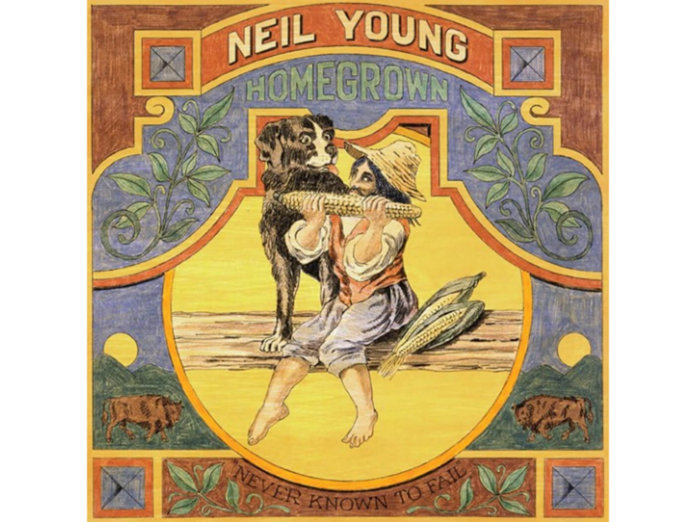
Intended as a follow-up to On The Beach, Homegrown was pulled – apparently at the suggestion of The Band’s Rick Danko – in favour of a rehabilitated Tonight’s The Night. Young’s official reason for cancelling Homegrown was that its downbeat mood depressed him. Describing it now as “the sad side of a love affair”, at the time Young may have also felt uneasy about the number of songs about Carrie Snodgress, from whom he separated shortly before recording began. Five of Homegrown’s 12 songs later made it onto American Stars ’N Bars, Decade, Hawks & Doves and Ragged Glory. Among the other seven, several have only been played live a handful of times over the years, while three have never been heard until now.
Superficially, Homegrown resembles Hitchhiker – another ‘lost’ album from Young’s golden era that was finally released in 2017. But while Hitchhiker was a focused snapshot of Young’s creative process, recorded during one night in August 1976, Homegrown had more digressive beginnings. Sessions ran between June 1974 and January 1975 in Los Angeles, at Young’s Broken Arrow Ranch and even in England. The bulk of the work, though, took place at Nashville’s Quadrafonic Sound, where Young recorded Harvest along with producer Elliot Mazer. Reunited with Mazer and Harvest alumni Ben Keith on pedal steel and Tim Drummond on bass, Young also called on future International Harvester drummer Karl Himmel, Hawks/Band pianist Stan Szelest, Emmylou Harris, Levon Helm and Robbie Robertson.
More than just a trove of buried treasure from Young’s fecund ’70s – Homegrown is the missing chapter in his fabled Ditch Trilogy. Ben Keith’s exquisite pedal steel and Tim Drummond’s agile basslines provide a musical through-line; meanwhile, as Young picks through the debris of his relationship with Snodgress, Homegrown displays both the introspective qualities of On The Beach and the vérité nakedness of Tonight’s The Night.
Opener “Separate Ways” begins halfway through a chord, as if the band had started playing a split second before Mazer hit ‘record’. Sparsely arranged for a bare-bones ensemble, Young reflects on his split from Snodgress: “Though we go our separate ways/Lookin’ for better days/Sharin’ our little boy/Who grew from joy back then.” Keith’s pedal steel weeps sympathetically behind him as Levon Helm plays a slow, measured beat. The mood deepens with “Try”, a tribute to Snodgress’s mother, who committed suicide shortly after the couple separated. Here, Young incorporates some of her favourite expressions, including “Shit, Mary, I can’t dance”. Emmylou Harris harmonises on the chorus while Helm’s discreet fills and a lovely, rolling piano from the great Stan Szelest lift the final third of the song. The rainy days continue with the sorrowful “Mexico” – the first of three travelogues – where Young sits alone at the piano, asking, “Why is it so hard to hang on to your love?”
“Love Is A Rose” – familiar from Decade – opens with a supple bass run from Tim Drummond and a blast of Young’s harmonica before settling into the kind of palatable country-folk familiar from Harvest. Then it’s into “Homegrown” itself. Essentially a goofy jam about the pleasures of the herb, the version here is breezier and funkier than the Crazy Horse re-recording on American Stars ’N Bars. It’s welcome light relief before Young drifts back into his cursed fog. On the unreleased spoken-word piece “Florida”, he relates a macabre yarn about a glider crashing into a 15-storey building in the city centre. On this, Young is accompanied by what could either be a saw, a detuned violin or perhaps someone running a wet finger around the rim of a glass – or, more likely, all three.
After the strangeness of “Florida”, “Kansas” is a more conventional acoustic piece. The narrator wakes up to find a companion lying next to him in bed – “Although I’m not so sure if I even know your name.” With its world-weary delivery, “Kansas” resembles one of the more downcast moments from On The Beach, the harmonica motif seeming to reference “Ambulance Blues”. Thematically, it is another meditation on the hollowness of stardom – this transient romantic assignation takes place “In my bungalow with stucco/That the glory and success bought.” With the album’s temperament growing unstable, Young withdraws into “We Don’t Smoke It Anymore” – a strung-out blues vamp that wouldn’t sound out of place on Tonight’s The Night.
Sometime in September 1974, shortly before CSNY played Wembley Stadium, Young and Robbie Robertson recorded a song called “White Line”. You’ll know the electrified version from Ragged Glory, of course; but here, in a simple acoustic arrangement, it casts a note of wary optimism: “I’ve been down but I’m coming back up again.” The guitar interplay between Young and Robertson is warm, complementary – you might wish they’d collaborated musically more often. Meanwhile, whatever positive emotions Young had experienced on “White Line” have evaporated by the time the churning riffs of “Vacancy” start up. This is Young at his most fractious. “I look in your eyes and I don’t know what’s there,” he sings in a sarcastic jeer. “You poison me with that long vacant stare.” Is he addressing Snodgress directly? Or perhaps he’s expressing a broader disdain for the industry sharks and hangers-on around him?
The album winds down with two more acoustic songs: “Little Wing” and “Star Of Bethlehem”. If you squint hard enough, it’s possible to read the former as an allegory about Snodgress – “LittleWing, don’t fly away” – but “Star Of Bethlehem” rages with acrimony and betrayal. A crepuscular ballad, graced with elegant harmonies from Harris, it finds Young at his most merciless: “All your dreams and your lovers won’t protect you/They’re only passing through you in the end/They’ll leave you stripped of all that they can get to/And wait for you to co As with much of Homegrown, a heaviness crashes through the mellow musical vibes.
Had Homegrown been released in June 1975, as intended, would Young’s career be any different? Does this previously missing instalment of the Ditch Trilogy (now Quartet?) alter our perceptions of the releases around it? If Time Fades Away, On The Beach and Tonight’s The Night address the tragedies of Young’s recent past and his disillusionment with the limousine lifestyle Harvest bought him, Homegrown telescopes in on troubles at home – making it the most human of this run of albums. Young’s writing is unashamedly autobiographical in ways it has seldom been since (other unreleased songs from this period like “Frozen Man”, “Homefires” and “Love/Art Blues” further illuminate Young’s inner character). He is bereft, injured, cold – but he also experiences a certain karmic resignation. As he sings on “Separate Ways”: “Me for me, you for you/Happiness is never through/It’s only a change of plan/And that is nothing new.” There will always be heartbreak and loss. It’s the way things are and the way they will always be. It’s Young’s Chinatown moment.
Neil Young puts it best:
“This album is the unheard bridge between Harvest and Comes a Time”.
Recorded between June 1974 and January 1975, Homegrown was intended to come out in 1975 before Neil cancelled the release. The album has remained unreleased until now, achieving a legendary status among Neil Young fans in the process.
The album is made up of twelve Neil Young songs, of which seven are previously unreleased – “Separate Ways,”“Try,” “Mexico,” “Kansas,” “We Don’t Smoke It No More,” “Vacancy” and “Florida” (a spoken word narration). Also included are the first recordings of “Love Is A Rose,” “Homegrown,” “White Line”, “Little Wing,” and “Star Of Bethlehem” – different versions of which would all later appear on other Neil Young albums.
Neil plays solo on some tracks (guitar, piano and harmonica), and is joined by a band of friends on other tracks, including Levon Helm, Ben Keith, Karl T Himmel, Tim Drummond, Emmylou Harris and Robbie Robertson.
Recorded in analogue, and mastered from the original master tapes, this long-lost album is a wonderful addition to Neil’s incomparable catalog.
Neil Young has released “Vacancy,” the latest offering from Homegrown, the previously shelved 1975 album he’s finally releasing on June 19th.
One of the seven unreleased tracks on the album, “Vacancy” opens with a churning guitar riff, as Young sings “Who are you?/Where are you going to?” He then addresses an old lover: “I look in your eyes and I don’t know what’s there/You poison me with that long, vacant stare.” One of the seven unreleased tracks on the album, “Vacancy” opens with a churning guitar riff, as Young sings “Who are you?/Where are you going to?” He then addresses an old lover: “I look in your eyes and I don’t know what’s there/You poison me with that long, vacant stare.”
Recorded at Young’s Broken Arrow Ranch Studio in January 1975, the track features Stan Szelest on Wurlitzer organ, Ben Keith on lap slide guitar, bassist Tim Drummond and Karl T. Himmel on drums.
“Vacancy” follows the single “Try,” another previously unreleased track he performed on tour between 2007 and 2008. He recently performed the title track — released off 1977’s American Stars ‘N Bars — during his home concert series in quarantine.
Young, who recently announced a Bootleg Series, dropped a 2019 solo acoustic rendition of “Southern Man” in the wake of mass protests over the police killing of George Floyd. “Have hope,” he wrote in an op-ed on his website on Monday. “I feel a change. … We know black lives matter. My heart goes out to all our black families affected, so that’s all the black families through American history. I feel like we are turning a corner. All Together, all colours on the street. We know our mission is the right one for America and for mankind.”
Neil Young’s “Vacancy” from ‘Homegrown’ available on June 19th.
At the core of Neil Young’s catalogue is the belief that art has the power to transform the world around us: whether he is speaking truth to power, highlighting the injustices he sees in our society, or using his platform to elevate the voices of those who are not as fortunate as himself, Young has come to signify a certain kind of relentless optimism in the face of a very harsh reality.
Right now, we sorely need this sort of optimism. The Trump administration’s commitment to denigrating, brutalizing, and criminalizing immigrants has reached a fever pitch with the family separation policy. Although the practice of family separation has reportedly been halted, there are still thousands of children that have been lost by DHA.
TFN is excited today to premiere this new video from New Hampshire’s Rick Rude. The track is their version of Neil Young’s “Everybody Knows This Is Nowhere,” which can be found on the new release “Look Out For My Love: A Neil Young Covers Album to Benefit RAICES”. Their track is a highlight from the compilation and should also get you geared up to hear some more new music from the band!
The compilation features 18 tracks from different indie musicians, that not only includes Rick Rude but Lung, Halfsour and Adult Mom (which contributed an excellent version of “Harvest Moon.”) All funds raised by this compilation will be donated to RAICES which is a nonprofit that provides free and low-cost legal and social services for immigrants.
Neil Young’s personal life was in free fall by 1974. His wife, actress Carrie Snodgrass, was gone for good, and attempts to rekindle a working relationship with CSNY only resulted in the aborted Human Highway project and the goodwill-shattering “Doom Tour.” It was during this turbulent time that he composed songs for a new collection to be named “Homegrown”.
“It was intense, like trying to make a record in the middle of 42nd Street, or Vietnam,” says producer Elliot Mazer “Here’s a guy going through hell, and this is like a fuckin’ catharsis for him.” Titles like “Frozen Man,” “Separate Ways” and “Love-Art Blues” paint a stark portrait of a lonely and heartbroken man. Those who heard the completed album insisted that it was as strong as Young’s breakthrough smash, Harvest. Cover art was printed, and label executives braced themselves for a million seller.
And then Young changed his mind. He had assembled friends, including the Band’s Rick Danko, at L.A.’s Chateau Marmont to get an opinion on his latest work. As a tape of “Homegrown” came to an end, a mix of the dark, gritty and unreleased “Tonight’s the Night” came on the stereo by chance.
Danko preferred the raw power of “Tonight’s the Night” to the comparatively delicate “Homegrown”. Disregarding advice from his label, Young released it instead that June. “[Homegrown] might be more what people would rather hear from me now, but it was just a very down album,” he told Rolling Stone at the time. “It was a little too personal. It scared me.
Neil Young fans have been clamouring for the release of Homegrown, the lost album that was nearly released in 1975 and most recently slated for the still-yet-to-happen Record Store Day 2020. Now, it’s been announced that the album described by Neil as “the missing link between “Harvest, Comes” “A Time, Old Ways” and “Harvest Moon” will finally reach fans on June 19th.
“Homegrown” is all analouge! The purest sound,” Young wrote in a post on his Neil Young Archives site. “Hear the vinyl. Get a nice phonograph player. This is the record to do that on! My first ever narration with Ben ‘Longgrain’ Keith and live sound effects. Some beautiful music and fun rockin’ songs as well. This is the one that got away. I am stoked to share this with you.”
While much of the industry is in flux due to the COVID-19 outbreak, Neil hasn’t stopped moving forward with his Archives projects. Also on the radar is a audiovisual release of a Greendale stage tour performance from Toronto in September 2003 entitled Return to Greendale. That one is currently set for release on double vinyl in July.
The Neil Young Archives team has also unearthed pro-shot video and multitrack audio tapes of Neil Young and Crazy Horse’s celebrated November 1990 show at The Catalyst. Previews have been posted sporadically in the Hearse Theatre section of the Archives website, whetting the appetite for the October release. “I think this has to be one of my all-time favorite Crazy Horse performances!” Neil wrote last year. “It’s hard to believe this did not come out a long time ago! .
Neil will also look back to a solo show from January 1971 with Young Shakespeare, the show came three days after his Massey Hall concert and stands as a career “high water mark,” according to producer John Hanlon. Currently slated for November 27, Young Shakespeare will include both audio and video content.
If that weren’t enough, it seems that the long-awaited box set Neil Young Archives, Volume 2 will finally arrive on August 21st should all go to plan. Neil has revealed it will be a 10-CD set covering the prolific period from 1972-1976 and will include Odeon Budokan, a live album and concert film from the Zuma tour’s stops in London and Japan.
Finally, Neil has been in touch with Graham Nash about compiling a 50th Anniversary Edition of Crosby, Stills, Nash and Young’s “Deja Vu” album which would likely appear by the end of the year.Looking ahead to 2021, Young has announced that he’s also been working on an album called Road of Plentywhich spotlights his work with Crazy Horse during the late ’80s. The album will feature recordings from the group’s 1986 tour, plus “some amazing music” recorded during the rehearsals for Saturday Night Live in 1989.
This is the first of 5 Archives releases Neil Young has announced for this year. It’s confirmation gives me hope that the other 4 will happen as scheduled. The release schedule is 31st July-“Back To Greendale Live” album plus film of a 2003 Toronto concert of the Greendale album with Crazy Horse complete with actors and stage settings. He has been previewing a song a week on the Archives site
21st #August- Archives Volume 2.The big one-10 cds plus a DVD covering the years 1973 to 1976. Includes the already released Tuscaloosa, Roxy and Songs For Judy..The only other confirmed disc is a live album from the Zuma tour taken from shows at the Hammersmith and Budokan which is also the basis of the DVD. The Homegrown tracks are likely to be included but mixed in with other recordings rather than as a stand alone album.
16th October-Down In The Rust Bucket Live album plus film of a Crazy Horse show at a small club called the Catalyst at the outset of the Ragged Glory tour. Again he has been showing a song a week on the web site.
27th November-Young Shakespeare Live album plus film of a solo show done within a few days of the Massey Hall concert that was in Volume 1. Yet again previews have been on site.
There was some mention this would be part of an expanded After The Gold Rush but lately it is being referred to as a stand alone.
This Will be a great year to be a Neil fan if all this happens. Another good reason to stay safe.
Neil Young has announced that he’s working on a new archival album based around material from the mid-to-late 1980s. The album will consist of music made with his band Crazy Horse during a 1986 US tour, combined with tracks recorded in 1989 with the band he would go on to perform with on Saturday Night Live.
The title track is an early version of what would go on to be released as the song ‘Eldorado’ on Young’s 1989 LP ‘Freedom’. In a post on his website reflecting on the period, Young said that he first “tried out” the song during a private reunion with his 1960s group Buffalo Springfield. “It was my fault that we didn’t get together at the time and have a reunion, tour and album,” Young reflected in a post on his website.
He said that he and Crazy Horse have a “monster take” of the track, recorded at a show in Minneapolis in October 1986 which will be included on the album. “How this song escaped is hard for me to believe,” he said. Three years afterwards, Young and a band consisting of Crazy Horse guitarist Frank “Poncho” Sampedro, drummer Steve Jordan and bassist Charley Drayton “recorded some amazing music” while rehearsing for their SNL appearance, “all of which” will appear on ‘Road Of Plenty’.
“Niko [Bolas, producer] and I have been working on this project for a while and I think it will be a highlight of 2021,” Young said. A specific date next year for the album’s release is yet to be announced, with a number of archival Neil Young releases on their way in the intervening months.
His legendary ‘lost’ LP ‘Homegrown’, shelved in 1975, is finally coming out after 45 years on June 19th, followed by the release of a 2003 live performance ‘Return To Greendale’ on July 17th, a 1970s-spanning compilation ‘The Neil Young Archives Volume 2’ on August 21st, a 1990 Crazy Horse club gig ‘Rust Bucket’ on October 16th and a 1971 solo acoustic show ‘Young Shakespeare on November 27th.
Meanwhile the veteran singer-songwriter recently shared a new, re-recorded version of his 2019 track ‘Shut It Down’, prompted by fans “reaching out [and] expressing the elevated poignancy the song has come to represent during this pandemic”.
Neil Young and his Performance Series releases from the Neil Young Archives is “Bluenote Café” released on November 13th via Reprise Records. The album collects various performances captured during Neil’s 1988 tour.
The album is volume eleven in Young’s Archives Performance Series, and features performances from Young’s 1987–88 American tours with his then-backing band, The Bluenotes (renamed here as Bluenote Café ), with whom he recorded his seventeenth studio album, “This Note’s for You”.
Aside from live versions of “This Note’s for You” songs, the album features a number of songs that weren’t released at the time; “Welcome to the Big Room”, “Hello Lonely Woman”, “Bad News Comes to Town”, “Crime of the Heart” and “Doghouse” make their first appearances on any official Neil Young release (“Doghouse” was covered in 2011 by Young’s then-wife Pegi on her album “Bracing for Impact”. Two of the album’s tracks, “This Note’s for You” and “Ain’t It the Truth,” previously appeared on the compilation album “Lucky Thirteen”. The album received positive reviews,”generally favourable reviews”. Chris Gerard of PopMatters gave the album nine stars out of ten, stating: “Bluenote Café” is essential Neil Young, and further evidence that Young’s 80s work has more value than many would expect.
This superb live 2-CD, 4-vinyl LP set documents one of Young’s most funky and heartfelt periods and features seven unreleased songs: and a searing 19+ minute version of the immortal “Tonight’s the Night” from The Pier in New York City.
The Bluenote Café Band:
Neil Young – guitar & vocals
Rick Rosas – bass,
Chad Cromwell – drums
Frank Sampedro – keyboards
Steve Lawrence – lead tenor saxophone
Ben Keith – alto saxophone
Larry Cragg – baritone saxophone
Claude Cailliet – trombone
Tom Bray – trumpet
John Fumo – trumpet
Billy Talbot – bass
Ralph Molina – drums
Neil Young issued an apology for the delay in releasing the 1975 album “Homegrown”, calling it “the one that got away.” He’s finally putting out the LP this year. Neil Young has updated the timeline at Neil Young Archives to include dates for five upcoming archive titles scheduled for release during 2020.
First on the slate is shelved 1975 acoustic album Homegrown, which was given a release date of April 18th the original date for Record Store Day – despite the album disappearing from the official RSD list over the weekend. Just before its original scheduled release date, he decided to issue Tonight’s the Night instead. He later described Homegrown as “a very down album” and “the unheard bridge between “Harvest” and “Comes a Time.” It was recorded during a period when he was having marital problems as well as personal issues with his Crosby, Stills, Nash and Young bandmates.
“I apologize,” Young wrote on his archives website. “This album Homegrown should have been there for you a couple of years after Harvest. It’s the sad side of a love affair. The damage done. The heartache. I just couldn’t listen to it. I wanted to move on. So I kept it to myself, hidden away in the vault, on the shelf, in the back of my mind … but I should have shared it. It’s actually beautiful. That’s why I made it in the first place. Sometimes life hurts. You know what I mean.” an unreleased acoustic album by Neil Young from 1974-1975. Young originally recorded Homegrown at a time his career when new songs were coming to him at an incredible pace, many of them inspired by his painful split with girlfriend Carrie Snodgress.
According to the timeline, it will be followed on June 19th by Return To Greendale the concert film of Young’s 2003/4 Greendale tour; and most excitingly on July 24th by Archives Volume 2, reportedly covering the years 1972-82. It’s thought that it may contain unreleased albums Chrome Dreams and Oceanside/Countryside. The other planned 2020 releases are Rust Bucket (October 16th), a live album and film of a mammoth November 1990 show that Young has called “one of my all-time favourite Crazy Horse performances!”; and Young Shakespeare (November 27th), another live release dating from January 1971, billed as the earliest known film of any Neil Young performance.
He noted that Levon Helm and Emmylou Harris were among the artists who recorded with him and that the album carries “a narration, several acoustic solo songs never even published or heard until this release, and some songs played with a great band of my friends.”
Young said Homegrown would be his first release of 2020, though he didn’t provide a date for its arrival. “This is the one that got away,” he added. “This album, in vinyl, displays the beauty, feeling and depth of music record in the analog domain, before digital. It’s the perfect example of why I can’t forget how good music used to sound.
Neil Young puts it best: “This album is the unheard bridge between Harvest and Comes a Time”.
Recorded between June 1974 and January 1975, Homegrown was intended to come out in 1975 before Neil cancelled the release. The album has remained unreleased until now, achieving a legendary status among Neil Young fans in the process.
The album is made up of twelve Neil Young songs, of which seven are previously unreleased – “Separate Ways,” “Try,” “Mexico,” “Kansas,” We Don’t Smoke It No More,” “Vacancy” and “Florida” (a spoken word narration). Also included are the first recordings of “Love Is A Rose,” “Homegrown,” “White Line.”
“Little Wing,” and “Star Of Bethlehem” – different versions of which would all later appear on other Neil Young albums.
Neil plays solo on some tracks (guitar, piano and harmonica), and is joined by a band of friends on other tracks, including Levon Helm, Ben Keith, Karl T Himmel, Tim Drummond, Emmylou Harris and Robbie Robertson. Recorded in analog, and mastered from the original master tapes, this long-lost album is a wonderful addition to Neil’s incomparable catalogue.






 The Fat Angel Sings