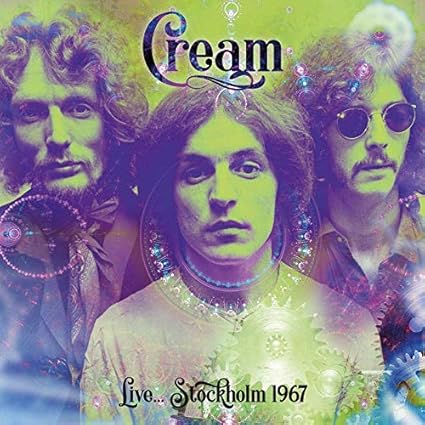
Cream, live at the Konserhuset, Stockholm, Sweden November 14th 1967. Just after the release of Disraeli Gears, Cream embarked on a Scandinavian tour on November 11th 1967, following dates in Denmark and Finland, they reached Sweden on the 14th. This explosive set, broadcast on Sveriges radio, was performed at Stockholm sKonserthuset that night, and captures them at their peak, stretching out on a selection of classics old and new. It s presented in full here, together with background notes and images.
Setlist:
1. Tales Of Brave Ulysses 2. Sunshine Of Your Love 3. Sleepy Time Time 4. Steppin Out 5. Traintime 6. Toad 7. I m So Glad
Cream ‘Nineteen Sixty-Seven’ features a fantastic live recording made for Swedish radio in March 1967 and previously un-released BBC radio sessions. It provides a unique picture of Cream in-concert and live in the studio in the period leading up to their classic 1967 album Disraeli Gears.
TRACK LISTING:
01: N.S.U. / 02: Stepping Out / 03: Traintime / 04: Toad / 05: I’m So Glad / 06: Sleepy Time Time (“Saturday Club”, Recorded 8 November 1966 – Broadcasted 11 November 1966) / 07: I’m So Glad (“Saturday Club”, Recorded 8 November 1966 – Broadcasted 11 November 1966) / 08: Traintime (“Saturday Club”, Recorded 10 January 1967 – Broadcasted 14 January 1967) 09: Toad (“Saturday Club”, Recorded 10 January 1967 – Broadcasted 14 January 1967) / 10: Tales of Brave Ulysses (“Joe Loss Show”, 14 July 1967) / 11: Take it Back (“Joe Loss Show”, 14 July 1967)
In March of 1968, Cream were about halfway through a long tour of the U.S., their popularity on the burgeoning psych-rock scene approaching climax. Their second album, 1967’s Disraeli Gears, had been a huge success, charting high in both Britain and America behind totemic songs like “Strange Brew,” “Tales of Brave Ulysses” and “Sunshine of Your Love.” Their third, the double-album Wheels of Fire was set for a summer release and would land with another thunder clap, with the near-unprecedented talents of Eric Clapton, Jack Bruce and Ginger Baker evolving into further experimental territory. But all was not well with the band. Baker and Bruce couldn’t stand each other, and Clapton complained that the band’s shows were devolving into garish displays of one-upsmanship. It hadn’t even been 18 months since the release of their debut LP Fresh Cream, but the trio had been hurtling forward with such speed and force that they were already out of gas. In May, they decided to break up for good, stunning the music world. As it turned out, this tour of America would be their last.
On March 9th, 1968, Cream were at the Winterland Ballroom for the penultimate performance of a two-week run in San Francisco. For this show, the band broke out a few songs from Fresh Cream, including “N.S.U.,”“Toad” and “Sleepy Time Time.” Even if the band was on the verge of collapse, they sounded no less powerful, with all three members locked into a power groove that couldn’t be equaled at the time, and maybe since. Listen to Cream play the molten blues on this date 50 years ago.
CREAM – 1966 – This band wasn’t called Cream for nothing. They were three top-notch musicians who had cut their teeth in bands like the Yardbirds, John Mayall’s Bluesbreakers, Manfred Mann and Blues Incorporated. They sprung fully formed in London in 1966 and quickly became the first successful supergroup. For two years they reigned, but their volatile personalities finally got the best of them and they packed it in as a group. But not before leaving behind some electrifying live performances with powerful solos from Clapton and Baker on guitar and drums respectively. In fact, their third album “Wheels of Fire,” (the live part – record two) was recorded at the Fillmore in San Francisco and was the world’s first platinum-selling double album. The band was the model for every power trio that followed it, beginning with the Jimi Hendrix Experience. Cream was short-lived but one of the best of its kind in Rock history.
Founded by drummer Ginger Baker when he recruited Eric Clapton, followed by Jack Bruce to form a new band, Cream would quickly become one of the most influential groups of the 1960s, changing the landscape of blues and rock ‘n’ roll simultaneously. Volcanic onstage, Baker and Bruce were equally volatile offstage. Despite antagonistic history between the two, Clapton convinced them to set aside their differences and Cream was born in 1966, becoming the prototype power trio, fusing the blues and rock ‘n’ roll into a powerful new brew. Three technically gifted musicians with a penchant for volume, Cream’s live performances made a strong impression in Europe, making all but a select few bands sound lightweight or tame by comparison. Although all three members, especially Clapton, had established reputations in Europe, none of them had ever ventured to America. Other than Clapton, who had a modest reputation from import recordings by the Yardbirds and John Mayall’s Bluesbreakers, the members of Cream were unknown commodities in America.
This all changed over the course of six months, with San Francisco and the city’s primary concert promoter, BillGraham, playing a major role in making it happen. The band’s initial visit to the States occurred in March of 1967 and was not an auspicious start. Cream played nine dates at Brooklyn’s RKO Theater for Murry The K, who presented five shows a day featuring Mitch Ryder, Smokey Robinson, Wilson Pickett, the Blues Project, and the Who, in addition to the virtually unknown Cream. As such, Cream were first relegated to playing three songs per show, which was soon paired down to a single song, “I’m So Glad,” which they were required to play five times a day.
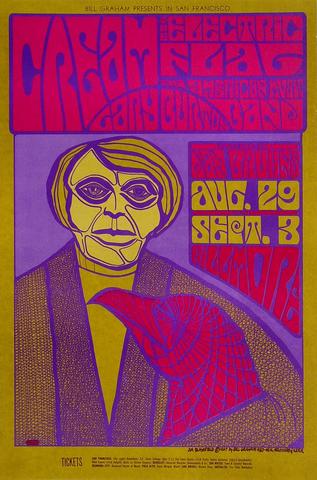
Not an inspiring first visit, but Cream would return to the States in August of 1967, when they would embark on their first American tour and experience an alternate universe flourishing on the other side of the country. Much had changed in the past several months, both culturally and musically. The Beatles had released Sgt. Pepper and the Summer Of Love was in full swing when Cream landed in San Francisco, a city that would have a profound impact on the band. Cream’s first residency at Bill Graham’s Fillmore Auditorium occurred the last week of August and the first week of September. For the first week, Graham presented the PaulButterfield Blues Band and Southside Sound System (which featured Charlie Musselwhite and Harvey Mandel) as openers to create a truly incredible triple bill of modern blues. The following week was no less impressive with jazz vibraphonist GaryBurton’s group (which included a young Larry Coryell on guitar) and the newly formed Electric Flag, featuring Mike Bloomfield, opening the shows.
Graham’s inspired billing and the great influx of young people that had descended on San Francisco at this time meant these shows were packed to the hilt. The Fillmore Auditorium had a legal capacity of 900, but somewhere between 1400 and 1500 people were reportedly crammed in for these shows, making Cream’s initial San Francisco residency a huge success. What they experienced in San Francisco, both culturally and musically, had a profound impact on the band. In turn, Cream’s performances had a lasting impact on the music scene now flourishing in the city. Faced with a more demanding performing experience, Cream began improvising more and incorporating spontaneous jams into many of their songs, some stretching out to nearly 20 minutes. The 1967 audiences in San Francisco embraced experimentation and sensory exploration and Cream took both to new levels on stage. With many of the key up-and-coming San Francisco musicians attending this run of shows, Cream had a significant impact, inspiring groups like the Grateful Dead, Quicksilver, and countless others to further embrace spontaneity in their own performances.
Thanks in large part to this initial run of 1967 Fillmore Auditorium performances, word of mouth spread rapidly. Cream established a reputation as one of the most exciting live acts to ever hit the city, which in turn increased album sales and demand for their performances in America. Early the following year, Cream returned to the States to record sessions for their third album at Atlantic Records New York City studios and to embark on their second US Tour. With much of the studio recordings for Wheels Of Fire just completed and with their new single, “Sunshine Of Your Love” just hitting the airwaves, Cream hit San Francisco for a second extended stay. With their reputation preceding them this time around, demand for tickets was now much greater. To address this, BillGraham presented Cream at the significantly larger Winterland Ballroom (5,000 capacity) for three nights, followed by a fourth night at the more intimate Fillmore Auditorium, with the Loading Zone and Big Black opening all four nights. These concerts—which began on February 29th and continued through the first three nights of March—were a huge success, and following a few days off, Graham presented an additional four nights. These shows would go down in history as the peak performances of Cream’s career.
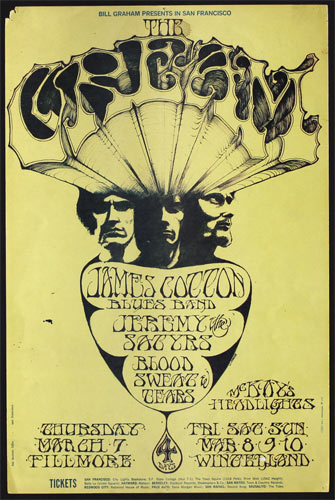
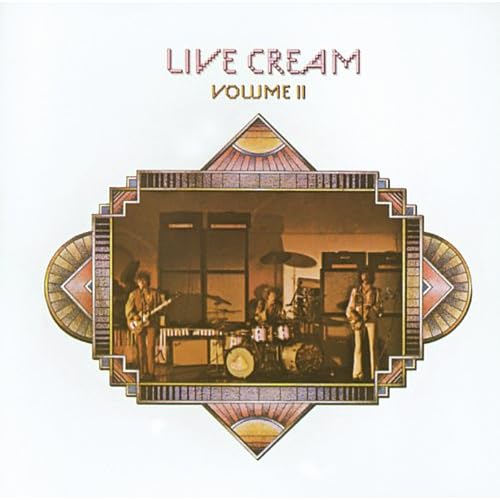
Atlantic Records and the group’s producer, Felix Pappalardi (who would soon team up with Leslie West to form the Cream-influenced band Mountain) were wise to capture the band’s onstage energy this time around, and much of Cream’s live legacy is based on the results of these recordings. Cream’s final run of San Francisco ballroom shows, which occurred on March, 7, 8, 9 and 10, 1968 would end up providing nearly all the evidence of Cream at their peak on stage and would also become the source of decades of confusion among fans, historians and collectors. For this final run, Bill Graham would reverse the approach of the following week, beginning with one night of two performances at the intimate Fillmore Auditorium, followed by six shows over the course of three nights at the much larger Winterland, this time with the James Cotton Blues Band and Al Kooper’s new outfit, Blood, Sweat & Tears opening. For this final four-night run, Cream producer Felix Pappalardi hired Wally Heider’s mobile unit and engineer Bill Halverson to record all eight performances. Essentially an eight track recording studio on wheels, Pappalardi and Halverson’s tapes from these nights would provide the incendiary live recordings fueling the second Wheel’s Of Fire album and eventually be mined for the posthumous Live Cream and Live Cream Volume 2 albums in the years to come.
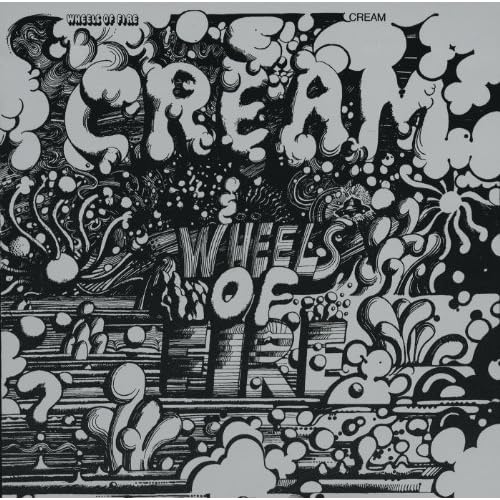
Cream’s double album, Wheel’s Of Fire, would achieve astounding success, becoming the first double-record to ever sell a million copies, due in large part to the live material recorded by Pappalardi and Halverson during the final four nights in San Francisco. Herein also lies the initial source of confusion surrounding the official notation of these gigs, as the liner notes in Wheels Of Fire attributed the second disc of the set as Live at The Fillmore, despite the fact that all but one of the tracks was actually recorded at Winterland. At the time, this made marketing sense, as the Fillmore had far greater name recognition thanks to the local cultural scene receiving so much attention in the media, especially in Life and Time Magazine, as well as Crawdaddy! and the bourgeoning Rolling Stone magazine, which had recently launched out of San Francisco.
The confusion surrounding the venues on these recordings was further convoluted as the years went by and subsequent releases and reissues (including Cream’s own recent career retrospective box set – Those Were The Days) identified some of the material from these recordings as being from Fillmore West, a venue the band NEVER played. For the benefit of those questioning the validity of this statement, the reality is actually quite easily explained. In March of 1968, which is when these live San Francisco recordings were made, Fillmore West did not yet exist. Graham had opened Fillmore East in New York City (that same week, in fact) but he was still in the early stages of pursuing the 2800 capacity venue in San Francisco, which was then known as the Carousel Ballroom. Graham would not present concerts there until June of 1968, which is when he moved operations and christened the venue Fillmore West. Three times the capacity of the intimate Fillmore Auditorium and an entirely different experience, Cream never got the opportunity to perform there. By the time they returned to California on their farewell tour in October of 1968, they were playing huge sporting arenas like the Forum in LosAngeles and the Oakland Coliseum in the Bay Area, having already outgrown the likes of Fillmore West or Winterland. Despite this, incorrect information persists in authorized biographies, official release liner notes and is ubiquitous in much of the online documentation surrounding the March 1968 recordings. Because these Fillmore Auditorium and Winterland recordings were utilized as individual tracks on multiple albums over the course of the next several years, much date confusion surrounds the individual songs as well. With Pappalardi and Halverson’s recording logs as a guide, much of this has been rectified during the past decade, as reissues have begun documenting individual live song dates accurately, but the incorrect Fillmore West notation persists.
Since the Pappalardi/Halverson recordings have only been released as individual song edits, spread out and re-sequenced over several different releases, it is difficult, if not impossible, to enjoy an accurately sequenced continuous recording of Cream at their peak, unless one pursues poor quality audience recordings of the era. All of which makes this 40-minute two-track board recording from Bill Graham’s archive quite fascinating. Recorded at the early show on March 10th, 1968, the final night of this historic run, this particular set includes the performance of “Crossroads” that forever cemented Eric Clapton’s reputation and presents an extended sequence from one of the group’s greatest performances. Being a direct board recording of the house mix, rather than a post-production multitrack mix, provides a significantly different listening experience that in some ways is a more satisfying one, despite the less polished nature of the recordings.
The recording begins with the first song of the set, “Tales Of Brave Ulysses,” well underway. This is the performance that would later surface on Live Cream Volume 2 and features some of the greatest wah-wah guitar soloing ever played by a white man. Written by Clapton, Cream is in fine form right off the bat, setting the stage for the incendiary performances to come. It’s difficult to believe that the versions of “Crossroads” and “Spoonful” that floored so many on the Wheels Of Fire album could have occurred so early on in a set (and during an early show to boot!), but indeed they did, although Pappalardi wisely chose to reverse their order on the album. Here one can experience both songs in context of the larger performance, beginning with that monumental version of Willie Dixon’s “Spoonful.” This is a prime example of Cream at the peak of their exploratory powers. Despite “Spoonful” being based on a very simple riff, the trio has the ability to improvise both tonally and rhythmically and the results burn for a solid sixteen minutes. It’s an extraordinarily daring performance that displays the intricate interplay and innate chemistry of these musicians. At approximately 10 minutes in, this performances heads for the stratosphere, with all three musicians furiously improvising, taking a basic blues soaring into regions few had ever explored.
This is followed by the now definitive Cream performance of Robert Johnson’s “Crossroads,” possibly the greatest live encapsulation of Eric Clapton’s strength as a guitarist. This is a blistering performance, in which Clapton, Bruce, and Baker all seem to be soloing simultaneously. “Crossroads” is a dazzling display of the fury and bravado when Cream was at the pinnacle of their powers. This raw two-track recording also dispels several long-standing myths regarding “Crossroads” on the Wheels Of Fire album, which is indeed this performance. Many have claimed Clapton’s blistering solo a result of studio overdubbing, but here it is, fully intact, exactly as it went down, proving that one of the most blazing guitar solos of all time was indeed done spontaneously live on stage. Several noted historians have also claimed “Crossroads” to be an edited amalgamation of only the best parts, but that too is clearly not the case, as Cream really did manage to compress that much finesse and energy into a little over four minutes.
Taking a few seconds to catch their collective breath after “Crossroads,” the band next tackle Jack Bruce’s “We’re Going Wrong,” which many listeners will find fascinating as it has never seen official release. This is another fiery performance that slowly builds in intensity over the course of nearly eight minutes, well over twice the length of its studio counterpart. Here Jack Bruce displays what a passionate singer he could be, while simultaneously playing extraordinary bass lines. A hybrid of blues, rock, and a dose of psychadelia, this is another exciting performance that demonstrates Cream’s unique chemistry onstage. Along with the Jimi HendrixExperience (arguably Cream’s only competition at the time) this music clearly foreshadows the “hard rock” sound that would come to dominate in the following decade.
Following “We’re Going Wrong” the band take a minute or so to debate what to close with. If one listens closely, Clapton can be heard suggesting “Cat’s Squirrel,” but Baker vetoes the suggestion, and since they’ve yet to play one of his songs, they pursue “Sweet Wine,” one of Baker’s contributions to their debut album. Although the tape runs out six and a half minutes in, this still provides another excellent example of the group building up a powerful performance based on the collective strengths of the individual members. Bruce and Baker are particularly impressive here, playing with a relentless fury that is well beyond what any rhythm section was attempting at the time. Clapton wails in response with seemingly boundless creativity.
Reaching the pinnacle of their collective strength, Cream wouldn’t last much longer and within a few short months; the constant bickering between Baker and Bruce would take its toll, leading the group to split up before years end. For the not quite three short years they were together, Cream was a prolific unit, releasing four (five if you count Wheels as a double) albums that set a new standard for rock musicianship. Despite their personal volatility (or perhaps in part, because of it), Cream burned brighter than most and left a lasting impression. GingerBaker’s jazz-influenced drumming and EricClapton’s blues guitar stylings, combined with the complex bass lines and extraordinary voice of Jack Bruce, created a distinctive sound that would have a lasting impact. In many ways, Cream is largely responsible for creating the basic blueprint for rock music, with their heavier (and much louder) fusion of blues and rock ‘n’ roll. Much of the recorded evidence of their power on stage is sourced from these SanFrancisco performances and it’s doubtful they ever played with more conviction or invention than they did on the final night at Winterland, March 10th, 1968.
thanks to Alan Bershaw
Eric Clapton – guitar, vocals; Jack Bruce – bass, vocals, harmonica; Ginger Baker – drums
In their short time as a band the supergroup, Cream were one of the top album bands on the British, and indeed the world, rock scene. But they also amassed quite a sequence of hit singles, and in this week in 1968, they debuted on with one of their signature songs, ‘Sunshine Of Your Love.’
The trio had four previous UK singles chart entries to their name, including two top 20 hits, but ‘Sunshine’ gave them their first-ever appearance on the charts. In their own country, ‘Wrapping Paper’ announced their arrival in the autumn of 1966, reaching a modest No. 34, after which ‘I Feel Free’ hit No. 11 and ‘Strange Brew’ No. 17. ‘Anyone For Tennis’all spent three weeks on the survey in June of 1968, reaching No. 40.
‘Sunshine Of Your Love’ was composed by the prolific Cream writing team of bassist Jack Bruce and his lyric-writing collaborator Pete Brown with Eric Clapton. Clapton’s brilliant guitar solo on the recording contains a conscious reference to the Marcels’ rock ‘n’ roll classic ‘Blue Moon,’ highlighting the song’s amorous theme of a “dawn surprise.”
This classic rock anthem was introduced on Cream’s second album Disraeli Gears late in 1967, then became Cream’s biggest transatlantic single and their one gold-selling single in the States. It first reached No. 36 there in a 14-week run starting on 13th January 1968, but re-entered the top 100 in July and climbed all the way to No. 5. It later won a place in the Rock & Roll Hall of Fame.
That US success prompted the UK release of ‘Sunshine,’ as a single the better part of a year after Disraeli Gears appeared. But the track has become a rock standard, performed live by both Bruce, before his passing, and Clapton on countless occasions. The classic status of ‘Sunshine’ has also been underlined in scores of cover versions, by everyone from Ozzy Osbourne to Santana.
Legendary performance, live at the Grande Ballroom, Detroit. Recordedlive includesthe complete WRIF-FM broadcast, Digitally remastered for greatly enhanced sound quality, This is an explosive show by Cream very early in their career. It seems to be the entire performance which is also a big plus. I tip my hat to the fellow who took the time to remaster a wealth of great Cream shows on tape. It’s not an excellent soundboard recording as is suggested. It sounds like a couple of generations back from the original as the crispness and clarity of most master board recordings is missing. Because of the slightly muddy sound quality this one loses a couple of points but overall is still a must-have for any Cream fan, fanatic or casual, simply because of the blistering performance and completeness of the recording. Clapton’s licks here are exciting. Ignore the above review because this is one of Cream’s best-ever concerts. It seems that so many people jump on the bandwagon when it comes to live Cream–“Oh, this is soooo self-indulgent,””Oh, these jams are too long and Clapton is too excessive,-you know what? Many people like to say that because for decades, ignorant, hack rock critics have come up with the stereotype of Cream as a self-indulgent live band who made studio albums that were far better. Critics don’t play on the level of Clapton.
Cream is truly underrated when it comes to jamming. They didn’t do pot or acid to get them jamming (although they did do other drugs, but not to intentionally effect the music), like the Dead or Quicksilver. They were musicians who listened to each other and created some of the best improvisational jamming in rock.
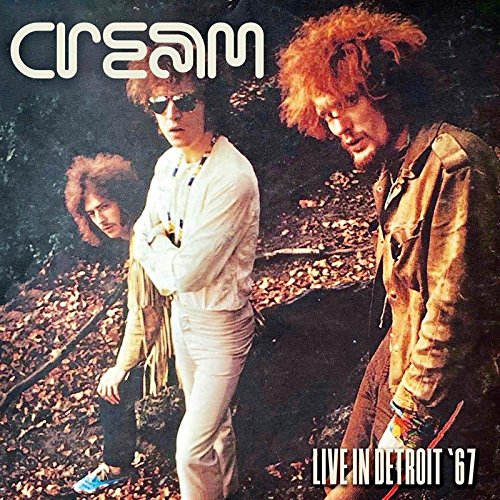
Cream, live at the Grande Ballroom, Detroit, MA on October 15th 1967
White-hot from two months of touring the US, Cream played this remarkable show shortly before the release of the album “Disraeli Gears”. Regarded by some as the finest live document of the trio in existence, it typifies their explosive chemistry, with some outrageous wah-wah from Clapton, thunderous bass from Jack Bruce, and virtuoso drumming from Ginger Baker. This show from Detroit’s Grande Ballroom on October 15th 1967, originally broadcast on WRIF-FM, is presented in full here
Disc One
1. Tales Of Ulysees2. N.S.U3. Sitting On Top Of The World4. Sweet Wine5. Rollin’ & Tumblin’, Disc Two
1. Spoonful2. Steppin’ Out3. Traintime4. Toad5. I’m So Glad,
Were Cream really to blame for ushering in the era of unchecked musical overindulgence? And is overindulgence necessarily so heinous? We only ask because, 51 years after the release of their debut album, it’s still the soft option to equate extended jams. It’s a fair point: but the dangerously unstable chemical compound that momentarily bound Jack Bruce, Ginger Baker and Eric Clapton together – star-crossed lovers in a hellbound ménage a trois – produced some startling fireworks before inevitably consuming itself.
December 1966’s Fresh Cream, reappearing here in mono and stereo iterations, and with several unreleased tracks among its booty of alternative versions, outtakes and radio sessions, maintains an edgy entente. Dreaming,“NSU” and the contemporaneous single “I Feel Free” demonstrate the trio’s little-remarked facility for hard pop, while their bewildering opening gambit, “Wrapping Paper”, only makes sense in the context of a long-vanished world wherein Winchester Cathedral could be a breakout hit.
Mindful of their blues-rock billing, Cream also break out a series of torrid R&B homages (Rollin’ And Tumblin’, Cat’s Squirrel, I’m So Glad): but Clapton became daring when Bruce and Baker loosened his purist girdle. The long lunar note that fanfares his solo on Spoonful – a delirious C# over E is as close to soundgasm as white-boy blues ever got. As you can see from the image above, this comes packaged in a large format book, no doubt with plenty of rare photos and liner notes. Four-disc set to feature outtakes, BBC sessions, Blu-ray audio version of debut LP .Cream, the trio of Eric Clapton, Jack Bruce and Ginger Baker, would release three more albums after Fresh Cream – Disraeli Gears, Wheels of Fire and Goodbye – before splitting up. Bruce embarked on a solo career while Clapton and Baker joined Blind Faith, though over the next several decades all three would partake in an array of different musical projects.
Fifty years ago, an album arrived that changed the way we hear rock music and made improvisation the test of credibility for rock bands. The album was, “Fresh Cream”. When it appeared, on December 9th, 1966, it inspired a rush of new terms, including “supergroup,” “power trio,” “jam rock,” and “drum solo.”
In ‘1966 it was all new, and all due to a band named Cream, which had formed just six months earlier. They arrived with a significant pedigree,The members from London’s early-to-mid ’60s blues and jazz scene. The bands that provided Cream’s ingredients—The Yardbirds, John Mayall’s Bluesbreakers, and the Graham Bond Organization—each had elements that suggested what the bold new band would become.
The resumes of Cream’s players, account for the first of their new catch-phrases “Supergroup”, though their previous, individual star power hardly qualified as “super.” Two of the band’s members—drummer Ginger Baker and bassist/singer Jack Bruce had far greater recognition among serious music listeners than casual pop fans. Guitarist Eric Clapton was the most renowned, for his work with both The Yardbirds and John Mayall’s Bluesbreakers. But because he ditched the former act before they scored their U.S. run of hits (like “For Your Love”), he had scant Stateside fame. Even so, the whole of the band added up to more than its parts, fueling enough buzz to birth the “supergroup” tag.
Fresh Cream featured originals like “N.S.U.,” “Dreaming,” and “Sweet Wine” plus American blues standards like Robert Johnson’s “Four Until Late” (sung by Clapton), Muddy Waters’ “Rollin’ and Tumblin’,” Willie Dixon’s “Spoonful” and Skip James’ “I’m So Glad.” Non-LP single “I Feel Free,” added to U.S. pressings of the album, would become the group’s biggest hit single in their native U.K.,
The super deluxe Fresh Cream offers three CDs and one Blu-ray Audio with a treasure trove of extras. In addition to mono and stereo mixes of the original U.K. album, the set includes a myriad of mono single and EP material (including two ultra-rare French mono EPs), seven brand-new stereo remixes of album tracks and ten unreleased outtakes, and four complete and unedited BBC session appearances in 1966 and 1967. The Blu-ray Audio features 24/96 KHz high-resolution mixes of the U.S. album running order in stereo and mono, plus U.K. album track “Spoonful” and non-LP tracks “Wrapping Paper” and “The Coffee Song,” also in stereo and mono.
This new edition is packed in a gatefold slipcase with a 64-page hardcover book featuring liner notes written by David Fricke. (The outer slipcover features the U.K. design of the album front, while the inner package features the slightly altered U.S. cover.)
Cream’s having just three players pared the sound down far enough to provide new rhythmic, and spatial, possibilities. The spareness of the instrumentation left extra room between the players, giving the music space to swing while also highlighting the contributions of each participant. The “power trio” dynamic make it easier to isolate and appreciate each star’s technique the set-up provided a generous enough platform for each player to encourage the third and fourth terms Cream presaged—”jam-rock” and the drum solo.
From their previous jazz flirtations, Cream’s players had plenty of experience with soloing. But for the new band, they brought the full expanse of jazz jamming to the chordal structures of the blues. Solos often became the focus of the song, In the process, Cream made improvisation the test of credibility for rock bands, as well as an integral part of the song rather than a mere elaboration or time-killer. The tracks’ longer lengths allowed listeners to bore further into the music, losing themselves entirely.
The band’s expansive solos mirrored the wanderings of the blissfully altered mind. Cream’s specific approach to soloing brought to rock a new density. The musicians often solo’d at the same time, allowing Bruce’s bossy bass line to wend in one direction while Clapton’s wild guitar wandered in another. The result created as many complex and exciting interactions as messy and indulgent ones. While Clapton later denounced Cream’s “all-at-once” approach as a result of sloppiness and ego, in fact it gave the band a sense of tension and dimensionality that remains unparalleled. Cream’s solo-centric style found its clearest expression in the drum cadenza, created by Baker for the instrumental track Toad. Ginger Baker infused his work with more freedom and complexity. After hearing “Toad,” every serious drummer in rock pined for a showcase, inspiring drum breaks ranging from the cogent (Led Zeppelin’s John Bonham in Moby Dick) to the clunky (Ron Bushy in Iron Butterfly’s In-A-Gadda-Da-Vida). Eventually, this led to 15 minute live smack-downs which did more to pack concert hall bathrooms than did the beer its patrons quaffed. Cream themselves indulged “Toad” to a greater degree on their 1968, half-live double set Wheels of Fire. It boasted a sixteen minute-plus elaboration of the song, hogging an entire side. If “Wheels” found the band in full jam-band mode, “Fresh Cream” presented a more tentative, and terse, manifestation of that mission. Like many debut works, it was more about potential than fulfillment. The lengths of the songs remained clipped by the band’s later standards. Only two tracks exceeded the five minute mark. The longest, Spoonful, offered a six and a half minute riff on Willie Dixon’s blues classic, starring Clapton’s shimmering dips and dives.
Other songs seem unformed, like the meandering waltz Dreaming, the campy bauble Wrapping Paper (included on international editions) or the indifferent run at Robert Johnson’s Four Until Late.
At the same time, the album’s opening track, I Feel Free, idealized Cream’s deliverance from the bonds of their previous bands. In the process, songs like the flamboyant N.S.U., or the swaggering Sleepy Time Time, provided a blueprint for all ’60s psychedelic blues-rock bands to come. ‘Fresh Cream’ became the test-run for groups as seminal as The Jimi Hendrix Experience, the Jeff Beck Group and Led Zeppelin.
Cream itself would go on to create more fully realized works, like 1967’s Disraeli Gears, which perfected their flower-power pop side, or the aforementioned ‘Wheels of Fire,’ which captured them in their full frenzy. But before all that came ‘Fresh,’ a work which forever changed rock’s sound, configuration, vocabulary and goals.
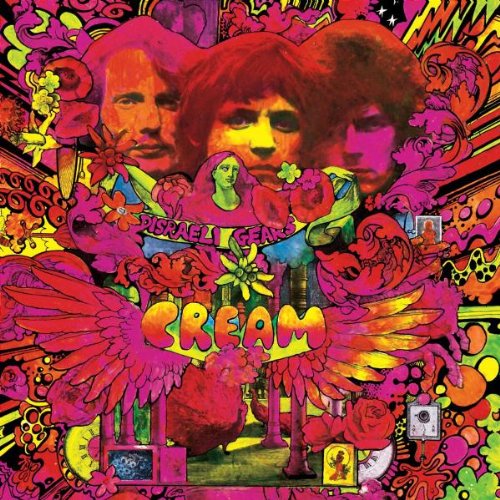
“Disraeli Gears” is the second studio album by the British rock band Cream. It was released in November 1967. The album features the two singles “Strange Brew” and “Sunshine of Your Love”. The album was recorded at Atlantic Studios in New York during May 1967, following the band’s nine shows as part of Murray the K’s “Music in the 5th Dimension” concert series. The sessions were produced by the future Mountain bassist Felix Pappalardi who also co-wrote the tracks “Strange Brew” and “World of Pain” with wife Gail Collins and were engineered by Tom Dowd According to Dowd the recording sessions took only three and a half days.
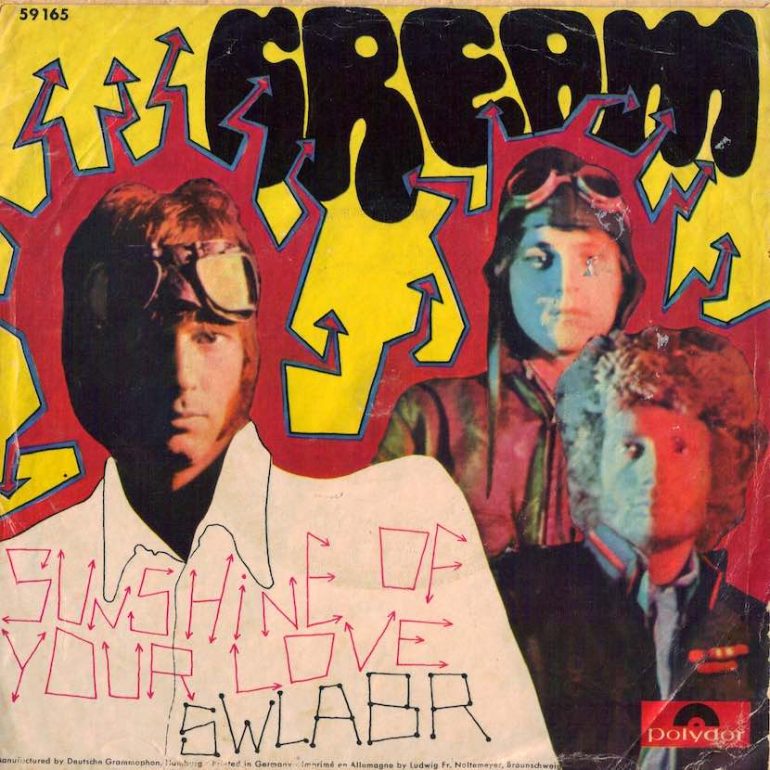
Disraeli Gears that turned Cream into a “supergroup.” Here they pursue the psychedelic ideals of the era with total abandon (the LP cover art still stands as one of the 1960s’ most striking designs), merging these ideals with their take on the blues and adorning the amalgamation with some superb pop craftsmanship. Of the 11 originals here, four–“Tales of Brave Ulysses”, “SWLABR”, “Strange Brew” and “Sunshine of Your Love”–earned major airplay. This, their excess-free greatest moment, does the Cream legend proud. “Disraeli Gears” features the group veering away, quite heavily, from their blues roots and indulging in more psychedelic sounds. The most blues-like tunes on the album are the remake of “Outside Woman Blues”, the Bruce/Brown composition “Take it Back” which had been inspired by the contemporary media images of American students burning their draft cards which featured harmonica work by Jack Bruce, and the opening track “Strange Brew” which was based on a 12-bar blues song called “Lawdy Mama” and featured Eric Clapton copying an Albert King guitar solo, note for note
The album title started as a joke. Mick Turner one of Cream’s roadies was discussing with drummer, Ginger Baker, how he fancied one of those bikes with’ Disraeli gears’. He meant, of course, derailleur gears, but the band found the mistake hilarious and so the name of one of one of the UK’s premier psychedelic albums was born.
For this Second album it was far different. Chemicals had been imbibed, Clapton had struck up a friendship with Australian artist Martin Sharp who not only provided the lyrics of “Tales Of Brave Ulysses” but also came up with the splendidly baroque cover. Meanwhile Jack Bruce was now working with underground poet, Pete Brown, whose lyrics were equally trippy. “SWLABR” (it stands for ‘She walks like a bearded rainbow’), “Dance TheNight Away” and “Sunshine Of Your Love” were perfect encapsulations of the point where the blues got psychedelic and in turn got heavy. “Sunshine…”’s riff is at once iconic and defines the power trio aesthetic that was to prove so popular with the band’s many disciples.
The other creative catalyst was producer Felix Pappalardi. Co-writing both “World Of Pain” he also helped transform the blueswailing “Lawdy Mama” into the slinky “Strange Brew” – a contender for best album opener of all time. Clapton’s guitar had by now been exposed to the effects heavy stylings of Jimi Hendrix and his heavy use of wah-wah gives Disraeli Gears just the right amount of weirdness, making this probably the most experimental album he ever made. The modish inclusion of Ginger Baker’s rendition of “A Mother’s lament” was the edwardiana icing on the cake.
Cream may have had all too short a lifespan as far as their millions of admirers around the world were concerned — but at least they had the chance to say ‘Goodbye’ to each other. That, of course, was the title of the trio’s fourth and final studio album, released a few weeks after they announced that they would soon be splitting. The album made its American chart debut 47 years ago exactly, on February 15, 1969.
It had been an eventful few months forEric Clapton, Jack Bruce and Ginger Baker, who had only released the preceding album, ‘Wheels Of Fire,’ the previous July in the UK. Then came the announcement that Cream would call it quits after a farewell tour that autumn.
With a shortage of material available, ‘Goodbye’ was something of a mixed bag. Just as ‘Wheels Of Fire’ had (in its double LP version) been one disc of studio recordings and another of live performances, the final album was another 50-50 split. Three of its six tracks were recorded at the Forum in Los Angeles on that last tour. 19th October 1968 . The other tracks recorded October 1968 at IBC Studiosin London, UK.
But the record did boast a very fresh and newsworthy studio number, and one written by Clapton with GeorgeHarrison, no less: ‘Badge’ featured George, or “L’Angelo Mysterioso” as he had to be credited for contractual reasons, on rhythm guitar. The song became, in many eyes, the last classic Cream number, and went on to reach the UK top 20 as a single.
Badge was written by Eric Clapton and George Harrison. In Georges handwritten lyrics he wrote the word “Bridge” as in bridge of a song and Clapton thought that it was “Badge” so they named the song that.
It appeared on Cream’s final album “Goodbye.”… Ringo Star threw in a line also.
George Harrison on writing Badge with Clapton
I helped Eric write “Badge” you know. Each of them had to come up with a song for that Goodbye Cream album and Eric didn’t have his written. We were working across from each other and I was writing the lyrics down and we came to the middle part so I wrote ‘Bridge.’Eric read it upside down and cracked up laughing – ‘What’s BADGE?’ he said. After that, Ringo [Starr] walked in drunk and gave us that line about the swans living in the park
I like when a band does something different. After blitzing audiences with Crossroads, Whiteroom, Sunshine of Your Love, and Strange Brew…out comes this song. It’s not my favorite Cream song…that would be Badge but this one always makes me smile.
The song was written by Eric Clapton and Martin Sharp for the movie “Savage Seven.” Unfortunately, this was nearing the end of Cream’s run.
Cream appeared on the Smothers Brothers and mimed this song. Who the hell knows what it means but when I heard “And the elephants are dancing on the graves of squealing mice. Anyone for tennis, wouldn’t that be nice?” I was hooked. It’s hard to get it out of your head once you listen to it.
‘Goodbye’ made its US chart entry on Billboard’s Top LPs chart, as it was called at the time, at No. 107, as ‘The Beatles’ moved back to No. 1. In a 26-week chart run, it spent two weeks at No. 2 in March, held off the top spot by Glen Campbell’s ‘Wichita Lineman.’








 The Fat Angel Sings