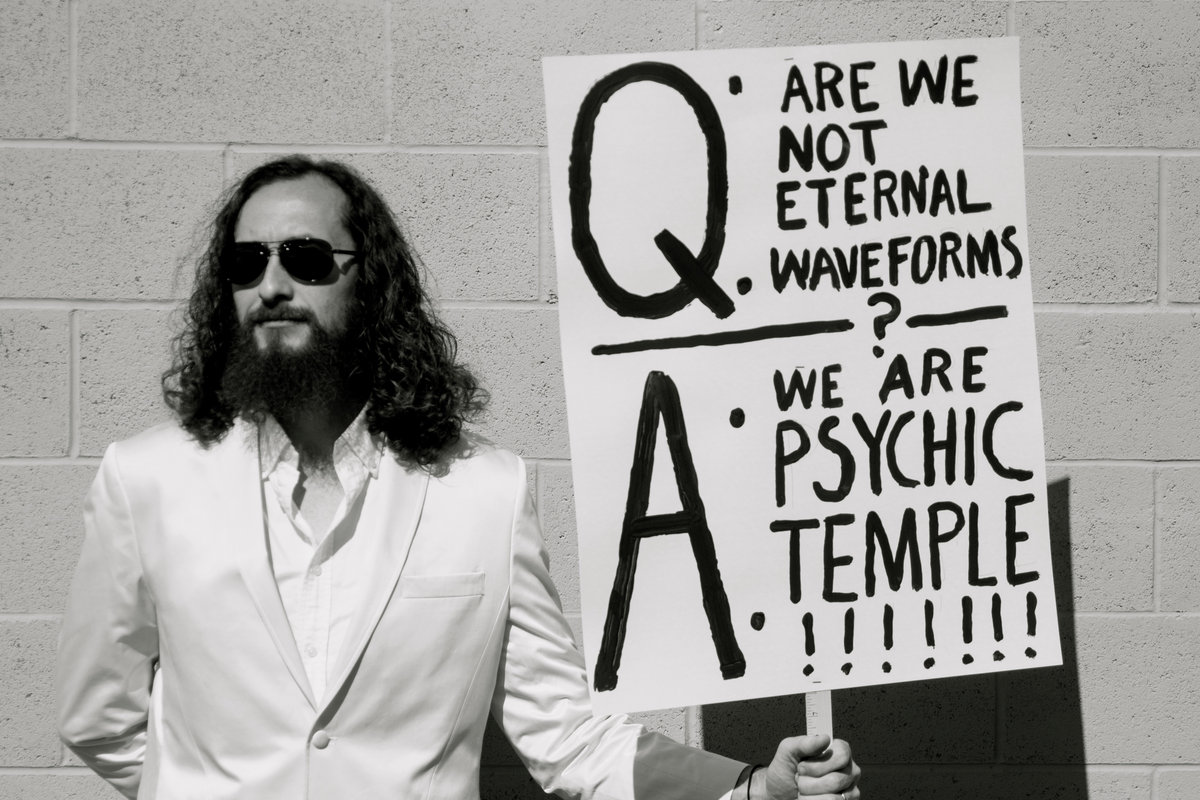
Two years ago, SoCal studio cultist Chris Schlarb, a.k.a. Psychic Temple, announced a new project in which he would collaborate with four completely different artists for each side of a double album. He called it “Houses of the Holy” which made sense, coming after albums titled I, II, III, and IV — and introduced it with a fun EP of desert-singed garage-pop tunes made with Los Angeles’ Cherry Glazerr. The full 2-LP adventure, rolled out this last September, features those songs plus some jazzier moods with cornetist Rob Mazurek’sChicago Underground trio; along with paisley-hued psychedelic rock with the Dream Syndicate; and big-band backpack rap with local MC Xololanxinxo.
All those sounds hang together with the logic of a long, weird dream, thanks to Schlarb’s instinct for unlikely musical connections. As a generous celebration of what can happen when you put a bunch of talented people together in one room — in this case, Schlarb’s Long Beach, California, studio, Big Ego “Houses of the Holy” was all the more welcome this lonely year.
The concept is pretty cool. Basically, I take over an existing band on each side and we write and record together.
Cherry Glazerr (Side A)
Chicago Underground Trio (Side B)
Dream Syndicate (SideC)
Xololanxinxo (Side D)
The first single, “Why Should I Wait?” with The Dream Syndicate is out now and you can pre-order the album over at Bandcamp today. I’m really proud of this record. If you take a listen, please let me know what you think. The vinyl is especially fun since each side is its own thing, but together its like the album is a mini box set. “Lightning” I particularly keep playing. It makes me feel like it could have been a song in an old old dream I had trouble remembering until I hear it and I can almost recall it again. Give the album a good listen and I think you’ll find something to enjoy.
Psychic Temple off the album ‘Houses of the Holy’ out on Joyful Noise Recordings.
Led Zeppelin released their 5th album titled “Houses of the Holy” on 28th March 1973. It is their first album composed of entirely original material, and represents a musical turning point for the band, who had begun to record songs with more layering and production techniques.
Containing some of the band’s most famous songs, including “The Song Remains the Same”, “The Rain Song” and “No Quarter”, Houses of the Holy became a huge success.
One interesting fact about this LP is that the title track was recorded for the album, but was delayed until the band’s next release, Physical Graffiti, two years later. Recorded between January–August 1972, Stargroves and Headley Grange with the Rolling Stones Mobile Studio, and Island Studios, London; Mixed at Olympic Studios, London and Electric Lady Studios, New York
“The Rain Song” is one of Zep’s finest moments, featuring a soaring string arrangement and a gentle, aching melody. “The Ocean” is just as good, starting with a heavy, funky guitar groove before slamming into an a cappella section and ending with a swinging, doo wop-flavored rave-up. With the exception of the rampaging opening number, “The Song Remains the Same,” the rest of Houses of the Holy is fairly straightforward, ranging from the foreboding “No Quarter” and the strutting hard rock of “Dancing Days” to the epic folk/metal fusion “Over the Hills and Far Away.” Throughout the record, the band’s playing is excellent, making the eclecticism of Page and Robert Plant’s songwriting sound coherent and natural.”
Upon its release, the album received some mixed reviews, with much criticism from the music press being directed at the off-beat nature of tracks such as “The Crunge” and “D’yer Mak’er”. However, the album was very successful commercially, entering the UK chart at number one, while in America its 39-week run (2 of them spent at number one) on the Billboard Top 40 was their longest since their third album.
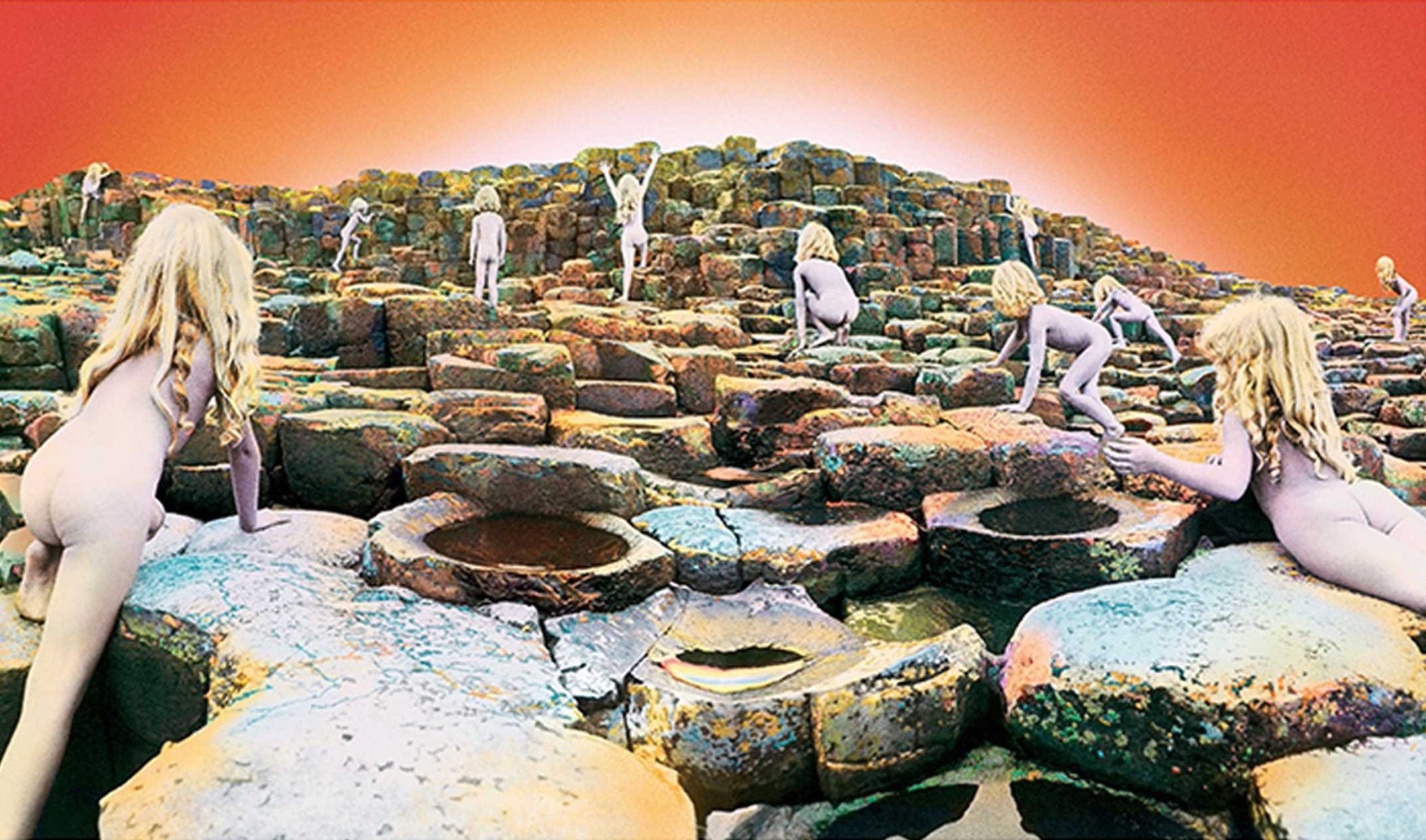
For 1973’s Houses of the Holy, the band and their management turned to the accomplished English design studio, Hipgnosis, for inspiration. Co-founder Aubrey Powell, inspired by Arthur C. Clarke’s 1953 science fiction novel, Childhood’s End, selected the remote area in Northern Ireland called Giant’s Causeway, a natural series of rock and columns which attracts over one million visitors each year, for the location of a photo shoot.
Siblings Stefan Gates—just five at the time—and his slightly older sister, Samantha, were selected for what proved to be a treacherous assignment. The children were pictured on the cover as they ascended the rocky terrain. Both are unclothed.
Houses of the Holy was released on March 28th, 1973. The album, featuring such Led Zeppelin favourites as “Over the Hills and Far Away,” “Dy’er Maker” and “The Song Remains the Same”—but not, ironically, the song “Houses of the Holy”—was another enormous success, reaching #1 in both the U.K. and U.S.
Released on Atlantic Records in 1973 Houses of the Holy was Led Zeppelins 5th album, It featured all original material with a running time at 40.58 minutes. The band were experimenting more with the production techniques and studio sounds, the epic scale of the band at this time, the loudest songs, the biggest tours and the largest tours.
the song “Houses of the Holy” was recorded for these sessions but was not released until the next album “Physical Graffitti” as it was felt it did’nt fit in . it also featured the “Song Remains the Same” and the reggae influenced “D’yer Maker”.
By 1973, Led Zeppelin had pushed themselves to deliver four stunning albums, but they were yet to see what could happen when you pushed the recording studio itself. A departure from their more simplistic sounds of earlier albums, Houses Of The Holy was an ambitious number that saw the group begin to experiment with production techniques, dividing their fan base almost straight down the middle in the process.
While the record was both a critical and technological success, some fans criticised the record for its rather unfocused sound which seemed to lack cohesion, while others praised the record as sounding exactly like the album that Led Zeppelin were born to make. While fans were divided upon release, almost 50 years laters, the record is considered not only one of the band’s finest moments, but also one of the greatest records of all time, and rightly so.





 The Fat Angel Sings