Posts Tagged ‘Graham Nash’

From the preliminary planning stages of Crosby, Stills & Nash, the musicians had always planned to pursue solo projects in conjunction with working together. Following the monumental success of the debut album in 1969 and its follow-up, “Déjà Vu”, in 1970, brought Neil Young into the fold, each of the band members remained quite active on their own. By 1973, a wealth of solo material had been released and each of these musicians had established themselves as individual songwriters and musicians. Crosby, with help from many of the San Francisco elite, had released his first solo album,  “If Only I Could Remember My Name”. likewise for Graham Nash, who released his first solo album “Songs For Beginners”, and was working on a second album. Crosby and Nash also released an impressive duo album during this time. Stephen Stills and Neil Young were even more prolific, with Stills releasing two impressive solo albums as well as a double album with his own band, Manassas, and Neil Young pumping out songs at an amazing rate, including the most popular album of his career, “Harvest”. By 1973, the clamoring for these four musicians to again work together was at an all-time high, but their well-publicized personality clashes made it seem unlikely that this would happen anytime soon.
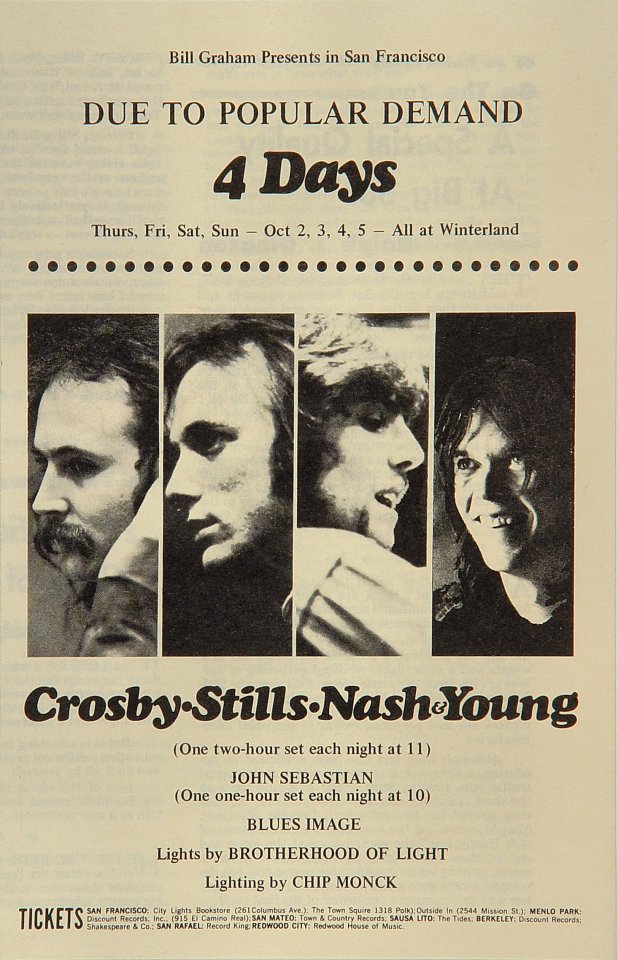
That same year, Stills took to the road with an outstanding band, Manassas, which also featured ex-Byrd Chris Hillman and several members of The Flying Burrito Brothers. booked to play two gigs at San Francisco’s Winterland on October 4th and 7th. Surprises were in store both nights, but the October 4th gig turned out to be the most delightful. Following a lengthy set by Stills and Manassas, which featured two highly-charged electric sets and a semi-acoustic set in the middle featuring Flying Burrito Brothers classics, the audience was charged up and cheering for more.
When Stephen Stills returned to the stage with David Crosby and Graham Nash in tow, the audience was ecstatic! The trio hadn’t shared a stage since 1970. Strapping on acoustic guitars, they first delight the audience with two staples from their debut album: “Helplessly Hoping” and “Wooden Ships.” The harmonies are ragged and the delivery unrehearsed, but regardless, just having these musicians playing together again, and more importantly, obviously enjoying it, was a cause for celebration. This remarkable acoustic set continues with the trio performing a lovely take of Paul McCartney’s “Blackbird,” after which Stills switches to piano for “As I Come Of Age,” a number he often performed with CSN&Y on the 1970 tour and recorded for his first solo album.
The personality clashes between Stills and Young were the most publicized of all and had been going on since the Buffalo Springfield days, so when Neil Young walks out to join the other three, the crowd goes nuts. The musical chemistry between Stills and Young had always been undeniable, but many believed they’d never see the two on the same stage again, so this was indeed a monumental moment. Young was just about to release his controversial “Time Fades Away” album, but in typically unexpected style proceeds to play nothing from this album, instead performing three new songs, “Roll Another Number,” “Human Highway,” and “New Mama.” The middle song was rumored to be the title song of a potential third CSN&Y project, while the other two would be destined for “Tonight’s The Night”, an album that wouldn’t see the light of day until June of 1975.
Graham Nash next gets the spotlight, and he too debuts new songs, “And So It Goes” and “Prison Song,” both destined for his second solo album, Wild Tales. Crosby follows with a rare acoustic performance of “Long Time Gone” before they close the set with Stills’ “Change Partners,” the single from his second solo album.
These performances are unique and the chemistry between these musicians was obviously still intact. Following these shows, all four members expressed a strong desire to tour together acoustically. It wouldn’t come to pass, but this was likely the spark that ignited the idea of touring together the following year, which is when they would indeed get back together and perform before the largest audiences of their career.

Just two months after their historic appearance at the Woodstock Festival, Crosby, Stills, Nash and Young were scheduled to play their first-ever gigs at Bill Graham’s Fillmore West and Winterland. CSNY was forced to postpone the show, and Janis Joplin and Santana stepped in to replace them, along with the original billing of Blues Image and John Sebastian. The poster, however, had already gone to print.

The posters artists and designer Greg Irons moved to San Francisco in 1967 and roamed around Haight-Ashbury with his sketchbook, creating images he would later use in his posters. As usual, promoter Bill Graham needed a poster in a hurry, and Irons succeeded in producing one overnight. As his talent as a draftsman developed, a distinctive line quality and refined sense of balance set Irons‘ posters apart. His cartoonist inclinations are often evident, and he became one of the seminal figures in underground comics. Greg Irons also found work producing album graphics and book illustration, but it was the art of tattooing that became his passion.

csny

Crosby Stills Nash & Young star in a VH1 documentary from 2000, The original purpose of the channel was to build upon the success of MTV by playing music video’s but targeting a slightly older demographic than its sister channel, focusing on the lighter, softer side of popular music. More recently, much like MTV, VH1 has been in the area of music-related programming, such as the series “Behind The Music” series as part of the channel’s current focus on popular culture.

https://www.youtube.com/watch?v=Mjbq6K2ziDQ

Crosby, Stills & Nash’s The Acoustic Concert is mastered with a loud and full sound. Videotaped at a 1991 show in San Francisco that was done as a memorial to the group’s friend, Bill Graham, there is more here than meets the eye — indeed, what initially meets the eye is most unpromising, the decidedly overweight presence of David Crosby and Stephen Stills,  Graham Nash’s metabolism won’t let him gain weight. But as it turns out the group vocal prowess is still very much intact, because they harmonize magnificently far better, in fact, than they generally did at Woodstock, and despite its being credited as The Acoustic Concert, that doesn’t stop Stephen Stills from picking up an electric guitar to add a little appropriate wattage to “Deja Vu,” “Just a Song Before I Go,” and more. Graham Nash, whose guitar was seldom ever even plugged in when he was in the Hollies, gets to play a little acoustic guitar on “Marrakesh Express,” in the midst of a superb lead vocal performance. “To the Last Whale” is presented visually as more of a conceptual video than anything else here, in its opening, before the camera returns to the stage for the song’s second half (featuring Nash on grand piano). Neil Young, though absent, gets a song dedicated to him in “Try to Find Me.” When Stephen Stills takes center stage for his spot, he delivers a loud, crunchy rendition of “For What It’s Worth” that’s more a deconstruction of the song than a performance — much more successful are the resurrections of “Suite: Judy Blue Eyes” (to which he tacks on an extended acoustic guitar coda that incorporates elements of “Carry On,” and a high-speed solo in which he sounds like he’s playing 16th notes) and other early songs by the trio. The cameras are constantly in motion and the editing keeps the eye moving and occupied, and the show was more than good enough to occupy the ear as well, especially with the audio quality as good as it is here.


See the source image

David Crosby  has the distinction of being a founding member of both the Byrds and Crosby, Stills & Nash who has survived drug busts in Texas (nine months in state prison for possession of heroin and cocaine), a hit-and-run driving accident, possession of a concealed pistol and drug paraphernalia, an arrest for driving into a fence in Marin County, a transplanted liver, the ire of Graham Nash, and fathering two children by Melissa Etheridge. He is a bit of a lightning rod to be sure! Love him or hate him, Crosby, now 79 years old, has had a stellar career. A singer-songwriter and guitarist, he wrote or co-wrote “Wooden Ships,” “Deja Vu,” “Guinnevere,” and “Lady Friend,” among others.

He is also noted for his soaring high harmonies, a trademark of his songs. In addition to performing on the Byrds first five albums (their best in my opinion), he also played on eight Crosby Stills & Nash albums including three with Neil Young), he has made solo albums, and collaborated with Graham Nash on five long players. Croz is  pretty prolific workhorse. He has been inducted into the Rock and Roll Hall of Fame twice with the Byrds and Crosby, Stills & Nash. He can be seen in an excellent 2019 documentary “Remember My Name,” in which he pulls no punches about his failed relationships, scrapes with the law, and regrets about years lost to drug abuse. Crosby is certainly a survivor.

David Crosby’s 1971 solo album “If I Could Only Remember My Name” was developed in a time of great emotional upheaval but also intense creativity for David Crosby and the contributing musicians. Many if not most of the finest San Francisco musician’s fingerprints can be found on this record. Often referred to as the ‘Planet Earth Rock and Roll Orchestra’ the combination of talents can also be discovered adding their unique abilities to other albums of that era. Jefferson Starship’s Blows Against the Empire, Graham Nash’s Songs for Beginners, Mickey Hart’s Rolling Thunder as well as Paul Kantner/Grace Slick’s solo excursions feature many of the same artists. David Freiberg, Neil Young, Michael Shrieve, Graham Nash, Joni Mitchell as well as the members of the Grateful Dead and Jefferson Airplane all make appearances in various combinations equaling some mind expanding and amazing music created in the early 1970’s. This amazing time in rock history will never be witnessed again, a time where wonderful collaborations and a shared love of musical discovery took precedent over record contracts, royalties and tour receipts.

David Crosby’s 1971 masterpiece “If I could Only Remember My Name”. Emotionally recovering from the loss of his lover Christine Hinton from a devistating car crash,

“If I Could Only Remember My Name” is the result of David Crosby’s escape from depression and his eventual refuge found through music and his friends. The collaborations featured on the recordings did not occur in a vacuum, the relationships were developed early on in the respective musicians careers. Paul Kantner, Crosby and Stephen Stills collaborated on the songwriting of the CSN track ‘Wooden Ships’, Jerry Garcia was a ‘spiritual advisor’/producer for the Jefferson Airplane’s Surrealistic Pillow album and David Freiberg, Kantner and Crosby often cross pollinated each others work in the early stages of their careers.

Crosby gathered a superb supporting cast, one that featured the communal contributions of friends and fellow travellers, among them, members of the Grateful Dead (Jerry Garcia, Phil Lesh, Bill Kreutzmann and Mickey Hart), Jefferson Airplane (Grace Slick, Paul Kantner. Jorma Kaukonen, Jack Casady), Santana (Gregg Rolie and Michael Shrieve) and Quicksilver Messenger Service (David Freiberg), along with faithful standbys Graham Nash, Neil Young and Joni Mitchell.

The LP opens fittingly opens with the aptly titled ‘Music Is Love’. The song features three of the four principals of Crosby, Stills, Nash and Young, with Stills the only member not appearing. The song encapsulates the pervading attitude of the record with the ‘Music Is Love’ mantra harmonized by Nash and Young while Crosby spreads a soaring free form vocal over the top. Young, Crosby and Nash interweave crystalline acoustic guitars with Young offering his personal rhythm section of bass and congas and a ghostly vibraphone. The campfire vibe song rises weightless like smoke, soaking into the glorious melodic sunshine.

The cinematic and epic ‘Cowboy Movie’ follows, spotlighting the rhythm section of the Grateful Dead with Hart, Kreutzman and Lesh in addition to featuring a Jerry Garcia and Neil Young in a dusty ten paces and turn guitar duel. The story line of the tail fictionalizes the CSNY break up through the premise of a spaghetti western and comments on some of the personal issues that haunted the band, like certain principals relationship with the ‘Raven’ (Rita Coolage). Garcia and Young go toe to toe through deft uses of moaning feedback and the perfect finishing of each other’s guitar phrases. The heavy footed groove slowly gains in intensity, Crosby shreds his vocals thrillingly eventually climaxing in an instrumental orgasm that fades out much too soon. (There is a thrilling and extended version of this track available on the David Crosby box set Voyage)

The cool night air of ‘Tamalpais High (At About 3)” settles in, again featuring the Grateful Dead’s Billy K. on drums and Phil Lesh on bass. Garcia and the Airplane’s Jorma Kaukonen hold the six strings while Nash and Crosby handle the delicate wordless melody. Crosby stated that this song was not really ‘received’ by ‘CSNY’ so it ended up on his solo record. A quintessential Crosby melody, circular and umbrageous in its design, lyrical content is not required due to the aural portrait conjured by the instrumental and vocal alchemy. The organic blending of Crosby and Nash’s melody lines slither over the morphing jazz groove driven by Lesh’s thumping Alembic bass and Kreutzman’s multiple arms. Garcia and Kaukonen trade virginal clean tone lines over the additively shifty composition.

One of Crosby’s most enduring melodies and enchanted compositions, ‘Laughing’ follows and closes the first side of the record. Opening like the birth of a vibrant sunrise, the songs design is again built around the Grateful Dead rhythm section featuring Lesh’s well timed and plump detonations. Crosby’s glistening twelve string strums sparkle like solar rays through rain drops. On top of all of the swirling magic Garcia lays a sleek and spectral pedal steel line that is extremely emotive, acting as its own independent star sailing melody line. The song lyrically is the search for answers and according to Crosby directed to George Harrison and expressed psychedelically through a collaborative chorus highlighted by the smooth styling of Joni Mitchell.

Flipping over the LP, the second side of the record begins with ‘What Are Their Names’ a still relevant song that still features in CSN and CSNY set lists , but now performed acapella. This original rendition is a full band performance constructed around a descending set of changes. Three crisp guitars wrap themselves around a central pole to open the song, Crosby, Garcia and Young gently caressing the songs internal melody. As the drums and bass enter (Shrieve and Casady) the song gains a slightly disturbing and dramatic edge, Young and Garcia’s guitars bite deep. The finger pointing lyrics are sung in huge super group choral fashion featuring but not limited to Crosby, Nash, Grace Slick, Paul Kantner, Laura Allen and possibly Crosby’s brother Ethan. A stunning start to side two and a commentary on the organic creation of the music contained on the record.

Traction in the Rain’ follows next and allows time for Crosby acoustic introspection. The drumless melody hangs weightless on woody strums and finds Crosby and Nash on shimmering acoustics and Laura Allen contributing on beautiful and cascading auto harp. Crosby’s vocals are some of the finest on the record and the song would become a highlight of future Crosby/Nash duo performances.

‘Song with No Words (Tree with No Leaves)’ is a prismatic meditation where in a role reversal, the music colours and supports the stunning wordless Crosby/Nash vocal melody. The supporting players act as one swirling instrument enveloped into each other through intent listening. The players cannot always be confirmed on these resulting tracks, but my ear hears, Garcia, Kaukonen, Shreive, Nash and possibly Young on piano. In the ‘rock room’s humble opinion one of the finest tracks on the record.

The final two songs of the LP are also wordless compositions. In many ways this increases the emotional effectiveness and melodic strength contained within the numbers. ‘Orleans’ is a traditional French children’s song that lists the cathedrals of France. Of course Crosby arranges it into a strange and weaving mood piece based around overdubbed acoustics and his perfectly stratified vocals.

The album closes with the exhilarating and supernatural ‘I’d Swear There Was Somebody Here’. A vocal only movement, Crosby is quoted as saying he was in a good place, high as a kite and experimenting with the echo chamber in Wally Heider’s studio. Crosby sang six different parts developed on the spot, vocally improvised and bringing into existence a masterful representation of his recently departed love. Crosby felt that the creation of this song was initiated by Christine visiting him and/or making her presence known to him during the song’s genesis. Something is definitely happening during the brief apparitional and aural experience. This song epitomizes what this music is all about, remembering, feeling, expressing and being in the moment. The track is a fitting conclusion to the record and inspiring statement of Crosby’s talent and the towering importance of the record in the pantheon of rock history.

https://www.youtube.com/watch?v=xHWcVC971X4#t=22

David Crosby’s musical journey is a tale rife with contradictions. There’s the obvious brilliance he first shared while with the Byrds and then, later, his contributions to America’s first true supergroup, Crosby, Stills, Nash and (at times) Young. By having a hand in the writing of songs that helped define both bands—among them, such enduring classics as “Lady Friend,” “Why” and “Eight Miles High” for the former, and “Guinnevere,” “Wooden Ships,” “Almost Cut My Hair” and “Déjà Vu” for the latter—he played a major role in establishing a timeless template that reflected a freedom-first attitude of the ’60s that resonates even today. Likewise, his rich tenor and unmistakable jazz-like sensibilities imbued each group with a firm foundation for their exacting vocal harmonies. Crosby also helped establish a free-flowing communal kind of creativity, another distinctive element that led to a more synchronous sound.

Engineer Stephen Barncard had his reservations when he was assigned to do the record, referring to Crosby’s reputation as being that of an “asshole.” However in Crosby’s autobiography Long Time Gone, he describes the recording, which began in November 1970, as “the most exhilarating project I’ve ever done in my life…It was a loose setup…but I learned to relax with it and before we knew it we were ready to mix.”

Crosby and chief Byrd watcher Roger McGuinn clashed when Crosby insisted the group record his ode to hedonism, “Triad,” a song that celebrated the joys of a ménage à trois (they didn’t record it, but Jefferson Airplane happily included it on one of their albums). During 1967’s Monterey Pop Festival, Crosby broke ranks with a rant about a Kennedy assassination coverup, after which he famously took the stage with Buffalo Springfield, filling in for an absent Neil Young.

If I Could Only Remember My Name is not only a career defining statement for David Crosby it is also a commentary on the collaborative and communal environment surrounding music in the 1960’s and 1970’s. Friends created music on this record, credits or royalties did not matter. What mattered was sharing in the making of something bigger and better than its individual components. The songs contained on this record are inspired by the joy of giving and creating and the proof lies within the jagged grooves of its vinyl. The record is arguably David Crosby’s finest achievement and a photographic capture of some of the contributing musician’s finest moments ever committed to tape. The record is a standard of the rock room and a must have addition to any rock collection . (Note: an outtake from the sessions, “Kids and Dogs,” later included on Crosby’s Voyage anthology, would also have found a fit within that surreal setting.)(There are also a multitude of outtakes of the sessions available for those willing to search)

May be an image of 1 person

nashandjoni

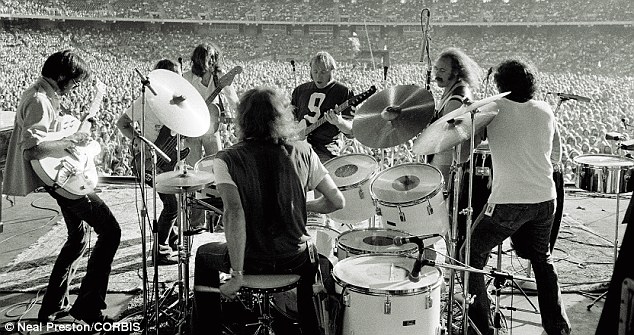
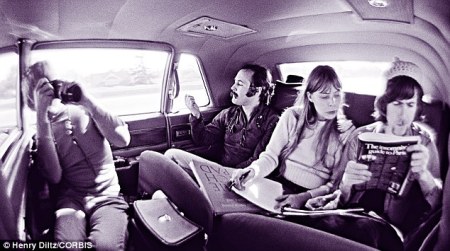
It was the biggest tour ever staged. The Beatles had played Shea Stadium and the Stones had done some big dates, but until Crosby, Stills, Nash & Young hit the stadiums and arenas of America in the summer of 1974, no rock band had ever played to that many people, night after night, for two-and-a-half months.
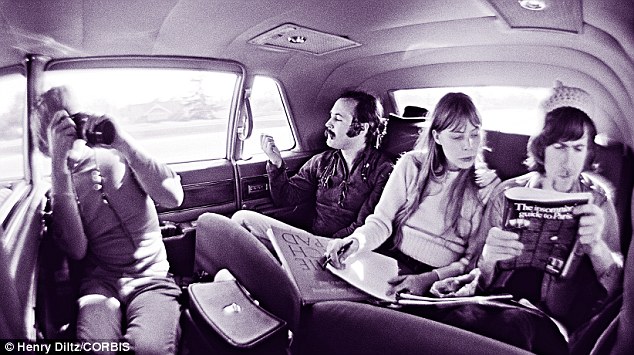
Everything was going to be first-class. Travel was in private planes, helicopters and limousines with police escorts. There were hand-embroidered pillowcases in every hotel with Joni Mitchell’s drawing of the four of us silk-screened in five colours on the front. That same logo was burned into the teak plates we all ate from.
It was a wild, profligate, orgiastic, self-indulgent tour. David Crosby, our resident free spirit, took two beautiful young women on the road with him.
Some nights, we’d have great parties, with strange people all taking the weirdest things and eating the best food – all paid for by us. Other nights, the excess would overwhelm. Tensions between us crept up all the time.
It was six years since David Crosby, Stephen Stills and I had first sung together and discovered a flawless three-part harmony that came naturally to us.
Our first album caught fire and went burning up the charts; our second show was Woodstock. We were in love with each other and in possession of something magical.

grahamnash

On an August evening in 1968, the sun was sinking in the western sky as the cab crawled up Laurel Canyon, bathing the Hollywood Hills in a golden flush of summer.
We stopped in front of a small wooden house on Lookout Mountain Avenue. Inside, lights glowed and I could hear the jingle-jangle of voices.
I leaned on my guitar case – the only baggage I’d carried off the plane at LAX – and considered again where I was and what I was doing here: leaving my country, my marriage and my band, all at once.
It was August 1968, and the Hollies and I had come to an impasse. We had grown up together and enjoyed incredible success, but we were growing apart.
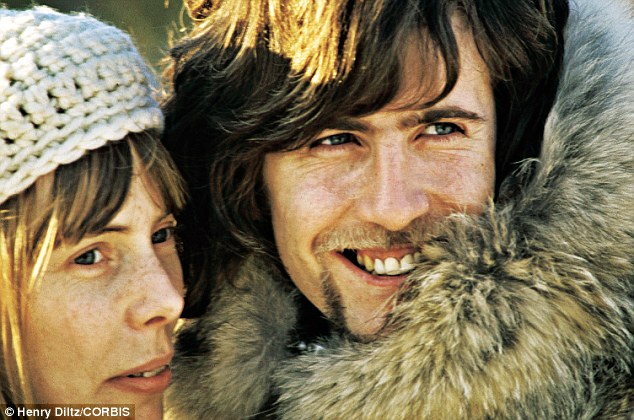
The same with my marriage: Rosie was off in Spain chasing another man, and I was in Los Angeles, the city that already felt like my new home, to visit Joni Mitchell, who had captured my heart.
For just a moment, I hesitated. Sure, I was an English rock star – I had it made. I had co-written a fantastic string of hits with The Hollies. I was friends with the Stones and The Beatles.
You could hear me whistle at the end of All You Need Is Love. But deep down, I was still just a kid from the north of England, and I felt I was out of my element.

csny

Suddenly, Joni was at the door and nothing else mattered. She was the whole package: a lovely, sylphlike woman with a natural blush, like windburn, and an elusive quality that seemed lit from within.
Behind her, at the dining room table, were my new American friends David Crosby and Stephen Stills – refugees, like me, from successful, broken bands. I grinned the moment I laid eyes on them.
I had never met anybody like Crosby. He was an irreverent, funny, brilliant hedonist who had been thrown out of The Byrds the previous year. He always had the best drugs, the most beautiful women, and they were always naked.
Stephen was a guy in a similar mould. He was brash, egotistical, opinionated, provocative, volatile, temperamental, and so talented. A very complex cat, and a little crazy, he had just left Buffalo Springfield, one of the primo LA bands.
That night, while Joni listened, the three of us sang together for the first time. I heard the future in the power of those voices. And I knew my life would never be the same.
Joni and I had first met after a Hollies show in Ottawa, Canada in March. I’d seen this beautiful blonde in the corner by herself, and I’d shuffled over and introduced myself.
‘I know who you are,’ she said, slyly. ‘That’s why I’m here.’
She had invited me back to her room at a beautiful old French Gothic hotel, where flames licked at logs in the fireplace, incense burned in ashtrays and beautiful scarves were draped over the lamps. It was a seduction scene extraordinaire.
She picked up a guitar and played me 15 of the best songs I’d ever heard, and then we spent the night together. It was magical on so many different levels.
That evening with Crosby and Stills at Joni’s, five months later, was the first time I’d seen her since.
After that, I moved out to Los Angeles for good, as soon as I had messily extricated myself from The Hollies.
The plan was to crash at Crosby’s house, where a party was always in full swing: beautiful young women all over the place, some clothed, some not so clothed. Music pulsing through the place. Hippy heaven.
csnycarpic

On my first night, in the midst of the party, Joni appeared.
Taking me by the arm, she said: ‘Come to my house and I’ll take care of you.’
America – what a country this was! I moved into Joni’s and never made it back to David’s.
Joni had a great little place, built in the 1930s by a black jazz musician: knotty pine, creaky wooden floors, a couple of cabinets full of beautifully coloured glass objects and Joan’s artwork leaning discreetly here and there.
From the moment I first heard her play, I thought she was a genius. I’m good at what I do, but genius?
Not by a long shot. She was finishing her Clouds album and writing songs for what would become Ladies Of The Canyon.
We both wrote whenever the spirit moved us, but in Joni’s house, when it came to the piano, I always gave way. If she was working there or playing guitar in the living room, I’d head into the bedroom with my guitar or simply take a walk.
Occasionally, I lingered in the kitchen, just listening to her play. I wrote there too.
On one of those grey days in LA that foreshadows spring, Joni bought a vase on the way home from breakfast.
When we got back, she gathered flowers in the garden, and while she was away from the piano, I wrote Our House, capturing that little domestic moment.
Our house is a very, very, very fine house; With two cats in the yard, life used to be so hard; Now everything is easy ’cause of you.’
Early on, Joan and I went to visit her parents in her Canadian hometown of Saskatoon. I can’t describe what her childhood room looked like because I wasn’t allowed within 20 feet of it.
Bill and Myrtle were a very straight, religious couple, and they weren’t about to let a long-haired hippy sleep with their daughter under their roof.
It wasn’t like she was a virgin – not even close. But just to make sure, they put me in a downstairs bedroom, separating us by a floor, and made it clear I’d need an army behind me if I intended to sneak up there.
Joni represented one aspect of my new life in LA; Crosby and Stills the other. Crosby and Joni had been lovers not long before, but he wasn’t the possessive type.
He had fallen in love with a beautiful girl named Christine Hinton, enjoying a ménage à trois with her friend, Debbie Donovan. He even wanted me to experience what he had, so one night when I crashed at David’s, he asked Christine to go downstairs to be with me. Rock ’n’ roll, huh?
When David, Stephen and I flew out to The Hamptons for our first serious Crosby Stills & Nash rehearsals, we rented a wooden chalet by the lake and invoked the ‘no women’ rule. We were finally free from our previous bands.

csnyonstage

We had a hell of a time, cementing our friendship, getting wasted, working up the first CSN album – three hippies wired to their eyeballs in a snowbound cabin for a month.
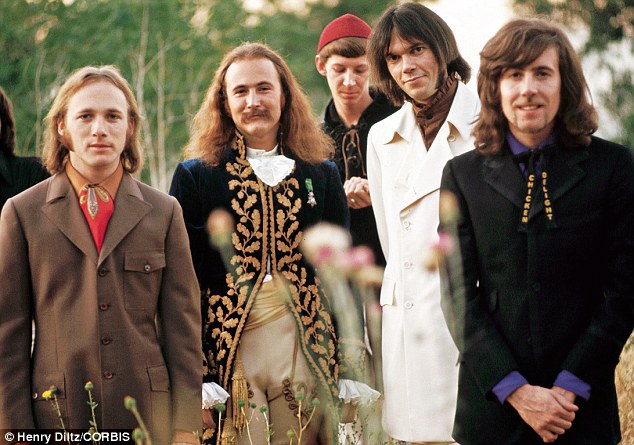
We recruited Stills’s old bandmate Neil Young as our fourth member and played our first show in Chicago. Now, I know a few things about crazy tours.
At our height, the Hollies’ shows had been insane: wall-to-wall teenage girls, screaming their heads off in a sexual frenzy at these young, good-looking guys playing loud rock ’n’ roll.
At one of our shows in Glasgow, 75 girls fainted during the Hollies’ set and had to be passed hand-over-head, like in a mosh pit.
Some of those gigs had an eerie, war-zone quality. If a chick took a shine to the lead singer, you could bet he was going to get his ass kicked by her boyfriend and his pals after the show. I can’t tell you how many buses I ran for after concerts. One time, I got three front teeth shattered.
Woodstock, however, was something else. We heard it was going to be monumental, transformative, a cultural flashpoint.
As the festival approached, rumours told of 100,000 people there, then 200,000. By the time we headed to New Jersey to catch a helicopter on the Sunday evening, they were calling it a disaster, a revolution; they were calling out the National Guard.
We flew up along the Hudson River, and then it came into view. David said it was like flying over an encampment of the Macedonian army. It was more than a city of people – it was tribal. Fires were burning, smoke was rising, a sea of hippies clustered together, shoulder to shoulder, hundreds of thousands of them.
John Sebastian of the Lovin’ Spoonful met us. We went straight to his tent at the right-hand side of the stage and got incredibly wasted. It was such a tumultuous, smoke-ridden moment that it’s hard to remember everything as it went down, but we played for an hour and we could hardly hear ourselves.
The sound of the audience was enormous, their energy thrumming like an engine. We only knew we had done well. We could sense it. As we left, Jimi Hendrix was launching into The Star-Spangled Banner.
There’s no doubt CSNY were a political band. We were flame-throwers in the best democratic sense.

We recorded Neil’s song Ohio in response to the 1970 Kent State University shooting of four American students by National Guardsmen, and we put it out within two weeks. It was us at our best: town criers, saying, ‘It’s 12 o’clock and all is not well.’

When Nixon resigned in August 1974, we were onstage at the Roosevelt Raceway in New York, in front of 60,000 people. We had a TV backstage.
‘Guess what, folks? He’s gone!’ we announced. We didn’t have to say who, everyone knew. Huge cheers erupted.
Some time before Woodstock, Joni and I had talked about marriage, but I’d already been in a marriage that ended after three years. I was very hesitant, and Joan picked right up on that. Although I loved her, our relationship started winding down.
Crosby had far worse problems. His girlfriend Christine was taking the cats to the vet, when one escaped in the van. Veering into the opposite lane, she was hit by a school bus and killed instantly. I watched a part of David die that day. He wondered aloud what the universe was doing to him. And he went off the rails; he was never the same again.
We kept working, but the hippy love and sunshine in the first album had disappeared. We were all tormented, miserable, all coked out of our minds.
We had a short tour in Europe with Joni, and it went weird in Copenhagen. A few days earlier, we did a show in Stockholm, rapping as usual about politics onstage with a gentle anti-American slant, especially when it came to the Vietnam War and the myth behind the Kennedy assassination. It upset Joan. We were in our hotel when I asked her what was up.
‘You keep slagging America after it gave you all this opportunity,’ she said. ‘Why are you biting the hand that feeds you?’
We argued. Then she poured her cornflakes and milk over my head. I was stunned, not to say p****d off.
She expected some response from me – she knew who I was. There was a maid in the room. I turned to her and said: ‘Would you kindly leave?’
Then I put Joni over my knee and I spanked her. With all due respect, she took it very well. It was over within 30 seconds.
Later, we laughed it off. I’m not so sure what she is going to make of me writing about it now, but what can I say? It happened. Me, with a bowl of cornflakes on my head, spanking Joni Mitchell. It was a crazy time.
Back in the U.S., with Crosby torturing himself over Christine’s death, he and I took his boat and embarked on a trip from Fort Lauderdale, Florida to San Francisco: 3,000 miles, seven weeks at sea, with a bottomless supply of weed and coke.
Joni met us just outside Panama, and it wasn’t pleasant. A row broke out, Joan yelling that I hated all women. Things had turned ugly between us. She decided to leave us and fly back to LA. I was somewhat relieved.
When I got home, Joni decided she needed a break. I was laying a floor in her kitchen when a telegram arrived from her. It said: ‘If you hold sand too tightly in your hand, it will run through your fingers. Love, Joan.’ I knew at that point it was truly over between us.
The Déjà Vu album made us bigger than ever, but it wasn’t exactly lovey-dovey between us. Stephen in particular was pushing the limits of cocaine madness. Driving to rehearsal one afternoon, he was distracted by a cop in his rear-view mirror and veered into a parked car, fracturing his wrist.
Both of us were smitten by the singer Rita Coolidge, a gorgeous creature: part Cherokee Indian, part Southern belle with pigtails. She ended up living with Stephen for a couple of weeks, but I didn’t think her heart was in it.
‘I really like this woman,’ I told him. ‘I think I like her more than you do, and I think she likes me more than she likes you. So having told you this, I’m going to be with her.’
Stephen didn’t say a word. Then he spat at me. This was hardly going the way I’d hoped, so I made a beeline for my car, Rita on my heels. She grabbed her clothes and left with me. Stephen and I didn’t speak for a while. I’m not sure he’s forgiven me to this day.
We nearly lost him a couple of times in those days. I remember one occasion at his house in Surrey when he OD’d. A doctor pounded on his heart while Crosby and I anticipated a bad ending. Luckily, we were wrong.
Drugs were beginning to take an even more serious toll on David, who by the mid-1980s would end up near death and ultimately in prison.
When Crosby and I did an acoustic gig at Carnegie Hall in 1973, David didn’t want to travel with his stash, so he insisted our manager David Geffen bring it to New York. Begrudgingly, Geffen agreed. He put the envelope in his briefcase, got stopped at LAX, and was arrested and taken to jail.
Somehow, Geffen made bail and got to New York. He showed up at our hotel before we went on, at which point Crosby demanded the dope.
Geffen couldn’t believe his ears. ‘I was arrested and put in jail!’ he explained, completely exasperated. ‘I don’t have it.’ David was apoplectic.
‘I’m gonna f****** kill you!’ he screamed. Geffen had the last word. He figured handling us was a nightmare and ditched us and all his rock clients, dissolving his management business.
That’s how things were by 1973. But Crosby, Stills, Nash & Young were a habit I couldn’t kick, and we jumped at that 1974 tour.
We made $12 million, though David, Stephen, Neil and I only got $300,000 each. Plenty of people took their cuts off the top, while we picked up the tab for the decadence.
We were our own worst enemy. Put the four of us in a room, and anything could trigger a fatal blast. Crosby, Stills, Nash & Young wouldn’t tour together again for 26 years.

Extracts from Graham Nash “Wild Tales” and taken from the Daily Mail

crosbynashandyoung

By early 1972, Crosby, Stills, Nash & Young were enjoying huge success, both as a group with tremendous album sales, and as a touring band in high demand. Individually, each member had recently recorded career-defining solo albums, but had not toured together in well over a year, which heightened the frenzy for any public appearance. This Sheriff’s Benefit Concert, arranged to help raise awareness of prisoner issues, featured local groups Earth Rise and Stoneground and  Elvin Bishop  headliners Crosby and Nash with a guest appearance from Neil Young a surprise during the duo’s set. He too had also been off the road, recording the now legendary Harvest album; Crosby & Nash, had also recently recorded their first, self-titled, album together.  To say the three of them together was a momentous occasion in March of 1972 is not overstating the case, as these guys were at the peak of their popularity. They were international superstars and the press was touting them as everything from the new Beatles to The Second Coming ,this is a very relaxed, totally acoustic affair. A few CSNY favourites, such as the set opener, “Wooden Ships,” and two tracks from Deja Vu, Nash’s “Teach Your Children” and Crosby’s “Almost Cut My Hair” (a rarity in acoustic form) are featured, but the set primarily focuses on newer material from solo albums by all three. This was a particularly prolific era for Graham Nash, who had released some of his most memorable songs over the previous two years. From his excellent Songs for Beginners album the politically charged “Military Madness” and “Chicago,” in addition to “I Used to Be a King,” one of his most beautiful songs Three of his best songs from the debut Crosby-Nash album are also included; “Southbound Train,” “And So It Goes” and “Immigration Man.” Crosby’s acoustic guitar playing and harmony vocals greatly enhance much of Nash’s material. In addition to the aforementioned numbers, the pair perform a lovely acoustic rendition of “The Lee Shore” and Crosby debuts “Page 43.” As one might expect, the crowd is very appreciative when Neil Young is invited to the stage, and he begins with the title track from Harvest, followed by a lovely version of “Only Love Can Break Your Heart.” When he returns later during the evening, he performs one more classic “The Needle and the Damage Done,” and then remains for the rest of the killer set.

available from Amazon £7.99

csny1

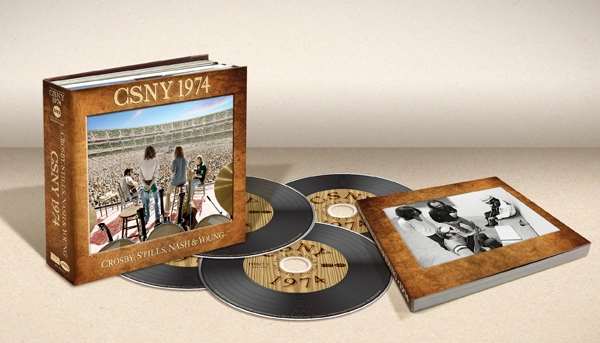
Due to be released on the 8th July a 3CD/DVD set from the bands 1974 reunion tour produced by Bill Graham,there will also be a 16 track single CD, The four members reunited for an American Arena and Stadium Tour with a further one show at Wembley stadium in London, contain 40 songs and in an order that replicates the shows running order, starting with an Electric set an acoustic set sometimes with drums and bass and sometimes not then the Kick Ass electric finale. and a DVD with 8 songs plus a 188 page booklet, there will also be a coffee table box set. there were 30 shows performances some lasting up to a period of Four hours. Graham Nash took the responsibility of sorting out the tracks but every song and every minute of each show was listened too for the best quality or best performance and then had to be authorised by each band member. The DVD has eight tracks recorded at the Capital Centre in Landover and Wembley Stadium, Neil Young was writing songs furiously at the time and would often try out the new material playing some songs only a handful of times, some rarities “Love Art blues”,”Pushed It Over The Edge”,”Don’t Be Denied” and a song called “Goodbye Dick”.

csny74

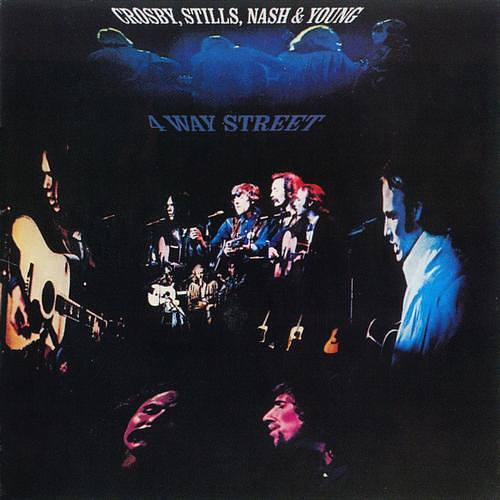
4 way street

The third album and the first live album, taken from shows at the Fillmore East in NYC, the Forum in L.A and the Chicago Auditorium, it contained music already available on their studio albums either as the band or on solo albums, Tensions were running high on this tour with constant dressing room disputes and fighting becoming legendary, fact the band did not record together for another six years in 1977, they received positive reviews, Rolling Stone saying it was their best album to date.