On this studio demo above of the song recorded by just Crosby and his Martin guitar its a softer acoustic demo of this song…recorded at a studio in Hollywood, he came in barefoot with a guitar straped across his back…and I set up 2 mics..one for him and one for his Martin, and he just did it .
Although the band did record “Triad” and perform it live during a September 1967 engagement at the Whisky a Go Go, it was eventually not included on the final release of “The Notorious Byrd Brothers” album. According to Crosby, Roger McGuinnand Chris Hillmanfelt that its subject-matter was too controversial with McGuinn allegedly deriding the song as a “freak-out orgy tune. However, this has since been denied by Hillman who has stated “I don’t think it was a moral decision. The song just didn’t work that well. David Crosby was drifting and bored and he wanted to do something else, and that song just added fuel to the fire. “Notorius Byrd Bros” would have broke big if they had kept this song and ditched that awful opening track “Artificial Energy” …..Triad was perfect for its time and would have put the Byrds right back at cutting edge status. I think the exclusion of this song from Notorious was the nail in the coffin for his days as a Byrd. And his behavior at Monterey didn’t help or his guesting with the Springield there didn’t help. Or his being adamant against ‘Goin’ Back’ being on Notorious. Regardless, David had emerged as a writer of great skill and his songs needed to be heard. They were and still are! – Although the decision to keep this song off the Notorious LP may have played a minor role, it was the power struggle between McGuinn and Crosby that led to David’s dispatch from the group.
There had been growing animosity between Crosby and the rest of the band throughout 1967. Tensions had arisen from several factors, including Crosby’s displeasure over the band’s wish to record the Goffin–King composition “Goin’ Back“, his fraternization with fellow L.A. musicians, and his controversial remarks to the audience during The Byrds’ performance at the Monterey Pop Festival. These factors, along with the discord over “Triad”, contributed to McGuinn and Hillman’s decision to fire Crosby in October 1967. Crosby then gave the song to Jefferson Airplane, who recorded it on their 1968 album, “Crown of Creation“. Airplane did it after the Byrds told Crosby they were not going to include it on their next album. He got pissed off and gave it to airplane.
David Crosby certainly shone more brightly as a solo artist with CSN; but the Byrds moved on to pioneer the genre of Country-Rock which, despite the insulting lack of recognition from the industry today, ultimately shaped the future of the Country music genre.
Crosby, Stills & Nash’sThe Acoustic Concert is mastered with a loud and full sound. Videotaped at a 1991 show in San Francisco that was done as a memorial to the group’s friend, Bill Graham, there is more here than meets the eye — indeed, what initially meets the eye is most unpromising, the decidedly overweight presence of David Crosby and Stephen Stills,Graham Nash’s metabolism won’t let him gain weight. But as it turns out the group vocal prowess is still very much intact, because they harmonize magnificently far better, in fact, than they generally did at Woodstock, and despite its being credited as The Acoustic Concert, that doesn’t stop StephenStills from picking up an electric guitar to add a little appropriate wattage to “Deja Vu,” “Just a Song Before I Go,” and more. Graham Nash, whose guitar was seldom ever even plugged in when he was in the Hollies, gets to play a little acoustic guitar on “Marrakesh Express,” in the midst of a superb lead vocal performance. “To the Last Whale” is presented visually as more of a conceptual video than anything else here, in its opening, before the camera returns to the stage for the song’s second half (featuring Nash on grand piano). Neil Young, though absent, gets a song dedicated to him in “Try to Find Me.” When Stephen Stills takes center stage for his spot, he delivers a loud, crunchy rendition of “For What It’s Worth” that’s more a deconstruction of the song than a performance — much more successful are the resurrections of “Suite: Judy Blue Eyes” (to which he tacks on an extended acoustic guitar coda that incorporates elements of “Carry On,” and a high-speed solo in which he sounds like he’s playing 16th notes) and other early songs by the trio. The cameras are constantly in motion and the editing keeps the eye moving and occupied, and the show was more than good enough to occupy the ear as well, especially with the audio quality as good as it is here.
David Crosby has the distinction of being a founding member of both the Byrds and Crosby, Stills & Nash who has survived drug busts in Texas (nine months in state prison for possession of heroin and cocaine), a hit-and-run driving accident, possession of a concealed pistol and drug paraphernalia, an arrest for driving into a fence in Marin County, a transplanted liver, the ire of Graham Nash, and fathering two children by Melissa Etheridge. He is a bit of a lightning rod to be sure! Love him or hate him, Crosby, now 79 years old, has had a stellar career. A singer-songwriter and guitarist, he wrote or co-wrote “Wooden Ships,” “Deja Vu,” “Guinnevere,” and “Lady Friend,” among others.
He is also noted for his soaring high harmonies, a trademark of his songs. In addition to performing on the Byrds first five albums (their best in my opinion), he also played on eight Crosby Stills & Nash albums including three with Neil Young), he has made solo albums, and collaborated with Graham Nash on five long players. Croz is pretty prolific workhorse. He has been inducted into the Rock and Roll Hall of Fame twice with the Byrds and Crosby, Stills & Nash. He can be seen in an excellent 2019 documentary “Remember My Name,” in which he pulls no punches about his failed relationships, scrapes with the law, and regrets about years lost to drug abuse. Crosby is certainly a survivor.
David Crosby’s 1971 solo album “If I Could Only Remember My Name” was developed in a time of great emotional upheaval but also intense creativity for David Crosby and the contributing musicians. Many if not most of the finest San Francisco musician’s fingerprints can be found on this record. Often referred to as the ‘Planet Earth Rock and Roll Orchestra’ the combination of talents can also be discovered adding their unique abilities to other albums of that era. Jefferson Starship’s Blows Against the Empire, Graham Nash’s Songs for Beginners,Mickey Hart’s Rolling Thunder as well as Paul Kantner/Grace Slick’s solo excursions feature many of the same artists. David Freiberg, Neil Young, Michael Shrieve, Graham Nash, Joni Mitchell as well as the members of the Grateful Dead and Jefferson Airplane all make appearances in various combinations equaling some mind expanding and amazing music created in the early 1970’s. This amazing time in rock history will never be witnessed again, a time where wonderful collaborations and a shared love of musical discovery took precedent over record contracts, royalties and tour receipts.
David Crosby’s 1971 masterpiece “If I could Only Remember My Name”. Emotionally recovering from the loss of his lover Christine Hinton from a devistating car crash,
“If I Could Only Remember My Name” is the result of David Crosby’s escape from depression and his eventual refuge found through music and his friends. The collaborations featured on the recordings did not occur in a vacuum, the relationships were developed early on in the respective musicians careers. Paul Kantner, Crosby and StephenStills collaborated on the songwriting of the CSN track ‘Wooden Ships’, Jerry Garcia was a ‘spiritual advisor’/producer for the Jefferson Airplane’s Surrealistic Pillow album and David Freiberg, Kantner and Crosby often cross pollinated each others work in the early stages of their careers.
Crosby gathered a superb supporting cast, one that featured the communal contributions of friends and fellow travellers, among them, members of the Grateful Dead (Jerry Garcia, Phil Lesh, Bill Kreutzmann and Mickey Hart), Jefferson Airplane (Grace Slick, Paul Kantner. Jorma Kaukonen, Jack Casady), Santana (Gregg Rolie and Michael Shrieve) and Quicksilver Messenger Service (David Freiberg), along with faithful standbys Graham Nash, Neil Young and Joni Mitchell.
The LP opens fittingly opens with the aptly titled ‘Music Is Love’. The song features three of the four principals of Crosby, Stills, Nash and Young, with Stills the only member not appearing. The song encapsulates the pervading attitude of the record with the ‘Music Is Love’ mantra harmonized by Nash and Young while Crosby spreads a soaring free form vocal over the top. Young, Crosby and Nash interweave crystalline acoustic guitars with Young offering his personal rhythm section of bass and congas and a ghostly vibraphone. The campfire vibe song rises weightless like smoke, soaking into the glorious melodic sunshine.
The cinematic and epic ‘Cowboy Movie’ follows, spotlighting the rhythm section of the Grateful Dead with Hart, Kreutzman and Lesh in addition to featuring a Jerry Garcia and Neil Young in a dusty ten paces and turn guitar duel. The story line of the tail fictionalizes the CSNY break up through the premise of a spaghetti western and comments on some of the personal issues that haunted the band, like certain principals relationship with the ‘Raven’ (Rita Coolage). Garcia and Young go toe to toe through deft uses of moaning feedback and the perfect finishing of each other’s guitar phrases. The heavy footed groove slowly gains in intensity, Crosby shreds his vocals thrillingly eventually climaxing in an instrumental orgasm that fades out much too soon. (There is a thrilling and extended version of this track available on the David Crosby box set Voyage)
The cool night air of ‘Tamalpais High (At About 3)” settles in, again featuring the Grateful Dead’s Billy K. on drums and Phil Lesh on bass. Garcia and the Airplane’s Jorma Kaukonen hold the six strings while Nash and Crosby handle the delicate wordless melody. Crosby stated that this song was not really ‘received’ by ‘CSNY’ so it ended up on his solo record. A quintessential Crosby melody, circular and umbrageous in its design, lyrical content is not required due to the aural portrait conjured by the instrumental and vocal alchemy. The organic blending of Crosby and Nash’s melody lines slither over the morphing jazz groove driven by Lesh’s thumping Alembic bass and Kreutzman’s multiple arms. Garcia and Kaukonen trade virginal clean tone lines over the additively shifty composition.
One of Crosby’s most enduring melodies and enchanted compositions, ‘Laughing’ follows and closes the first side of the record. Opening like the birth of a vibrant sunrise, the songs design is again built around the Grateful Dead rhythm section featuring Lesh’s well timed and plump detonations. Crosby’s glistening twelve string strums sparkle like solar rays through rain drops. On top of all of the swirling magic Garcia lays a sleek and spectral pedal steel line that is extremely emotive, acting as its own independent star sailing melody line. The song lyrically is the search for answers and according to Crosby directed to George Harrison and expressed psychedelically through a collaborative chorus highlighted by the smooth styling of Joni Mitchell.
Flipping over the LP, the second side of the record begins with ‘What Are Their Names’ a still relevant song that still features in CSN and CSNY set lists , but now performed acapella. This original rendition is a full band performance constructed around a descending set of changes. Three crisp guitars wrap themselves around a central pole to open the song, Crosby, Garcia and Young gently caressing the songs internal melody. As the drums and bass enter (Shrieve and Casady) the song gains a slightly disturbing and dramatic edge, Young and Garcia’s guitars bite deep. The finger pointing lyrics are sung in huge super group choral fashion featuring but not limited to Crosby, Nash, Grace Slick, Paul Kantner, Laura Allen and possibly Crosby’s brother Ethan. A stunning start to side two and a commentary on the organic creation of the music contained on the record.
‘Traction in the Rain’ follows next and allows time for Crosby acoustic introspection. The drumless melody hangs weightless on woody strums and finds Crosby and Nash on shimmering acoustics and Laura Allen contributing on beautiful and cascading auto harp. Crosby’s vocals are some of the finest on the record and the song would become a highlight of future Crosby/Nash duo performances.
‘Song with No Words (Tree with No Leaves)’ is a prismatic meditation where in a role reversal, the music colours and supports the stunning wordless Crosby/Nash vocal melody. The supporting players act as one swirling instrument enveloped into each other through intent listening. The players cannot always be confirmed on these resulting tracks, but my ear hears, Garcia, Kaukonen, Shreive, Nash and possibly Young on piano. In the ‘rock room’s humble opinion one of the finest tracks on the record.
The final two songs of the LP are also wordless compositions. In many ways this increases the emotional effectiveness and melodic strength contained within the numbers. ‘Orleans’ is a traditional French children’s song that lists the cathedrals of France. Of course Crosby arranges it into a strange and weaving mood piece based around overdubbed acoustics and his perfectly stratified vocals.
The album closes with the exhilarating and supernatural ‘I’d Swear There Was Somebody Here’. A vocal only movement, Crosby is quoted as saying he was in a good place, high as a kite and experimenting with the echo chamber in Wally Heider’s studio. Crosby sang six different parts developed on the spot, vocally improvised and bringing into existence a masterful representation of his recently departed love. Crosby felt that the creation of this song was initiated by Christine visiting him and/or making her presence known to him during the song’s genesis. Something is definitely happening during the brief apparitional and aural experience. This song epitomizes what this music is all about, remembering, feeling, expressing and being in the moment. The track is a fitting conclusion to the record and inspiring statement of Crosby’s talent and the towering importance of the record in the pantheon of rock history.
David Crosby’s musical journey is a tale rife with contradictions. There’s the obvious brilliance he first shared while with the Byrds and then, later, his contributions to America’s first true supergroup, Crosby, Stills, Nash and (at times) Young. By having a hand in the writing of songs that helped define both bands—among them, such enduring classics as “Lady Friend,” “Why” and “Eight Miles High” for the former, and “Guinnevere,” “Wooden Ships,” “Almost Cut My Hair” and “Déjà Vu” for the latter—he played a major role in establishing a timeless template that reflected a freedom-first attitude of the ’60s that resonates even today. Likewise, his rich tenor and unmistakable jazz-like sensibilities imbued each group with a firm foundation for their exacting vocal harmonies. Crosby also helped establish a free-flowing communal kind of creativity, another distinctive element that led to a more synchronous sound.
Engineer Stephen Barncard had his reservations when he was assigned to do the record, referring to Crosby’s reputation as being that of an “asshole.” However in Crosby’s autobiography Long Time Gone, he describes the recording, which began in November 1970, as “the most exhilarating project I’ve ever done in my life…It was a loose setup…but I learned to relax with it and before we knew it we were ready to mix.”
Crosby and chief Byrd watcher Roger McGuinn clashed when Crosby insisted the group record his ode to hedonism, “Triad,” a song that celebrated the joys of a ménage à trois (they didn’t record it, but Jefferson Airplane happily included it on one of their albums). During 1967’s Monterey Pop Festival, Crosby broke ranks with a rant about a Kennedy assassination coverup, after which he famously took the stage with Buffalo Springfield, filling in for an absent Neil Young.
If I Could Only Remember My Name is not only a career defining statement for David Crosby it is also a commentary on the collaborative and communal environment surrounding music in the 1960’s and 1970’s. Friends created music on this record, credits or royalties did not matter. What mattered was sharing in the making of something bigger and better than its individual components. The songs contained on this record are inspired by the joy of giving and creating and the proof lies within the jagged grooves of its vinyl. The record is arguably David Crosby’s finest achievement and a photographic capture of some of the contributing musician’s finest moments ever committed to tape. The record is a standard of the rock room and a must have addition to any rock collection . (Note: an outtake from the sessions, “Kids and Dogs,” later included on Crosby’s Voyage anthology, would also have found a fit within that surreal setting.)(There are also a multitude of outtakes of the sessions available for those willing to search)
By early 1972, Crosby, Stills, Nash & Young were enjoying huge success, both as a group with tremendous album sales, and as a touring band in high demand. Individually, each member had recently recorded career-defining solo albums, but had not toured together in well over a year, which heightened the frenzy for any public appearance. This Sheriff’s Benefit Concert, arranged to help raise awareness of prisoner issues, featured local groups Earth Rise and Stoneground and Elvin Bishop headliners Crosby and Nash with a guest appearance from Neil Young a surprise during the duo’s set. He too had also been off the road, recording the now legendary Harvest album; Crosby & Nash, had also recently recorded their first, self-titled, album together. To say the three of them together was a momentous occasion in March of 1972 is not overstating the case, as these guys were at the peak of their popularity. They were international superstars and the press was touting them as everything from the new Beatles to The Second Coming ,this is a very relaxed, totally acoustic affair. A few CSNY favourites, such as the set opener, “Wooden Ships,” and two tracks from Deja Vu, Nash’s “Teach Your Children” and Crosby’s “Almost Cut My Hair” (a rarity in acoustic form) are featured, but the set primarily focuses on newer material from solo albums by all three. This was a particularly prolific era for Graham Nash, who had released some of his most memorable songs over the previous two years. From his excellent Songs for Beginners album the politically charged “Military Madness” and “Chicago,” in addition to “I Used to Be a King,” one of his most beautiful songs Three of his best songs from the debut Crosby-Nash album are also included; “Southbound Train,” “And So It Goes” and “Immigration Man.” Crosby’s acoustic guitar playing and harmony vocals greatly enhance much of Nash’s material. In addition to the aforementioned numbers, the pair perform a lovely acoustic rendition of “The Lee Shore” and Crosby debuts “Page 43.” As one might expect, the crowd is very appreciative when Neil Young is invited to the stage, and he begins with the title track from Harvest, followed by a lovely version of “Only Love Can Break Your Heart.” When he returns later during the evening, he performs one more classic “The Needle and the Damage Done,” and then remains for the rest of the killer set.
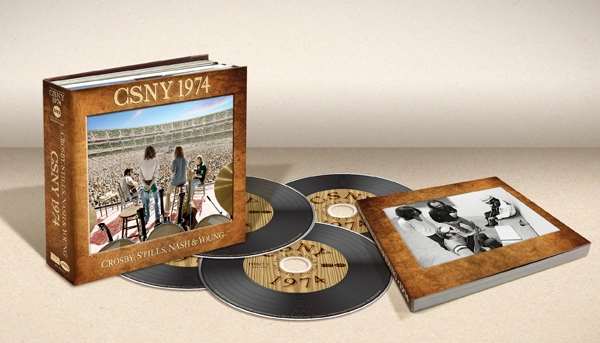
Due to be released on the 8th July a 3CD/DVD set from the bands 1974 reunion tour produced by Bill Graham,there will also be a 16 track single CD, The four members reunited for an American Arena and Stadium Tour with a further one show at Wembley stadium in London, contain 40 songs and in an order that replicates the shows running order, starting with an Electric set an acoustic set sometimes with drums and bass and sometimes not then the Kick Ass electric finale. and a DVD with 8 songs plus a 188 page booklet, there will also be a coffee table box set. there were 30 shows performances some lasting up to a period of Four hours. Graham Nash took the responsibility of sorting out the tracks but every song and every minute of each show was listened too for the best quality or best performance and then had to be authorised by each band member. The DVD has eight tracks recorded at the Capital Centre in Landover and Wembley Stadium, Neil Young was writing songs furiously at the time and would often try out the new material playing some songs only a handful of times, some rarities “Love Art blues”,”Pushed It Over The Edge”,”Don’t Be Denied” and a song called “Goodbye Dick”.
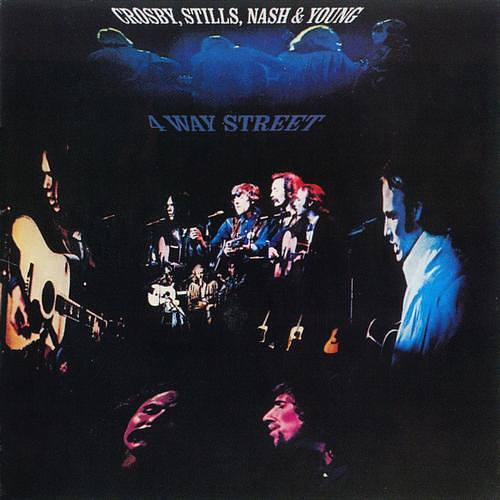
The third album and the first live album, taken from shows at the Fillmore East in NYC, the Forum in L.A and the Chicago Auditorium, it contained music already available on their studio albums either as the band or on solo albums, Tensions were running high on this tour with constant dressing room disputes and fighting becoming legendary, fact the band did not record together for another six years in 1977, they received positive reviews, Rolling Stone saying it was their best album to date.


:format(jpeg):mode_rgb():quality(90)/discogs-images/R-4698673-1484915399-6061.jpeg.jpg)


 The Fat Angel Sings