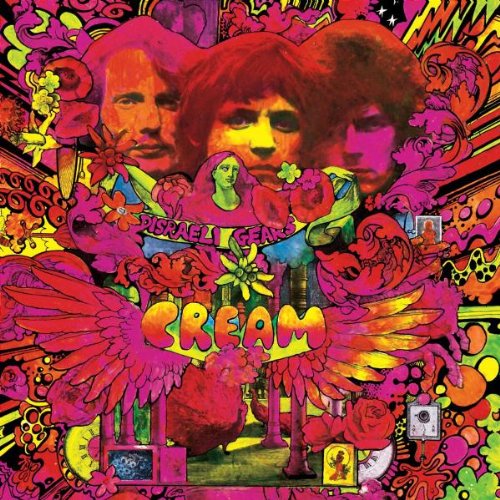
“Disraeli Gears” is the second studio album by the British rock band Cream. It was released in November 1967. The album features the two singles “Strange Brew” and “Sunshine of Your Love”. The album was recorded at Atlantic Studios in New York during May 1967, following the band’s nine shows as part of Murray the K’s “Music in the 5th Dimension” concert series. The sessions were produced by the future Mountain bassist Felix Pappalardi who also co-wrote the tracks “Strange Brew” and “World of Pain” with wife Gail Collins and were engineered by Tom Dowd According to Dowd the recording sessions took only three and a half days.
Disraeli Gears that turned Cream into a “supergroup.” Here they pursue the psychedelic ideals of the era with total abandon (the LP cover art still stands as one of the 1960s’ most striking designs), merging these ideals with their take on the blues and adorning the amalgamation with some superb pop craftsmanship. Of the 11 originals here, four–“Tales of Brave Ulysses”, “SWLABR”, “Strange Brew” and “Sunshine of Your Love”–earned major airplay. This, their excess-free greatest moment, does the Cream legend proud. “Disraeli Gears” features the group veering away, quite heavily, from their blues roots and indulging in more psychedelic sounds. The most blues-like tunes on the album are the remake of “Outside Woman Blues”, the Bruce/Brown composition “Take it Back” which had been inspired by the contemporary media images of American students burning their draft cards which featured harmonica work by Jack Bruce, and the opening track “Strange Brew” which was based on a 12-bar blues song called “Lawdy Mama” and featured Eric Clapton copying an Albert King guitar solo, note for note
The album title started as a joke. Mick Turner one of Cream’s roadies was discussing with drummer, Ginger Baker, how he fancied one of those bikes with’ Disraeli gears’. He meant, of course, derailleur gears, but the band found the mistake hilarious and so the name of one of one of the UK’s premier psychedelic albums was born.
For this Second album it was far different. Chemicals had been imbibed, Clapton had struck up a friendship with Australian artist Martin Sharp who not only provided the lyrics of “Tales Of Brave Ulysses” but also came up with the splendidly baroque cover. Meanwhile Jack Bruce was now working with underground poet, Pete Brown, whose lyrics were equally trippy. “SWLABR” (it stands for ‘She walks like a bearded rainbow’), “Dance TheNight Away” and “Sunshine Of Your Love” were perfect encapsulations of the point where the blues got psychedelic and in turn got heavy. “Sunshine…”’s riff is at once iconic and defines the power trio aesthetic that was to prove so popular with the band’s many disciples.
The other creative catalyst was producer Felix Pappalardi. Co-writing both “World Of Pain” he also helped transform the blueswailing “Lawdy Mama” into the slinky “Strange Brew” – a contender for best album opener of all time. Clapton’s guitar had by now been exposed to the effects heavy stylings of Jimi Hendrix and his heavy use of wah-wah gives Disraeli Gears just the right amount of weirdness, making this probably the most experimental album he ever made. The modish inclusion of Ginger Baker’s rendition of “A Mother’s lament” was the edwardiana icing on the cake.
On this day (February. 20th) in 1969: the ill-fated rockumentary ‘Farewell Concert’, documenting Cream’s final performance at London’s Royal Albert Hall, opened in Baltimore, Maryland; director Tony Palmer incorporated pieces of six performances with narration by BBC announcer Patrick Allen & interviews with the band members themselves, showcasing their playing abilities; it was critically panned for its mediocre sound & visual effects; a much-improved special extended edition was issued in 2005, featuring full versions of all songs separated from the narration & interviews, digitally remastered sound & video, plus three bonus songs
The band had performed two sets at the Albert Hall, but it is believed only the second set was filmed in its entirety. Several times during the performance, it is apparent that the on-screen shot is not in sync with the audio. In fact, in several songs, including duringGinger Baker‘s drum solo, he seems to change clothes at lightning speed due to careless post-editing, as well as Eric Clapton playing 2 different guitars. This is because footage from both sets, with the band wearing different clothes and Clapton using a Gibson Firebird for the first set, a Gibson 335 for the second, were edited together. The BBC used 4 static cameras and 2 hand held cams, all recording onto video tape, whilst Palmer himself filmed footage at the front of the stage, utilising a 16mm film camera. The difference in quality can be detected easily during the broadcast. However, the BBC “Pete Drummond” version was better quality overall, and is the only version that has these 16mm film clips removed – the remastered release on the 2005 DVD presents both audio and video in excellent quality.
Ginger Baker himself has lashed out in an interview against the Farewell Concert video, claiming: “Cream was so much better than that.” Nonetheless, most Cream fans regard the actual performance with great enthusiasm, discarding the poor quality of the video.
Farewell Concert is the live recording of the Cream’s final concert at the Royal Albert Hall on 26th November 1968. Aside from the band’s reunion concert in 2005, it is Cream’s only official full concert release on video. It was originally broadcast by the BBC on 5th January 1969. It was not released on video in the US until 1977. The opening act for the concert was future progressive rock stars Yes who were just starting out.
Cream may have had all too short a lifespan as far as their millions of admirers around the world were concerned — but at least they had the chance to say ‘Goodbye’ to each other. That, of course, was the title of the trio’s fourth and final studio album, released a few weeks after they announced that they would soon be splitting. The album made its American chart debut 47 years ago exactly, on February 15, 1969.
It had been an eventful few months forEric Clapton, Jack Bruce and Ginger Baker, who had only released the preceding album, ‘Wheels Of Fire,’ the previous July in the UK. Then came the announcement that Cream would call it quits after a farewell tour that autumn.
With a shortage of material available, ‘Goodbye’ was something of a mixed bag. Just as ‘Wheels Of Fire’ had (in its double LP version) been one disc of studio recordings and another of live performances, the final album was another 50-50 split. Three of its six tracks were recorded at the Forum in Los Angeles on that last tour. 19th October 1968 . The other tracks recorded October 1968 at IBC Studiosin London, UK.
But the record did boast a very fresh and newsworthy studio number, and one written by Clapton with GeorgeHarrison, no less: ‘Badge’ featured George, or “L’Angelo Mysterioso” as he had to be credited for contractual reasons, on rhythm guitar. The song became, in many eyes, the last classic Cream number, and went on to reach the UK top 20 as a single.
Badge was written by Eric Clapton and George Harrison. In Georges handwritten lyrics he wrote the word “Bridge” as in bridge of a song and Clapton thought that it was “Badge” so they named the song that.
It appeared on Cream’s final album “Goodbye.”… Ringo Star threw in a line also.
George Harrison on writing Badge with Clapton
I helped Eric write “Badge” you know. Each of them had to come up with a song for that Goodbye Cream album and Eric didn’t have his written. We were working across from each other and I was writing the lyrics down and we came to the middle part so I wrote ‘Bridge.’Eric read it upside down and cracked up laughing – ‘What’s BADGE?’ he said. After that, Ringo [Starr] walked in drunk and gave us that line about the swans living in the park
I like when a band does something different. After blitzing audiences with Crossroads, Whiteroom, Sunshine of Your Love, and Strange Brew…out comes this song. It’s not my favorite Cream song…that would be Badge but this one always makes me smile.
The song was written by Eric Clapton and Martin Sharp for the movie “Savage Seven.” Unfortunately, this was nearing the end of Cream’s run.
Cream appeared on the Smothers Brothers and mimed this song. Who the hell knows what it means but when I heard “And the elephants are dancing on the graves of squealing mice. Anyone for tennis, wouldn’t that be nice?” I was hooked. It’s hard to get it out of your head once you listen to it.
‘Goodbye’ made its US chart entry on Billboard’s Top LPs chart, as it was called at the time, at No. 107, as ‘The Beatles’ moved back to No. 1. In a 26-week chart run, it spent two weeks at No. 2 in March, held off the top spot by Glen Campbell’s ‘Wichita Lineman.’
10 x 7” singles from the original rock power trio. Cream blazed an indelible trail through the latter half of the ‘60s with their challenging and exquisite mélange of blues, pop and psychedelia. These tracks offered a window to the wilder, widescreen adventures of their long players and here they are in glorious mono with specially designed picture sleeves; a fitting tribute to the skills of the three players, and especially to Jack Bruce, who left us in October 2014.
• Original mono versions, deleted since 60s. 10 x 7” singles, picked from Reaction, Atco and Polydor labels.
• Each 7” single comes complete with a brand new exclusively designed picture sleeve.
• Housed in a rigid ‘lid-and-tray’ box, full colour and matt lamination.
• Standard weight, classic dinked vinyl.
• Cream collectors dream!
Did you know that ‘Wrapping Paper’ was Cream’s very first single? If you didn’t, and you’ve never heard it we think you may be more than a little shocked. The band that became the model for just about every heavy rock band that followed in the immediate wake, sound anything but a rock band. Even allowing for the kind of off the wall reviews that appeared in 1960s pop papers this one is surprisingly accurate. This is the very first review of any Cream release, anywhere in the world.
Released by Reaction Records in the UK early October 1966 this piece of whimsical jazz influenced pop was written by Jack Bruce and Pete Brown (Pete co-wrote ‘I Feel Free’, ‘White Room’ and ‘SWLABR’ with Jack and ‘Sunshine of Your Love’. WithEric Clapton). ‘Wrapping Paper’does feature a guitar solo, but it’s far from a trademark blistering blues outing. According to Ginger Baker, “‘Wrapping Paper’ is the most appalling piece of shit I’ve ever heard in my life! I was totally against it, right from the start... Eric and I didn’t like it”
‘Wrapping Paper’ made the UK singles chart on 22 October 1966 and eventually staggered to No.34, but no higher. The b-side is ‘Cat’s Squirrel’, a song made popular by bluesman Doctor Ross, that was also the opening track on side 2 of Fresh Cream the band’s debut album that was released in early December 1966. Unsurprisingly given Ginger’s views it did not include ‘Wrapping Paper’: Fresh Cream did come out in Sweden with ‘Wrapping Paper’ included.
The very first advert for any Cream release…
Single 1: Reaction 591007
Wrapping Paper 2.24
Cat’s Squirrel 2.59
Single 2: Reaction 591011
I Feel Free 2.48
NSU 2.43
Single 3: Atco 6522
Spoonful – Part I 2.25
Spoonful – Part II 2.28
Single 4: Reaction 591015
Strange Brew 2.45
Tales Of Brave Ulysses 2.50
Single 5: Polydor 56258
Anyone For Tennis 2.37
Pressed Rat And Warthog 3.12
Single 6: Polydor 56286
Sunshine Of Your Love 4.11
SWLABR 2.30
Single 7: Polydor 56300
White Room 4.58
Those Were The Days 2.52
Single 8: Atco 6646
Crossroads 4.16
Passing The Time 4.31
Single 9: Polydor 56315
Badge 2.43
What A Bringdown 3.56
Single 10: Atco 6708
Lawdy Mama 2.47
Sweet Wine 3.16
Arguably the supergroup to beat them all, Cream were formed during that incredible summer of 1966 amidst a period of huge artistic upheaval in British rock, with psychedelia beginning to infiltrate the mainstream. Eric Clapton, Jack Bruce and the estimable Ginger Baker pooled their talents, bringing skills perfected in the Yardbirds, John Mayall & The Bluesbreakers and the Graham Bond Organisation. It’s impossible to overstate the goodwill and praise heaped upon them by press and public alike and from the outset their studio music and live performances became a byword for excellence, enabling them to rival the The Who and The Rolling Stones as one of the most fruitful periods in British rock history started to make England swing.
Their albums and singles successes include – well everything. Consider that their third disc, Wheels of Fire, was Britain’s first Platinum selling double album. So they had impeccable progressive integrity. Yet they also knocked out wah-wah driven hits ‘Sunshine of Your Love’, ‘I Feel Free’, ‘White Room’ and the sublime ‘Badge’, that featured George Harrison and kick-started another new chapter in the music business. They were also fashion icons, post-mod dandies of the underground. They were all over the scene.
Cream’s musical dexterity Eric Clapton’s epic guitar playing, Bruce’s jazz sculpted bass and impeccable vocals, and Ginger Baker’s virtuosity around his drum kit foreshadow the arrival of Led Zeppelin, The Jeff Beck Group and the whole second British Invasion of the late 1960s in America. Cream pioneered that. Considering they were only really together for just over two years they were incredibly prolific and became such a legend that their reunion dates in 2005 were as eagerly anticipated as those of Led Zep.
Rock and Roll Hall of Famers, individually and collectively, creators of seven Top 40 UK hits, holders of six consecutive Gold selling albums Cream’s achievements are many and their legacy is to be a lasting influence on power trios, the beginnings of heavy metal and classic British blues rock – modern music full stop.
Eric Clapton’s presence as the pre-eminent British guitar player of his day meant that when he quit the Yardbirds there were already signs of the graffiti ‘Clapton is God’ adorning London walls. His friendship with Jack Bruce and Ginger Baker stemmed back to nights sitting in with the Graham Bond Organisation and at Baker’s instigation the trio was formed and readily named as a semi-jocular reference to their ‘cream of the crop’ reputations. In reality Cream also endured a long period of internal friction. Baker’s view that Cream might become a jazz-rock hybrid wasn’t really shared by the others who preferred to wander into psych or white blues and soul. That tension only made them sound better. After playing a club date and headlining the Windsor Jazz and Blues Festival, Cream were joined for an on-stage jam by Jimi Hendrix and suitably energised by his endorsement, the band began to get down to serious song writing.
The debut Fresh Cream was recorded in London in the late summer of ’66 during a period of intense national euphoria following the England team’s victory at the World Cup Final and released at Christmas. Musically, Fresh Cream is a pointer to things to come. It combines elastic pop tunes like ‘N.S.U.’ with exploratory blues affairs: you can hear the participants sizing each other up on ‘Spoonful’ and ‘Toad’.That sense of boundaries being pushed is significant, since most other records of the time were based around some kind of democratic structure. Cream sounded like they were about to break out and go nuts.
This they did on Disraeli Gears (1967), a fully-fledged psychedelic and hard rock masterpiece knocked out in short order in New York’s Atlantic Studio during May ’67. Pulsating tracks ‘Sunshine of Your Love’ and ‘Strange Brew’ were epic enough when heard on the radio, but takes of ‘Tales of Brave Ulysses’, Baker’s ‘Blue Condition’ and ‘Outside Woman Blues’ continued to break down barriers. Bruce had brought the lyricist PeterBrown into the fold so while they continued to mine traditional material and give it a fresh Cream slant they also had a poetic slant to contemplate now. ‘Strange Brew’ was actually a co-write between Eric and the American husband and wife team of Felix Pappalardi and Gail Collins (they also penned ‘World of Pain’). While the trio combined to grand effect on the harmonised ‘Mother’s Lament’. A calm before the storm?
Disraeli Gears would go Platinum, as would their third album Wheels of Fire. This double is half-studio (London, August ‘67) and half-live from the West Coast (March ’68), where the San Francisco elite (the Dead and Airplane included) feted Cream. Pappalardi was now brought in to produce and he extracted marvellous performances. The first part of the pact includes such revered neo-metal items as ‘White Room’ and ‘Politician’ (Bruce and Brown in tandem) while the second album allows listeners to hear Cream in their expanded pomp, jamming around ‘Crossroads’, ‘Spoonful’, ‘Traintime’ and ‘Toad’. Each band member gets ample room to shine and this is generally considered to be one of the most inspired and vital recordings of this or any other epoch. It is totally recommended.
Wouldn’t you know it; just as their star burns brightest, Cream decided to disband. But that was the spirit of the era. Musicians were restless and keen to explore new ground. Even so they left behind a generous farewell gift, the album Goodbye (1969). Having given their notice of a slightly protracted farewell tour, Cream played at the Royal Albert Hall and the Forum in Los Angeles, amongst other venues. Three of the songs on the disc are taken from a show at the Forum, making a seamless transition from the previous set.
The luscious ‘Badge’ which features some of Clapton’s most thrilling guitar work also has a rhythm guitar and vocal cameo from George Harrison, and the poignantly titled ‘What a Bringdown’ bring this chapter to a close. Goodbye is a very esoteric set indeed.
But that’s by no means the end . Live Cream Volume 1 and Live Cream Volume 2 compile their Fillmore West, Winterland and Oakland Coliseum shows from the American 1968 tour, but with some subtle differences that make them both hugely worthwhile. The first disc features ‘Hey Lawdy Mama’ done after the style of Buddy Guy and Junior Wells, and a precursor to ‘Strange Brew’, while the re-mastered editions allow one to explore ‘Deserted Cities of the Heart’ and the strung out version of James Bracken’s ‘Steppin’ Out’.
just as invaluable is the superb BBC Cream Sessions (recorded between 1966-1968) since this captures them in a neutral environment, often showcasing their material for the first time to fans. The first five tracks are taken from a November ’66 performance at the Playhouse on Lower Regent Street, and were aired on radio even before the debut album Fresh Cream became available. There are also pieces from Top Gear, the rare Guitar Club take on ‘Crossroads’ (done for the Home Service) and three live in the studio recordings made for the World Service. A most unusual and desirable artifact – this 26-track disc is a valuable historical document.
The Very Best of Cream and Those Were The Days are a classic compilation and a classic compilation plus. The second collection is a 4-CD marvel stuffed full of rarities, demos, unreleased material and single B-sides. We’re digging on the long form ‘Toad’, freaking out to the version of ‘Sunshine of Your Love’ they cut for the Glen Campbell Show in 1968, the demo on ‘Weird of Hermiston’ and the flipside track ‘Anyone for Tennis’. There’s so much to discover here. As a supplementary, we also have The Cream of Clapton, a more than nifty run through Eric’s work as a solo artist, founder of Derek and the Dominos and axe man incarnate with the Cream boys.
Hendrix wasn’t one to play by the rules, and on Jan. 4, 1969, during a guest appearance on the Lulu television show, the guitar legend was up to the task. While Lulu was a great pop singer, she and Hendrix were pretty much worlds apart in the public eye,. Still, the producers of her BBC TV show booked the Jimi Hendrix Experience and approached Hendrix about singing a duet with Lulu on her big hit, “To Sir With Love,” which was not first and foremost on Jimi Hendrix’s mind, to say the least.
The band were scheduled to perform two songs, one from their latest LP, Electric Ladyland, and later in the show, they were to do their first U.K. hit, “Hey Joe.” According to Noel Redding in his autobiography, Are YouExperienced?, Lulu would join the band to finish up “Hey Joe” before a segue into her signature song. To deal with the stress of the situation, Redding said the band were “so straight it was only natural that we would try to combat that atmosphere by having a smoke in our dressing room. In our haste, the lump of hash got away and slipped down the sink drainpipe,” he continued. “I found a maintenance man and begged tools from him with the story of a lost ring. He was too helpful, offering to dismantle the drain for us. It took ages to dissuade him, but we succeeded in our task and had a great smoke.”
The band went on and performed “Voodoo Child” as scheduled, but once Lulu introduced the band for their classic take on “Hey Joe,” the Experience veered loudly off script. A raucous free-form, feedback-drenched jam eventually gave way to “Hey Joe,” but midway through, Hendrix stopped and announced “We’d like to stop playing this rubbish and dedicate a song to the Cream, regardless of what kind of group they may be in. We dedicate this to Eric Clapton, Ginger Baker and Jack Bruce.”
At that moment, the band plowed through an instrumental version of the Cream classic “Sunshine of Your Love.”Cream had just announced their breakup, hence the tribute. “We played past the point where Lulu might have joined us,” said Redding. “Played through the time for talking at the end, played through [producer] Stanley [Dorfman] tearing his hair, pointing to his watch and silently screaming at us.”
This stunt, which led to a ban on Hendrix and friends by the BBC, would be imitated eight years later by ElvisCostello during an appearance on Saturday Night Live. Costello and the Attractions started off playing “Less Than Zero,” before he stopped the song and the band kicked into “Radio Radio.” NBC banned Costello for 12 years. He later admitted that it was indeed an homage to Hendrix on the Lulu show.
Live In Iowa City, Iowa on June 7, 2013. Richard Thompson thinks of music as a spiritual act and as soon as he picks up a guitar you don’t doubt him. There is a great deal more than flesh and blood and bone about his fingers. Thompson, always the dark horse in those Rolling Stone polls to determine the greatest guitarist of all time, who John Peel liked to call the “best-kept secret in the world of music”, is one of the few artists who derives inspiration from both Sufi mysticism and the back catalogue of George Formby. He has taken lately to playing on stagea not-quite random shuffle from the greatest hits of the past 1,000 years: he channels multitudes.
the Former bass guitar player and a great harmonica player Jack Bruce who formed the influential band Cream along with Eric Clapton and Ginger Baker, Bruce who wrote some of the band biggest songs “Sunshine Of your Love ” and “I Feel Free” the band split up after only two years together in 1968.After Cream Bruce played jazz with artists like John Mclaughlin and drummer Tony Williams and rock musicians Lou Reed and Frank Zappa.Cream reformed for brief concerts in 1995 and 2003, Bruce born in Glasgow started playing bass as a teenager and dropped out of music school because he was not allowed to play jazz. Bruce also recorded many solo albums with the last one released last March. there are report he was suffering from a liver disease.




 The Fat Angel Sings