


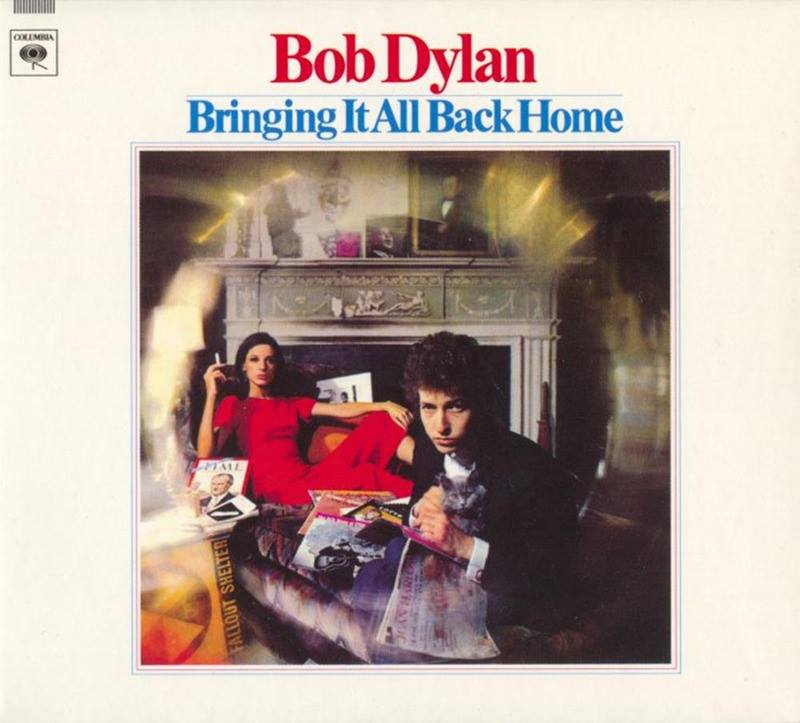
Bringing It All Back Home is the fifth studio album by American singer-songwriter Bob Dylan, released in March 1965 by Columbia Records. The album is divided into an electric and an acoustic side. On side one of the original LP, Dylan is backed by an electric rock and roll band—a move that further alienated him from some of his former peers in the folk song community. Likewise, on the acoustic second side of the album, he distanced himself from the protest songs with which he had become earlier identified (such as “Blowin’ in the Wind” and “A Hard Rain’s a-Gonna Fall”), as his lyrics continued their trend towards the abstract and personal. although the acoustic side included some tracks in which other instruments were backing up Dylan and his guitar, but no drums were used.
The album reached the top ten of the Billboad Albums chart, the first of Dylan’s LPs to break into the US top 10. It also topped the UK charts later that Spring. The lead-off track, “Subterranean Homesick Blues”, became Dylan’s first single to chart in the US, This is the point where Dylan eclipses any conventional sense of folk and rewrites the rules of rock, making it safe for personal expression and poetry, not only making words mean as much as the music, but making the music an extension of the words. A truly remarkable album.
“She Belongs To Me” extols the bohemian virtues of an artistic lover whose creativity must be constantly fed (“Bow down to her on Sunday / Salute her when her birthday comes. / For Halloween buy her a trumpet / And for Christmas, give her a drum.”)
“Maggies Farm” is Dylan’s declaration of independence from the protest folk movement. Punning on Silas McGee’s Farm, where he had performed “Only A Pawn In Their Game”at a civil rights protest in 1963 (featured in the film Dont Look Back), Maggie’s Farm recasts Dylan as the pawn and the folk music scene as the oppressor. Rejecting the expectations of that scene as he turns towards loud rock’n’roll, self-exploration, and surrealism, Dylan sings: “They say sing while you slave / I just get bored.”
“Love Minus Zero/No Limit” is a low-key love song, a “hallucinatory allegiance, a poetic turn that exposes the paradoxes of love (‘She knows there’s no success like failure / And that failure’s no success at all’)…[it] points toward the dual vulnerabilities that steer ‘Just Like A Woman.’ In both cases, a woman’s susceptibility is linked to the singer’s defenseless infatuation.” Among other things, Bringing It All Back Home had a substantial effect on the language of a generation.
“Outlaw Blues” explores Dylan’s desire to leave behind the pieties of political folk and explore a bohemian, “outlaw” lifestyle. Straining at his identity as a protest singer, Dylan knows he “might look like Robert Ford” (who assassinated Jesse James), but he feels “just like a Jesse James”.
“On The Road Again” catalogs the absurd affectations and degenerate living conditions of bohemia. The song concludes: “Then you ask why I don’t live here / Honey, how come you don’t move?”
“Bob Dylan’s 115th Dream” narrates a surreal experience involving the discovery of America, “Captain Arab” (a clear reference to Captain Ahab Of Moby Dick fame), and numerous bizarre encounters. It is the longest song in the electric section of the album, starting out as an acoustic ballad before being interrupted by laughter, and then starting back up again with an electric blues rhythm. The music is so similar in places to Another Side of Bob Dylan’s “Motorpsycho Nitemare” as to be indistinguishable from it but for the electric instrumentation. The song can be best read as a highly sardonic, non-linear (historically) dreamscape parallel cataloguing of the discovery, creation and merits (or lack thereof) of the United States.
“Gates Of Eden” builds on the developments made with “Chimes of Freedom” and “Mr. Tambourine Man”. “Of all the songs about sixties self-consciousness and generation-bound identity, none forecasts the lost innocence of an entire generation better than ‘Gates of Eden,’” “Sung with ever-forward motion, as though the words were carving their own quixotic phrasings, these images seem to tumble out of Dylan with a will all their own; he often chops off phrases to get to the next line.” (This is the only song on the album that is mono on the stereo release and all subsequent reissues.)
One of Dylan’s most ambitious compositions, “Its AlrightMa (I’m Only Bleeding) is arguably one of Dylan’s finest songs. Heylin wrote that it “opened up a whole new genre of finger-pointing song, not just for Dylan but for the entire panoply of pop”, A fair number of Dylan’s most famous lyrics can be found in this song: “He not busy being born / Is busy dying”; “It’s easy to see without looking too far / That not much is really sacred”; “Even the president of the United States / Sometimes must have to stand naked”; “Money doesn’t talk, it swears”; “If my thought-dreams could be seen / They’d probably put my head in a guillotine.” In the song Dylan is again giving his audience a road map to decode his confounding shift away from politics. Amidst a number of laments about the expectations of his audience (“I got nothing, Ma, to live up to”) and the futility of politics (“There is no sense in trying”; “You feel to moan but unlike before / You discover that you’d just be one more / Person crying”), Dylan tells his audience how to take his new direction: “So don’t fear if you hear / A foreign sound to your ear / It’s alright, Ma, I’m only sighing.”
The album closes with “Its All Over Now Baby Blue” described as “one of those saddened good-bye songs a lover sings when the separation happens long after the relationship is really over, when lovers know each other too well to bother hiding the truth from each other any longer … What shines through “Baby Blue” is a sadness that blots out past fondness, and a frustration at articulating that sadness at the expense of the leftover affection it springs from.” If Paul Clayton is indeed the Baby Blue he had in mind, as has been suggested, Dylan was digging away at the very foundation of Clayton’s self-esteem.” However, the lyric easily fits in with the main theme of the album, Dylan’s rejection of political folk, taking the form of a good-bye to his former, protest-folk self, according to the Rough Guide to Bob Dylan. According to this reading, Dylan sings to himself to “Leave your stepping stones [his political repertoire] behind, something calls for you. Forget the dead you’ve left [folkies], they will not follow you … Strike another match, go start anew.” The only musician besides Dylan to play on the song is Bill Lee on Bass guitar.
In a interview Dylan said, My thoughts, my personal needs have always been expressed through my songs; you can feel them there even in ‘Mr Tambourine Man’. When I write a song, when I make a record, I don’t think about whether it’ll sell millions of copies. I only think about making it, the musical end-product, the sound, and the rhythmic effect of the words. ~Bob Dylan (to Sandra Jones, June 1981)
A surrealist work heavily influenced by Rimbaud (most notably for the “magic swirlin’ ship” evoked in the lyrics), The album was hailed it as a leap “beyond the boundaries of folk song once and for all, with one of [Dylan’s] most inventive and original melodies.
“Mr. Tambourine Man” was “Dylan’s pied-piper anthem of creative living and open-mindedness…a lot of these lines are evocative without holding up to logic, even though they ring worldly.” called “rock’s most feeling paean to psychedelia, all the more compelling in that it’s done acoustically.”
One of Dylan’s most celebrated albums, “Bringing It All Back Home” was soon hailed as one of the greatest albums in rock history.
In a 1986 interview, film director John Hughes cited it as so influential on him as an artist that upon its release, “Thursday I was one person, and Friday I was another.”The album closes with “It’s All Over Now, Baby Blue“, However, the lyric easily fits in with the main theme of the album, Dylan’s rejection of political folk, taking the form of a good-bye to his former, protest-folk self, according to the Rough Guide to Bob Dylan. According to this reading, Dylan sings to himself to “Leave your stepping stones [his political repertoire] behind, something calls for you. Forget the dead you’ve left [folkies], they will not follow you…Strike another match, go start a new.” The only musician besides Dylan to play on the song Bill Lee on bass guitar.
Other songs and sketches recorded at this session: “Love Minus Zero/No Limit”, “It’s All Over Now, Baby Blue”, “She Belongs to Me”, “On the Road Again”, “If You Gotta Go, Go Now”, “You Don’t Have to Do That”, “California,” and “Outlaw Blues”, all of which were original compositions.
….when we recorded Bringing It All Back Home, that was like a break through point, it’s the kind of music I’ve been striving to make and I believe that in time people will see that. It’s hard to explain it, it’s that indefinable thing..
~Bob Dylan


 The Fat Angel Sings