
Juliana Hatfield will do anything to win the guy’s heart on “Invisible,” the opening track on her new album, “Whatever My Love”. She jumps up and down, throws a tantrum, feigns choking on candy—all just to get him to acknowledge her existence. It plays like a rom-com soundtrack, perhaps scoring a montage of wacky and increasingly self-deprecating behaviour egged on by a sassy best friend. Hatfield doesn’t hide her character’s desperation or humiliation, and her determination—simply to be noticed, much less loved.
http://
With each verse, however, Hatfield slyly changes the perspective and therefore the stakes of the song. “I let them dress me up in other people’s clothes, but you still don’t want to know,” she sings, leaving it to our imagination just who “them” is and whose clothes she is wearing. “Invisible” is, at heart, less a love song than a professional lament; Juliana Hatfield isn’t singing to a love interest, but to an uninterested audience that has not acknowledged her considerable accomplishments as an independent woman in the music industry. After coming up with the Blake Babies in the early 1990s, she launched a solo career and has sustained it over two decades. She founded and runs her own label, produces her own records, often plays all the instruments, and has developed a conversational lyrical style whose influence can be heard on albums by Best Coast, Lady Lamb the Beekeeper and Courtney Barnett. What else does she need to do so we’ll take notice?

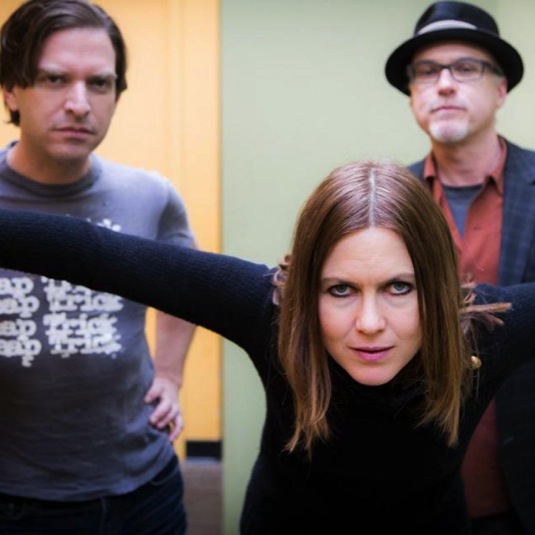
Well, she could release a reunion record. “Whatever My Love” is not a solo record, but the sophomore release by the Juliana Hatfield Three. The band—which includes Hatfield on guitar and vocals, Todd Philips on drums and Dean Fisher on bass—recorded her landmark album “Become What You Are” back in 1993, right around the time that alternative rock was taking over the mainstream. It produced two hit singles, “My Sister” and “Spin the Bottle,” the latter of which was featured prominently in Ben Stiller’s Gen-Xploitation flick Reality Bites.
http://
They were a tight trio, with Philips and Fisher lending Hatfield’s pop songs a hard-rock drive, but the group quickly spun out of control. “Todd had some drug problems that I ultimately didn’t want to deal with,” Hatfield says, more than 20 years later. “That’s why I fired him.” Her next record, 1995’s “Only Everything”, was billed to Juliana Hatfield without the Three, even though Fisher played bass on those songs, including the hit “Universal Heartbeat.”
Since then, Juliana Hatfield has released a steady stream of new records, most of them on her own Ye Olde Records label. Subsequent hits have been elusive, but she has retained a loyal fan base by developing a style that expresses messy emotions via sharp melodies and plainspoken lyrics. She didn’t intend to reunite the Juliana Hatfield Three, but the trio simply gravitated back to each other,
“Like many things in my life, there’s no planning, no strategy,” she explains. “It just happened. I was getting ready to make a new album. I had some songs ready, and I asked Todd if he would like to play drums on the new record.” It was Philips’ suggestion that they bring in Dean to play bass. The reunion was pure happenstance, although Hatfield admits she had already considered revisiting “Become What You Are”. “I knew people who were playing their whole album on tour, like the Lemonheads went out and played It’s a Shame About Ray in its entirety. I thought people might be interested,
Instead, Hatfield, Philips and Fisher booked time at a studio in New Jersey and recorded a handful of new songs. None of them knew how it would turn out. Would they be able to re-create that old energy? Or would it sound like another nostalgia trip? “We went in hoping it would work out, and it worked out,” she says. “The chemistry was intact. It was like riding a bike.” After two decades apart, the Three had sharpened their chops, which brought a new dynamic to the sessions. “We’re all a little more mature, although just slightly.
If “Whatever My Love” sounds like a direct sequel to “Become What You Are”, it might be because several of these songs were written in the mid to late 1990s, when Hatfield was at the peak of her popularity. She recorded “If I Could,” “Now That I’ve Found You” and “Invisible” as demos, with Philips on drums, but they never fit on any of her subsequent albums. “I loved those songs and I didn’t want to forget about them. Todd was actually the one who suggested I bring them back for this record. He made me remember how much I liked them.



 The Fat Angel Sings