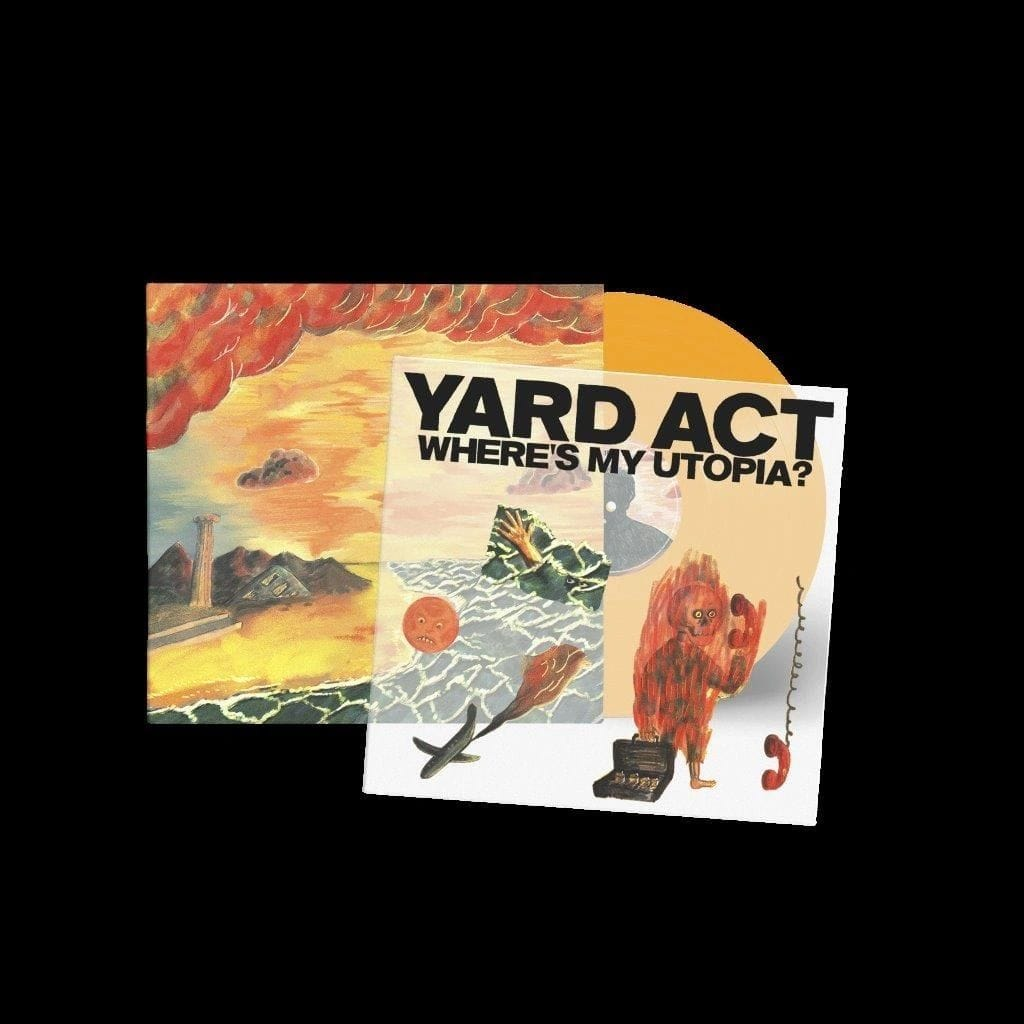
The Leeds outfit Yard Act return sounding as lively as ever. Showing no signs of slowing down Yard Act announce a new co-produced record with Gorillaz’ Remi Kabaka Jr.Taking notes from Fela Kuti to Ennio Morricone, the band dig into a broader sonic world with Smith’s lyrics front and centre that reach to new heights.
In the wake of this year’s riff-tastic, parklife-esque epic, ‘Trenchcoat Museum’, our ears are salivating at the prospect of a whole new album of creatively virile new material, as Yard Act unveil their sophomore opus, ‘Where’s My Utopia?’
for us, this release has some pretty big shoes to fill, as it’s following in the footsteps of a debut that blasted its way into our top 10 favourite records of 2022! but all signs point towards a group that’s honed its sardonic, groovy post-punk sound whilst expanding into more vibrant & explorative avenues, & we can’t wait to reap the whirlwind.
can they catch lightning in a bottle twice? our money’s on “absolutely they can!”
The New Pornographers are thrilled to share “Firework in the Falling Snow (Acoustic Version),” a reworking of the “Continue as a Guest” standout featuring a huge guest of its own in Aimee Mann!
As they begin their West Coast tour, The New Pornographers shared a reworked, acoustic version of the track “Firework in the Falling Snow,” featuring Aimee Mann.
“I played the new song ‘Firework in the Falling Snow’ at last year’s Aimee Mann and Ted Leo Christmas Show, and Aimee joined me on vocals,” A.C. Newman says. “So I figured, let’s do a for-real studio version like this, and here it is. Honoured to sing with her—she is a giant and just a cool person.”
New album ‘Continue as a Guest’ out now on Merge Records.
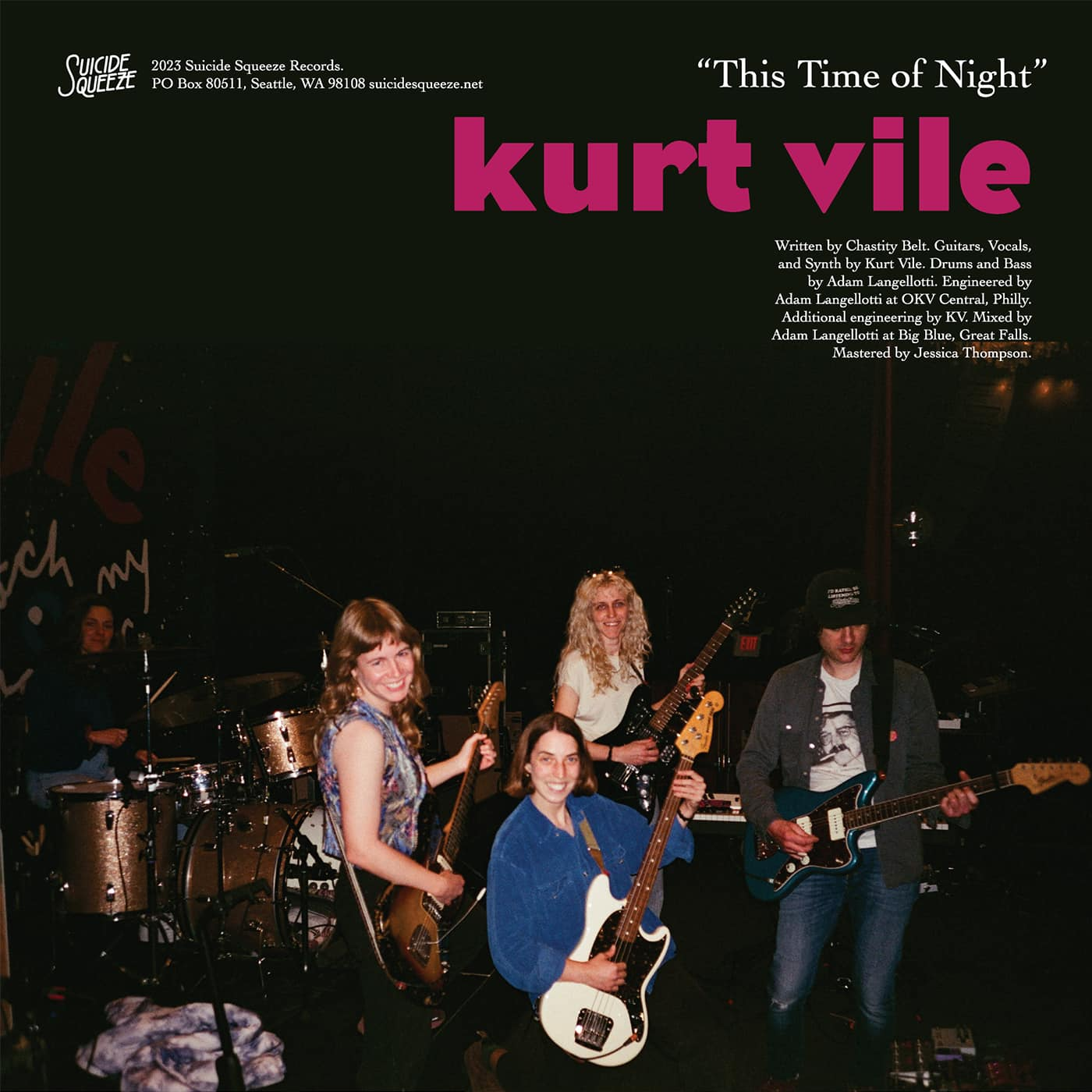
Suicide Squeeze celebrates Chastity Belt with the latest in its split 7″ single series–a pair of covers by Friends of the Band and tourmates Kurt Vile and Courtney Barnett. For this release, Kurt and Courtney each recorded a song from the band’s third album, 2017’s “I Used to Spend So Much Time Alone”, in their signature styles. Side K is Kurt’s version of “This Time of Night,” on which he lovingly recreates the anxious interplay of Julia Shapiro and Lydia Lund’s guitars, stretching each note of the song’s fraught vocal melody to its breaking point.
Says Kurt Vile of this Chastity Belt cover: “When I first met Chastity Belt it was Halloween 2015 in Amsterdam and they were all wearing pointy elf ears. I joke with them that ever since I saw them with those pointy ears I knew… but what? Maybe that we were soul mates! I missed their set that night but we had alotta fun anyways… A couple yrs later I heard a joint interview / podcast with Julia (of Chazzy) and Courtney (Barnett!) and then I immediately played Chazzy’s latest album: “I Used To Spend So Much Time Alone”. It hit me hard right away… So catchy but with lyrics both hilarious while true to life… sad and beautiful all at once… nostalgic hooks, great songs.”
Flip the record to Side C for Courtney’s take on “Different Now,” where she pulls the song from its Pacific Northwest haze, leaves it out to dry in the middle of the desert, and wrings something almost joyous from the original’s ambiguity. “This Time of Night” / “Different Now” will be available on vinyl and digital platforms, with a one-time retail vinyl pressing limited to 1500 (250 pink, 250 black, 1000 blue) copies on heavyweight vinyl.
From the founding member of Sonic Youth, a passionate memoir tracing the author’s life and art—from his teen years as a music obsessive in small-town Connecticut, to the formation of his legendary rock group, to thirty years of creation, experimentation, and wonder.
A study of a life lived in an environment of wild music and endless wonder, Sonic Life is the long-awaited memoir of iconic American musician and Sonic Youth frontman, Thurston Moore. A music-obsessed retrospective, beginning with his childhood epiphany of rock ’n’ roll in the early 1960s into an infatuation with the subversive world of 1970s punk and no wave blasting forth from New York City – where he eventually runs off to join a band in 1978. By 1981 Moore would form the legendary and notorious experimental rock group Sonic Youth, who proceeded to record and tour relentlessly for almost 30 years, always progressing, always exploring.
Along the way we meet a constellation of artists and musicians who colluded and collided with Sonic Youth including Velvet Underground, Stooges, Patti Smith, Television, Sex Pistols, Clash, Nirvana, Hole, Beastie Boys, Neil Young and a cavalcade of other musical visionaries, as well as figures from the art world – Jean Michel Basquiat, Keith Haring and Gerhard Richter.
Simply put, Thurston Moore and Sonic Youth changed the sound of modern alternative rock music and opened the minds of a generation of artists to new possibilities within the form. This is essential reading.
“Laugh Track” is the band’s most freewheeling, all-hands-on-deck album in years. If “Frankenstein” represented a rebuilding of trust between group members after 20+ years together, the vibrant, exploratory “Laugh Track” is both the product of that faith and a new statement of intent.
Revelling in the license to radically upend its creative process, The National honed most of this material in live performances on tour this year, and captured those invigorated versions in impromptu sessions at producer Tucker Martine’s Portland studio, Flora Recording & Playback. The nearly eight-minute album closer ‘Smoke Detector’ was recorded in June during a Vancouver soundcheck, completing a body of work bristling with spontaneity and vintage rock energy that makes a perfect complement to the songs found on its more introspective predecessor.
The surprise companion to The National’s April release “First Two Pages of Frankenstein”, “Laugh Track” is the band’s most freewheeling, all-hands-on-deck album in years.
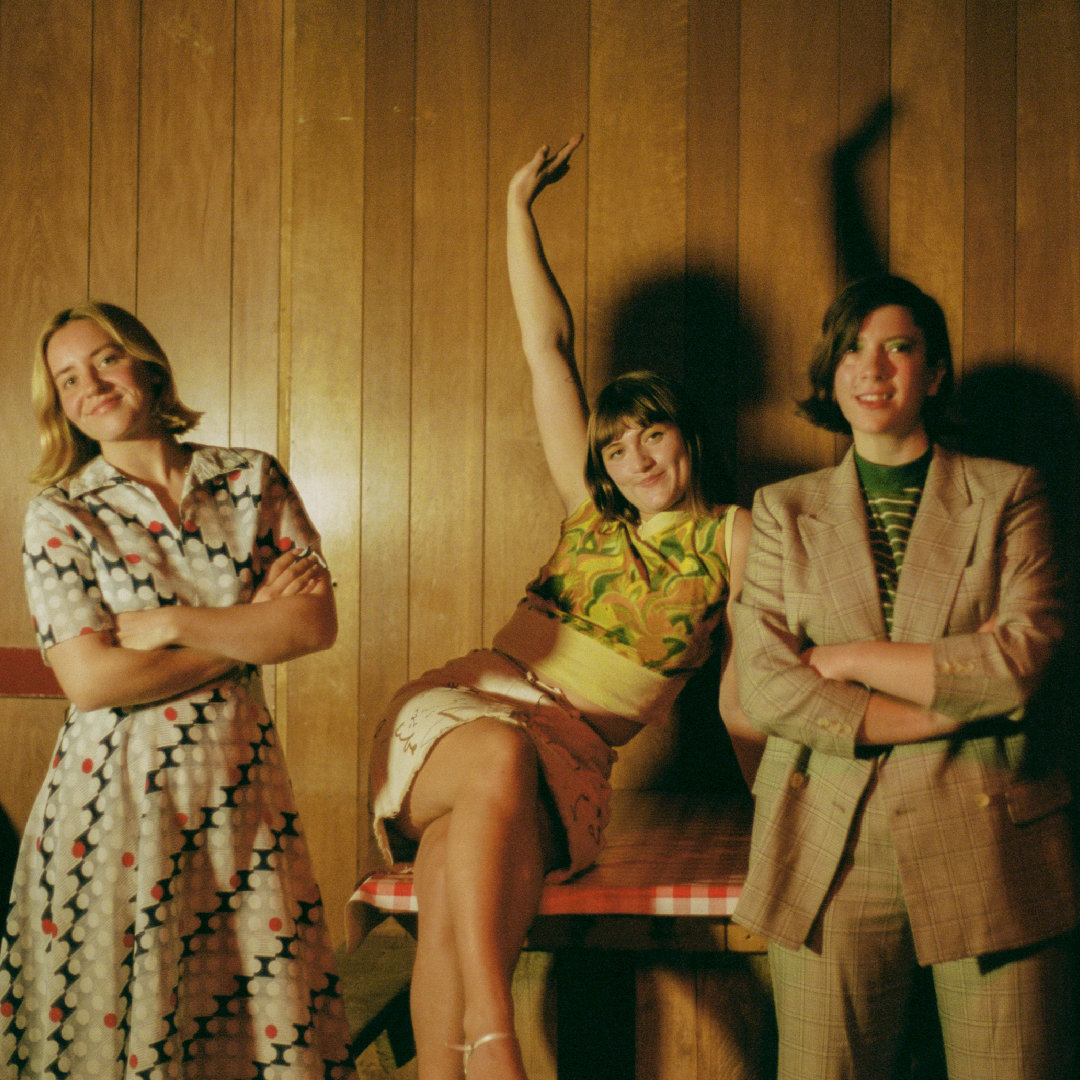
“Hurt So Bad” is the brand new single from London three-piece Girl Ray, and their first new music since the recent critically acclaimed album “Prestige”.
The band share on the track, “Hurt So Bad” was written during the pandemic, when I was working on writing our third album and still deciding what the feel of it would be. Initially I thought that a more electronic/house inspired sound would be a good fit for us, and with “Give Me Your Love” and “Hurt So Bad” demoed, we visited Al Doyle and Joe Goddard’s studio near Brick Lane to flesh them out. They were a great match for the songs, and we loved playing with their mountains of rare synths.
Although our album ended up being more live, I think you can still hear the beginnings of our disco inspiration in this track.”
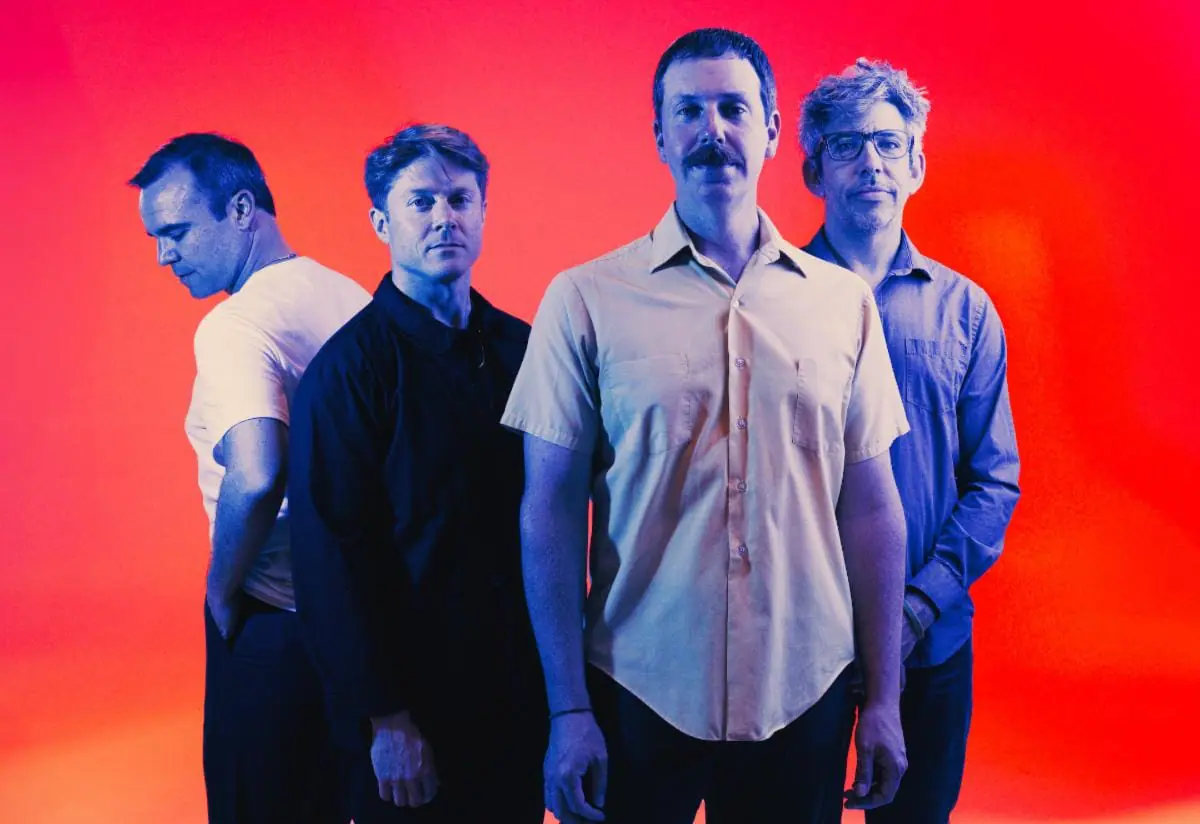
Future Islands announced they’re set to drop their eagerly awaited seventh album, “People Who Aren’t There Anymore”, on January. 26th, 2024. The news comes just two months after concluding their As Long As You Are tour, and they’re ready to unveil a bold new chapter in their musical journey.
Known for their high-energy anthems in the past, Future Islands–comprised of Samuel T. Herring (vocals, lyrics), William Cashion (bass, guitars), Gerrit Welmers (keyboards, programming), and Michael Lowry (drums)–have opted for a more introspective approach. The band has harnessed a newfound intensity, crafting tracks that are both inspiring and heart-wrenching, all by taking their time and making every note, lyric, and cymbal crash count. This album marks a defining moment in the band’s career, proving their evolution as musicians.
In celebration of the album’s announcement, Future Islands have released a new single from “People WhoAren’t There Anymore” titled “The Tower,” accompanied by a captivating music video directed by Jonathan van Tulleken. Notably, this is the second collaboration between van Tulleken and Herring, who previously worked together on Apple TV’s The Changeling. In an interview, van Tulleken expressed his admiration for Herring’s unique stage presence and how it translated into a mesmerizing on-screen performance.
The video for “The Tower” explores the duality of light and darkness, echoing the band’s artistic exploration.
“The Tower” joins previously released singles “Deep In The Night,” “King of Sweden,” and “Peach,” all of which are included in the forthcoming album.
Co-produced by Future Islands and Steve Wright,“People Who Aren’t There Anymore” showcases a collaboration between Wright and Chris Coady. Interestingly, this marks the first time Coady has worked with the band since their 2014 album, “Singles”.
The album will be available in various formats, including digital, CD, cassette, and standard black vinyl. For vinyl enthusiasts, it will also be available in transparent vinyl (indie-retail only) and a unique yellow & black ‘yolk’ vinyl with alternative artwork
King Gizzard & the Lizard Wizard are taking what counts for them as a break. After two European tours, a series of residencies in US cities and a sprinkle of Australian shows in between, King Gizzard have slowed down just long enough to release their second new album of the year, the fully electronic “The Silver Cord” (out October 27th).
On the cusp of releasing their 25th album a little over a decade since their first, 2012’s “12 Bar Bruise”, King Gizzard have travelled a long, zig-zagging path from their garage punk origins. With the attention to detail as King Gizzard & the Lizard Wizard do on synth-heavy new album “The Silver Cord“. Its seven tracks may seem like the polar opposite of predecessor “PetroDragonic Apocalypse“, but the attentive listener will notice that these two albums have a lot more in common than you might think. “The Silver Cord” is the yang to “PetroDragonic Apocalypse’s” yin, in more ways than one.
The album has two versions – a short one clocking in at 28 minutes, and extended one exactly one hour longer. Neither version is the definitive one, with each version having their own strengths, weaknesses and WTF-moments. The version is the second shortest King Gizzard & the Lizard Wizard studio album to date, beating 2013’s “Eyes Like the Sky” by a mere ten seconds. Opening trio “Theia, The Silver Cord” and “Set” marked the first glimpse of what to expect, coming out as a triple single earlier this month by means of a music video best watched on shrooms. There’s a distinct absence of ‘traditional’ instruments on the entire album, with the band opting solely for synthesised sounds (you name it, they definitely used it). The last time King Gizzard went for this approach was on the summery “Butterfly 3000” in 2021, and even though Theia may bear reminiscence to that sun-kissed album, these comparisons don’t last much longer.
Title track “The Silver Cord” is perhaps the most absurd the band have ever sounded, with warped vocals, haunting melodies and intense lyrics making for an unsettling experience. Its finale restores some sanity into proceedings by way of beautiful synth patterns and ethereal vocals, before “Set” throws all that out of the window in favour of some swaggering beats, rapping from Ambrose Kenny-Smith and a repeated chant of, “slay the mighty Set”. For those unaware, “Set” was the Egyptian god of war and chaos. War and chaos are also pretty good descriptors for this song, destroying the ethereal worlds tracks one and two created without hesitation.
The album’s opening trio painted a relatively positive picture sonically, but the sonic serenity pretty much ends with “Set”. “Chang’e” – the weakest of a strong bunch – is a sudden shift in tone, bridging the gap between “Set’s” playfulness and the intensity still to come. Just like its counterparts across the album, “Chang’e” has a knack for combining warm synth tones with unhinged melodic passages and ethereal vocals. For those curious, Chinese mythology refers to Chang’e as “the woman in the moon”. Interestingly, “PetroDragonic Apocalypse” track “Witchcraft” (also track four…) refers to a similar blood moon goddess. Coincidence? Not at all, but you’d have to keep reading to find out why. “The Silver Cord’s” strongest moments come during the final three songs, which fused together are an absolute monstrous experience. “Gilgamesh” sounds like a bad trip, with heavily altered vocals and another rapped verse from Kenny-Smith. The beats are raw, the synths are warped and the interplay between Mackenzie and Kenny–Smith is infectiously good. “Swan Song” enters much darker territory, both sonically and lyrically. If “Gilgamesh” was a bad trip, then “Swan Song” is the comedown from hell.
There are even moments where Mackenzie veers into throat singing, hauntingly so. It all makes way for “Extinction“, King Gizzard & the Lizard Wizard’s most unhinged album closer to date, a culmination of two entire albums worth of experimentation, lore and hidden connections. Its endingpushes the band into new sonic territory: hardstyle, but not quite in the classic sense of the genre. It’s fast, it’s in your face and and beat-driven to the point of no return. The synths which snake around drummer Michael Cavanagh’s drums are relentless, ensuring “The Silver Cord” goes out on a (for some listeners, literal) high. Think of it as ending on a peak, or being on a trip which you never want to end.
And now for the extended version. Let’s start with the elephant in the room: constant references to previous album “PetroDragonic Apocalypse”. By way of callbacks on each song to its corresponding soundtrack counterpart on PDA, “The Silver Cord” serves the purpose of a mirror, reflecting back elements of a previous album yet in a warped fashion. Yin and yang, basically. “Theia’s” extended cut spawns twenty minutes, although they fly by pretty quickly by way of sprawling melodies, programmed beats and both a call-back to the previous album as well as a call-forwardto the next song: we hear Mackenzie sing both “Motor Spirit”repeatedly, as well as recite the “I’m just a vessel” verse from title track “The Silver Cord“. This song’s own extended version centres on acid-laced synth passages (and an oh so subtle melodic callback to PDA’s “Supercell”), also presenting us with the first hints of drum and bass to grace the record. There’s a sense of fleeting urgency to “The Silver Cord’s” extended version, which the groove-based “Set” builds on in and amongst utterings of the word “converge” laced in a near-robotic level of vocoder. Instrumentally, it continues to play on that one quirky melody, with an extra rapped verse from Ambrose Kenny-Smith adding to the fun.
“Chang’e” – which was the weakest track on the short version – is elevated to completely new heights as its extended version borrows both melodies and entire verses from “PetroDragonic Apocalypse” counterpart “Witchcraft”. This metal song’s solo is transposed to synths on “Chang’e“, flirting with upbeat percussion and layered melodies as Mackenzie sings of “red and deep burnt blues”and snakes, which slither “just out of sight”. “Gilgamesh’s” extended version takes the dark undertones of its short version and builds on them in such a way that they mark the perfect precursor for what “Swan Song” and “Extinction” will unleash later. As “Gilgamesh’s” extended version unpacks layer after layer of bubbling synths and obscure noises, we hear the band chant “Gila! Gila!”in what is by far the most obvious callback on the entire album.
It sets the scene perfectly for the Jungle-lite “Swan Song“, which takes no prisoners from the word go and manages to paint a morbid picture led by some of Mackenzie’s gnarliest and prettiest vocals on the record. Things kick up another notch just over halfway into the song, when a heavily roboticized voice makes a bold proclamation over some very subtle, pulsing synths: “The eye dilates, the air gyrates / A gate in the sky, a portal to die, A shriek from space, a mangled yell / Dragon descends, welcome to hell”. This makes way for an in your face instrumental passage, before this same verse returns amidst sonic hellfire. If you think it sounds like the end of the world, then that’s because it is. “Swan Song” is the album’s thematic and sonic breaking point, an apocalypse of sorts where the asteroids are Cavanaugh’s brute force drums, and the flames are synthesizers. In Kenny-Smith’s words, “this plane nosedives straight into hell”. Jungle is massive, and so is “Swan Song”.
“Extinction” is the aftermath of this chaos, although that’s not to say the intensity lets up one bit. Mackenzie’s gnarliness on “Swan Song” has been replaced with ethereal vocal passages, including lyrical references to PDA’s “Flamethrower” with “Extinction” centring on one key lyric throughout: “I can see everything, I can be in the music”. It’s an all encompassing line which King Gizzard fans will surely unpack in more ways than one. As the song prepares for its climax, you can sense that the intertwining synth tones and bubbling undergrowth of bass-y rhythms have one more punch yet to pack. King Gizzard attempting to make classic European hardstyle within the foundations of “The Silver Cord’s” sonic universe. The last four minutes of the album slowly build up in intensity, climaxing on what almost feels like a second apocalypse, one spearheaded by warped synths, a hi-BPM tempo and the constant recurrence of the song’s focal melody. It’s one hell of an ending, to one hell of an album.
Dylan LeBlanc is a singer-songwriter and multi-instrumentalist who often finds himself flirting with the edge — or “dancing on a razor,” as he calls it — as it is all he has ever known. A verdict vagabond since he was a little boy tossed between Texas, Louisiana and Alabama, LeBlanc thrives on the precipice, never staying in one place for too long. It is that nomadic spirit that drew him not only to a life as a touring musician, but also to the beast that titles his newest record: ‘Coyote.’
LeBlanc says he has always related to the insatiable, scavenging nature of the wily coyote. Much like the animal, LeBlanc is a wanderer who knows when to trust his instincts, musically and otherwise. It is a spiritual kinship that runs deep, but he credits one particularly hair-raising face-to-face instance with solidifying his bond with the animal.
‘Coyote’ marks Dylan LeBlanc’s fifth studio album and his first full-length LP to be self-produced. Recorded at the iconic FAME Studios in Muscle Shoals, AL, it boasts a handpicked ensemble of world renowned session players including Fred Eltringham, known for his work with Ringo Starr and Sheryl Crow, pianist Jim “Moose” Brown, who’s collaborated with Bob Seger, and bassist Seth Kaufman, celebrated for his contributions to Lana Del Rey’s tracks. The album is both semi-autobiographical and a concept album centered on the evocative character of “Coyote”, a man on the run in pursuit of an ever elusive freedom from his past.
The Last Dinner Party are a indie rock band from London, formed in 2021. The Last Dinner Party will soon be your new favourite band. They look like a gang of feral Catholic schoolgirl misfits who have staged a rebellion, raided the drama club’s wardrobe room and are throwing a goth party on the hockey pitch. They sound like a group who broke free of orchestra training when they discovered a stash of old Sparks and Roxy Music albums, The band consists of Abigail Morris (vocals), Lizzie Mayland (vocals, guitar), Emily Roberts (lead guitar, mandolin, flute), Georgia Davies (bass), and Aurora Nishevci (keys, vocals). The band’s debut single, “Nothing Matters“, was described as “art-rock bombast” by Rolling Stone UK, while the Evening Standard described their music and live shows as having a “distinctive baroque-pop sound and look”. The band have been compared to Kate Bush, Siouxsie and the Banshees, Sparks, and Warpaint,
The band signed with Island Records before releasing their debut single “Nothing Matters” in April 2023. Their second single “Sinner” was released in June 2023, and their third single “My Lady of Mercy” was released in October 2023. The band have just completed their first tour as a headline act was of the UK and US beginning in October 2023.
“My Lady of Mercy” is about being a girl. A girl looking at a painting of Joan of Arc for the first time and thinking that she looks so brave and so beautiful that maybe she wants to kiss her. And maybe she also wants to kiss the girl who stands next to her in the school choir.
The Last Dinner Party perform “My Lady of Mercy” on Later… with Jools Holland.






 The Fat Angel Sings