


Stephen Fain Earle the American country, rock and folk singer-songwriter. He began his career as a songwriter in Nashville and released his first EP in 1982. Later Steve Earle announced his arrival in our lives with his debut album in 1986. Since then, he has racked up almost thirty studio and live albums under his own name or in collaboration with others. I have, as far as I’m aware, every one of those albums. After seven marriages and a near fatal heroin habit, the great singer-songwriter is now single, sober and interested only in caring for his autistic son. I’ve probably seen Steve Earle live more times than most.
It is astonishing that Earle is still alive, never mind producing such great music. In the early 90s he looked as if he was on his way out. After the success of early albums such as “Guitar Town” and “Copperhead Road” in the late 1980s, he did not write a song for four years. During that time, he lost virtually everything. Bikes, cars, guitars, jewellery – they all went to feed his habit. “I sold them to buy heroin. I lost everything but my house. The house in Tennessee I still own, though I don’t know how. I guess it’s because I couldn’t figure out how to put it in the car and take it to the pawn shop.” But the house had no electricity and was uninhabitable. “I was homeless essentially for two years, living on the street.”
He was spending between $500 and $1,000 a day on drugs.
I’ve seen him with the different line-ups of his own band, in other bands, on his own and with members of his family. I consider him to be one of the finest songwriters America has ever produced and an outstanding musician and performer. I don’t think Steve Earle has made a bad album.
Earle is one of the great singer-songwriters of the past four decades. He is a master of country, rock and country-rock. His voice is both gruff and tender (Tom Waits meets Hank Williams), his tunes gorgeous (impossible to know where to start, The only thing that makes sense, to me, is to list the ten albums I go back to more than any of the others.
“El Corazon” (1997)
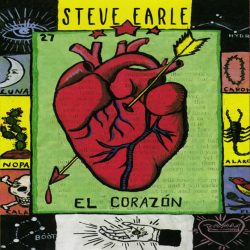
The problems start already. This was a difficult decision between this and “Train a Comin”, Train was the “comeback” album after his time in prison and kicking his heroin addiction and I’ve always loved its raw, stripped-down sound and the fact that he came back with such a great record – but “El Corazon” has to shade it because it has the superb ‘Fort Worth Blues’, Earle’s tribute to his friend and early inspiration, Townes Van Zandt, written to mark Van Zandt’s passing. It’s such a good song that, alone, it justifies the importance of this record but the album also includes tracks like ‘Taneytown’, a clever narrative song featuring Emmylou Harris on backing vocal, his beautiful duet with Siobhan Kennedy, ‘Poison Lovers’, the politically astute ‘Christmas in Washington’…so many great tracks.
To me, this was a turning point in his writing – it had always been good but, with this album, his songs started to become great. The strutting wannabe rock star was stepping back and a serious, thoughtful songwriter was starting to emerge. Fittingly, “El Corazon” is songs from the heart.
“So You Wanna Be An Outlaw” (2017)
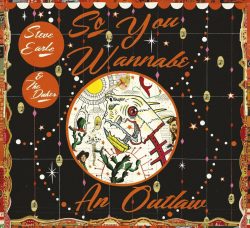
This was Earle’s album acknowledging the debt he owed to the Outlaw movement in general and Waylon Jennings in particular. It’s fair to say that Jennings was the musician who did the most to make Steve Earle, the musician, possible. Jennings took on the country establishment, as exemplified at the time by Nashville, Chet Atkins and the “Countrypolitan” sound, and won. He took artistic control back from the labels that wanted Country music to be smooth and sophisticated and returned it to the musicians who understood the true roots of the music. In doing that, he made it possible for younger singer/songwriters, like Earle, to tap into the lives of the rural working man and the blue collar stories that make such good songs.
This was Earle’s return to more familiar ground following his previous blues album, “Terraplane”, and probably the truest country music he has made since his first couple of albums. The title track features a duet with that other main man of outlaw country, Willie Nelson, and on tracks like ‘If Mamma Coulda Seen Me’ he’s referencing both Waylon Jennings and Merle Haggard in the same song – “If my mama coulda seen me in this prison she’d’a cried but she cain’t.” Pure country all the way. You also get the excellent duet with Miranda Lambert on their co-write, ‘This is How it Ends’ and, the cherry on the cake, Earle’s eulogy to his other major influence, Guy Clark, with the beautiful ‘Goodbye Michelangelo’.
“Ghosts of West Virginia” (2020)
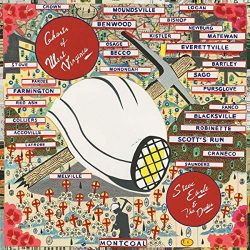
This album is a tour de force of narrative songwriting and shows just how far Earle has come as a master of his craft. Inspired by the events that took place in a West Virginia coal mine in 2010, when an explosion killed 29 miners, Earle explored the story when he agreed to write music for a planned Theatre Production called Coal Country. It’s almost impossible to single out individual tracks because it stands best as a whole album, but his revisionist take on the old country folk standard ‘John Henry Was a Steel Drivin’ Man’ is worthy of mention as is his song about the curse of the mining man, pneumoconiosis, or ‘Black Lung’ – “Black lung, never gets better, every breath a little bit harder to draw. Shotgun, loaded in the corner. Reckon I’m a lie here and die of black lung”. A bleak prospect that many miners faced.
This album draws on every aspect of Earle’s career as a musician combining all the threads of Americana to produce a real roots music classic. You can hear folk, country, blues, bluegrass and rock weaving their ways throughout the album. Critically acclaimed on its release and rightly so.
“Colvin & Earle” (2016)
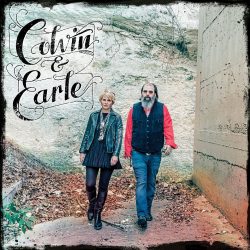
What I love about this album is that it sounds like exactly what it is; two old friends making an album together because their voices suit each other, and having a whole lot of fun while they do it. I’ve always enjoyed Shawn Colvin’s work since I first saw her (and I think her voice works well alongside Steve Earle’s; she has a sweet, melodic voice, though not without edge, and it counterpoints Earle’s gruff tenor perfectly. As they also collaborated on the writing of the original songs on the album, as well as getting to play some covers that they probably wouldn’t have picked in a solo capacity, it’s a very different album to what I would expect from either of them individually and that’s something that I always appreciate about Steve Earle as an artist – he likes to mix it up and it keeps him from getting stale and predictable.
Produced by Buddy Miller and, allegedly, recorded at his home, the album has a distinct folk/rock feel to it. This album was recorded between Earle’s blues album (“Terraplane”) and his return to country music on “So You Wanna Be an Outlaw” and, for me, is an interesting diversion from his “day job”. I love their cover of ‘Tobacco Road’ and, of the originals, ‘Tell Moses’ is a great take on a Pete Seeger style re-invention of a traditional song, though it’s all original, and ‘You’re Right (I’m Wrong)’ just oozes attitude. Probably not one for the purists but I love it.
“Guy” (2019)
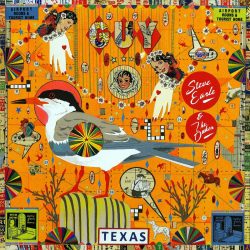
This is Earle’s tribute to one of the biggest influences in his life, perhaps the biggest in many ways. Earle has described Clark as the person who taught him how to write songs, which is quite an accolade given the writer Earle has become. When Earle went to Nashville, intent on becoming a singer/songwriter, it was fellow Texan Clark who took him under his wing, giving him a job as the bass player in his band and inviting him to sing back-up on his debut album, “Old No.1”. Though Earle has never made any bones about the fact that Townes Van Zandt was his big musical hero and the reason he wanted to get into music, he’s also reported as saying, “I knew when Guy died that I’d have to make a record, because I don’t want to run into that motherfucker on the other side having made Townes’s record and not made his,”! You can hear Clark’s influence in Earle’s songs, especially the narrative ones that deal with tales of ordinary folk and their day-to-day lives. Clark was a master of that type of storytelling in a song and you can see how he passed it on to Earle.
On this album, Earle opts for pretty straightforward covers of Clark’s songs and that seems to me a wise move. Clark’s songs are deceptively simple in that they sound easy to do but it’s easy to stray from the path and ruin them. I quite like The Highwaymen, but their cover of Clark’s ‘Desperadoes Waiting for a Train’ is overproduced and sounds pompous; it loses the simple connection between the young boy and the old man he has bonded with. By staying true to Clark’s vision of his own songs Earle does them full justice on this album.
“Together at the Bluebird Café” (2001)
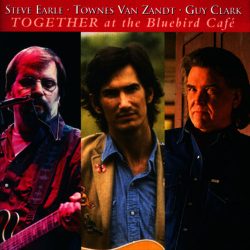
I consider the holy trilogy of Texan Singer/Songwriters to be Van Zandt, Clark and Earle so this album was clearly made for me! Obviously, there are a lot of other good songwriters in Texas, it’s a particularly prolific State in that respect (Willie Nelson, Butch Hancock, Lyle Lovett, Kimmie Rhodes, Robert Earl Keen, Joe Ely….I could go on and on), but these three have always stood out for me. Earle has never hidden his regard for Van Zandt and Clark and has always acknowledged their importance to his own work, but this sees him performing alongside them as an equal and shows how well his songs stand up to some of the best from his two mentors.
Recorded on the 3rd September 1995, just fifteen months before the death of Van Zandt, at the infamous Bluebird Café in Nashville, the gig was a fundraiser organised by Clark’s wife, Susanna, for a local charity she supported. It’s rare to hear Earle play in this sort of stripped-down, acoustic style, at least on record, and it’s a significant recording for that reason alone, but to have these three performing together in this way and interacting in a performance setting like this is something quite special. Earle and Clark singing together on Earle’s ‘Mercenary Song’ is particularly notable.
“Townes” (2009)
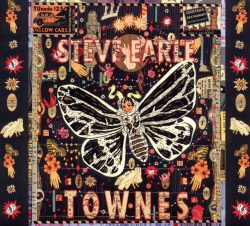
Now I know what this looks like. ‘Guy’ at number six, ‘Townes’ at four and the Bluebird Café album sandwiched between them but I didn’t think about that when I drew up the list. Perhaps it was something subliminal that made me group them in this way but this is how I see them. I think Earle’s tribute to Townes Van Zandt works just that little bit better than his one to Guy Clark. It seems a little more personal and Earle himself seems more involved in it. Some of these songs, like ‘Pancho & Lefty’ and ‘Lungs’ had long been in Earle’s repertoire but some were learned especially for the album because they were songs Earle had always admired.
Earle also makes it a family affair, with then-wife Allison Moorer singing with him on two tracks, ‘Loretta’ and album closer ‘To Live is to Fly’ and, perhaps most significantly, Earle’s son, Justin Townes Earle (as we all know, named for Townes) swapping verses with his father on the excellent ‘Mr. Mudd & Mr. Gold’. Sadly, Earle would be recording a eulogy album of his son’s songs just twelve short years later (an album I’m still processing, for those that wonder why it’s not included here). This album isn’t so much a tribute as a celebration,
Townes Van Zandt was a wonderful songwriter and that’s what Steve Earle is putting front and centre here. It’s an album that goes a long way to support a quote that has haunted Steve Earle for much of his life – “Townes Van Zandt is the best songwriter in the whole world,
“The Mountain” (1999)
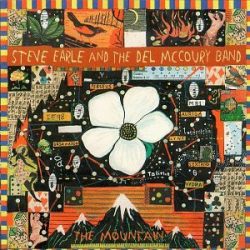
Another tribute album in that Earle has said he wrote the album as a tribute to Bill Monroe, who had died three years earlier. He said he wanted to write something “as timeless as ‘Uncle Pen’” and he certainly proved he could write classic bluegrass songs, ‘Carrie Brown’ and ‘Connemara Breakdown’ being two outstanding tracks but the whole album is a solid offering; every track is written by Earle and stands against the best Bluegrass has to offer. Of course, it helps to make a great bluegrass album if you team up with one of the best Bluegrass outfits around and, in uniting with the Del McCoury Band, that’s exactly what Steve Earle did.
The band had been going in one form or the other since the late 60s, when they were known as Del McCoury and The Dixie Pals, so had 30 years experience of making great Bluegrass music under their belts when Earle teamed up with them. It did make for an outstanding combination but to add icing to the cake the album is dripping with top drawer talent – Iris Dement, Jerry Douglas, Emmylou Harris, Sam Bush, Marty Stuart, Gillian Welch…the list just goes on; it seems like this was The album to be on. It could’ve been the start of a great long-term collaboration, but it was not to be.
Things were fine until they started to tour and then everything went steadily downhill. The story is that they fell out because Earle “cursed too much on stage”, according to McCoury. His view was that “There’s no room for vulgarity in bluegrass” – a line that Steve Earle would then steal for the song ‘Until the Day I Die’ on “Transcendental Blues”! It was good while it lasted.
“Guitar Town” (1986)
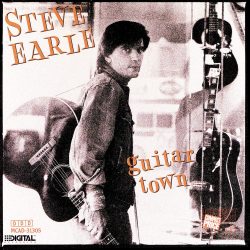
The album that started it all. Steve Earle’s debut offering in 1986. It topped the Billboard Country Albums chart and yielded a hit single with the title track. It’s the album that pinned a lot of people’s ears back and said there was a new gunslinger in town – and he looks like trouble! It was a new kind of Country/Rock, that little bit edgier, that little bit harder. Where the Country/Rock of the 70s had been more country than rock, Steve Earle’s version reversed that ratio – these were country songs but played with a rock and roll attitude. And they were great songs. In addition to the title track, there’s ‘Hillbilly Highway’, the hard-hitting, small town lament of ‘Someday’, and the simply brilliant ‘My Old Friend The Blues’ – ten tracks in total and not a bad one amongst them. We also met his band The Dukes and, in particular, Bucky Baxter, who would be his right-hand man for the next three studio albums and would lead the first incarnation of the band.
Few debut albums have been this outstanding – that he has continued to prove, throughout his career, that it was no flash in the pan shows what a good artist he was then and what a great one he has become.
“Copperhead Road” (1988)
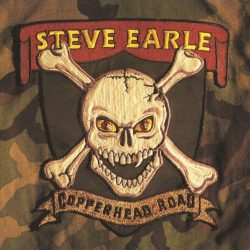
This is the big one for me. This is the Steve Earle album I still play more than any other. It’s worth it for the title track alone, which is a glorious tale of backwoods moonshine production and the eternal battle with the Revenue Man but it also sports such timeless gems as the gun savvy ‘Devil’s Right Hand’, the rousing ‘Johnny Come Lately’, complete with backing from The Pogues, and the rather lovely ‘Nothing But A Child’. It has been called his first Rock album but it’s really just a move away from traditional country production into a more rock-oriented way of doing things. Significantly, Earle himself co-produces for the first time; he’s finally in a position to say “this is what I want and this is how we’re going to do it” and the album really is a triumph in every respect. It was his last album of the 1980s and his last before he lost his way a little but, for me, it remains his best release to date – though several have pushed it close.
So there you have it. The Top Ten Steve Earle albums you should have, . Whether you agree with the list or the order of it, I would argue that these are all essential albums and should be in the collection of every discerning Americana fan.


 The Fat Angel Sings