Meaning all things magick and supernatural, the root of the word occult is that which is hidden, concealed, beyond the limits of our minds. If this is occult, then the Occult Architecture of Moon Duo’s fourth album – a psychedelic opus in two separate volumes released in 2017 – is an intricately woven hymn to the invisible structures found in the cycle of seasons and the journey of day into night, dark into light.
Offering a cosmic glimpse into the hidden patterning embedded in everything, Occult Architecture reflects the harmonious duality of these light and dark energies through the Chinese theory of Yin and Yang. Following the Yin (feminine, darkness, night, earth) represented on Occult Architecture Vol. 1, Vol. 2 presents the Yang.
Yang means “the bright side of the hill” and is associated with the male, sun, light and the spirit of heaven, and as such Vol. 2 explores the light and airy elements of Moon Duo’s complex psyche.
“In production we referred to Vol. 1 as the fuzz dungeon, and Vol. 2 as the crystal palace,” guitarist Ripley Johnson explains. “The darkness of Vol. 1 gave birth to the light of Vol. 2. We had to have both elements in order to complete the cycle. We’re releasing them separately to allow them their own space, and to ensure clarity of vision. To that end we also mixed Vol. 2 separately, in the height of Portland summer, focusing on its sonic qualities of lightness, air, and sun. Listeners can ultimately use the two volumes individually or together, depending on circumstance or the desired effect.”
Vol. 2 was mixed in Portland by the band’s longtime collaborator Jonas Verwijnen.
After David Bowie died in January 2016, his occasional collaborator Iggy Pop recalled the superstar musician’s impact on his career. Iggy didn’t undersell Bowie’s importance. “He resurrected me,” Pop told the New York Times “He was more of a benefactor than a friend in a way most people think of friendship. He went a bit out of his way to bestow some good karma on me.”
Bowie had been doing that ever since he’d heard the Stooges’ first two records, impressed by the force of nature known as Iggy and his pals’ gritty drive and wild noise. At the height of Ziggy-mania, he helped the former JimOsterberg kinda-sorta put the Detroit band back together and served as producer 1973’s “Raw Power” . But the Stooges imploded again, leaving Pop broke, drug-addicted and directionless. He checked himself into a mental institution.
While there IggyPop was paid a visit by Bowie, who then invited him on his 1976 tour. With both in the grip of drug addiction, they made a plan to move to Europe, get clean and make music at the same time. This marked the beginning of Bowie’s vaunted “Berlin Trilogy”, although the shift in musical style and tone actually began as the partners began working on what would become Iggy’s solo debut, “The Idiot”.
Pop and Bowie began sessions at Château d’Hérouville, just outside Paris, in the summer of 1976. Although they were staying in France, Iggy claimed that the two were inspired by “the idea of Berlin,” as well as the so-called krautrock of bands such as Neu! and Kraftwerk . In contrast to the garage rock of the Stooges, Pop and Bowie worked with drum machines, synthesizers and even toy instruments. It was very experimental even by Bowie’s design, according to Pop.
“I think I functioned as an outlet for his overflow. Because there are things he did with me that he couldn’t do as David Bowie, because it would have slowed him down or might have been a wrong move,” Pop said in 2006. “And then he was also able to use me to practice. … He made an Iggy album first, but watched the engineers there in the studio, learned how they worked, thought about it, had a chance to get to know the desk, and have daydreams about his own record while he worked on mine.”
So Pop saw The Idiot as a sort of test run/impetus for Bowie’s forthcoming “Low” which also began to take shape in France, then Germany in 1976. More than a decade later, the Thin White Duke confirmed Iggy’s take on the situation.
“Poor Jim, in a way, became a guinea pig for what I wanted to do with sound,” Bowie wrote in the Sound + Vision liner notes. “I didn’t have the material at the time, and I didn’t feel like writing at all. I felt much more like laying back and getting behind someone else’s work, so that album was opportune, creatively.”
Iggy would characterize his and Bowie’s working relationship in a few ways. One of them was that Bowie was like a film director. After all, he did encourage Pop to sing like Mae West on “Funtime.” Bowie would sometimes initiate a musical idea, a title, a concept and prod his collaborator to flesh out the idea. Pop later compared the relationship to My Fair Lady‘s Henry Higgins and Eliza Doolittle.
“He subsumed my personality, lyrically, on that first album,” Pop recalled, comparing it to having “Professor Higgins say to you, ‘Young man, please, you are from the Detroit area. I think you should write a song about mass production.’”
And “Mass Production,” with its finale of intertwined synthesizers, became The Idiot’s closing track. “Dum DumBoys” came about when Bowie suggested that Iggy write lyrics about his former band. For “Nightclubbing,” Bowie told him to imagine he was “walking through the night like ghosts.”
But not all of the concepts came from David. Iggy developed “China Girl” after falling for the girlfriend of French singer-actor Jacques Higelin, who was recording at the same studio. One night, Pop confessed his passion to Kuelan Nguyen, who replied with “Shh…” The lyrics were paired with something Bowie and Pop had created on toy instruments.
By the time the duo moved from Paris to Munich to Berlin, they had the material, although Bowie’s producer TonyVisconti recalled having to do quite a bit of mixing to get Pop’s album ready for release. Inspired by Fyodor Dostoyevsky’s novel of the same name (a Bowie idea),The Idiot was released on March 18th, 1977.
Even though The Idiot material predated the Low sessions, Bowie’s album was given precedence. It’s likely that the star wanted to debut the new “sound” with his own LP, not the one he had co-written and produced, but bore Pop’s name and picture on the sleeve.
Still, Bowie joined Pop’s band on keyboards to help promote The Idiot, which Iggy describedas “a cross between James Brown and Kraftwerk.” Meanwhile, Pop and Bowie’s German expressionism would continue, as Bowie made two more LPs in the trilogy and the duo collaborated onLust for Life, which came out only six months after The Idiot.
Even though Pop’s solo debut has been criticized for Bowie’s heavy hand, the record had a major influence on future new wave, alternative, gothic and electronic rockers .
They’re a young band of women playing boisterous indie rock outfit from Gothenburg, Sweden. and I heard about them recently. It’s sorta post-Riot grrrl, post-No Wave, experimental music and completely engaging from beginning to end.”, just listen to the track ‘Stupid’
Iggy Pop had hit bottom after the messy breakup of the Stooges and he needed help, and when friend and fan David Bowie offered to lend him a hand, he was smart and grateful enough to accept. Bowie produced Iggy’s first solo album, “The Idiot”, and after Iggy set up a tour to promote the record, Bowie put together the band and tagged along as their keyboard player. Bowie’s presence insured a larger audience than Iggy had attracted during the grim final days of his band, and he was determined to prove he could deliver the goods without making a spectacle of himself or collapsing into a drug-sodden heap on-stage.
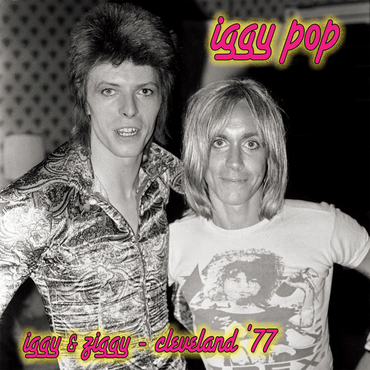
Unfortunately, anyone familiar with Iggy’s body of work knows the last thing you want from one of his live shows is a professional-sounding performance without a sense of danger, and unfortunately, that’s what the audience got during this March 21st, 1977 show in Cleveland, Ohio, part of a three-night stand Iggy and the band would perform at the Agora Ballroom. Iggy & Ziggy: Cleveland ’77 finds Iggy in fine voice, and at a time when he had a lot to prove, he leaves no doubt he was a solid musician and showman, singing with a sense of control and dynamics he couldn’t approach with the Raw Power-era Stooges.
However, Iggy also seems clearly afraid to push this material too far, and the caution robs the songs (nine of which are drawn from the Stooges‘ songbook) of much of their life force. Even worse, guitarist Ricky Gardiner doesn’t seem to know what to do with the Stooges material — he’s at least as skillful as Ron Asheton or James Williamson, but his attack is so toothless and polite that he reduces some of the greatest rock songs ever to mush. (Bowie’s keyboards are not nearly as ill-advised but they don’t fit the old material very well, though Hunt Sales and Tony Sales are a great rhythm section who do what they can to give Iggy the energy he needs.) Some of the material from this show also appeared on Iggy’s lamentable live album TV Eye Live.
David Bowie ‘Be My Wife’ 40th Anniversary Picture Disc 7″ Released Friday 16th June ,For those that follow these releases, it will be no surprise that Be My Wife is the latest in Parlophone’s series of 40th-anniversary Bowie 7″ picture discs.
Originally released in the UK on June 17th 1977, Be My Wife was the 2nd and final single from the ground-breaking album Low, the first of the so-called Berlin Trilogy. Despite a promotional video, the single didn’t chart, not helped by the fact that it was almost impossible to view it anywhere in the UK back in 1977.
With echoes of Life On Mars?, the Stanley Dorfman-directed promo was shot in an empty white room, with Bowie using a red Fender Stratocaster as a prop, while half-heartedly miming the guitar part. He somehow manages to appear nonchalant and anguished at the same time, in this bizarre plea for marital union.
The image used on the A Side is from the Be My Wife video shoot, while the AA side was taken during a visit to the studio of Victor Vasarely. Both photos are by Christian Simonpietri and were taken in Paris in June 1977.
Be My Wife is backed with a previously unreleased live version of the Low instrumental, Art Decade, recorded in Perth, Australia in 1978 during the ISOLAR II tour.
Katie Crutchfield, of Waxahatchee, came to Miner Street with drummer Ashley Arnwine and bassist Katherine Simonetti on January 21st, 2017—the day after the inauguration of Donald Trump. As millions of women marched in cities around the world, Waxahatchee made their voices heard in the studio, recording a fierce and powerful anthem called “No Curse” Since recording their forthcoming album ‘Out in the Storm’ at Miner Street, the band was happy to return and lay down one more track. Although the song is a band favorite, they had never actually played it together, and worked on the spot to arrive at a structure that did justice to the roaring hook and swaying melody.
Brian and Matt set out to A/B the Rode microphones used to capture all of last season’s Shaking Through songs with the mics that are most commonly used at Miner Street. They were pleasantly surprised to find that, in some instances, the Rode mics won over the Neumann and AEAs! The Rode NTRs were used as room mics over the AEAs, and to mic the bass, the K2 was favored for its texture in the high end. Brian, excited to record loud guitar tracks, employed the Fender Champ and the Supro in tandem with the ever-reliable BadCat.
The lyrics for “No Curse” are an honest confrontation in the face of lying and not being taken seriously. With this song, Katie distances herself from toxic relationships in her past. “No Curse” gives her a “greater sense of agency” to escape those with a “warped sense of reality”—an experience that’s so appropriate in this era of mass confusion and anger. As Brian says, “There are a lot of bands that have drums, bass, guitar, and vocals. but there’s really only one band that has Katie’s singing, personality, melodic style—and that’s Waxahatchee.” This song and this band are unapologetically themselves, and it comes across in their music loud and clear. “You can hear human personality at the core of what is being delivered. It’s not generic; it’s Katie.”
PERFORMED BY
Katie Crutchfield – Vocals, Guitar
Katherine Simonetti – Bass
Ashley Arnwine – Drums
Gillian Welch’s long-awaited first record pressing will be 2011’s The Harrow & The Harvest, coming out AconyRecords on July 28, 2017. We have been working and waiting 20 years to bring you our music on phonograph record. It took a while, because we wanted to do it the right way, the absolute best way humanly possible, and I believe that’s what we’ve done. No sonic stone was left unturned, no nuance let fall by the wayside. There is honestly nothing else I can imagine hoping to hear out of the original tapes. It is all there in the groove. As people whose lives were changed by the sound of music coming off turntables, we humbly invite you to include us in your record collection.
from THE HARROW & THE HARVEST now being released on vinyl for the first time on July 28th, 2017
Philly indie folk band Mt. Joy, dives into this idea of chasing your dreams and finding the meaning of true happiness. Take the new song “Cardinal,” When discussing how the song came to be, singer Matt Quinn shares, “I saw a cardinal flying around in the snow, and joked with a friend that maybe he just got high or something and missed his flight south for the winter.
That Cardinal really seemed to be thriving out there though. A lot of people I love are a lot like that cardinal, so this song is for them. Not everyone takes the traditional path, and that’s really what makes the world interesting. So, if you’re truly happy, don’t let other people try to tell you how to live.” Give the track a spin in the player above.
With over 3.6 million streams on their previous single “Astrovan” which was released last fall, and 1.8 million streams on their single “Sheep,” which was released earlier this year, Mt. Joy has a promising career ahead and we’re excited to be along for the ride! The band is currently recording their first full-length album, but fans can catch the guys on tour later this summer.
Azniv Korkejian started moving as a child and never stopped. Born in Syria to Armenian parents, she spent time in Saudi Arabia, Boston, Houston, L.A. Kentucky, Austin and Savannah, before finally settling (loosely) in Los Angeles.
Which is where the name Bedouine comes from – a vehicle for her artistry, it’s a nod to the nomadic character bedouin. An enchanting songwriter whose work is impossible to place, new cut ‘Dusty Eyes’ wanders across the landscape of husky 60s folk before adding some funkier elements. One day she walked into Gus Seyffert’s studio to inquire about getting a reel-to-reel tape machine, something analogue and portable to record herself in small, quiet places. On a whim, he asked if she would play a song right then, so she stepped into the room and cut “Solitary Daughter” in a first take, and they were off on a three year collaboration. One night, she approached Matthew E.White of Spacebomb Records after a show at The Echo in L.A., saying that she wanted to send him a song. He remembers listening to “One of These Days” on the rest of that tour “like a thousand times,” it knocked him and his band right out, and they even set it as their alarm to wake up to in the morning. If that all sounds a bit mythic, a bit rock-and-roll legend, remember that reality always outdoes the script, even in a town like Hollywood.
Literate and entrancing, you can check out ‘Dusty Eyes’ below.
Dusty Eyes” appears on Bedouine’s self-titled debut album, out June 23rd, 2017.
Cataldo is the recording project of Seattle musician Eric Anderson. His upcoming album is called “Keepers”, and the track we’re premiering today certainly fits the bill. “Person You’d Be Proud Of” is wistful and hopeful and beautiful, a brightly emotive yet understated slow-build that splits the difference between Anderson associate Ben Gibbard’s pensive indie rock stylings and rhythmically complex pop worthy of an ’80s teen movie’s closing credits. Or as Anderson himself explains it: At some point recording this tune my drummer asked “So…are we going full Gabriel?” As you can hear, we super, super did. This is a song about feeling lucky and wanting to somehow earn your own good fortune.
From start to finish each song on Keepers is better than the last. The first time I heard this album I thought it was an indie pop masterpiece. All year long I just love it more and more. The storytelling in these songs is amazing. Songs like “Little Heartbeat” and “Photograph” will make you dance while songs like “Straight Up Western” and “America, Goodnight!” will make you nostalgic for those friends you got into all of that trouble with.