At the end of The Lazy Eyes’ first proper show, vocalist/guitarist Harvey Geraghty over-excitedly told the crowd that they’d be releasing an EP soon. It turned out “soon” meant five years later, in 2020. “Things just took a lot longer than we thought they would,” Geraghty says, Zooming from his home in Sydney.
By comparison, their second EP (out July 16th) is being released at breakneck speed. It offers a more confident, expansive take on the psychedelic rock of ‘Cheesy Love Song’ or the hip-shaking groove of ‘Tangerine’, so it’s not a stretch to assume ‘EP2’ was created following the global attention that ‘EP1’ earned. Besides an outpouring of local support, the band were booked at taste-making festivals like SXSW in America and England’s The Great Escape. “We didn’t feel worthy,” says Geraghty.
Turns out ‘EP2’ was also written years ago while the band were still in school, and their upcoming but unfinished debut album was written around the same time as well. “It’s almost done,” beams Geraghty – though maybe take that with a pinch of salt. “Personally, something that I’ve taken away from this band is how shit always changes,” chimes in guitarist Itay Shachar.
“They’re all good songs,” says drummer Noah Martin of their decision to still release those early tracks, even though they haven’t stopped writing in the three years since graduation. “It makes sense to let them see the light of day. Eventually we’ll get to the stuff we’re writing now.” The leap in quality, they say, comes from the band upgrading their production toolkit from Garageband to Ableton. “We just got the hang of how to record things. We know how to get what we want onto the tracks,” says Shachar.
“We don’t want the songs to ever fall on deaf ears. There’s not really any rush anyway,” he adds. “It doesn’t feel like we’re taking our time. We just want to do things right.”
Bassist Leon Karagic, drummer Martin as well as guitarists Shachar and Geraghty grew up playing their respective instruments, but their desire to form a band only started while they were attending a performing arts high school. “It was mostly string and horn players creating ensembles, so we didn’t really have much of a choice,” grins Geraghty.
What started as lunchtime jam sessions quickly turned into the boys taking to the streets of Sydney and performing Katy Perry covers for loose change. Their own headline shows soon followed. In 2019 they supported The Temper Trap across Australia and before COVID-19 hit, they played alongside Earl Sweatshirt and The Chats at Laneway Festival.
Despite starting at school, “The Lazy Eyes never felt like it was just a ‘school band’,” according to Geraghty. When the four-piece left school in 2018, there were no conversations about packing it in to search for proper jobs. In fact, The Lazy Eyes “felt this pent-up energy. We were determined to give this band the attention it deserved. We knew there were things we always wanted to do but couldn’t because of school”. So The Lazy Eyes set up Lindfield Studios in the apartment below Shachar’s parents. A place to practice, write and record, it gives the band as much time as they need to create their dynamic tracks. Luckily, after all these years, Shachar’s parents still aren’t complaining about the noise.
The Lazy Eyes First release “EP1” offered three exciting and evocative psychedelic rock songs – so of course, the comparisons to fellow Aussie psych titans Tame Impala and King Gizzard And The Lizard Wizard came thick and fast.
“It’s hard not to wear your influences on your sleeve,” Shachar acknowledges. “When we were young, those bands were some of our heroes, so I get it.”
“We might not even be a band if it wasn’t for Tame and Gizz. They’ve paved the way for a lot of young artists,” says Martin. “There are so many artists who hit it big in Australia but don’t attract much of an international following,” Karagic adds. “It’s inspiring to see them tour around the world, drawing huge crowds. The comparisons aren’t something to be afraid of.”
“I just feel like we’re more than a psychedelic rock band, though,” says Martin. “Noah doesn’t like being boxed in,” quips Geraghty.
Their quest to be something more starts with ‘EP2’, which was heavily influenced by ‘Bon Voyage’, the 2018 alt-pop album by Melody’s Echo Chamber, the band led by French musician Melody Prochet. “It’s such a tapestry of layers and textures,” Geraghty continues. “She really didn’t care if one thing only came in for a moment. We were really inspired by how crazy it got.”
It’s why “Where’s My Brain ?” mixes Black Sabbath riffs into their psychedelic explorations. Geraghty wrote it hoping it would help punters let loose: “When it was written, we were getting into heavier music and our live set was really lacking some mosh music.”
Like all of their songs, the lyrics extend the vibe of the track. ‘Where’s My Brain???’ is about “losing yourself” while the nostalgic “Nobody Taught Me” talks about Geraghty’s childhood holidays to visit his grandparents in the English town of Royston. He’d make friends but when he returned next summer, they’d moved away.
And when Geraghty hears the tropical epic ‘The Island’ (also a prequel to ‘EP1’ track ‘The Seaside’), “I can picture this utopia vividly. It’s a song for escapism.” The idea of going someplace else is a constant throughout The Lazy Eyes’ music. “It’s just a tool to escape the struggles of life,” says Shachar. But the band don’t necessarily believe in escaping into the riff – losing yourself in self-indulgent wig-outs, like too much psychedelic music tends to do. The Lazy Eyes hope every moment of their expansive songs has something to say.
“It’s something we think about way too much,” says Shachar. “We enjoy it when bands know what they’re doing and they’re not just improvising for the sake of it. Just get to the point, y’know?”
For a band who refuse to put their music in a box, it’s no surprise that The Lazy Eyes are just as open-minded about what success could look like. They already have their debut album planned out, as well as the era that’ll follow. There’s talks of making Lazyfest, their festival that caters to under-18-year-olds and had its first outing in March, an annual event. “We know the struggle of being that age and wanting to see live music, but not being able to. It’s when you’re most passionate about it as well, so it’s just annoying,” says Geraghty.
Then there’s the small matter of finally playing those international festivals next year, if COVID lets them. “We won’t not give it a shot,” says Martin confidently before the rest of the band start teasing him. “Is that really the best hype slogan you can come up with?” needles Geraghty. “What does it even mean?” asks Shachar before helping him out.
“We’re just taking it day by day because being an artist, it’s one of the most random careers ever. It’s like gambling. You can’t really expect anything so we just want to do the best we can and have a good time. Fingers crossed though; anything is possible.”
Ought are a post punk band based in Montreal Canada on Constellation/Merge Records which is both the most obvious and most misleading thing you can say about them. For one, they’re not actually Montreal natives, or even Canadians their collective passports list birthplaces as far-flung as New Hampshire, New Jersey, Oregon, and Australia. Their tetchy, talkative brand of art-punk makes them anomalies .
Ought formed back in 2011 when its members began living together in a communal band practice space and recorded their earliest material. Ought came together at McGill University in 2012,
Their debut EP, “New Calm“, was released in 2012. After signing with Constellation Records, they released a full-length, “More than Any Other Day”, in 2014. The album achieved critical acclaim, including a Best New Music accolade.
It was noted in numerous year-end lists for 2014 including Rolling Stone, Pitchfork, Loud and Quiet and may others.
In October 2014, the band released “Once More with Feeling”, an EP featuring B-sides from “More Than Any Other Day” and re-recordings of earlier songs. “Sun Coming Down“, the band’s second full-length album, was released in September 2015.
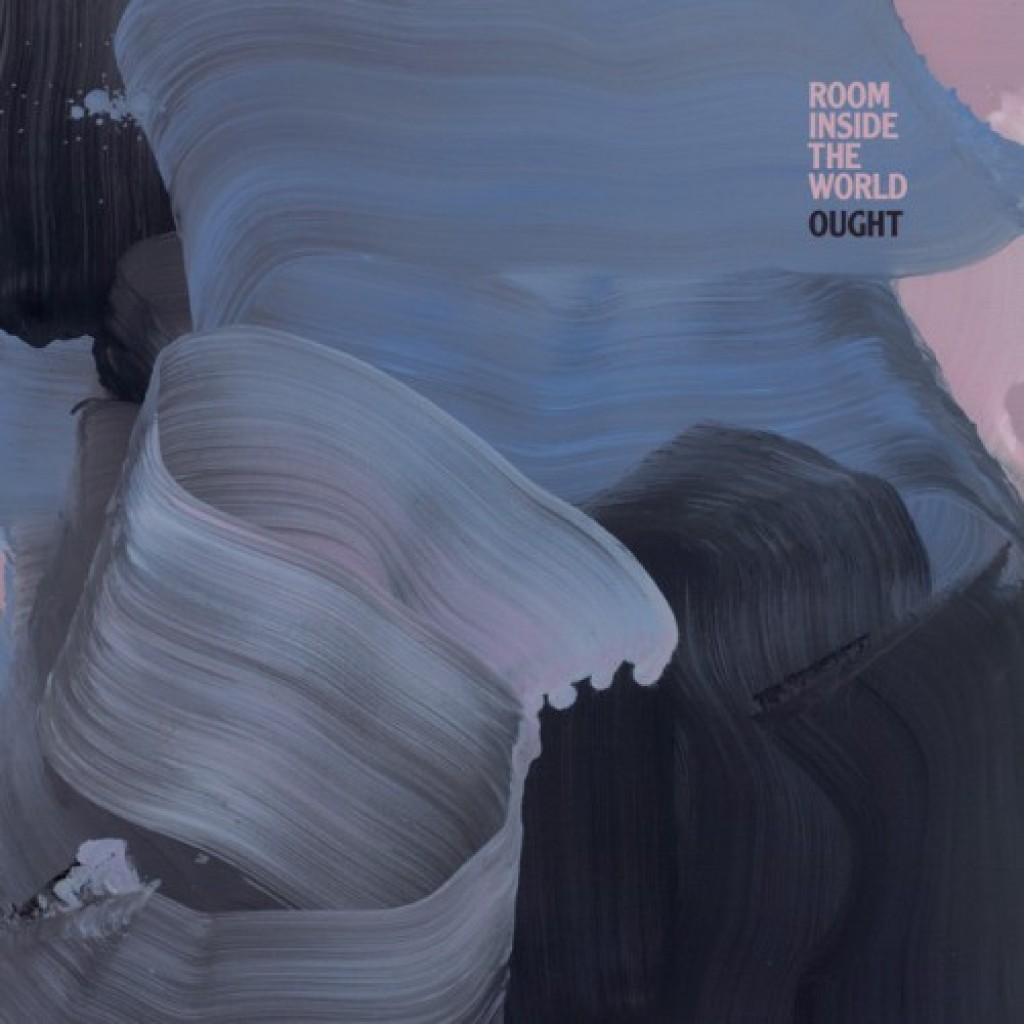
The band worked with French producer Nicholas Vernhes on their third studio album “Room Inside The World”, which was released February 16th, 2018, Lead singer Tim Darcy also released his debut solo album, “Saturday Night“, in 2017.
“More Than Any Other Day”
Ought’s debut album, More Than Any Other Day, so endearing and electrifying. It’s an anxious, distressed record to be sure—brimming with feelings of disaffection and dislocation—but it presents itself as such simply to show you how that nervous energy can be put to more positive, constructive use.
More Than Any Other Day over its eight tracks, Ought strive to recapture and inspire that same sense of anarchic abandon they witnessed on the streets of Montreal in 2012. To that end, they couldn’t have chosen a more emblematic album cover not because, as some have pointed out, its image of hands clasped in a show of solidarity bears an uncanny resemblance to another debut album, but because, as the liner notes reveal, that photo was found discarded atop a dumpster. Accordingly, More Than Other Day is Ought’s effort to ensure that the basic tenets of passion and commitment don’t get tossed aside amid a culture of instant gratification and distraction, and remind their hashtag activist generation of how it really feels to feel.
And as singer/guitarist Tim Darcy convincingly illustrates throughout the record, the process of reconnecting with your inner iconoclast can be more potent than any drug. In the standout, Marquee Moon-lit ballad “Habit”, the addiction in question is to the act of expression itself, and the liberating/empowering sensation of getting something off your chest (even if the strung-out, string-screeched coda nods to a song about a different sort of habit. The almost-title-track “Today More Than Any Other Day” puts that transformative theory into even more explicit action: over a slowcore trickle, a dejected Darcy mutters the dispiriting line “we’re sinking deeper”—but then repeats those words over and over as the song accelerates until his ennui is reborn as exhilaration. And as the song hits its joyously frantic stride, even the prospect of going grocery shopping is elevated to a near-religious experience: “Today more than other day/ I am prepared/ To make the decision/ Between 2 per cent and whole milk,” Darcy shares, fully aware that the concept of choice in a late-capitalist economy is an inherently flawed one. But for him, even such small victories can provide one with the motivation to achieve much greater ones.
With his sardonic, conversational style and ticking-time-bomb outbursts, Darcy belongs to a lineage of brainiac-maniacs that span the likes of David Byrne and the Violent Femmes’ Gordan Gano to modern-day rant-rockers like Parquet Courts and Protomartyr. Likewise, the band’s sound encompasses myriad eras and permutations of proto- and post-punk: Velvet Underground drones (via the omnipersent hum of keyboardist Matt May), Feelies speed-jangle, daydreamy Sonic Youthian sprawl. And with the gritty grooves of “Pleasant Heart” and “Around Again”, bassist Ben Stidworthy and drummer Tim Keen display an amazingly deft, Fugazi-like facility with injecting a little funk into their punk without turning it into punk-funk.
But more so than any identifiable influence, More Than Any Other Day is ultimately defined by its unsettled, restless spirit; this is an album that treats panic attacks and adrenalized ecstasy as two sides of the same pounding heart, with its simultaneous transmissions of joy and fear, discipline and chaos, comedy and tragedy. As Darcy spells it out in the album’s thrillingly combustible closer, “Gemini”: “I retain the right to be disgusted by life/ I retain the right to be in love with everything in sight.” Though born of a highly politicized protest movement, Ought aren’t telling you what to do with your life. They just want to make sure you live it.
Sun Coming Down
When Ought singer-guitarist Tim Darcy drops a fulsome “yes” in the middle of “Beautiful Blue Sky”—the spectacular centerpiece track of his band’s second album, “Sun Coming Down“—he’s sure to savour it. Amid a song whose chorus reads like a laundry list of 21st-century blights (“Warplane/ Condo/ New development”) and excruciating water-cooler chit chat (“How’s the family?/ How’s your health been?/ Fancy seeing you here!”)—Darcy declares, “I’m no longer afraid to die/ Because that is all that I have left/ Yessssss,” stretching out that last letter like pizza dough on a woodblock.
It’s an alarming admission, one that reads like the last will and testament of somebody who’s been so numbed by the dispiriting, clockwork demands of modern life that choosing death feels like the only empowering, self-actualizing move at their disposal. But Darcy invests his “yes” with an ecstatic sense of clarity. Though Darcy is a poet whose voluminous verbiage often overwhelms his melodies, it’s no insult to say that simple “yes” is the greatest lyric he’s written—because it so perfectly crystallizes his band’s essence and purpose.
Ought make indie rock that sounds like how urbanity makes you feel: nervous, antsy, sometimes hostile, yet intoxicatingly vibrant. And Darcy, likewise, gesticulates like a dutiful office drone who’s played by the rules his whole life but just can’t take it anymore. Ought’s 2014 debut “More Than Any Other Day” was an album of slowly unfurled epiphanies, stoking simmering tension into fiery, exultant release. Those sort of affirming moments are a little harder to come by on the more chaotic and caustic Sun Coming Down, but the album’s relentless drive and uncompromising attitude constitute their own special kind of thrill. If More Than Any Other Day was about the hard-fought, triumphant ascent, Sun Coming Down is the giddy, daredevil “wheeeeeey!” down the other side of the peak.
A lot has changed for Ought since the release of their first album—not the least of which is their lead singer’s surname. (Darcy was billed as Tim Beeler) More significantly, what was once a casual project among university roommates was promoted to workhorse touring act, and Sun Coming Down sounds like the sort of record that was hastily hashed out in between transatlantic jaunts. But that’s not to suggest the album sounds unfinished or is lacking focus—rather, the new album takes full advantage of Ought’s fully revved, road-tested engine and increased horsepower, in a strike-while-the-iron’s-hot move. Gone are the ambient styled ballads the strato stepped grooves that, on More Than Any Other Day, counterbalanced the band’s wiry freneticism. Here, Ought doubles-down on their oft-cited early-’80s Fall and late-’80s Sonic Youth reference points, handily destroying any inkling you might have had about this band following the likes of Clap Your Hands Say Yeah or Vampire Weekend into big-tent-indie territory.
Sun Coming Down’s more aggressive attack pushes Darcy out of his usual agitated-everyman mode to deliver more cryptic narratives in a theatrical snarl that, at times, verges on Mark E. Smith karaoke. But while Ought’s influences may be obvious, you’re never really sure where they’re taking them: the fearsome rapid-fire rants, clanging guitar tangle and jackhammered drums of “The Combo” turn oddly celebratory in the wake of the song’s surprisingly cheery chorus (“Jubilation, darling!”); the bee-swarm buzz and frantic accelerations of “Celebration” are undercut by Darcy’s wonderfully fey, Fred Schneider-worthy exhortations (“Okay… let’s do it!”). Other songs are subjected to more abrupt change-ups: “On the Line” alternates between ponderous tone poem and garage-punk rave-up, before settling into a sublime third act that recalls the steady, galloping build-up of Patti Smiths “Gloria” while “Passionate Turn”—the only time here Ought attempt to channel the nocturnal grace of More Than Any Other Day’s knockout ballad “Habit” turns from swooning, stumbling serenade into a menacing, militaristic march for its final verse/chorus run.
Ought performing “Beautiful Blue Sky” live in the KEXP studio. Recorded October 15th, 2015.
Even the songs that remain locked into formation undergo subtle yet substantial mutations. The opening sprint of “Men for Miles” sees Darcy rewriting his verse melody with each pass and, as the band lean their full weight into the song’s motorik momentum, his unyieldingly abrasive guitar noise gives way to hypnotic, third eye-prying bliss. And the aforementioned “Beautiful Blue Sky” may initially sound like Ought’s answer to “Marquee Moon” but spiritually speaking, it’s their “Once In A Lifetime”song that paints a vivid picture of cubicle-bound 9-to-5 conformity before providing you with the sledgehammer to smash it. The transmission may be a little more distorted this time out, but, with Sun Coming Down, Ought’s underlying message is the same as it ever was: you have the power within you to change your lot in life. When you feel like there’s no way out, just say “yes.”
Room Inside the World
Ought’s third album straightens out their sound, offering a more refined new wave palette underneath their singular and compelling lyrical style.
The best songs from Montreal post-punk band Ought contain the rapture of humble truths you might chance upon while spacing out on the subway, staring at the stars, or communing with a cup of coffee. “I am no longer afraid to die because that is all that I have left,” singer Tim Darcy sang on their 2015 album “Sun Coming Down”, which was a fun way of saying “I am alive.” Ought’s feverish, live-wire sound said that, too. The music was convincing because it felt scrappily human and Darcy could utter knotted word clusters about civilization or milk with a flair that somehow felt comforting. The band seemed to suggest, with a rare spark and radiant positivity, Mundanity can be a marvel. You will find the light at the end of the tunnel. Everything will be OK.
Ought’s third album, “Room Inside the World“, straightens out their sound. It offers a more refined and sophisticated new wave palette, redolent of the 1980s to an extreme, and it finds Darcy really singing—about isolation, tentative feelings, self-possession and lack thereof. Most of the record is cast in a newly muted and noirish hue with flourishes of vibraphone, sax, and clarinet. In its more compelling moments, Room Inside the World sounds like a young Scott Walker fronting the Gang Of Four a mix of grandeur and angular tension.
The album finds Ought making considerable changes, then, if not taking many risks. On “These 3 Things,” the singer preens in the glammy way you’d expect from a guy who legally changed his name to Darcy, while the droning closer, “Alice,” is named for cosmic jazz swamini Alice Coltrane. The best Room Inside the World songs still retain some post-punk fragmentation. One of the album’s most compelling moments occurs when “Disaffectation” methodically breaks apart after building itself into a deep trance, as Darcy sings of “some liberation” that “you can order […] online.” “Take Everything” fares better when it moves away from swirling psychedelia and towards lovely, threadbare balladeering, with images of dreaming and “the soul’s indecision.” “When the feel of a flower/Keeps you home for an hour/Throw it away,” Darcy sings, a curious and charming bit of verse.
Ought first ignited their sound with what they once called the “revolutionary spirit of radicalism and adventure” that they witnessed at the Quebec Student protests in 2012, and their songs pushed back with subtle comments on patriarchy, gentrification, and consent. Bits of Room Inside the World also have discernible political undertones or social critiques. The gentle “Brief Shield” flips gender scripts and comments on toxic masculinity. But where the title “Disgraced in America” seems like a bold gesture, any form of dissent therein is fairly oblique. At times, the album lends itself to superfluous jamming, and it can feel overwrought and opaque. Given Ought’s radical inklings, you wish they dared to make these lovely songs say or do something a little more righteous, to twist them into more adventurous shapes.
However, Ought achieve this spectacularly on the blue-eyed soul of “Desire” It towers over Room Inside the World like the album’s lighthouse. It begins wide-open, all wonder and shimmering drone, before Darcy unspools an exquisitely vulnerable Boss-style narrative about someone that left. A former lover is “the moon in a basket of weeds.” Two imagined characters drive through the night smiling. They escape a “petty little town.” It is a moment of romance and joy at a dead-end. “Desire was never gonna stay,” Darcy repeats like a mantra, scaling new reaches of passion and resolve with each turn, as if he were reckoning old feelings right as he recorded. A 70-piece choir eventually joins him and when they come in, the song’s architecture feels stitched to the sky.
“Desire” taps into a universal energy of persistence through life’s endless inquisition. It is at once the simplest and most ornate song Ought have done, but it feels in keeping with their essence. The power of Ought, and of many great artists, is an uncommon X-ray vision: to see things as they really are.
The band consists of Tim Darcy (vocals, guitar), Ben Stidworthy (bass), Matt May (keyboards) and Tim Keen (drums).
For the New York mayoral election, renowned New York band The Strokes have been placing their support behind candidate Maya Wiley. Back in May they performed an acoustic live stream even in support of her and brought her out for their recent gig at Irving Plaza, along with superfan John Mulaney and congresswoman Alexandria Ocasio-Cortez.
Today, the group have shared a preview of a new song “Starting Again” in an ad for Wiley. The track was co-written with New Radicals’ Gregg Alexander and co-produced with David Kahne. In a press statement, Julian Casablancas and Alexander said: “In an era of voter suppression and mega donors dismantling democracy, it’s crucial to remember New York City is too important to risk handing the reins of America’s most diverse metropolis to the same kind of party machine that’s controlled NY’s governance for most of the 20th century… one of Brooklyn clubhouse politics, big real-estate money, and mutual back-scratching. It is time we elect Maya as the city’s first woman mayor to make things better for ALL of our futures.”
We celebrate the 20th Anniversary of “Oh, Inverted World!”, I’m trying to imagine what it would be like if The Shins’ breakout debut “Oh, Inverted World” were released today. What would be the reaction? Best New Music laudits, a half-dozen profiles, commercial and film syncs out the wazoo? Or would it, as has been the fate of so many good to great albums over the last half-decade, become the proverbial fallen tree in the forest, muted by the deluge of downed pines? Oh, Inverted Worldis, after all, an inherently modest record, one whose charms of which there are many are lowercase in nature. Part of me wants to believe its blend of elegant simplicity and pop-hook mastery are timeless, that any generation would bend to the record’s amiable charm.
But while its charms may be timeless, popularity and specific cultural impact are not. Oh, Inverted Worldarrived out of nowhere, but right on time, marking the moment when Sub Pop Records met indie pop, becoming one of the most unlikely hit records of the 2000s. To comprehend how this little half-hour record by an unknown songwriter from Albuquerque, New Mexico by the name of James Mercer made such an impact, you have to understand a few things about the alternative/indie rock landscape of the moment and the legendary label who was able to ride it’s coattails to another two decades of relevance. Sub Pop may feel like a totem of independent music, an institution birthed by a boomer, nurtured by generation X, and brought to fruition by millennials, but in reality there are actually two versions of Sub Pop with a distinct line of demarcation, and it isn’t an overstatement to mark this as pre- and post-Shins.
You’re likely familiar with both, but to summarize in general terms, the Before Shins era is highlighted, of course, by Nirvana, that ubiquitous cultural touchstone whose legacy includes several other ambiguously categorized grunge bands all hailing from the same previously forgotten corner of the Pacific Northwest. After-Shins Sub Pop is something different. This was the Sub Pop familiar to us now with as a late-millennial: sensitive and a little bit twee with ample spoonfuls of straight pop. It’s not a coincidence that The Shins share many of these signifiers. Even those closest to the label acknowledge how essential The Shins were to Sub Pop after grunge’s boom and equally colossal bust of the last-’90s. 1998 to 2000 are often described as the label’s “dark years,” and it’s pretty clear these would have continued until an eventual complete blackout had it not been for the influence of bands like The Shins and their successive sonic brethren including The Postal Service and Iron & Wine. We’re used to the idea of labels powering a small, discreet indie band to success, but we forget the opposite is often true.
Looking at this situation in the inverse, does Oh, Inverted World take off in the same way without Sub Pop? It’s hard to listen to this record without at least hopingthat answer is yes. It’s important to mention again how damn charming this record truly is, but equally important to remember how much this charm is rooted in sincerity rather than sarcasm or liberal-art wit, making it an outlier of the indie rock of the time. “This is way beyond my remote concern of being condescending,” sings James Mercer on album opener “Caring Is Creepy,” staking his claim as neither pissed off, sardonic, or morose, but romantic in a kind, wistful, endlessly endearing, notebook-margin-poetry sort of way. Mercer is harmless but not pathetic, clever but not arrogant, somehow staking a middle ground between Belle & Sebastian and Pavement in a way that filled a significant hole in the early-2000s indie landscape.
But all the context in the world doesn’t make an album hold up as well as Oh, Inverted World. For that, all the credit must go to the songs. “It’s a luscious mix of words and tricks,” sings Mercer later on “Caring Is Creepy,” successfully capturing the twin pillars of this record’s greatest achievements. We’ll start with the words which thread an awfully thin needle between highfalutin ambiguity and evocative, captivating imagery. The latter brings us moments like when Mercer compares his muse’s lips to “the valleys and peaks of a mountain range on fire” on the swaying ode to love “Girl Inform Me,” or the de facto title track “One by One All Day” which imagines the “inverted world” of a life “cradled softly in the hands of some strange and gentle child.” Sure, not all these lines fit neatly, but like a needlepoint pillow of non-sequiturs Mercer’s breezy, low-key charisma is comfortable and familiar in a way that renders specifics moot.
Ironically, the more absurd moments come to a head in what is probably the greatest song the band’s ever written, the “change your life I swear” breakout single “New Slang,” whose most memorable line is something about the “king of the eyesores” which, yeah, I have no clue either. But let’s be honest—it really doesn’t matter, due in large part to those luscious tricks I touched on earlier; the layered strumming, the way Mercer’s vocals sink and swim in the mix from word to word, that swirling solo that tucks everything in with a kiss on the cheek. It’s a song that still transcends no matter how many times you’ve heard it. The back half of the record continues to expand some of the band’s more adventurous palettes. It’s in these moments you most notice the improvements made here by mastering engineer Bob Ludwig. “Girl on the Wing,” with its echoing synths and punchy percussion, is perhaps the most satisfying of the bunch, forgoing the pop structure of much of the record for something more dynamic.
Oh, Inverted World, the earth-shattering, indie-rock-redefining 2001 debut album by The Shins, is presented here in its finest form, dressed up all nice for its 20th birthday. The classic tunes get new life by way of a full remastering job under band leader James Mercer’s watchful eye, the art is given a little extra zest via a die-cut jacket and a classy inner sleeve, and the package is rounded off with a big ol’ booklet with vintage photos, handwritten lyrics, and more.
So while trying to transpose Oh, Inverted World onto the landscape of 2021 might be impossible, there’s really no questioning how well this record continues to hold up. Charm like this simply doesn’t age.
David Crosby is a long time Steely Dan super fan; he’s called Donald Fagen one of his all-time song writing heroes, and he lists Aja and the Royal Scam among his favourite albums ever created. But he never actually got a chance to work with Fagen until the sessions for his upcoming LP “For Free” (out July 23rd) where they teamed up to create “Rodriguez for a Night.”
“I’m so honoured he gave us a set of words,” said Crosby “I’ve been asking him for a couple of years. He started to trust us, I think. It took a long time, but he gave us a set of words that are really wonderful and we just wrote the shit out of them.”
The music was created by Crosby and his son/bandmate James Raymond, and it features Andrew Ford on bass, Dean Parks on guitar, Gary Novak on drums, Michelle Willis and Becca Stevens on background vocals, Steve Tavaglione on tenor sax, Walt Fowler on fluegelhorn and trumpet, and Raymond on Fender Rhodes, synthesizers, percussion, and synth guitar.
The song is about an insecure “drugstore cowboy” that loses his girlfriend to a cocky rival he calls “the outlaw Rodriguez.” “It was then that her heart took flight,” Crosby sings. “Well, now I’d sell my soul if I could only be/Rodriguez for just one night.”
For Free is Crosby’s fifth record since 2014. And even though the title track is a cover of a 1970 Joni Mitchell classic and Fagen helped out with the “Rodriguez for a Night” lyrics, the vast majority of the songs were written by Crosby and Raymond. The last song, “I Won’t Stay For Long,” is a sparse, haunting ballad credited solely to Raymond.
“‘I Won’t Stay for Long’ is my favourite song on the record,” Crosby said in a release. “I’ve listened to it 100 times now and it still reaches out and grabs me, it’s so painfully beautiful. I did end up getting a pretty stunning vocal on it, because it meant so much to me that I sang the hell out of it. One thing James and I both believe is that songs are an art form and a treasure — so when a song comes along that’s as good as that one, we’ll just give it everything we got.”
Crosby hasn’t played live since the pandemic hit, and he initially worried his long absence from the road would cause him tremendous financial pain and the possible loss of his house. But in March, he sold off his publishing rights to Irving Azoff Iconic Artists Group, putting him on much firmer financial footing.
Crosby he turns 80 in August and has expressed concern that he may never play guitar again due to trigger-finger tendinitis in his hands. But his singing voice remains extremely strong, and he’s very pleased with the end result of For Free. “I think people are going to love the record,” he said last year. “I think people are going to like the music. And that is great. That is what I’m holding onto, fiercely, to try and get through all the crazy. And there’s a lot of crazy.”
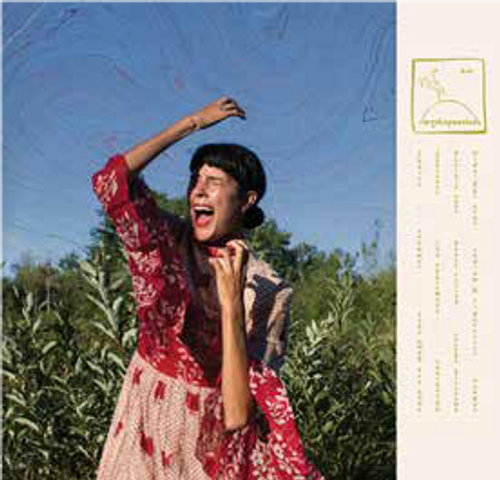
With her musical project Half Waif, AKA Nandi Rose dives deep into the waters of artistic expression by layering evocative vocals and synths to create a powerful form of pop music.
On “Mythopoetics”, Rose explores a full spectrum of sounds that sparkle with memorable hooks, otherworldly production and uplifting grooves. “this is the record I’ve been trying to make for 10 years,” Rose says. previous albums the Caretaker (2020) and Lavender (2018) garnered acclaim for their compelling journeys through solitude, desire and the search for independence. Half Waif declares a new chapter on Mythopoetics, a collection of 12 new songs – mythical stories that transcend time, each sung with a glorious contralto wrapped up in synths and electronic percussion, and her lyrical piano serving as the backbone. it is an essential reminder that we have the power to shape the stories we tell and the myths we make of our lives. this is music that you feel.
The electronic-heavy, synthy “Horse Racing” is the latest single off Half Waif’s new album ‘Mythopoetics’ and about it, Nandi Rose writes, “I started writing ‘Horse Racing’ in an Airbnb in Brooklyn that week in March 2020 when everything got really real. Alone in an unfamiliar apartment, as an unseen force took over our lives, I was struck by how much of a wake-up call it all was. How we were being shaken by our shoulders and told to face something really ugly and monstrous about our ways of being. It felt like we were race horses who had only just realized we were on a track, going around again and again. There’s no end in a circle. And maybe now that we recognized this, we could break out of it, bust right out of the ring – which is what the end section feels like sonically to me. A shot at freedom.”
Sweden’s Hater are back with their first new music in a while, a charming song abourt awkward moments. “The song is about some kind of social awkwardness between myself and new faces,” says singer Caroline Landahl. “Feeling left out due to not knowing how to read a situation but also not wanting to know more than I should.”
Returning with a four minute examination of things gone wrong, Hater’s ‘Bad Luck’ is a very personal examination of that luck, an introvert’s story of learning to live again; of understanding how relationships work and how to communicate in them; a reawakening for new times. Caroline says: “The song is about some kind of social awkwardness between myself and new faces. Feeling left out due to not knowing how to read a situation but also not wanting to know more than I should.” ‘Bad Luck’ is filled with apprehension and ambiguity, a gorgeous ethereal jigsaw that builds as Caroline’s brittle delivery sharpens and concludes, it’s a piece of aching romanticism destined to feature on a thousand mix tapes. A melodious wisp for a new circumstance.
Recorded in January this year ‘Bad Luck’ was mixed and mastered by John Cornfield and produced by Joakim Lindberg in his “Sickan” studio in Malmö. Coinciding with its release Hater accompany their latest track with a striking brand new video.
Recorded at the Palladium theatre in Malmö, the video was directed by Jacob Nilsson and shot by Benjamin Zadig. Currently working on their new album due to be released next year, Hater are Caroline Landahl, Måns Leonartsson, Frederick Rundquist and Rasmus Andersson.
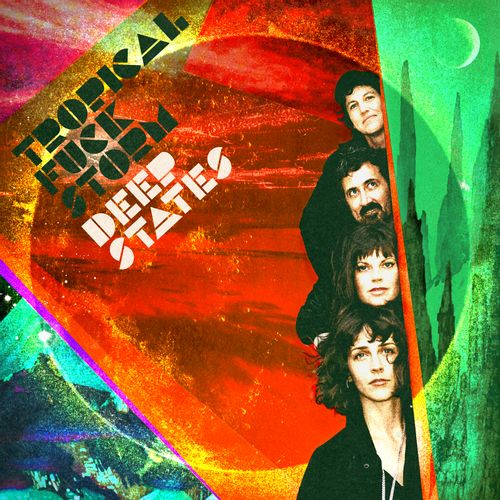
Australia’s Tropical Fuck Storm will release their third album, “Deep States“, on August 20th via Joyful Noise. The band have always felt like they were making music on the brink of the apocalypse, and that hasn’t really changed here. “We make pop records that don’t deny we’re all in a bit of trouble here,” says the band’s Gareth Liddiard. Deep States feeds off the paranoia and conspiracies of the last year and focuses it through their distinctly warped lens.
The first single from the album is “G.A.F.F.” which stands for “Give a Fuck Fatigue.” Over a slinky, grimy funk backing, Liddiard spits out lyrics like “one death’s a tragedy, we want the stats / sadistic statistics keep the shit abstract / pestilence, treachery, cloaks and daggers / when I’m talking arms length I’m talking knuckle draggers.” The band say, “‘Give A Fuck Fatigue’ is an ode to the occasional dispassion brought about by the mandatory concern for every perceived injustice that happens, has happened and might yet happen that is being foisted upon the masses by super-yacht dwelling tech barons who monetise our indignation.”
Most of us have lived some inner Tropical Fuck Storm over this past year and a half.
Even for a band that’s made a career out of crafting songs attuned to political and social crisis, there was a new bleak in the air for Tropical Fuck Storm, what the band calls “give-a-fuck fatigue.” the third album from the avant-punk quadaptly titled deep states mines familiar ground as well as new cultural terrains, while digging deeper into the subjective state of contemporary panic. while not quite a protest album, “Deep States” comes complete with q drops, nods to the January 6th capitol riot, a riff on pizzagate, magas squaring off with antifas, waterboarded martians, dangerous cults from heaven’s gate to the shining path and, not to be outdone, romeo agents who bed us at night only to betray us by morning. We live in a world in which the bizarre has become the normative, and Tropical Fuck Storm plumbs that paradox. That said, the band is far too wary of the self-importance attached to songs in the didactic mode. “we make pop records,” frontman Gareth Liddiard says, “that don’t deny we’re all in a bit of trouble here.” what makes Tropical Fuck Storm so great is the intersection between their dark but satiric storytelling and musical arrangements intent on perverting received canons and wisdoms. these are songs as experiment, advancing and retreating at their own idiosyncratic, deeply unsettling pace.
They hang on the slant beat and slide into jazzy, distortion-packed jams so tumultuous they’d make charlie mingus proud. musically, deep states goes wherever it wants, riffing on pop, r&b, talking heads-style new wave, delta blues, Tom Waits, and some of the band’s hip-hop favourites such as wu-tang clan and missy elliot. Barriers aren’t just broken, they seem to have completely fallen away. in this present moment, parts of the world are opening up, or trying to. but Tropical Fuck Storm is here to remind us that many of our most urgent political and social problems have been around a long time now. same as it ever was, as another genre bending band once sang. as the signs of the latest crisis subside, and the dull ache of awareness with it, deep states is here to remind us that there is no foreseeable end to human folly, nor, fortunately, to the creativity that resists it. over the past few years we’ve all heard the noise in our own heads. Tropical Fuck Storm has made music of it.
Titus Andronicus will give their classic 2010 album “The Monitor” a slightly delayed (for obvious reasons) 10th anniversary reissue on October 22nd via XL Recordings. It’s been remastered for vinyl, with the originally intended vinyl track transitions restored, and for a limited time, this edition will feature the long-out-of-print embossed cover.
Titus will also celebrate the reissue by performing the album in full on ‘The Monitor Revisited 2021 Tour’ this fall.
“As the 10th anniversary came and went, I considered scrapping the whole thing,” said frontman Patrick Stickles. “But my audience has helped me so much to endure during this difficult time, and knowing how much they themselves have had to endure, I couldn’t ignore or deny that they deserve a little treat. After so many years of doing whatever I want, for once, I’m going to give the people what they want.”
The tour begins in Titus’ original home state of NJ.
Along with the announcement, the band put out a new video for a 2009 demo of “Titus Andronicus Forever.”
TheMonitor is among the 100 best punk albums of 2010’s, “The indie rock scene that Titus grew out of is often known for practicing restraint, but The Monitor had less inhibitions than even most of the 2010s’ actual arena rock records.”
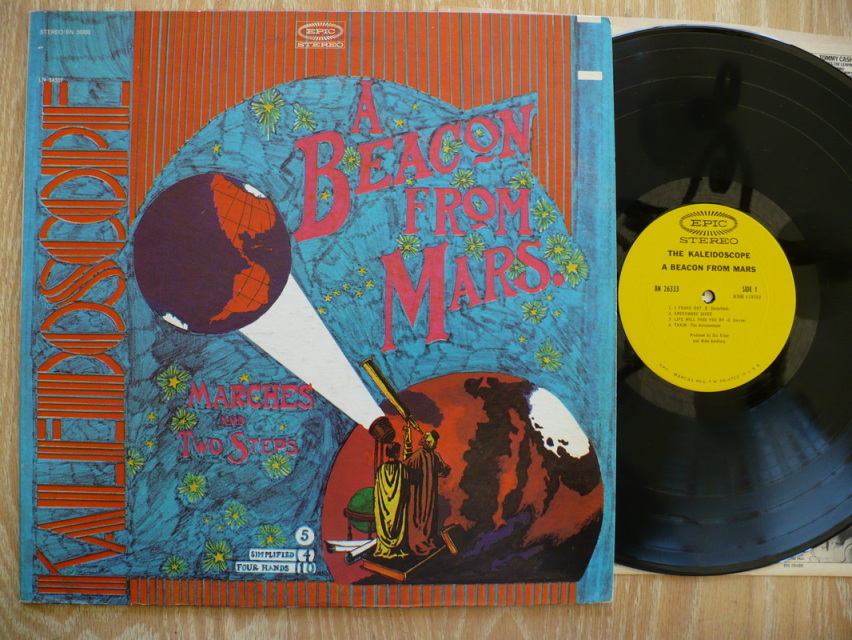
Kaleidoscope’s second album is the best non-compilation showcase of their legendary eclecticism and versatility. It takes in a blues-rocking cover of Willie Cobb’s “You Don’t Love Me” and Doug Kershaw’s Cajun “Louisiana Man”; a scary old folk song (“Greenwood Sidee,” about a woman who kills her two babies); a hilarious country-ish indictment of marriage “Baldheaded End of a Broom” two good acid-folk originals “Life Will Pass You By” and “I Found Out” and two completely dissimilar ten-minute-plus originals: the Middle Eastern “Taxim,” and the psychedelic workout “Beacon from Mars.” Every one of these disparate styles is performed with authority and commitment, and the result still has the power to amaze.
Wielding a battery of exotic instruments that once adorned a thrift-shop front window (bazouki, oud, vina, saz, doumbeg), the Kaleidoscope was every bit as multi-hued and subject-to-change as the telescope full of bright bits of colored glass the band was named after. If there had been a prize for the most eclectic psychedelic outfit, L.A.’s Kaleidoscope would have had it stashed on a shelf–between the hookah pipes and the bowling trophies–in the band’s rehearsal space.
Having released one of the best albums of 1967 (“Side Trips”), this time they become more weird more obscure more Eastern-inspired more PSYCH with “A Beacon From Mars” (released in January 1968), an album where they managed to capture all of the crazy mind-blowing atmospheres of their live appearances, inside the vinyl grooves using a wide range of “unknown-instruments-in-rock-music” and a variety of influences, traditional Country and Blues among them! Solomon Feldthouse, David Lindley, Chester Crill, Chris Darrow, and John Vidican made one of the Best Psychedelic Eastern-tinged Rock albums, innovative, influential and a true precursor of many others that follow. An Eclectic piece of Kaleidoscopic PSYCH!
Formed by multi-instrumentalists David Lindley and Chris Darrow, with a membership that also included multi-instrumentalist Solomon Feldthouse and multi-instrumentalists Max Buda, Chester Crill and Fenrus Epp (all the same person!) along with drummer John Vidican, this wildly experimental outfit pioneered what would become the world-music genre by darting deftly between rock, folk, blues, Cajun, country, Middle Eastern, good-time ballads and Eastern European styles, with plenty of full-blown psychedelia on the side. It’s an exotically diverse approach, explored to great effect on 1968’s A Beacon from Mars, Kaleidoscope’s second LP (the working title for the album was Bacon from Mars). Just float your head through the buoyant, sprawling, mystical title track; the driving, raga-esque “Taxim”; or the graceful opener, “I Found Out,” which unfolds like the tender petals of a young rose. “Beacon from Mars” is an album no fan of –60s West Coast psych can afford to miss!








 The Fat Angel Sings