“I can’t remember the exact genesis of the track,” says Elbow’s Guy Garvey of their new single “Six Words,” “but it is definitely one of Craig’s. In some ways it’s familiar territory lyrically, it has similar sentiments to ‘Mirrorball’ but it draws heavily on my teenage years: the bottle green in the song is the colour of my school uniform and the six lanes is the traffic on the road to school in Prestwich.
Though that six lanes line was something I originally wrote back in the early Elbow days when I sat in The Cornerhouse people watching so it’s a double reminisce and a return to my love of writing about love. The musical revelation came when we heard the backing singers that now end the track. We had this pyramid of voices making something incredible that reminded me of the early classic Disney soundtracks. It was so powerful that we knew we had to throw the spotlight onto them so that is why they end the track.” Elbow’s new album “Flying Dream 1” is out November 19th.
‘Flying Dream 1’ was written remotely in the band’s home studios before coming together at the empty Brighton Theatre Royal to perfect, perform, and record the songs. ‘We don’t phone each other for a chat. We don’t talk about life outside the music until we’re together. These hushed night-time missives told us how each other were doing. When we finally got together, all that was to do was record the songs, honour them with amazing additional singers and players in a gorgeous space and catch up. It was beautiful.’ Guy Garvey, August 2021.
Elbow release their ninth studio album, ‘Flying Dream 1’, on 19th November 2021.
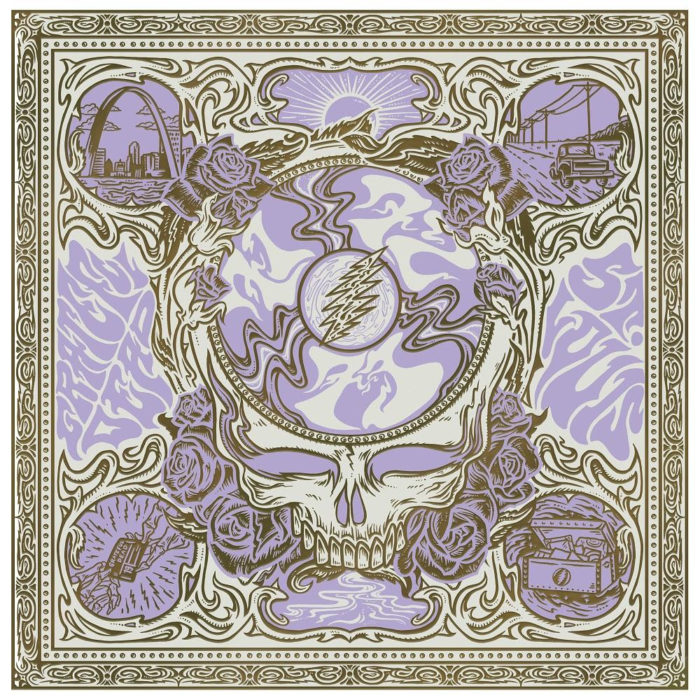
The Grateful Dead have announced they will be releasing a 20-CD box, that will feature seven previously unreleased live shows that were performed in St. Louis, Mo. between ’71 and ’73.
The unreleased concerts were recorded on: December 9th and 10th, 1971 at the Fox Theatre; October 17th-19th, 1972 at the Fox Theatre; and October 29th and 30th, 1973 at Kiel Auditorium. Each show was restored, and speed corrected by Plangent Processes and mastered by Jeffrey Norman. Jeffery Norman mastered the 2017 release of the Grateful Dead’s Cornell 5/8/77 performances, which were also speed corrected by Plangent Processes.
“There are only a few truly great eras in the Grateful Dead’s performing history that span more than a year and one of the very best is the transitional period that covers December 1971 through Fall of 1973. This was a period during which the Dead solidified their touring format (several distinct, somewhat short, geographically defined tours every year), where every night the Dead would wow their fans with a mix of over six years of music that clearly demonstrated their many transitions and transmutations,” said David Lemieux, Grateful Dead archivist and the set’s producer in a press release.
Fox Theatre, St. Louis, MO (12/10/71) will be released as a 3-CD Set And A Limited-Edition 5-LP Set On 180-Gram Vinyl.
A previously unreleased performance of “Sugaree” from the Fox Theatre show on December 10th, 1971,
Steamboats and BBQ, ice cream cones and Mardi Gras – are you ready to laissez les bons temps rouler with the “gateway” to the Grateful Dead? Meet us, won’t you, in St. Louis for a series of releases celebrating the Dead’s early 70s ride along the river including the Dead set, LISTEN TO THE RIVER: ST. LOUIS ’71 ’72 ’73. You can hear a previously unreleased performance of “Sugaree” from the Fox Theatre show on December 10, 1971 now.
Bear recorded 9 of the 20 CDs and the booklet includes three full-page photos of him — the most we’ve ever seen in a release, including OSF releases!! It’s also a treat to read the rich and insightful notes by our friends Nicholas Meriwether, Sam Cutler, and others. Sam’s piece about the Tour Manager’s remit dovetails beautifully with our section, which focuses on Bear’s bumpy re-entry into the scene after 2 years in prison, which Sam also had the dubious pleasure of managing. We are grateful for his candid, first hand account. We also spoke with Bobby about Bear’s approach to sound (“He was a wizard”) and with Betty Cantor-Jackson about the similarities and differences in their respective tapes.
Two special gigs comes to Leicester with an afternoon with Kate Stables performing an intimate 135 cap all seated at the MusicianVenue and then the fully blown thisisthekit set on the evening at TheQ Room, International Arts Centre, Garden St, Leicester
Carl “Buffalo” Nichols opens his self-titled debut with a crisp acoustic blues riff, bending the notes upwards while he depicts himself as a deeply and irredeemably lonely man. “If you see me in your town, looking tired with my head hanging down,” he sings on “Lost & Lonesome“, “you may wonder what went wrong and why I’m alone”.
It’s a bracing introduction to an artist who uses blues to examine the world around him and who understands the historical weight of the music without being burdened by it. Nichols spends the rest of the album trying to explain himself – why he’s weary, what went wrong, how he found himself alone. He tells a sad story but one enlivened by his skills as a guitarist, his expressiveness as a singer and his insights as a lyricist.
Nichols sings and plays with the understanding that this musical form is an apt vehicle to capture this current moment in America, not despite its long history but because of it. Blues is a means of contextualising police violence, gentrification, Black Lives Matter and income inequality within a larger framework. “When my grandpa was young, he had to hold his tongue,” Nichols sings on the harrowing “Another Man“, “’cause they’d hang you from a bridge downtown/Now they call it stand your ground”. For him, 2021 is no different than 1921. Blues remains powerful and relevant because the conditions that inspired so much of the music still persist.
It took Nichols years to come to that conclusion. Born in Milwaukee, he taught himself to play guitar and specifically to play guitar like the artists in his mother’s record collection, such as Robert Cray and BB King. But few cities have a robust blues scene these days, let alone a blues scene open to young kids trying to learn the rules and pick up some techniques. Instead, he played in punk bands around town and, while the form didn’t leave much room for the kind of self-expression that he craved, it taught him important lessons about intensity, concision, and targeted outrage. He saw blues as a roomy museum in the United States, the province of boxsets and high-brow documentaries, something that spoke to the past rather than to the present.
Travelling throughout Europe and visiting clubs and coffeeshops, however, Nichols saw how this American music might be more closely integrated into everyday life. Upon returning to the States, he began writing songs about the state of his world, then made rough demos and field recordings at his apartment or nearby at National Recording: spare, often desolate acoustic performances usually featuring just his husk of a voice and his nimble guitar playing. Those demos became the foundation for his self-titled debut, a stunning collection of songs that treats blues less as a musical style and more as a way of seeing the world in all its glory and horror. Buffalo Nichols is not a blues revival record. It’s just a blues record.
“It’s hard to write a song while folks get murdered every day,” he exclaims on Another Man, a song he shelved after the murder of George Floyd in May 2020 . As difficult as this creative enterprise may be, Nichols emerges as a sharp, succinct, inventive and insightful songwriter, one who can convey complex ideas with just a few words. In fact, every song has at least one line that will stop you in your tracks, some songs two or three. One of his finest moments comes at the beginning of “Living Hell“, when he sings, “Only two kinds of people come here after 3:00/That’s police and crooks and they’re the same to me”. It’s a tidy rhyme but it’s that simplicity that makes it all the more powerful and persuasive.
The world Nichols evokes is treacherous, with each song testifying to great pain and paranoia. Without sounding preachy, he lets you know that this is the state of being black in America, where death is one traffic stop away, where small mistakes have impossibly dire consequences. On “Living Hell” he admits that he goes to church just to hear fire-and-brimstone sermons, because the Hell of the Bible may be the only place where wrongdoings are punished, where evil men get their comeuppance. When he sings “I’m clinging to the memory of a bright and peaceful day but I really don’t remember that things ever were that way,” it’s one of the saddest moments on the entire album.
Not every song on Buffalo Nichols is explicitly political but every song bears the weight of these constant tragedies. His protest songs mingle with love songs until you can’t distinguish one from the other: the horrors of the world drive lovers together but also rip them apart. “You’re gonna suffer anyway but it’s better with a friend,” he decides on “Lost & Lonesome“. “How To Love” is even more heartsore, as Nichols counts the lessons and scars he took from a relationship, knowing his lover took just as many of both. “The way they hurt you showed you how to love,” he sings over a jumpy guitar theme, “the way you hurt me showed me how to love”. It’s a pain that gets passed around from person to person, like a disease. However, these aren’t songs of recrimination and blame. They’re disarmingly generous, startlingly tender, especially “These Things“. Nichols apologises for not being a better, stronger man, for not being able to create a safehaven for himself and his lover, finally admitting that “I can’t be saved from all these things” – by which he means the things that these other songs are about.
These songs skirt pessimism by virtue of Nichols’ committed and unflinching performances as both a singer and a guitarist. His voice is always sensitive to the complexities of his lyrics, never steamrolling through a song or overplaying the emotions. As an instrumentalist, he’s energetic and nimble, pushing even the slower songs along at a brisk pace. On the first few tracks his guitar is a useful foil that can convey a certain sardonic anger, that can push back against the world when he sounds too weary to do it himself. As the album progresses, however, Nichols builds up the arrangements, adding a feverish cymbal roll to “Sick Bed Blues“, then a sympathetic fiddle to “These Things”. A full band rambles through “Back On Top”, which sounds like a particularly lively night at a North Mississippi juke joint.
On closer “Sorry It Was You” he’s joined by a tight rhythm section and an organ that sneaks around the shadows of the arrangement, before everything finally falls away so that he can add a short acoustic flourish like an exclamation point to the album. Partly because Nichols plays almost all the instruments, he doesn’t sound any less lonely with all that activity around him. But it does imply a trajectory, a journey, perhaps even an epiphany about the power of the blues to defy and to console. The world doesn’t get better, nor does he learn to view it in a different light, but Nichols knows he has a listener at the other end of the song. It’s better with a friend.
“Anything Can’t Happen” is the long-awaited debut album from Dorothea Paas, one of Canada’s most beloved singer-songwriters. For over a decade, Paas has played her unique, prismatic style of folk songcraft for audiences across North America, and lent her talents as a guitarist and vocalist to artists like Jennifer Castle, U.S. Girls and Badge Epoque Ensemble. The songs on this album have been through a near-infinite number of forms – Paas has played them solo and with a full band, electric and acoustic, at house shows and in sold-out venues. they manage to fit inside each context, like water taking the shape of its container.
All of this makes “Anything Can’t Happen” feel far more mature and complex than a debut album. It’s a statement of purpose, a next step in a decade-long process of artistic growth and evolution, and a bridge between the DIY style of Paas’s previous cassette releases and a more refined studio sensibility.
Recorded in studios in Hamilton and Toronto, and mixed by Max Turnbull of Badge Epoque and U.S. Girls and Steve Chahley, these songs bring a diverse range of musical influences into conversation: inflected with the layered reverberations of Grouper, shot through with the piercing harmonies of the Roches, electrified with the searing energy of Sonic Youth. You can hear Neil Young in the grittiness of the title track’s guitar; Joni Mitchell’s Hejira in the album’s lyrics, Fairport Convention in Paas’s voice. The influence of Stevie Wonder – one of Paas’s greatest musical role models – is present too, in the album’s conceptual foundations.
Personnel: Dorothea Paas Liam Cole Paul Saulnier Robin Dann Thom Gill
Guitar, drum and bass beds recorded to tape at Fort Rose in Hamilton with Dan Edmonds, Wayne Petti and Aaron Hutchinson
All vocals, additional guitars, synthesizers, and Rhodes recorded at Palace Sound with Chris Sandes and Maximilian “Twig” Turnbull
All music and lyrics written by Dorothea Paas Recorded over 2018-19
Lambchop began in the 1990s, at the time pronouncing itself “Nashville’s most fucked-up country band.” Provocative it may have been, but the description made sense: at the heart of all that ruckus was a band at once defying and embracing the musical legacy of its hometown.
Lambchop’s Kurt Wagner can’t play piano. So for Lambchop’s 15th studio album – the third in this Americana artist’s recent experiments in electronics – he transposed music he had written on the guitar on to a midi keyboard. The result is “Showtunes”, an album whose title suggests razzmatazz but delivers Wagner’s customary laid-back profundity with well placed digital embellishments.
“Showtunes” is indelibly a Lambchop album, a set of songs that references the legacy of American song writing from inside a vat of shimmering treacle. The pace is slow but spacious, giving rise to a pair of instrumental meditations and a seven-minute track, “Fuku“, whose percussive pops, blithe piano motif and bittersweet brass accretes into a quasi-standard pondering the imperfect nature of love. Drop C uses cut-up found sound in a more staticky way, and Blue Leo essays some disorienting vocal manipulations that are perhaps too reminiscent of the latterday Bon Iver. “Showtunes” is much stronger, however, when Wagner layers its disparate elements more subtly – leaning into its limpid jazz horns and electronic atmospheres, with just the distant memory of an opera singer punctuating The Last Benedict.
“Showtunes” is Lambchop’s follow-up to 2019’s “This (is what I wanted to tell you)”. Lambchop mastermind Kurt Wagner recorded the album remotely with Yo La Tengo’s James McNew, Ryan Olson, co-producer and engineer Jeremy Ferguson, horn player and arranger CJ Camerieri, and Cologne DJ Twit One.
Released May 21st, 2021
Ryan Olson: horn production and rearrangements, sound manipulation. C.J. Camerieri: horns and arrangements. Andrew Broder: grand piano and turntables. James McNew: upright bass. Twit One: beats. Kurt Wagner: vocals, MIDI piano, guitar, composition and editing.
with Jeremy Ferguson: a snare drum. Eric Slick: a drum pass.
Renee Reed from Lafayette, Louisiana, is a musician who possesses a special gift, one that I have always loved in any musician, the ability to make complex ideas seem beautifully simple. The evidence is there to hear on her stunning, self-titled debut album, released last month on the wonderful label Keeled Scales. Across the twelve songs she describes modestly as, “dream-fi folk from the Cajun prairies”, Renée chronicles a three year period, full of making sense of the world and her place in it.
The resultant record has a timelessness to it, songs carved from the ancestral coal face, weaving together the seemingly disparate strands of the Cajun and Creole music scene in which she grew up surrounded by at her parents shop-come-music-venue at the owned by her parents Lisa Trahan and Mitch Reed; and her own musical discoveries, seeming to pick out sounds from minimal folk to French Chanson. Renée Reed grew up on the accordion-bending knee of her band-leading grandfather Harry Trahan; in the middle of countless jam sessions, soaked in the storytelling of her great uncle, folklorist Revon Reed and his infamous brothers from Mamou; and surrounded by a litany of Cajun and Creole music legends, both backstage at the many festivals of Southwest Louisiana and on the porch of her family home.
While Renée’s music is certainly informed by these deep roots, her dark dreamlike folk has more in common with contemporaries like Cate Le Bon and Jessica Pratt. It’s also not unlike the intangible magic contained in Mazzy Star’s songs.
For the most part this record is just Renée and her acoustic guitar, yet it has a depth of character to it, whether it’s the dreamy musical textures she rings from six-strings, or her voice, that seems almost to say one thing, while hinting at much more. It’s a voice that seems to carry a story alongside the lyricism; in the almost dismissive hint to the delivery of Your Seventh Moon, or the exquisite and undeniably sad tones of “Fool to the Fire“, as she laments, “all your love that you never really gave”.
Throughout the record, there’s a certain dream-like quality, it allows space for your mind to wander, before pulling you back with an arresting tone or a lyric that hits like an arrow and demands you come back into a more conscious, attentive state. Take the wonderfully hypnotic Little Flower Dance, it flows in on a gorgeous, bright-guitar line, a gentle lilting piece, that suddenly takes a dark turn that catches your ear entirely off-guard, “feeling kind of bruised, feeling black and blue inside”, or when Fast One’s driving guitar-tone is cut through by the dancing melody, “with you darling, I could live a lie”. It’s these moments that are littered throughout the album, these little drips of trouble in the serene surroundings, the moments of vulnerability and humanity that make this album so much more than just a truly beautiful listen.
Today Renée Reed is sharing an exclusive live version of one of the record’s stand-out moments, “Neboj” by Renée Reed (recorded live) From her self-titled record coming March 26th, 2021
Renée Reed’s debut album is out now via Keeled Scales Records.
So, the group game together at the “Le Guess Who?” Festival in Utrecht, Netherlands in 2018. I was asked by the organizers to find another group on the festival to collaborate with for a one off performance. I was immediately drawn to Kikagaku Moyo. We share similar guitar scuzz and riff heavy improvising when playing live. Seemed like the most fun and natural thing to do. I was in the middle of a european tour, so had my full backing band. So with Kikagaku Moyo and me, 9 mother fuckers total on stage wailing.
It was a lot of Sound. At first glance this may seem a little meandering, but if you start digging into the layers it becomes apparent that there’s always another sound to find; always another layer to parse. Boisterous chord skronks, whiny sitar buzzes, the quiet tugs of cello strings, gentle bass thrums, and swirling keyboards all coalesce to form a cosmic tapestry that flows outward like an ever-morphing and undulating mandala.So we passed the live recordings off to Cooper Crain of Cave and Bitchin Bajas to tweak the levels and add some sprinkles. He shaped the raw recordings into a cohesive piece that works for a 40 min slab. We had an afternoon of rehearsal and it mostly just drinking espresso, smoking cigs and saying “man, we’ll be fine”
And it was great.” (Ryley Walker/Husky Pants Records)
A terrific new album “I Ain’t Leavin’” from storyteller singer songwriter Bert Deivert This is his 14th album in 48 years of being a professional musician. With everyday stories of life with folk, blues, and even some jazz influences. Originally from New Hampshire in the US, but have lived in Sweden now for 47 years and played in 25 countries. . The new album is getting radio play right now in the UK, Ireland, Canada, and the US.
This year Bert also appeared playing on many tracks on Peter Case’s “The Midnight Broadcast” album which came out in March 2021. Although mostly known for his blues mandolin work in recent years, Bert has been writing songs for more than 50 years and has released some excellent albums mainly original songs , solo and including his work with bluesman Eric Bibb.
Some of the subjects of these songs include: the murder of his policeman grandfather in Boston in 1930; hitchhiking to Montreal from his home in New Hampshire to see if he could seek asylum there if drafted to go to Vietnam; the joys of singing the country blues songs of Yank Rachell and Sleepy John Estes; the humorous trials and tribulations of a woman that doesn’t love all his vintage instruments; and a noisy and sleepless trip on the Orient Express to Istanbul while traveling to Afghanistan in 1976.
“I Heard the Dark Roads Call” – the fear of war in Vietnam and being drafted in 1969, This song by Bert Deivert is about a trip to Canada before the lottery for the Vietnam war draft was held in December 1969. All previous student deferments were cancelled and the lottery would be done for all eligible men from the ages of 18-26 years old. It was the first time a lottery system had been used to select men for military service since 1942. He hitchhiked from his home in Derry, New Hampshire in the summer of 1969 to Montreal to check out the possibilities of moving there and seeking asylum if drafted. The song tells of his feelings and what happened. It is a document of that time of a young man at the age of 18 and his feelings about what was going on in the world around him.
This next song from my album “I Ain’t Leavin” about my maternal grandfather’s murder in the line of duty in 1930. James J. Troy was a detective on the police force in Boston. The photos and articles were from newspapers and private sources from our family.
“I Ain’t Leavin” by Bert Deivert features 10 songs, 41 minutes long – all the songs, except for one traditional, are written by Bert Deivert.
Released in August 2021 on his own label, Hard Danger Records, Sweden,
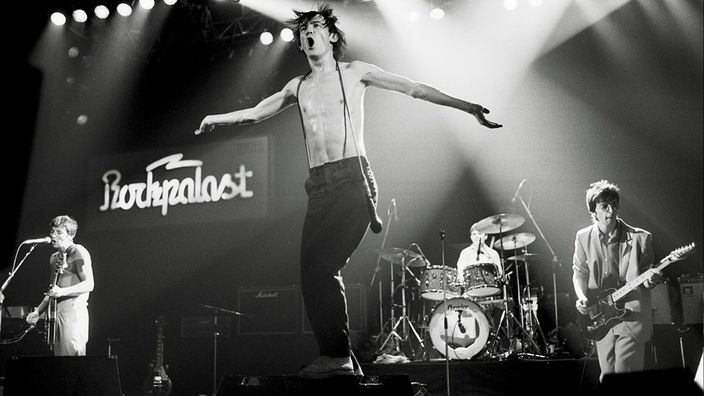
The Undertones will open the 9th Rockpalast-Festival. The group was formed in 1976 in Londonderry, Northern Ireland. For the five band members, this seemed to be the best attempt to be able to stand the depressing life in their hometown. The early days of the Undertones were mainly filled with playing songs from well-known rock bands, then they slowly wrote their own texts and compositions.
In the mid ’70s, there was a movement in English rock music. All at once, it was no longer necessary to play perfectly whenever possible, nor to be able to appear on-stage only with a large technically- equipped set-up. To play live concerts was important, no matter how. It also wasn’t important whether one called himself a musician or tried to prove himself as a virtuoso instrument player. These differences also had some effects on the Undertones. The members of the group decided to become pros and to write only some of their songs.
In 1978, the Undertones released their first LP on one of the many labels that existed back then. ‘Teenage Kicks’ was a sales success. Now the group was well-known everywhere and regularly completed extended club tours, to which ever-increasing fans always came.
Today, the Undertones count amongst the most successful live groups in Great Britain. At concerts, the band presents a varied musical repertoire: For one, their stage appearance and the impressive voice of the singer, Feargel Sharkey and, for another, the way the group works the dense and imaginative arrangements. The Undertones don’t waste any time on-stage. The songs are short and have no solo side-trips. The performances are played straight to the point, without forgetting to communicate with the audience. As the Undertones see it, it is very important that the audience doesn’t come out short on fun and entertainment at their concerts.
In 1975, five friends from Northern Ireland got together as the band The Undertones in order to close up the gap between punk, pop, rock and rhythm and blues. Three years later, they were in Belfast and had a first record contract. With the LP ‘Positive Touch’ in 1981, the Undertones changed stylistically and experimented with string and wind sections. They closed a big tour through North America and Europe (including Rockpalast). After a pause, the LP ‘Sin ofPride’ appeared in 1983, which did not meet expectations. Disappointed, the Undertones gave a farewell concert on July 17th, 1983, in Dublin, and then dissolved the group.
‘Rockpalast’, Essen Grugahalle, Germany 17th October 1981
You’ve Got My Number/ Hypnotised/ His Good Looking Girlfriend/ Tearproof/ See That Girl/ Girls That Don’t Talk/ It’s Going To Happen!/ Jimmy Jimmy/ I Don’t Know/ More Songs About Chocolate & Girls/ Forever Paradise/ Beautiful Friend/ Julie Ocean/ You’re Welcome/ When Saturday Comes/ Jump Boys/ Teenage Kicks/ Get Over You/ Sigh & Explode/ My Perfect Cousin/ Get It On
This show was broadcast live on both television and radio throughout Europe. The original broadcast featured an interview with the band twenty minutes after they came off stage. The show has been broadcast on the WDR satellite channel in recent times, minus the interview at the end.





 The Fat Angel Sings