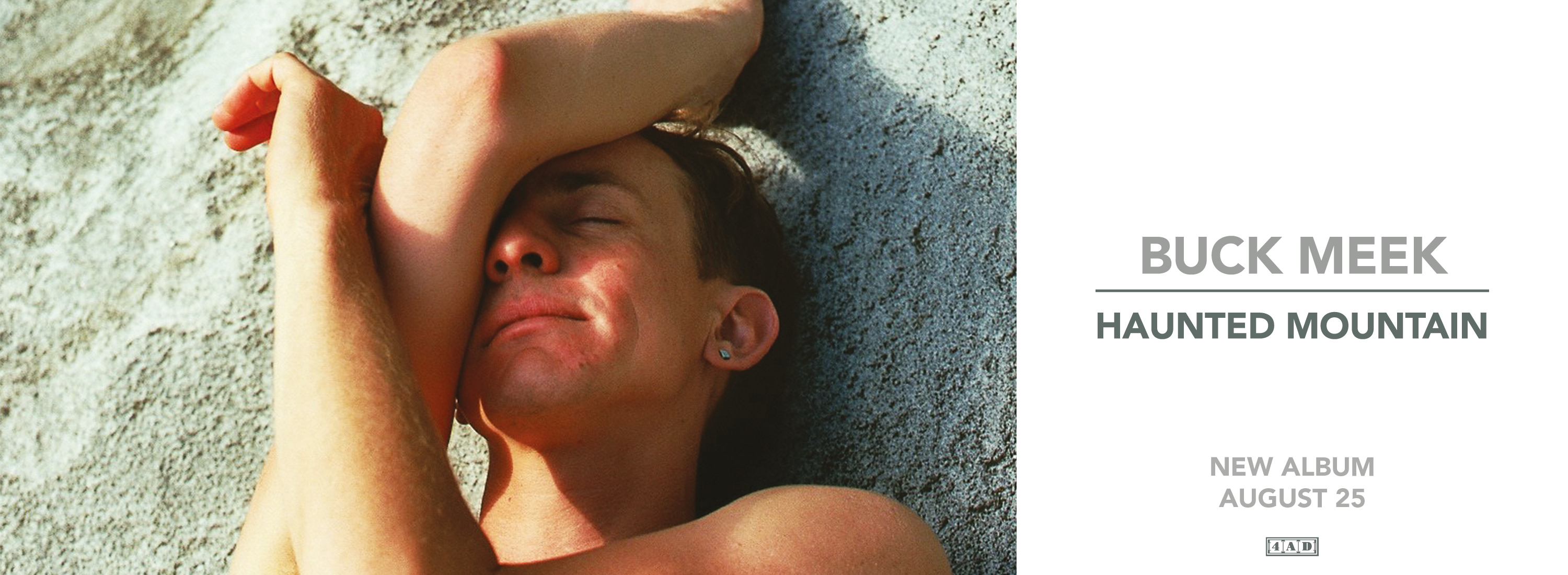
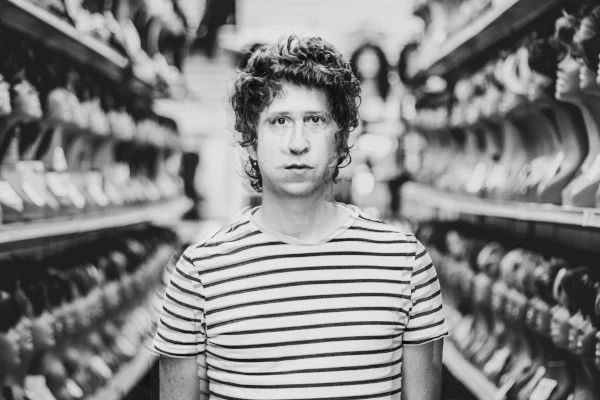
The newest solo effort from Big Thief guitarist Buck Meek is a truly wondrous sight to behold. As a follow-up to his 2021 album “Two Saviors”, “Haunted Mountain” is a wide landscape of rock ‘n’ roll. Meek might not be the centre of attention while sharing a stage with his Big Thief bandmates, but on “Haunted Mansion” he has the legs to explore every type of mood he can conjure. With three teaser tracks out already, the singer/songwriter has already proven that his solo work is daring, contemplative and spiritual. From the bluesy guitar leads on “Haunted Mountain” to the pensive balladry of “Paradise,” Meek is on another level. Beyond August, as far as folk-rock records in 2023 go, “Haunted Mountain” is the one we’re most excited about.
“Paradise”, was the second single from Buck Meek’s record “Haunted Mountain”, is out now Buck says, “Sometimes when you half-hear something spoken, something unspoken inside the words is revealed. Your mind fills in the blank, finishes the sentence, infers deep meaning – though you still can’t fully explain it. Jolie Holland sent me some of the lyrics for this song, about feeling in awe of the vastness within a loved one, and I wrote it thinking about how love often feels too big to comprehend, like death, or life after death, or space.”
“Paradise”, the second single from Buck’s record “Haunted Mountain”,
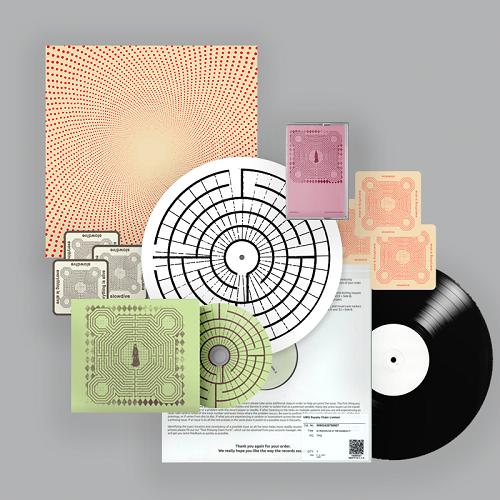
Slowdive’s 5th record is exactly what the title suggests: an exploration into the shimmering nature of life and the universal touch points within it. while there are parts of this record that could sit neatly next to the atmospheric quality of 1995’s ‘Pygmalion’;
Slowdive’s “the slab” is the latest addition to a new era which has seen the band rocket into the 21st century with as much panache and grace as their self-titled did six years ago. The third single off of “Everything Is Alive” is typically—and delightfully—woozy, an aura of quiet suspension permeating its rhythmic bones. “the slab” was intended to be heavier than many of the songs on the record, and it has a notable pull to it; deeper instrumentals and thick sonic textures add weight to the track, creating a loud, prowling soundscape. Over five, sprawling minutes, the song’s intensity increases to a distorted pinnacle before fading quicker than it came. It’s a spacey, moody closer to the eight-track album set to arrive next month.
‘Everything Is Alive’ also manages to break down the boundaries of what’s come before it. spanning psychedelic soundscapes, pulsating 80’s electronic elements and John-Cale-inspired journeys, the album lands immediately as something made for 2023 and beyond.
For a genre that is often thought of as divisive, and often warrants introspection, here Slowdive show their craft as the masters of it by pushing it outwards, beyond the singular; the end result being a record which feels as emotional and cathartic as it is hopeful.
Slaughter Beach, Dog released a folky new single “Strange Weather” today. It comes with backing vocals from Erin Rae.Slaughter Beach, Dog have released a new easygoing indie folk song, “Strange Weather,” alongside the announcement new tour dates coming up in the fall. According to band leader Jake Ewald, “Strange Weather” is about “doing your very best to disappear from yourself. Hiromi Kawakami and Jason Molina live in here. I think Jia Tolentino, too. Trying to hold light in your hand. Certainly as a bad prank that unfolds across decades. Sometimes all I get is sha-la-la. Thanks to Erin Rae for lending us her amazing voice here – I remember listening to Putting On Airs in the van after a show some years ago and the whole tour melted away for a minute. An honor to finally share the mic with you, ER. If I saw the light, would I know?”
“Strange Weather” by Slaughter Beach, Dog Lame-O Records 2023
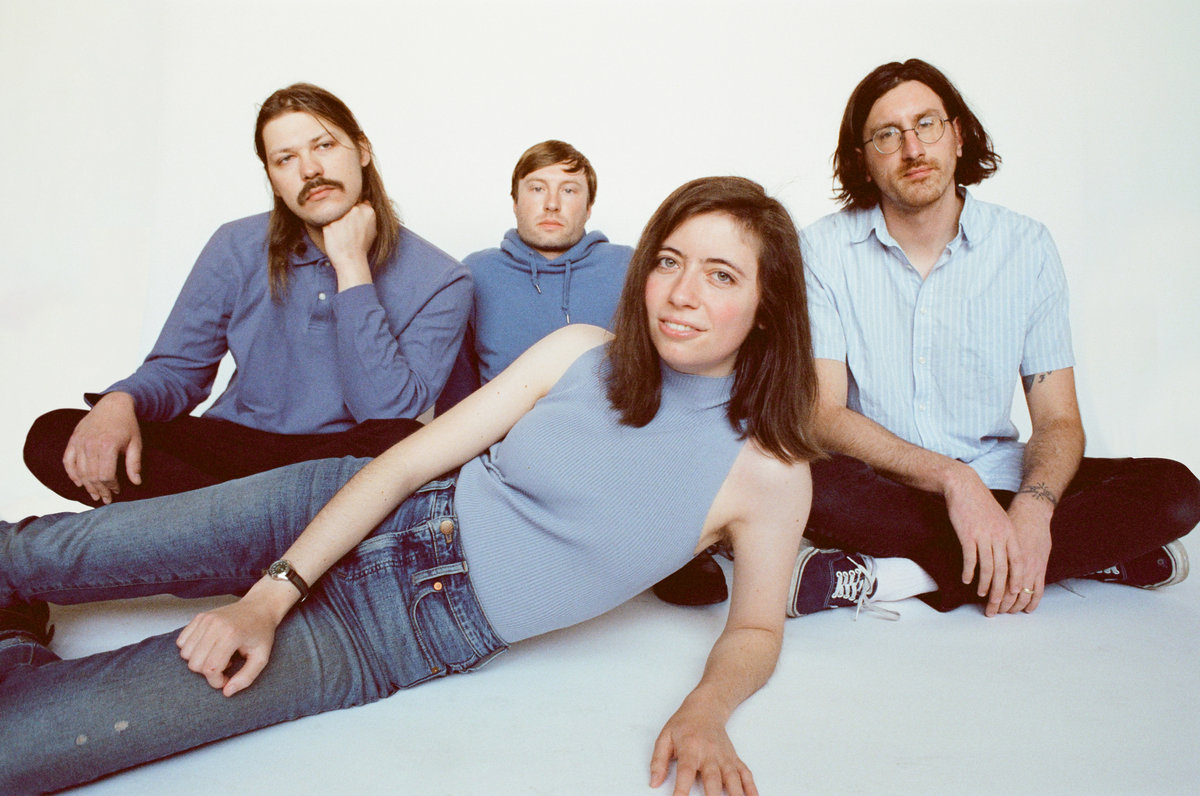
The fifth song to arrive from Ratboys’ forthcoming record, “The Window”, is, possibly, the very best. “Morning Zoo” is the post-country masterpiece that will surely become a definitive track of 2023 when it’s all said and done. The violin that Abby Gundersen injects into the instrumental is mesmerizing and unreal, and it perfectly compliments vocalist Julia Steiner’s twangy, precise and zoomed-in vocals—as she examines her own anxieties and the weight of being in a band at a time when it’s becoming harder and harder to find successful longevity. “How long does it take to find the peace that I want?” she sings. “And how long must I wait to decide that it’s over? Well, I don’t know.” Though it juxtaposes greatly with the epic, mountainous unfurling of “Black Earth, Wi,” “Morning Zoo” glitters just as brightly, perhaps even more so.
Written & Performed by Ratboys Produced by Chris Walla “Morning Zoo” is taken from Ratboys’ ‘The Window’, out August 25 via Topshelf Records
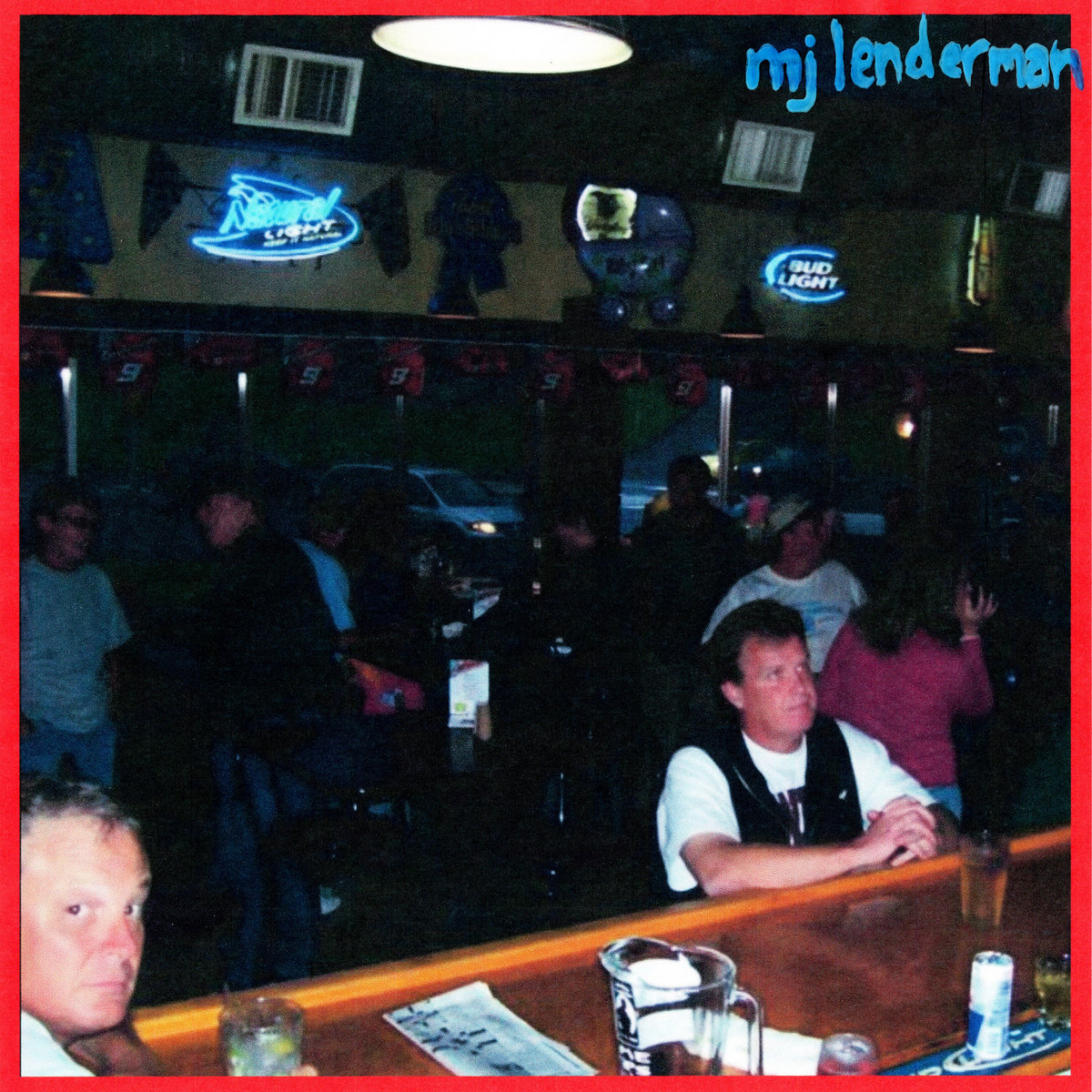
Last month, MJ Lenderman released one of the song’s of the summer, “Rudolph.” Cut to a few days ago, and the Asheville singer/songwriter is giving his own accolade a run for its money with “Knockin.” The track is a perennial live show favorite that appeared on his 2021 EP of the same name but, this time around, it’s a hi-fi update of a not-so-new song, and it’s just as good as anything Lenderman has made, maybe better—depending on who you ask. “Knockin” is a blistering country-rock stunner that puts one thing at the center of attention: Lenderman’s uncanny ability to absolutely shred. With Xandy Chelmis’ pedal steel and a mountain of percussion backing him up, “Knockin” takes on a life of its own.
Lenderman’s lyricism is at an 11 here, too, as he makes a play on Bob Dylan’s “Knockin’ on Heaven’sDoor” while keeping up his trademark fusion of earnestness and poetic humor. “Loneliness is simple, not much else is,” he waxes. “Her love for me is real, she gives me what she has to give. She gave me wings and I caught blight.”
Title track from MJ Lenderman’s brand new EP ‘Knockin,’ out August 20th via Dear Life Records Digital Editions
When Bad Moves’ David Combs released “Ride the Vibe” under the moniker Dim Wizard earlier this year, he was tapping into a deep bag of momentum. He’d tapped Jeff Rosenstock, Illuminati Hotties’Sarah Tudzin and superviolet’s Steve Ciolek to round out the track and, even then, it felt like an all-time guest list. Fast-forward to this week, and Combs has done it again. The latest Dim Wizard track, “X-Games Mode,” calls upon Mike Krol and Ratboys’ Julia Steiner, while Tudzin is tagged as a co-producer. “X-Games Mode” is a shredding delight. Catchy riffs and overblown guitars aplenty, Krol and Steiner pierce through the walls of distortion to form a pretty perfect alt-rock track with power pop inflections.
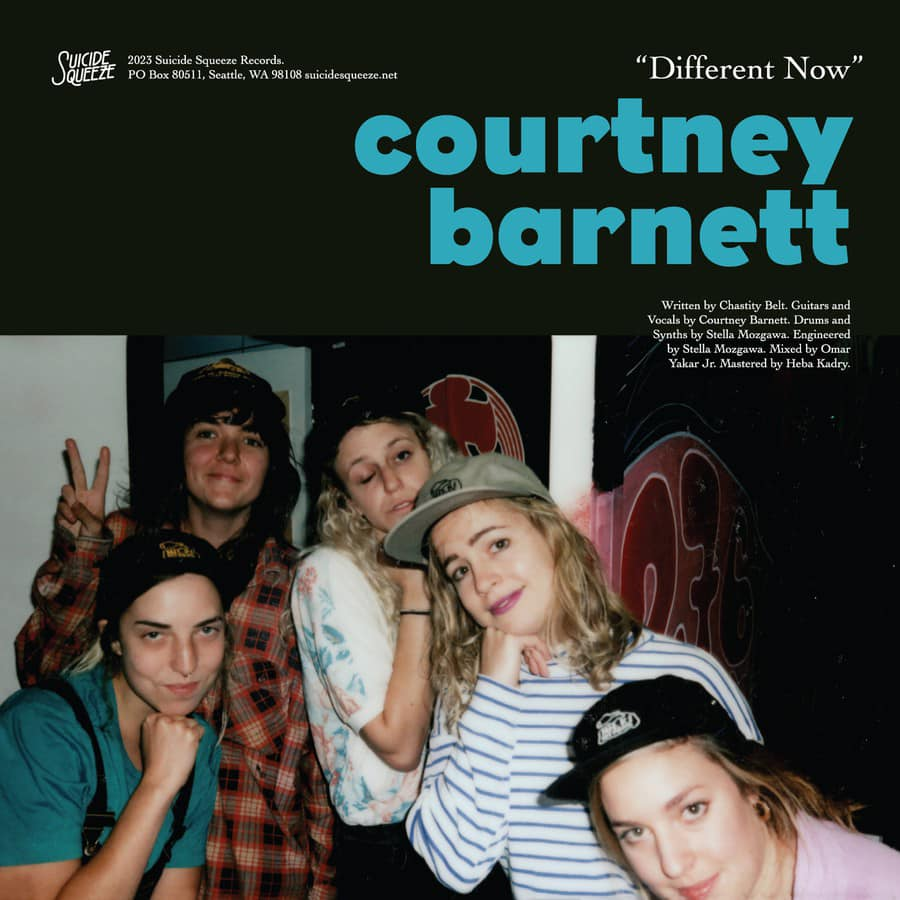
Though Courtney Barnett has her own record, “End Of The Day”, due out next month, the Australian singer/songwriter took some time to release a cover of Chastity Belt’s all-time track “Different Now.” Originally appearing on their 2017 album “I Used to Spend So Much Time Alone”, it remains the one Chastity Belt song I return to more than any other—because it’s just one of the most beautiful songs ever written. The only person in the world who could cover it and do the record justice is Barnett, who called upon Warpaint’s Stella Mozgawa to play drums and synths. Barnett’s vocals take a subdued, scaled back route, as she morphs the song into an ‘80s pop soundscape—all thanks to Mozgawa’s intricate yet bubbly contributions.
This version matches the undeniable catchiness of the original by carving out its own space without stealing the thunder of Chastity Belt’s OG vision. That’s what the best covers do, and Barnett has constructed a perfect homage to the Washington band’s reflective and intimate classic.
Written by Chastity Belt Guitars and Vocals by Courtney Barnett Drums and Synths by Stella Mozgawa
“Different Now” out August 7th, 2023 on Suicide Squeeze Records
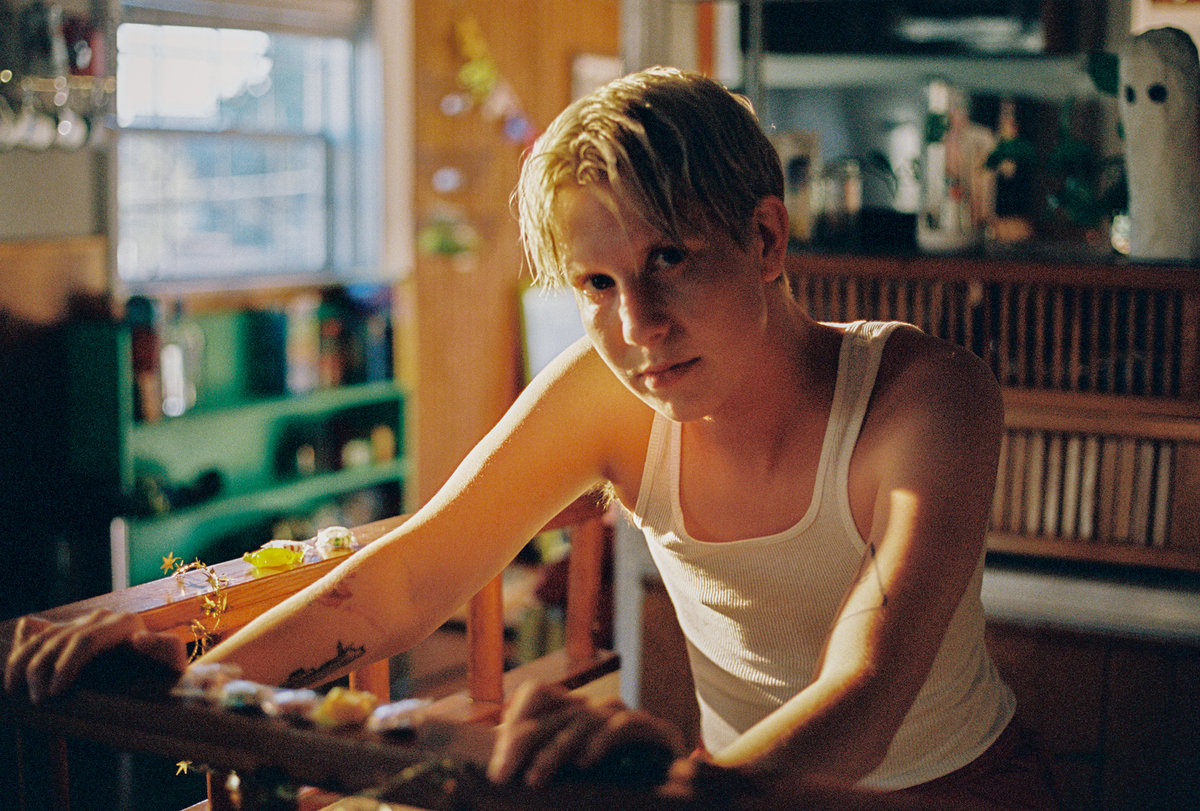
“Grandma’s Garden,” is the second single from Al Menne’s forthcoming album “Freak Accident”, is short and softly insistent; a rearview-mirror childhood recollection told with all the diaristic vulnerability of youth. It shakes and glimmers with triumphant guitar and rich backing instrumentals, a synesthetic description of late summer and days long gone. With, as always, impeccable guitar playing from HandHabits’ Meg Duffy, “Grandma’s Garden” is a hypnotic, nostalgic slice of sharp nostalgia—as Menne conjures memories of running through their grandparents’ pastures. “Petulant kid playing silent treatment, doubling down ‘cause you know I’m stubborn,” Menne sings. “Obvious where I could’ve got that from. Am I not who you thought I would be?”
“Freak Accident” is the debut album from Al Menne. Menne came up in the music scene as the lead singer of Seattle-based rock band Great Grandpa. In this outfit, Menne’s remarkable voice—capable of quicksilver flicks between vocal registers—was on full display. Aside from the occasional posting of half-finished demos on Bandcamp, “Freak Accident” marks their first official foray as a solo artist.
“Freak Accident” is available everywhere on LP/CD/digital September 22nd on Double Double Whammy.
68 track 3CD box set celebrating Leeds’ independent scene of the 1980s. Featuring Soft Cell, Sisters Of Mercy, Gang Of Four, The Wedding Present, Scritti Politti, The Mission, and many more.
Also including The Mekons, CUD, Delta 5, The Pale Saints, Girls At Our Best, Age Of Chance, The Bridewell Taxis who all stamped their mark on the indie charts and were regulars/favourites on John Peel’s radio show.
Like many Northern cities, Leeds enjoyed an explosion of music triggered by the big bang of punk rock in 1977. Indie labels sprung up to cater for a new wave of bands, who carved their own identity as the 80s dawned. ‘Where Were You’ is the first comprehensive anthology of Leeds’ independent music from that period, through to the end of the 1980s. From punk to goth, indie pop to industrial dancefloor, out-and-out pop to underground psychedelia, the four hours’ worth of recordings here are a celebration of the musical diversity emanating from the city’s studios and clubs.
Co-compiled by Benoît Farvak (Salvation) with invaluable help and support from Richard Rouska (Rouska Records), ‘Where Were You’ also boasts numerous obscurities which make their debut on CD – including many tracks taken from records now worth a small fortune on the collector’s scene. Featuring extensive sleevenotes written by Andy Peterson, this is a fitting tribute to the legacy from one of the UK’s finest northern musical cities.
The first year of a new decade… who could have predicted Watergate, the oil crisis and the Star Wars phenomenon that were to come in the years ahead?, The plight of the Apollo 13 manned mission to the Moon had us riveted for days, after an oxygen tank exploded. Four students were shot and killed by the Ohio National Guard at Kent State University.
Jimi Hendrix and Janis Joplin died, weeks apart.
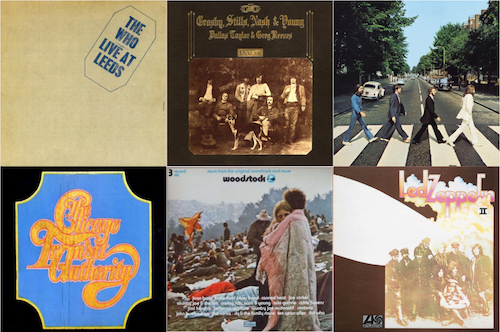
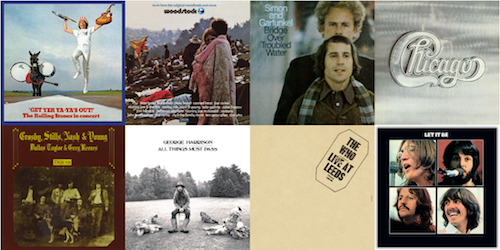
Recordings made by some of the most enduring classic rock artists dominated the list of 1970’s top-selling albums in the U.S. The chart, compiled by the former music industry trade magazine, many of the year’s biggest albums were actually released in 1969. The Rolling Stones‘ Let it Bleed, released in December 1969, includes “Gimme Shelter,” “Midnight Rambler” and “You Can’t Always Get What You Want.” Many of these albums from that year remain cornerstones of any essential classic rock record collection, with works by George Harrison, Traffic, the Rolling Stones, Joni Mitchell, Led Zeppelin, the Grateful Dead, Simon & Garfunkel, The Who, Chicago, CSN&Y, and more, sounding as fresh now as when we first removed the vinyl from the shrink-wrapped album jacket.
The Allman Brothers Band—Idlewild South Their second album (“Midnight Rider,” “In Memory of Elizabeth Reed”) rewrote all preceding notions of what rock from the South could be.
The Band—Stage Fright Less “rustic” than its predecessor, more rocking, somewhat darker, it set them up as more of a mainstream band and gave them some hot new material to try out onstage.
The Beatles’ “Let It Be“, recorded before Abbey Road but released after it, is where it all ended. Despite the group’s disfunction, the album includes such classics as the title track, “Get Back,” “The Long & WindingRoad” and “Across the Universe,”.
Black Sabbath—“Paranoid” Their second album (the self-titled debut was released earlier in the year), this was the blueprint for heavy metal. Talk about rock anthems, this album was stacked with them.
The Byrds—“Untitled” Only Roger McGuinn remains from the early days, but the sound is still unmistakable on this half-studio/half-live double album.
Though it was released in April 1969, Chicago‘s debut two-record set, “Chicago Transit Authority”, continued to sell well enough to be 1970’s #11 biggest album. Its songs include “Questions 67 and 68,”“Does Anybody Really Know What Time It Is?” and “Beginnings.”
Chicago—”Chicago” Also known as Chicago II (after they dropped “Transit Authority” from their name), this double album was ambitious and wide-ranging. Includes “25 or 6 to 4,” “Make Me Smile” and “Colour My World.”
Eric Clapton—”Eric Clapton” After the Yardbirds, Bluesbreakers, Cream and Blind Faith all behind him, the guitarist/singer/songwriter decided it was time to make his own solo album tracks included “After Midnight,” “Blues Power”.
Joe Cocker—“Mad Dogs & Englishmen” The traveling road show to end all traveling road shows cut this live double set that personified the rock ’n’ soul party. Joe Cocker released “MadDogs & Englishmen“, a live double set that personified the rock ’n’ soul party.
The singer, just 25 when it was recorded, was joined by musical director Leon Russell and a “cast of thousands” that included superstar band Chris Stainton, Carl Radle, Jim Gordon and Rita Coolidge.
Creedence Clearwater Revival—“Cosmo’s Factory” Their fifth album was a monster seller, Their album “Cosmo’s Factory”, at continued Creedence Clearwater Revival’s remarkable stretch. The album’s track listing reads like a greatest hits collection with such favourites as “Travelin’ Band,” “Who’ll Stop the Rain,” “Up Around the Bend”.
“Willy and the Poor Boys” was Creedence Clearwater Revival‘s fourth of fivealbums released in less than two years. The 1969 album includes “Fortunate Son,” “Down on the Corner” and CCR’s covers of “The Midnight Special” and “Cotton Fields.”
Crosby, Stills, Nash & Young—“Déjà Vu” The poster boys for the rock supergroup upped their game with the addition of Neil Young. topped themselves when the supergroup trio released one of the most acclaimed albums of 1969? for 1970, add a fourth member for your follow-up. So, Crosby, Stills and Nash became Crosby, Stills, Nash & Young.
Their “Déjà Vu” reached #1 in the U.S. (#7 for the year) and yielded three hit singles: “Our House,” “Teach Your Children” and “Woodstock,” plus a great lead-off track, “Carry On.” And how cool was that Civil War-era photo and the original leatherette paper used for the album cover?.
Derek and the Dominos—“Layla and Other Assorted Love Songs”Eric Clapton’s short-lived group created an all-time classic with this studio set. The title track was inspired by the guitarist’s infatuation with Pattie Boyd, George Harrison’s wife.
The Doors—“Morrison Hotel” Their fifth (of six) studio album, it was less meandering and experimental than its predecessor. Its lead track, “Roadhouse Blues,” became an radio staple.
Bob Dylan—”New Morning” Following the head-scratcher that was “Self Portrait“, Dylan’s 11th studio album wasn’t as country as “Nashville Skyline“, and wasn’t folk, but it surely wasn’t like his ’60s rock either.
Aretha Franklin—”Spirit in the Dark” At the time it wasn’t one of her biggest sellers, but many now consider it among her finest works.
Free—“Fire and Water” For “All Right Now” alone, the rock song of the year, it would become a rock classic, but this album that served as the breakthrough for the Paul Rodgers-fronted British quartet is solid from start to finish.
George Harrison—“All Things Must Pass” He’d released two experimental solo albums that received little notice. Then came this triple-LP that showed, even more than his work with the Beatles, that he was a true leader.
Jimi Hendrix—“Band of Gypsys”—After three albums with the Experience, he wanted something different. Working with bassist Billy Cox and drummer Buddy Miles, he cut this live New Year’s Eve show in New York that presented a whole new side. Sadly, he’d passed away before the end of the year.
Jethro Tull—“Benefit” They started out as a jazz-rock band in Britain—their leader even played a flute!—but by their third album they’d hardened up somewhat, featuring tougher guitar lines and darker lyrical themes.
The Kinks—“Lola Versus Powerman and the Moneygoround, Part One” With albums like “Village Green Preservation Society” and “Arthur”, Ray Davies proved one of our most astute observers and craftsmen. On his latest concept album, he takes aim at everything from the music biz to society itself, and the band delivers a tour de force.
Led Zeppelin—“Led Zeppelin III “II” was a hard act to follow, so Zeppelin was wise not to go in the same direction, instead incorporating more acoustic elements into songs that tended more toward the poetic and introspective than bludgeoning hard rock.
John Lennon—“Plastic Ono Band” His debut solo album (not counting three with Yoko) was raw and confessional in spots, vulnerable and tender in others. Songs like “Working Class Hero” and “Mother” were among his most poignant post-Beatles work.
Paul McCartney recorded his solo debut largely in secrecy at his home recording studio in London. It’s a true solo album as he played all the instruments. (His wife, Linda, sang harmony.) The LP, with such songs as “Maybe I’m Amazed,” “Every Night” and “That Would Be Something,” reached #1 and was the year’s #6 overall. The “reverse” album cover, shot by Linda McCartney, features a fruit bowl on the front, with a photo of a bearded McCartney – with baby Mary in tow – on the back.
Joni Mitchell—“Ladies of the Canyon” She’d begun developing a devoted audience, and her peers raved about her, but this third album served notice that a major star had arrived. Includes classics like “Woodstock,” “Big Yellow Taxi” and “For Free.”
Van Morrison—“Moondance” His 1968 “Astral Weeks” was intricate and dense even though it was entirely acoustic. Here the Irish enigma morphs into a full-blown major singer-songwriter. Every song is a gem, including the title track, “Crazy Love” and “Into the Mystic.” The also-excellent “His Band and Street Choir” would follow later in the year.
The Rolling Stones—“Get Yer Ya-Ya’s Out” The Stones’ 1969 tour of the U.S. was an event of gargantuan significance in the rock world, and the souvenir recording is still considered by many to be among rock’s most perfect live albums.
Leon Russell—Leon Russell—He was already a studio veteran by 1970, having played on dozens of hit records as a member of the Wrecking Crew. But it wasn’t until he released this debut solo album, containing classic hits like “A Song for You,” “Delta Lady” and “Roll Away the Stone,” that we experienced the full breadth of his talents as singer, songwriter and instrumentalist.
Santana—“Abraxas”Santana‘s self-titled debut was released two weeks after they electrified the crowd at Woodstock in August 1969. Thanks to their reception and the big single, “Evil Ways,”“Abraxas” a perfect marriage of rock and Latin rhythms, all fronted by one of the most original guitarists on the scene. The follow-up refined the approach, giving us hits like “Black Magic Woman” and “Oye Como Va.”
The debate of what is the best live rock album is sure to include The Who‘s electrifying “Live at Leeds”. The original release featured just six tracks though the concert featured a far, far lengthier performance that included the entire “Tommy” rock opera. Its no-frills cover was designed to resemble an album bootleg.
Simon and Garfunkel—“Bridge Over Troubled Water” Their farewell studio set remains one of their finest, a diverse and powerful creation. The title track alone is a masterwork, and it’s kept company by other ace tunes like “The Boxer” and “The Only Living Boy in New York.”
Spirit—“Twelve Dreams of Dr. Sardonicus” has become a classic album, Although it didn’t fare as well on the charts as their three previous releases, the California band’s ’70 effort continued to display solid musicianship and songwriting: “Nature’s Way” and “Mr. Skin” are memorable tracks.
Cat Stevens—“Tea For the Tillerman” Following Mona Bone Jakon, released earlier in the year, the British singer-songwriter truly began to find his voice on this one, which included literate but radio-friendly songs like “Wild World” and “Father and Son.”
Rod Stewart—”Gasoline Alley” His tenure as vocalist for the Jeff Beck Group brought him recognition, but who knew that he had such depth and versatility in him? The title track and “Cut Across Shorty” are two highlights. That same year the debut by Faces, with Stewart singing lead, was also issued.
James Taylor—”Sweet Baby James” Discovered in the U.K., he cut an album for the Beatles’ Apple Records, then came home, where he made this sophomore gem. Produced by Peter Asher, it went a long way toward defining the singer-songwriter movement of the decade ahead.
Traffic—“John Barleycorn Must Die” Traffic was down to a trio by now, with Steve Winwood, Chris Wood and Jim Capaldi, and they used the occasion to indulge in more jamming. But some of the songs—including “Glad” and “Empty Pages”—were among their most accessible.
1969’s Woodstock festival received plenty of coverage on the nightly news and daily newspapers. But it wasn’t until the Woodstock film was released in March 1970 that millions got to see what the experience of being there was like. And in May, the 3-LP set was released on Atlantic’s Cotillion label. And though it was significantly truncated from the hours upon hours of landmark performances, it was the only way for music fans to discover and relish the festival’s songs. The album was at top spot in the charts and was the year’s 4th biggest seller pretty incredible for a 3 Lp set.
The Velvet Underground—“Loaded” This would be the end for the New York City band that became much more influential after it split up. “Loaded” isn’t as ear-opening as their debut orWhite Light/White Heat, but songs like “Sweet Jane” and “Rock & Roll” are now firmly ensconced in the rock lexicon.
Neil Young—“After the Gold Rush”—Throughout his career, the Canadian has thrived on challenging himself to keep trying different things. But at this early date it was something of a surprise when his third solo release, which followed the first raucous Crazy Horse LP, was mostly on the soft side—except for the finger-pointing anthem “Southern Man,” that is.