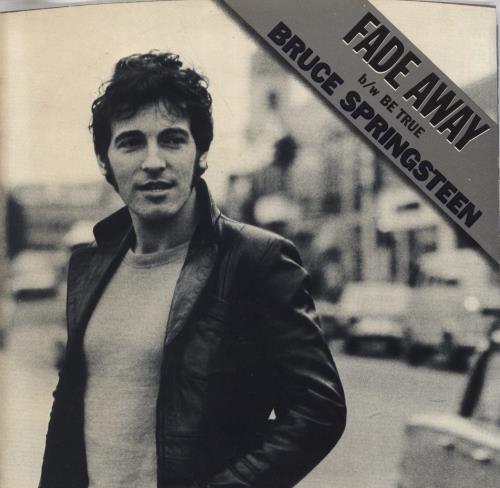
“Fade Away” is a 1980 song written and performed by Bruce Springsteen, accompanied by the E Street Band. It is contained on his album “The River”, and the second single released from it in the United States, “Fade Away” is “certainly among his most pessimistic and helpless depictions of life and love gone wrong.
E Street Steve Van Zandt has proclaimed “Fade Away” as one of his favorite Springsteen songs, but thinks that it is not played in band shows because it is too slow. Regardless, he says, “It’s just one of those funny, lost little gems, you know?” .
Bruce Springsteen and the E Street Band – “Fade Away” at Nassau Coliseum in Uniondale NY on December 31, 1980.
The song was recorded at The Power Station in New York in March to June 1980, one of the last songs to be recorded for the album. Musically and lyrically it is a slow, pained lament:
Well now, you say you’ve found another man, who does things to you that I can’t
And that no matter what I do, it’s all over now between me and you girl
But I can’t believe what you say
No, I can’t believe what you say …
it is was the second single taken from The River, released in February 1981 in the U.S. In the UK and Europe, “TheRiver” was released instead. “Fade Away” was not as successful as the previous single from the album, “Hungry Heart”, but still reached #20 . It was only performed sporadically on The River Tour,and not at all for nearly the first two months. The judgement behind its selection as the second single was questioned, considering the more radio-friendly songs on the record, and the choice was blamed for slowing down sales of the album. It was then dropped from Springsteen’s concert repertoire completely, only rematerializing for a handful of solo renditions on the 2005 Devils & Dust Tour.
Filmed at Madison Square Garden, New York, NY. 8-11-2009
The song was performed once on the Wrecking Ball Tour on July 20th, 2013 at King’s Hall in Belfast; Springsteen made reference on stage that it was Van Zandt’s favorite song. The song was played nightly during the North American leg of Springsteen’s 2016 River Tour, where The River was played in its entirety. When the tour reached Europe, the album presentation format of the tour was dropped, with the exception of a few shows. “Fade Away” has not been performed outside of the album format.
Meanwhile, Southside Johnny and the Asbury Jukes (old Van Zandt cohorts) had added “Fade Away” to his concerts from the 1980s on, and it would be included on his 1997 Spittin’ Fire live album.Southside’s renditions have often been of a slow, bluesy nature, accompanied only by bandmate Bobby Bandiera.
“Fade Away” live at Entertainment Centre, Brisbane, Australia, 26th February 2014.
It was finally given an E Street Band performance again at Stockholm Stadion on June 7th, 2009 during the European second leg of the Working on a Dream Tour; Springsteen made reference on stage to Van Zandt’s desire to hear it.
Just over a year ago year, singer-guitarist Nils Lofgren, who as a member of Bruce Springsteen’s E Street Band, put out the solo album “Face the Music Live”, an acoustic collection of his songs, and booked some tour dates for 2016. Lofgren himself has selected the 169 tracks which stretch back to 1968 and his early work with his Washington, D.C.-area band Grin. It also includes material from both his major-label solo albums and independent self-released music. Two of the CDs contain 40 previously unreleased tracks and rarities. The DVD features 20 video clips and the 136-page booklet sounds excellent with track-by-track commentary from Lofgren and personal reflections on his work, as well as his tours with the likes of Neil Young, Bruce Springsteen, and Ringo Starr.
He knew that Springsteen needed him for a Saturday Night Live appearance in support of the just-released the “Ties That Bind: The River” box set. But he didn’t think Springsteen had planned an extensive tour in support of the album. to be titled The River Tour
He thought wrong.“I knew about Saturday Night Live and knew there were no plans past that for us to play,” says Lofgren . “I booked five months of solo work. They had a true change of heart. I’m not involved with the blow-by-blow decision-making. It’s like when me and [my wife] Amy sit around with my four dogs and wonder how much time I’ll spend on the road. I don’t call my band mates and have them weigh in.”
Not that he had any reservations about heading out with the E Street Band — they call Bruce Springsteen “The Boss” for a reason. When he beckons, you best pack your bags.
“It’s always a blessing,” Lofgren says of touring with Springsteen. “I’m coming up on my 32nd year with the band. It’s no fun to cancel or postpone solo shows. I’ll try to reschedule them all. It’s not like I had a huge choice in the matter. These clubs will forgive me, and I hope the fans will come and see me when I make up the dates.”
Even by Springsteen’s standards, 1980’s The River has an epic feel to it. Springsteen originally intended it to be a 10-song single album before scrapping the initial song sequence and extending it into a double album that features 20 songs.
It opens with “The Ties That Band,” a jazzy number punctuated by the late Clarence Clemons’ woozy sax solo. The album goes through a number of musical peaks and valleys: Springsteen sounds somber on mid-tempo ballads such as “Independence Day” and “I Wanna Marry You”; the punchy “Hungry Heart” comes across as a rowdy barroom rocker; and the title track stands as one of Springsteen’s best narratives. The album notes, “Scope, context, sequencing and mood are everything here,” and the review draws comparisons to American authors such as F. Scott Fitzgerald and Theodore Dreiser.
On the current tour, which started in America the Europe and back to America, Bruce is about to perform the most amount of shows ever in Australia for 2017, the band began by playing the album in its entirety.
Nils Lofgren, who says he first met Springsteen in 1970 when his band Grin and Springsteen’s band Steel Mill auditioned for promoter Bill Graham, wasn’t yet in the E Street Band when Springsteen cut The River. He can still remember the first time he heard the album.
“I bumped into [Springsteen] at the [Sunset] Marquis [hotel],” he says. “He mentioned that he had just finished a double album called The River. He asked if I wanted to listen to it. I was very grateful for that. He threw me in the car and went over to the studio. He sat me in front of the old [Yamaha] NS-10 speakers, which were popular playback speakers. I listened to the whole double album, and I still remember being struck by how I felt like they got the sizzle and electricity of the live show into the grooves for the first time. My favorite thing is playing live when there’s that sizzle and energy and crackle in the air. It’s deafening and maddening, and it’s just a muddy mess of musical insanity sometimes. That’s part of the live experience. I felt like they got that into the record. Now, God knows how many decades later to be playing it as a set piece and adding my bit because I wasn’t there is a great honor and I’m embracing it.”
Released during a deep recession, the album reflects the times. In “The River,” Springsteen famously sings, “For my 19th birthday, I got a union card and a wedding coat” as he confesses that finding steady employment was a challenge “on account of the economy.”
Lofgren, however, says he thinks the album has more to do with “personal struggle” than politics.
“I love how Bruce writes,” he says. “He’s as great a lyricist as we’ve ever had. That’s his forte if I had to pick one. [In life] either you’re at peace and everything is okay with friends, family and money or there’s something coming apart. Sometimes, it’s all coming apart. He speaks to that more from the common man perspective but doesn’t exclude everybody because it’s more about the internal workings of man and the inherent human nature of greed and satisfying yourself and never having enough of things. It’s the reality of how is your family doing. Maybe your wife is sick. Maybe my parents are getting old and feeble and what do I do?”
He says a variety of emotions run through the tunes.
“You’re sitting there inconsolable with ‘Stolen Car’ and then he starts ‘Ramrod,’ and it’s a wake up call,” he says. “It’s back and forth. I’m that schizophrenic writer myself. I do country, blues, rock, R&B and metal. It all comes from the blues and folk. Bruce has put it together in his own voice as well as anyone in history has ever done. I’m happy to sit there and play these songs that are so dear to me and add my piece to it and know that I have good instincts for it.”
Between touring with Bruce and doing solo shows Lofgren just played in Northeast Ohio last year — Lofgren is more active than ever. Not bad, given that he’s now 64.
“[Growing up] in middle America, we loved the Beatles and Stones and Hendrix and of course everything that went with it,” he says when asked about his initial aspirations. “But nobody thought you could do that for a living where I lived. One night, I saw the Who and the Jimi Hendrix Experience in the same night at two different venues in D.C. I still remember being uncomfortably possessed with this notion that I needed to try to do it as a living. It seemed so foreign to me.”
One of the highlights came when singer-guitarist Neil Young befriended him and asked him to play in his backing band.
“Neil asked me to play on After the Gold Rush at 18 years of age,” he says. “That was an enormous challenge and opportunity for a rookie musician just on the road trying to make his way. That served me well. I remember going to work and thinking, ‘It’s nice going to work and not having to be the boss today.’ I liked being part of a team of people and playing rhythms and singing harmony. That served me to this day. I’m happy to lead any band anywhere. If we’re in a bar jamming and someone says, ‘Sing something,’ I would say, ‘Okay, follow me,’ and off we go. But I do thrive in the band setting as a member of instead of always the leader. That’s served me well all these decades.”
The Bruce Springsteen concert at the Arena Accor Hotels Paris was interrupted for a few minutes Monday night because of a failure of sound and lights.
He put so much energy that he blew a fuse. The Bruce Springsteen concert in Paris Accor Hotels Arena Monday night was interrupted for about twenty minutes when the sound and the stage lights stopped working. According to spectators in the room, the fire alarm was also triggered. Far from being disconcerted, the singer apologized to his fans with the means at hand, before approaching the crowd to sign autographs. The management of the concert hall explained that these technical problems happen, without elaborating further.
The concert finally resumed after about twenty minutes, but without the giant screens, projectors or the lights directed on the stage, the remaining room fully illuminated. With humor, Bruce Springsteen chose to continue the evening by interpreting … “Dancing in the dark”.
It was a wild night in Paris. Bruce arrived to a city that was stuck in between the heartbreak of a national soccer team loss and the celebration of a historical revolution. Before the three hour and forty-seven minute* show concluded, the crowd would witness three tour premieres, Bruce making his own sign requests, and the long-awaited fulfillment of a Bruce Springsteen and the E Street Band unplugged show.… in some fashion, at least.
On the first night Bruce took the stage alone and greeted the crowd. “Bonjuor Paris! Comment allez-vous? Tres bien,” he said, before taking a seat at the piano. In soft purple and turquoise lighting he fumbled around for a few chords before settling into a nearly ten-minute “Incident on 57th Street.” A hush fell over the crowd, and I saw at least one person reaching for their eyes as Bruce lent his powerful voice to an incredibly personal rendition.
Bruce’s solo “Incident on 57th Street” was the first of several in the set that leaned towards the intimate and the emotional. Springsteen reached for some unusual selections that could be heard to address the troubling news back home in the U.S. — “American Skin” isn’t the only song in his back pocket for mean times like these. For the first song with the band, he brought back the distorted bullet microphone effect from the Devils & Dust and Magic tours for a 2016 premiere of “Reason to Believe.” The full-band arrangement featured a blues rhythm and LittleSteven at the front on the white Vox teardrop guitar. The instrumental bridge had the floor jumping and Bruce dancing in the center cutout, silhouetted against a dark stage.
A workhorse “Badlands” kept the crowd’s blood pumping, with Bruce shuffling to the back of the stage to point at some familiar faces dancing wildly on the first row. And the songs about faith and hope in dark times continued: “Fella outside the hotel today lost his wife recently,” Bruce said. “This was one of her favorite songs.” In dim lightning Soozie opened with a few long and mournful notes on the violin before Bruce and the band joined in the tour premiere of “Into the Fire.” Springsteen would later take the stage alone with a 12-string styled Telecaster for another tour premiere from his 1982 solo album. With the shrill sound of his harmonica, standing in a single spotlight on an otherwise dark stage, Bruce played “Nebraska” — performed at only one other E Street Band show since 1985, in Belfast ‘2013.
Despite the rare dips into Nebraska, this was most certainly a River show: the set featured 15 songs in total from the tour’s eponymous album, and for a stretch it seemed like they might play the whole thing. The band had a little trouble finding all the right instruments for “Jackson Cage.” “We’ll be right there,” Bruce said. He stopped during “Hungry Heart” to shake the hand of a young girl on her father’s shoulders, and he pulled another fan up onto the walkway for a lengthy hug during “I’m a Rocker” while the band continued to play.
The intimacy would continue with the River album standouts “Point Blank” — with Roy bathed in hard purple and red light and the silhouette of Bruce whispering tenderly to the audience — and “Drive All Night,”featuring a booming Jake Clemons saxophone solo. Bruce turned his affection towards Patti Scialfa for a duet on “Tougher Than the Rest,” serenading his wife on the harmonica to close the song. The Queen of E Street’s vocals also featured heavily on “Darlington County” and “Because the Night.”
After the main set, which brought us out of the valley with “The Rising” and “Land of Hope and Dreams,” Bruce came to the mic and hushed the crowd. He turned his back and held his guitar over his head while Roy and Soozie started “Jungleland.” Elliott Murphy and his son Gaspard joined Bruce on stage for “Born to Run,” with Bruce falling to his knees to plead to the crowd, “Lemme see your hands!”
“Steve, look over yonder, see the Eiffel Tower lights,” Bruce said, beginning Ramrod. Little did he know, his words would prove inauspicious. For the second time in just over four years, the E Street Band was too much for the Parisian power grid, and the lights and sound failed mid-song. The crowd went wild as the band kept right on playing, with lighting equipment crackling and sputtering overhead. Bruce, with a bewildered look on his face, led everyone to the front of stage to dance and play. The only sound that could be heard from the band were the drums and the occasional faint hint of saxophone.
The crowd filled the void with chanting and wild cheering as Bruce and the band marched their way onto the floor. Charlie and Nils picked up accordions to join the procession and try to be heard by the nearby crowd at least. Overhead speaker loops were calling for evacuation, but the fans refused to leave. By the time the band had made its slow circuit of the pit, the stage was crawling with techs trying to figure out what was going on.
The band circled around for an impromptu meeting on stage, Bruce and Patti laughing and gesturing at one another. Bruce asked to borrow a fan’s sign and wrote his own request on the back — for five more minutes — and held it up for the crowd. Bruce, Patti, and Jake sat down on the front of stage and started signing autographs while Garry tossed water bottles to fans in the crowd. Photographer Annie Leibovitz even took to the stage and started snapping candid photos of the mayhem.
When the lights finally returned, the band performed a quick, 30-second sound check. Bruce took the microphone after what had been about a 20-minute intermission. “Stevie,” he said, “Is it quitting time? Is it fuse-blowing time?” The crowd went crazy, the show returned to something like normalcy, and the band jumped right back in to the end of “Ramrod” like this was any other hijinks. Bruce wasn’t finished having fun with the band’s misadventure. “Can you hear me?” he asked to start “Shout.” “Are you sure?!” Bruce drenched himself in water, once for the front of stage and again for the back, and Steve cloaked Bruce in a shining coronation mantle embroidered with a “Boss” insignia. “You’ve just seen the heart-stopping, pants-dropping… rock out till the lights are out, legendary E StreetBand,” Bruce hollered before one last verse of “Shout.”
Bruce took a moment to reflect on the evening before a solo acoustic “Thunder Road.” “What a surprising night. What a great night,” he said, “Electricity is on. It’s off again. It’s on. It’s off. Nothing stops the mighty E Street Band. Thanks for sticking in with us.” Rolling with the punches, Bruce and the band took full advantage of the smaller venue and stage to provide a uniquely intimate performance, with three solo arrangements, three tour premiers, and enough E Street Band power to shut out the lights all over Paris.
First Night in Paris 11th July 2016
Setlist:
Incident on 57th Street (solo piano)
Reason to Believe
Badlands
Into the Fire
The Ties That Bind
Sherry Darling
Jackson Cage
Two Hearts
Independence Day
Hungry Heart
Out in the Street
Crush on You
You Can Look (But You Better Not Touch)
Death to My Hometown
Nebraska (solo acoustic)
The River
Point Blank
Cadillac Ranch
I’m a Rocker
Darlington County
Tougher Than the Rest
Drive All Night
Because the Night
The Rising
Land of Hope and Dreams
* * *
Jungleland
Born to Run (with Elliott and Gaspard Murphy)
Ramrod
Dancing in the Dark
Tenth Avenue Freeze-out
Shout
Bobby Jean
Thunder Road (solo acoustic)
Bruce Springsteen arrived in Paris for two shows over three nights, European prayers have finally been answered. If Monday’s fuse-blowing Paris concert demonstrated for the first time on this tour the magnetic energy generated from combining the intimacy of a typical American arena with the the signature passion of a European crowd, the second Accor Hotels Arena show tested what would happen when these fans were finally treated to the first-ever full album performance of “The River” in Europe. After much begging, cajoling, pleading, screaming, and yes, even praying on the part of the European fan contingent, it was well worth the wait.
The second concert opened with an equally rare occurrence: the first performance in Europe (the third ever in the world, and only the second with the E Street Band) of “Iceman.” The Darkness outtake was given a tight, focused, and intense full band treatment (sans Patti) with Bruce’s voice fittingly gruff to match the song’s subject. They kept the rarities coming with “Lucky Town,” which was once again capped with a fiery Boss guitar solo.
And then, it was time for the main event. When Springsteen revealed in a little speech — in French, no less —that “The River” would be played in its entirety specially for Paris, the crowd erupted with a deafening ovation of sheer joy. As many fans have made clear since this European leg began, they’ve been waiting years for the opportunity to see one of Bruce’s greatest albums performed in full. It felt like all of the anticipation and hoping and dreaming was released in a rush of excitement to the opening chords of “The Ties That Bind,” and this ceaseless enthusiasm was sustained through the final notes of “Wreck on the Highway.”
Their starved desire for these tracks makes even more sense considering how rarely a lot of them have been played in Europe since the original River Tour 35 years ago: “Stolen Car,” never since 1981; “Wreck on the Highway,” one time (solo); “Fade Away,” three times. Ignoring performances on this tour, “I Wanna Marry You” (never performed since 1981), “The Price You Pay,” (performed once) and “Independence Day” (performed four times) are almost as rare. The entire crowd responded in a way that made it feel like they understood the special significance of this evening.
Everyone from the pit to the upper deck looked and sounded engaged from beginning to end, rarely allowing the energy to wane enough even to sit down — the first two sides of the record were basically a non-stop sing-along, jump-along, and chant-along party — while always remaining deadly silent for the ballads. Many fans clearly bought tickets for this River Tour 2016 to hear The River, and not only its greatest hits: the whole place bellowed the lyrics to “Jackson Cage”; applause greeted the opening chords of “Stolen Car”; “The Price You Pay” elicited a decibel-busting level of crowd participation that rivaled “Badlands”; and the entire arena respectfully applauded through the final coda of “Wreck on the Highway.”
Bruce brought back a lot of the same stage blocking from the American leg, including a “Hungry Heart” crowd surf that was way slower than normal — it seemed the handlers in the pit wanted to pass Bruce back and forth to give everyone a chance to touch the Boss. As he did in Baltimore, Bruce once again oversaw a wedding proposal during “I Wanna Marry You,” pronouncing them “Mr. and Mrs. Rock ‘n’ Roll… in the name of rock ‘n’ roll!” Two songs later, the crowd continued Bruce’s soul-stirring humming at the end of “The River” all the way through the silence while Bruce and the Band cued up “Point Blank.” Bruce waited until this humming had organically reached the melody’s end before having Roy seamlessly begin the song — a hauntingly beautiful transition between the two records.
All together the evening felt like one long ecstatic catharsis. Tears, hugs, kissing, jumping, clapping, singing, chanting, smiles, all plentiful throughout. More than any other show on this tour, the concert actually felt the most like the first time The River was played in its entirety way back in 2009 at Madison Square Garden. Since the crowd knew this wasn’t a nightly occurrence, a special vibe of overwhelming elation was in the air. Judging from the rousing standing ovation that greeted the album’s conclusion, their lofty expectations were exceeded, and then some more.
With the exception of a story-less performance of “Growin’ Up” — the only sign request of the night — the rest of the night felt predictable and a little rushed; the set-ending “The Rising” literally went directly into the encore-opening “Born in the U.S.A.,” with not even a second of a pause between them. But after The River, any other song was just gravy for this crowd. These fans had finally gotten what they had been waiting so long to hear. Paris will only enhance the legendary status of the “grass-mowing, fuse-blowing, legendary E Street Band’s” full album River performances (“Ramrod” also included a bevy of references to fuse-blowing by Bruce and Stevie), and I’m sure all of the European fans not in Paris will be chasing it for the remainder of the tour. Gothenburg 3? Zurich for the final European stop? They can only pray…that it might happen again.
Second Night in Paris 13th July 2016
Setlist:
Iceman
Lucky Town
The Ties That Bind
Sherry Darling
Jackson Cage
Two Hearts
Independence Day
Hungry Heart
Out in the Street
Crush On You
You Can Look (But You Better Not Touch)
I Wanna Marry You
The River
Point Blank
Cadillac Ranch
I’m a Rocker
Fade Away
Stolen Car
Ramrod
The Price You Pay
Drive All Night
Wreck on the Highway
Badlands
The Promised Land
Growin’ Up
Because the Night
The Rising
* * *
Born in the U.S.A.
Born to Run
Dancing in the Dark
Tenth Avenue Freeze-out
Shout
Thunder Road (solo acoustic)
Nils Lofgren’s released a superb career history box set late last year. Some of this year’s crop of presidential hopefuls could learn a thing or two about Lofgren’s finesse and economy in conversation; how stays on point about what he needs to plug, shares the spotlight with others, gets in an anecdote or two about his illustrious associates, and still manages to be a regular Joe throughout. He has been on the road for 48 years come this September, rocking, shaking hands, and who knows, probably kissing babies. For the last 20 years that campaign has been a grassroots one with which he has been able to maintain a thriving solo career without involving a phalanx of people.
And of course there is his 30-plus year association with Bruce Springsteen and the E Street Band, Now touring to promote the Boss’ boxed set The Ties That Bind: The River Collection, which celebrates that double album recorded just a few years before Lofgren joined the band in 1984.
On Chasing Amy
“Strangely enough, 35 years ago, I met Amy in Asbury Park [New Jersey] at the Stone Pony. We were both just kids. After a show at the Pony, she didn’t even come to see me. I met her, convinced her to hang out with me, and at 6 a.m. I went to Boston and begged her to come with me. She said no, she had a job and her mom and all this. So I thought I’d see her in a few months. I never saw her again for 15 years. Twenty years ago, we met again. I was passing through Scottsdale at a great club, The Rocking Horse, that burned to the ground not long after. She came up and said ‘Hi, remember me?’ And we were both at the end of divorces, and we’ve been together ever since.”
That’s when Lofgren moved his home and studio base from D.C. to Arizona, a place he hates to leave for long stretches and sounds eager to return to as he is calling in from The River tour in St. Louis.
“This is my 48th year on the road,” he ruminates. “I’ve long tired of leaving home, but that’s a champagne problem, as Amy points out. We were talking about how much I love playing live, it’s kind of like my favorite thing. And the way Amy put it, and it applies to the E Street Band as we started this tour, for musicians that love to perform live, it’s like going to Oz and the audience is Oz and you go there to find you heart, you go there to find your musical brain, you go there to find your courage. And speaking for myself as a 64-year-old and not being very happy about dragging the suitcase out, saying goodbye to Amy, and having my dogs, who I love, giving me dirty looks, and leaving home is rough, it is truly like going to Oz and finding this part of yourself you don’t find anywhere else. There’s a level of heart and courage and your musical brain getting fired up that you don’t get jamming at a local bar, you don’t get in recording in a studio, you don’t get puttering around at home. You only get it in front of an audience.
On living in Arizona
Did Lofgren find moving here a tough adjustment after years of living back east? “Well I’ve been traveling the entire country since ’68. I’d been through Phoenix many times. It’s not like you’re playing the Sahara. It’s a town, there are friendly people and great crowds. I always thought the audiences there were really good. I’d go through there regularly, but I never stuck around.
“I got to love the mild climate. Between Chicago and D.C., I’d had decades of winter, ice, slush, freezing — I just tired of that. And even though it’s grown incredibly over the past 20 years, when Amy was there you could ride horses down Scottsdale, and north of Shea there was nothing but desert. When I got there, the 101 wasn’t even open. Even though it’s got a large populace, it’s still a slower pace of life to me than the coasts.”
On The River Lofgren recalls the first time he heard the album, having bumped into Springsteen while he was out in L.A. mixing the album, the first Springsteen album to incorporate his serious writing style with the kind of pop throwaways he’d previously given to the likes of Southside Johnny, Greg Kihn, or The Pointer Sisters, only to watch the other artists enjoy great chart success.
“Bruce describes the album as a young adult being part of a planet instead of an outsider. I heard it well before it was released, and I was always impressed how they got the sizzle of the live performance into the album so to be out here playing here is a beautiful thing.”
The E Street Band has only played the album in its entirety once in concert, in New York City a few years back. The learning of an entire double album is a drop in the bucket of what a Springsteen sideman has to learn for each tour.
“We’ve been friends since we did an audition night together in 1970 for Bill Graham at the Fillmore West with SteelMill and Grin. When I first joined I was overwhelmed with just a hundred songs, but on the last tour we played 240 different songs, so you could imagine the scope. You can’t stay on top of the entire catalog so you kind of guess, you communicate, Bruce gives us a heads up and he’ll surprise us with an audible on stage and we use our instincts to make do and make it work. There’s a great boxed set with bonus tracks we’ll probably dig into. We’re starting off with a great bonus track called ‘Meet Me Tonight In the City.'”
“It’s very organic the way the band comes together. I defer to Bruce and Steve all the time. I hear endless parts. I’ll look at what they’re doing and play the third part I hear and it usually always works out. Much more than musicianship, as a band our instincts are spot on because we love Bruce’s songs and that type of music and have an affinity for how to play it.
On Keith Richards Lofgren classifies himself as an artist with no hits, but he did have a popular radio hit with a song “Keith Don’t Go” that somehow missed the lower regions of the Top 100. Lofgren has told a story about how he finally met his idol, who meant as much to him as Chuck Berry meant to Keith Richards.
I wondered, when he met his idol was it the same experience as when he and Springsteen played in an all-star band backing up Chuck Berry at a Rock and Roll Hall of Fame show? Chuck reportedly kept changing keys on the band, making all the Hall of Famers with onstage sound like rank amateurs.
“I love Keith Richards, and I’m not speaking about the diabolical nature of Chuck but more the positive nature that inspired Keith and many young guitar players of that generation. I’ve met Keith many times; he’s always been kind and gracious. We never discussed the song I wrote for him, ‘Keith Don’t Go.’ I know he knows I wrote it and I have to believe he understands the spirit with which it was intended, which is ‘You share a gift we all need. It’s a beautiful thing you do. Please stick around and keep doing it and hats off to you on behalf of all us fans.’
“After all these years, Steve Jordan, who plays in The Expensive Winos, brought me into a dressing room, and there is Keith. He said hi, he was very friendly, but he’s there sitting in a corner practicing through this little amp. So I’m visiting with Steve on the other end and all the sudden I hear Keith playing the famous Chuck Berry lick. I have to say I’ve played it a thousand times and I’ve heard it 10,000 times, and I’ve never in my life heard it sound like that and I can’t even explain it to you. It’s just three notes put together in a different way. But there was something going on physiologically and spiritually and musically what was going on inside of him and how he heard that riff of Chuck’s. It was a deeper thing. It meant more to Keith than it meant to Chuck even though Chuck who created it.
“And that’s kind of like what the Stones did for Howling Wolf, Chuck Berry, Muddy Waters, and what it became. ‘Honky Tonk Women,’ ‘Jumping Jack Flash.’ It came from them but they made it their own because they had a deeper affinity for it and it meant deeper for them and it became something else.
“Fast forward to a Willie Nelson and Friends TV Special where he would play with a cast of 20 great singers. I was part of a house band, one of four guitar players. I was with Greg Leisz, one of the great lap steel players and Hutch Hutchinson on bass, all this cast of amazing singers coming through and one of the guests was Keith Richards. There was like 20 people onstage and on the other side of the drummer was this giant piano Jerry Lee Lewis was gonna play and in the bell of this piano was Willie Nelson, Merle Haggard, and Keith Richards.
“Now we’re playing so technically now onstage playing with Keith Richards. Now, I’m an old, grizzled veteran myself so I had a sense of humor about it. ‘Hey Keith, I can barely see you there but we’re making music together.’ So Kid Rock comes out … he’s a great showman. We were doing, I can’t even remember. ‘Whole Lotta Shakin,’ maybe. And he’s up there whipping the crowd into frenzy and I understand with monitors and the frenetic sound onstage. He didn’t notice but just as Kid Rock got a buzz to go jump off the piano and run to the audience, you know Jerry Lee tells the band to bring it down. None of us thought it was an intentional slight but he didn’t hear the cue. So what of you do? Part of you wants to acknowledge the frenzy but that other part of you says wait a minute, Jerry Lee says bring it down.
“So we’re all just treading water. I could see a look on Keith’s face, he was feeling the same thing we were feeling but he’s freakin’ Keith Richards, so out of the blue he just explodes out of the little pack of guitar players he’s in, he goes right to the front of the stage, steps in front of Kid Rock and does one of his twirls when he spins on one leg twirls around. He’s still a showman so he’s not going to try to openly bring the show down, with some kind of scary gift that bums everyone out.
“And even better, as soon as he spun around he turned his back on Kid Rock and walked to the other end of the band and he got down with his guitar between his legs and his legs are spreads and he’s looking right in my face and he just sits there rocking out with his back to in our faces with his back to Kid Rock. I can’t tell you what’s going through Keith’s mind but all I can tell you is instead of Keith rocking out 20 feet away, now he’s just rocking out dirty in front of Greg, Hutch, and me. And all three of us are just in heaven. And Keith went and made a statement and rocked out with the band and I was like ‘Hey, there’s a lot of people here besides you.’ I don’t know if that’s what he was saying to him but that’s what he was saying to me.”
“I don’t think this existed six weeks ago,” Steven Van Zandt said, chuckling to himself, over a late lunch of salad and tea a few hours before showtime on January 16th, the day Bruce Springsteen and the E Street Band opened their unexpected 2016 tour in Pittsburgh. “It wasn’t ‘Maybe it’s gonna happen, let’s get ready,'” the guitarist went on. “It was Bruce putting out this box set and thinking, ‘Maybe we should do a show or two.’ When I heard that, I was like, ‘Wait a minute. We’re not playing a residency at the Stone Pony anymore. Assembling 160 people to do a show or two — that’s complicated.’ I thought, ‘If that happens, it could well turn out to be more’ — which is what happened.”
Steve Van Zandt has played with Bruce Springsteen and been a consistent, trusted confidant longer than anyone else in the E Street Band — that is from the very beginning, in the mid-Sixties, when the two were NewJersey teenage misfits mutually determined to make their futures in rock & roll. “This year will make it 50 years,” said Steve Van Zandt, 65, claimed proudly of their bond. But even Van Zandt was taken by surprise when BruceSpringsteen a week before the December release of “The Ties That Bind: The River Collection”. a multi-disc reflection on the prolific turbulence that became his 1980 double LP, The River suddenly called his band to order for a tour that is already in its second month, features nightly performances of that entire album and is now set to run into the summer.
“I’ve known him longer than anybody, and he just doesn’t think the same way everyone else thinks,” Van Zandt said of Springsteen. “He’s earned the right to have total freedom. He wants to keep his life wide open, and that’s great. Occasionally it’s going to be a problem. I was very lucky with The Sopranos,” Van Zandt noted, referring to his breakout television role as wise guy Silvio Dante in that HBO series. The show’s creator David Chase “was such a fan — he would book all my scenes on off days during a tour.”
In this last installment of conversations from the first weekend of the 2016 River tour, for more than hour before Van Zandt departed for soundcheck (including a run-through of “Rebel Rebel,” Springsteen’s tribute that night to David Bowie), the guitarist affirmed many of the themes from my interviews the day before with Springsteen and drummer Max Weinberg: the narrative transformation in Springsteen’s writing for The River and the torrent of songs from which he eventually built the final 20-song album; the dizzying momentum of the sessions; the invigorating element of discovery in the current shows, as Springsteen and his E Street Band play that record live each night.
Van Zandt also spoke about The River and its resonance from his unique perspective as the album’s often frustrated co-producer; as a super fan of the two dozen songs that got left behind; and as a true believer, to this day, in Springsteen’s determined, idealistic course. Asked about future of the E Street Band — how soon they’ll know how long is too long — Van Zandt was as blunt and certain as his friend and leader. “There is no end in sight,” the guitarist says. “And as long as I’m standing there next to him, it’s a band.”
You have been outspoken in the past about the songs Bruce left off The River that, in fact, it was some of his best work and didn’t deserve to be left behind. The River, to me, meant 43 songs.
The actual album plus the outtakes.
And those are among the greatest records ever made, as far as I’m concerned. It’s funny, because all these years you’re thinking “outtakes.” There’s really not that much he’d have replaced on The River. It works very well. And these two other albums’ worth of songs are just two legitimate albums. The second outtake album is another band’s career. The first one [the initial sequence, The Ties That Bind, pulled by Springsteen before release] — that’s some of our best stuff: “Loose Ends,” “Restless Nights.”
Does it feel strange to be going on the road without new music, playing an album from 1980?
I’m looking at that outtake album as new music — absolutely, which is why I hope some of it gets integrated into the show, whether we’re doing it in sequence or not. We might have occasionally played “Loose Ends.” We did “Where the Bands Are” maybe twice, “Take ’em as They Come” a couple of times, “Restless Nights” once. Honestly, I think we’re coming out to promote a new album in that sense.
What did you think of that initial sequence, The Ties That Bind, before Bruce pulled it to create The River?
I don’t remember knowing about that. I don’t know how I missed it [laughs]. And I’m there producing. A couple of songs, like “Cindy,” I don’t remember at all. And there it is — second track on the album we delivered.
He was right in pulling it back, saying it doesn’t feel finished. He thinks so deeply about this stuff, so comprehensively. I can’t pretend to understand everything he’s thinking about. I can only do what my instincts tell me and what he says he wants to do — out loud [laughs], which might be five or ten percent of what’s actually going on.
He described The River as his first “insider” album — about the struggles in working life, personal relationships and family — after making four albums about “outsiders.”
He had a vague film-noir aspect to Darkness on the Edge of Town. Born to Run was a mixture of things but mostly about youth and fantasies. Now, all of a sudden, it’s “The Ties That Bind” and “I Wanna Marry You.” It was partially the fantasy of being normal. He wasn’t quite there yet. He would wisely wait until he felt a bit more secure, which wouldn’t be until that album came out and we had our first, real success with [the Top Five hit] “Hungry Heart.” That allowed him to start thinking about having a real life, so to speak.
Was there a turning-point song in The River sessions where you could hear the material becoming more than a sprawl of material, developing a narrative course?
I don’t think so. It was one song after the other. He was in that hundred-song run which maybe Bob Dylan and a few others have had. That run of songs from Darkness to The River it just became normal. “The Ties That Bind” felt like a statement. “The River” had that wonderful thing he does — very detailed nuance in a story. The more detailed, the more particular it gets, the more universal it is. I found that fascinating.
As Bruce’s co-producer on The River, how did you deal with telling him “No” or “You should change this”?
It’s about having the right conversation at the right time. In the end, you accept the fact that you’re there to help him realize his vision. Every single outtake was a lost argument. He was getting 10, 12 great songs very quickly at that point. I would be like, “OK, let’s put that out. You want to do 12 more?
It’s not something you plan, that you aspire to. You have this stuff built up inside, wanting to come out, and you tap into that faucet. Born to Run was eight songs. He went from that to a hundred [over Darkness and The River]. It was some of divine … [pauses] It’s something you can’t take for granted. That’s what made me mad sometimes. I’d get angry with him. Here I am, struggling to write a good song; every fucking one of them is war. And I’d be like, “Hey, man, you’re annoying me here. You’re taking this shit a little bit for granted. [Laughs] What do you mean you’re throwing out this song other people would have a career with?” “Restless Nights,” that’s a career. “LooseEnds,” that’s a career. But you can’t stop it. Once it’s happening, you go with it.
We had a wonderful recording method by then. We’d found the right studio [the Power Station in New York City]; we’d found the right engineers. We figured all that stuff out. It felt so good to go to work every day, after three years of torture. Suddenly, recording is fun. That alone is good for 40 fucking songs.
In a way, The River marked a break in what had been an indivisible thing. He wrote songs; the E Street Band played them.
I actually think The River is somewhat underrated, even by fans, because it came between the breakout records. It’s actually caught in the long shadows between Born to Run, Darkness on the Edge of Town and Born in the U.S.A.
I think that’s right. I’ve had a theory for years: I don’t think the human brain can absorb more than 10, 12 songs at a time. Altbough it was the right thing to do a double album, it becomes diluted. Your energy is going to 20 songs instead of 10, and you appreciate them less. If it had been a single album, it would have been appreciated more, especially if he had put more of the pop-rock stuff on there. It would have been our biggest album. All you gotta do is throw on “The River” that’s all the content you need. [Laughs] A little of Bruce’s content goes a long way. But he felt he had to do eight or 10 songs like that. And I understand that. He was very conscious of carving out his own identity.
He just continues to break the rules. You can’t categorize or predict what he’s going to do. That is part of the fun.
And you just wait for the call.
And hope you’re available [laughs]. All you can do is try and keep up. This tour is a bit of a miracle, really. There’s no grand plan here. It just happened. And we’ll see what happens tonight. We haven’t played with this small a band in a few years.
Actually, half of the 10 people onstage were on The River. You lost organist Danny Federici and saxophonist Clarence Clemons, but that’s still a good survival rate.
In many ways, this tour is probably the biggest tribute to Clarence and Danny in the details. I was enjoying that at rehearsal, enjoying the detail in the songs – not just in the arrangements but in the different keyboard sounds and the great melodies of the sax solos. Jake Clemons, Clarence’s nephew and replacement] is getting better and better. And you realize those solos are part of the compositions — that old King Curtis style. The drum fills are totally part of the composition.
Those seven guys on The River — everybody was doing something important, playing a very specific role. It’s a real “band” album, in the true sense of the word.
The Tempe 1980 concert film features 24 songs — 2 hours, 40 minutes — on 2 DVDs, and is included in The Ties That Bind: The River Collection. The new film was produced from footage professionally filmed in 1980 using four cameras and recorded in multitrack audio.
A comprehensive look at The River era, the box set contains 52 tracks on 4 CDs with a wealth of unreleased material, and 4 hours of never-before-seen video on 3 DVDs.
Included in the box set: The River (Records 1 & 2) The River: Single Album (Previously unreleased) The River: Outtakes (Contains previously unreleased music) The Ties That Bind (Brand new 60-minute minute documentary) The River Tour, Tempe (Never-released video footage of famed 1980 show) The River Tour Rehearsal (Rare video footage)
Coffee table book of 200 rare/previously unseen photos
New essay by Mikal Gilmore
Hear “Party Lights” a poignant yet anthemic Bruce Springsteen rarity, released for the first time on the upcoming box set ‘The Ties That Bind: The River Collection.”
Springsteen spent well over a year writing songs for his 1980 LP The River, and by the time he was done, he had much more songs than he could fit on even a double album. Some of the tracks wound up as B-sides, while many others appeared on the 1998 box set Tracks or the 2003 Essential Bruce Springsteen collection. But when it came time to collect material for Springsteen’s upcoming box set, The Ties That Bind: The River Collection due out 4th December, the curators still found 11 songs that hadn’t previously appeared on any previous release.
You can listen to one of those songs here, “Party Lights,” right now. An incomplete, solo acoustic home demo of the song from 1979 originally leaked out to bootleggers many years ago, but the finished, full-band rendition has never been heard until now. It contains lyrics that were later used on “Point Blank” and in the additional verse that Springsteen added to “Jersey Girl” by Tom Waits. Much like the title track of The River, the song is about a young girl forced to “grow up fast” after becoming a young mother.
Bruce Springsteen and the E Street Band are promoting the new River box set on Saturday Night Live on December 19th, but plans beyond that are unclear. Earlier this week, Springsteen performed “American Skin (41 Shots)” with Tom Morello, Max Weinberg and Roy Bittan at theShining a Light: A Concert for Progress on Race in America event in Los Angeles.
One month and 20 shows into his 1980 tour,Bruce Springsteen took a turn east, from Los Angeles to Arizona. The River, his new two-record set, had reached the top of the charts, which should have put anyone in the best of moods. And even though he was about to play to a Phoenix audience that had supported him going back to 1974, something must not have been sitting well with him as the sun came up on November 5th. On stage that night in Tempe, he would tell the crowd, “I don’t know what you guys think about what happened last night, but I think it’s pretty frightening.” It was the day after the landslide election of Ronald Reagan.
That historic event and the performance it helped inspire have been central threads in the Tempe 1980 story. Another is the knowledge that footage of the legendary concert existed, the missing counterpart to the multi-track audio used just once, for “Badlands” on Live/1975-85.
Now, for the first time anywhere, 35 years later to the day, fans can see a complete song from the fabled concert. The film itself, part of the anniversary box set The Ties That Bind: The River Collection, comes out on December 4th. In an exclusive first look, we present an excerpt from that two-hour-and-40-minute Tempe 1980 concert film: not “Hungry Heart” or “Badlands,” but “Ramrod.”
“Ramrod” has always stood out. It was among the first River songs Bruce Springsteen performed (in Pittsburgh, one of the last stops on the 1978 tour), and it was the last great stretch of rock on the album. Its concert arrangements have varied, from straight-down-the-middle on the River tour, to acoustic rave-ups, whether solo in 2005 or with the Sessions Band in 2006. As recently as last year, anyone who wants to know the time will find out soon enough after Bruce tells the E Street Band, “Let’s roadhouse!”
On The River, Springsteen set up “Ramrod” not as a rambunctious, pile-driving encore, but as the lead in a series of goodbyes, casting that entire LP side — the last of four, rather than the two he had intended only a year before — as “summational.” Until that detail was revealed in the initial coverage of the new box set, one might never have put two and two together quite that way. But it was that attention to detail, sometimes woven into songs that might otherwise come off as simple rockers, with which The River cut a deep bed.
Few songs typify the 1980 E Street Band better than “Ramrod.” To the car, the girl, and the story arc, Bruce joined a live-in-the-studio sound he’d been seeking, including a rich Clarence Clemons solo and the complementary work of Roy Bittan and Danny Federici. Max Weinberg called it his favorite song to play. As the tour went on, “Ramrod” gained prominence, often serving as the set-up for “Rosalita.”
Watching it 35 years later, the first thing one notices about “Ramrod” is the array of wonderful viewing angles. Director Thom Zimny says that a four-camera crew captured the evening’s proceedings. Numerous vantage points, including wide shots from the back of the floor, show a vintage performance in ways no other video release has before Tempe. One might easily conclude more than four cameras were present: they seem to be everywhere.
That results in stunning moments, from a zoom to the audience through the Big Man’s wide stance, to a close-up of Bruce and Miami Steve at the mic and Bruce’s fancy footwork at the end. The interplay between the band members is remarkable, and so is the plain-as-day fact that they’re having fun up there. For any longtime fan, the ability to watch what was previously only a listening experience is astounding.
In part, Tempe’s legend stems from its availability: a decent soundboard recording of this night has long circulated among fans (though it can’t compete with Bob Clearmountain’s new juggernaut mix from the original multi-track audio tapes). And speculation about the existence of a video component has bolstered its reputation. But the show’s rep (Springsteen performed 18 of the new LP’s 20 songs in Tempe), and a clamoring for footage, ultimately comes down to the intensity of the performance.
As he’s told it over the years, Springsteen wasn’t exactly enthused about being filmed, fearing interference with his audience. But it’s good that he tolerated it to the extent that he did; 35 years later, we have a treasure on our hands. Tempe captures a transition, a moment where Springsteen was still largely content to let the music do the talking for him.
Watch “Ramrod” a time or two, and that becomes apparent. A film crew can’t hurt, it turns out; elections and hit songs come in handy, too (at the time, “Hungry Heart” was well on its way to becoming Bruce’s first Top Ten hit). More than anything, what shines through is the pure, unadulterated joy of Bruce Springsteen and the E Street Band playing rock ‘n’ roll, like they could do it ’til half-past dawn. –
The Ties That Bind: The River Collection, which includes the Tempe 1980concert film with more than two-and-a-half hours of the 11/5/80 performance, is just one month away. Thanks to Backstreets magazine.
http://
Bruce Springsteen and the E.St Band perform “The River” live at the Seattle Centre Coliseum, October 24th 1980. from the new fan based recording coinciding with the 34th anniversary of the concert and “The River” album
the Belle Game are Adam Nanji and Alex Andrew with vocals from Andrea Lo playing Orchestral Dark Pop the band sre from Vancouver in British Columbia they have released two EP’s which both received positive reviews the first full debut album released last year titled “Ritual Tradition Habitat”



 The Fat Angel Sings