Posts Tagged ‘The Beatles’

There are few albums in rock ‘n’ roll history as sacred and as legendary as Sgt Pepper’s Lonely Hearts Club Band by the Beatles.

It’s been picked apart and written about to death, with every note of its nearly 40 minutes scrutinized. From the classic double-hit single that began the album’s sessions to the final sustained note that ends the LP, there isn’t much left of the Beatles’ most celebrated record that the group’s most devoted fans don’t know.

Even the countless hours of studio time that went into the making of the album have been documented on many bootlegs and even an official release in the 50 years since Sgt. Pepper‘s release. With the six-disc Sgt. Pepper’s Lonely Hearts Club Band: Anniversary Edition, the Beatles aim to have the final word on the matter.

It’s an impressive set. Maybe not as extensive as a similar collection assembled by one of the Beatles’ main competitors, the Beach Boys, whose own classic “Pet Sounds” sessions box collected hours of alternate takes, studio chatter and false starts, but the breadth of material collected on the four audio CDs (the other two discs contain new surround mixes and video programming) is astounding: a 2017 stereo remix, the original mono mixes of the album and the “Strawberry Fields Forever” and “Penny Lane” and, best of all, more than 30 tracks from the sessions that chart the growth of the album’s songs from near demos to near completion.

The most revealing cuts fall somewhere in between: the five takes of “Strawberry Fields Forever” that chart its evolution; the first stab at “A Day in the Life,” with the famous final chord hummed rather than played on pianos; the earliest take of “Lucy in the Sky With Diamonds”; and an instrumental version of “Within You Without You” featuring various Indian instruments.

At times, the Anniversary Edition drops listeners right into the studio with the group. Hearing songs — particularly “Strawberry Fields Forever” and “A Day in the Life,” but also highlights like “Penny Lane” and “Being for the Benefit of Mr. Kite!” — take shape as the Beatles and producer George Martin work them out is often fascinating, though it does become a bit tedious at times, especially when certain songs didn’t change much from inception to release.

The sessions are the heart of the box, but Giles Martin’s new mixes are eye-opening too. He worked with his father’s original tapes, and the new remix he gives the finished album combines the punchier mono version from 1967 with state-of-the-art tweaking that brings out every rattle and breath buried in the songs. It gives new life to one of the most popular records ever made. (This new mix is also available on single- and double-disc editions.)

Sgt. Pepper fanatics will get more out of all this than casual Beatles listeners. Even so, 50 years after its release, the album remains a landmark recording and document of the era. It’s a timeless cultural marker that hasn’t lost much of its ability to dazzle after all these years. And from the sound of things, Sgt. Pepper will never go out of style.

In 2006, the Beatles coaxed producer George Martin out of retirement to remix and rearrange several of their iconic songs for Cirque du Soleil’s Las Vegas stage production Love. Martin, though, had a worry: At age 80 his hearing had turned difficult, and so he brought in a collaborator: his son Giles. The younger Martin had produced classical music, as well as recordings by Kula Shaker, Jeff Beck, Elvis Costello and Kate Bush. “He’s my ears,” George Martin said. What ears they turned out to be: Giles recombined parts of many of the Beatles‘ songs into a mash-up of the band’s audio history, sometimes encapsulating much of it in a single song. “Get Back” opened with George Harrison’s memorable thrum from “A Hard Day’s Night” and Ringo Starr’s drum prologue from “The End,” caught sight of an overpassing jet from “Back in the U.S.S.R.,” pulled in part of the audience’s expectant murmur from “Sgt. Pepper’s Lonely Hearts Club Band” and borrowed a bit of the orchestral swell from “A Day in the Life,” landing on John Lennon’s “Glass Onion.”

Giles Martin taks us through alternate endings, different instrumentation and studio instructions on massive upcoming set

The results proved radical and revelatory and conveyed how resilient and exciting the band’s music remains – and how beautifully and imaginatively George Martin had produced it all in the first place, working with four-track recorders and inventing new sounds and technology. With Love, Giles Martin did what nobody had ever done successfully before: He reconfigured the Beatles’ sounds into an alternate sound map, making it plain these decades old songs still had revelations and delights for contemporary ears. When Love was over, you didn’t want it to be – much like many viewed the Beatles themselves.

Now, the surviving band members and their legatees have authorized the reconsideration of a major canonical work: Sgt. Pepper’s Lonely Hearts Club Band, originally released 50 years ago on June 1st, 1967, in England, and the following day in the U.S. The new Pepper comes in various packages: single and double CDs, a deluxe box of four CDs and two DVDs (containing videos and 5.1 surround mixes of the original album), as well as a double LP that, like most versions here, includes several of the album’s original developing and alternate tracks. All editions feature a stereo remix by Giles Martin (George Martin died in 2016, at 90) and Abbey Road audio engineer Sam Okell. The ambition might seem a bit of a risk or even redundant. After all, Sgt. Pepper has been considered by many as not just rock’s greatest moment, but also as a central touchstone for the 1960s – an exemplar for a generation that was forging new ideals, and granting themselves new permissions, including the use of psychedelic drugs. The Beatles had already done a lot to make that change possible, but Sgt. Pepper – coming along at a time when many thought the Beatles superfluous, in the face of other new adventurous bands and records .

Additionally, Sgt. Pepper’s groundbreaking sonics – its mix of pioneering textures, complex composition and inventive recording techniques –also won the album standing as a legitimate art form that revised and extended classical music’s archetypes. (This achievement also imbued much of rock itself with a new prestige and aspiration.) In part, the unprecedented acclaim resulted from Paul McCartney’s insistence on the album as a conceptual song cycle that existed as a whole entity: The Beatles, posed in ornate Victorian brass-band military costumery on the cover, were playing a fictional band, singing from perspectives free of any indebtedness to their prior musical sensibility and well-established images. (Ringo Starr later described it as “a bunch of songs and you stick two bits of ‘Pepper’ on it and it’s a concept album. It worked because we said it worked.”)

But that was 50 years ago. A lot changed – including the Beatles, who ended acrimoniously in 1970. What can we learn now from Sgt. Pepper’s new incarnation? As it turns out, Giles Martin reveals considerable new wonders – particularly in his stereo remix of the original album (which appears in all the new editions, and as a standalone disc and digital download). The remix, in fact, provides a long overdue epiphany. Martin observes in his liner notes: “The original Sgt. Pepper’s Lonely Hearts Club Band was primarily mixed as a mono album. All care and attention were applied to the mono LP, with the Beatles present for all the mixes. … Almost as an afterthought, the stereo album was mixed very quickly without the Beatles at the sessions. Yet it is the stereo album that most people listen to today.” In other words, popular music’s most elaborate and intricate creation – and one that helped end the mono era – wasn’t made to be heard in stereo.

Perhaps that’s been Sgt. Pepper’s unlikeliest secret, though for those who compared the original mixes over the years the difference was noteworthy: The mono version hit harder, sounded fuller, whereas the stereo soundstage diffused that force. You hear it from the start: The mono version of the title track jolted full-force, particularly in the collusion of Paul McCartney’s bass and Ringo Starr’s storming drums. Martin has said that in attending to the new album’s mix he was aiming for a “3-D mono” rendition – and he has achieved it. The titular opening track finally jumps out of the speakers in a more centralized stereo: It’s sharp, vivid, forward leaning – the sound of a big band doing very big things and not fucking around about it one bit. Indeed, everything here is more vibrant and forceful; it’s for the ears of today. Ringo’s three-beat drum salvo that launches the chorus in “Lucy in the Sky” now gives new gravity to the song’s hallucinogenic imagery and chimerical whirl; “Getting Better” has an aggression that belies the song’s title claim, making clearer the idea that this is a song about a fucked-up man contending to overcome himself and confessing his flaws and confusion; “Good Morning Good Morning”‘s horns and relentless rhythms propel the distress implicit in John Lennon’s vocal (Lennon later said he was going through a personal hell as the Beatles recorded Sgt. Pepper, and this song reflects that); and “A Day in the Life” acquires even more frighteningly palpable depth. The song has always stood outside of Sgt. Pepper’s phantasmagoria. It was a vision of dreams, death, chaos, revelation, and it held and scared us as it faded into a final oceanic piano chord, reverberating around a room of keyboards. That moment now holds and scares even more; its finality sounds boundless.

Extra discs in the various Pepper packages consist mostly of the album’s tracks in development (the fourth of the six-disc box showcases mono versions). It’s particularly fascinating to hear the simple and spare origins of John Lennon’s “Strawberry Fields Forever” (recorded for the album but released earlier in February 1967 as a single, along with “Penny Lane”) and “A Day in the Life.” Both songs sound abstracted and simple at their outset, then grow otherworldly; they are mesmerizing transfigurations, and they transmute right before our ears. Some songs arguably benefit from their fundamental, pre-effects treatment: “Being for the Benefit of Mr. Kite!” is spookier in its Take 4 version, and much warmer in Take 7, with McCartney’s pumping bass steps and Ringo’s razor-sharp cymbal accents. Similarly, newly released takes of “With a Little Help From My Friends,” “Lucy in the Sky with Diamonds,” “Lovely Rita” and “Fixing a Hole” demonstrate that before curlicues and overdubs were added there was still a quartet sensibility at the heart of most of this music (The Beatles never would have made this music had they kept touring, but contrary any claims, they could have effectively played almost everything here live and stripped.) You especially feel the band as a tight unit in “Getting Better,” “Good Morning Good Morning” and the blazing “Sgt. Pepper’s Lonely Hearts Club Band (Reprise).”

By contrast, “She’s Leaving Home” which featured Paul and John’s voices accompanied by a string nonet but none of the other Beatles. (The song’s writing credit now appears solely as Paul McCartney’s. Several other credits have shifted as well: the title track, along with “Lucy in the Sky with Diamonds,” “When I’m 64,” “Good Morning Good Morning,” “With a Little Help from My Friends,” “Getting Better” and “Being for the Benefit of Mr. Kite!” appear as McCartney-Lennon creations, rather than the more familiar Lennon-McCartney attribution. “A Day in the Life” shows as Lennon composition, while “Lovely Rita,” “Fixing a Hole” and “Sgt. Pepper’s Lonely Hearts Club Band (Reprise)” appear under the original Lennon-McCartney arrangement.) George Harrison’s “Within You Without You” stands outside the Beatles. Harrison set aside his guitar, instead playing sitar and conducting Indian classical musicians while George Martin conducted a conventional classical string section. “Within You Without You” was derided by some as tedious and preachy, but it has weathered beautifully. Sgt. Pepper has often been characterized as a gestalt: a whole that was greater than the sum of its parts. But Harrison’s Hindustani song and Lennon’s “A Day in the Life” proved the exceptions. “Within You Without You”‘s message of transcendence and unity – and of haughty judgement – was, as one critic observed, the conscience of Sgt. Pepper. “A Day in the Life,” the album’s closer, dispelled the whole fantasia that had come before. It was haunted – the ghost that outlasted the dream.

Image may contain: 1 person

Marking the 50th anniversary of one of the greatest singles by the Beatles and indeed by anyone of all time “Penny Lane/ Strawberry Fields Forever” is coming out on Record Store Day 2017.

The song was written by John Lennon  and credited to the Lennon-McCartney songwriting partnership. It was inspired by Lennon’s memories of playing in the garden of Strawberry Field a salvation Army children’s home near where he grew up in Liverpool.

The song was the first track recorded during the sessions for the BeatlesSgt. Pepper’s Lonely Hearts Club Band album and was intended for inclusion on the album. Instead, with the group under record-company pressure to release a single, it was issued in February 1967 as a double A side with the song  “Penny Lane” . The combination reached number two in the UK singles chart .

Lennon considered the song his greatest accomplishment.  The track incorporates reverse-recorded instrumentation and tape loops, and was created from the editing together of two separate versions of the song – each one entirely different in tempo, mood and key. The song was later included on the US released album “Magical Mystery Tour”  (although not on the British double EP package of the same name).

“Strawberry Fields Forever” is one of the defining works of the psychedelic rock genre . The Beatles made a promotional film clip for the song that is similarly recognised for its influence in the medium of music video.

At the time of its release most people did not know the backstory, hearing the songs as psychedelic messages from the all mysterious Beatles, when in fact, most Beatle songs were deeply rooted in reality and real places, though for those of us traveling the mystic highway of fascination, we were all more than willing to listen to the rumors, even making up some of our own, and dive headlong down the rabbit hole. Of course all these years later, and with countless books having been written, exploring every nuance of the of all things Beatle, I so wish that I could return to those cherished fabricated underground memories from so long ago.

Both of the songs were artistically different, lush, layered, hypnotic, yet with their dream laden musical construction and surreal lyrics, this back to back adventure made for a contextually complete image, one that made it impossible for one song to exist without the other. I remember hearing both songs on Top Of the Pops and thinking these songs were singular moments in time, they were defining points on the map of life, the numbers became even more alive, more magical, filled with divine purpose and provenance, Both “Strawberry Fields and “Penny Lane” were musical scripts being played out.

With both songs being recorded in late 1966, and released as a single due to pressure from their record company, neither of these tracks would find their way onto Sgt. Pepper, though it was Lennon’s intention that “Strawberry Fields” should be the opening track for Sgt. Pepper’s, where if one considers the sublime nature of these two numbers, they would have completely redefined that album as we know it, without a doubt making it much stronger and influential.

Penny Lane is where Lennon used to live before moving in with his Aunt Mimi. As such, Strawberry Fields was also a factual place, a Salvation Army home in Liverpool where John Lennon used to go. He had fond memories of the place that inspired this. In 1984, Lennon’s widow Yoko Ono donated $375,000 to the home. One of the buildings has been named Lennon Hall.

John’s aunt Mimi did not like John going to Strawberry Fields, as it was basically an orphanage and she thought they would lead John astray. John liked going there because having lost his father and later his mother he felt a kinship to the lads. When John and his aunt would argue about his going he would often reply, “What are they going to do, hang me?” Thus the line “Nothing to get hung about.” In America, to be “hung up” is to worry about something, so many US listeners thought the line meant that it was nothing to get “hung up about.”

A distorted voice at the end sounds like “I buried Paul,” which fueled rumors that Paul McCartney was dead. The voice is actually Lennon saying, “Cranberry sauce.”

It turns out Strawberry Fields is not forever. In 2005, Britain’s Salvation Army closed the Strawberry Field children’s home in Liverpool, stating that it’s preferable for children to be raised in a foster or small group home instead of a large orphanage. The home opened in 1936.Image may contain: text

A new stereo mix of the album will be available as a single CD and as part of every other package. An expanded deluxe edition will be released digitally, as a two-CD set or two-LP vinyl package. A super deluxe six-disc box set will also be available.

All three deluxe editions of Sgt. Pepper will boast previously unreleased complete takes of all 13 album tracks. The deluxe CD and digital versions will also include new stereo mixes: a previously unreleased instrumental take of “Penny Lane” and two unreleased takes of “Strawberry Fields Forever.”

The super deluxe box set come with all of the aforementioned CDs, plus 33 more recordings from the Sgt. Pepper sessions, most of which have never been released and were newly mixed from the four-track session tapes. A fourth disc will include early, unreleased mono mixes of several songs and a direct transfer of the album’s original mono mix. Discs five and six will boast surround-sound audio mixes of the album on Blu-ray and DVD, as well as promo films for several tracks and a restored version of the rare 1992 documentary, The Making of Sgt. Pepper.

the beatles, sgt pepper's lonely hearts club band, sgt pepper's 50th anniversary, sgt pepper's reissue, the beatles, the beatles sgt pepper's box set, sgt pepper's reissue box set

The super deluxe package will also come with a 144-page hardcover book featuring a new introduction from Paul McCartney and producer Giles Martin, who newly mixed the reissue with Sam Okell. The book will explore every facet of Sgt. Pepper, from its songs and legendary cover art to musical innovations and historical context. Beatles historian Kevin Howlett, composer and musicologist Howard Goodall, producer Joe Boyd and journalists Ed Vulliamy and Jeff Slate all contributed to the book. A 50-page abridged booklet will be available in the two-CD deluxe edition.

Standard CD:
The new 2017 stereo mix, complete with the original UK album’s “edit for LP end” run-out groove.

Deluxe 2CD (and digital edition):
The new stereo album mix on Disc One, plus a second CD of 18 tracks, including previously unreleased complete takes of the album’s 13 songs, newly mixed in stereo and sequenced in the same order as the album.

Disc Two also includes a new stereo mix and a previously unreleased instrumental take of ‘Penny Lane’, plus the 2015 stereo mix and two previously unreleased complete takes of ‘Strawberry Fields Forever’.

Deluxe 2LP:
The new stereo album mix on Disc One and previously unreleased complete takes of the album’s 13 songs, newly mixed in stereo and sequenced in the same order as the album, on Disc Two.

Super Deluxe 4CD+DVD+Blu-ray:
CD1 features the new 2017 stereo album mix.

CDs 2 and 3 include 33 additional recordings from the studio sessions, most of which are previously unreleased and have been mixed for the first time from the four-track session tapes, sequenced in chronological order of their recording dates, plus the new 2017 stereo mix of ‘Penny Lane’ and the 2015 stereo mix of ‘Strawberry Fields Forever’.

CD4 features a direct transfer of the album’s original mono mix, plus the ‘Strawberry Fields Forever’ and ‘Penny Lane’ singles, along with the US promo mono mix of ‘Penny Lane’ and previously unreleased early mono mixes of ‘She’s Leaving Home’, ‘A Day If The Life’ and the once-thought-lost early mono mix of ‘Lucy In The Sky With Diamonds’.

The DVD and Blu-ray discs both include new 5.1 surround sound audio mixes of the album and ‘Penny Lane’ by Giles Martin and Sam Okell, plus their 2015 5.1 surround sound mix of ‘Strawberry Fields Forever’, along with high-resolution audio mixes of the album, ‘Penny Lane’ and the 2015 stereo mix of ‘Strawberry Field Forever’.

Additionally, these discs will include 4K restored promo clips for ‘Strawberry Fields Forever’, ‘Penny Lane’ and ‘A Day In The Life’, plus The Making Of Sgt Pepper, a restored, previously unreleased documentary film originally broadcast in 1992.

The return of Sgt. Pepper’s Lonely Hearts Club Band looks to be a welcome one for longtime fans,

The UK arm of global publishers De Agostini, have launched ‘The Beatles Vinyl Collection‘ a series of magazines that all come with a stereo vinyl copy of a Beatles album.
Issue one is, inevitably, a special price of £9.99 and includes a vinyl copy of the band’s swan-song, 1969’s “Abbey Road”, but going forward (the magazines will be published fortnightly) all issues with single albums will be £16.99 and double and triple albums, £24.99. With 23 issues planned and mention of triples, it’s assumed this series will including Past Masters volumes, ‘Red’ and ‘Blue’ compilations, the ‘1’ album, “Live at the BBC”, Love and more. However the publishers haven’t clarified the full list of titles.

Supported with some TV advertising, De Agnostini are hoping fans will check out their webpage and subscribe to the whole series, and they’ve lined up plenty of incentives to lure in the punters, including T-shirts, album artwork display frames and two ‘high quality vinyl storage boxes’.


Lego has announced the impending arrival of the latest in its ongoing Ideas series, and it’s packed with colorful Fab Four fun. Starting November. 1st, you’ll be able to purchase Lego’s Yellow Submarine Set recreates the titular vehicle in detail with more than 550 pieces in all, plus Minifig versions of George Harrison, John Lennon, Paul McCartney and Ringo Starr.

Like other sets in the series, Lego’s Yellow Submarine set was approved after gathering 10,000 votes . “It features a functioning propeller and rudder, as well as a set of periscopes that can rotate to different angular positions,” reads the description. “Perhaps the funnest part of this model, however, is that the top cover of the chassis is removable to reveal a cockpit that fits all four minifig Beatles members.”

Unsurprisingly, designer Kevin Szeto was motivated by a love of the band’s work. “As an amateur musician and songwriter, I have always been drawn to the music of the Beatles. The creation of the Yellow Submarine model was really my way of showing my affection for the Beatles, as well as trying to pay a small tribute to the Beatles phenomenon, The Yellow Submarine is bright, fun, and colorful, which also made it a good subject to translate into Lego form.”

“I€ watched€ the€ film€ when€ I€ was€ younger€ and€ was €really €inspired€ by €how €it €oozed€ so€ much€ imagination€ –€ comparable€ to€ how€ I€ view€ Lego€ elements,” added Lego’s Justin Ramsden. “€I’m €also €a €massive €fan €of €the€ Beatles, ˆ€having €grown€ up€ with €their €music€ all€ my €life, ˆ€so €to €see €the €Beatles €in €Lego €form €is€ a €dream €come €true.”

47 Years Ago: The Beatles End An Era With Final Rooftop Concert | Society Of Rock Videos

January 30th 1969 Marks The Event’s 47th Anniversary

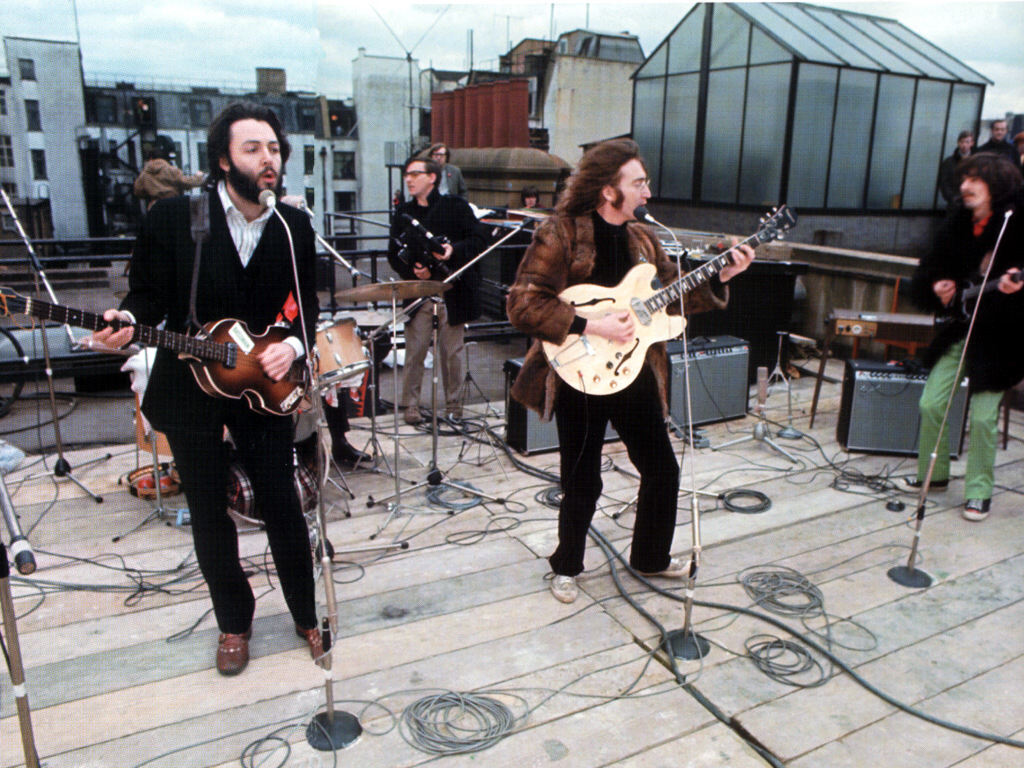
The Beatles Rooftop Concert took place on January 30th, 1969, at infamous Abbey Road Studios, George Harrison was several weeks shy of his 26th birthday on February 25th. The rooftop concert was performed at the end of January 1969 at Apple Studios, Saville Row, London. Abbey Road Studios, located in the fashionable London district of St. John’s Wood is where the Beatles recorded most of their albums, as well as the final one, “Abbey Road”. It is here where the iconic album cover pictures the Beatles crossing the street outside o the studio.

It’s hard to believe that it’s 47 years since The Beatles said goodbye with their final – albeit explosive – public appearance, perched on top of the Apple headquarters in London.

On this day in 30th January 1969 The Beatles delivered what was to be their final public performance; they’d planned on doing a live show during their Get Back sessions but it wasn’t until days before the actual event took place that the idea of performing on the roof of Apple headquarters really came together.

Written by John Lennon as an expression of his love for Yoko Ono, the song is heartfelt and passionate. As John told Rolling Stone magazine in 1970, “When it gets down to it, when you’re drowning, you don’t say, ‘I would be incredibly pleased if someone would have the foresight to notice me drowning and come and help me,’ you just scream.”

During filming on the roof of Apple, two days after the recording of the track, the band played ‘Don’t Let Me Down’ right after doing two versions of ‘Get Back’ and it led straight into ‘I’ve Got A Feeling’. Michael Lindsay-Hogg was once again directing a Beatles’ shoot. He and Paul met regularly at the tail end of 1968, while Hogg was directing The Rolling Stones Rock and Roll Circus, to discuss the filming of The Beatles’ session in January. By the time that fateful Thursday came around, the penultimate day of January would be the last time The Beatles ever played together in front of any kind of audience.

This is not the version of ‘Don’t Let Me Down’ heard on the single but the version from the Let It Be… Naked album – a composite of both versions that were performed on the roof of Apple in Savile Row

Late Beatle George Harrison explained in the liner notes for The Beatles’ Anthology,

“We went on the roof in order to resolve the live concert idea, because it was much simpler than going anywhere else; also nobody had ever done that, so it would be interesting to see what happened when we started playing up there. It was a nice little social study.

With a 5-song set list that included “Get Back” and “Don’t Let Me Down,” The Beatles did a total of 9 takes live from the rooftop before London’s Metropolitan Police Service was dispatched to break up the concert, citing “noise complaints” from tenants on the same block.

The concert effectively signaled the end of an era for both the band and their fans; despite Abbey Road’s release in September of that year the band had unofficially disbanded, never to reunite as a 4-piece again. While there’s a slight note of sadness to The Beatles’ final public appearance, there’s a note of something electric, too. In a way, they left us the same way they found us; in absolute chaos and unable to make heads or tails of our emotions and somehow, we wouldn’t have it any other way.

The Beatles released the single “Let It Be” on March 11, 1970 in the US. At the time, it had the highest debut on the Billboard charts, coming in at Number 6 in its first week. It was written and sung by Paul McCartney. It was their final single before Paul McCartney announced his departure from the band. Both the “Let It Be” album and the US single “The Long and Winding Road” were released after McCartney’s announced departure from and subsequent break-up of the Beatles as a group.

The alternate mix on their album “Let It Be” features an altered guitar solo and some minor differences in the orchestral sections.

letitbe

“Let It Be” holds the number-one spot on “The Fans’ Top 10” poll included in The 100 Best Beatles Songs: An Informed Fan’s Guide by Stephen J. Spignesi and Michael Lewis. The song is number three in the 100 Best Beatles Songs list, only behind “Strawberry Fields Forever” and “A Day in the Life”, which is number one. Would you put “Let It Be” in your list of your top 3 Beatles songs? Happy 45th US Birthday to the Beatles single “Let It Be”!!!

Paul McCartney said he had the idea of “Let It Be” after he had a dream about his mother during the tense period surrounding the sessions for The Beatles (the “White Album”). According to McCartney, the song’s reference to “Mother Mary” was not a biblical reference. The phrase has at times been used as a reference to the Virgin Mary, the mother of Jesus Christ  in fact, the words “let it be” are direct quote from the Prayer of the Annunciation, Mary’s response to the Angel Gabriel in Luke 1.38. Nevertheless, McCartney explained that his mother who died of cancer when Paul was just fourteen 

The first rehearsal of “Let It Be” took place at Twickenham Film Studios on 3 January 1969, where the group had, the previous day, begun what would become the Let It Be film. During this stage of the film they were only recording on the mono decks used for syncing to the film cameras, and were not making multi-track recordings for release. A single take was recorded, with just McCartney on piano and vocals. The first attempt with the other Beatles was made on 8th January. Work continued on the song throughout the month with  Multi-track recordings 

The master take was recorded on 31st January 1969, as part of the ‘Apple studio performance’ for the project. McCartney played Blüthner piano, Lennon played six-string electric bass, Billy Preston played organ, and George Harrison and Ringo Starr assumed their conventional roles on guitar and drums. This was one of two performances of the song that day. The first version, designated take 27-A, would serve as the basis for all officially released versions of the song. The other version, take 27-B, was performed as part of the ‘live studio performance’, along with “Two of Us” and “The Long and Winding Road“. This performance, in which Lennon and Harrison harmonised with McCartney’s lead vocal and Harrison contributed a subdued guitar solo, can be seen in the film Let It Be.

The film performance of “Let It Be” has never been officially released as an audio recording. The lyrics in the two versions differ a little in the last verse. The studio version hasmother Mary comes to me…there will be an answer whereas the film version has mother Mary comes to me…there will be no sorrow. In addition, Paul McCartney’s vocal performance is noticeably different in both versions: in the film version, it sounds quite a bit rough in certain moments since he’s not using anti-pop on his mic; there are also a couple of falsetto vocals performed by Paul (extending the vocal ‘e’ on the word ‘be’), for instance in the ‘let it be’ line that precedes the second chorus. Still another version of the song appeared on the Let It Be… Naked album in 2003. This version contains a different piano track than the one on the studio and single version; it can be noted that in the intro, Paul plays an extra A bass note during the A minor chord (very similar to the way he plays the intro in the film version) and also plays a standard A minor chord in the piano at the first beat of measure two in the last verse (on the lyric ‘mother’, also like in the film version), while the other versions have a different piano harmonisation.

beatles-rooftop

“I’d like to say thank you on behalf of the group and ourselves, and I hope we passed the audition” – John Lennon

Trying to come up with a conclusion for the film, “Let It Be”, it was suggested that the band play an unannounced lunchtime concert on the roof of the Apple building. On 30th January, The Beatles with Billy Preston played on the rooftop in the cold wind for 42 minutes, about half of which ended up in the film. The Beatles started with a rehearsal of “Get Back,” then played the five songs which are shown in the film. After repeating “I’ve Got a Feeling” and “Don’t Let Me Down,” takes which were left out of the film, the Beatles are shown in the film closing with another pass at “Get Back” as the police arrive to shut down the show. The Apple building concert was the first live gig since The Beatles stopped touring 29. August 1966 (tired of screaming girls and not able to hear themselves through the screams) and it was to be their last. It’s a fantastic show, sweet and short, really makes us long for more. It gives us a glimpse of what could have been, and it shows us what a magnificent live band they were.

The songs performed in the Rooftop concert, Apple building:

Get Back (5 versions)
I Want You (She’s So Heavy)
Don’t Let Me Down (2 versions)
I’ve Got A Feeling
One After 909
Danny Boy (in between the main songs)
Dig A Pony (2 versions)
God Save The Queen (incompl.)
A Pretty Girl Is Like A Melody (between main songs)

letitbe
Most of the LET IT BE album was recorded in January 1969, before the recording and issue of the album ABBEY ROAD.
LET IT BE was originally intended to be released before Abbey Road during 1969 as the album Get Back then mixed and completed by Glynn Johns but was then temporarily shelved with a new version remixed and produced by Phil Spector in 1970. serving to assist the release of the movie “Let it Be” three songs were issued as singles “Get Back/Don’t let me Down” and “Let It Be”, the rooftop film of the Beatles performing songs from the album is classic music filming.