Strand Of Oaks (the project of Timothy Showalter) has shared a new song titled “Jimi & Stan.” It is the latest offering from his forthcoming album “In Heaven”, due out October 1st on Galacticana Records via Thirty Tigers. Listen below.
“Jimi & Stan,” like other songs on In Heaven, deals with grief and the loss of a loved one. Showalter explains in a press release the meaning behind the song: “My sweetest buddy/cat Stan sadly passed away. And the only way I could describe my love for him was imagining Stan and Jimi Hendrix hanging out in heaven together smiling and going to shows and having the best time.”
Very proud to share my new song “Jimi & Stan”. If you’ll allow me to get personal for a moment. Stan was my beloved cat. In 2018, Stan got cancer right around the time Sues mom was killed in a car accident. Our home was filled with immeasurable sadness. I believe Stan held on as long as he could just to be there for us until finally saying goodbye. In my grief I tried to imagine a Heaven that Stan so rightfully deserved. And that Heaven is Stan hanging out with Jimi Hendrix going to shows and having a warm spot to look at the galaxy. I wanted the song to be a joyous sendoff for my sweetest buddy. It’s also a song for all of us who have lost and can only dream that those that we love can live in our hearts forever. I cry every time I hear this song but I know it’s all from love. Thank you for listening and please call the people you love and hug your pets. I cherish you all.
Upon the announcement of In Heaven, Showalter had earlier shared the song “Galacticana” His previous album, “Erasureland” came out in 2019
Strand Of Oaks (Timothy Showalter) will release a new studio album “In Heaven” due on October 1st. The album features the lead track and single, “Galacticana.”
Showalter recorded In Heaven in October 2020 at Invisible Creature in Los Angeles with producer Kevin Ratterman, who also produced 2019’s Eraserland. The sessions followed Showalter’s relocating from Philadelphia to Austin, Texas and the unexpected deaths of Showalter’s wife Sue’s mother in a car accident and the couples’ beloved cat Stan.
Showalter played guitar and, for the first time since 2014’s Heal, synthesizers. My Morning Jacket guitarist Carl Bromel and keyboardist Bo Koster, who contributed to Eraserland, were brought back for the In Heaven sessions. Ratterman played drums alongside bassist Cedric LeMoyne. Violinist Scott Moore appears on the new album and special guest James Iha (The Smashing Pumpkins) added guitar and vocals to the track “Easter.”
I am beyond thrilled to announce my newest record In Heaven. Hard to put into words how much these songs mean to me and the love that went into creating them. Over this tough year or so this Oaks community has brought me endless strength and made me feel less alone. The first single Galacticana is for all of you, it’s my love letter to all of us. Please do me a favour and if you like this band/song share this with your friends. You can pre order and listen at our website. Let me know what you think in the comments, as always I’d love to hear from you! You all mean the world to me, Best tim
“In Heaven” was created with so much love and my greatest hope is that it connects with people and provides a momentary space for reflection, joy, catharsis and whatever else someone might be looking for in their life,” Showalter stated. “Music is magic and I feel like the luckiest person in the world that I’m allowed to share it.”
Strand Of Oaks will tour the U.S. in support of In Heaven throughout October and November.
Timothy Showalter recently moved to Austin and explained how good the change has been for him. Additionally, Tim has stopped drinking and detailed how he’s reaping the rewards of that decision. The pandemic hit just as Showalter was about to take time to work on new music. He discussed his song writing process as well as the ambient album, Ambient For Change that Strand Of Oaks released in June.
While Tim acknowledged all the strife and struggle going on in the world, Showalter spoke about the positive attitude he’s taken towards the future. Showalter called it his “survival mode” to talk about the future and projects in a hopeful way. Another topic hit upon by Showalter was Tim’s appreciation for the jam scene and the band Phish in particular. Tim explained how much Phish’s Dinner And A Movie weekly video broadcasts mean to him. He noted that Tuesday nights are his most social time of the week. Other subjects discussed are ways both artists and fans can help the live music infrastructure,
Timothy Showalter was done. Despite the acclaim that greeted Strand Of Oaks’ fifth album, Hard Love, the guitarist and songwriter found himself in a hole, and was on the verge of quitting music altogether. Then his friends in My Morning Jacket decided to pull him out, dragging him into the studio and providing an elite backing band to create his most impressive album yet, Eraserland.
“I didn’t really wanna do it anymore,” says Showalter, the artist also known as Strand Of Oaks. That’s quite an attention-grabbing admission, but in these clickbait-heavy times, he’s keen to emphasise that this isn’t just a good marketing line. “It’s not for dramatic press. I know that’s how this game works – put a fireworks show up so people wanna write about it. But when I was trying to explain the record to people, that’s the only way that I could. I think it was an identity crisis.”
Back in 2017, Tim was promoting and touring his new album, Hard Love, but despite the album being well received by both critics and fans, something wasn’t right. “I released Hard Love a year after I made it, and I was singing about someone who I wasn’t anymore,” he reflects. “I was pretty wild for a little while there. But over the course of that year making Hard Love and being home, I changed in a good way. I loved the record and playing those songs live, but I had this idea of, ‘What am I doing? I’ve been doing this for 10 years. Who am I?’”
The changes may have been positive, but it coincided with Tim finding himself stuck in a rut, and unable to write new material, which in turn brought up a host of other issues. “Most of my life, playing guitar and singing, and writing songs, was an escape route out of anxiety and life,” he admits candidly. “That was my safe place… and then I was like, ‘Shit…’ Because being a musician is most of my identity – if you were to speak to friends or family, they would say: ‘Oh, he was really depressed.’ Like clinically depressed! But I equated it to, ‘I’m just not feeling the tunes right now!’”
Such was Tim’s disconnect from music at this time, he barely registered his label’s decision to take the wealth of unused material from the Hard Love sessions to create a brand-new album, Harder Love, which came out in 2018. “I forget that Harder Love even came out!” he exclaims. “I had very little to do with that. There was some good stuff on there, and the label kind of approached me and said: ‘People should at least hear these songs…’ And I’m like, ‘That sounds good. I’m gonna hike in the woods for a while!’”
And then something quite remarkable happened. “I got a phone call from my manager saying: ‘Are you making a record with My Morning Jacket?’ And I went, ‘What are you talking about?!’” Tim remembers. “He said: ‘WelI, I just got a call from all of them and they say they have studio time booked…’ and I didn’t have any songs written!”
Renowned indie-rock bands don’t just go around booking studio time with songwriters on a whim, and what was actually happening was something of a rock ’n’ roll intervention…
“They’re friends of mine, and the producer Kevin [Ratterman] is also a dear friend, and to their endless credit they caught wind that I wasn’t in a good spot, and they dropped everything,” he reflects wistfully. “For Chrissakes, Bo [Koster] the keyboard player… he’s Roger Waters’ keyboard player! And he had two weeks off in the midst of the The Wall Tour, and he decided to spend those two weeks with me in a studio in Louisville. It’s the last place he should have been – he should have been on a fuckin’ beach or something!
“My epiphany truly started when all these people started to come to my aid, and my first inclination was, ‘I need to write good songs, ’cos I can’t give this band mediocre shit!’ So I began writing the opposite of how I usually write – unselfishly! It gave me enough room to get out of my own head, and because of that, it became a pure form of expression that I couldn’t have planned on. And the songs just came – I don’t know where from! I still need to learn chords for half of them. I don’t remember writing them. I hope I did!”
Working with a very short deadline was a new one for Tim – “Sometimes I’ve written songs where there’s like a three-year gap between writing a song and putting out a record,” he admits – and with just a few short weeks to write an album, he headed for the beach to write…
“I love beaches in the off-season,” Tim explains. “I don’t know why, it’s just romantic. It looks like death, but a beautiful death! And the songs just kinda varied depending on my mood from day to day, or even what the weather was like at the beach! Like if it was a rainy day, it would be more introspective, but if it was sunny, the major chords would come flying. It all happened so fast.”
If the writing and demoing process was a breeze, when it came to recording, the reality of the shoes he was filling rendered things a lot less comfortable. “I had a panic attack the first day at the studio, because we recorded everything live in this huge room, and I was standing where [MMJ frontman] Jim James should be standing!” Tim recalls. “And if anyone knows Jim James, I can’t sing like him – 99 per cent of the planet that’s ever existed can’t sing like him. I’m like, ‘What am I doing here!? I shouldn’t be allowed in this party!’
“But that night, the guys went for dinner and I stayed at the studio because I wanted to get my guitar tone working. And while I was there on my own, I walked around the studio and I saw that they all had extensive notes that they’d written. That to me, was like this moment of like, ‘Oh, they are so involved with this.’ This is not like when a label sets you up with a bunch of studio musicians. These are friends and they’re invested. Yes, they’re extremely accomplished and you look up to them, but this is not the moment to be starstruck. This is the moment to collaborate.”
With that hurdle overcome, the chemistry between Tim and the rest of the band was immediate and the recording process was remarkably smooth.
“It’s a testament to what good musicians they are,” he enthuses. “We really set ourselves up for failure, because we’d never played together before! But outside of maybe a few overdubs, everything was live. Even if it was nine minutes long. That’s the performance.”
Operating with that one-take mindset really gave Showalter an appreciation for how good his new backing band was, and one member in particular. “Tommy [Blankenship], the bass player, is a perfect bass player.” he insists. “After five days, a few of us went out for dinner, and he went somewhere else, and we had this realisation… ‘Guys, Tommy hasn’t messed up yet…’ He never hit a wrong note! You’re supposed to do something wrong, to make everyone else feel better! It’s like, ‘Tommy, please, I messed up my own lyrics on that last track!’”
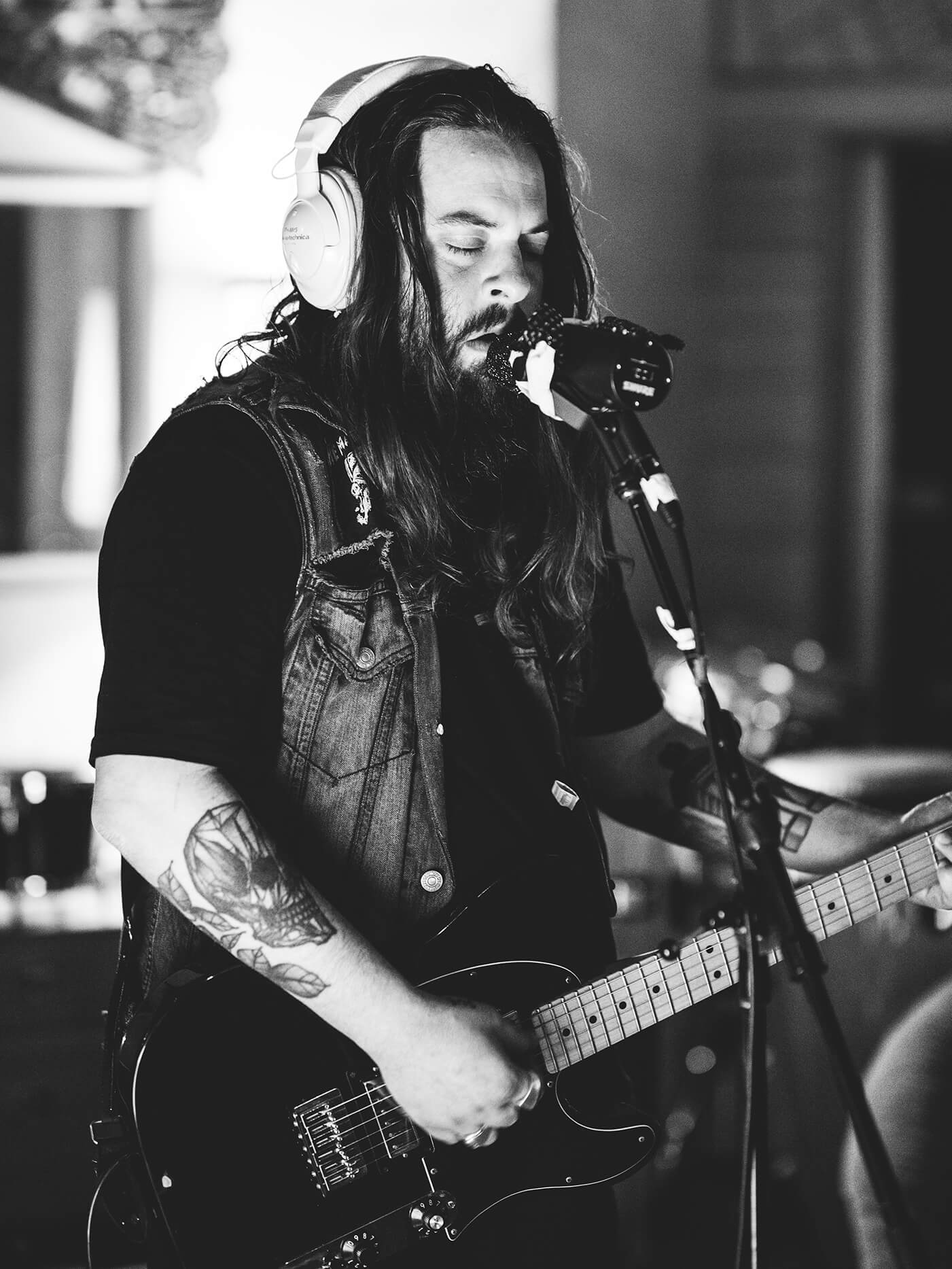
When it came to the album’s guitar sounds, Tim found himself in the unusual position of not being the primary lead guitarist, with MMJ’s Carl Broemel filling that chair. “Usually, I have a ‘space station’ pedalboard and everything. But my stuff was really simple, it was strictly for rhythm,” Tim recalls. “I was mostly playing a Frankenstein Telecaster – that for some reason I put mini-humbuckers on – through what looked like a Magnatone, but it’s got a single 12 in it – I don’t know if one of Kevin’s friends made it or what.”
Taking a back seat on the lead guitar side did give Showalter a chance to appreciate the creativity and uniqueness of Broemel’s playing, however…
“He has a Duesenberg that’s like a tour de force of tone,” Tim enthuses. “But his secret is that he would be sitting down in front of this pedalboard, and he had an Echoplex. And as he was soloing on stuff like Weird Ways or Forever Chords, his right hand was constantly working that as he was playing.”
Showalter has developed a reputation as a fan of extended jams, exploratory solos and a general tendency to wig out whenever possible, but by not really playing solos on the album, he began to look at things from a different perspective.
“The thing I love about Eraserland is that there’s very little jamming,” he admits. “It’s extremely structured, and I think that to me always felt unappealing in the past. But when you think about The Dark Side Of The Moon, in your memory, it’s almost as if Gilmour is soloing the whole time. Like an epic jam. But then when you go back and listen to it, it’s actually so composed and orchestrated.
“In my past records, like Hard Love, I was just like, ‘Let’s just jam, fuck it all, start the track!’ And that was fun and all, but for something like Forever Chords, we had it down to a measure. Technically, there are only like three solos on this album.”
One of those three solos was reserved for a very special guest – Jason Isbell. The guitarist is another friend who wanted to help Tim get back in the saddle, and leant his considerable skills to the track Moon Landing.
“Jason and I go way back,” Tim explains. “I played shows with him maybe 10 years ago? We’ve remained friends and played off and on together since, and he’s a wonderful person. He has such a beautiful voice and writes award-winning songs, and we sent him the most crazy and dissonant song on the record.
“He really wanted to be on it, but was touring so he couldn’t come to Louisville, so we sent him the track after we were done with it, and we were like, ‘Well, what’s he gonna do with this?’ And then he came back with like a Hendrix-level Machine Gun solo! And I think that I’m most proud of that – because you see it with him live, but I want more people to know that he’s one of the most inventive players around.
“My god, if you listen to the raw track of Moon Landing and his solo, there’s things in there that sound like he’s eating his guitar or something! How is he doing that?! And it was bone dry – no delay or reverb, or anything, just deadly tone. Love that.”
After coming so close to jacking it all in before Eraserland reignited his creativity and love of music, we can’t help but conclude our chat by asking Tim how he’s feeling about the whole thing now…
“I wanna make more records,” he affirms. “But I have to put this album to rest as a piece of art in order to open my brain up to make the new. I always tell friends that the two weeks after I get the master, I have this golden moment where I listen to my own record, and I listen to it, and I like it… and then it’s done forever. I’ve given it to the people.
“It feels good to know that maybe in six months, I’ll be able to maybe start the next one, but I just need to have that moment to let go. It took me a long time to let go of Hard Love, but that enabled me to do this, which was such a positive experience. Hopefully, I won’t have to go through that again this time, though… these dramatic stories, I’m just tired of them!”
This year Tim Showalter released his sixth album as Strand Of Oaks, “Eraserland”. Recorded with the assistance of his friends in My Morning Jacket, Eraserland is of his strongest works yet, and one of the best albums of 2019 so far. One of its key tracks sits as a centerpiece of the album, the funky, seemingly stream-of-consciousness “Moon Landing” And, appropriately enough, Showalter has chosen the 50th anniversary of the moon landing, to share an alternate take of the song.
The original “Moon Landing” is a feverish rush. The new alternate take is a more restrained, acoustic-based reading that allows the lyrics to come through a bit clearer. In each version, Showalter touches on various aspects of his life, including the fact that he shares his birthday with Chris Cornell and the anniversary of the moon landing — being born on that day then becoming some unifying symbol for all the loose pieces visited throughout the song, the pieces that formed his identity.
Here’s what Showalter had to say about “Moon Landing,” and sharing this new meditative iteration on his birthday:
If Eraserland is a place, “Moon Landing” is the door to get there. There is no chorus or even riffs. It is a glossary to help define who I was when I wrote the record and help piece together all the loose ends. On record it is a career highlight for me probably because my only contribution was vocals. When it came time to play this live, it was bittersweet, missing Jason Isbell’s guitar, Carl’s sax, Kevin’s insane sonics, and really just everyone who was on that recording. It’s meant to be a document and not to be duplicated. I was trying to unlock the song, and I sat on my acoustic strumming three chords and found a totally different song. What I couldn’t recapture was the frenetic energy of studio production, but what I found was the emotional waterfall of lyrics that I honestly never paid a lot of attention to. Then the added weight of 50 years since the Moon Landing, 37 years since I was born, and the beautiful gift that I got to share my birthday with Chris Cornell. I feel like even the date of my birth sums up my life and musical career, the cosmic mixed with musical admiration. I hope you enjoy listening and do me a favour after you do put on “The Day I Tried to Live” and let it flow over you.
“Eraserland” is Strand of Oaks’ most lasting, accessible album yet, one that’s not as concerned with its own internal drama and more interested in communicating the power in dreaming up a better life.
Tim Showalter returns with Eraserland, his sixth album as Strand Of Oaks. It almost didn’t happen. As the touring behind 2017’s Hard Love was coming to a close, Showalter found himself defeated. After the wild journey from his 2014 breakthrough Heal to its follow-up, something didn’t click. Unsatisfied with his band, with the project overall, with himself, he entered into in a bout of deep depression.
Then he got a call from an old friend and a musician he’d looked up to: My Morning Jacket guitarist Carl Broemel. The other members of the group besides singer Jim James — keyboardist Bo Koster, bassist Tom Blankenship, and drummer Patrick Hallahan — wanted to offer their services as backing band for a new Oaks album. The only problem was Showalter didn’t have any songs.
He embarked on a writing retreat, secluding himself on the beaches of Wildwood, New Jersey in the dead of winter. In a few weeks, he emerged with the songs that would become Eraserland. He met the band in Louisville and they recorded the material in a matter of weeks as well.
Tim comments,
I know a lot has already been said about this record. So I guess I will just dig right to the core. Eraserland will forever hold such a special place in my heart, I’ve never been more proud of a group of songs, and in many ways I feel like this is my first record. But more importantly when I listen to or think about Eraserland, I’m filled with the love of all those around me and the special people that guided me back from being so lost, to make this record a reality. Whereas most Strand of Oaks records were made in such a solitary creative space, Eraserland was created by a community of friends and people I love so dearly. This community also includes all of you, who are a part of this family. I would like to thank (we can tag them here))) Carl, Bo, Tom, Patrick, Kevin, Ryan M., Jason Isbell, Emma,Lacey Guthrie, Anne (insta annegthr), Alysee, Dead Oceans, and most importantly my wife and partner Sue. When you listen to Eraserland and if you find some connection, please know that this would not have been possible without these wonderful people in my life. Eraserland means whatever you want it to, but for me its a place where you can be anyone you want to be, and hopefully find some peace. I love you all very much and now we get to share these songs together. The last line on the album is my hope for all of us, “If you believe you can be loved, you’ll outlive you’re past”.
Thank you- Tim
several of its songs are more rewarding and evocative each time you listen. And below, Showalter’s stories may provide a sort of first listen companion.
1. “Weird Ways”
As a mission statement and lead single, “Weird Ways” feels like such a perfect re-entry point. Like opening up the album with sort of a rebirth moment. Tim: In my time at the beach, which was basically a writing retreat, that was the last song I wrote. It was towards the end of my time there, before my wife and her family came, and I was breaking down my gear , then I just wrote one more song. I felt like I was in this rush to write it because I needed to get the apartment clean before her parents came. But I had one thing left I needed to say, after three weeks and many more songs than are on the record.
I wrote it so fast. It was just another song, I had no idea about its impact on my catalouge. We got to the studio, and it was kinda far down on the list. I always have my marquee songs I really like, hence my past mistakes like “Passing Out” not being on Hard Love. But then “Weird Ways” was the first song we tracked. It had this weird life, it was the underdog. The original, it was like two minutes and the refrain at the end was a four-bar “There are colors.” Since it was the last song I wrote, I think it actually encapsulated the entire experience of the album. I think I was summarizing the record, and then it’s the first song on the album. It’s like I’m calling my shot before the album happens.
“Weird Ways,” from the demo, is the least familiar on the album. Kevin Ratterman, my producer, he and I didn’t talk about it, but how we developed the arrangement on the album was like the curtain coming up. And the curtain comes up for everybody pretty much individually. You initially hear Carl’s ethereal little slide, then Bo comes in with the keyboards, Patrick comes in with the snare, and finally Tommy comes in when everyone kicks in.
It’s beautiful in a way, because yes it’s introducing their instruments, but it’s also introducing how each member individually — and this is the theme of the whole recording process — was there for me and embracing me. It starts out extremely alone, it’s just me with an acoustic sounding extremely lonely. With them and Lacey Guthrie from Twin Limb, by the end it feels like there’s 500 people in the room around me.
This was the first time [My Morning Jacket] members and I recorded together. In the midst of the tracking, I really messed up a take. And I was the worst one to mess up a take because I had very little responsibility — I was just tracking ghost vocals and rhythm guitar. So whenever I messed up when we’re tracking a six and a half minute song live, I felt really bad. Just like, “Who is the amateur in this room!? It’s your song!” But I did, I messed up.
It was my first and only deep crisis of conscience, where I had the inevitable, “What am I doing here? This is where Jim should be and … I cannot sing like Jim …” I didn’t express it to anyone else as it was happening but luckily I got over it fast. I saw things within the studio. I was communicating with one of my favorite bands in that way.
A key moment arrangement-wise in that song was the “There are colors” refrain. Originally it was a falsetto and a low part. On demo, it just wasn’t there. The song really didn’t take off until I was doing the vocals and I told Kevin “I wanna do a Liam Gallagher part.” He was like, “What does that mean!?” There was this high part and low part and then I did this middle part like “That’s what Liam Gallagher would’ve done there!” It added a heft that wasn’t there. The story that came with Eraserland’s initial announcement was that you were feeling pretty defeated, then got a call from Carl.
SHOWALTER: The worst I felt is when Carl originally contacted me. That was at the end of the Hard Love tour. I was done. I was very depressed. Unbeknownst to me, I was equating it to my music because I’d become so tied to that identity as that’s who I was. I was thinking, “It’s the band, I don’t want the band to go on anymore.” But I think I didn’t want to go on anymore. I think I was done, in a lot of ways.
So the beach happened because they all booked studio time and Bo had two weeks off from the Roger Waters tour to be with us. All of that happened, and I legitimately didn’t have songs. I love Wildwood, New Jersey, and I love it in the winter.
2. “Hyperspace Blues”
Eraserland has these towering, emotional tracks that kind of trace this journey. But, on our way, right from “WeirdWays,” we go to “Hyperspace Blues.” this song definitely seems like it’s about drugs. I love “Hyperspace Blues” because it served such a functional purpose in my daily process at the beach. My favorite thing to do on the beach, I would take my bike, and the beach is frozen in the winter, and I’d just ride my bike forever at night.
It’s the most freeing experience, because the Jersey Shore is so wide, and you can just ride your bike forever and I felt like a kid. I felt like I was absolutely alone in the universe. I had music on, it was pitch black, and I had no consequences — if I fell off my bike it was sand, I wasn’t going to get hit by a car. It was like hyperspace. I think that played into it a lot. That’s the song I’m most excited to play live.
How do I say it … there’s a bit of trolling on Eraserland. I’m trolling Hard Love a little bit on Eraserland. It’s deeply referential but the idea of like, “Somebody put me back together!” It’s kind of like me responding to that whole situation.
3. “Keys”
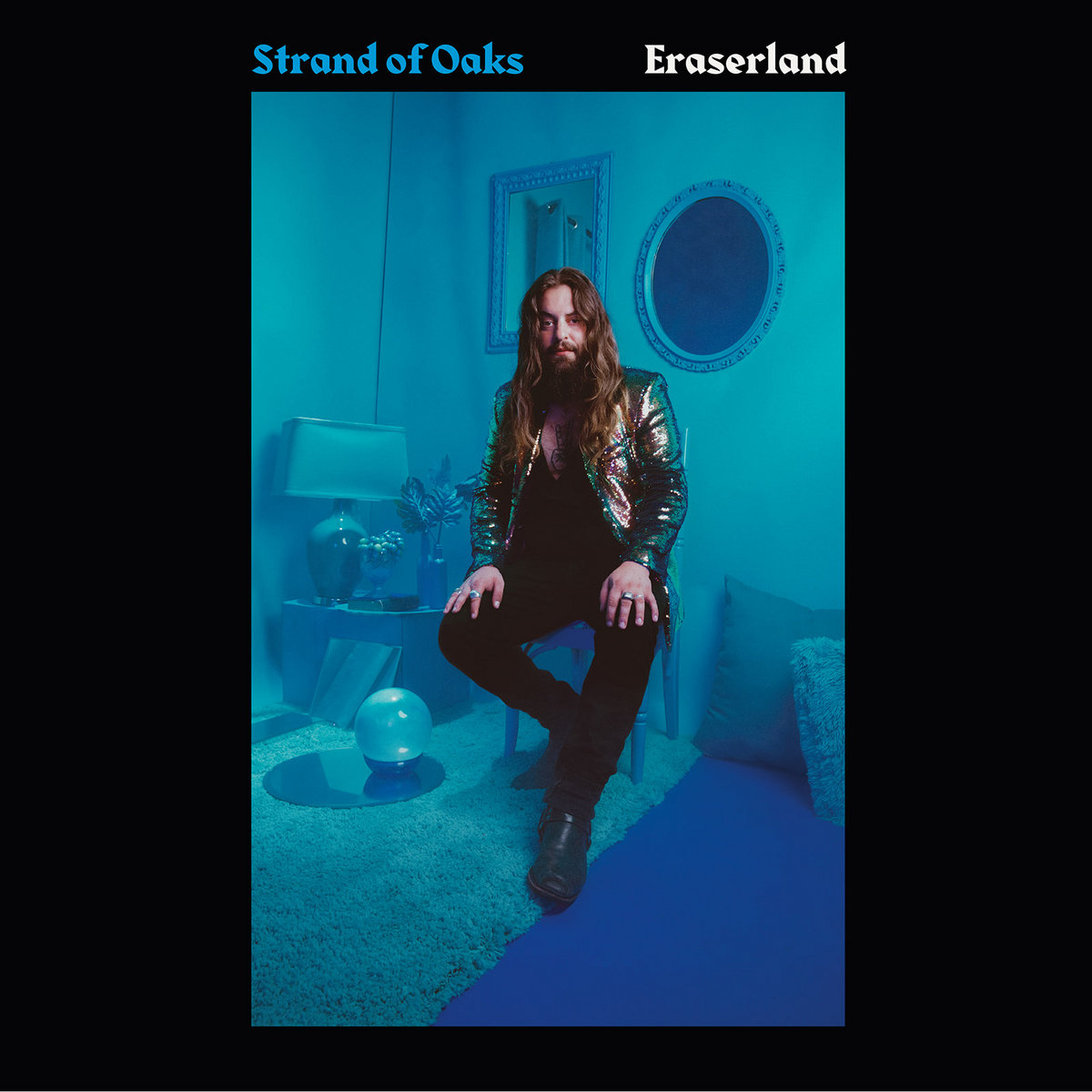
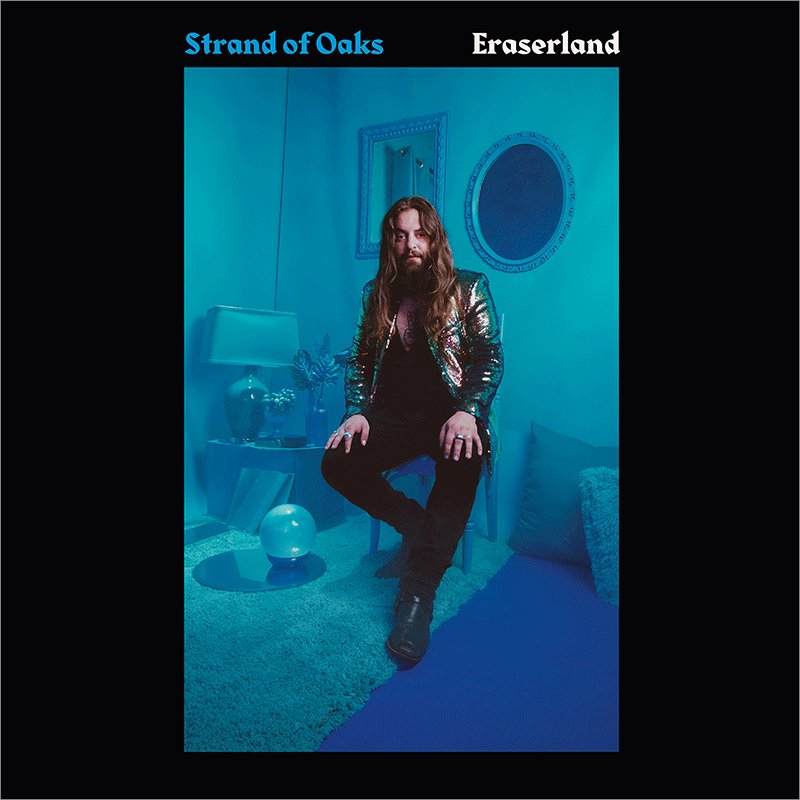
The way I hear albums is often informed by the artwork. So I hear Eraserland as taking place in this glossier place than the other albums, but also blue and nocturnal, a little bit surrealist. So it took me a bit to hear “Keys” this way, But there’s also something so poignant and universal about this sentiment, just being with your partner and saying “We’re done, let’s just get out of here together.” I think “Keys” might be the best love song I ever wrote for Sue. I’ve written a lot of love songs for her but this truly sums it up.
I really like that song because it’s chords I’ve used before, and I really didn’t want to write that song when I was playing the chords. I had a melody that was a really atypical Strand Of Oaks melody. Then I put it away and I was actually trying to hum an organ part I was going to put on, but that became that wandering melody in the verse.
We tracked vocals after the band left, in another session. It was just Kevin and I in the studio. You can hear it on the last chorus, where I say “I’ll buy us a trailer down in the Keys,” which to me is so bittersweet. I was just zooming through the vocal takes and I got to that part and I started crying. It got me, completely.
When I got to that second verse, and I choked up, and I go “Ah, sorry Kevin.” And I couldn’t see him so I go “Kevin, are you there?” I said it three times, and it turns out he was crying, too. We weren’t in the same room, couldn’t see each other, but it hit us equally as hard. Then we went to the second take, and I do break up a little bit again, and we kept it. I was happy that Kevin didn’t push me to do a more refined take in that moment.
4. “Visions”
“Visions” is one of the heavier, more harrowing songs on the album. “Visions” is a crazy song because I wrote that chorus melody before Heal. That melody has existed for like six years, and I’ve spent hundreds of hours trying to find that chorus a home. It wasn’t until I did the verse, and a two-chord for the pre-chorus … I think the song feels heroic in a way, simply because I felt so happy I finally found a place for this chorus to live.
It’s one of the few songs on the record that touches on the depression I was in. It’s interesting. I think back to a lot of the songs I wrote and “Visions” introduces something I never had before, and that’s hopelessness. For me, there’s a few lines that nail it home, to the truth. “2017 tried its best to take the magic from me.” “Magic,” that’s self-referential that’s what I say in “Goshen ’97,” “The magic began.” That’s a code word for music, and how music has saved me. I felt like the year, and all that was wrapped up in 2017 — my career, my band, the world — it was gone. The whole song is hopeless at that moment but what’s cool is the music is heroic, and I think the music saves the lyrics. The arrangement is trying to save the person who’s singing.
I was so into that arrangement. If this would’ve been Hard Love me or Heal me I would’ve added a thousand more things to that fucking song. Harmonies on the chorus. That song is begging for a guitar solo! It’s begging for a Slash to show up and step off the train tracks! .
5. “Final Fires”
Track order is so essential on Eraserland, more so than on any other record I’ve done. “Visions” … it’s a commitment to get to track 4 and end “Visions.” Then moving to “Final Fires,”. What’s cool about this song is it captures the aesthetic of the album pretty well. You think it’s going to be kinda new wave-y in the beginning with that intro, then it’s like this rollicking, breezy rock song. I’m excited for people to hear the whole record, because there are moments that are fun. This feels fun in a way that not even “Goshen ’97” did. More awareness I may have earned in my life, and understanding that every year you live you realize everyone’s as completely as fucking lost as you are and everyone has problems and there’s an enormous amount of confusion in everyone’s life. In the past, I would’ve written a whole record like, “I think I’m crazy!” And now I can sum it up in one kinda funny line in the beginning of “Final Fires,”.
6. “Moon Landing”
“Moon Landing” feels like it would’ve sat here on the album regardless, a kind of mid-album funk freakout. And you have Jason Isbell playing on it. Jason and I go way, way back. He’s a wonderful person. I think Jason knew I was having a tough time. He reached out and was like, “If you need anything on this record let me know. I’d love to be a part of it.”
We always had that in the back of our mind, like I have Carl Broemel and then I also have the opportunity to have Jason Isbell. We were thinking of where to put him. My God, Jason plays slide guitar amazing, he could’ve done something amazing on “Keys.” We had this absolute groove song so we sent it to Jason. I kept telling Kevin, “You have no idea what he can do on a guitar. It’s more indebted to Hendrix’s “Machine Gun” than an Allman Brothers song. It’s fucking crazy. I felt so pleased in such a tiny, tiny way, that if anyone didn’t know the depth of Jason’s playing,
Since Heal, I’ve had songs that are sort of the gravitational center of the record. “JM” was that, and “On The Hill” was that for Hard Love … and “Moon Landing,” in a different way, feels like it’s gluing things together. Especially lyrically. There’s a lot of lyrics to unravel.
I started the song with Malcolm Young, as a fan … in life, there are certain moments that are perfect. I think Malcolm Young was perfect in what he did. It’s something that cannot be emulated, it’s something about the way he played, and that’s the impact of him being gone now. No one will ever play rock ‘n’ roll rhythm guitar as flawlessly as Malcolm Young did. It’s book-ended with the last verse, with Chris Cornell. I always took a lot of pride in [having the same birthday] as him. Another monumental perfect thing, Chris Cornell’s voice.
Another Rosetta Stone moment is when I say “Bobby’s singing ‘Prophet’ with the futuristic eyes,” it’s Bob Weir singing “Estimated Prophet.” The lyrics in “Estimated Prophet” had a huge impact on the lyrics for “Moon Landing.” Chris Swanson, who started Secretly Canadian, told me the best thing ever: “Some songs are for the people, some songs are for the heads.” This is one of those for the heads, I think.
7. “Ruby”
I don’t think you’ve ever written something as effortlessly catchy and warm as “Ruby.” I loved what you said when this came out as a single. There has been nostalgia, especially on the last couple Oaks albums, but there was a pang with it. And “Ruby” is this more contented remembrance. And then there’s that refrain at the end where, like “Weird Ways,” it really strikes me as the exact sound of Strand Of Oaks playing with My Morning Jacket.
Musically, “Ruby” is probably my proudest moment, because there’s a lot of strange key-shifting. The chorus is in a different key than the verse, the refrain is in a completely different key, and it all fits together.
What really nailed it is it for a long time existed as just the chorus and verse and it was last minute when I shifted into that “Ruby, won’t you slow it down.” That, to me, along with “Keys,” is one of the prettiest moments in my career. Then the waltzy piano outro was just another idea that was on the demo, that had no connection. That was Bo — I don’t think he knew, I didn’t intend for that outro to be on the song. So we finished and he just went into it and I was like, “Whoa, whoa the song’s over!” And Bo was like, “Oh, I thought this was part of it,” so I said, “Well, now it is!” So it ends in this 6/8 time signature. Man, it was fun to put together. In four minutes there’s like five different themes put together.
8. “Wild And Willing”
After “Ruby” the album definitely goes into a sad and ruminative place for the final stretch. It begins with “Wild And Willing.” Now, you write self-referentially a lot, you write autobiographically a lot. On this particular album, I feel like there are more lyrical references to being in a band and being on tour. Is that something — compared to say, “Keys” — that you worry people aren’t going to connect with as much.
With Eraserland, there are references to band and musician and it does seem like a closed society in some ways. I kind of feel the opposite. In “Wild And Willing,” I think it does feel a lot more inviting and welcoming because, yeah, I’m referencing being in a band but the way I’m presenting the lyrics is, hopefully, a lot more universal. “Wild And Willing,” that is the one song that should not be on this record. We had this other great song we made in the studio, that’ll probably come out at some point. But I got to this point where we had recorded that song and I was doing vocals and I asked Kevin, “Can I do something just for posterity?” We had the vocal mic set up, I grabbed what turned out to be Jim’s guitar — which is beautiful, because it’s like he’s on the record in a way, this was his main acoustic at the beginning of Jacket. “Wild And Willing” is the first and only take.
9. “Eraserland”
This final one-two is the most powerful way you’ve ever ended an album, in my opinion. And this title track is a weird song. It has this synth-gospel thing going on almost, and these big breaks and this dramatic outro. It’s one of the most interesting Oaks songs, I think. “Eraserland” the song is, for anyone that knows — that’s Pope Killdragon, who’s come back after 10 years. He’s speaking to the Virgin Mary, who was the heroine of Pope Killdragon. In my head, on the beach, I thought about the world and myself and what happened in the 10 years since I wrote Pope Killdragon and I brought him back. I never thought I would. If “Visions” was hopeless, this is… It’s a dark song.
I think the song itself is like four vignettes. Some are global, some are extremely personal. It was the self-assessment moment: What would I say if this angel or patron saint came back and talked to me? And she was like, “The last time I hung out with you, you were trying to write Pope Killdragon, and then you made an anthem record, As opposed to something like “Wild And Willing,” where I just forgot about it, I was pretty adamant about not putting “Eraserland” on the record. It wasn’t called “Eraserland,” it was just this song. That should be the end of the record. “Eraserland” should be the last song, and in a way it is. The one thing that was beautiful about the song “Eraserland” is I didn’t have the name of the album until one time Sue visited us in Louisville and I told her, “I think I’m going to call it Land Of The Dead.” And she was like “…You can’t do that.” .
I do strangely say “erase” like five times on the record. We came up with “Eraserland,” and this song didn’t have a name, so I made it the title track. And with that we had that outro without any vocals. Kevin said, “You need to say one more thing in this song.” That’s when that refrain [happened], and we were very specific about how to put those words together, because it’s “I am the Eraserland,” not “I’m in the Eraserland.” It feels more powerful, it’s a declaration. I think that’s an extremely different statement.
It’s also a reference to “Goshen ’97,” “I don’t want to start all over again.” This is me saying to that, “I can start again.” I can do whatever I want. the song is strikingly beautiful and has this effect coming after all these other tracks. Then you have Emma Ruth Rundle come in, and her voice is just totally otherworldly.
When I was doing the vocals, Kevin was like, “I wanna have Emma sing on this song.” We called it the Eraserland Vibe. Emma’s around my age, and I realized maybe she was having a lot of the same feelings. I saw so much of myself in her. Those that know Emma know she can sing huge. And I love that both of us were singing in our lower register.
10. “Forever Chords”
“Forever Chords” is this gigantic epilogue. Sonically speaking, it brings in the MMJ element one more time because it reminds me of “Dondante” a bit, this spectral and sprawling thing, big but not loose, with like an orchestrated build. It’s just two chords, C to E minor. Those are forever chords. Music is my language. Forever chords, that means more than C to E minor. I say it in the song. “Major to minor in a slow beating pulse.” That should be on my gravestone, that’s my mission statement in life. There’s so much to unravel with that song. I think the song explains it. I don’t want it to end. I think I’ve felt that way my whole life,
I think another gravestone lyric is “If you believe you can be loved/ You’ll outlive your past.” If I never write a lyric again… There is a lot of finality to “Forever Chords,” which is scary as a songwriter. Did I just do it at 36? Is that it for me? Because I just summed up what I thought for 36 years.
Strand of Oaks (aka Timothy Showalter) have announced their sixth studo album – “Eraserland” out March 22nd via Dead Oceans Recordings.
Eraserland features the impressive backing band of Carl Broemel, Bo Koster, Patrick Hallahan and Tom Blankenship of My Morning Jacket, as well as special guest Jason Isbell.
According to Showalter, the lead single “Ruby” is a reflection on a certain kind of nostalgia.
“Ruby is the happiest song I’ve ever written,” he said via a press release. “Ruby isn’t a person, rather the concept of time and memory and how with every passing year it becomes non linear. In the past I would’ve dismissed such unabashedly pure optimism, but I’ve been through a lot and I’ve learned to appreciate those rare moments of light.
“Ruby” off Strand of Oaks’s new album “Eraserland” out March 22nd on Dead Oceans
Kevin Ratterman and I first met when his incredible band Twin Limb opened for us on tour. Instant friendship. But the real kicker came about a week into tour and I asked him about previous bands he’d been in. He said a few and then mentioned off the cuff that he was the drummer of Elliot. My mind was completely blown. Not only did I love the music but it was at an Elliot show where I first saw Sue. At Kevin’s concert, 15 years ago I saw who was going to be the love of my life. If that doesn’t align the starts than nothing will. From there we talked music and recording and I just continued to discover how talented Kevin was in the studio. So when everything came together to make Eraserland, it was Kevin who truly brought it all together. We would get up every morning and have coffee and map out our day, then work about 14 hours, then after everyone would leave we stay up till about four in the morning just talking, laughing, planning and just really growing so close as friends. I’ve spent a lot time in the studio but I’ve never seen someone work harder but somehow float on air and make everyone involved feels so relaxed and inspired. I think everyone would agree, that Kevin was the boss, in the best of ways. When we would finish a live take all together (sometimes a nine minute song), there would be a stillness in the air of all us waiting to hear over the headphones if we got the take. That 15 seconds felt like a lifetime, especially when Kev would casually say “Let’s get another one”. Partnerships like this don’t come around often, or maybe ever, and for the first time in my life I was smart enough to recognize that and appreciate every second I got to spend with Kevin, and be around his magic.
Eraserland is the first record I’ve ever written where the majority of the songs started with a bass part. I needed to switch a lot of stuff up in my life and writing songs on a different instrument really proved beneficial. I feel like Oaks was becoming a “shred” band and at the time I wanted to be as far from that as possible. If you build songs from a bass line you start from an extremley centered and structured place, and that is exactly what my chaotic mind needed. Long story but all that work was then put into the hands of Tom Blankenship. Hanging with Tom was like going on a spiritual retreat so much thoughtfulness, kindness, observation, listening or to put it simply the ingredients that make a PERFECT bass player. When we recorded Eraserland, we tracked all the parts live together. Even with my songs which definitely aren’t prog anthems, it can be tough to get a complete take out of five individuals. But Tom NEVER messed up, I’m serious, NEVER messed up. Just quietly in the zone and constantly coming up with something fresh that somehow worked in the arrangement even better than his last take. It was amazing to talk with everyone and quickly find out that this is just Tom, he is the rock that holds everything together.
“Weird Ways” off Strand of Oaks’s new album “Eraserland” out March 22nd on Dead Oceans
This record wasn’t supposed to be here. I had thought for a moment Strand of Oaks might be over until a text from my friend, Carl Broemel, changed all that. Unbeknownst to me, four members of My Morning Jacket and Kevin Ratterman booked studio time to record songs I didn’t think I’d ever write. But they believed I could and pulled me back from the brink. At last, the songs came–and quickly morphed into everything I’ve ever worked toward as this band. These ten songs are about existing and continuing on, a testament to the hope that even if we feel like we are disappearing, there is that glimmer of light. You may not come out the same person you started as, but that’s okay. I’m glad this record is here now for whoever chooses to find it. Welcome to Eraserland, where we all can start again. ~tim
Harder Love facts: when I was 8 or 9 I made a comic book called “the nuclear warheads”. It was about a punk band (or what I imagined punk to be). It talked about each members instrument/super power, their secret fortress, and the nemesis who was always trying to shut down the concert. That was over 25 years ago and very little has changed. Swap out the band name and replace the ninja guy with a Mohawk lead singer and you arrive at Strand of Oaks. The records I make are my escape into the same safe world that I made those comic books. There was SO much happening in my life during the writing and recording of Hard Love that is wasn’t enough to just have nine songs and be done. Harder Love is yet another transmission from this weird head of mine.
I don’t really have a reason to release this record except for the fact that I want you to hear it. Isn’t that exciting!? Well that’s why I write these songs, I want to share them. Harder Love needs to exist because it closes the chapter on 2017 and to be honest I really need that to happen. As much as I fight it I’m an optimist and always reach for that silver lining. Harder Love is something I’m extremely proud of and life is way to short for these songs not to be heard. Thank you and much love – Tim
Harder Love tracklisting
1. Harder Love
2. Passing Out
3. Cry (Alt Version)
4. On The Hill (Alt Version)
5. Sober
6. Dream Brother
7. Rain Won’t Come
8. Wicked Water
9. Chill Tent
———————-
10. On The Hill (Extended) [Bonus Track, Digital Only]
11. Wanna Get Lost [Bonus Track, Digital Only
Strand Of Oaks’ Timothy Showalter performs a solo version of “Radio Kids” on the Steinway grand piano in the studios of The Current.
Somewhat unexpectedly, Tim Showalter of Strand of Oaks sat down at the piano in The Current studio. “It’s nice to switch it,” Showalter says. “It’s definitely something you need to learn over the course of writing a song; tricks don’t make a song. It still has to have some basis.”
In the Twin Cities for a show at the 7th Street Entry in Minneapolis, Showalter visited The Current studio for a solo-piano session hosted by Mary Lucia. “I’m not a trained pianist by any stretch of the imagination,” Showalter says about playing the songs on piano, “but I think the lyrics take on a whole new meaning.”
Strand of Oaks’s latest album, Hard Love, reflects Showalter’s life view. “I think life is totally capable of being ecstatically joy[ful] and sad at the same time,” he says. “That’s just how I approach loving other people and trying to love myself.”
Showalter says he’s doing his best to live in the present and to be sincere. “One thing I’m really happy about is I don’t have cynicism,” he says. “If I genuinely love something, I sing about it or feel it. … It’s such an important thing to remember as we continue to go through this life: Just because you feel like you’ve experienced a lot doesn’t mean there’s thousands and millions of new firsts you can have.”






 The Fat Angel Sings