Posts Tagged ‘Steve Gadd’

Albumism_SteelyDan_Aja_MainImage.jpg

Steely Dan’s records were pristine to the point where you could eat off their glistening surfaces. They were never as sharp or as focused as they are on ‘Aja,’ their 1977 hit that balances cool jazz with timeless pop appeal. Band leaders Donald Fagen and Walter Becker have been criticized for their coldness. But on ‘Aja,’ they reveal a warm, beating heart beneath that steely exterior.

One of the many signature qualities of this album is that it is impeccably produced, a fact that has garnered both praise and condemnation. Admittedly, I’ve always found it silly to criticize a band for being too proficient at their job. Becker, Fagen and crew ease you into Aja with “Black Cow,” a song about a man who grows fed up with his lover’s pill addiction and continuous infidelity. You have to appreciate that the beauty of Steely Dan’s music is found in  its sonic flawlessness enveloping sharp and intelligent lyrics.

Ian Dury once said of this album, “Well, Aja’s got a sound that lifts your heart up… and it’s the most consistent up-full, heart-warming…even though, it is a classic L.A. kinda sound. You wouldn’t think it was recorded anywhere else in the world.

The title track is the antithesis of what should be on a rock album. Then again, is this a rock album? The nearly eight-minute opus has been described by Donald Fagen as being about “tranquility that can come of a quiet relationship with a beautiful woman.”

These people are too fancy, they’re too sophisticated,” William S. Burroughs said of Steely Dan in 1977. “They’re doing too many things at once in a song.” Burroughs, who had no personal connection to the band, had been asked to comment on Aja, Steely Dan’s new record, because co-founder Walter Becker and Donald Fagen had named themselves after “Steely Dan III from Yokohama,” the surreal dildo featured in Burroughs’ most notorious novel Naked Lunch. His comment embodied a common-man criticism made about Steely Dan by their detractors: The unit, who stated their claim in the pop sphere with clean, blues-steeped singles like 1972’s “Reelin’ in the Years” and “Do It Again,” had gradually but consistently ceased to resemble a meat-and-potatoes rock band, instead spiraling off into groovier, jazz-inspired pop experimentalism.

‘Aja’ (1977): “Aja”

The eight-minute title song to Steely Dan’s best-selling album brilliantly combines jazz and rock. But even the fiery interplay between drummer Steve Gadd and saxophonist Wayne Shorter was more the product of studio wizardry than in-studio camaraderie. Gadd recorded his titanic drum fills live — and, he’s said, in one surprising take no less — with the rest of the legendarily picky members of Steely Dan. Shorter was brought in later and taped his answering solo over their already completed parts. At this point, that had become the norm, rather than the exception. Aja ended up taking a year and half to record, with studio expenses piling up into the hundreds of thousands of dollars. “We overdubbed a lot of the overdubs over,” Becker joked with Cameron Crowe in 1977, and he wasn’t really kidding. Still, the extended sessions allowed Fagen and Becker to explore entirely new corners of the their self-taught musical minds. The result is a moment like “I run to you” on “Aja,” where the song seems to come totally unmoored.

The effect heightened as Fagen and Becker systematically fired all of their band’s other members, and replaced them with industry-standard jazz, soul, and blues musicians. They stopped touring; the songs’ narratives and jokes became more acidic and obscure. Rolling Stone’s review of 1976’s sprawling, sinister The Royal Scam summarized the feelings of the band’s skeptics and newfound admirers alike, that they would “eventually produce the Finnegan’s Wake of rock.” On the day Aja came out, Walter Becker told Cameron Crowe that he was empathetic toward the concerns, but also uninterested in compromise: “These days most pop critics, you know, are mainly interested in the amount of energy that is…obvious on the record. People who are mainly Rolling Stones fans and people who like punk rock, stuff like that… a lot of them aren’t interested at all in what we have to do.”

Instead of the Rolling Stones or punk rock, Aja was deliberately intellectualist pop music that appealed easily to music-school types and jazz fans–chops-y rock music that helped “legitimize” the genre. Becker and Fagen’s songs, charted out across six or seven sheets normally, prized and necessitated technical musicianship. They used horns as expressive, exalted instruments in rock songs, not just padding or blunt, skronking deus ex machinas. But the record’s appeal extended well beyond the ranks of any subgenre of snobs. Standard-issue rock listeners, after all, indulged in elaborate, preciously-conceived, and strange things in the 1970s, a decade which yielded four Top 10 albums for Emerson, Lake, and Palmer.

Years later, Aja is still Steely Dan’s commercial triumph. It was their only record to sell over a million copies, spawned three Top 40 singles—”Peg” hit No. 11—and stayed on the charts for well over a year, peaking at No. 3. In 1977, the music industry was at the apex of LP sales and mammoth recording budgets. In the year-and-a-half Fagen and Becker spent making Aja, the Dan would push their studio expenses into the hundreds of thousands, all while not playing live. On its 20th anniversary, Becker would chalk Aja’s success over past Steely Dan ventures up to the right-place-right-time factor: “That was a particular time when people were just selling lots of records.” They assumed, he said, that “‘we’re gonna sell three times as many records as we would have two years before.’”

To just chalk it up to a general market uptick, though, would be to sell the unique, subversive appeal of the re-minted Dan of Aja way short. Today, Aja still stands as the crucial microcosm of Becker and Fagen’s artistry, and as one of the most inventive blockbuster rock albums of its decade.

‘Peg’

“Peg,” which is the most well-known track on the album, is in a class by itself. It’s also the song that took forever to complete. The band went through seven studio guitarists to find the right sound on the guitar solo before settling on Jay Graydon’s version. Detractors will point to this fact as not letting a moment happen organically, but I would argue that it made a good song great. Having Fagen’s lead vocal mix with Michael McDonald singing background made it even better. “Peg” is the middle point of Aja and ensures that the album has already exceeded expectations before you even listen to the latter half. The interesting thing about this song is that Becker did not play bass on it. Those duties were handed to veteran session player Chuck Rainey.

‘Home at Last’

From: ‘Aja’ (1977)Donald Fagen once called this Steely Dan drinking song a “blues for Odysseus.” As such, it’s only appropriate that the hero in ‘Home at Last’ would be served “smooth retsina,” a Greek resinated wine, during his stay in paradise. Contrary to the track’s title, he can’t stay – “it’s just the calm before the storm.” Maybe he can take a bottle to go.

‘Black Cow’

From: ‘Aja’ (1977)Could it be that there’s a drink referenced in a Steely Dan song that doesn’t contain alcohol? Nothing’s for certain, but ‘Black Cow’’s titular beverage could be a simple coke float or a more adult version of the beverage. I guess it depends on what one finds most comforting during a break-up: “It’s over now / drink your big black cow / and get out of here.”

‘Deacon Blues’

This ‘Aja’ classic romances the idea of being a jazz musician toiling in obscurity – something that might have seemed appealing as Becker and Fagen became more famous throughout the ’70s. ‘Deacon Blues’ concocts the appropriate cocktail for this: get a cool name, learn to play an instrument, refuse to compromise, “Drink Scotch whisky all night long and die behind the wheel.” Wow. Sounds great, doesn’t it? (Kids, really, don’t try this at home.)“They got a name for the winners in the world / I want a name when I lose / They call Alabama the Crimson Tide / Call me Deacon Blues.” There are song lyrics that make you scream, “Damn, I wish I wrote that.” A prime example are the lyrics to “Deacon Blues,” one of those songs that’s easily quotable and just stays with you forever. The name “Deacon” was influenced by Hall of Fame football player Deacon Jones. Fagen and Becker’s ode to underdogs clocks in at 7:36, but feels like a four-minute song that you wished lasted longer. Fagen’s inspiration came from his thought that “if a college football team like the University of Alabama could have a grandiose name like the ‘Crimson Tide,’ the nerds and losers should be entitled to a grandiose name as well.” It may the coolest nod to geeks that I know of.

During the making of Aja, the Dan were well-settled into retirement from live performance. Fans had gotten used to the band’s new, faceless new image. Over the months they spent fashioning the album, a suite of 7 songs about lust, wanderlust, delusions, and the destructive effects of American Dream, Donald Fagen and Walter Becker methodically reimagined the sound of their studio-assembled ensemble. It was not a dramatic repositioning. Steely Dan had been mostly made up of session musicians since 1974’s Katy Lied, and their songs had already featured plenty of weird chords and prodigious horn solos. But there was nothing like a big, rollicking rock’n’roll single on Ajano “Kid Charlemagne,” no “My Old School,” and certainly no fucking “Reelin’ in the Years.” Guitars provided auxiliary punctuation and effects-less solos rather than the brunt of the song; a stew of acoustic piano and electric keyboards, reminiscent of Miles Davis’ In a Silent Way, were at the warm center of the mix. Aja’s sound was a direct offshoot from jazz and fusion, steeped in its harmonic language, as well as that of turn-of-the-century modernist classical music (Debussy and Stravinsky, especially).

The particular musical syntax on Aja was in many ways uniquely Dan’s, however, the misbegotten result of Becker and Fagen’s own self-taught musical education. Their chordal sense was central to the issue: The complex changes left the average rock listeners’ ear out in the cold, pointing toward whole new keys for choruses and away from easy resolution. Moments like “I run to you” on Aja’s title track leave one totally adrift for clues as to where the song will move; elsewhere, there are deceptive instrumental flourishes, like the mystical Rhodes-and-guitar fanfare that introduces “Deacon Blues.” Fagen and Becker voiced chords so unusually that theory-heads refer to a specific “Steely Dan chord” (or “mu major chord”): a substitution for the typical primary (or tonic) chord featuring an added 9th rubbing up against the major 3rd. Harmonies like these pop up everywhere on Aja, imbuing its songs with sophisticated, decidedly un-rock’n’roll atmosphere.
Steely Dan’s <i>Aja</i>: Remembering the Band’s Trailblazing Moment 40 Years Later

But Becker and Fagen also borrowed plenty from contemporary pop music, despite their general dismissiveness of it. Plenty of why Aja was so successful–and spawned actual hit singles–came from its emulation of the backbone of American R&B and soul of the time. They hired players that had defined the sound of records by James Brown, Aretha Franklin, and Quincy Jones, as well as virtuoso jazz soloists (Larry Carlton, Victor Feldman, saxophone luminary and Miles/Weather Report alum Wayne Shorter). The most time-consuming sessions would be devoted to the lock-groove-based tunes, the ones that wouldn’t be too out-of-place next to disco on a playlist: “Peg,” the warped blues of “Josie,” the lascivious “I Got the News.” Fagen and Becker’s obsession with precision backbeats would become a more empirically insane compulsion during the more troubled sessions for 1980’s Gaucho, with some interference from a custom-designed drum machine called “Wendel.”

Decades later, Becker admitted just how much of this had to do with disco. “They had all these records that were just whack-whack, so perfect, the beat never fluctuated, and we didn’t see why we couldn’t have that too, except playing this incredibly complicated music, and the drummer would go and play a great fill or something and come exactly back at the perfect beat at the same tempo, you know?” he told GQ UK in 2014. “It seemed like a good idea.”

Much gets made of how obsessively Fagen and Becker would plot parts for musicians, but many of Aja’s best and most famous were defined by their players’ independent innovations. As bass player Chuck Rainey recalled in the Steely Dan biography Reelin’ in the Years, Fagen and Becker had specifically told him not to slap his bass during the sessions for “Peg.” Rainey responded by turning his back to the control room and slapping away. Fagen and Becker liked the sound, despite their prejudices, and Rainey went on to slap again on “Josie.”

Then there was Bernard Purdie, one of soul music’s most inimitable drum stylists, whotold the story of taking control of the direction of the recording of “Home at Last” himself in the Classic Albums episode on Aja. “They already told me that they didn’t want a shuffle. They didn’t want the Motown, they didn’t want the Chicago,” Purdie explained. “But they weren’t sure how and what they wanted, but they did want halftime. And I said ‘Fine, let me do the Purdie Shuffle.’” It was precisely what Fagen and Becker hadn’t asked for, until they heard it. Purdie would go on to use the same beat on one of the Dan’s greatest singles, Gaucho’s “Babylon Sisters.”

Meanwhile, drum prodigy Steve Gadd foiled the duo’s plans for the day by running down the intricate title track of Aja in just one take. For the most muso-focused listener, his epic, virtuosic solo in the instrumental middle of the song is the beating heart of the album, layered over with chunky horn charts from arranger Tom Scott and alien synthesizer atmosphere (an anomaly for a Becker/Fagen recording at the time.)

Like their hero Duke Ellington, Fagen and Becker needed the identity of individual soloists to create their finished canvas, but within quite specific and refined structural limits. The duo was not as good with people as Ellington, but they didn’t have to be. From the safety of the studio booth, they could just say “try it again” as much as they needed, and scrap the solos they didn’t like after the fact. According to Reelin’ in the Years, the band’s career-long producer Gary Katz would break the disappointment to the players by talking to them about baseball, before dropping the news that their solo—which the person had spent hours trying to hammer out—would not make the record. When it came to the prospect planning a live tour behind Aja, they got as far as rehearsals, but ultimately backed down.

“We had 4,000 dollars worth of musicians in the room, guys who wouldn’t go out on the road for Miles Davis, literally, and they were committed to doing this,” Fagen explained. “And we both left the room together and said, ‘What do you say, you wanna can it?’ And we both said ‘Yeah’ without thinking twice.”

Once you get to “Home at Last” and “Josie,” you realize that something truly special happened during the recording of Aja. A rock band named Steely Dan made a jazz album that masqueraded as a rock album, and the results are glorious. A smartly crafted, well-produced album does not equate to selling out or being soft. Their sound may not be for everybody, but it works for me.

Aja, despite its detractors, is one hell of an album that demands not just one play, but multiple spins. Aja makes you think. It compels you to listen again and again, as you continually uncover new elements and flourishes you hadn’t heard before. Great albums make you want to come back for more. And Aja is a great album.

Aja was one of the only records Becker and Fagen ever made that they would speak about with real pride. (Less than a year after Gaucho’s release, they would characterize it as a “sideways” move; Fagen admitted, “It’s possible that we took a few steps backward with this album.”) Today, Aja remains the extreme of their modernistic progress, a place they could not effectively move forward from or visit again, except when running down its songs on reunion tours two decades later.

See the source image

In such a glorious year for rock’n’roll 1966 was, the year that the formation of Stray. More than 50 years later, lead guitarist Del Bromham’s living-room wall isn’t plastered with gold and platinum discs, though he has achieved something equally difficult. Pointedly lacking record label support, his band accumulated some colourful rock’n’roll anecdotes while colluding with murky gangland figures to record several of the most underrated albums of the 1970s. And, continuing to defy the vagaries of the music business, the band still is gigging today. “I’ve been a member of this band for most of my adult life,” Bromham muses. “I often meet people who tell me that Del Bromham and Stray are one and the same entity.

In keeping with their sound’s rough and readiness, Stray’s other co-founders – vocalist Steve Gadd, bassist Gary Giles and drummer Steve Crutchley (later replaced by Richard Cole) all came from working-class backgrounds, having met at various schools in London’s Shepherd’s Bush. All four had been weaned on the pop-rock of The Small Faces, but before too long they were turned on to Led Zeppelin’s stadium-friendly electrified blues and the writing style of The Who’s Pete Townshend. Gadd and Giles were just 17 when Stray started playing prestigious shows at London’s Roundhouse, opening for the likes of  bands like Deep Purple and Spooky Tooth. 

See the source image

Within a year the band had signed to Transatlantic Records, a UK label that had previously specialised mainly in the folk-rock scene . Issued in 1970 and featuring the classic nine-minute “All In Your Mind”Stray’s self-titled debut was a commendable enough effort but, with hindsight, the ill-fitting liaison between group and label was doomed from the start. “Going with them [Transatlantic] was the wrong decision. Transatlantic wanted to move into the prog market, and the press, who never really looked at us favourably, thought that we were too young to be any good,” Bromham reflects on the album’s failure to chart.

Stray probably experienced the golden era of British rock in all of its kaleidoscopic, even more intensely than most. As such, they quickly progressed beyond their Brit blues and mod-ish beginnings to dabble in acid rock and psychedelia before diving more permanently into the nascent progressive and hard rock movements. It is clearly the latter two styles that inform the core of their eclectic eponymous debut from 1970, and especially its sprawling, nine-and-a-half minute opener, “All in Your Mind” Building slowly at first, the song gradually sprouts into an insistently driving juggernaut offering ample opportunities for guitarist Del Bromham to showcase his wah-wah intensive solo flights, and to introduce the quartet’s penchant for singing in harmonic unison.

https://www.youtube.com/watch?v=AVytzYONBic

As with most of the album’s other heavy rockers (“Taking All the Good Things,” the Hawkwind-like “Only What You Make It,”), we’re talking about weight streaked with softer dynamics and stylistic variety, on par with the parallel work of the Groundhogs or Pink Fairies — but not single-minded riff leviathans like Black Sabbath or earliest Budgie — although, curiously, shades of the latter’s lighter, more explorative mid-’70s material do crop up in mellower tracks like the mildly exotic “Around the World in 80 Days” (featuring a mournful Spanish guitar figure) and the sultry grooves of “Yesterday’s Promises” The H.G. Wells-inspired “Time Machine” in particular, collects an astonishing array of unrelated genres (folky acoustic guitars, handclaps, chucka-wucka guitars, etc.) but then so does “Move On” with its kinetic, funk-meets-jazz-meets-proto-metal mishmash, and LP closer “In Reverse/Some Say” with its tightly executed fuzz rock jam.

Along with most everything found on Stray’s fascinating debut album, these songs’ rampant diversity suggest a far more seasoned and experienced group of musicians than the 18- and 19-year-olds they were then. 

As the 1970s wound on, the likes of UFO, Judas Priest and Motorhead would all open for Stray, who put on a high-volume, visually enhanced show that included a dustbin that exploded (yes, really) during “All In Your Mind”

See the source image

Signed to a label with little money or inclination to promote them, the band struggled to raise their profile. Recorded in just 30 hours, 1971’s “Suicide” album was a step in the right direction. As well as introducing “Jericho”, which the band still performs live today, the album is said to feature the very same Mellotron that The Beatles used on Strawberry Fields Forever.

Suicide, which of course was just dandy since “more of the same” on this occasion essentially entailed another imaginative melding of different musical genres under the broad, forgiving definition afforded by the progressive rock tag. As to the album’s rather negative title, it didn’t foreshadow a radical shift toward the quartet’s pre-existing heavy rock tendencies so much as a reflection of these songs’ darker overall mood when it came to their lyrics. Opener “Son of the Father” offered a perfect example, as it alternated quiet passages of sublime but chilling beauty with other hard-driving but rather upbeat sections — all supporting questioning meditations about generations of men sent off to war after war.

Some ensuing tracks, like “Nature’s Way” and “Do You Miss Me?” continue to showcase Stray’s copious wicked power chords and boogie grooves (but always interlaced with some unexpected jam or jazzy accent), and the especially forceful “Jericho” catapults untold scores of contrasting riffs against one another with urgent intensity, ultimately culminating in a truly frightening descending riff sequence. Other songs take the opposite course of gentle introspection, achieving both mesmerizing (the lyrically corny but musically elegiac “Where Do Our Children Belong”) and dismaying results (string-laden Muzak of “Dearest Eloise”), while the neither-here-nor-there “Run Mister Run” evokes a Southern rock feel with its cow bells and blue-collar construction. And, finally, there’s the controversially themed title track, which combines a Black Sabbath-like bass progression from Gary G. Giles with foreboding fuzz chords and sizzling solo licks from Del Bromham to impart its gloomy story. 


See the source image

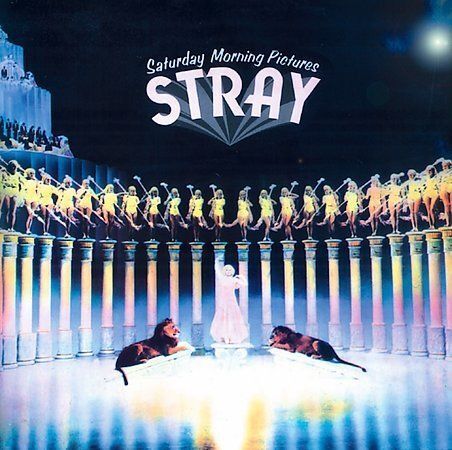
By the time “Saturday Morning Pictures” released in 1972, Stray’s belief in their support mechanism was wavering. Besides hiring Martin Birch to co-produce, this time Transatlantic did get around to releasing a single, “Our Song”.

After two albums of inventive, unpredictable progressive hard rock, Stray kept chugging right along with their third album, 1972’s “Saturday Morning Pictures”, which notably found guitarist and guiding force Del Bromham growing ever more obsessed with the latest synthesizer technology, although not to the point where gadgetry was crowding out his ever-dominant fretwork, or completely hijacking the band’s analogue roots. Rather, Bromham’s ever-growing arsenal of synths and keyboards mostly added enriching nuances to some of the band’s more adventurous material like “After the Storm,” “Sister Mary,” and “Move That Wigwam,” featuring an odd mixture of country-fried harmonicas and Native American themes.

Another interesting hybrid, the first single, “Our Song,” came complete with churchy organs and soulful backing vocals from P.P. Arnold, as did “Mr. Hobo,” which kept any sign of high-tech machinery at bay with its sprightly acoustic jamboree. In conjunction with the similarly eclectic material rounding out Saturday Morning Pictures, these tracks appeared to bode well for Stray’s slow-building success, and, indeed, the album (which was cleverly launched with a Saturday matinee performance by the group, at London’s Rainbow Theatre) managed to climb higher up the charts than either of its slightly heavier, more aggressive predecessors. Unfortunately, it too would stall long before reaching the higher echelons, or breaking the band to a wider audience, eventually driving Bromham into taking Stray in some truly questionable stylistic directions on subsequent albums.

When “Saturday Morning Pictures” failed to chart an intended spot at 1971’s Reading Festival was cancelled, so the band headed to a small seaside town in Essex to join T. Rex, Rod Stewart and Status Quo at the now semi-legendary Weely Festival instead. This lead to an embarrassing situation when the pyro that went off during “All In Your Mind” was mistaken for distress flares in nearby Clacton-On-Sea, causing lifeboats to scramble. “We apologised and sent them a donation,” Bromham grimaces.

See the source image

Things threatened to take a turn for the better when Stray were signed for management by a shady individual called Wilf Pine. The first Brit to be accepted into America’s wave of organised crime, Pine had been one of Don Arden’s heavies during the previous decade. 

A close personal friend of London gangsters the Kray Twins, his gangland exploits were later detailed in John Pearson’s book One Of The Family: The Englishman And The Mafia. Pine had become accepted as a trusted friend of the influential godfather Joe Pagano, and with the help of business partner Patrick Meehan had begun to make waves in the music business, accumulating a management and promotion roster included Black Sabbath, Yes, The Groundhogs, Gentle Giant and The Edgar Broughton Band

Wilf turned up like a cliché, with a white suit, a big cigar and a Mercedes car, insisting he could take us further,” Bromham recalls. “But it wasn’t to be. Years later, after re-establishing friendship with Peter Amott and Ivan Mant [the group’s original managers], I learned they’d been on the brink of signing us to Island Records, who were very much the label of the time. Had we become part of that stable, history might have been very different.”

After the disappointment of the previous year, for Stray’s appearance at 1972’s Reading Festival, Bromham decided to cause a splash by making a suit covered entirely in mirrors. “All was good until I tried to walk in it,” he giggles. “I was like the Tin Man from The Wizard Of Oz, because I couldn’t bend my knees. Three roadies had to lift me onto the stage. 

“We were going on after Status Quo and before Wizzard our set was during the daytime but even so, I’m told that it looked amazing. This was a year or so before Noddy Holder had the idea for his famous reflective top-hat.” 

See the source image

Stray’s fourth album was to be their final realistic shot at the big time. Musicians from the London Symphony Orchestra contributed brass and strings to 1973’s “Mudanzas“, which was recorded in subterfuge with Pine as producer whilst an escape from Transatlantic Records was plotted.

But decades later, Mudanzas still remains a superb album that some fans still cite as their favourite. If their business worries were getting them down – surprisingly, it surfaced via Transatlantic after the label described the secret session as “fantastic” – they were not affecting anybody’s confidence, nor a desire to keep on pushing the envelope. Indeed, the sleeve notes penned by Tony McPhee of The Groundhogs, who called the album “still Stray music, but with changes”, seemed a excellent summation.

“Did we go too far with Mudanzas?” Bromham muses. “I don’t think so, but the band did perhaps get a little swamped by the orchestral elements. Having said that, I’m often told that Oasis later nicked what we were trying to do.” 

1973’s tellingly named “Mudanzas” (which means “changes” in Spanish) was where it all started to go pear-shaped for England’s Stray. Frustrated with the British media’s dismissive attitude toward their first three albums, and eager to expand their following beyond a loyal stable of heavy prog diehards, the quartet enlisted producer Andrew Powell to embellish many songs on Mudanzas with loads of brass and string arrangements, perplexing many consumers.

At least none could fault the size of the band’s “cojones” (might as well stick with the Spanish theme here, right?) when faced with the western movie sound tracking of instrumental opener “Changes,” or bite-sized symphony “Come on Over,” with its ambitious emulation of Electric Light Orchestra. Equally daring were the album’s many tracks enhanced with horn sections: “Gambler” was an upbeat saxophone-laden single; “I Believe It” an elegiac number crowned with a guitar solo reminiscent, in key, to “Stairway to Heaven”; and “Pretty Things” more urgent, with room for blistering six-string work from Del Bromham. The guitarist did away entirely with these frills on more stripped-down, fan-familiar hard rock efforts like the Quadrophenia-esque “It’s Alright Ma!” and the Status Quo-styled boogie rock of “Hallelujah,” then led the group down distinctly Beatles-ish roads on “Oil Fumes and Sea Air” and “Soon as You’ve Grown,” with its soothing, McCartney-like vocals and what might be synthesizers or real oboes rounding out the Sgt. Pepper feel. In the end, though, it was a credit to Stray’s formidable talents that they even managed to keep all of this variety together in any shape or form, but “Mudanzas” nevertheless failed to take them to the next level of commercial success, and alienated many members of their dedicated hard rock fan base.

Although Mudanzas once again fell short of the chart, sheer roadwork brought the group their one and only gold disc in the UK.

See the source image

Struggling on with Transatlantic, in an increasingly desperate move Wilf Pine suggested recording Cliff Richard’s 1958 hit “Move It” as the title track of their next album. “We went, ‘Wha-a-at?!’ But Wilf was insistent,” Bromham marvels. Stray had flown to Connecticut to record “Move It” at night – in the same studio where Donovan was also recording, as he worked during daylight hours. 

It was Stray’s fifth studio album, 1974’s “Move It”, was their first recorded in America and represented something of a back-to-basics approach following the baroque orchestrations and surprising horn sections that had dominated the previous year’s Mudanzas. Ironically, though, even fans who had thought that album a bit too excessive would probably agree that “Move It’s” comparative boogie rock simplicity felt more like an admission of defeat than a confident creative redirection, especially in light of the abundance of pedestrian tracks like “Hey Domino,” “Don’t Look Back,” and “Give It Up” (a weepy ballad as dispirited in execution as its title suggested) and contrasting short supply of edgy, hard rock muscle (only really mustered for “Somebody Called You”).

Vocalist Steve Gadd’s songwriting appeared to be growing increasingly distant from that of his bandmates, with ho-hum, hippie-folk-lite contributions like “Mystic Lady” and “Our Plea” featuring hokey words like “Sweet mother Earth, man has raped you,” etc., and foretelling this imminent departure from Stray. And, for a band that had heretofore staunchly avoided recording cover versions for any of their previous studio albums, the inclusion of Cliff Richard’s ancient hit that named the album and American soul singer Jimmy Helms’ (he of “Gonna Make You an Offer You Can’t Refuse” fame) “Customs Man” suggested an even more troublesome dearth of inspiration. It was therefore hardly surprising when Move It signalled the conclusion of Stray’s career-long relationship with Transatlantic Records and separation from frontman Gadd a short time later, when they would attempt to relaunch their career with 1976’s more familiarly eclectic “Stand Up and Be Counted”.

Critically speaking, the band were starting to gain the grudging respect of reviewers, though with sales still failing to materialise they were also conscious of Pine putting them “on the backburner”, in Del’s words, as other business interests filled his time. More damaging still, tension with Steve Gadd, who was starting to make loud noises about wanting to write more, was about to explode. “How can I put this?” Bromham sighs. “Steve was a great frontman – a cross between Mick Jagger and Paul Rodgers – and we’d been a tight-knit group, until he found new friends new lady friends. For a while there was a bit of a John and Yoko thing going on.” The singer’s departure almost ended in fisticuffs with Richie Cole in particular, but in later, wiser years, following a long period of estrangement, Gadd would confess to Bromham: “I couldn’t have lived with what I was like back then.” 

Assuming the role of lead vocalist was something that filled Bromham with an icy dread. A naturally shy person, at one of the band’s earliest gigs in Dunstable a stagehand’s broom handle was actually used to prod him from the wings into the audience’s view. With Bromham also assuming the extra responsibility of playing keyboards onstage and in the studio, Stray added second guitarist Pete Dyer for their next album in 1975.

See the source image

Although its contents had been largely intended as a Bromham solo album, “Stand Up And Be Counted” was another well-honed smorgasbord of hard and soft rock, offering quality tunes such as “For The People” and “Precious Love”, though once again the band failed to settle into a particular niche. Tellingly, the quirky though aptly titled “Waiting For The Big Break” included the couplet: ‘Maybe we’ll never get out of our record contract/And all disappear down the hole in the middle.’ 

After parting ways with Transatlantic Records and signing on with Pye subsidiary Dawn in 1975, English heavy prog veterans Stray briefly expanded from a quartet to a five-piece with the addition of rhythm guitarist Pete Dyer — a move which had been intended to allow vocalist Steve Gadd the chance to focus on his frontman duties, but wound up driving the already disgruntled singer out of the band for good, instead. Into the breach stepped the already present Dyer, who proceeded to share vocals with lead guitarist and long time band architect Del Bromham on the band’s sixth long player — and Pye debut — Stand Up and Be Counted.

Ironically, the album was composed predominantly of tracks originally slated for Bromham’s first solo record, but when faced with Gadd’s departure, he decided to re-purpose them for what proved to be a typically eclectic, if slightly chaotic-sounding LP. Starting with the symphonic title track, which contrasted strings of evocative beauty with surprisingly lifeless female voices in the chorus  and devolving quickly into simplistic, largely acoustic, easy listening-type radio fodder such as “Waiting for the Big Break,” “Down, Down, Down,” and the unfathomable drudge of “Woolie.” In other words, with the arguable exception of the brooding chords used in “For the People” and momentary guitar crunch launching “As Long as You Feel Good,” this is not the Stray album recommended for hard rock and metal fans (try their 1970 debut or 1971 follow-up Suicide, instead). Nor, likewise, progressive-minded listeners, who will chafe at the aforementioned compositional simplicity and positively wince at the clearly over-taxed Bromham’s intolerably sappy lyric writing on forgettable pop numbers like “Precious Love” and “Everyday of My Life.” Stray would thankfully rediscover some of their edgy swagger on the following year’s Houdini (perhaps because of recent tours supporting Kiss in the U.S. and Rush in the U.K.), but the end of the road was nevertheless within sight for the beleaguered group.

By now Wilf Pine had prised them away from Transatlantic, but the same old issues of label disinterest and a dearth of chart action returned after the band signed to Pye Records’ prog offshoot, Dawn. During a trip to America opening for Spirit and Canned Heat, Stray were shocked to see the familiar face of Ozzy Osbourne in the crowd at the Starwood in Los Angeles (they had originally supported Black Sabbath at London’s Alexandra Palace back in 1973). 

Ozzy came backstage and insisted that he wanted to produce our band,” laughs Bromham. Things became more surreal still when cops stopped the band’s car after Ozzy requested a lift to his hotel, also on Sunset Strip. 

“Our driver jumped a red light and suddenly there were all these sirens,” Bromham remembers. “Sat between myself and Gary [Giles], Ozzy started wriggling about. In the same car the following day, much to our astonishment, we found this elk horn full of dubious-looking white powder hidden down the back of the seat. I’m not saying that Ozzy left it there, but make up your own mind.”

See the source image

Back at home, Pye Records pulled the plug on the Dawn imprint, casting Stray as labelmates with such un-rock acts as the Brotherhood Of Man, Frankie Vaughan and Carl ‘Kung Fu Fighting’ Douglas on their main roster. 

Eschewing orchestras and outré distractions, the band tapped into the Stateside vibe, stripping things down for 1976’s Houdini album. With American radio in mind, “Feel Like I’ve Been Here Before” and the album’s heavy-duty title song, the group sounded a lot more confident than in recent years.

The release of Stray’s Houdini happened to coincide with the debut UK dates from US glam-rock titans Kiss. Strange to say it now but, still uncertain of the headliners’ pulling power, promoter John Curd booked Stray to ensure that bums would occupy at least a few seats. Stray themselves knew very little about Kiss until the tour’s first night at the Birmingham Odeon. “Just as we were walking onstage they bounded down this staircase in full make-up, looking like they’d come straight out of a Captain Marvel comic, and shouted: ‘Good luck, guys’. It was the weirdest thing ever,” reminisces Bromham

With punk rock a dominating musical force, 1976 was a tough year for Stray. Captain Sensible sometimes turned up at the band’s shows, and on one notable occasion The Damned and Stray actually shared a stage in St Albans. And despite their average age of just 25, Stray’s expansive discography seemed to tar them with the ‘rock dinosaur’ brush. 

“Many of the punk bands were the same age as us,” says Bromham, “and of course The Stranglers were even older. So, I think, were The Clash. [Joe Strummer, their oldest member, was born a year after Bromham ] But we found ourselves firmly on the outside of what was going on, and before we knew it the gigs dried up.”

Having parted with Wilf Pine and seeking a quick fix, Stray’s underworld links were to escalate with the engagement of none other than Charlie Kray as their next manager. The elder sibling of infamous gangster duo Ronnie and Reggie, Kray had been a showbiz agent during the 60s, but fresh out of jail for having helped to dispose of the body of Jack ‘The Hat’ McVitie, association with Charlie guaranteed the band instant notoriety. 

“It was all a publicity stunt, and we made all of the daily papers but it backfired on us big-style,” rues Bromham now, unsurprisingly. The initial plan had been for Arden himself to take them on, but following a chance meeting at Arden’s office in Wimbledon, the unlikely deal was struck. “Like me, Charlie had come to see Don, but Charlie doesn’t wait for anyone and after an hour he realised we both were being given the runaround,” Bromham remembers. “So we chatted as I drove him to his mum’s place in Bethnal Green.” 

The deal done, it didn’t take long for things to change. “On the first night of our tour, in Scarborough, the club’s manager came into the dressing room and asked: ‘Are we expecting trouble?’ Plain-clothes police had turned up. Other bands were terrified of us. It all got out of hand. For a while there was even a stupid rumour that we beat up our support bands.” 

Stray would release one further album, the underrated Hearts Of Fire, and open for Rush on the latter’s mid-1976 UK tour – drummer Neal Peart had become a fan of the group while living in London’s Hammersmith – but in late 1977, submerged in writs, debts and perceived artistic baggage, they played their final gig at Nottingham’s Boat Club.

There were several reunions during the 1980s, including a Stray band without Bromham, who had formed a short-lived band with former Heavy Metal Kids frontman Gary Holton. Bromham returned a year later and Stray were briefly rejoined in ’84 by Gadd, splitting again afterwards. 

Stray’s stock rose immeasurably in 1990 when Del received a phone call from Steve Harris. Iron Maiden’s bassist wanted to know whether it was okay for his own band to cover “All In Your Mind” as the B-side to their “Holy Smoke” single. “When Steve called out of the blue I thought it was a wind-up,” the guitarist beams. “We met up for a drink and ended up becoming good friends.” Iron Maiden later invited Stray to tour Europe with them in 2003 (see left), and Steve’s daughter Lauren went on to cover the Mudanzas choice “Come On Over” on her debut album. 

For the past two decades, Del Bromham has patiently rebuilt the name of his band. “Some artists from my era still think that it’s 1972, that they can just walk back into a venue and it will be full,” he comments. “I’m here to tell them that’s not the case.” 

Stray’s catalogue remains a mine of unknown (if occasionally flawed) treasures, but the remastering of their first eight albums by Castle Music in 2007 was a welcome profile boost. The band got to work with Grammy-nominated producer Chris Tsangarides on their last studio album, 2010’s Valhalla, the release party for which saw a spontaneous reunion with Pete Dyer and Steve Gadd, with Gary Giles watching from the bar. 

Ultimately Stray’s diversity has turned out both a blessing and a curse. “People get confused by seeing this loud, hard rock band on stage, but when they got our albums home they often featured acoustic songs,” Bromham points out. “As a fan of The Beatles, that’s something I hold my hands up to.” Bromham retains the energy and drive of a man half his age – but he has no plans to stop just yet. “I’m the last remaining member of the original band, and the reason I’m still doing this is very simple: I’ve never wanted to do anything else,” he declares proudly. “I’d play in someone’s front room for nothing as long as there are people that still want to hear the songs.”

They released their last record, the ambitious “Hearts of Fire”, in 1976 on the Pye label, and proceeded to splinter off into various solo projects. Bromham re-formed the group in 1997 as a three-piece with newcomers Dusty Miller and Phil McKee, renaming the band Del Bromham’s Stray, and released a live record called Alive and Giggin’ on Mystic Records. In 2003, Castle put out the sprawling 35-track Anthology: 1970-1977. 

May be a black-and-white image

A imagem pode conter: laptop e área interna

It does exist ! It is genuine and it is awesome. Stray / Stray on white/ grey vinyl complete with the original die cut cover… Great package limited edition of just 1000. The English hard rock band Stray released their self-titled debut album back in 1970. In their early years they were influenced by the psychedelic and acid rock music. These influences are combined with their progressive and hard rock outfit. The different melodies of their energetic songs marks one of the greatest impressions of early metal.

The different melodies of their energetic songs marks one of the greatest impressions of early metal/Acid rock. The 9-minute “All In Your Mind” fades in with drums and cymbals ticking away on a steady rhythm, before the guitar enters with one of the first of many riffs. “In Reverse/Some Say” has everything from dual guitar lines, minor chord progressions aka Black Sabbath, and galloping pacing to boot. Two of the many highlights on this versatile record which brought this UK band a cult following.

Stray didn’t achieve any commercial success with its record releases, but proved to be a popular draw on the local club scene in the ’70s. In 2003 they supported Iron Maiden on several of their European dates.

Gloriously added as a bonus track on the CD issue of Stray’s first album.

Del Bromham – Guitar, Vocals Steve Gadd – Lead Vocals Gary G Giles – Bass Guitar Richie Cole – Drums

Strayis available as a limited edition of 1.000 individually numbered copies on silver coloured vinyl.

  • 180 gram audiophile vinyl
  • Die-cut gatefold sleeve
  • Limited edition of 1.000 individually numbered copies on silver coloured vinyl

Official website: http://www.stray-the-band.co.uk/