

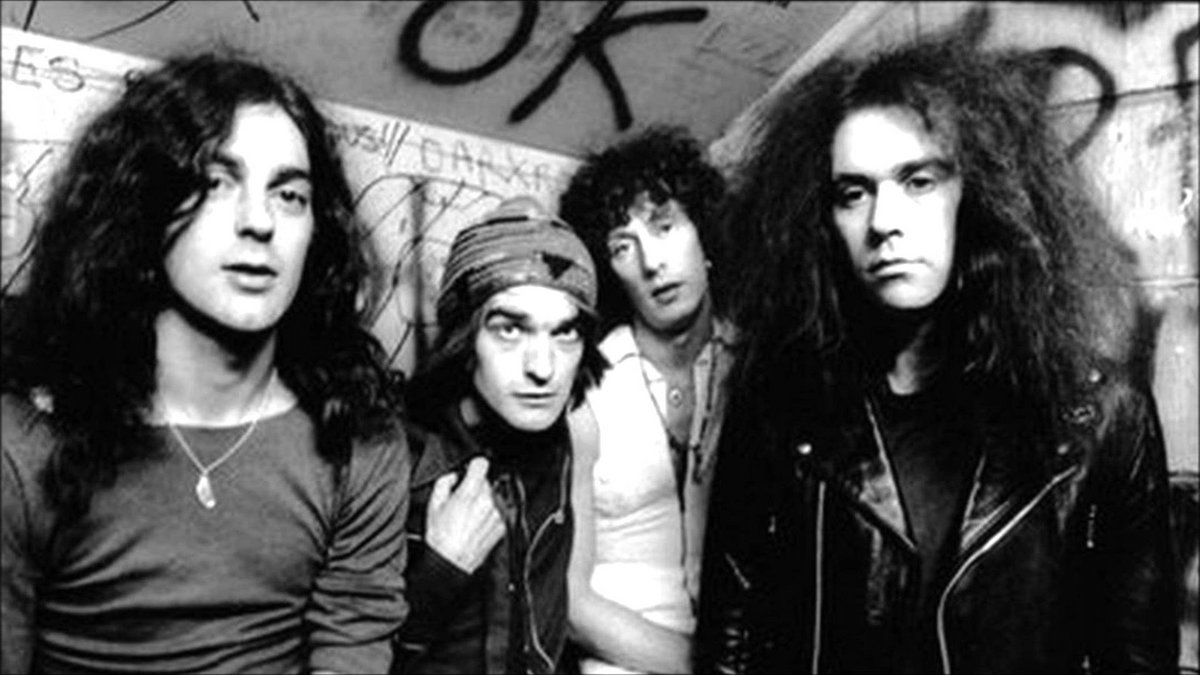
The story of the Pink Fairies is like a trip down a rabbit hole into a psychedelicized wonderland that includes characters like “Lemmy” Kilmister and Hawkwind, Mick Farren and The Deviants, Twink, Larry Wallis, Steve “Peregrin” Took, Sandy Sanderson, the MC5, Eno and a host of other tripped-out pranksters. Paul Rudolph, who was there for all of it as a member of both The Deviants and Pink Fairies. Most of the musicians involved were members of a drinking club called the Pink Fairies Motorcycle Club and All-Star Rock and Roll Band, taken from a story written by Jamie Mandelkau . While the former Deviants’ sidemen were still stranded in America after the tour, Twink, Farren and former Tyrannosaurus Rex percussionist Steve Peregrin Took had used the Pink Fairies name for various activities including one shambolic gig in Manchester (with Farren on vocals, Took on guitar, Twink on drums and his girlfriend Sally “Silver Darling” Melzer on keyboards.
There were many gigs from around that time when Rudolph’s band, Pink Fairies, would exchange headlining slots with Hawkwind, where both bands would combine at some point toward the end of the show to become: Pinkwind. As usual, everyone was very high. Paul remembered: “Preceding going on, everybody was partying in the dressing room; lots of psychedelics. They had these huge World War II strobes. Depending on the speed of the strobes, it can almost look like an old movie. All the lights in the place go out. Two big strobes are firing off: POW, POW, POW! And as it gets closer to the start of the set the lighting guys increase the speed of the strobes and then add a little bit of synthesizer drone into the P.A.
Often these shows could end up with three or more drummers onstage to only end with cops shutting the power off and physically removed them from their kits. Hawkwind were, of course, major league cosmic troglodytes, theirs was a sound that Lemmy Kilmister once described as “a black nightmare”: atonal jams about bleeding orifices, cosmic orgasms, and coma-induced trips through endless galactic nightmares, something akin to an inverted model of Funkadelic’s Mothership mythos with less funk in the oxygen supply. Pink Fairies were a more straightforward “rock.” Their first single, “Do It!”, has for a long time been known as punk before punk. Frequently naked, ferociously stoned, and always up for a good time, there was a brief window where these reprobates almost upended the financial arrangements of the music industry with public why-don’t-we-do-it-in-the-road warfare on the eardrums of squares.
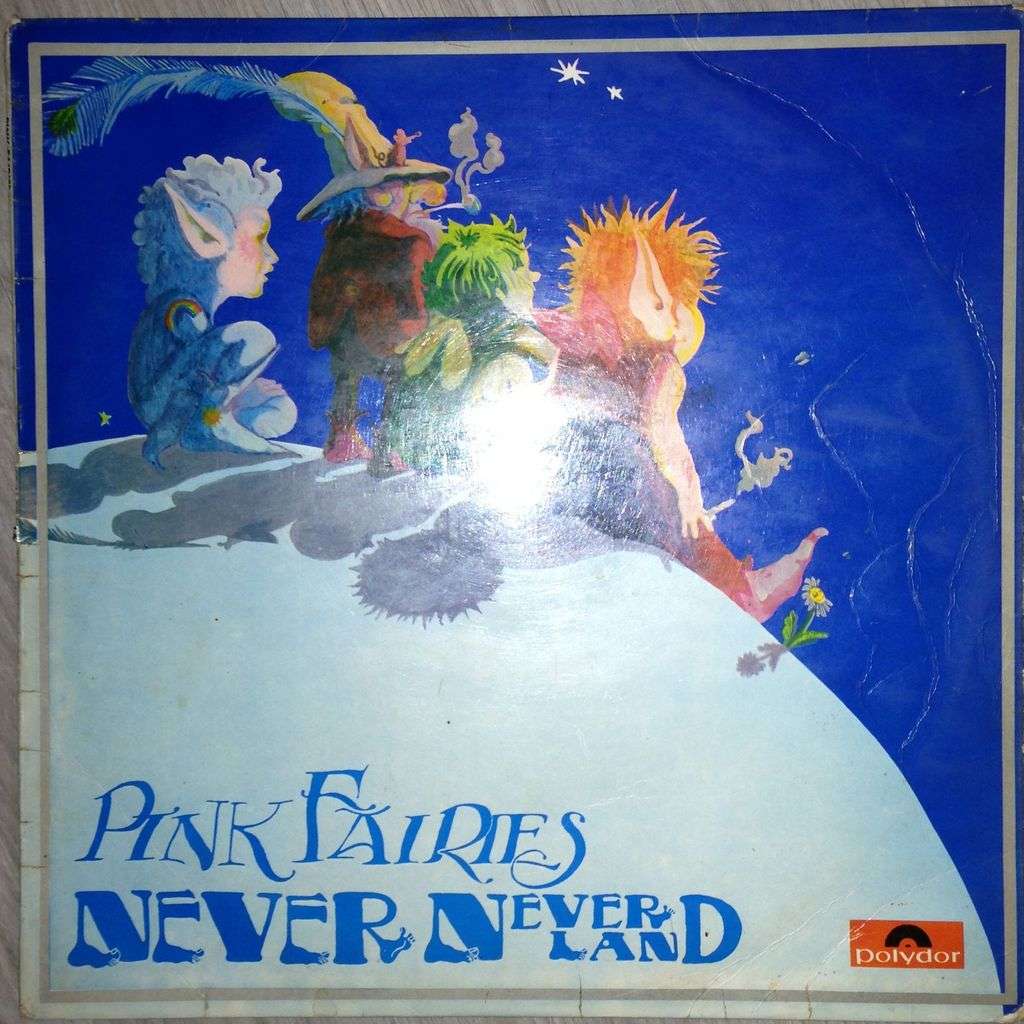
“Do It!” had already been released as a single but was also the first track on 1971’s Never Never Land. The lyrics (by Twink) and music (by Rudolph) were more than just a mission statement for Pink Fairies, they were like a primitive cave painting illuminating the way for any band trying to make an anti-art punk rock tune for the next 50 years. And, yes, it went on to become a semi-hit for The Rollins Band.
“I’m a big fan of continuous performance,” Rudolph said recently, almost 50 years later, from his home in Victoria B.C. He still plays and is currently working on a new Pink Fairies album with original Motorhead drummer Lucas Fox and Hawkwind bassist Alan Davey. Their previous album, “Resident Reptiles”, came out in 2018.
Rudolph was doing gigs with Pink Fairies and Hawkwind somewhere between 1969 and 1976. “It was always like, ‘Well, who’s the headliner here?’ Well, nobody. So when we said: ‘Who’s going to go in first?’ We just drew straws. Then it rotated every other gig. We took turns. Then, of course, the idea was that at the end of the last band’s set everyone got on stage and started screaming and yelling and jumping.”
Centred around the Ladbroke Grove and Notting Hill area of London, the sonic ooze of anarchic Pink Fairies feedback spilled out of theaters like The Blob to flow under freeways along Portobello Road and out to perform at free festivals like Phun City (24th July to 26th July 1970) which was a rock festival held at Ecclesden Common near Worthing. Those who did appear included MC5, The Pretty Things, Kevin Ayers, Steve Peregrin Took’s band Shagrat, Edgar Broughton Band, Mungo Jerry, Mighty Baby and Pink Fairies “who were taking all their clothes off as they played”. The Beat generation poet William Burroughs also appeared, excluding the one-day free concerts in London’s Hyde Park, Phun City became the first large-scale free festival in the UK along with the Glastonbury Fayre, then onto flatbed trucks outside the gates of ticketed festivals like Isle Of Wight and Bath. Pink Fairies and Hawkwind became a nebulous constellation of musical instigators. Paul Rudolph was the only one to “officially” record studio albums with both groups. Of course, this is all one part of a major geometric diagram that could be labelled “Stoned In The 1970’s.” Their sets climaxed with the lengthy “Uncle Harry’s Last Freakout”, essentially an amalgam of old Deviants riffs that included extended guitar and double drum solos.
Rudolph eventually replaced Lemmy in Hawkwind after leaving Pink Fairies, where he in turn was replaced by Larry Wallis, only for Lemmy to go on and form Motorhead with a post-Fairies Larry Wallis on guitar.
Pink Fairies” means different things depending on the time and place, a group that came out through a combination of many of the same members going into different bands and vice versa. But it is pretty much accepted that the peak line-up was that early 1970s’ version which orbited around Paul Rudolph, Larry Wallis, Twink, the continuous performances of drummer Russel Hunter and bassist Duncan Sandy Sanderson and, on the periphery, roadie David “Boss” Goodman and spirit animal Mick Farren.
Of course, without Mick Farren, none of this would have happened. Around 1966, Farren started a band called The Social Deviants while also contributing to the legendary anarchist newspaper International Times. Farren’s career as a writer, his involvement with The White Panthers as an agitprop instigator, and his contributions to IT, OZ, and other underground papers/comics .
For now, it’s enough to say that by 1967, the band had simplified their name to The Deviants and released an album known as Ptoof! This album and its followup in 1968, Disposable, were part of a theme for Farren which involved deconstructions of Bo Diddley riffs, Sixties R&B, doses of Blue Cheer fuzz, psychedelicized folk with antisocial lyrics, and raga beats overlaid with whispers and grunts all designed to make perfect sense to the deeply stoned: a beautiful ephemera of junk rock filtered through a malcontent brain. “Garbage can make you feel so good!” Farren proclaimed at one point on Ptoof! and the sounds on these albums were enough to make you believe it.
“My first night in London,” Paul Rudolph said, “ David “Boss” Goodman and my friend Jamie Mandelkau met me at the airport. Boss remarked that I looked like Black George, an old English pirate. I had really long hair and it just naturally fell into ringlets. Then (the name) got further cemented because I had corduroy bell bottoms and all the gear of the day, but decided I’d get something a little more durable. A couple of blocks up the road from the Marquis there was a place called Lewis Leathers that sold motorcycle gear. I went and bought black leather pants and boots and a jacket.”
Jamie Mandelkau was living with The Deviants and sleeping with Mick Farren’s wife. He said, ‘These guys are looking for a guitar player. But if you don’t like this band there’s lots of other bands.’ So, when I arrived and started to get the lay of the land, I realized that The Deviants had two bass players. I thought, ‘No, this is not going to work.’ But I started trying to put in my own two bits.” Rudolph’s first album with the band was Deviants 3 which, like the others, was very weird, but now with more actual bad ass rock guitar solos due to Rudolph’s more musical/less experimental but still totally fuzzed-out senses on songs like “Rumbling B(l)ack Transit Blues.”
Mick Farren might not have been totally stoked about the new direction, even supposedly making the comment: “(Rudolph) really had this idea to be Jimmy Page.” Sound wise, Rudolph probably has more in common with Pete Townshend. But whether Farren really believed that or not, the Page comparison is worth noting for the mutual affinity with Les Pauls and for Rudolph’s resemblance to the pirate Black George.
Mick Farren’s vocals and musical ideas might’ve been moved to the back burner, but everyone got along well enough with Mick filling his role as ringleader, organizer of free shows, and causer of general mayhem: “The Deviants were the ones who started the Portobello Road free outside concerts,” Rudolph said. “Mick Farren decided that it’d be a great idea. We got a generator and there was a huge motorway flyover right through Notting Hill Gate, there’s all these empty arches open to the elements. We got a generator and went down there on a Saturday. About halfway through the set police showed up, and there were thousands of people by that time. The head cop said, ‘Stop, stop, stop.’ He’s standing on stage and the mic’s on and he says to Mick Farren. ‘What are you doing?’’ Mick says, ‘We’re putting on a free concert!’ and (the cop) says, ‘Do you have permission to do this?’ And Mick says, ‘We need permission? This is vacant land!’ Over the course of a couple of months, (the shows) became so popular that the local council put in a powerpoint, so people could actually plug in and not use a generator.”
The Deviants eventually got involved with the enigmatic drummer John Alder who went by the name Twink he was known as a charismatic wild man and a good enough drummer to play on several of the tracks from The Pretty Things classic album “SF Sorrow”.
But it is the 1970 LP “Think Pink” where he made his mark. The album featured Mick Farren, Boss Goodman, and some ripping guitar from Paul Rudolph on the tracks “Ten Thousand Words In a Cardboard Box” and “The Sparrow Is A Sign” The latter jam was written by Steve “Peregrin” Took, who also appeared on the album and, at the time, was still partners with Marc Bolan in Tyrannosaurus Rex. “Think Pink” is the rare studio recording that somehow captured both the menace and playfulness of a genuine psychedelic experience. This group of people playing together at that point would become a catalyst for what occurred when The Deviants later returned from a disastrous tour of North America. The Deviants had just begun their American odyssey when certain things started to crack. One of them being Mick Farren’s mind. “It was a broken tour. He had a psychotic break when we were in Vancouver and Jamie, who was with us, arranged to get him back home. The band quickly ran out of money, ended up heading south to San Francisco, and crashed at a commune in Haight Ashbury.
Despite their close proximity in the psychedelic scene, reports that Pink Fairies later adopted the idea for two drummers from seeing the Grateful Dead during this time are not accurate. “It came about because Russ and Twink (both) played drums, and we wanted to start this band. As it turned out the two of them were pretty powerful together.”
Rudolph and the Fairies also found themselves at the Altamont Festival. “Boss was a good friend of Sam Cutler, the Rolling Stones tour manager. We got picked up by the green Family Dog school bus, got driven out, and were parked about twenty feet behind the stage for the whole thing. It was interesting to see it winding up because by mid-afternoon the younger members of the Hells Angels were really trying to show their stripes. There were a couple of them behind the stage: one guy with like six joints in one hand and a half a gallon of wine in the other. They were just going for it. I thought, ‘There’s trouble a-brewin here.’ For me, watching all that stuff go down was almost like watching a dream crumble.”
Meanwhile in England, Mick Farren was recording his solo album Mona – The Carnivorous Circus while Rudolph’s old friend, Jamie Mandelkau, was hanging out with Twink. “Eventually somebody from the record company got us plane tickets to Montreal. We were playing gigs in Montreal to get enough money to get back to the U.K. My friend Jamie had gone back and had been going out for some drinks with Twink. Jamie suggested to him: ‘When those guys get back, why don’t we just start up another band and see what happens?’ So that was the plan. We’d do some rehearsing, and if it sounded good, we’d go with it. Everybody got along at that time, everybody got along well with Twink, so it just kind of took off.”
When they returned from America in 1970, the band known as The Deviants transformed into Pink Fairies. With Twink now installed as sometime lyricist/singer and second drummer, they emerged fully formed and covered in glowing lysergic afterbirth at The Roundhouse in April 1970. Polydor Records commissioned the group to record a single, “The Snake” / “Do It”, and were happy enough with the results to offer the group an album contract. The debut album “Never Never Land” was released in 1971. It featured live favourites “Uncle Harry’s Last Freakout” and “Do It” but curiously omitted “The Snake”. Their first single was “The Snake” b/w “Do It”.
Though he had first landed in England a few years before, the sound of these two songs heralded the true arrival for Rudolph with his Vox Fuzz Tone distortion cannon laying waste to entire coastlines of tabla-chanting acoustic-strumming hippie mindscapes. One famous free gig from around that time was the Phun City fest. “It was incredible,” recalls Rudolph. “It was very spontaneous. Free wouldn’t play because they didn’t get paid. It’s the first time I saw the MC5 and they were absolutely mind-blowing, and really nice guys. I thought, ‘Okay now that is American rock and roll with a bit of an edge!’ That was a great gig. I mean, we were extremely… right out there. And I remember we’re playing away and the drum solo started off with a thunderous roar, then petered down to one drummer. I was banging on the cowbell, next thing I know the two drummers are on the front of the stage with their clothes off. And that started a whole trend.”
In addition to being the first UK gig for MC5 and a chance to witness these rock drummers in their natural state, Phun City was notable as one of the first appearances of Shagrat, which featured Steve Took and a future Pink Fairies guitarist Larry Wallis.
Never Never Land was not without hippy dippy interludes like “War Girl” and the title track, no doubt the result of everyone being completely high. But by the end of the album, it’s back to the cosmic rock boogie fuzz of “Teenage Rebel” and the steamrolling “Uncle Harry’s Last Freak-Out” which was one of the most durable freakout pieces of sonic ever made by any band.
Though Pink Fairies did not make it into Nicolas Roeg’s 1972 documentary about Glastonbury Fayre, there are recordings of “Do It!” and “Uncle Harry’s…” on A Musical Anthology For Glastonbury Fayre and a more recent comp: Live Fuzz 1970-1971 that give a good idea of the forces these guys were meddling with. After the whole thing crash lands, someone in the band appeals to the crowd to: “Keep it together!” as if their collective mind has just been melted and they will now have to figure out a way to carry on. In July 1971 Twink left to travel to Morocco. The band continued as a three-piece occasionally augmented by former The Move bassist Trevor Burton on guitar. They released their second album “What a Bunch of Sweeties” in 1972, which featured some contributions from Burton.
One of the first actual Pinkwind gigs was at the Bath Festival: “We went to the gig with a generator and our roadie Boss was a good friend of Pete (Watts), who was Pink Floyd’s road manager. We were on a hill overlooking the festival site and Boss went to have a beer with Pete and Pete said, ‘As soon as I finish unloading Floyd’s gear, I’ll drive the flatbed truck up to the top of the hill where you guys are and you can have it as a stage.’ So, you know, both bands on the flatbed truck playing with a garbage can on the ground at each end of the truck where people threw in donations. We’d get everything from dope to money to food.”
:format(jpeg):mode_rgb():quality(90)/discogs-images/R-8977741-1472632956-8557.jpeg.jpg)
Despite these run-ins with the man, Pink Fairies socio-political connections had mostly to do with just playing benefits. Besides, they never lost touch with a comedy streak that originated during the Social Deviants days. In fact, it is a spoken word prologue based on a comic strip by Texas artist Gilbert Shelton (creator of The Fabulous Furry Freak Brothers) that opens Pink Fairies second album: “What a Bunch Of Sweeties”. It features an intergalactic promoter offering the band 15,000 for a gig on Ur-anus. “I instigated some of it and went along with it,” Rudolph said of the stoner comedy aspects of The Deviants/Fairies before adding in true no horse shit fashion: “It was something to do.”
The radio show ridiculousness became much more pronounced later, during Rudolph’s time working on Hawkwind singer Robert Calvert’s quasi-historical solo concept album from 1974: Captain Lockheed and The Starfighters. This was also a “what if” type of event that featured most of Hawkwind, including Lemmy on bass, and Rudolph on guitar, plus Brian Eno and Arthur Brown.
“Bob Calvert was much more theatrical,” says Rudolph. “And he was also friends with some of the crew from the Bonzo Dog Band who were very theatrical on stage. That’s where he got a bit of his stuff from. (But) a lot of that was his concept. So everybody just sort of played along.”
“What A Bunch Of Sweeties” provided the most open landscape yet for Rudolph to expand his rolling sustain over green fields scattered with weed plants and monolithic monuments. “Marilyn” includes that ultimate rarity: a non-boring mid-album drum solo. But it’s on a very loose cover of The Ventures “Walk Don’t Run” where the cosmic swell rolls in, with the Fairies alternately riding inside a tube passing a joint back and forth and running for their lives in a futile attempt at escaping the canyon of a tidal wave.
“I don’t want to sound like a hypocrite,” Rudolph said “but my main concern was the heavy drugs. Once the heroin thing started, it was such a down vibe. What really struck me was that a lot of the Pink Fairies fans were younger, and it was becoming pretty obvious that there was heroin use going on. I thought, ‘If this continues, it’s going to become known that this is what’s going on and some of the younger crowd are going to think this is cool.’ And it ain’t cool. It was just bumming me out. I was feeling responsible.”
In 1972 former Shagrat/UFO/Entire Sioux Nation guitarist Larry Wallis became the new guitarist/singer for Pink Fairies as Rudolph began working with Brian Eno on his first post Roxy Music solo album Here Come The Warm Jets. The Eno albums are also their own whole story, but one thing Rudolph mentioned could be of interest to guitar geeks worldwide. It has to do with the question of who really played on the reality shattering solo of “Baby’s On Fire”, a solo that has always been credited only to Robert Fripp: “I haven’t listened to it for a while, but I think it was both of us. What used to happen was Eno was basically a facilitator. So, if it was a session that both me and Robert Fripp were on, sometimes he’d say, ‘Okay, you play a solo.’ And then he’d say to Robert, ‘You play a solo. See if you can kind of get the (same) sort of genre, but do it an octave up.’ Then when he was mixing it, he would just sit at the mixer pressing the channel cut buttons. Cause when you listen to it, there’s no way anybody could ever jump octaves like that. So that was a lot of Eno’s ideas.”

Mick Wayne was Rudolph’s replacement, having recorded with Sanderson, Hunter and Steve Peregrin Took on sessions for Took at Olympic Studios and later on loose sessions (along with sundry other underground musicians) in Took’s flat in the basement of manager Tony Secunda’s office, the fruits of which were released by Cleopatra Records in 1995. Feeling that Took’s exceptionally heavy drug consumption would not make him a going concern, the remaining three instead formed a new version of The Pink Fairies (much to Took’s subsequent chagrin), releasing the single “Well, Well, Well” / “Hold On”, as well as doing a radio session for Radio One.
However Sanderson and Hunter became unhappy with the musical direction Wayne was taking the band. They convinced Larry Wallis, who had played with Steve Took’s Shagrat and later UFO, to join the group as a second guitarist. Shortly after, they sacked Wayne, passing songwriting and singing duties onto Wallis. This new three piece then recorded the 1973 album Kings of Oblivion. Out of contract with Polydor, the band continued touring to a decreasing audience until finally calling it a day. Wallis went on become the in-house record producer for Stiff Records. Sanderson joined The Lightning Raiders. Hunter left the music business.
Larry Wallis was thrown in the deep end. Apparently not realizing he was joining a Rudolph-less version of The Fairies he was, at first, bummed out. But once the band kicked out temporary replacement Mick Wayne, Wallis was handed the reins and told to write some tunes. Wallis claims to have never sung live or written music before the Pink Fairies classic “Kings Of Oblivion”. The album is a combination of naive good times and dirty rock ‘n’ roll kept afloat by Wallis’ Strat with certain similarities to Love It To Death-era Alice Cooper. “When’s The Fun Begin” was co-written with Mick Farren, and Sandy Sanderson co-wrote “City Kids” which, after Wallis joined Motorhead, showed up on that band’s first album and continued as a Motorhead regular live jam even after Wallis had left the band, even turning up as the finale of the What’s Wordsworth? live album.
During 1973-1976, Paul Rudolph alternated between recording sessions with Robert Calvert and Brian Eno, but played two more classic gigs with Pink Fairies: one opening for Hawkwind at The Roundhouse in February 1975 that included the line-up of Rudolph, Wallis, Sanderson and Hunter and again in July 1975 with the same line up, plus Twink. Rudolph confirmed “Yeah. Those were the only times” that he and Wallis played live, though they both worked together in the studio for Mick Farren’s fantastic 1977 EP, “Screwed Up”. (Farren’s 1978 “Vampires Stole My Lunch Money” is also a terrific combo of jams that mix MC5, Velvet Underground, and Dr. Feelgood, including several tracks with Wilko Johnson.)
Not too long after, Lemmy was fired from Hawkwind for total bullshit reasons and Rudolph was asked to step in as replacement. Rudolph says: “I was still doing the recording sessions for Eno, trying to get some impetus together to get another band going but basically hanging out with my old beatnik friend who had a house in West London. And we were just trying to keep the wolf from the door. He was a Ferrari restorer and I was helping him. One afternoon there was a phone message from (Hawkwind manager) Doug Smith saying, ‘Can you fly out tomorrow? Lemmy’s been busted.’ I said, ‘Sure. I already know all the numbers.’
Astounding Sounds, Amazing Music had desert-dry production and was a change from the Neanderthal hypnotized at the black monolith sounds of earlier Hawkwind records. The idea that Rudolph was taking the band in a more ”funky” direction seem unfounded. Regardless, it’s one of the last truly good Hawkwind albums, the other last good one being Quark, Strangeness, and Charm on which Dave Brock replaced all of Paul Rudolph’s guitar parts after recording the entire album.
In 1987 Jake Riviera, head of Demon Records, offered a recording contract for a reformed Pink Fairies. Of the five group members, Paul Rudolph was not involved so the second guitarist position was taken up by Andy Colquhoun, who had previously played alongside Wallis. This band released the album Kill ‘Em and Eat ‘Em and toured following a sell-out show and London’s Town & Country Club before once again splitting up in 1988. After Twink’s ignominious departure they had carried on until Wallis too left at which time the remaining members toured and recorded as Flying Colours.
“Dave Brock was upset at the carryings-on at the session because everybody was a little spaced out, to say the least,” Rudolph said as he remembered getting hit with a similar line of bullshit (though different circumstance) that had befallen Lemmy. “Dave didn’t like what was going on at that point and so Nick Turner, Alan Powell, and myself got called into the manager’s office and he said, ‘Dave’s really upset with you guys. You need to apologize for your behaviour or, basically, you’re out of the band.’ And we all looked at each other and said, ‘Fuck you, what behaviour?’ Everybody was misbehaving and coked-out. Anyway, Dave was so upset that he erased everybody’s stuff off the album before it got mixed and got in session musicians. The only thing that didn’t get changed was “Hassan I Sahba” a tune I wrote with Bob Calvert, because nobody could play guitar like that.”
Some of the Rudolph versions of the other songs have since turned up on special edition reissues of the album.
Rudolph has continued to collaborate with Nik Turner and played on the track “End of The World” on the Life In Space album from 2017.
“Nik Turner was a founding member. I still stay in touch with Nik. He wanted to go out on tour and he thought, ‘I’m going to call it Nick Turner’s Hawkwind.’ Dave sued him. Every time even “Hawk” is mentioned, everybody gets sued.” There are other shenanigans involving Dave Brock but Paul Rudolph maintains “Dave wrote some great songs.”
It turns out that the problem with everyone in a band being high all the time is that, eventually, you gotta come down to the reality that no one is (or maybe only certain people) watching the finances. “A lot of it was to do with (was) sex, drugs, and rock and roll, and honestly we didn’t care if we got paid or not. We just wanted to get the music out there and do stuff and have fun.” There is no doubt that another factor in the dissolution of the Fairies involved getting screwed by Polydor: “Some of our biggest mistakes were not treating the music business like it was the music business. Nobody in the whole record company ever played music or had ever been in a band. It was just an old boys club.”
Boss Goodman, who went on to become a renowned chef, once cooking for US President Bill Clinton at the Portobello Gold. Larry Wallis died in September 2019, and Duncan Sanderson died just two months later in November 2019.
In the mid-1990s Twink collaborated with Paul Rudolph and the pair recorded 1996’s Pleasure Island and 1997’s No Picture, released as the Pink Fairies on Twink’s own label. Twink also issued a plethora of albums featuring outtakes, alternative versions, BBC sessions and live material including: The Golden Years 1969-1971, Do It, Live at Weeley Festival 1971 and Mandies and Mescaline Round at Uncle Harry’s.
During the early 2000s Polydor remastered and released their Pink Fairies back catalogue with bonus cuts and issued the sampler albums Master Series and Up the Pinks: An Introduction.
Then there is the ever-complicated issue of Twink. After departing the Fairies, the trickster-like drummer played some gigs with Syd Barret in a band called Stars and in ‘77 put out a really killer punk single called “I Wanna Be Free” as vocalist of The Rings. He has continued to release sequels to Think Pink, an album good enough to not need much improvement. At the current point in time, Twink and Paul Rudolph are the last men standing from the classic Fairies lineup, but their relationship is, at best, frosty.
:format(jpeg):mode_rgb():quality(90)/discogs-images/R-1197410-1201720585.jpeg.jpg)
Despite whatever financial clusterfucks still exist, the hippie barbarians legacy of Deviants/Pink Fairies/Hawkwind remains intact. “We always thought that the audience was part of the band,” said Paul. “You get on stage and start playing, particularly in places like The Roundhouse and a lot of the festivals, you could feel the energy in the air. That may sound very hippy dippy, but the audience was kind of steering the band.
The Albums:
“Never Never Land (Polydor) – Rudolph; Sanderson; Hunter; Twink “What a Bunch of Sweeties” (Polydor) – Rudolph; Sanderson; Hunter “Kings of Oblivion”(Polydor) – Wallis; Sanderson; Hunter “Previously Unreleased” (Big Beat) – Wallis; Sanderson; Butler “Kill ‘Em and Eat ‘Em” (Demon) – Wallis; Colquhoun; Sanderson; Hunter; Twink
Thanks Adam Ganderson and the pleasekillme.com


