Posts Tagged ‘Pete Townshend’

The Who performed a more upbeat set. “Well, here the fuck we are,” Pete Townshend announced with biting good cheer as the band stepped onstage Sunday, also the birthday of their late bassist John Entwistle, who died in 2002. With a long history of career-defining moments at events from the Monterey Pop Festival and Woodstock to the Concert for New York after the attacks of 9/11, he expressed special affection for the young fans in front of him in the Southern California desert venue.

“You young ones, we love you for coming to see us,” he said. “It must be pretty tough out there for the old ones. Why don’t you make a little chair for them, and they can sit down and rest.”

The Who didn’t exactly slow down in a set that emphasized the muscular rockers of their first two decades. “I Can See for Miles” was tuneful hard rock, with Townshend’s riffs of increasing tension and a beat always pushing forward, shattering eardrums for 50 years. The guitarist crouched as he slammed the downstroke attack on “My Generation.”

The Who were always an exceptionally physical band, with Roger Daltrey wailing up front and Pete Townshend leaping with windmill guitar strokes. Few performers in their 70s can maintain that physical presence, but the Who remain a vibrant musical force for other reasons. Like all the acts at Desert Trip, the Who were always as much about ideas and attitude as youthful spectacle.

Daltrey reshaped some vocal parts from the superhuman originals to fit his range, more improvising bluesman than young shouter. And at 71, Townshend often just seemed like a more experienced version of the literary, snot-nosed hooligan from the 1960s.

“Good luck with the election, folks,” Townshend teased his American listeners, without further comment.
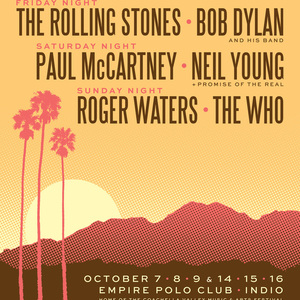
Desert Trip 2016

Daltrey and Townshend were supported by a backing band of seven players, including drummer Zak Starkey, who was born the year “My Generation” was released in 1965, and guitarist Simon Townshend, brother of Pete. Midway into the show, Pete told of how his younger brother was at a premiere of Tommy at the Royal Albert Hall in 1968 and was looked after that night by an unknown David Bowie.

The band performed a suite of songs from the rock opera Quadrophenia, beginning with “I’m One,” with lead vocals by Townshend, who closed with the defiant plea, “Why should I care? Why should I care?” the song’s character Jimmy pissed off and thinking hard. They followed with the album’s instrumental of sweeping guitar, piano and an anxious beat called “The Rock,” introduced by Daltrey: “This is as good as any classical piece ever written.”

From the Eighties was “Eminence Front,” mingling a dynamic funk riff with cascading electronics, but it was as much of a guitar epic as anything else in their catalog, sending Townshend into spasms of slicing leads.

https://www.youtube.com/watch?v=lBIAPiBFfaQ

The Who set ended as they have traditionally for years, with the career-defining songs “Baba O’Riley” and “Won’t Get Fooled Again” (both from 1971’s Who’s Next), euphoric anthems of rebellion, escape and history repeated. In these final moments, Townshend was moved to emphasize the pent-up rage, frustration and the “teenage wasteland” of his lyrics by sliding across the stage floor on his knees. It wasn’t as graceful as the band’s old movie footage, but Daltrey looked pleased.

https://www.youtube.com/watch?v=80MA7C_yxq4

The Who set list

“I Can’t Explain”
“The Seeker”
“Who Are You”
“The Kids Are Alright”
“I Can See for Miles”
“My Generation”
“Behind Blue Eyes”
“Bargain”
“Join Together”
“You Better You Bet”
“5:15”
“I’m One”
“The Rock”
“Love, Reign O’er Me”
“Eminence Front”
“Amazing Journey”
“Sparks”
“The Acid Queen”
“Pinball Wizard”
“See Me, Feel Me”
“Baba O’Riley”
“Won’t Get Fooled Again”

The Who - Whos-Next

“Who’s Next” is the fifth studio album by English rock band The Who, released in August 1971. The album has origins in a rock opera conceived by Pete Townshend called Lifehouse. The ambitious, complex project did not come to fruition at the time and instead, many of the songs written for the project were compiled onto Who’s Next as a collection of unrelated songs. Who’s Next was a critical and commercial success when it was released,

Much of “Who’s Next derives from Lifehouse, an ambitious sci-fi rock opera Pete Townshend abandoned after suffering a nervous breakdown, caused in part from working on the sequel to Tommy. There’s no discernable theme behind these songs, yet this album is stronger than Tommy, falling just behind Who Sell Out as the finest record The Who ever cut. Townshend developed an infatuation with synthesizers during the recording of the album, and they’re all over this album, adding texture where needed and amplifying the force, which is already at a fever pitch. Apart fromLive at Leeds“, the Who have never sounded as LOUD and unhinged as they do here, yet that’s balanced by ballads, both lovely (“The Song Is Over”) and scathing (“Behind Blue Eyes”). That’s the key to Who’s Next  there’s anger and sorrow, humor and regret, passion and tumult, all wrapped up in a blistering package where the rage is as affecting as the heartbreak. This is a retreat from the ’60s, as Townshend declares the “Song Is Over,” scorns the teenage wasteland, and bitterly declares that we “Won’t Get Fooled Again.” For all the sorrow and heartbreak that runs beneath the surface, this is an invigorating record, not just because Keith Moon runs rampant or because Roger Daltrey has never sung better or because John Entwistle spins out manic basslines that are as captivating as his “My Wife” is funny. This is invigorating because it has all of that, plus Townshend laying his soul bare in ways that are funny, painful, and utterly life-affirming. That is what the Who was about, not the rock operas, and that’s why Who’s Next is truer than Tommy or the abandoned Lifehouse project. 

Track listing:

Side one
1. “Baba O’Riley” 5:08
2. “Bargain” 5:34
3. “Love Ain’t for Keeping” 2:10
4. “My Wife” (John Entwistle) 3:41
5. “The Song Is Over” 6:14
Side two
6. “Getting in Tune” 4:50
7. “Going Mobile” 3:42
8. “Behind Blue Eyes” 3:42
9. “Won’t Get Fooled Again”

All songs written and composed by Pete Townshend, except where noted.

https://www.youtube.com/watch?v=gGT0CohU034&feature=share

Personnel:

The Who
  • Roger Daltrey – lead vocals, backing vocals, harmonica on “I Don’t Even Know Myself”
  • Pete Townshend – guitars, organ, VCS3 and ARP synthesiser, backing vocals, piano on “Baba O’Riley”, lead vocals on “Going Mobile” and the original version of “Love Ain’t for Keeping”, co-lead vocals on “Baba O’Riley”, “Bargain” and “The Song Is Over”
  • John Entwistle – bass guitar, backing vocals, brass, lead vocals and piano on “My Wife”
  • Keith Moon – drums, percussion
Additional musicians
  • Nicky Hopkins – piano on “The Song Is Over” and “Getting in Tune”
  • Dave Arbus – violin on “Baba O’Riley”
  • Al Kooper – organ on alternate version of “Behind Blue Eyes”
  • Leslie West – lead guitar on “Baby, Don’t You Do It”
Production
  • Kit Lambert, Chris Stamp, & Pete Kameron – executive production
  • The Who & Glyn Johns – production
  • Glyn Johns – engineering, mixing
  • Ethan A. Russell – photography
  • John Kosh – album design

With its acoustic guitars and drumless bits, this triumph of hard rock is no more a pure hard rock album than Tommy. … And… it uses the synthesizer to vary the power trio format, not to art things up.

Check out this live cut of the song “Bargain”  with Pete’s  Dialogue – Long Beach, California December 10, 1971.

“Bargain” – San Francisco Civic Auditorium December 12, 1971. (This is an edited version of the performance)

On Who’s Next, the band crossed that line with power and grace. The album spawned the concert classics “Baba O’Riley” and “Won’t Get Fooled Again”; the great Daltrey vocal vehicles “Bargain” and “Song Is Over”; Entwistle’s scorching, anxiety-ridden “My Wife”; and Townshend’s most delicate song on record, “Behind Blue Eyes.” On Who’s Next, Townshend unleashed the power of the synthesizer as a rock & roll instrument, to be used like guitar or bass rather than as a special-effects novelty.
Recorded March May 1971 at Olympic Studios  in London

This is Track 09 of the Who’s album – Who’s Next. First recorded (then rejected) in New York on March 16th, 1971, this became the first song to be worked on with Glyn Johns during a trial session at Stargroves with The Rolling Stones Mobile studio in April, 1971. This version (unlike the New York original) used the synthesizer track from Pete’s demo and was edited down for the single which reached #9 in the UK and #15 in the USA. Played onstage at the Young Vic ( see Other Post ) and retained at every Who concert thereafter.

Tommy, The Who’s defining, breakthrough concept album – a full-blown rock opera about a deaf, dumb and blind boy that launched the band to international superstardom reissued in multi format editions.

Originally released in May 1969, The Who were at a career crossroads, they were known mainly as a singles band but this project launched them as a serious ‘albums band’ and has now sold over 20 million copies as well as regularly turning up in lists of the most influential albums of all time.

It’s all too easy to go, “Yeah, The Who’s Tommy is great, love it.” But just put it into perspective for a moment. This was one man’s imagination, one man’s vision and it was groundbreaking. Add into the mix, Roger, Keith and John, who along with Pete, created what is one of the most amazing records of the rock era. It was released on 23rd May 1969 and every home should have one…

From the opening chords of ‘Overture’ you know you are in for something different.  But try imagining what it was like to hear this for the very first time in the last week of May 1969 when The Who released their magnum opus, the much vaunted, Tommy. To add to the sense of wonderment ‘Overture’ features a French Horn, previously the sole preserve of the Beatles in popular music, but here played by The Who’s bass player, John Entwistle.

This was rock music, but not as we knew it. It wasn’t the first extended musical piece in rock, but it was the first to have the audacity to bill itself as an opera.  Being a double album it certainly demanded to be taken seriously; to this point there had been few such lengthy albums, even ones that were not a cohesive piece of work. With its triptych of a fold out sleeve that was a lavish presentation of Mike McInnerney’s fabulous painting it all helped to make this an even more auspicious musical work.

A quick check of the album credits showed that all but four of the 24 tracks were written by Pete Townshend. It’s another reason why this monster of a work should command such respect. Few individuals had the ability, or the vision, to create such a complex and such a long piece of work; Pete’s inspiration came from the teachings of the Meher Baba.

Tommy took six months to record, and another two months to mix, while not unheard of even as long ago as 1969, but it was even then very unusual. With layers of Townshend’s acoustic guitar and the numerous overdubs Tommy was for the time a sonically very different album from most everything else. It’s another example of the passage of time fooling us into believing that this was not as significant an album as it was. So much has happened since the release of Tommy that it dulls the collective retrospective – what is now commonplace was then a step outside the accepted, a step into uncharted territory.

‘Pinball Wizard’, ‘Go to the Mirror!’, ‘I’m Free’, ‘Christmas’, and ‘See Me, Feel Me’ all came out as singles, with the first and last becoming hits in both America and the UK. ‘See Me, Feel Me’ was one of the highpoints of The Who’s appearance at Woodstock – has there ever been a better rock vocalist than Roger Daltrey.  If  The Who doing Tommy at Woodstock doesn’t send shivers down the spine try checking that you are still alive.

Coming after The Who Sell Out in 1967 it marked a complete change in style with Pete Townshend’s lengthy conceptual narrative brought exciting new opportunities to rock music. Tommy was and remains to be an ambitious, complex and controversial work, which was initially banned by the BBC. This new Deluxe and Super Deluxe version of the album comes with a wealth of previously unheard material in the form of 20 demos from Pete Townshend’s archive and also a live performance of Tommy from 1969 taken from tapes that infamously Townshend asked the band’s sound engineer to burn!

https://www.youtube.com/watch?v=lyR8vcyi14M

18 of the previously unheard and thought to be long lost live tracks are taken from a live show at the Capital Theatre, Ottowa, Canada on October the 15th 1969. Three others, I’m Free, Tommy’s Holiday Camp and We’re Not Gonna Take It were lost due to tape reels being changed during the show so are taken from later shows of the same era.

As discussed at length in Pete Townshend’s autobiography the tapes were all supposed to be destroyed but were kept by long time Who sound man Bob Pridden despite Pete’s instructions.The Who: Tommy: Super Deluxe Boxset

Super-Deluxe box set:
Disc 1 – The original album (2013 re-master) Digitally remastered in HD
Disc 2 – The demos and out-takes. Features 20 previously unreleased tracks from Pete Townshend’s archive.
Disc 3 – The 5.1 album mix – Hi Fidelity Pure Audio Blu-ray The complete album remixed in surround sound on new Hi Fidelity Pure Audio Blu-ray format
Disc 4 – The live ‘bootleg’ album. Features 21 previouslyunreleased tracks from 1969

  • Hardback 80-page full-colour book featuring rare & unseen period photos, Pete’s hand-written lyrics & notes and fascinating memorabilia.
  • 22,000-word essay by legendary Who aficionado Richard Barnes
  • Facsimile 20” x 30” Tommy concert poster
  • Limited edition, housed in a hard-back deluxe slip-case
Final Who Singles Box Announced
The fourth instalment in The Who’s singles box set series has been released on 6th May. Tracing the final part in The Who’s singles story to date, from the years 1975 to 2015, it contains 15 7”s pressed on heavyweight vinyl, replete with picture sleeves and replica artwork, collecting the group’s A- and B-side releases on the Polydor label.

If The Who’s creative output up to 1975 hadn’t already made the case (they had, after all, released two groundbreaking rock operas, Tommy and Quadrophenia, along with a slew of classic albums, among them The Who Sell Out, Live At Leeds and Who’s Next), the four-decade period covered in Volume 4: The Polydor Singles 1975-2015 is a clear reminder of the group’s ability to evolve and adapt to any situation they found themselves in. As punk attempted to lay waste to the rock bands that emerged in the 60s, The Who more than held their own with the likes of ‘Who Are You’, issued in 1978. After the tragic death of drummer Keith Moon later that same year, Pete Townshend, Roger Daltrey and John Entwistle recalibrated themselves for the 80s, releasing Face Dances and It’s Hard at the beginning of the decade, flexing their hit-making prowess with the likes of ‘You Better You Bet’.

The group remained sporadically active as a live band across the next two decades, but when John Entwistle passed away in 2002, Townshend and Daltrey found themselves having to yet again roll with the punches and reboot their beloved band. The Wire & Glass EP emerged in 2006, a taster of what would become Endless Wire, The Who’s first studio outing in 24 years. Taking as its inspiration the Townshend novella The Boy Who Heard Music, Wire & Glass formed the core of the mini-opera that was itself at the heart of Endless Wire. Though new music wasn’t coming as fast as it had in previous decades, the Wire & Glass EP was followed, in 2014, by ‘Be Lucky’, a new song recorded for the group’s anniversary collection The Who Hits 50!.

A fitting celebration of one of the longest-serving bands to have emerged from the 60s,Volume 4: The Polydor Singles 1975-2015 brings the group’s story fully up to date. Though, as ever with The Who, you’d be unwise to count it as a full-stop on their remarkable career.

Scroll down to see the full tracklist, and purchase Volume 4: The Polydor Singles 1975-2015 

Disc 1:
‘Listening To You’/‘Se Me, Feel Me’/‘Overture’

Disc 2:
‘Squeeze Box’/‘Success Story’

Disc 3:
‘Who Are You’/‘Had Enough’

Disc 4:
‘Long Live Rock’/‘I’m The Face’/‘My Wife (Live)’

Disc 5:
‘5.15’/‘I’m One’

Disc 6:
‘You Better You Bet’/‘The Quiet One’

Disc 7:
‘Don’t Let Go The Coat’/‘You’

Disc 8:
‘Athena’/‘A Man Is A Man’

Disc 9:
‘Eminence Front’/‘It’s Your Turn’

Disc 10:
‘Twist And Shout (Live)’/‘I Can’t Explain (Live)’

Disc 11:
‘Won’t Get Fooled Again’/‘Bony Maronie (Live)’

Disc 12:
‘Join Together (Live)’/‘I Can See For Miles (Live)’/‘Behind Blue Eyes (Live)’

Disc 13:
‘Real Good-Looking Boy’/‘Old Red Wine’

Disc 14:
Wire & Glass EP: ‘Sound Round’/‘Pick Up The Peace’/‘Endless Wire’/‘We Got A Hit’/‘They Made My Dream Come True’/‘Mirror Door’

Disc 15:
‘Be Lucky’/‘I Can’t Explain (Remixed)’

Maple Leaf Gardens, Toronto, October 21, 1976 – The final song The Who played with drummer Keith Moon in North America. Includes a guitar smash by Pete at the end! Overall, a fitting finish for Keith’s last stand in America.

Keith Moon played his final tour date with The Who on October. 21st, 1976, at the Maple Leaf Gardens in Toronto. It was the final date on the band’s 1976 tour. Within two years, Moon would be found dead from an overdose of Heminevrin, a sedative used to combat his alcoholism. Though Moon would perform with the Who in a couple of special gigs filmed for use in the documentary, The Kids Are Alright, this would be his last official Who date.

After tours spotlighting mammoth works of the rock opera Tommy and Quadrophenia, the 1976 trek was more of a back-to-basics jaunt and by most accounts, a truly rocking round of shows. The tour, however, was not without its share of incidents. The band crossed the U.K. and Europe before heading to the U.S. By the time the tour made it to the States, Moon had become ill, forcing the rescheduling of the opening date. Despite the drama, the band was still capable of the firepower that made it so great.

Keith Moon embodied the spectacle and glory that made the Who such an amazing live act. In the early days, he and Pete Townshend would often try and one up each other’s stage antics. Townshend stated in The Kids Are Alright, “As soon as I started smashing something up, Keith, who’s a great sort of joiner-inner used to smash up his drum kit!”

“A lot of people really, really, really, have never understood how important Keith’s drumming style was to the Who,” said Roger Daltrey in the Classic Albums – Who’s Next DVD. “I kind of describe it as, if you imagine Pete and [bassist] John [Entwistle] as two knitting needles, and Keith was the ball of wool. He would kind of keep it all together.” Townshend added, “Keith Moon’s drumming was an expression of his personality and his ego and his grandiosity and his ridiculousness and his theatricality and his sense of humor.”

The band’s onetime manager Chris Stamp put it best: “He was, in a sense, the soul of the band.” when Keith Moon died on  September. 7th, 1978, at age 32, and rock ‘n’ roll hasn’t been the same without him.

Setlist:

1. I Can’t Explain
2. Substitute
3. My Wife
4. Baba O’Riley
5. Squeeze Box
6. Behind Blue Eyes
7. Dreaming From The Waist
8. Magic Bus
9. Amazing Journey
10. Sparks
11. The Acid Queen
12. Fiddle About
13. Pinball Wizard
14. I’m Free
15. Tommy’s Holiday Camp
16. We’re Not Gonna Take It
17. See Me Feel Me/Listening To You
18. Summertime Blues
19. My Generation
20. Join Together
21. My Generation Blues
22. Spoonful (tease)
23. Who Are You
24. Won’t Get Fooled Again


Music video by Jean-Michel Jarre, Pete Townshend performing Travelator, Pt. 2. (C) 2015. A Brand new song from Pete Townshend and Jean Michel-Jarre featured on Jarre’s new album “Electronica Pt 1″The Time Machine, Released today through I-Tunes.In an  exclusive license to Sony Music Entertainment Germany GmbH, The new song by Pete and Jean-Michel Jarre is out now

“ELECTRONICA 1: The Time Machine” was conceived with Jarre’s wish to encompass the last decades of electronic music with the participation of outstanding artists of all generations with whom Jarre feels especially connected with by a common DNA. The album alsofeatures 15 different collaborators, including M83, Tangerine Dream, Gesaffelstein, Armin van Buuren, 3D from Massive Attack and many more.

https://www.youtube.com/watch?time_continue=145&v=RUTqKYLbLts

This is a fairly rare Pete Townshend demo of “I Can See For Miles”. Inexplicably he left this off his fantastic “Scoop” series of CD’s released over the past 30 years.It was Pete Townshend’s ace in the hole; to use his own words, “the ultimate Who record,” and the one he felt certain would be the band’s first #1 hit single. Though he’d written and recorded a demo version of “I Can See for Miles” as early as 1966, Townshend decided not to have the Who record it right away, partly because he didn’t think Who producer Kit Lambert’s production skills had reached a level where he would be able to do it justice, and partly because “It was the number we’d been saving, thinking that if the Who ever got into trouble, this would be the one that would pull us out.”

Recorded over a period of four months at studios in London, New York and Los Angeles during the spring and summer of 1967, “I Can See for Miles” was finally released as a single in the United Kingdom on October 14th, 1967. It is today widely regarded as the Who’s greatest single, arguably one of the best 45 rpm records ever made by anyone, but Townshend’s masterpiece not only failed to top the British charts, it’s peak position of #10 failed even to match the chart success of most of the Who’s previous UK singles. In fact, no fewer than six of the Who’s previous singles had charted higher.

Interestingly, it’s nearly identical chart performance in the United States, where it peaked at #9, was considered the Who’s major commercial breakthrough in America, where “I Can See for Miles” remains their only Top 10 hit (though Townshend himself would crack the Top 10 as a solo artist in 1980, when “Let My Love Open the Door” also reached #9).

Still, it was the rejection in his native country of what he considered to be his best song that may well have caused Townshend to forever give up on the idea of the three-minute single as his principal mode of musical expression. From that point forward, he would begin to think in terms of a far larger canvas, with four LP sides barely enough to contain the sprawling ambitions of his greatest conceptual works.

Here’s Pete’s seldom-heard 1966 demo recording of “I Can See for Miles.” Though several volumes of his “Scoop” series of demo collections have been released, this particular track, surprisingly, has not appeared on any of them.

https://www.youtube.com/watch?v=sJM4IvSmEXM

This Autumn, The Who’s epic 50th Anniversary Tour finale show is coming to cinemas, recorded at Hyde Park this Summer. Come and experience (or relive!) all the greatest hits on the big screen, including ‘Who Are You’, ‘My Generation’, ‘I Can See For Miles’, ‘Pinball Wizard’, ‘See Me Feel Me’, ‘Baba O’Riley’ and ‘Won’t Get Fooled Again’. Plus Pete Townshend, Roger Daltrey, Iggy Pop, Robert Plant, Johnny Marr and others share their stories of the band’s history and influence as legendary pioneers of British Rock.

Filmed on June 26th last year as The Who celebrated their fiftieth anniversary, this stunning show from London s famous Hyde Park this a triumphant return to their home city. On a glorious summer evening the band delivered a brilliant performance of all their greatest hits in front of a 50,000 strong crowd. With a series of stunning backdrops making full use of the huge screens surrounding the stage and an exceptional light show this is a Who concert on a grand scale but as Pete Townshend says at the start of the show You re a long way away…but we will reach you! . He s absolutely true to his word.

In cinemas worldwide from 7 October http://www.TheWhoFilm.com

https://www.youtube.com/watch?v=HWU9nNT1oUQ

The Who at Monterey Pop Festival
June 18, 1967. Although already a big act in the UK, and now gaining some attention in the US after playing some New York dates two months earlier, The Who were propelled into the American mainstream at Monterey. The band used rented Vox amps for their set, which were not as powerful as their regular Sound City amps which they had left in England to save shipping costs. At the end of their frenetic performance of My Generation, the audience was stunned as guitarist Pete Townshend smashed his guitar, smoke bombs exploded behind the amps and frightened concert staff rushed onstage to retrieve expensive microphones. At the end of the mayhem, drummer Keith Moon kicked over his drum kit as the band exited the stage. The Who, after winning a coin toss, performed before Jimi Hendrix, as Townshend and Hendrix each refused to go on after the other, both having planned instrument-demolishing conclusions to their respective sets.

No automatic alt text available.

The Who Hits 50 and The Hits Just Keep on Coming

For many The Who are the greatest rock band in the world and their 50th anniversary year is shaping up to be very special. And to prove the point the band are set to release all eleven of their studio albums on 180gm vinyl along with a double vinyl version of their ultimate hits package, The Who Hits 50 on 23rd March.

All eleven studio albums will feature the original issue artwork and other highlights include Tommy with its original six-panel fold out / 12-page colour booklet and the four sides pressed as they were on the original 1969 vinyl. The Who Sell Out Includes a replica of the original 20″ x 30″ poster as an insert, while Quadrophenia has a gatefold sleeve with original 20-page booklet and Face Dances Includes a replica of the 24″ x 24″ poster of the album cover. The other studio albums are, My Generation (1965), A Quick One (1966), Who’s Next (1971), The Who By Numbers (1975),   Who Are You (1978),  It’s Hard (1982) and Endless Wire (double) (2006).

Two weeks later on 6th April the first in a series of 7” singles box sets is released covering their first seven 45 rpm releases as The Who as well as their one and only 7” as The High Numbers. The Brunswick Singles 1965 – 1966 is volume one of a four-part set of classic Who singles by labels (Brunswick, Reaction, Track and Polydor). Pressed on heavyweight vinyl with paper sleeves (reproducing the period graphics front and back with die-cut centre holes). The singles are housed in a rigid ‘lid-and-tray’ outer box and features a 7” sized colour booklet with liner notes about each release by Who biographer Mark Blake.

1. ‘I Can’t Explain’ 2.04
b/w ‘Bald Headed Woman’ 2.08
Brunswick 05926. Released 15 January 1965

2. ‘Anyway, Anyhow, Anywhere’ 2.40
b/w Daddy Rolling Stone 2.46
Brunswick 05935. Released 21 May 1965

3. ‘My Generation’ 3.15
b/w ‘Shout and Shimmy’ 3.15
Brunswick 05944. Released 25 October 1965

4. Circles 3.10
Instant Party Mixture 3.26
(Bruns 05951) Unreleased at the time

5. ‘A Legal Matter’2.47
b/w ‘Instant Party’ AKA CIRCLES 3.10
Brunswick 05956. Released 7 March 1966

6. ‘The Kids Are Alright’ 3.03
b/w ‘The Ox’ 3.47
Brunswick 05965. Released 12 August 1966

7. ‘La-La-La Lies’ 2.13
b/w ‘The Good’s Gone’ 4.01
Brunswick 05968. Released 11 November 1966

And if all that’s not enough Record Store Day 2015 on 18th April will see a special blue vinyl 7” of The Who’s latest song, ‘Be Lucky’ from ‘The Who Hits 50’ album backed with the band’s very first single from 1965 ‘I Can’t Explain’. ‘Be Lucky’ is The Who’s first new material in eight years and in keeping with their ongoing support for Teenage Cancer charities, the band have donated their royalties from the song to Teen Cancer America, a charity founded in 2011 by Roger Daltrey and Pete Townshend.