Posts Tagged ‘Paul Thompson’

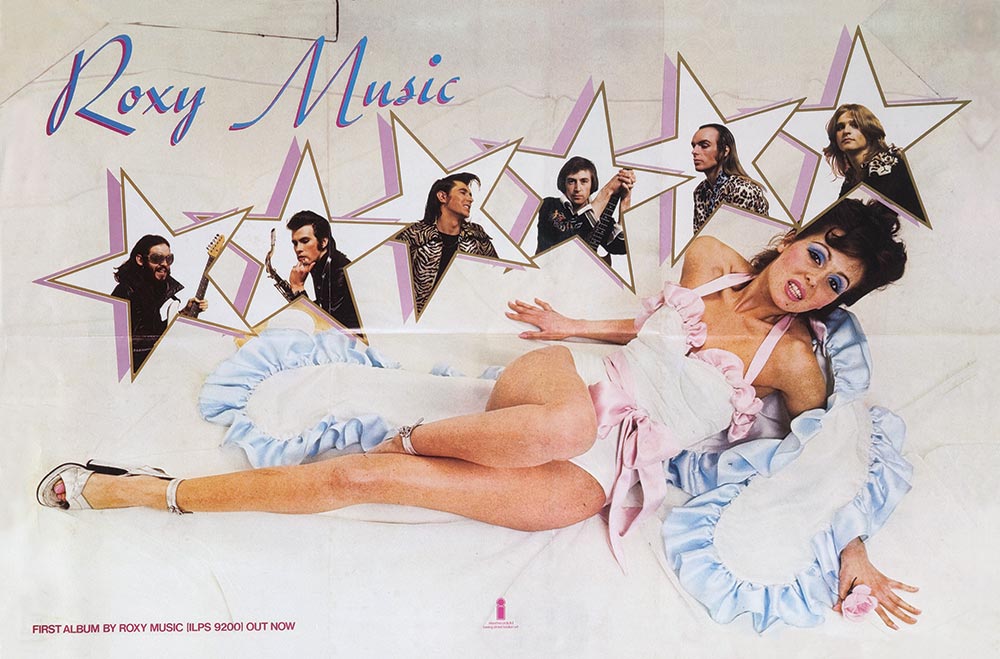
Roxy Music Album Cover Poster Web Optimised 1000

Back in 1972, “postmodernism” was a rarely used term, much less “retro” or “vintage” – words now almost fetishised in their description of everything from fashion to music, gaming to boutique coffee shops. Without describing themselves in such terms, however, Roxy Music embodied postmodernism a full decade before the thought of cycling through styles and genres entered the mainstream.

Released on 16th June 1972, the same day as Bowie’s breakthrough The Rise And Fall Of Ziggy Stardust And The Spiders From Mars, Roxy Music was a true raid on pop music’s past… and present… and a signpost towards its genre-blind, boundary-breaking future.

Roxy Music’s opener, ‘Re-Make/Re-Model’, blares out of the speakers as a perfect declaration of intent: a manifesto for the group’s assault on the pop world, reconfiguring and recontextualising old tropes, while presenting them as something utterly unique – futuristic, even. “Eno was always pushing the boundaries,” Manzanera recalled. “I know it sounds ridiculous, but there was a point where we used to be DIed [direct injection] into, through his synths, a mixing desk, and he’d be out in the audience mixing.”

Not that music was Roxy Music’s sole concern. As a song title such as ‘Ladytron’ suggests, with its hint of glamour welded to futuristic possibilities, Bryan Ferry (vocals, keyboards), Brian Eno (vocals, synths, tape effects), Phil Manzanera (guitar), Andy Mackay (vocals, oboe, saxophone), Graham Simpson (bass) and Paul Thompson (drums) were juxtaposing disparate elements from all over the pop culture spectrum.

Roxy Music themselves weren’t the only ones entering history with ‘Virginia Plain’: “Make me a deal and make it straight/All signed and sealed, I’ll take it/To Robert E Lee I’ll show it,” Ferry sings at the start, directly name-checking his lawyer. As with ‘2HB’ – and almost everything Roxy Music did – the reference is doubled: “The Bob” took its title from Battle of Britain (1968) and included a passage simulating the sound of gunfire.

Discussing the music, Andy Mackay later said “we certainly didn’t invent eclecticism but we did say and prove that rock ‘n’ roll could accommodate – well, anything really”

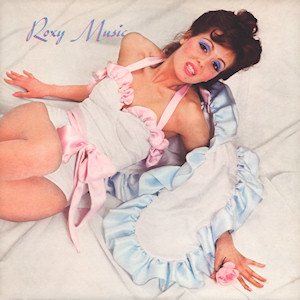
Still astoundingly modern today, Roxy Music remains not only one of the finest debut albums in history, but rock music’s first true postmodern masterpiece. What follows is an attempt to trace the influences and pop culture references in an album that continues to go beyond all expectations – not only of what a rock group can do, but what a true work of art can accomplish. The band’s penchant for glamour was showcased both in the lyrics and in the 1950s-style album cover. The photographer Karl Stoecker shot the cover, featuring model Kari-Ann Muller, who later married Chris Jagger, brother of Mick Jagger

Phil Manzanera recalls “sitting down with Bryan at the first audition and talking about Humphrey Bogart and all the films we loved”. For later solo albums and Roxy Music appearances, Ferry would adopt the image of Bogart as Rick Blaine in Casablanca, suave in a white dinner jacket. On Roxy Music, Bogart is homaged in ‘2HB’, the lyrics directly quoting his Casablanca catchphrase: “Here’s looking at you, kid.”

“The great thing is that we had friends who were great fashion designers, who were just beginning to make their mark,” guitarist Phil Manzanera recalled to this writer in 2009. Among them were painter Nick de Ville, who acted as the group’s art director; designer Anthony Price, who advised on clothing and make-up; and hairdresser Keith Wainwright. Each band member conferred with them individually, “never as a coherent, co-ordinated thing”, Manzanera recalled. The first time the band would see each other’s costumes was “literally just before going on the first gig of the new tour… and we’d go, ‘My god! Where did that come from?’”

That’s how you create a group that looks as though each member is performing in a different band – or on a different planet, as Brian Eno noted when he described some of the Roxy Music costumes as the sort of thing the president of the Galactic Parliament might have worn in a sci-fi movie. It was, as Manzanera recalls, a “wonderful coming together of random elements – but behind those random elements were people with a lot of learning”.

Roxy Music 1972 Press Shot Web Optimised 1000

Demos • Outtakes • Peel Sessions • Steven Wilson 5.1 mix • Expensive

500-only of the super deluxe with Bryan Ferry SIGNED print

After years of hints, rumours and speculation, Universal Music have announced today that Roxy Music‘s eponymous 1972 debut album will be reissued as 3CD+DVD super deluxe edition in February 2018.
This four-disc anniversary set consists of the original album on CD 1 (which interestingly uses the 1999 Bob Ludwig remaster), a further disc of demos and outtakes, a CD devoted to BBC radio sessions (including the January ’72 Peel Sessions that featured the unsigned Roxy Music with David O’List on guitar) and a DVD that includes a brand new Steven Wilson 5.1 surround sound mix, along with rare video footage of TV appearances and live performance.

All the discs are presented in a large-format 12″ x 12″ 136-page hardcover bookwhich features some fantastic notes by author and journalist Richard Williams, who first wrote about Roxy Music in Melody Maker back in 1971! The book also delivers an incredible array of rare photos, including many outtakes from the famous Karl Stoecker cover shot of model Kari-Ann Muller (each disc in the set uses a variant from the session). The band’s penchant for glamour was showcased both in the lyrics and in the 1950s-style album cover. The photographer Karl Stoecker shot the cover, featuring model Kari-Ann Muller, who later married Chris Jagger, brother of Mick Jagger (a stylised portrait of Kari-Ann Muller also graces the cover of Mott the Hoople’s 1974 album The Hoople). The album was dedicated to Susie, a drummer who auditioned for Roxy Music in the early days

The second disc in this set is an incredible insight into this era, with four demos recorded (on Brian Eno’s Ferrograph reel-to-reel tape recorder at his flat in Camberwell) just over a year before the album came out. At this point in time, the band had played no gigs at all and included Roger Bunn on guitar and Dexter Lloyd on drums.

Band member Andy Mackay said “The drumming and guitar playing were quite noodley, quiet and fiddly. And interestingly, by the time we got Paul [Thompson] and Phil [Manzanera] in, the Roxy sound was much stronger – it had that rock ‘n’ roll element, which I always thought was absolutely crucial to our continued success… that tipped us across from being just an art-school experimental band, to a proper pop group.”

Outtakes from the actual album sessions (which lasted just over two weeks) are also included. Every track is represented in some form or another and there’s the odd snippet of studio chatter and laughter to really take you back to Command Studios in Piccadilly, in London where the album was recorded, in March/April 1972. Non-album single Virginia Plain also features on this disc (the song was included on the album when issued in America and on some later pressings).

Two Peel Sessions (from January ’72 and May ’72) feature on CD 3 along with five tracks (including the then new single Virginia Plain) for a BBC In Concert broadcast in August of the same year.

Finally the DVD features Steven Wilson’s ‘new’ 5.1 mix (it was actually created back in 2012) in DTS 96/24 and Dolby AC3 Sound. For some reason, there isn’t a hi-res stereo version on the DVD (something that was promised for 2012’s Complete Studio Recordings box set, but eventually not delivered (without explanation). Steven Wilson has noted this omission too.  Commenting on Facebook today, about this reissue, he says “Back in 2012 I also remixed the album and several out-takes in stereo, and 2 years ago 2 of these mixes were released on a record store day 10 inch single, including an extended version of Ladytron. However, please note that none of these stereo mixes are included in this new deluxe set, so hang on to that 10 inch if you have it!”

This DVD also has video content, including the band performing Ladytron on The Old Grey Whistle Test, their first Top Of The Pops appearance doing Virginia Plain(according to Phil Manzanera, Brian Eno was “really pissed off that all you could see was his gloved hand”) and rare footage of Roxy Music at the Bataclan Club in Paris in November 1972, apparently “the only surviving visual document of this line up live on stage”.

There is also a two-CD deluxe edition of Roxy Music, but the record companies know what they are doing and they haven’t included any of the demos or the outtakes on this edition. Disc 2 is the BBC Sessions disc (disc three on the super deluxe edition). The packaging does look very nice though – you can see a photo of the hardcover casebound book package above, which comes with a 24-page booklet. The album is also being reissued on 180g vinyl LP.

We must address the issue of pricing. Amazon in the UK currently have a pre-order price of £172, which is insane. This price will inevitably come down to at least the £130 mark before the release date (Amazon France currently have a price equivalent of around £137). That is still very, very high of course and you wonder if the executives at Universal have been chatting with Scott Rodger and Paul McCartney about price points. Worth it? Only you can decide, but the content is excellent and presentation looks very good.

Roxy Music were,
  • Bryan Ferry – vocals, piano, Hohner Pianet, Mellotron
  • Brian Eno – VCS3 synthesizer, tape effects, backing vocals
  • Andy Mackay – oboe, saxophone, backing vocals
  • Phil Manzanera – electric guitar
  • Paul Thompson – drums
  • Graham Simpson – bass guitar (except on “Virginia Plain”)
  • Rik Kenton – bass guitar (on “Virginia Plain”)

Roxy Music is reissued on 2 February 2018, Original Release date: 16th June 1972

Roxy Music-Roxy Music.jpg

Looks can be deceiving. And with Roxy Music, that was the entire point.

Bred mostly in the working-class backgrounds from the industrial outskirts of mid-century London, the core personnel who founded Roxy Music did so as much out of artistic vocation as they did self-image reformation.

The otherworldly personae, the cobbled genre-mutations, the elegantly forged retro-futurism—the look and sound of Roxy Music are the visual and aural reflections of an inflated sense of grandeur cycling between fantastical and romantic. And while it was the unorthodox of art-school training that the band—especially vocalist Bryan Ferry, saxophonist-oboist Andy Mackay and noise architect Brian Eno wore on their sleeve, no environment could inspire such appetites for extravagance as the bleakness of rural England.

Brian Ferry, was the son of a County Durham coal miner, sought escape in the far-off glamour of Old Hollywood and Tin Pan Alley standards while Eno, brought up in Essex, was transfixed with the sonic control of tape manipulation; Mackay’s activities were decidedly avant-garde, partaking in experimental sound performances and the radical Fluxus art movement. Guitarist Phil Manzanera, a virtuoso with particular hankerings for complex prog-rock and psychedelia, was the sole well-heeled Roxy youth, while drummer Paul Thompson the only whose blue-collar origins remained resolutely well-preserved in taste.

It’s not uncommon to hear 1972’s Roxy Music framed as the natural result of Ferry’s elaborate aesthetic vision compounded by Eno’s technical wizardry. Other less prominent, but equally wastebin-bound, interpretations attribute the LP’s glow to either Eno or Ferry alone. Each of these theories, however, offer indefensibly lacking accounts of the gorgeous, alien glamour captured on Roxy Music’s self-titled debut. There’s hardly a more compact tutorial on the world of Roxy than the album’s track-one, side-one. The band’s penchant for glamour was showcased both in the lyrics and in the 1950s-style album cover. The photographer Karl Stoecker shot the cover, featuring model Kari-Ann Muller, who later married Mick’s brother Chris Jagger (a stylised portrait of Kari-Ann Muller also graces the cover of Mott The Hooples album “The Hoople” . The album was dedicated to Susie, a drummer who auditioned for Roxy Music in the early days

EG Management financed the recording of the tracks for their first album, “Roxy Music” , recorded in March–April 1972 and produced by King Crimson lyricist Pete Sinfield Both the album and its famous cover artwork were apparently completed before the group signed with Island Records. A&R staffer Tim Clark records that although he argued strongly that Island should contract them, company boss Chris Blackwell at first seemed unimpressed and Clark assumed he was not interested. A few days later however, Clark and Enthoven were standing in the hallway of the Island offices examining cover images for the album when Blackwell walked past, glanced at the artwork and said “Looks great! Have we got them signed yet?” The band signed with Island Records a few days later. The LP was released in June to good reviews and became a major success,

The introduction to Roxy Music“Re-Make/Re-Model,” stirs gently before it rumbles. Entering with a musique concrète sound collage abruptly supplanted by a lone Ferry suggestively moving between a pair of two-note piano chords, the song then erupts with the band firing a volley of competing fragments that swell into a formidable art-rock clash. “I tried but I could not find a way,” Ferry bellows through Manzanera’s maniacal noodling and Thompson’s percussive thunder; Mackay’s tenor sax trades blows with Ferry’s vocal intervals as Eno paints a squealing sonic backdrop. Building toward the song’s close, the band repeats a series of breaks, granting a brief solo moment to each member—exploiting the prog-rock bravado of the era to assert their avant-garde idiosyncracies.

“Virginia Plain,” the band’s first single was, consequently, also their first big hit, reaching no. 4 on the U.K. charts. A daring choice for a single, the song spurns the mandatory inclusion of a chorus, coasting instead on a continuous verse, offering only seldom breaks in the dominant melodic motif.

Roxy music-virginia plain.jpg

“Looking back, all I did was look away,” Ferry continues on “Re-Make/Re-Model.” But in terms of Roxy Music’s essence, nothing could be further from the truth. Ferry’s longing admiration for the stilted glitz of Golden Age cinema is transparent all throughout the album, even amid the futuristic imagery and cacophonous experimental penchants.

The track “2HB” is the most glaring example. Discreetly abbreviated from “To Humphrey Bogart,” the song is an unabashed tribute to Humphrey Bogart and his role in the celluloid classic Casablanca in particular. Lyrically, “2HB” incorporates dialogue from the film while the sax melody provided by Mackay is lifted from “As Time Goes By,” a central musical piece in the film.

The band’s appreciation for motion-picture memorabilia is felt where it isn’t outrightly declared. “Chance Meeting” plays like a despairing solo scene following act one of a Depression-era musical, before Eno’s sonic trickery intensifies the lament and drags it into the realm of feverish nightmare. The gang-vocal harmonizing and whimsical ratchet-and-clapper percussion on “Bitters End,” which closes out the record, vaguely evoke a pre-war barbershop setting. The medley “The Bob” inspires a variety-show mood, with each section separated into differing segments, structured in the manner of an orchestral suite.

Roxy Music outlasted the fleeting mania of ’70s glam rock by revising it to fit their image, rather than vice versa. And accordingly, their debut album is a triumph not just for how it shines amid the fad, but also in how it could just as easily be argued with that it belongs nowhere near such a thing.

https://www.youtube.com/watch?v=hyxdwE2tv6s