

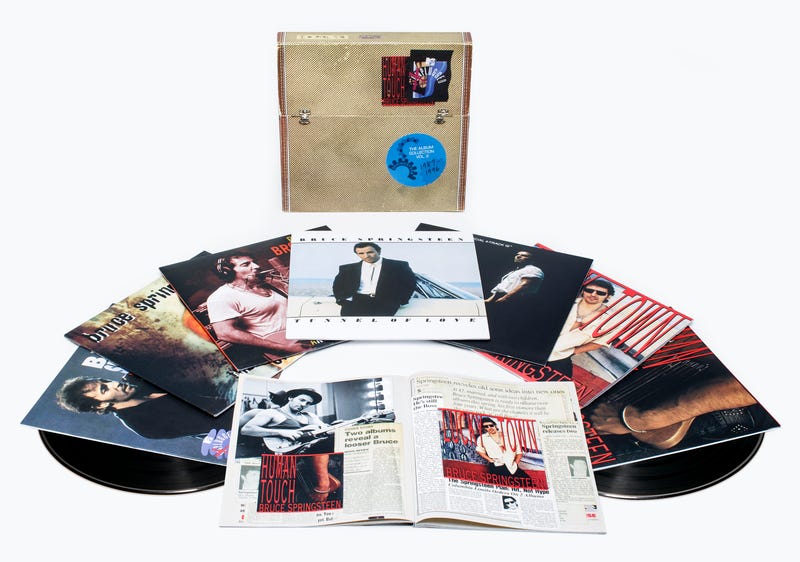
The new remasters collection Bruce Springsteen: The Album Collection Vol. 2, 1987-1996 makes a strong case for the artistic value of Springsteen’s E Street-less, mid-period output. Starting with 1987’s Tunnel Of Love, it was no longer really Bruce Springsteen & The E Street Band. Despite the occasional presence of various bandmates on the album and subsequent tour, the signs were already there for his creative restlessness and decision to separate from the group to pursue different avenues of making music. (He made the split official in 1989.) And to hear tell of it in various biographies and assessments of his career through the years, Springsteen spent most of the next decade wandering the artistically frustrated desert, on albums and tours that lacked the passion and vision of his earlier work. The limited-edition release Bruce Springsteen: The Album Collection Vol. 2, 1987-1996 probably isn’t going to convince anyone that the Boss was better off without his once and future band than with it, but what it does do is make a cohesive and convincing argument for the merit of his work during this creatively searching era—yes, even the stuff with the really crappy production values.
When Springsteen published his memoir Born To Run in 2016, it was clear he didn’t want to talk much more than he already had in interviews about the hiatus of the E Street Band or the interpersonal and creative tensions that led to his decision. He barely spends two pages on it, admitting his own role in the issues, but seems to summarize it with, “I felt I’d become not just a friend and employer for some, but also banker and daddy.” The recording of the simultaneously released Human Touch and Lucky Town is omitted entirely, and aside from discussions about his personal life, much of these years is dismissed by him as his “mid-’90s drift.” It’s too bad he glosses over it, because as is made clear by the engrossing 60-page book of photos, press clippings, and interviews accompanying this new collection, there’s a lot to be said about what he was trying to achieve with each of these albums.
Tunnel Of Love is perhaps the most contentious of these records. Hailed as a masterwork of a newly mature artist upon its initial release, it was subsequently criticized for its production and lack of consistent E Street input, with Springsteen playing many of the instruments himself. (The only thing he never attempted was drums, with Max Weinberg providing the sporadic percussion.) But while the cheesy keyboards and digitally fussy drums do indeed make some of the songs harder to listen to with fresh ears, one of the best elements of the newly remastered edition of this long-out-of-print vinyl is the very deliberate minimization of the hokier instrumentation, and teasing out the guitars wherever possible. Even “Brilliant Disguise,” an excellent song that became a hit for a reason, sounds a little crisper and less late-’80s smooth. But to take the time to study Tunnel Of Love closely is to again marvel at some of the finest lyrics of Springsteen’s career. From the solo vocal performance that kicks off “Ain’t Got You” to the muted angst of “Valentine’s Day,” the subtlety and depth of these songs about complicated adult love shine. It’s a strange beast for a record from the Boss, but it’s a hell of a successful one-off experiment.
From there, things admittedly get a little muddled. Human Touch and Lucky Town are the twin pillars of his respective artistic tactics: the former an agonized and fussed-over result of several years of obsessive workaday grind, the latter a three-week burst of raw and loose inspiration. Lucky Town is undeniably the superior of the two simultaneous releases, suggesting Springsteen was indeed at loose ends over the direction his music should take, finding more success in the fuck-it attitude of just unleashing some rock and hoping it worked. It’s the sound of him trying to genuinely create the feeling of rock ’n’ roll as a revivalist celebration, chasing that near-religious fervor his concerts are often credited with having. Hence the three backing female singers, shouting out refrains like they were gospel—he wanted it to sound like the gospel of rock. At the time it mustn’t have been clear he was pushing this angle too hard, chasing it too blatantly, as opposed to the vibe arriving organically from the music. The bluesy American roots rock that pops up is solid, but too often harnessed to his church-hymnal instincts. (“Souls Of The Departed” is just a hair’s breadth away from being an all-time killer rock song.) It’s a good album that should’ve been great.
Human Touch, by contrast, does many of the same things as Lucky Town, only milder and with less success. While some of it can be chalked up to his insistence on playing so many of the parts himself, thereby denying himself superior musicianship on the instruments, his session players did him no real favors either, especially Randy Jackson’s uninspired bass. Similarly, the songs often sound like the result of a guy in an echo chamber, demoing to a 4/4 beat on a drum machine and then not being pushed to vary those beats in the rhythm section. Great songs intermittently appear—“Gloria’s Eyes” cooks, and “I Wish I Were Blind” overcomes its generic-ballad orchestration to deliver a moving elegy—but it’s not enough to overcome dreck like “57 Channels (And Nothin’ On).” Human Touch, as he discusses in the lengthy Rolling Stoneinterview functioning as the accompanying book’s centerpiece, was who he was in the wake of his post-Tunnel divorce; Lucky Town was the direction he was moving. It was clearly the better direction to go.
But even with the albums being this uneven, the accompanying live record and EP demonstrate Springsteen’s power remained largely undimmed. 1993’s In Concert: MTV Plugged is an hour straight of killer live music, showing how even weaker studio tracks like “Man’s Job” get a rush of energy and power from the Boss in full onstage swagger. Plus, it provides previously unreleased tracks “Red Headed Woman” and the spectacular “Light Of Day,” long a set-closer during the era. But it also showcases what people don’t like about this era of Springsteen: He basically cedes lead instrument duties to keyboardist Roy Bittan, the keys taking pride of place in mixing and songwriting, never more apparent than in the full-band version of “Atlantic City.” It’s a hell of a show, but it does minimize Springsteen’s ax work far too much. The EP Chimes Of Freedom (from the Amnesty International charity tour in ’88) features four killer performances, one of them a cover of Bob Dylan’s title tune.
The Ghost Of Tom Joad stubbornly resists alteration in remastering. The record is an odd admixture of spare Nebraska-style minimalism (even more so, really, with the acoustic guitar barely audible at times) and the swooning high-gloss production that has always been his weakness. It’s a two-pronged strategy that would find better synthesis—if uneven results—on Devils & Dust, but that nonetheless contains some moments as good as anything he’s done. Songs like “Highway 29” and the title track find a fusion of wordy poetry and sparse melodism that elevate the material, but it’s occasionally too flat musically to really land, stripped-down folktales easier to admire than enjoy. Still, it stands as a coda to this era of Bruce’s wandering muse, finding meaning in the stories of the Mexican-American borderlands that feel more relevant than ever.
Blood Brothers(his much-vaunted E Street reunion to provide new tracks for the Greatest Hits release) is a superb five-song blitz, even if it now looks like little more than a tease for the reunited greatness to come. Still, taken as a whole, these records function as a kind of musical travelogue that saw the guy who made the world-conquering Born In The U.S.A. spend a creatively frustrating decade reinventing himself into the again-master songwriter and bandleader that would see the 2000s deliver on the promise of his former excellence. The path to get there was rocky, but filled with enough magic to make it worthy of appreciation in its own right.
The Album Collection Vol 2. This release spans the period of 1987-1996, picking up where Volume 1 – released back in November 2014 – left off. It’s due on May 18th from Columbia Records and Legacy Recordings on vinyl only. Unlike the previous box set, no CD release has been announced.
Volume 2 contains four studio albums, one live album, and two EPs on 10 vinyl LPs – all remastered by Bob Ludwig and Toby Scott from the original analogue masters. The set chronicles Springsteen’s adventurous, experimental period during and following the dissolution of The E Street Band. While the band’s members are all present in guest spots on 1987’s Tunnel of Love(and the band would tour the album) it was a mostly solo, introspective affair highlighted by such standout tracks as “Brilliant Disguise,” “Tougher than the Rest,” “One Step Up,” and the title track. Tunnel Of Love is followed by the pair of albums released by Springsteen on the same day, March 31, 1992: Human Touch and Lucky Town. Though Roy Bittan was on board as a musician and co-producer, the only other E Streeters to make an appearance on Human Touch were Patti Scialfa and former member David Sancious.
The album instead welcomed studio veterans like Jeff Porcaro and Randy Jackson as well as background vocals from Sam Moore of Sam and Dave and Bobby Hatfield of The Righteous Brothers. Human Touch scored hits with its title song and “57 Channels (And Nothin’ On).” Lucky Town employed a sparer sound and seemingly a more personal approach than Human Touch. Bittan and Scialfa were on hand, along with drummer Gary Mallaber, Randy Jackson, The Faces’ Ian McLagan, and future E Street touring member Soozie Tyrell. The album yielded favorites such as “Better Days” and “If I Should Fall Behind.”
The box continues with 1993’s live album In Concert/MTV Plugged (featuring Bittan, Scialfa, and Bruce’s touring band) and then with 1995’s The Ghost of Tom Joad, a dark, stripped-down spiritual sequel to Nebraska that was hailed by many as his best album in years, and certainly his most adventurous. Garry Tallent, Danny Federici, Scialfa, and Tyrell all contributed to the album. Two EPs round out the box’s contents. 1988’s Chimes of Freedom was released in support of Amnesty International’s Human Rights Now! tour. Anchored by a cover of Bob Dylan’s title song, it also featured live versions of “Tougher than the Rest,” “Born to Run,” and the rare B-side “Be True.” Blood Brothers, the second EP, was originally released in 1996 to coincide with a film of the same name chronicling The E Street Band’s temporary reunion to record additional tracks for Springsteen’s Greatest Hits LP (which isn’t included in this box set but will be released on vinyl for Record Store Day on April 21). Blood Brothers has five tracks from the reunited band – four from the studio sessions and one (“Murder Incorporated”) live, as heard in the song’s music video.
In Concert/MTV Plugged makes its U.S. vinyl debut in this box set, while Blood Brothers is a worldwide vinyl premiere. A 60-page book featuring memorabilia, photos, and period press clippings is included with the set.
Look for The Album Collection Vol. 2, 1987-1996 from Columbia/Legacy on May 18th.
Bruce Springsteen, The Album Collection Vol. 2, 1987-1996 (Columbia/Legacy, 2018) (Amazon U.S. / Amazon U.K. / Amazon Canada Links TBD)
LPs 1-2: Tunnel of Love (Columbia OC 40999, 1987)
LPs 3-4: Human Touch (Columbia C 53000, 1992)
LP 5: Lucky Town (Columbia C 53001, 1992)
LPs 6-7: In Concert/MTV Plugged (Columbia CK 68730, 1993) **
LP 8: The Ghost of Tom Joad (Columbia C 67484, 1995)
LP 9: Chimes of Freedom (Columbia 4C 44445, 1988)
LP 10: Blood Brothers (Columbia CSK 8879, 1996) *

:format(jpeg):mode_rgb():quality(90)/discogs-images/R-1154504-1461764400-6042.jpeg.jpg)
:format(jpeg):mode_rgb():quality(90)/discogs-images/R-1137878-1441734508-8420.jpeg.jpg)

 The Fat Angel Sings