

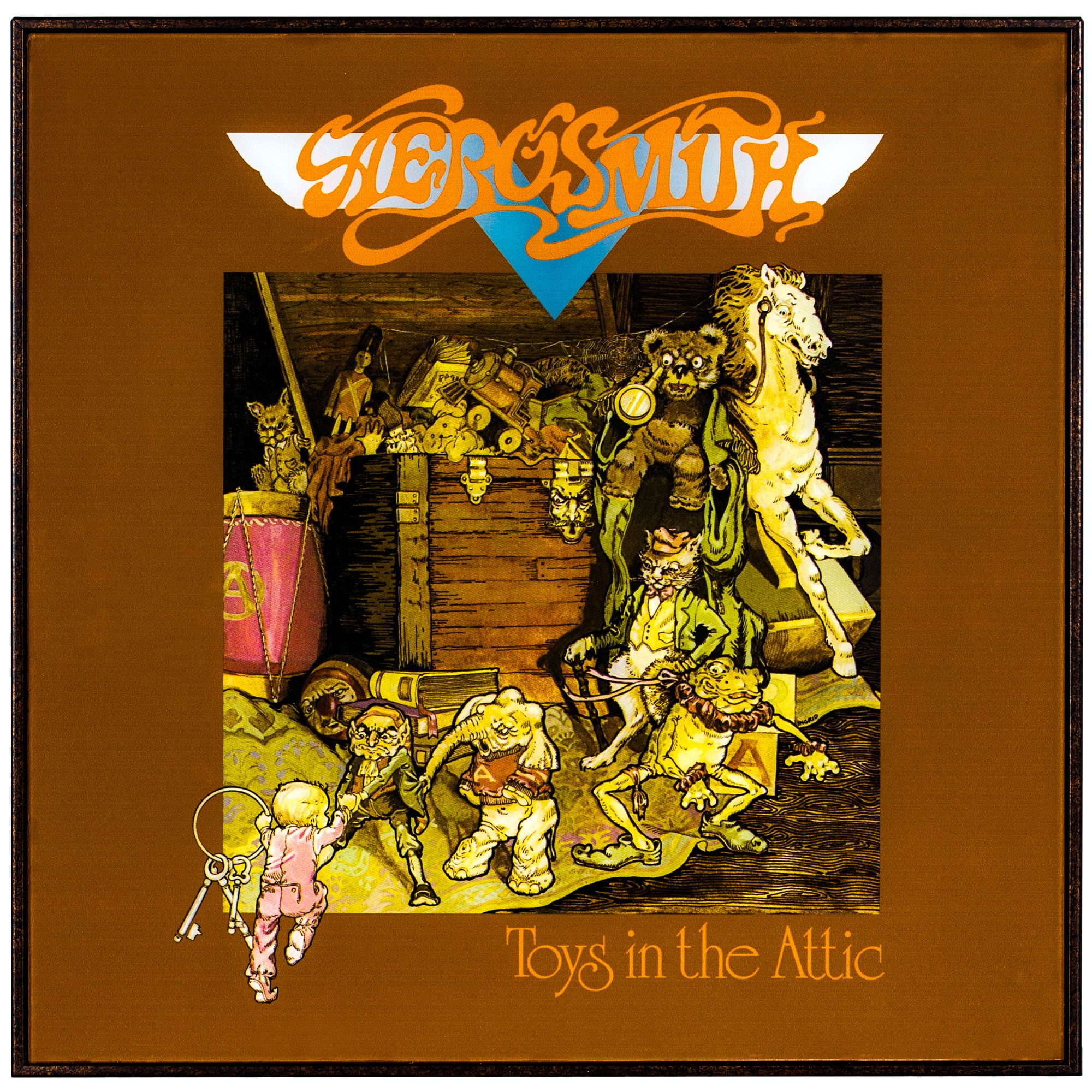
Aerosmith hit their stride on their third album, perfecting the nasty guitar licks and powerhouse performances they were honing onstage almost every single night. They carried this momentum to their next record, ‘Rocks,’ but ‘Toys in the Attic’ is the one album that defines Aerosmith in all their sleazy rock ‘n’ roll glory. “Aerosmith” was a different band when we started the third album. They’d been playing Get Your Wings on the road for a year and had become better players – different. It showed in the riffs that Joe [Perry] and Brad [Whitford] brought back from the road for the next album. “Toys in the Attic” was a much more sophisticated record than the other stuff they’d done.”
Aerosmith got off to a solid start with their debut album and avoided the sophomore jinx with their second. They truly took off when their third album arrived on April 8th, 1975.
“Toys in the Attic” found the group working to maintain its rock audience while making another bid for the crossover success that, to that point, had continued to flit just out of reach. Reconvening at the Record Plant in New York City during the early winter months of the year, the band members were under the gun in terms of delivering new material — but after years of live performance, they were now better prepared than ever.
Perhaps the most ambitious recording on the album is “You See Me Crying”, a complex piano ballad that was heavily orchestrated. Jack Douglas brought in a symphony orchestra for the song, which was conducted by Mike Mainieri. The song itself was written by Tyler and outside collaborator Don Solomon. Some of the band members became frustrated with the song, which took a long time to complete, due to the many complex drum and guitar parts. The band’s label, Columbia Records, was nonetheless very impressed with the song and the recording process.
“Toys” was the first record where we had to write everything pretty, much from scratch,” guitarist Joe Perry said. “And also, we had to do it after having been on the road for a while. And, though we were still playing a lot of gigs, we took a couple months off to make this record. So this was our first real studio record. And we would write a lot of the material in the studio. So we’d rehearse them and then go into the studio in the morning with a couple of guitar riffs, and we’d build all these songs out of them.”
Crediting an offhand remark from producer Jack Douglas during the Get Your Wings sessions with sending him into an emotional tailspin, bassist Tom Hamilton admitted in Walk This Way: The Autobiography of Aerosmith that the band’s ability to, as Perry put it, “could afford better dope” allowed him to embark on a cocaine-fuelled practice regimen in order to impress Douglas when they started Toys in the Attic. “When we started Toys, I felt better about my playing for once,” said Hamilton. “It was up to this higher level where the rest of the band had already progressed.”
Hamilton’s increased confidence and instrumental dexterity paid off in the studio, leading to the bass line for future Toys in the Attic classic track “Sweet Emotion,” among other things. But the band members weren’t entirely starting from scratch. All their touring helped road-test some of the new material, Perry later noted, saying that “We had an idea of what songs were working for us live at that point, and so we kind of had an idea of what direction we wanted the songs to go in. We knew we wanted to play some uptempo songs, some shuffle songs and some blues rock. But though we knew what kind of songs we wanted, we didn’t really know how it was going to turn out.”
Acknowledging the building pressure on Aerosmith to deliver a hit, Perry also openly credited producer Douglas with accentuating the band’s strengths and encouraging them to deliver their best songs and performances. “Jack really helped us a lot in that department,” noted Perry. “He really became the sixth member of the band and taught us how to do it.”
As far as singer Steven Tyler was concerned, whatever pressure the band might have been feeling was decidedly secondary to his growing belief that Aerosmith could stand shoulder-to-shoulder with any of the greats.
“I knew we’d made it,” he wrote in Does the Noise in My Head Bother You?: A Rock ‘n’ Roll Memoir. “I was the kid who put my initials in the rock ’cause I wanted the aliens to know I was there. It’s a statement of longevity. The record will be played long after you’re dead. Our records would be up there in the attic, too, with the things that you loved and never wanted to forget. And to me, Aerosmith was becoming that. I knew how the Beatles, the Animals and the Kinks did it — with lyrics and titles. I saw reason and rhyme in all the lunacy that we were concocting.”
Looking back, it isn’t hard to see why Tyler was so confident. Toys in the Attic marked a quantum leap forward for Aerosmith, in terms of writing as well as performance, and the band’s artistic growth was soon matched by a sales boom: Toys soared to No. 11 on the chart, sending “Sweet Emotion” into the Top 40 and “Walk This Way” all the way to No. 10 — their biggest hit to that point.
“Walk This Way” starts with a two-measure drum beat intro by Joey Kramer, followed by the well-known guitar riff by Perry. The song proceeds with the main riff made famous by Perry and Brad Whitford on guitar with Tom Hamilton on an early 1960s Fender Jazz bass. The song continues with rapid-fire lyrics by Steven Tyler. The song originated in December 1974 during a sound check when Aerosmith was opening for the Guess Who in Honolulu, Hawaii. During the sound check, Perry was “fooling around with riffs and thinking about the Meters”, a group guitarist Jeff Beck had turned him on to. Loving “their riffy New Orleans funk, especially ‘Cissy Strut’ and ‘People Say'”, he asked the drummer “to lay down something flat with a groove on the drums.”The guitar riff to what would become “Walk This Way” just “came off [his] hands
Saying it evolved from a riff he had “in the back of my mind” that arose out of a desire to write “something funky,” Perry recalled “Walk This Way” evolving slowly, from that first guitar part to a demo in progress that producer Jack Douglas helped nudge across the finish line after a viewing of Mel Brooks’ film Young Frankenstein.
There was this one scene where one of the movie characters says ‘walk this way,'”said Perry . “Jack began fooling around with that line and did this imitation of it from the movie, and so it became a great title for the song. Then Steven went ahead and wrote the eventual lyrics.”
“Walk This Way” launched Aerosmith firmly into the ranks of crossover rock acts, and they continued to broaden their fan base as they pounded the arena circuit as a headliner and/or opening act alongside a growing list of artists that included Ted Nugent, Foghat and REO Speedwagon. They’d score even bigger hits later in their career, but Toys in the Attic marked the point of no return, setting them up for the superstar status they continue to enjoy.
“At the end of Toys, I had become a different player and Aerosmith was probably a different band,” Hamilton said in Walk This Way. “We knew this album would launch the band like a missile. I’d written two of the songs and finally was able to feel like I wasn’t fooling anybody anymore. It was an incredible time.”
“This was the year it all changed for us,” Tyler wrote in his memoir. “The album got good reviews and people started taking us more seriously — about fucking time!” But for Perry, Toys in the Attic’s success wasn’t necessarily a sign that Aerosmith had made it; instead, he seemed to feel a responsibility to try harder than ever.
“I wonder if I’m doing it right. If I’m actually contributing. Are we doing something good, or are we just followers?” Perry told Creem. “I don’t know. We can go the BTO route, be a really commercial band, do the road trip. But to satisfy my own artistic needs, I wonder if the things I write … maybe I’m not getting better on guitar. Maybe I’m no better than your average guitar player. But I’ll tell you — if I find out after a year or so more that I’m not improving, I’ll just quit touring and work on my cars.”


 The Fat Angel Sings