Posts Tagged ‘Jefferson Airplane’

Jefferson Airplane’s contribution, the immense “Bless Its Pointed Little Head”, seems to have gone oddly un-heralded, despite being one of the very best of the period. Jefferson Airplane were -and remain- legends of the hippie counter-culture that sprang up in the mid-sixties in San Francisco. Their politically-charged and drug-tinged anthems touched a deep chord in the hearts and minds of California’s youth, whilst the charisma and beauty of singer Grace Slick made them perhaps the most media-friendly of all the West Coast bands bar The Byrds. Their 1967 hits ‘Somebody to Love’ and ‘White Rabbit’ became staples and signatures for an entire generation of American refuseniks.”

No ’60s concert scene was better documented than the San Francisco explosion . But of the official releases that came out at the time, the one to have is this Jefferson Airplane set, recorded during October ’68 dates at SF’s Fillmore West and a month later at Fillmore East in NYC. Here in that time between Monterey and Woodstock, between the albums “Crown Of Creation” and “Volunteers” , the band was growing daily in confidence, muscle and a knack for making the most of the moment. The constantly shifting dynamic of vocal triad Grace Slick, Marty Balin and Paul Kantner was a nimble beast, but more evident than ever was how much the tandem of guitarist Jorma Kaukonen and bassist Jack Casady formed the beating heart of this band.

Must-hear song: Balin’s “Plastic Fantastic Lover” has fury only hinted at on the Surrealistic Pillow studio version . But the real treasure is the version of folk figure Fred Neil’s written staunch and steely “The Other Side Of This Life” , a live Airplane staple from the early days, but never before seeing official release.

The cheat: Not only was it pieced together from several dates, some of the songs themselves are multi-date spliced jobs.

The live rock album really took flight at the end of the decade with Bay Area bands like The Grateful Dead “Live/ Dead”  Quicksilver Messenger Service  “Happy trails” , Big Brother & the Holding  Company(parts of ’68’s ) Cheap Thrills . It made perfect sense: part of the San Francisco mystique was the live experience, the sense of community and unpredictability, bands being given the space—and the state-of-the-art sound systems to take winding (and long) musical trips. With , a combination of 1968 recordings from the Fillmores East and West on both coasts,

The Airplane

Jefferson Airplane made one of the defining albums of the band’s career, with dynamic vocal interplay among its three singers (Marty Balin, Grace Slick, Paul Kantner), a blues spotlight for guitarist Jorma Kaukonen and Rock Me  , a swirling rendition of Donovan’s “Fat Angel” (“Fly Jefferson Airplane, gets you there on time,” it goes, making this a self-referential self-tribute), and a soaring 3/5 of a Mile In Ten Seconds . The Airplane were a strange amalgam, part post-folk (there’s a terrific take on Fred Neil’s “The Other Side Of Life” on ‘Pointed Little Head’), part psychedelic rock, part electric blues, and it could all get scattered, but when it locked in, they were one of the more mesmeric of the groups who came out of San Francisco scene. If you want to get a sense of what made them, on a good night, so special, you can start here.

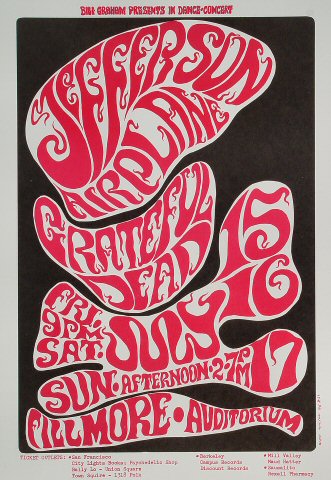
This poster is sure to become a cornerstone of the finest quality Bill Graham poster collection. Other 9.0+ example may eventually surface, but none will ever exceed this mind boggling example! It will take a very strong bid to acquire this museum piece but history shows that today’s stretch price is tomorrow incredible bargain. The key is to be the colector that actually ends up with finest known classic rarities such as this!

Poster – Jefferson Airplane, Fillmore Auditorium

Catalog #BG-17
Grade – CGC Grade 9.8
Bands/Bill – Jefferson Airplane, Grateful Dead
Venue – Fillmore Auditorium
City – San Francisco, CA
Date –7/15-17/66
Dimensions – 13 7/8”x 20 3/64”
Printing – OP-1, Original Pre-Concert First Printing
Artist – Wes Wilson
Series/Promoter – Bill Graham
Paper Type – Vellum
Condition Deatils- Absolutely Superb. Razor sharp pinpoint colors, bright fresh colors and flawless paper. Unimprovable condition for the collector that only the best will do. Could be many years until a comparable example surfaces, the time to act is NOW!

Jeffair.jpg

With a new singer, Grace Slick, who also happened to bring a pair of classic songs with her (“Somebody to Love” and “White Rabbit”), Jefferson Airplane’s second album in part defined the Summer of Love. The band was one of the best in San Francisco, whose scene helped shape an entire era. ‘Surrealistic Pillow,’ is a pinnacle of that period.

Surrealistic Pillow was the second album by the American psych rock band, released on February 1st, 1967, by RCA Victor. It is the first album by the band with vocalist Grace Slick and drummer Spencer Dryden

Original drummer Alexander Skip Spence had left the band in mid-1966. He was soon replaced by Dryden, an experienced Los Angeles jazz drummer and the half-nephew of Charlie Chaplin. New female vocalist Slick, formerly with another San Francisco rock band The Great Society , joined the Airplane in the fall of 1966. Slick, Dryden, lead vocalist Marty Balin, guitarist-vocalist-songwriter  Paul Kantner, lead guitarist (and occasional vocalist) Jorma Kaukonen , and bassist Jack Casady formed the core of the best-known line-up of the group, which remained stable until Dryden’s departure in early 1970.

Jefferson Airplane singer Grace Slick is also known for that powerhouse voice – responsible for classics like  ‘White Rabbit’. At a time when studio production was limited and live concerts were almost always dominated by an incredibly loud band in direct competition with an even louder audience, it made it difficult to fully appreciate voices like Grace Slick’s; but it’s in this isolated vocal track from ‘White Rabbit’ that we’re able to finally concentrate on the star of the song .

https://www.youtube.com/watch?v=eChgEiovCww

The album is considered to be one of the quintessential works of the early psychedelic rock.

Image may contain: one or more people and crowd

Surrealistic Pillow was the first blockbuster psychedelic album by a band from San Francisco.

https://www.youtube.com/watch?v=Jv7FNyckr7w

Jefferson Airplane recorded their own version of the song for their controversial fifth album, “Volunteers”.

When Crosby, Stills & Nash released their eponymous debut album in 1969, there was only one co-write on it (which would be the norm for future albums by the group). That Woodstock-era song, which became a classic both on its own and as part of an album that helped shape the musical tastes of a generation, was “Wooden Ships.”

Written by Stephen Stills, David Crosby, and Crosby’s onetime roommate, Jefferson Airplane/Starship’s Paul Kantner, “Wooden Ships” is generally interpreted as a veiled look at the aftermath of nuclear holocaust. The song was written during a period when the threat of a final nuclear war was uppermost in so many minds, during the ‘60s crisis in Indochina and heightened tensions between the United States and the USSR. Artists like Barry McGuire, with his throaty “Eve of Destruction,” and songwriting satirist Tom Lehrer, with his pretty-damned-funny “We Will All Go Together When We Go,” addressed the same theme. But CSN, with their wonderful harmonies and Stills’ great performance on several instruments, made a thing of beauty from a decidedly less-than-cheery premise.   

Crosby told the website MusicRadar in 2012 that the song is, indeed, about a dismal subject that numerous books and movies had addressed before, and have made millions of dollars from since, from The Time Machine to The Terminator. “I had that set of (chord) changes,” Crosby said. “Stephen added to them … and we all wrote the song. It’s a post-apocalyptic story. The world has gone to hell … The idea was that we were sort of sailing away from that madness. It’s the song that Jackson [Browne] wrote For Everyman in response to. It’s him saying, ‘Hey, we don’t all have a sailboat to sail away in. We have to stay here and fix it for everybody. That’s a fantasy that you’re writing.’” Kantner and his Jefferson Airplane bandmates recorded their own version of the song shortly after CSN’s for their controversial fifth album, Volunteers. JA’s version was awesome in its own right and is actually preferred by many, though it had a darker tone and less musicality than CSN’s.

It’s hard to think of a lyric much more depressing than Horror grips us as we watch you die/ All we can do is echo your anguished cries/ Stare as all human feelings die/ We are leaving, you don’t need us. Well, nearly half a century later, the world is still here, but we still worry about and pontificate about an apocalyptic event as much now as we did then. And we probably will until, well, until it happens. In the meantime, we can keep hoping and praying for a wooden ship for the survivors to sail away in.

Exhibits_Vietnam_Music_WoodenShips

thanks to Rick Moore

Paul Kantner; dead

Founding member ,Paul Kantner guitarist and singer for Jefferson Airplane and Starship, died Thursday of multiple organ failure and septic shock. He had suffered a heart attack earlier in the week, according to San Francisco Chronicle. He was 74. The musician had been in ill health in recent years, with Kantner suffering a heart attack in March 2015,

With Jefferson Airplane, Kantner helped pioneer the oft-imitated psychedelic sound: simple, fuzzy guitar lines steeped in dreamlike reverb. The group formed in 1965 and, within a few years, scored hits with “Somebody to Love” and “White Rabbit.” In their first run, five of the band’s seven albums went gold, including 1967’s Surrealistic Pillow and 1968’s Crown of Creation.

Verging on a breakup in the early Seventies, Kantner recorded a solo album, “Blows Against the Empire”, with Jefferson Airplane singer Grace Slick, crediting it to Paul Kantner and Jefferson Starship. The album was nominated for a Hugo Award presented to the best science-fiction and fantasy works. After formalizing the band Jefferson Starship, the band went on to greater commercial success than Jefferson Airplane, scoring platinum and gold records, including the double-platinum 1975 record Red Octopus. Kantner quit the group in 1984, but would rejoin in 1992 and continue to play with them until his death.

jefferson airplane somebody to love 300

“Our condolences go out to the friends, family and fans of Paul Kantner of Jefferson Airplane on the news of his passing,” members of the Doors wrote on their Facebook page. “Music would not be the same without the sounds of The Doors and Jefferson Airplane, which both contributed so heavily to the signature sound of the Sixties and Seventies.”

Paul Lorin Kantner was born on March 17th, 1941 in San Francisco. His father was a traveling salesman, according to the Chronicle, and he was sent to military school after his mother’s death. He found inspiration in science-fiction books and folk music, dropping out of college to pursue music.

Jefferson Airplane came together after Kantner began playing in a folk group with former actor turned singer and guitarist Marty Balin and vocalist Signe Toly Anderson. The group subsequently brought in guitarist Jorma Kaukonen and bassist Jack Cassidy. Balin plucked Skip Spence, a guitarist, for drums because he “looked like a drummer,” and with the first lineup complete they commenced playing rock reminiscent of early Beatles, folk, blues and ballads. The year they formed, they became the first San Francisco band to sign to a major label.

https://www.youtube.com/watch?v=c2yQLXTuctA

The group’s 1966 debut, Jefferson Airplane Takes Off, was a modest hit, charting in the lower half of the Top 200, but their fortune would change when lineup changes would welcome model-turned-singer Grace Slick, who’d been playing with the Great Society, into the fold.

With her powerful voice, the band recorded their breakthrough hits and became one of the defining bands of acid rock’s free-love movement, printing bumper stickers that read “Jefferson Airplane Loves You.” Their 1967 album, Surrealistic Pillow – which marked a turn toward more understated guitar playing with overtones of jazz and even Indian sensibility – brought the “San Francisco sound” to the mainstream. Later that year, they’d score a lesser hit with “The Ballad of You and Me and Pooneil,” a harder-rocking song that Kantner wrote that would become the lead track on their After Bathing at Baxter’s album.

Kantner’s writing would become more politicized toward the end of the Sixties, and as Jefferson Airplane became falling apart – with Kaukonen and Cassidy forming Hot Tuna – and Balin leaving, the guitarist stepped into a larger role. He and Slick collaborated with several other San Francisco musicians.

After putting out Blows Against the Empire, which featured members of Crosby, Stills and Nash and the Grateful Dead, Kantner and Slick formed Jefferson Starship. Balin returned to the fold in time for Red Octopus, a Number One album, and the group’s mainstream rock ambitions came into focus. The album’s lush “Miracles” earned them a Number Three hit, and their next two albums – 1976’s Spitfire and 1978’s Earth – would also earn them Top 10 singles. By 1980, though, Kantner was the only original Jefferson Airplane member left in the lineup. He suffered a cerebral hemorrhage that year but recovered and continued with the band.

In 1984, he left the group and formed a legal agreement with the other members that they could not use the “Jefferson” name without the approval of all respective members. Slick kept her band’s momentum with Starship, which earned a big hit with “We Built This City,” without Kantner.

Kantner and Jefferson Airplane would reform in 1989, when they put out a self-titled album, and again in 1996, when they were inducted into the Rock and Roll Hall of Fame. Kantner put together Jefferson Starship – The Next Generation in 1992, which led to a trademark infringement suit with his former bandmates. He would continue to play with them, eventually dropping the Star Trek-y part of their name and putting out two albums, until his death.

Outside of his main bands, Kantner recorded two albums with Slick and a 1983 solo record, Planet Earth Rock and Roll Orchestra. He also recorded with the KBC Band, which featured fellow Airplane members Balin and Cassidy.

Kantner is survived by three children: Gareth, Alexander and China.

Triad” is a song written by David Crosby in 1967 about a ménage à trois, a subject perfectly in keeping with the “free love” and hippie philosophies of the day. The song was written while Crosby was a member of the rock band The Byrds, who were at that time recording their fifth studio album, “The Notorious Byrd Brothers“. 

On this studio demo above of the song recorded by just Crosby and his Martin guitar its a softer acoustic demo of this song…recorded at a studio in Hollywood, he came in barefoot with a guitar straped across his back…and I set up 2 mics..one for him and one for his Martin, and he just did it . 

Although the band did record “Triad” and perform it live during a September 1967 engagement at the Whisky a Go Go, it was eventually not included on the final release of “The Notorious Byrd Brothers” album.  According to Crosby, Roger McGuinn and Chris Hillman felt that its subject-matter was too controversial with McGuinn allegedly deriding the song as a “freak-out orgy tune. However, this has since been denied by Hillman who has stated “I don’t think it was a moral decision. The song just didn’t work that well. David Crosby was drifting and bored and he wanted to do something else, and that song just added fuel to the fire. “Notorius Byrd Bros” would have broke big if they had kept this song and ditched that awful opening track “Artificial Energy” …..Triad was perfect for its time and would have put the Byrds right back at cutting edge status. I think the exclusion of this song from Notorious was the nail in the coffin for his days as a Byrd. And his behavior at Monterey didn’t help or his guesting with the Springield there didn’t help. Or his being adamant against ‘Goin’ Back’ being on Notorious. Regardless, David had emerged as a writer of great skill and his songs needed to be heard. They were and still are!  – Although the decision to keep this song off the Notorious LP may have played a minor role, it was the power struggle between McGuinn and Crosby that led to David’s dispatch from the group.

There had been growing animosity between Crosby and the rest of the band throughout 1967. Tensions had arisen from several factors, including Crosby’s displeasure over the band’s wish to record the GoffinKing composition Goin’ Back, his fraternization with fellow L.A. musicians, and his controversial remarks to the audience during The Byrds’ performance at the Monterey Pop Festival. These factors, along with the discord over “Triad”, contributed to McGuinn and Hillman’s decision to fire Crosby in October 1967. Crosby then gave the song to Jefferson Airplane, who recorded it on their 1968 album,Crown of Creation.  Airplane did it after the Byrds told Crosby they were not going to include it on their next album.  He got pissed off and gave it to airplane. 

A Live version of the song “Triad” was later included on Crosby, Stills, Nash & Young‘s 1971 album, 4 Way Street
David Crosby certainly shone more brightly as a solo artist with CSN; but the Byrds moved on to pioneer the genre of Country-Rock which, despite the insulting lack of recognition from the industry today, ultimately shaped the future of the Country music genre.
Also here is a version of “Triad” by the Icicle Works it is great!  the band recorded “Triad” as a medley with another Byrds’ song, Chestnut Mare, on the 1989 Byrds’ tribute album Time Between – A Tribute to The Byrds.
‘Why should we all stop at three’ . Now that’s a good last line for the song!
Fantastic song.

From the LP Surrealistic Pillow, is the second album by American rock band Jefferson Airplane, released in February 1967 as RCA Victor It is the first album by the band with vocalist Grace Slick and drummer Spencer Dryden. The album peaked at #3 on the Billboard album chart,


Original drummer Alexander “Skip” Spence had left the band in mid-1966, replaced by Los Angeles jazz drummer Spencer Dryden, a nephew of filmmaker Charlie Chaplin. New lead vocalist Grace Slick, formerly with another San Francisco rock band called the Great Society, joined the Airplane in the fall of 1966. Slick, Dryden and guitarist-songwriter Paul Kantner formed the core of the best-known line-up of the group, which would remain stable until Dryden’s departure in early 1970. The album is considered to be one of the quintessential works of the early psychedelic rock and 1960s counterculture