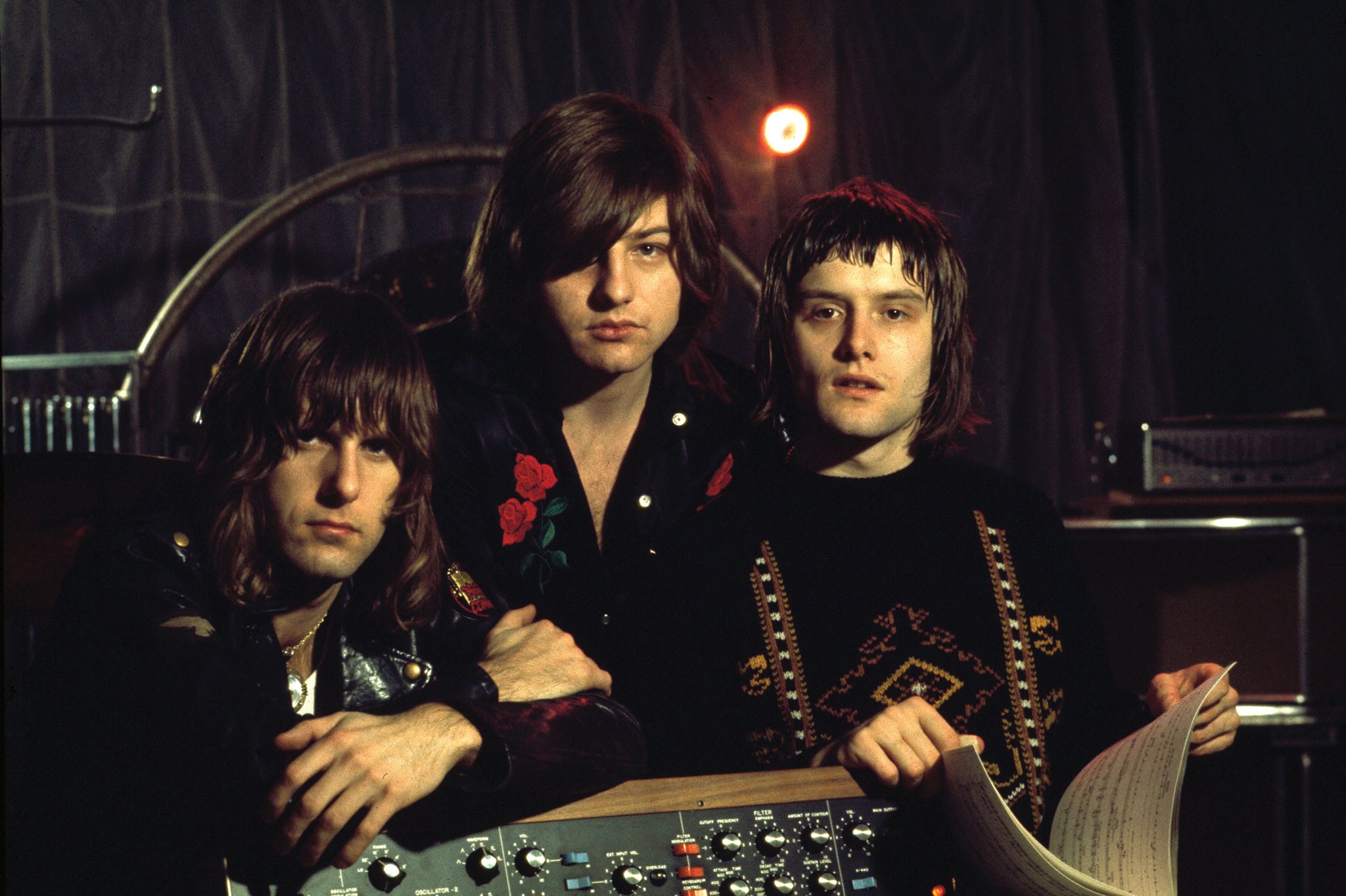
With the release of “Brain Salad Surgery”,Emerson, Lake and Palmer had outgrown any initial perceptions that they were simply a trendy supergroup possessing limited commercial appeal. Instead, they were now finding themselves well positioned on the precipice of mainstream success. To be sure, they were still seen as something of a phenomenon; after all, Keith Emerson’s over-the-top keyboard antics, Greg Lake’s engaging vocals and Carl Palmer’s thundering percussion placed them within a decidedly higher musical pantheon, one that found them capable of attracting audiences of stadium-sized proportions.
Thanks to the success of their preceding live album, “Pictures at an Exhibition”, Emerson, Lake and Palmer had become accredited practitioners of a prototypical prog/classical crossover configuration, one that boded well for continued accreditation. Emerson had initiated that stance with his previous group, the Nice, only to have it further realized with ELP, courtesy of a refined and sophisticated sound accompanied by a solid instrumental undertow. The fact that the three musicians were capable of such an achievement had never been in doubt, but with “Brain Salad Surgery“, that reputation was indelibly entrenched in both pedigree and practice. The group had bought a cinema in Fulham, which they renamed the Manticore Cinema, and they rented it out as storage and rehearsal space to groups. But in the rehearsals for “Brain Salad Surgery“, they left their gear set up on stage and rehearsed it as if playing a live show.
Released on November 19th, 1973, “Brain Salad Surgery” didn’t contain the same variety of instantly accessible music that songs like “Lucky Man” and “Take a Pebble”—both culled from ELP’s eponymous debut—had offered early on. Like the ELP albums that followed in its wake, it bore a sound that was increasingly more complex, built on majestic motifs that were far removed from what most people would have ever identified as an easy listening experience. Their fourth album, 1972’s Trilogy, had reached Number Two in the UK and Number Five the USA, but in rehearsing and arranging the music for “BrainSalad Surgery, ELP made a decision to pursue a quite different approach. “Music technology was really expanding,” Lake explained. “Tape recorders were going from 8-track to 24-track.
And yet, it did have one singular song in particular—“Still…You Turn Me On,” a wistful ballad that Lake sang with a certain soothing assurance is one of his dreamiest acoustic songs. These had always provided dynamic contrast to ELP’s power play, both live and on record, and here Emerson joins in on harpsichord. Was the idea that the song was addressed to a certain person in the audience?. Given the fact that Palmer played no part in its recording, the idea of releasing the track as a single was nixed entirely. So, too, because at least half the album consisted of elegiac suites (dubbed “Impressions”), part of an extended work titled “Karn Evil 9,” there was very little material that could be considered a possible choice as far as selection as a single. “Benny the Bouncer,” composed by Lake and his one-time King Crimson colleague, lyricist Pete Sinfield, might have been an option, but the hokey theme and fickle approach didn’t really represent the band’s artful approach, their purpose or their prowess, and, as a result, it was never a real contender.
The album opens in a blaze of light, though, with a flamboyant version of William Blake and Hubert Parry’s “Jerusalem“, with Palmer playing gongs and timpani, and executing lavish multiple tom-tom rolls around his stainless steel kit. Emerson garnishes proceedings with exultant Moog clarion calls, while Lake’s magisterial voice holds the middle ground. “Jerusalem” was the consensus pick, but the BBC quickly vetoed that idea due to its refusal to play anything that was perceived to be sacrilegious. Although the album reached the upper tiers of both the British and American charts and sold well enough to be certified gold the lack of a viable single seemed to hinder its overall possibilities. Palmer still laments the fact that “Jerusalem” was stillborn as far as a singles candidate was concerned. “We wanted to put it out as a single,” Palmer saying. “We figured it was worthy of a single…I think there was some apprehension [as] to whether or not we should be playing a hymn and bastardizing it, as they said, or whatever was being called at the time … We thought we’d done it spot-on, and I thought that was very sad…I actually thought the recording and just the general performances from all of us were absolutely wonderful. I couldn’t believe the small-mindedness…It got banned and there was sort of quite a big thing about it. These people just would not play it. They said no, it was a hymn, and we had taken it the wrong way.”
Another portion of the album initially presented a problem as well. “Toccata” was a piece Emerson had first considered for the Nice, but the idea of doing it with ELP hadn’t surfaced until Palmer suggested spicing it up with an extended drum solo. However, its complexity proved to be a handicap due to the fact that Lake didn’t read music and Palmer couldn’t find a musical score that adapted the piano arrangements for drums. Those difficulties were overcome, but the real problem lay in the fact that the publisher of the piece refused to grant the group permission to do an adaptation. That led to Emerson flying to Geneva to personally play the group’s arrangement for the publisher’s representatives, in hopes of persuading them to change their minds. The tack worked, and the publishers, duly impressed with what they heard, eventually allowed ELP to proceed. “Toccata” would eventually coalesce into a spectacular mesh of sound, fury, flash and finesse, a standout selection that ranks as one of the highpoint of the entire LP.
The aforementioned “Karn” suite became notable in its own right, due not only to the trio’s usual over-the-top instrumental antics, but also because the computerized voice featured in its third movement gives Emerson his only vocal credit of the entire ELP lexicon. Likewise, the second section of the first movement boasts the lyric that would become one of the most famous lines in the entire prog rock canon: “Welcome back my friends, to the show that never ends.” It would famously become the title of the band’s epochal three-LP live album a few years later.
“Brain Salad Surgery” is the group at the pinnacle of its powers,” says drummer Carl Palmer of EmersonLake & Palmer’s fifth album. “It’s very well recorded and it was definitely one of our most creative periods. If I had to choose one of our albums, that would be the one.”
It’s a viewpoint echoed by his erstwhile bandmates. Keyboard player Keith Emerson sees it as a “step forward from the past”, which “represented the camaraderie of the band at the time”. Bass player and vocalist Greg Lake reckons that it was “the last original, unique ELP album”.
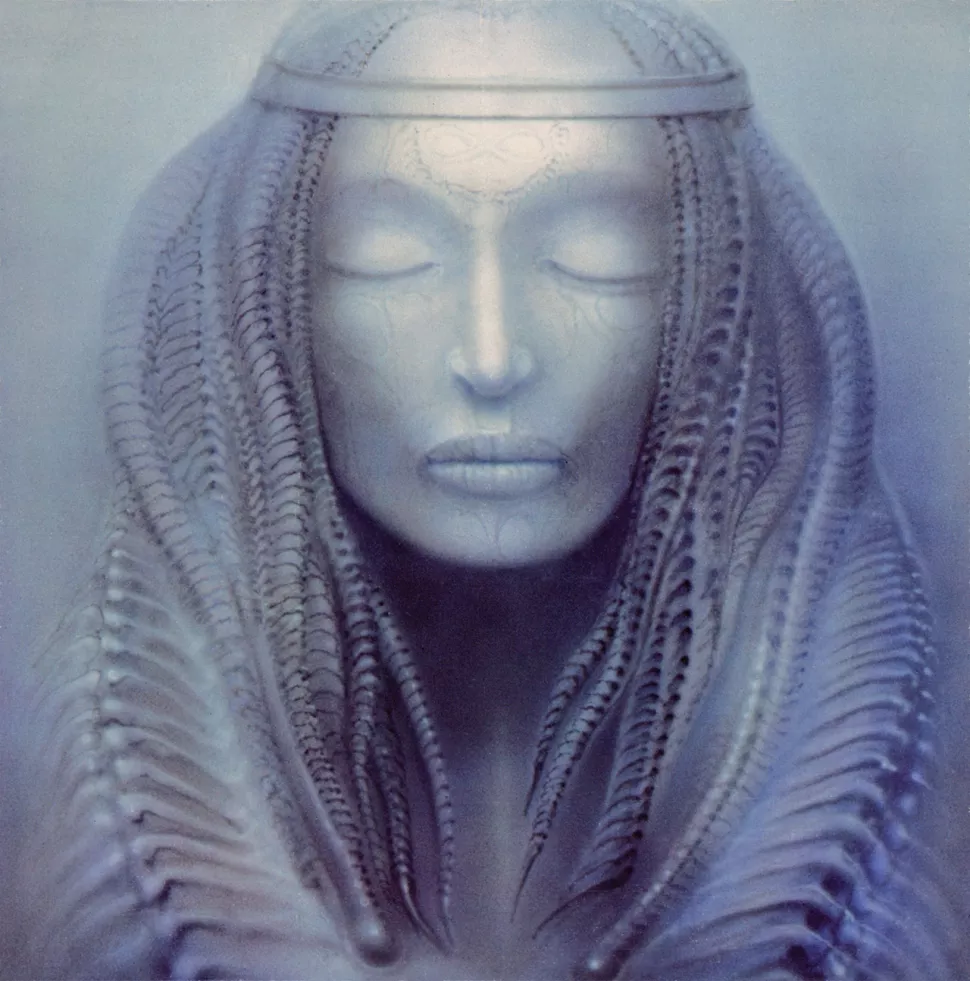
The fold-out cover sleeve, designed by the Swiss artist H.R. Giger, was also notable and, in fact, considered quite innovative as well. Given that the working title of the album had been “Whip Some Skull On Ya“—shorthand slang for fellatio—the skull triptych designs Giger was working on at the time seemed to find a perfect fit, even after the title was changed to Brain Salad Surgery.
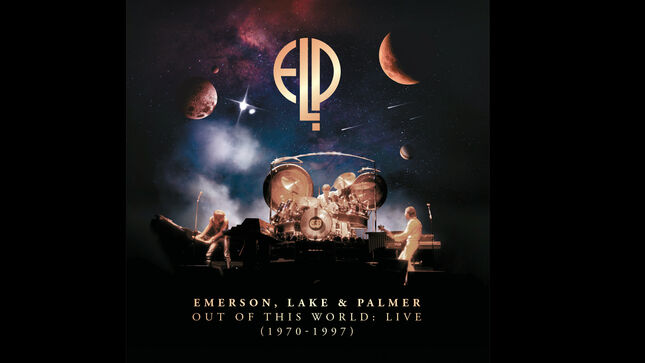
Prog legends Emerson, Land & Palmer will release a new 10 LP/seven disc live box set in October.
Prog legends Emerson Lake & Palmer were one of the early supergroups (formed from the roots of The Nice, King Crimson and Atomic Rooster in 1970) and cemented their legacy in the first half of the 70s. Often overblown, they stripped away much of the blues, soul and psychedelia from rock music, playing classical music like an insane robot. Immensely popular and rightfully so . ELP split at the end of the decade and reformed a number of times.
There is quite a live legacy, as the number of official live albums show. And while the 4 multi-disc box sets in the Official Bootleg series filled many a gap, the quality was often ropey at best. This album is just wonderful from the moment you open it up. Out of the box comes a booklet and five live albums in card sleeves, all gatefold, two of them double sets. That’s the weekend’s listening sorted then.
“Out Of This World: Live (1970-1997)” will be released through BMG Records on October 29 as part of Emerson, Lake &Palmer’s 50th Anniversary celebrations.
The new set pulls together five of the biggest and most important shows ELP played across their 50 illustrious years, including their performances at the Isle Of Wight Festival in 1970 and their headline show at the 1974 California Jam. You can view the new artwork and full track lisitng below.
“I could not think of a better way to celebrate this anniversary period for ELP. The box set is one of my proudest moments,” says only surviving member Carl Palmer. “I know Keith and Greg would agree with me! “Out Of This World” is something I will remember for a long time to come. For me, this shows ELP at their very best throughout years of touring and recording. The box set represents the lifeline of our music in our time.”
Each album has been reimagined with impressive new artwork, reflecting various aspects of the band and their epic, ground-breaking music. The LP box contains 5 x deluxe gatefold double LPs with high quality, fully-restored audio mastering.
Most of the LPs are previously unreleased on vinyl; Phoenix 1997 has never been released. The CDs have been out of print for many years and never released to this standard of artwork and audio. Each set comes complete with a 32-page, glossy photobook, featuring many intimate, rare and unseen images of the band from legendary photographers including Lynn Goldsmith and Neil Preston. Liner notes are provided by Prog Magazine Editor Jerry Ewing.
The Box Set:
Isle of White Festival 1970 The first set is the band’s debut performance at the August 1970 Isle Of Wight Festival (the DVD now long out of print).
The first set is the band’s debut performance at the August 1970 Isle Of Wight Festival (the DVD now long out of print). Opening track “The Barbarian” (from their eponymous debut) showcases the classical leanings, as much as the band’s technical craft. It’s fast and aggressive. As with much of their music, it is Keith Emerson’s keyboards take the lead. There’s a jazz metal element to Carl Palmer’s drumming too. The second track “Take A Pebble” is a gentler track, featuring vocalist and guitarist/bassist GregLake.
The audience response is muted, largely due to the fact that while the names were known, the band and music weren’t, it was a learning experience for everyone. Next up is a 35 minute run-through of Mussorgsky’s “Picture’s At An Exhibition” (which was the basis of a live album in it’s own right a year or two later). It’s a track that has everything; from folky whimsical sections to, at the heavier end, imagine a robot having an epileptic fit while playing rock’n’roll. Marvellous. A take on “Rondo” (The Nice) and a cover of “Nutrocker” close the set. “Rondo” is take from The Nice’s debut a few years earlier, which is often considered the first bone fide progressive rock album. And the disc here is completed by a band interview.
Isle Of Wight Festival, Newport, UK, 29 August 1970 1. The Barbarian 2. Take A Pebble 3. Pictures At An Exhibition: Promenade Part 1 / The Gnome / Promenade Part 2 / The Sage / The Old Castle / Blues Variation 4. Pictures At An Exhibition (Continued): Promenade Part 3 / The Hut Of Baba Yaga / The Curse Of Baba Yaga / The Hut Of Baba Yaga / The Great Gates Of Kiev 5. Rondo 6. Nutrocker 7. Interview
California Jam 1974 The second set is the band’s performance at the 1974 Opening track “Toccata” is pretty much a drum solo, then the gentler “Still You Turn Me On“, featuring some nice acoustic guitar from Lake. “Lucky Man” follows suit, and clearly a loved track from the audience cheer. There’s the usual Emerson piano improvisation before the highlight of 2 segments of “Karn Evil 9” (the full track comes form the Brain Salad Surgery album, a staple of any decent record collection).
California Jam, Ontario Motor Speedway, Ontario, California, USA, 6 April 1974 1. Toccata 2. Still … You Turn Me On 3. Lucky Man 4. Piano Improvisations (Including ‘Fugue’ And ‘Little Rock Getaway’) 5. Take A Pebble 6. Karn Evil 9 1st Impression Part 2 7. Karn Evil 9 3rd Impression 8. Pictures At An Exhibition: The Great Gates Of Kiev
Works Live 1977 The 3rd set is the double disc Works Live. Although previously released, it has been long out of print. It is the full and expanded show from which the original live set In Concert was taken. This concert is with an orchestra and is stunning
The 3rd set is the double disc “Works Live”. Although previously released, it has been long out of print. It is the full and expanded show from which the original live set “In Concert” was taken. There’s a selection of the usual and classic Emerson Lake & Palmer, coupled with tracks from the two “Works” sets. “C’Est La Vie” is the band although it is effectively a Greg Lake solo track, and the “Peter Gunn Theme” is always good. “Tiger In A Spotlight” gets the head nodding, and Keith Emerson’s take on Scott Joplin’s “Maple Leaf Rag” is excellent too. The sound and mix are good. A highlight is the cover of “Fanfare For The Common Man” (an unlikely hit single for the band). And several tracks feature a 70 piece orchestral.
‘Works Live’, Stade Olympique De Montreal, Quebec, Canada, 26 August 1977 1. Introductory Fanfare 2. Peter Gunn 3. Tiger In A Spotlight 4. C’est La Vie 5. Watching Over You 6. Maple Leaf Rag 7. The Enemy God Dances With The Black Spirits 8. Fanfare For The Common Man 9. Knife-Edge 10. Show Me The Way To Go Home 11. Abaddon’s Bolero 12. Pictures At An Exhibition: Promenade Part 1 / The Gnome / Promenade Part 2 / The Hut Of Baba Yaga / The Curse Of Baba Yaga / The Hut Of Baba Yaga / The Great Gates Of Kiev 13.Closer To Believing 14. Piano Concerto, Third Movement: Toccata Con Fuoco 15. Tank
Royal Albert Hall 1992 Set 4 is a nicely packaged gig at the Royal Albert Hall, 1992. Newer tracks “Black Moon”, “Paper Blood” and “Romeo & Juliet” sit nicely next to “Tarkus”, “Pirates” and “Fanfare For The Common Man“. Set 4 is a nicely packaged gig at the Royal Albert Hall, 1992, when the band had reformed for an excellent studio album or two. This show I had wanted to go to but it soon sold out. The band are solid, tight and it’s well recorded.
The Royal Albert Hall, London, UK October 1992 1. Karn Evil 9 1st Impression Part 2 2. Tarkus: Eruption / Stones Of Years / Iconoclast 3. Knife-Edge 4. Paper Blood 5. Romeo And Juliet 6. Creole Dance 7. Still … You Turn Me On 8. Lucky Man 9. Black Moon 10. Pirates 11. Fanfare For The Common Man / America / Rondo
Union Hall Phoenix 1997 (unreleased) The final set here is the 2CD Phoenix Arizona 1997, which showed that ELP still had a solid fanbase. The production is solid and modern,
The final set here is the 2CD Phoenix Arizona 1997, which showed that ELP still had a solid fanbase. The production is solid and modern, although as a general rule the tracks weren’t as long. “Honky Tonk Train Blues” gets a blast, “Take A Pebble” is the longest track on disc one at 8 minutes, and Emerson Lake & Powell’s Touch And Go gets a run out. Disc two is more classic ELP with “Tarkus” running to 12 minutes and “Pictures At An Exhibition” to 24. This is the kind of music prog rock fans live for. And a gem and highlight is the closing track, a medley of “21st Century Schizoid Man” (King Crimson) and “Rondo” (the Nice). This is music you can drink wine and chill out or rock out to, with ease.
Union Hall, Phoenix, Arizona, USA, 23 September, 1997 1. Karn Evil 9 1st Impression Part 2 2. Hoedown 3. Touch And Go 4. From The Beginning 5. Knife-Edge 6. Bitches Crystal 7. Creole Dance 8. Honky Tonk Train Blues 9. Take A Pebble 10. Lucky Man 11.Tarkus: Eruption / Stones Of Years / Iconoclast / Mass 12. Pictures At An Exhibition: The Hut Of Baba Yaga / The Great Gates Of Kiev 13. Fanfare For The Common Man (including drum solo) / Blue Rondo A La Turk 14. 21st Century Schizoid Man / America
Emerson Lake And Palmer were both classic and classical prog rock and this set is to be really enjoyed. Overblown, self-indulgent and marvellous all the way.
Much of this material has been officially released previously, some in a different format and all long out of print. The packaging is top-notch and there’s a colourful booklet with it too. Well worth your money, and a few hours listening too. A little bit more previously unreleased recorded to the same quality would have been the icing on the cake.
Recorded in the aftermath of King Crimson’s implosion in 1969, when two of its founding members unexpectedly quit the band, “In the Wake Of Poseidon” is an eclectic and experimental mix of bone-crunching riffs, Beatles-ish pop, tender ballads, soaring mellotron-drenched anthems and inscrutable atonal episodes. Highlights include Fripp’s savage guitar throughout Pictures Of A City and Greg Lake’s stunning vocal on the title track – his last with the group before his departure to form ELP. Thanks to the success of their 1969 debut, when In The Wake Of Poseidon was released in May 1970 it peaked at No.4 in the UK charts with one journalist proclaiming “If Wagner were alive today he’d work with King Crimson.”
47 years ago this album was, King Crimson’s second album, In The Wake Of Poseidon was released. Recorded in the aftermath of King Crimson’s implosion during their US tour in 1969, In The Wake Of Poseidon is the sound of an idea that simply refused to quit in the teeth of extreme adversity and apparently insurmountable odds. Understandably, the shock departure of half of the group had dented the confidence that had characterised King Crimson’s demeanour during much of the previous 12 months. Yet in a remarkable display of personal and artistic determination, Poseidon meets the challenge of retaining and developing the fierce originality of ideas that helped fuel King Crimson’s debut album. Whilst Court Of The Crimson King had been a truly collective endeavour, it was undeniably moulded to a large degree around Ian McDonald’s writing and musicality. With Fripp now in sole command of King Crimson’s musical direction, there’s a move into harder-edged, less rock orientated territories which would be expanded upon further in later Crimson records. Despite a superficial resemblance to Court, caused largely by a decision to sequencing the tracks in a way which mirrors the dynamics of side one of Crimson’s debut, In The Wake Of Poseidon deserves to be judged on its own merits and not merely as an adjunct of its more famous predecessor.
Without a working band, Fripp asked Greg Lake, then biding his time until the newly formed ELP could start work, to stay on as guest vocalist whilst also recruiting drummer Michael Giles (along with his bass playing brother, Peter) to return as session musicians. This was a solution that was practical as it was pragmatic. Having lived and worked together as Giles, Giles & Fripp during most of 1968, the core team responsible for laying down the tracks for the album had a proven track record of working quickly and efficiently. The pressure to maintain the commercial momentum of In The Court Of The Crimson King produced a surprise single release. Cat Food (backed with Groon) was issued in March 1970 was about as far removed from the debut album as it was possible to get. The anarchic mood of the song occasioned by Keith Tippett’s freewheeling piano and Greg’s mid-song laughter (caused by Fripp dropping his trousers whilst Lake was singing) made this one of the most unlikely single releases of the year.
Despite these factors, not to mention Peter Sinfield’s satirical lyrics, King Crimson’s profile at the time was such that the band were asked to lip-sync a performance of the song for the BBC’s prime time TV show, Top of the Pops. Perhaps unsurprisingly it failed to catch the ear of mainstream pop-pickers. Nevertheless, it signalled to critics and fans that Crimson was a going concern, and just as importantly, their ability to turn heads remained undiminished.
The haunting melody of Peace – A Theme (whose music dates back to 1968) opening and closing the album, provides a delicate and simple frame into which all kinds of stunning musicianship, dramatic themes and turbulent motifs, jostle and compete for attention. Pictures of a City is brimming with numerous guitar overdubs, a tour de force of densely- wrought picking. Here Fripp gathers the implications of Schizoid Man’s fast running lines, and constructs them into hurtling force in with his trademark dexterity and love of bone-crunching power chords is brilliantly harnessed. The heavyweight nature of Pictures is enhanced still further by guest sax player Mel Collins’ additional firepower. At the time of recording, Mel was still a member of Cirkus – a band which had shared the bill with Crimson and Keith Tippett’s group as part of the Marquee’s New Directions series of gigs the previous year. His work on this track, and in particular the sublime flute on Cadence and Cascade, ensured his recruitment to a new incarnation of King Crimson.
One of the last songs to be completed in the sessions, Cadence and Cascade like POAC, dated from 1969. Substantially revised in the Poseidon sessions, it quickly becomes one of Fripp and Sinfield’s most memorable collaborations. With Lake now off to ELP, he was unavailable for the final recording and his place on this track was taken by Fripp’s old friend, Gordon Haskell. Echoing both the sombre aspect of Epitaph and the hymnal qualities of Court, In The Wake of Poseidon is nevertheless an outstanding track in its own right. Its magnificent mellotron-driven chorus, inspired acoustic guitar interventions, astonishing drumming throughout, and the fragile beauty of Libra’s Theme contained within, is one of Fripp’s most heartfelt melodies every bit as equal to the yearning romanticism found in Peacock’s Tale (Lizard), the title track from Islands and the main instrumental melody from Starless.
When the album was released in May 1970 it was well received in the press, giving rise to the classic Melody Maker headline “If Wagner were alive he’d work with King Crimson”. Thanks to an irresistible combination of anticipation sparked by the runaway success of the debut, along with an overwhelming curiosity to find out what King Crimson would do next, Poseidon actually outsold Court in the UK album charts where it reached No.4. Poseidon was one of the King Crimson albums Steven Wilson was especially looking forward to remixing for 5.1. However, he was disappointed to discover that the multi-tracks for the Devil’s Triangle no longer existed. “Because it’s a bit of a soup, being able to go in and bring out some clarity and detail might have really helped it. As with so much other Crimson stuff, it has got a sense of ‘otherness’ that transcends so many of the other experimental pieces of the same era which haven’t dated well. Harmonically it’s very bizarre but it’s also a kind of prototype of the kind of thing they would try on Lizard in terms of its density and use of free-jazz piano. So there’s basically 12 minutes in the second half of the record where we’re having to rely upon the original stereo master. I think we have to count our blessings that we’ve been able to do what we’ve done so far because to go back and hope to find and work with tapes that are 40 years old is a tall order.”
Robert Fripp guitars & Mellotron, Michael Giles drums, Peter Giles bass Greg Lake vocals with guests MelCollins saxes & flute, Keith Tippett piano, Gordon Haskell vocals. Appears on In The Wake of Poseidon
On the evening of Monday January 13th, 1969, King Crimson formally began rehearsals in the basement of the Fulham Palace Road Cafe. After hauling their equipment down the stairs into their cramped rehearsal room Greg Lake, Ian McDonald, Michael Giles, Robert Fripp plugged in their instruments, and with Peter Sinfield operating lights and sound, played and worked on material for the next hour and a half.
King Crimson’s debut album, “In The Court Of The Crimson King”, was released. The recorded entered the UK charts and later, the US charts and catapulted King Crimson from underground cult act to mainstream success.
It was Fripp’s idea to subtitle the album “An Observation By King Crimson”, which had the effect of framing the five pieces within an implied concept of sorts. Fripp also his suggestion that there be no print anywhere on the exterior artwork. John Gaydon, Crimson’s co-manager at the time recalls Island Records were worried about objections from retailers who would be confused about the lack of information on the sleeve. “Fripp said, well, it’ll be the only record in the shop without anything down the spine on it, so they’ll know which one it is. Which was brilliant when you think about it.”
Housed in its distinctive cover painted by Peter Sinfield’s friend, Barry Godber, it remains the most widely recognised album by King Crimson.
This is the “Ur” record of progressive rock. It is by turns jarring and aggressive, lush, gorgeous and ethereal, depending on the track. It is an essential album because, even if you don’t think you like “Prog Rock,” it has such a variety of sounds, styles and moods, there is bound to be something you’ll find appealing.
Writing in the booklet accompanying the Epitaph box set Robert Fripp recalled “The cover was as strange and powerful as anything else to do with this group. Barry Godber, and Dik the Roadie, was not an artist but a computer programmer. This was the only album cover he painted. Barry died in bed in February 1970 at the age of 24.
The cover was as much a defining statement, and a classic, as the album. And they both belonged together. The Schizoid face was really scary, especially if a display filled an entire shop window.
Peter brought the cover into Wessex Studios in Highgate during a session. At the time Michael Giles refused to commit himself to it, nor has he yet. But Michael has also never agreed to the name King Crimson. We went ahead anyway.
The original artwork hung on a wall in 63a, Kings Road, in full daylight for several years. This was the centre of EG activities from 1970 and remains so today, albeit in its diminished and truncated form. For several years I watched the colours drain from the Schizoid and Crimson King faces until, finally, I announced that unless it was hung where it was protected from daylight, I would remove it. Several months later I removed it and it is now stored at Discipline Global Mobile World Central.”
In 1969, Rhett Davies, who would come to work with King Crimson on Discipline in 1981, was then employed in the Liverpool Street branch of Harlequin Records in London. He ensured that Crimson’s debut album occupied a whole window of the store. “I phoned up the label and asked them to send me over twenty album sleeves and I stuck a joint in one of the mouths!”
Rarely had an album sleeve so accurately echoed the shock-and-awe reaction which this extraordinary music produced in its listeners. Even the advent of the CD and the jewel-case has done little to dilute its iconic power.
Reflecting on the factors surrounding the making of the album, Fripp said “Any group working together has to have a common aim. The ‘69 band’s common aim was to be the best band in the world, whatever we understand by that, but that was the shared aim. Not the most successful band in the world, not the most famous band in the world – the best band in the world. And while you share that aim, and that is your primary focus together, things might happen.” Things certainly did happen for Crimson and at a dizzying speed. Just days after Lake, McDonald, Giles, Fripp and Sinfield began rehearsing in January 1969 in the basement beneath a Turkish cafe on the Fulham Palace Road, record companies were being invited down to listen to their hybrid mix of folk, rock, jazz and symphonic-hued compositions. As word began to spread about the group’s extraordinarily audacious abilities, one early interested party were The Moody Blues who fancied King Crimson might be the first outside signing for their soon-to-be-established Threshold label. “One or two of them came down with their producer Tony Clarke and we played two or three songs and they were impressed” recalls Fripp. A few days later the entire band came to see Crimson play at The Speakeasy. “They hadn’t heard the heavy stuff such as Schizoid Man or Court at that point. We were meant to be going to out on tour with them but they came and saw us live.” After that, Crimson were dropped from the support slot. “They knew we’d blow them off stage” concludes the guitarist.
The association with the Moody Blues continued however with Clarke as the would-be producer of Crimson’s debut album. After only a few sessions however, first in Morgan Studios and then Wessex Studios, Crimson found themselves increasingly dissatisfied with the results, opting to produce themselves. Given that they still had only a handful of gigs under their collective belt, one can’t help but think that this band must have had balls of steel to tell one of the best-selling producers his services were no longer required. “It wasn’t balls of steel it was just this wasn’t right. Look at it a different way; this has to be right. It wasn’t right. I believe we had a meeting in the EG Volkswagen Beetle and the decision was taken: if we produce ourselves we’ll make mistakes but they’ll be our mistakes and not someone else’s. Tony Clarke would get me strumming rhythm chords to I Talk To The Wind for hours through the night. Well, through the night is not my best time for working. Strumming lots of chords is not the best use of me as a guitar player. In other words, he didn’t see these artists; he didn’t see this band. Not really. He saw what he obviously thought was a good band at the very least and it would be good for him as a producer and he probably gave it his best shot, but it wasn’t the production for us. That’s not a criticism of him as a producer. It was just a mismatch between producer and artist. I saw him a few years after that at Heathrow. I can’t remember exactly what was said but there was an edge there. There was something not resolved for him. He seemed to have a bit of attitude about it. For me it was clear he wasn’t the producer for this band. It doesn’t mean the band’s bad or wrong or the producer; it’s just not the match.”
In the years that have followed its release the self-produced album has been widely regarded by many as having kick-started progressive rock. By July of that year, the band was performing in Hyde Park on the same bill as The Rolling Stones to an audience of up to 500,000 people. By October, the debut album: “In the Court of the Crimson King” was in the Top 5 of the UK album charts, shortly followed by a top 30 position in the US album charts and a No 1 slot – replacing Abbey Road – in the Japanese international chart. By December, following a series of US concerts finishing at San Francisco’s Fillmore West, the band’s first line-up had imploded.
1001 Albums You Must Here Before You Die cites Scizoid Man as “perhaps the first alternative anthem, featuring a gargantuan main riff,squalling sax and apocalytic visions.”
Mojo said “The intense brew of classical melodies, jazz and hard rock, matched with fantastical lyrics – and housed in an intriguing, lurid sleeve – created the template for progressive rock. All the more remarkable, then, that the music was created in a week.”
That’s a view that Steven Wilson, who remixed the album in 2009 shares. ”For me this the birth of progressive rock. Yes, there were other albums before that; you could say Sgt Pepper or The Moody Blues’ Days of Future Passed have a claim to laying down a blueprint of progressive rock, but In the Court.. really is the first time you have such technical prowess allied to musical experiments, great songwriting and a conceptual feeling all tied together in one record.”
While fans will argue the pros and cons of such an argument there’s no disagreement that Court represents one of the most coherent, cohesive and collectively powerful debut albums of the era.
As new generations of fans discover the album, barely a month goes by without an online reassessment of the record and barely a day goes by without it being cited as one of the most significant and influential rock albums to emerge from the 1960s.
Here’s how some of the music papers of the day reacted to In The Court of The Crimson King.
Melody Maker:
This eagerly-awaited first album is no disappointment, and confirms their reputation as one of the most important new groups for some time. It gives little idea of their true power on stage, but still packs tremendous impact especially the brutally exciting “21st Century Schizoid Man” and the eerie title track, with its frightening mellotron sounds. It’s not all high power stuff though – there’s some nice flute from Ian McDonald on the beautiful “I Talk To The Wind” and “Moonchild” is pretty, though too long. The vocals are clear and controlled and the instrumental work can hardly be faulted. This is one you should try and hear.
Disc:
The first LP from the group heralded by those who know to be the most exciting discovery of the year. Get over the most horrific cover of the year and you’ll find the pundits are not wrong. A brilliant mixture of melody and freakout, fast and slow, atmospheric and electric, all heightened by the words of Peter Sinfield.
International Times:
The Ultimate Album. There is little one can fault with it: the arrangements make masterful use of multi-tracking, compressing and reducing, the standard of playing almost defies belief at time, the vocals are merely excellent and the numbers are brilliantly and excitedly written.
I don’t like one of the numbers, despite my total commitment as a Crimson-Bopper, which is ‘Moonchild’ and is too long. Otherwise a gassy, jazzy, heavy, complex, smooth and totally magnificent album: written, arranged, played and produced by the most original group since …….. (fill in your answers to Apple Ltd., Saville Row, London., for instance.
NME
Long-awaited first album from the remarkable King Crimson, a group which manages to provoke either loathing or fanatical devotion but which is undoubtedly capable of building for itself a sizeable reputation. This stunningly-packaged LP provides a varied selection of King Crimson’s style, although it lacks some of the drive of the stage performances that have made their name. Nevertheless as a first album it is extremely good.
Daily Sketch
If you want to know where pop is going in the 70s listen to this. It is magnificent.
Finally, the American edition of Rolling Stone had this to say:
“There are certain problems to be encountered by any band that is consciously avant-garde. In attempting to sound “farout” the musicians inevitably impose on themselves restrictions as real as if they were trying to stay in a Top-40 groove. There’s usually a tendency to regard weirdness as an end in itself, and excesses often ruin good ideas.
Happily, King Crimson avoids these obstacles most of the time. Their debut album drags in places, but for the most part they have managed to effectively convey their own vision of Desolation Row. And the more I listen, the more things fall into place and the better it gets.
The album begins by setting the scene with ‘21st Century Schizoid Man’. The song is grinding and chaotic, and the transition into the melodic flute which opens ‘I Talk to the Wind’ is abrupt and breathtaking. Each song on this album is a new movement of the same work, and King Crimson’s favorite trick is to move suddenly and forcefully from thought to thought. ‘Epitaph’ speaks for itself: “The wall on which the prophets wrote/Is cracking at the seams…Confusion will be my epitaph.”
‘Moonchild’ opens the second side, and this is the only weak song on the album. Most of its twelve minutes is taken up with short statements by one or several instruments. More judicious editing would have heightened their impact; as it is, you’re likely to lose interest. But the band grabs you right back when it booms into the majestic, symphonic theme of ‘The Court of the Crimson King’. This song is the album’s grand climax; it summarizes everything that has gone before it: “The yellow jester does not play/But gently pulls the strings/ And smiles as the puppets dance / In the court of the Crimson King.”
This set was an ambitious project, to say the least. King Crimson will probably be condemned by some for pompousness, but that criticism isn’t really valid. They have combined aspects of many musical forms to create a surreal work of force and originality.
Besides which they’re good musicians. Guitarist Robert Fripp and Ian McDonald (reeds, woodwinds, vibes, keyboards, mellotron) both handle rock, jazz, or classical with equal ease. Bassist Greg Lake and drummer Michael Giles can provide the beat, fill in the holes, or play free-form. While Dylan and Lennon are still safe, lyricist Peter Sinfield does show a gift (macabre as it may be) for free association imagery.
How effectively this music can be on stage is, admittedly, a big question. The answer is probably not too well. Still, King Crimson’s first album is successful; hopefully, there is more to come.”
At the time of its release in the States, the track that seemed to get the most play was “21st Century Schizoid Man” a disturbing piece of sonic violence. But, there’s “I Talk to the Wind,” a guileless song with harmonies that remind me of sixties soft pop. “Moonchild (including the Dream and the Illusion)” is a narcoleptic study of contrasts, a mix of sparkling cymbal play over Ennio Morricone -stylized string parts (played, as best I can tell, on a Mellotron), transitioning to a series of softly ringing vibraphone sounds, discordant jazz guitar, keyboards, drum rattles and cymbal swells. In short, there is something for everyone, if you are willing to take the trip.
Pressings: there’s lot’s of controversy and some degree of mystery here. The early UK pink labels have matrix information showing A2/ B 2 or 3 or 4; there are even earlier copies with at least an A1 side and some that apparently share an A1/B1 matrix. (My copy is an A3/B3).
Then there’s the legend of the missing tape; the misaligned tape heads and the nasty distortion on the original mix down tape. (I always thought that was by design on Schizoid Man). My UK pink rim, with “U” designations has quieter surfaces than the earlier pink label, but doesn’t really sound any better. There’s a George Peckham (‘Porky’) mastered version floating around (I think those are all pink rims, not pink labels, so they shouldn’t bear a heavy price tag). There are multiple reissues, most of which I haven’t heard.
I did buy the 2010 vinyl re-do, re-mastered digitally and taken from the “missing” first generation mix tapes that had been re-discovered. That “re-do” sounds flatter and less full-dimensioned than either the pink label or pink rim, but that’s most apparent on the “soft” tracks; however, when I switch to the pink label, where I can get more “dimension,” I’m also hearing more distortion and surface noise, particularly on these softer tracks. If you are going head-on with Schizoid Man, it’s a toss up- a biting, nasty piece of work at best.
The Steve Wilson remix, which is offered in a variety of formats (I have yet to see or hear a vinyl version of that), with alternate tracks, apparently relieves some of the distortion. If you are into obscurities, the album was originally released in New Zealand as a Vertigo Swirl!
Which one(s) would I buy? Probably an early Island UK pink rim if it is cheap enough. The sonics of this album are challenging, but it is worth having a copy when you are in the mood, and possibly, even when you are not.
King Crimson aren’t so much a band as a series of bands, all featuring and led by idiosyncratic guitarist Robert Fripp. With a demeanour that resembles a University professor more than a rock star, Fripp’s plotted an erratic course for his band. The group formed in London in 1968, but their ninth album, 1982’s Beat, was the first time the band’s lineup remained the same for two consecutive albums.
While the term “progressive rock” has come to mean a specific style of music that’s symphonic and complex, KingCrimson’s shifting lineups, fondness for improvisation, and changes of musical direction mark them as truly progressive. This daring approach can make for some difficult listens, but makes them constantly interesting – their discography is a wild ride, especially in the early 1970s as Fripp struggled to replace the mighty lineup that created their stellar 1969 debut, In The Court of The Crimson King.
A look through King Crimson’s studio discography is absolutely huge but here are five favourite albums, but you should bear in mind that a lot of their live material is also universally acclaimed albums like Epitaphfrom the initial lineup or Absent Lovers from 1984 are considered key parts of their discography.
Starless and Bible Black (1974)
I actually bought this album at the time because I loved the sleeve artwork, And of all King Crimson’s line-ups, my favourites and because of John Wetton’s vocal, the mid-1970s iterations of the band, featuring John Wetton on bass and vocals and Bill Bruford on drums. Starless and Bible Black is less coherent than the two albums that bookend it, as it’s largely formed around live improvisations, but it’s still full of highlights like the complex, heavy instrumental ‘Fracture’ and the beautiful ‘The Night Watch’.
Released in March 1974, the bulk of Starless And Bible Black is a live album with all traces of the audience skilfully removed. Coming between the startling inventions of Larks’ Tongues In Aspic, and the far-reaching repercussions of Red, Starless And Bible Black is a powerful and experimental album mingling live recordings with stand-alone studio tracks. Brimming with a confidence borne out of the band’s increasing mastery of the concert platform as a basis for inspired improvisations, the sparse, pastoral beauty of Trio, the impressionistic, sombre moods of the title track, and the complex, cross-picking rhythmic brilliance of Fracture all stand testimony to the musical ESP that existed between Cross, Fripp, Wetton and Bruford. A classic and compelling blast of KingCrimson as you’re likely to hear.
Discipline (1981)
After breaking King Crimson up in 1974, Robert Fripp rebooted the band in 1981, retaining Bill Bruford from the previous lineup, and adding guitarist and vocalist Adrian Belew and Tony Levin on Chapman Stick and bass. The new lineup’s extreme virtuosity is impressive, a unique blend of new wave, progressive rock, and world rhythms.
After seven years away from the public King Crimson returned in 1981 with a brand-new incarnation. Joining Robert Fripp and Bill Bruford are ex-Zappa/Bowie guitarist, Adrian Belew and ace session and Peter Gabriel bassist, Tony Levin. Incorporating sounds reminiscent of the resonant chimes of ancient gamelan music and the sleek, clear lines of modern minimalism,this Anglo-American combination forged a startlingly different musical vocabulary. Frame By Frame, Thela Hun Ginjeet and the album’s title track in particular, showcase Belew and Fripp’s dovetailing guitar parts and Levin and Bruford’s cyclical grooves, forming a mesmeric sound unlike anything heard before on any previous King Crimson albums. The shimmering, hypnotic textures of The Sheltering Sky and savagely raucous Indiscipline provide aleatoric counterweights to the album’s tightly-controlled complexity.
Larks Tongues in Aspic (1973)
After a few unconvincing albums in the early 1970s, Fripp replaced his entire band, bringing in Wetton and Bruford along with percussionist Jamie Muir and electric violinist David Cross. The record is split between complex instrumentals, like the two parts of the title track, and strong songs like ‘Exiles’ and ‘Easy Money’, featuring Wetton’s gritty vocals. King Crimson’s 1973 album marked a radical departure from everything they’d previously done. With guitarist Robert Fripp as the only survivor from the original line-up, the new line-up featuring the heat-seeking work of ex-Yes drummer Bill Bruford and the virtuoso bass work of ex-Family bassist John Wetton, who also took on vocals here, presented a breath-taking tour of killer riffs, jaw-dropping dynamics, and poignant ballads. Featuring pastoral Vaughan Williams-style interludes from violinist David Cross, this line-up also embraced a spikier sound that was both willing to rock out, as on the unhinged complexities of LTIA Pt2, as well as explore and experiment with unorthodox textures and atmospherics thanks to eccentric percussionist Jamie Muir.
In The Court of the Crimson King (1969)
King Crimson immediately made an impact with their debut, with Fripp sharing the limelight with Greg Lake on vocals and bass, Michael Giles on drums, and Ian McDonald on woodwinds; McDonald contributed a lot of the song-writing to the album. It’s not perfect, as ‘Moonchild’ drags, but it’s a landmark of progressive rock, effectively defining the symphonic prog genre with highlights like ’21st Century Schizoid Man’ and ‘Epitaph’. This remains King Crimson’s only gold record – they never capitalised on its success, as the initial lineup disintegrated – Lake went on to form Emerson, Lake and Palmer.
Described by The Who’s Pete Townshend as ‘an uncanny masterpiece’, King Crimson’s debut was released in October 1969 becoming an instant chart hit on both sides of the Atlantic – not bad for a band who only got together less than ten months earlier. 21st Century Schizoid Man showcases the band’s ability to blend music that had the brutal attack of a claw hammer yet wielded with the skilled precision of a surgeon’s scalpel. Consisting of a visionary blend of gothic ruminations, anthemic Mellotron-laden grandeur, ornate arrangements and introspective folkish abstractions, the album was a huge influence on bands such as Yes and Genesis and countless other acts on the ‘70s rock scene. The albums distinctive sound is as fresh, bold and as startling as when it first appeared.
Red (1974)
Gradually whittled down to a trio over the previous couple of records, the dominant sound on Red is the hard, complex rock of the title track and ‘One More Red Nightmare’ from Wetton, Fripp, and Bruford. But it’s the majestic closing ‘Starless’ that’s the gem of King Crimson’s oeuvre, a twelve minute epic that builds to a triumphant, unforgettable climax. Starless is one of King Crimson’s most popular songs came when the view counter for the video of the song performed by the Radical Action team tipped over the 3 million mark.
The song which originally closed off the ’70s incarnation of the band was reinstated to the KC setlist in 2014, 40 years after it had last been performed, and has stayed there ever since. The version posted on the King Crimson Youtube Channel is taken from 2016’s Radical Action to Unseat the Hold of Monkey Mind. In case you’re not one of the three million people-plus to have watched it,
Recorded at the end of two lengthy tours of the USA in 1974, the final album of the 1970s finds King Crimson in an raw and uncompromising mood. Consisting of Crimson founder guitarist Robert Fripp, bassist and vocalist JohnWetton and drummer Bill Bruford, the trio serve up a sound that’s metal-edged, gritty and powerful. Opening with the classic bulldozer instrumental title track, the album contains a typically eclectic mix that includes the jazzy rock of Fallen Angel, the punchy attack of One More Red Nightmare, the unsettling but dazzling near-telepathic improvisation of Providence and the stirring anthem, Starless whose opening ballad section gives way to a moving and emotional climax that is frequently cited as the ultimate King Crimson listening experience.
• The remastered CD versions of the 11 classic original ELP albums (1970-94), with original sleeve artwork reproduced:
• EMERSON, LAKE & PALMER (1970)
• PICTURES AT AN EXHIBITION (1971)
• TARKUS (1971)
• TRILOGY (1972)
• BRAIN SALAD SURGERY (1973)
• WELCOME BACK, MY FRIENDS, TO THE SHOW THAT NEVER ENDS (1974) (2CD)
• WORKS VOLUME 1 (1977) (2CD)
This lavishly packaged, super-deluxe, multi-component rigid box set showcases the immense musical talents of Keith Emerson, Greg Lake and Carl Palmer.
Fanfare contains a wealth of exciting ELP treasure, including: Triple vinyl LP of previously unreleased live audio, all the original album CDs (remastered versions), previously unreleased live CDs and BBC archive material, 5:1 album mixes audio blu ray, 7” singles, deluxe hardback photo-book with rare photos and extensive sleeve notes, reproduced original tour programmes and poster, enamel ELP pin badge.
Each Box will be numbered and every pre-order here will receive an exclusive bonus CD of the previously unreleased BLACK MOON – ROUGH ALBUM MIXES.
Greg Lake vocalist and bassist of Emerson Lake and Palmer died yesterday (December. 7th) after what the band’s Facebook page describes as “a long and stubborn battle with cancer.” He was 69.
Greg Lake, who came to fame as the singer on King Crimson’s classic first two albums, formed ELP in 1970 with drummer Carl Palmer and keyboardist Keith Emerson from the Nice. The group went on to become one of the biggest progressive rock bands of the ’70s on the strength of their jazz and classical music-influenced compositions.
This is the second loss in a year Emerson, Lake and Palmer . Keyboard player Keith Emerson died of a self-inflicted gunshot wound, in March this year after battling depression and a degenerative nerve issue which was effecting his playing .
“It is with great sadness that I must now say goodbye to my friend and fellow bandmate, Greg Lake,” Carl Palmer said in a statement. “Greg’s soaring voice and skill as a musician and songwriter will be remembered by all who knew his music and recordings he made with ELP and King Crimson. I have fond memories of those great years we had in the 1970s and many memorable shows we performed together. Having lost Keith this year as well, has made this particularly hard for all of us. As Greg sang at the end of Pictures at an Exhibition, ‘Death is life.’ His music can now live forever in the hearts of all who loved him.”
Lake became friends with King Crimson leader Robert Fripp while in school. Even though he had been playing guitar since he was 12, Fripp encouraged him to switch to bass, the instrument Lake would play for most of his career. He was in the band for only a year, recording the now classic “In The Court Of The Crimson King”
Their debut album In the Court of the Crimson King featured such songs as 21st Century Schizoid Man.It set a standard for progressive rock and received a glowing, well-publicised testimonial from The Who’s Pete Townshend, who called it “an uncanny masterpiece”. But within a year, founding member Mike Giles quit and Lake refused to work with the band – although he stuck around long enough to sing on their second album, In The Wake Of Poseidon with King Crimson.
While on tour with the group, Lake met Emerson, who played keyboards in one of the opening bands, the Nice. Even though Lake was more of a rock ‘n’ roll player than the classically inclined Emerson, the pair formed, along with Atomic Rooster drummer Carl Palmer, Emerson, Lake & Palmer made their live debut at the Guildhall in Plymouth in 1970 before giving a career-making performance at the Isle of Wight Festival.what was then a sort of supergroup.
The trio released eight albums in the ’70s before breaking up at the end of the decade. They reunited for two more albums in the early ’90s. Lake and Emerson also released one album in 1986 with drummer Cozy Powell as Emerson, Lake & Powell.
Greg Lake also had some solo success, most notably with his 1975 song “I Believe in Father Christmas,” which reached No. 2 on the U.K. chart. In 1983, he joined Asia for a year, replacing John Wetton (who had replaced Lake in King Crimson a decade earlier). Over the years, he’s led the Greg Lake Band, and toured with his old ELP bandmates in different configurations.
On this date 46 years ago King Crimson released their debut album, In The Court Of The Crimson King.
In the Court of the Crimson King (subtitled An Observation by King Crimson) by the British rock group King Crimson, released on 10th October 1969. The album reached number five on the British charts,
The album is generally viewed as one of the first works to truly embody the progressive rock genre, where King Crimson largely departed from the blues influences that rock music had been founded upon and mixed together jazz and classical symphonic elements. In his 1997 book Rocking the Classics, critic and musicologist Edward Macan notes that In the Court of the Crimson King “may be the most influential progressive rock album ever released”.The Who’s Pete Townshend was quoted as calling the album “an uncanny masterpiece”. In the Q & Mojo Classic Special Edition Pink Floyd & The Story of Prog Rock, the album came fourth in its list of “40 Cosmic Rock Albums”.
The album was remastered and re-released on vinyl and CD several times during the 1980s and 1990s. All of these versions were based on tape copies that were several generations removed from the originals. The original first-generation stereo master tapes were thought to be lost, but were finally located in a storage vault in 2003. This led to a much improved remastered CD version (see below), released in 2004. Recorded at Wessex Sound Studios between 21st July and 21st August 1969.
Once again, in time for the album’s 40th anniversary, the album was re-released both on vinyl and CD with newly cut masters approved by Robert Fripp. The CD/DVD set includes a stereo and 5.1 mix done by Steven Wilson, as well as the original mix.
King Crimson made their live debut on 9th April 1969, and were on the bill for the Rolling Stones at Hyde Park in July 1969 before an estimated 250,000 to 500,000 people.
Initial sessions for the album were held in early 1969 with producer Moody Blues producer Tony Clarke. After these sessions failed to work out, the group were given permission to produce the album themselves. The album was recorded on a 1″ 8 track recorder at Wessex Sound Studios in London, engineered by Robin Thompson, and assisted by Tony Page. In order to achieve the characteristic lush, orchestral sounds on the album, Ian McDonald spent many hours overdubbing layers of Mellotron and various woodwind and reed instruments.
Some time after the album had been completed, however, it was discovered that the stereo master recorder used during the mixdown stage of the album, had incorrectly aligned recording heads. This misalignment resulted in a loss of high-frequencies and introduced some unwanted distortion. This is evident in certain parts of the album, particularly on “21st Century Schizoid Man“. Consequently, while preparing the first American release for Atlantic Records, a special copy was made from the original 2-track stereo master in an attempt to correct some of these anomalies. (The analog tape copying process usually results in generation loss). From 1969 to 2003, this second-generation “corrected” copy was the source used in the dubbing of the various sub-masters used for vinyl, cassette and CD releases over the years. The original, “first-generation” stereo masters, however, had been filed away soon after the original 1969 mixdown sessions. These tapes were considered lost until 2003.
On November 19th, 1973, Emerson, Lake & Palmer released their fourth album “Brain Salad Surgery”. Greg Lake wrote the lyrics for the album with the assistance, on two tracks, “Karn Evil 9: 3rd Impression” and “Benny the Bouncer” of former King Crimson bandmate Peter Sinfield. This was the first Emerson, Lake & Palmer album to have no songwriting contributions from Carl Palmer. The cover art is by H. R. Giger.
After they released Trilogy, the band decided to make an album that they could perform live. Trilogy was recorded on the 24-track machines with a lot of overdubbing, and that made the music difficult to recreate the songs on stage. The band purchased a cinema and would perform the music “live” on the stage, then write, perform again, write, etc., resulting in a feeling of addressing the audience directly and a more Live feel to the production.
For ELP were huge, their every gesture enormous, their deliciously overblown muse utterly titanic and, my God, were we impressed?
Even the ever-cynical bubble-popping hacks of the NME saw their prose grow ever more purple as they snatched desperately for the requisite adjectives to describe just how ‘not worthy’ we all were. Carrying an Emerson Lake & Palmer album under your arm became the schoolboy equivalent of Mensa membership; it screamed to all who gazed upon you that: ‘He gets this: ergo he is old enough to shave, Here, then, was true sophistication, a vinyl passage-to-manhood in a cardboard sleeve.
Prog-rock behemoth Emerson Lake & Palmer unleashed their ultimate album: Brain Salad Surgery, the record that marked the pinnacle of their creative extravagance,
ELP had long since abandoned the constraints of the stultifying three-minute form. By introducing both classical and jazz elements to cutting-edge rock technology, ELP appeared to be nothing less than larger-than-life progenitors of a giant evolutionary leap forward; One day, we mused, all bands will be as unapologetically enormous as this. But, with our awe-stricken pre-punk appetites whetted for the unfeasibly massive, we craved something even more gargantuan from our three heroes, and like all true thrill-seekers were compelled to push the envelope yet further.
We wanted the hugest, most ear-boggling sounds from the furthest technological frontier available to modern man; we wanted the fastest and most intricate keyboard runs and percussive paradiddlings audible to the human ear; we wanted lyrics that we couldn’t possibly understand; and, most importantly of all, we wanted them in morbidly obese half-hour slabs.
Coming up to the recording of Brain Salad Surgery, Emerson Lake & Palmer seemed unassailable. They’d been voted, both collectively and individually, to the very top of every readers’ poll extant and had just set up their own Manticore label which ostensibly gave them greater artistic freedom than ever before.
“We’d had a long lay-off,” Keith Emerson recalled, “and were really unsure of what direction we should go in. All our previous stuff had gone gold, which we were very thrilled about, and we simply wanted to augment upon that. But it took me a long time because I never like to jam around and play indiscriminately whatever it is that comes into my head. But I do remember arriving at Advision Studios with this fugue design, Greg learning the notes and it being a pretty painless procedure. We were all inspired and one thing would lead to another. We’d all contribute and that’s what a band should be. Whether or not you regard yourself as a composer, it doesn’t really happen unless everybody else involved enjoys playing what you’ve written.”
“We quickly learned that whatever you put on a record you’d have to play live,” added Greg, “So we started preparing the records in the same way that you’d prepare a tour. Brain Salad Surgery was made by rehearsing live in a cinema. We bought a cinema – now that was an indulgence – and rehearsed it in there until we got it in a state where we thought it was good. Then we took it to the studio for an upgrade, but would essentially record live – which was one of Keith’s great abilities. That way, when we finally took it back on to the stage we knew how to play it.”
“It was recorded at a time when the band felt incredibly warm to each other,” said Carl, “and, while I think it marks the height of ELP’s creative powers, it came very quickly. I can’t remember having to labour over much of it, and I don’t think it took more than six weeks to make. “I just remember it as being a very lovable period really. Just so experimental; I was laying cymbals on the floor for overdubs to get a different sound, and we were putting keyboards into different rooms, putting a microphone into the street to get ambient noise and it was just fantastic. It was one of those things that just happened and you wish would happen every time you go into the studio.”
“Brain Salad Surgery” included extra lyrics from Pete Sinfield (Greg Lake: “I worked with him in King Crimson and while I’m not a bad lyricist, Pete’s better”), stunning cover art from the then relatively unknown HR ‘Alien’ Giger. “The working title was Whip Some Skull On Ya,” expounded Keith, “until our tour manager pointed out a Dr John lyric that features the line ‘give me some Brain Salad Surgery’ which, in the vernacular, means the same as Whip Some Skull On Ya: a blow-job, basically.”
Emerson Lake & Palmer toured tirelessly (not least in support of Brain Salad Surgery) and with their own proscenium arch, as well as every kind of revolving instrument that you ever thought possible, including some that you hadn’t, like a grand piano that flipped end-over-end while a strapped-in Emerson hammered manfully at the ivories like an unholy cross between Arthur Rubinstein and Biggles. But according to an ostensibly impenetrable party line the trio were usually far too pooped from on stage improvisation to reach for the proverbial mud shark.
Keith Emerson’s father played piano competently enough by ear, but when his young son started to mimic his decidedly amateur ivory-tinkling he insisted upon paying for some expert tuition for the boy. Lessons with Mrs Smith were “really boring to begin with”, but the benefits of his new-found skill soon began to pay dividends: “I became popular at school,” remembered Keith, “and avoided a lot of bullying simply by playing all the rock’n’roll tunes of the day.”
After making his first public appearance at the local rifle-club dinner and dance Emerson set about honing his own style: “I wasn’t into the genre of the day – The Beatles, Stones and Yardbirds – I fancied myself more as a jazz player. Then I got more into blues and – after hearing guys like Brother Jack McDuff on the Hammond organ.” In late summer 1965, Emerson joined established Brighton-based R&B group, Gary Farr & The T-Bones: “I found playing with them acceptable because Gary Farr, who was a pretty good blues singer, had jammed with Sonny Boy Williamson and when T-Bone Walker came over to play the clubs we’d back him.”
Following a brief spell with Island Records’ first non-Jamaican recording artists, The VIPs, Emerson formed The Nice, a band that rapidly developed a flamboyant style of virtuoso cross-generic experimentation, but started life as the relatively anonymous sidemen to PP Arnold: a former Ike & Tina Turner Ikette, hand-picked for stardom by Mick Jagger and summarily signed to Andrew Oldham’s Immediate label. “[Nice bassist] Lee Jackson was a late addition to the T-Bones,” Keith recalled, “and we’d often jam backstage at gigs. I’d play some Brubeck or Bach.
“I loved the guitar,” smiled Greg Lake, his reminiscences still characterised by the slightest suggestion of a lilting Dorset burr. “I loved playing, not only was it an open door to a career, there was also this mass adoration thing. It was the early days of The Beatles so it became the fashion to scream; I remember distinctly coming out of gigs and the van would be completely covered in lipstick. Following a couple of years spent gravitating through the ranks of The Time Checks and The ShameGreg ultimately relocated to London to join future Uriah Heep members Lee Kerslake and Ken Hensley in The Gods. Heavy duty gig rotation earned the band a deal with EMI, but on the eve of their first recording date The Gods fell apart.
“When we were boys,” said Lake, “Robert Fripp and I went to the same guitar teacher – a guy called Don Strike – and used to play duets together. Robert would come along and watch me before he was in a band, but he eventually formed a very strange outfit called Giles, Giles & Fripp. They’d made this album for Decca called The Insanity Of Giles, Giles & Fripp.
Robert gave me the call and said, ‘Hello, my dear’ in his West Country accent. ‘Would you be interested in being the lead singer for the band?’ he asked, and I said, ‘Yeah’ – because they had a record deal, which was fantastic. But then he said, ‘The only thing is, we don’t need two guitarists. Will you play bass?’ So that’s how that started.”
The Lake-augmented combo were re-named King Crimson. King Crimson, featuring the quintessentially English, choirboy clarity of Greg Lake’s vocals, had supported The Nice on a number of previous occasions but it wasn’t until this crucial juncture that Emerson really started to take notice of their singer’s not insubstantial melodic potential. And, when he was informed that not only could Lake double up on bass but also played lead guitar, offered the choice between remaining with Robert Fripp or accepting a fresh challenge with Keith Emerson, Lake ultimately opted for the latter. You’re probably comfortably ahead of me here, and primed for the inevitable arrival of pot-free zone Carl Palmer in the soon-to-be-revolving drum stool.
Upon answering a classified advertisement in The Birmingham Mail, young Carl Palmer found himself auditioning for local R&B chancers The King Bees at the Plaza Ballroom, Handsworth, conveniently situated at the top of his road. “I expected them to give me music and they didn’t,” remembered Palmer, “They gave me a bunch of forty-fives and said, ‘Learn those and come back tomorrow’. I thought that was kind of bizarre, so I dashed home, charted them out immediately and couldn’t believe how easy they were.”
Carl Palmer was a King Bee before the day was out. Eight months of gruelling all-nighters later and the tireless 16-year old caught the eye of Chris Farlowe who offered him a job on the spot. Carl’s transition from moonlighting Black Country schoolkid to scene-making London circuit pro was nothing if not swift: “I left school on the Friday, left home on the Sunday, did the audition on the Wednesday and was working in Chris Farlowe’s Thunderbirds by the following weekend. It was an exciting time, certainly, but Palmer remained uncommonly astute, and set about securing all the extracurricular session work he could find. Tireless networking paid off when star management team Kit Lambert and Chris Stamp called Carl in to record sessions with The Crazy World Of Arthur Brown, for when the band’s original drummer Drachen Theaker bailed for “some kind of religious sect” midway through an hallucinogen-fuelled American jaunt, it was Palmer who leapt into the breach.
The Crazy World were riding high after their hit single, Fire, but as the band endeavoured to snort Haight-Asbury whole, the drug experience began to take its toll and after a few months of sustained psychedelic fame Arthur disappeared and Carl formed Nice-styled, super-heavy power trio Atomic Rooster with keyboard player Vincent Crane. “I was only ever interested in playing in a three-piece group,” Palmer recalled, “but when Keith asked me if I was interested I was apprehensive because Atomic Rooster were doing incredibly well and I’d just bought a Mercedes van. I knew of The Nice, obviously, but I didn’t know who Greg Lake was. I knew of King Crimson but I didn’t know he was the singer, so I was a bit apprehensive.
ELP made their big-league debut at the 1970 Isle Of Wight festival,
Happy 41st Birthday to “Brain Salad Surgery”. Welcome back my friends,








 The Fat Angel Sings