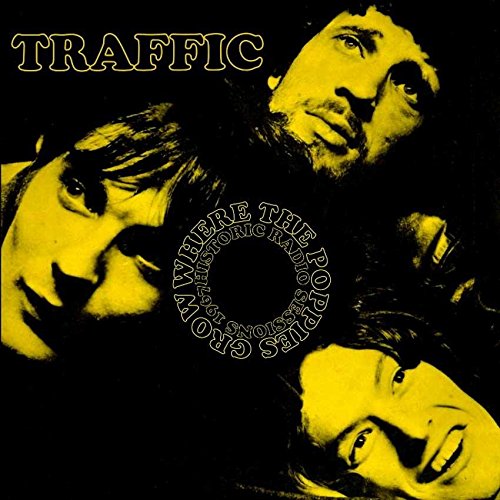
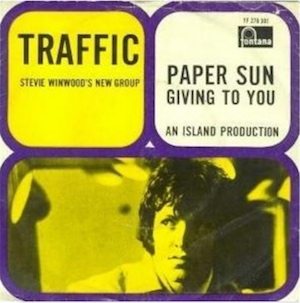
Steve Winwood formed Traffic with Jim Capaldi, Dave Mason, and Chris Wood in 1967. In the spirit of the times, the group was intended to be a cooperative, with the members living together in a country cottage in Berkshire and collaborating on their songs. Signed to Island Records their single “Paper Sun,” peaked in the U.K. Top Five in July 1967 and also spent several weeks in the lower reaches of the charts in America. Traffic recorded two sessions for Saturday Club and Top Gear shows in 1967. Session 1 first aired October 1967 while Session 2 first aired December 1967 recorded for the BBC Top Gear programme. Both are released here for the first time. Traffic also toured Europe and the live recording that comprises part two of this album was also made for radio broadcast, this time in Sweden at Radiohuset, Stockholm on September. 12th, 1967
John Peel’s legendary status is defined by the vast amount of bands and artists he championed. His urge to “hear something he hadn’t heard before” led to a relentless search through demo tapes sent in to his radio show from songwriters and musicians looking for a break. His conviction in not following conventional programming formats, and offering his listeners an alternative to daytime pop pap would ensure that his relevance to broadcasting would remain vital right up to his untimely death in 2004. Chris Wood’s Flute playing is amazing on this. Their BBCSessions deserve to be officially released! As does the Copenhagen ’67 Concert.
His sessions would become an important outlet for new listeners to sample live selections from fledgling and established artists. Many of these recordings have been released to the public, some remain in the vaults. Here is a continuing history of all the sessions, starting in 1967 for his “Top Gear” show right up to the final recording in October 2004.
December 11th 1967: Traffic John Peel Session Studio – 201 Piccadilly, Studio 1
Tracklist:
Here We Go Round The Mulberry Bush
Heaven Is On Your Mind
No Face No Name No Number
Dealer
Hope I Never Find Me There
The Band:
Jim Capaldi – drums, acoustic guitar, lead vocals, Dave Mason – electric guitar, bass, vocals Steve Winwood – electric guitar, keyboards, vocals Chris Wood – flute. percussion ,
Over the years there have been many records that have been given the tag, “lost classic” or “forgotten masterpiece”, and perhaps many of them are. But I like to think that this Dave Mason album released in June 1970 in America is one such Classic. Dave had left Traffic and gone to the West Coast where he had met producer Tommy LiPuma who signed him to his, Blue Thumb Records – a label whose smattering of releases since 1968 included Captain Beefheart’s Strictly Personal, Aynsley Dunbar’s Retaliation and W.C. Fields’s, Anyone Who Hates Dogs and Children Can’t Be All Bad.
Dave Mason’s reputation was such that he attracted some of the best musicians around including some from JoeCocker’s Mad Dogs and Englishman band. There’s Leon Russell, drummer, Jim Keltner, guitarist, DonPreston and singers Claudia Linnear and Rita Coolidge. Drummer, Jim Gordon and bass player Carl Radle, were also in the Cocker band and they, soon after recording “Alone Together”, become the Derek and theDominos’ rhythm section; Larry Knechtel who played the piano on Bridge Over Troubled Waters also plays bass on Mason’s album. You get the picture, it really was the best musicians that could be assembled in 1970.
Recording was at Sunset Sound and Elektra Recording Studio with Bruce and Doug Botnick handling the engineering and Tommy LiPuma and Dave himself acting as producers; Al Schmitt did the mixing. We namecheck them because it’s the ‘sound’ of this record that is one of its strengths. It really did ‘play’ better than so many records at the time.
Aside from the brilliant musicianship what shines though on this record is Dave Mason’s song writing, there is not a dud among the eight tracks. The album opens with ‘Only you Know and I Know’, which could so easily have been a track from Mad Dogs – it has all the trademarks. ‘Can’t Stop Worrying, Can’t Stop Loving’ is the musical polar opposite from the groove of the opener. It is a delicate ballad that features Dave’s plaintive vocals; so often over-shadowed in Traffic by Stevie Winwood.
‘Waitin’ On You’ is back in the groove with some funky electric piano from Leon Russell. Side one of the original record closes with the stately, towering, ‘Shouldn’t Have Took More Than You Gave’ that is one of the real stand out tracks; it features Mason’s brilliant wah-wah guitar – the best since Eric Clapton’s ‘Tales of Brave Ulysses’, Leon Russell’s piano is just as superb.
‘Sad and Deep as You’ opens the second side and is another reflective song from Dave and it again shows that he’s no slouch in the vocal department. ‘World In Changes’ is a great song, acoustic layered guitars build under Dave’s vocal and the track brings out the best in the musicians – so tight and together. Russell’s organ underpins the whole track and he’s allowed a great solo towards the end of the song.
The penultimate track, ‘Just A Song’ is redolent of The Band and the beginnings of Americana, with its banjo motif and the gospel infused backing vocals from Bonnie Bramlett, Claudia, Rita and co. The album’s closer is arguably its best track, ‘Look at You Look at Me,’ a song Mason cowrote with Traffic’s drummer, Jim Capaldi, who also plays on it with his trademark tight sound. This is one of those songs that you can play to people and they will instantly ‘get it’. It’s quintessential 1970s rock…and that’s no bad thing.
When the album came out Billboard said, “Mason with help from friends Jim Capaldi and Leon Russell proves his mastery of the rock idiom once and for all. The lyric content and music content of every song catches the senses of the listener and creates excitement.” That sorta nails it, but this is an album that will take repeated listenings, trust us, we’ve been playing regularly for 45 years. It also reminds us that 8 songs does make an album, less can so often be more. Alone Together is perfection. As a little footnote, when the original LP came out it was a masterful piece of packaging, designed and photographed by Barry Feinstein and Tom Wilkes. Housed in a triple gatefold sleeve, a die cut triple fold-out picture jacket, with Dave’s head and top hat popping up when you opened the record. A number were pressed with marbled vinyl. It was impossible to see the grooves and it made it appear that the needle was floating above the record
All songs written and composed by Dave Mason, except where indicated.
1. “Only You Know and I Know” 0:00
2. “Can’t Stop Worrying, Can’t Stop Loving” 4:05
3. “Waitin’ on You” 7:09
4. “Shouldn’t Have Took More Than You Gave” 10:11
5. “World in Changes” 16:11
6. “Sad and Deep as You” 20:46
7. “Just a Song” 24:19
8. “Look at You Look at Me” (Dave Mason, Jim Capaldi) 27:20
Credits and personnel Dave Mason – guitar, vocals Bonnie Bramlett – vocals Leon Russell – keyboards CarlRadle – bass Chris Ethridge – bass Larry Knechtel – bass Jim Capaldi – drums Jim Gordon – drums JimKeltner – drums Michael DeTemple – guitar Don Preston – keyboards John Simon – keyboards John Barbata – drums Rita Coolidge – vocals Mike Coolidge – vocals Claudia Lennear – vocals Lou Cooper – vocals Bob Norwood – vocals Jack Storti – vocals
Production Dave Mason, Tommy LiPuma – producer Bruce Botnick, Douglas Botnick – recording engineer Al Schmitt – mixing Barry Feinstein, Tom Wilkes – photography/design
On this date in 1967, Traffic released their debut album ‘Mr. Fantasy’.
The second half of 1967 is memorable for many landmarks in the annals of pop history, but one that’s sometimes a little underplayed is the remarkable arrival of a new British rock force called Traffic.
In the space of less than six months, the band racked up no fewer than three top ten hits in the UK with ‘Paper Sun,’‘Hole In My Shoe’ and ‘Here We Go Round The Mulberry Bush.’ Then, exactly 48 years ago on the countdown on 30th December, 1967, they rounded off the year in style by charting with their first album, Mr. Fantasy.
Beneath the surface of what appeared to be a new driving force in creative British pop, all was less than harmonious, because by the time the album appeared, Dave Mason was about to split with his colleagues Steve Winwood, Jim Capaldi and Chris Wood. He returned to the fold in time for their self-titled follow-up of 1968.
“Dave Quits, But Traffic Keeps Moving’ was the Melody Maker’s headline in its 16 December issue. “It’s because there are things I want to do and for me to do them while still in the group would hang the others up,” he told the paper’s Chris Welch. “The best thing to do is leave. I decided ages ago.” Almost immediately, he started producing the debut album by Family, Music In A Doll’s House, which came out the following July.
Nevertheless, Mason still had three solo compositions on Mr. Fantasy, in the form of ‘House For Everyone,’‘Utterly Simple’ and ‘Hope I Never Find Me There.’ He also had a co-write on the closing ‘Giving To You,’ with all six remaining tracks credited to the Winwood/Capaldi/Wood triumvirate. As a notable example of the way that the singles and album markets were now splitting in two, the album didn’t contain any of Traffic’s hit singles.
Mr. Fantasy opened on the chart at No. 38, as The Beatles‘ Sgt.Pepper’s Lonely Hearts Club Bandcontinued at No. 1, in what turned out to be the penultimate week at the summit for that particular classic. The Traffic album then faltered at No. 40 before rallying in the new year to spend two weeks at No. 17, and then hitting a No. 16 peak in early February. In the US, a different version of the album, with alternative sequencing and the notable addition of ‘Smiling Phases,’ hit No. 88. Bigger achievements were in store for Traffic on both sides of the Atlantic.
Over the years there have been many records that have been given the tag, “lost classic” or “forgotten masterpiece”, and perhaps many of them are. But we like to think that this Dave Mason album released in June 1970 is the real deal. Dave Mason had left Traffic and gone to the West Coast where he had met producer Tommy LiPuma who signed him to his, Blue Thumb Records – a label whose smattering of releases since 1968 included Captain Beefheart’s Strictly Personal, Aynsley Dunbar’s Retaliation and W.C. Fields’s, Anyone Who Hates Dogs and Children Can’t Be All Bad.
Dave Mason’s reputation was such that he attracted some of the best musicians around including some from Joe Cocker’s Mad Dogs and Englishman band. There’s Leon Russell, drummer, Jim Keltner, guitarist, Don Preston and singers Claudia Linnear and Rita Coolidge. Drummer, Jim Gordon and bass player Carl Radle, were also in the Cocker band and they, soon after recording Alone Together, become the Derek and the Dominos’ rhythm section; Larry Knechtel who played the piano on Bridge Over Troubled Waters also plays bass on Mason’s album. You get the picture, it really was the best musicians that could be assembled in 1970.
Recording was at Sunset Sound and Elektra Recording Studio with Bruce and Doug Botnick handling the engineering and Tommy LiPuma and Dave himself acting as producers; Al Schmitt did the mixing. We namecheck them because it’s the ‘sound’ of this record that is one of its strengths. It really did ‘play’ better than so many records at the time.
Aside from the brilliant musicianship what shines though on this record is Dave Mason’s song writing, there is not a dud among the eight tracks. The album opens with ‘Only you Know and I Know’, which could so easily have been a track from Mad Dogs – it has all the trademarks. ‘Can’t Stop Worrying, Can’t Stop Loving’ is the musical polar opposite from the groove of the opener. It is a delicate ballad that features Dave’s plaintive vocals; so often over-shadowed in Traffic by Stevie Winwood.
‘Waitin’ On You’ is back in the groove with some funky electric piano from Leon Russell. Side one of the original record closes with the stately, towering, ‘Shouldn’t Have Took More Than You Gave’ that is one of the real stand out tracks; it features Mason’s brilliant wah-wah guitar – the best since Eric Clapton’s ‘Tales of Brave Ulysses’, Leon Russell’s piano is just as superb.
‘Sad and Deep as You’ opens the second side and is another reflective song from Dave and it again shows that he’s no slouch in the vocal department. ‘World In Changes’ is a great song, acoustic layered guitars build under Dave’s vocal and the track brings out the best in the musicians – so tight and together. Russell’s organ underpins the whole track and he’s allowed a great solo towards the end of the song.
The penultimate track, ‘Just A Song’ is redolent of The Band and the beginnings of Americana, with its banjo motif and the gospel infused backing vocals from Bonnie Bramlett, Claudia, Rita and co. The album’s closer is arguably its best track, ‘Look at You Look at Me,’ a song Mason co wrote with Traffic’s drummer, Jim Capaldi, who also plays on it with his trademark tight sound. This is one of those songs that you can play to people and they will instantly ‘get it’. It’s quintessential 1970s rock…and that’s no bad thing.
When the album came out Billboard said, “Mason with help from friends Jim Capaldi and Leon Russell proves his mastery of the rock idiom once and for all. The lyric content and music content of every song catches the senses of the listener and creates excitement.” That sorta nails it, but this is an album that will take repeated listenings, trust us, we’ve been playing regularly for 45 years. It also reminds us that 8 songs does make an album, less can so often be more. Alone Together is perfection.
As a little footnote, when the original LP came out it was a masterful piece of packaging, designed and photographed by Barry Feinstein and Tom Wilkes. Housed in a triple gatefold sleeve, a die cut triple fold-out picture jacket, with Dave’s head and top hat popping up when you opened the record. A number were pressed with marbled vinyl. It was impossible to see the grooves and it made it appear that the needle was floating above the record.






 The Fat Angel Sings