Posts Tagged ‘Charisma Records’

No photo description available.

In the short existence of the Nice (first as a quartet, later on as a trio) they released just 3 albums, of which the third, simply called “The Nice”, already consisted of a concert recording at the Fillmore East in 1968 on the second half. Furthermore they recorded a wealth of other material, like the non album “America” and the “Five Bridges Suite”-album, which was released after the band has disbanded, plus a numerous quantity of compilations.

The Nice were an English progressive rock band active in the late 1960s. They blended rock, jazz and classical music and were keyboardist Keith Emerson’s first commercially successful band. The band played its first gig in May 1967, and had its first major break at the 7th National Jazz and Blues Festival in Windsor on 13th August. Now a band in their own right, the Nice expanded their gear, recruiting roadies Bazz Ward and Lemmy, the latter of whom provided Emerson with a Hitler Youth ceremonial dagger to stick into the keys on his Hammond organ.

The group was formed in 1967 by Emerson, Lee Jackson, David O’List and Ian Hague to back soul singer P. P. Arnold. After replacing Hague with Brian Davison, the group set out on their own, quickly developing a strong live following.

The group’s early sound was geared more towards psychedelic rock with only occasional classical influences. Following O’List’s departure, Emerson’s control over the band’s direction became greater, resulting in more complex music. The absence of a guitar in the band and Emerson’s redefining of the role of keyboard instruments in rock set the Nice apart from many of its contemporaries. He used a combination of Marshall Amplification and Leslie speakers in order to project a full sound to compensate for the lack of a guitarist.

See the source image

The band released 3 studio albums (i.e. “The Thoughts of Emerlist Davjack”, “Ars Longa Vita Brevis” and the aforementioned “The Nice”) plus a version of “The Five Bridges Suite” . The Nice was one of the forerunners of playing together with an orchestra . Keith Emerson with a more prominent feature of the Hammond organ.

See the source image

The Thoughts of Emerlist Davjack

The name of Keith Emerson has forever been sullied by the activities of behemoth classical-rock monsters ELP, but as with so many artists of his generation, if you scratch the surface and do a little delving, you come across a very different beast indeed. No one who buys this album will be unaware of Mr Moog-mauler’s pedigree, but for those unschooled in prog history it may come as some surprise to hear that this, his sophomore outfit, started as a support band for sixties soul diva PP Arnold. While performing warm-up sets prior to her arrival onstage, the band discovered a talent for stage craft and theatre which, when married to Emerson’s Jimmy Smith licks and Davy O’List’s psychedelic guitar strangling, resulted in a sound that was very much flavour du jour in early 1967.

The title track and their freaked-out mangling of Dave Brubeck’s “Rondo” (12 minutes plus!) are present and correct as is “Flower King Of Flies”, the psychedelic stomper which demonstrates that The Nice could easily match contemporaries such as the Pink Floyd and Soft Machine for lysergic weirdness.

The group’s first album was recorded throughout the autumn of 1967, and in October of that year they recorded their first session for John Peel’s radio show Top Gear. The album included classical and jazz influences including extracts from Leoš Janáček’s Sinfonietta and a rearrangement of Dave Brubeck’s “Blue Rondo a la Turk” renamed as “Rondo”, changing the time signature from the original 9/8 to 4/4 in the process. The group clashed with producer Oldham in the studio over the length of the track, but eventually won the argument; the full eight-minute piece was included on the album. After the album was released, the group realised that Oldham had a conflict of interest as manager and record company owner, so they recruited sports journalist Tony Stratton-Smith to take over management duties.

For their second single, the Nice created an arrangement of Leonard Bernstein’s “America” which Emerson described as the first ever instrumental protest song. The track used the main theme of the Bernstein piece (from West Side Story) but also included fragments of Dvořák’s New World Symphony. The single concludes with Arnold’s three-year-old son speaking the lines “America is pregnant with promise and anticipation, but is murdered by the hand of the inevitable.” The new arrangement was released under the title “America (Second Amendment)” as a pointed reference to the US Bill of Rights provision for the right to bear arms. In July 1968, Immediate Records publicised the single with a controversial poster picturing the group members with small boys on their knees, with superimposed images of the faces of John F. Kennedy, Robert F. Kennedy and Martin Luther King Jr. on the children’s heads. A spokesman for the band said: “Several record stores have refused to stock our current single …. the Nice feel if the posters are issued in United States they will do considerable harm”. During the tour that followed the release of their second album in July, the group spawned controversy when Emerson burned an American flag onstage during a performance of “America” at a charity event, Come Back Africa in London’s Royal Albert Hall. The group were subsequently banned from ever playing the venue again.

Completists will love the inclusion of three non-originals including the almost mandatory (for the time) Dylan number and a lumpen version of “You Keep Me Hanging On” which may even pre-date Vanilla Fudge’s useless rendition.

The version of “Sombrero Sam”, however, really allows Emerson’s funky keyboard chops to come to the fore. He truly was a precocious master of the Hammond and in a light jazz setting such nimble-fingered wizardry shines out. Overall you sense a band stretching each other to the limit, reaching out to invent a new format which would eventually become their downfall. At this point, however, the quartet was wandering in a perfumed garden of psychedelic modishness,
Ars Longa Vita Brevis

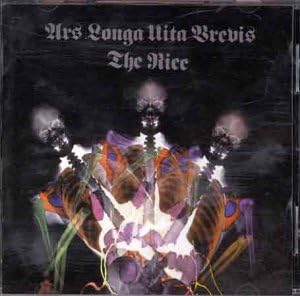
The band’s second LP “Ars Longa Vita Brevis” featured an arrangement of the Intermezzo from the Karelia Suite by Jean Sibelius, which the band’s friend Roy Harper had recommended they cover, and the album’s second side was a suite which included an arrangement of a movement from J.S. Bach’s Brandenburg Concerto No. 3. The group used an orchestra for the first time on some parts of the suite. The band were on the bill at the 1969 Isle of Wight Festival

A transition from the flower power and revolution themes of Thoughts of Emerlist Davjack. This marks the end of one cycle and the start of another, in that Davey O’List makes his last contribution to the band, which becomes a trio plus guests in the studio. This is a very sophisticated, inventive and influential first stab at what would eventually become an important part of the progressive rock genre … the first steps to concept/symphonic rock.
The Nice

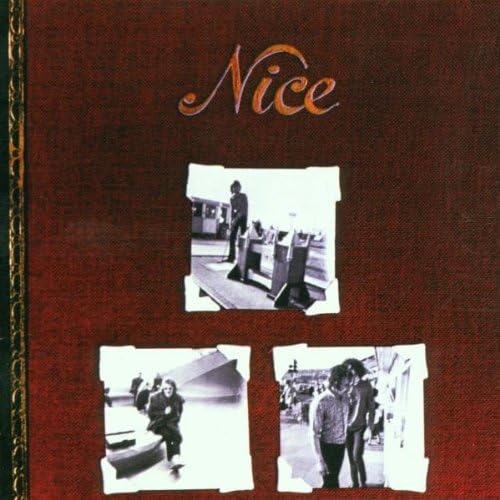
The third album, titled “Nice” in the UK and “Everything As Nice As Mother Makes It” in the US, featured one side recorded live on their American tour and one side of studio material. As with previous albums, it included arrangements of classical material, in this case the Third Movement of Tchaikovsky’s Sixth Symphony (Pathetique), and rearrangements of Bob Dylan’s “She Belongs to Me” and Tim Hardin’s “Hang on to a Dream”.

This was one of the first ‘progressive rock’ LPs, Those that remember these things will know you had to turn the things over to play the other side.
BUT we never bothered with the first 4 tracks of side 1. The killer and standout track here is the live side 2. The stand out track being “Rondo 69″.

Now I’m not saying the first four tracks are bad it was just that side two was so dam good. We played that side to death. The Nice were like that the single ‘America’ was always an anthem for them. Now some people will read this review thinking that I am saying the first 4 tracks from the original LP are bad- they are not. They are studio tracks which to my ear always sound better played live and as extended live track sets.

The live side of the LP has always contained my favourite Nice track “Rondo ’69” and captures what the Nice were, a really fabulous Live band. That organ sound that Emerson produces drives the trio along. No lead guitars see. ‘She belongs to me,’ a Bob Dylan song, has Lee Jackson barking out the vocals, his bass guitar being the powerhouse backing with able support by Brian ‘Blinky’ Davison on the drums.
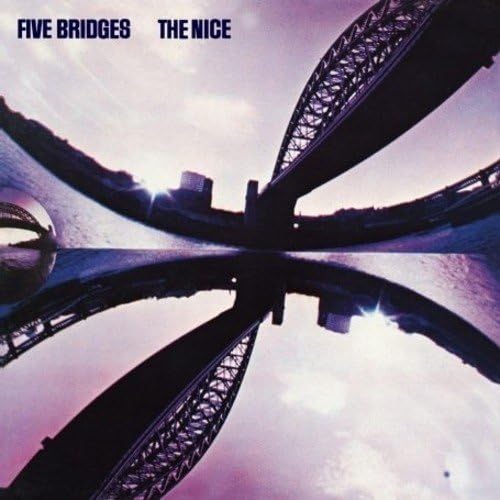
Five Bridges

In 1969, the band found time to contribute to other projects. Emerson performed as a session player for Rod Stewart and the Faces, while the whole group provided instrumental backing for the track “Hell’s Angels” on Harper’s 1970 album “Flat Baroque and Berserk”.  Mid-year, tour promoter Michael Emmerson asked the Nice to write some music for the Newcastle upon Tyne Arts Festival. The result was the “Five Bridges” suite. The group premièred the piece on 10th October 1969 at Newcastle City Hall.

A complete version with an orchestra was performed at the Fairfield Hall, Croydon on 17th October, which was recorded for the album of the same name. The title refers to the city’s five bridges spanning the River Tyne, and Jackson’s lyrics refer to his Newcastle childhood and the St James’ Park football ground.

Emerson played the piano on several other tracks, solely and/or in combination with the organ. The band made clear where they stood an amalgam of pop, jazz, blues, rock and classical music. With only three people aboard they could produce a lot of noise. Emerson tried everything to make the organ sound more abrassive, agressive and louder. He played it like an lead guitarist with use of feedback, overdrive and distortion, in an unusual way, by mistreating the hapless instrument and even with the help of army of knives, thus creating before unheard sounds and effects. Lee Jackson added an earthly sounding bass guitar and his gruff vocals, whilst Brian Davidson used everything he could fit to bash on. All in all they were an unique group an could not be easily compared with other contempories. The Nice were one of the best progressive rock groups that ever existed. Some of it was prolonged in ELP but that is another story.

John Peel, was an early champion of the Nice, called ELP “a waste of talent and electricity”

See the source image

Elegy

In 1971, the posthumous Nice album “Elegy” was released. It included different versions of previously released tracks, two being studio versions and two live from the 1969 US tour. Emerson had no involvement with compiling the album, which was done by Jackson, Davison and Charisma Records

As the name suggests “Elegy” ,a song after mourning, was released after the band had broken up.
Immediate their label had been slaughtered causing all sorts of reissue hell for the collectors to fathom.

This was the last official Nice album. released after they split up, it shows a band at the peak of their live performance. the original album consisted of four lengthy tracks which were nice interpretations of other people’s music. “Hang On to a Dream” features some great piano work from Keith and an extended jazz work out in the middle where, at times, he plucks at and hits the strings – a style used to great effect on “Take A Pebble” from the 1st ELP album. some great bass playing throughout this track.
this is followed by a radical interpretation of Dylan’s “My Back Pages” with some excellent hammond work. next up is a romp through “Pathetique” with Lee Jackson showing just how good he was at his best. give it a try yourself and you’ll sees what I mean
Finally, there’s “America”. the best recorded version. The last 5 mins are amazing. don’t forget, this is all pre synth days and the sounds generated from Keith’s trusty hammond are stunning and well complimented by the bass and drum work from Lee and Brian (who plays well and unobtrusively throughout.

Bonus tracks not really needed. the live version of country pie is much better than this one and the “Pathetique” is very similar to the album version although the BBC sound is better.
As a Keith Emerson, ELP and Nice fan (the group not an adjective) I still believe that the Nice never realised their full potential as a group. This CD confirms it.
The original 4 tracks have been enhanced with further tracks. BUT beware there are now two different reissue versions of this CD. At the time of writing in Feb 2012 the one with 2 is the cheaper.
To the actual tracks with bonus later.
Track one is a live version of the Tim Hardin penned `Hang on to a Dream’. Here as with all tracks Lee Jackson’s vocals were not top division.
Track 2 is My Back Pages a Bob Dylan song with which the Byrds found success with. The Nice really seemed to go for Bob Dylan at that time but then everyone seemed to be releasing Dylan Tracks at that time from Manfred Mann’s Mighty Quinn to Hendrix’ All Along the Watchtower.

The final and the Stand out track of the original LP and of course the Nice’s only single success is “America”. This is a really stomping version and is worth the price of the CD alone. (But then most Nice fans would say this so I’m not alone.)

On the 2009 reissue. The first enhanced edition includes 2 bonus tracks which I believe have been previously released on a 1968 LP on Charisma called Charisma Perspective. They are much earlier tracks than the one included on the original “Elegy” but really make this a worthwhile investment. (see what I mean about recycling and completists’ hell?) many tracks by the Nice appear and reappear on countless editions in different but all too often the same forms on many not only best of type but as extra tracks on the original LPs.
These two additional tracks are another Bob Dylan written Country Pie and another Pathetique! Both from the BBC live.

This includes two tracks from the final recording session by The Nice for a BBC Radio One Sounds of the ’70s session. The Nice would go down in history as one of the most exciting live acts of their age and as the creators of a series of excellent albums that would fuse the worlds of Rock and classical music, taking in elements of Jazz, Psychedelia and Rhythm & Blues on the way, effectively spawning the genre of Progressive Rock in their wake.

Studio albums

  • The Thoughts of Emerlist Davjack (Immediate, 1968)
  • Ars Longa Vita Brevis (Immediate, 1968)
  • Nice (aka Everything As Nice As Mother Makes It) (Immediate, 1969)
  • Five Bridges (Charisma, 1970)

See the source image

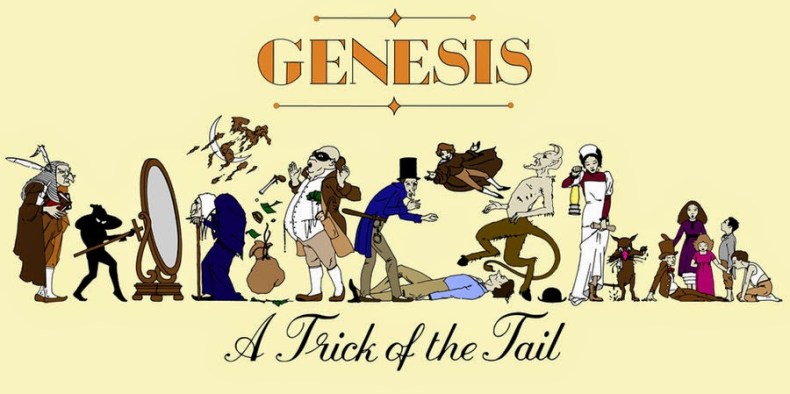
Peter Gabriel’s last show as Genesis’ lead singer was May 22nd, 1975, in Besançon, France. His bandmates had known for months he was quitting the group, but they kept the news out of the press, and completed their world tour supporting the ambitious double-album “The Lamb Lies Down on Broadway”. The next steps for drummer Phil Collins, bassist/guitarist Michael Rutherford, keyboardist Tony Banks and guitarist Steve Hackett were unclear. Would the band stay together or not?. “A Trick of the Tail” is the seventh studio album by English progressive rock band Genesis. It was released in January 1976 on Charisma Records and was the first album to feature drummer Phil Collins as lead vocalist following the departure of Peter Gabriel.

Hackett went into Kingsway Recorders in London almost immediately to record a solo album (Voyage of the Acolyte, released in October of that year). With Genesis in limbo, Rutherford and Collins were there to help out. When Genesis at last convened at London’s Trident Studios in the autumn, they were toying with the idea of becoming a completely instrumental band. Their co-producer David Hentschel, who’d worked with them as tape operator and engineer for years, was supportive of whatever they wanted to do.

A Melody Maker advertisement announcing auditions for a “Genesis-type group” had drawn a large number of applicants, but few seemed suitable to replace Gabriel, whose theatrical panache and flexible voice had become, in the words of Banks, “our logo.” Working vocalists like Colin Blunstone (The Zombies) and Mick Rogers (Manfred Mann’s Earth Band) were briefly considered, as was, according to one unsubstantiated account, Nick Lowe of Brinsley Schwarz.

The singer Mick Strickland made the initial cut, and was invited to Trident to assay the new song “Squonk,” but it wasn’t in a comfortable key for him, and he was quickly rejected as well. A collective frustration led to Collins, who had done some light singing in the band already, and as a teenager had played the Artful Dodger in a production of Oliver!, to attempt the lead vocal on “Squonk” himself. He did well enough that the sessions continued with Collins singing whatever lyrics were proffered, while he mostly held down his post at the drumkit. Collins later said that he figured they’d find a real lead singer by the time they hit the road again.

Tony Banks was focused on making the new music equal to that made with Gabriel, who remained a good friend. “If it isn’t, we won’t play again,” he told a journalist just before entering Trident Studios. “If it’s not as good, there’s no point in playing. Peter left and life goes on. We were all sort of sad. We spent some time trying to make him change his mind, but when he didn’t, we just carried on. We’ve always had confidence in our own abilities, but we’re apprehensive about whether audiences will accept us without Peter.”

Released in February 1976, A Trick Of The Tail proved that far from being over, Genesis was set to achieve commercial and artistic successes beyond what they’d accomplished during the Gabriel years. The opening track, “Dance on a Volcano,” immediately announced that strong melodies, dramatic dynamics, majestic classical flourishes and intimate vocals were still in full force. “Holy mother of God/You’ve got to go faster than that to get to the top,” sings a double-tracked Collins at the start.

Time signatures ricochet, multiple keyboards (including synthesizers and mellotron) and 6- and 12-string guitars interweave. Chunky bass and muscular drumming negotiate some spectacular rhythm accents. It’s a kaleidoscopic, virtuosic group performance, developed out of a jam session in the studio at the start of sessions. You can hear the confidence driving the band to believe it could write the bulk of a crucial album on the fly.

See the source image

The composition of “Entangled” began with Hackett’s 3/4-time guitar figure, to which Banks added a chorus section, Hackett’s lyrics carried upward magnificently by Collins: “Well, if we can help you we will/You’re looking tired and ill/As I count backwards/Your eyes become heavier still.” Some delicate chiming percussion is added to Banks’ harpsichord-like keyboard, and he also adds an ethereal, theremin-like synth solo that fills the final minute. The mellotron, imitating a human vocal chorus, joins for a dramatic conclusion. Banks often identifies “Entangled” as his favourite track on the album.

“Squonk,” credited to Rutherford/Banks, has been described by Collins as “our Led Zeppelin moment.” Taking off from “Kashmir” and “When The Levee Breaks,” it sounds unlike either, but Collins is clearly thinking of John Bonham in his booming rhythm. Banks’ keyboards harken back to the band’s solid prog-rock days of “Watcher of the Skies” and “Supper’s Ready,” and the Rutherford/Hackett interaction is again a master class in arranging. Every inch of its 6:30 length contains something interesting, and when Banks’ organ launches yet another gorgeous melody in the last moments, the fade feels too soon. The lyrics refer to the mythical animal that dissolves into a pool of tears when captured. “Squonk” is one of the tracks that suggested to the Hipgnosis album cover design crew that a “storybook” theme would be a way to convey the feel of the album.

Banks’ solo composition “Mad Man Moon” is the most overlooked track on “A Trick of the Tail”, maybe because in many ways it’s the most conventional performance on the disc, and a bit too unfocused. Banks says he wanted it to sound “unusual but not weird,” and it certainly gives him a showcase, with a full display of mellotron, synth and piano expertise. Collins gets to add some xylophone, and he sings it perfectly, but there’s something unconvincing about the upbeat, dramatic section about five minutes in that starts “Hey man/I’m the Sandman.” As the second-longest track on the album, it drags too much, and brings side one of the LP to a close.

The rousing “Robbery, Assault and Battery” launches side two with Collins in Artful Dodger mode for a tale he devised with Banks. Using a put-on Cockney accent (he was born in Chiswick, not the East End, of London), Collins shows the wit that allowed him to truly become a “front man” when Genesis toured A Trick of the Tail in ’76, with Bill Bruford drumming whenever Collins needed to be at the microphone. Again, the whole band contributes backgrounds of spectacular coloration and invention.

“Ripples,” credited to Rutherford and Banks, is over eight minutes long, and justifies every second, from the delicate baroque opening, through the soaring chorus of “Sail away, away/Ripples never come back,” to the mid-point switch to an instrumental cinematic landscape. Hackett’s backward-sounding guitar, Banks’ trumpeting synth, and the solid drum/bass lock-in eventually winds back to another chorus, this time underpinned by every emotional hook in the Genesis repertoire. No wonder “Ripples” remained in Genesis’ live sets for decades.

The album’s title track is a jaunty Banks-penned piece, which Collins again superbly acts out. The vocal arrangement is outstanding, unlike anything else on the album: listen to what happens around the first iteration of the lyrics “Am I wrong to believe in a city of gold/That lies in the deep distance.” This is the song that points to hit singles in the band’s future, like “Follow You, Follow Me,” “Misunderstanding” and “That’s All.” “A Trick of the Tail” was released as the B-side to the album’s only 45rpm single, “Entangled,” but neither scored any pop radio success at the time.

The instrumental “Los Endos,” inspired by Santana’s “Promise of a Fisherman,” ends the album, and manages to reference “Squonk” and “Dance on a Volcano” for a nice circular conclusion to the disc. Collins even sings a couple of lines from “Supper’s Ready” in a nod to Gabriel before it’s over. It’s a full-band composition, and shows what Genesis would have sounded like had they dumped the whole idea of having a singer—still damn good. “Los Endos” meshes with the “classic” Gabriel-era Genesis perfectly, and serves as a message to their fans that they’re not going to jettison anything that made them previously beloved, but rather add to their legacy and keep moving forward. It’s been a highlight of their live performances ever since.

Music critics and the public loved the album, and it got solid FM airplay in the U.S. and U.K. Three promotional films were made, for “Robbery, Assault and Battery,” “Ripples” and the title track, which helped spread the word. A Trick of the Tail sold well, The subsequent North American tour started with Collins nervous at first and triumphant after—he’d proven himself capable of being out front.

“The visual show has always been the trimmings,” he told a journalist during the tour. “That’s the least important aspect of what we’re about. Recording good music and the playing of the music is the most important thing. The presentation was the icing on the cake. A Trick of the Tail is a typical Genesis album but the major change is that it has a much stronger appeal than any other.”

See the source image

No photo description available.

Rare Bird were an English prog-rock band, formed in 1969. They had more success in other European countries. They released five studio albums between 1969 and 1974. In the UK, they never charted with an album but charted with one single, the organ-based track “Sympathy”, which peaked at number 27. It sold one million copies globally.

The history of Rare Bird began when Graham Field placed an advertisement for a pianist in a musical periodical. He got thirty replies and formed a group called “Lunch”. He met Dave Kaffinetti in November 1968, and together they formulated the basic ideas for Rare Bird. In August 1969, they finally found the ideal rhythm section in Steve Gould, Chris Randall and Mark Ashton. Field and Kaffinetti had originally envisaged that the band would be a four-piece and were looking for a singer/bass player. Gould and Randall, who had both previously been members of the Pop-Psych band “Fruit Machine”, applied to the advert as vocals/guitar and bass respectively and were taken on. Lunch played a few gigs; one notable one was at the Tilbury Working Mens Club for the princely sum of five pounds. The band had no van and they managed to get amps, drums, guitars and Hammond organ into their cars. The gig was marred by Randall receiving a bad electric shock whilst on stage. It later turned out that the founders of the band were more interested in Steve Gould and convinced him to play bass. Randall was now high and dry and was kicked out of the band.

https://www.youtube.com/watch?v=IMWz5tMn2_M

Two weeks later, they had signed management and agency contracts, and three weeks later, were in the studio recording their debut album. Before joining Lunch, Randall and Gould had previously written a song called “To the Memory of Two Brave Dogs”. Rare Bird included this song in their debut album, renaming it “Iceberg” but Randall received no credit on the L.P. Along with Van der Graaf Generator and The Nice, they were one of the very first bands that signed to Charisma Records, the record label that Tony Stratton-Smith had founded.

The eponymous debut album from Rare Bird. Released on the newly formed Charisma label in 1969, this commercial organ based progressive rock album spawned the worldwide hit ‘Sympathy’. Vocalist Steve Gould had previously been in Brit psych band Fruit Machine.

Image may contain: 4 people

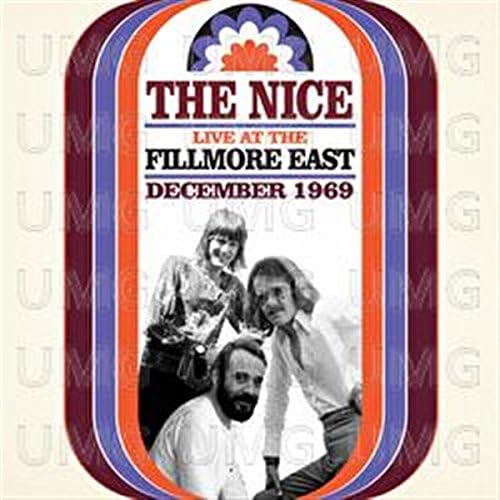
Out of all of EMI’s new reissues of The Nice’s Charisma label back catalogue is among the most interesting, this two-disc set totaling over 90 minutes is likely to be of most interest to fans of The Nice.

Whilst the song titles will be familiar this is the first time this concert at New York’s legendary Fillmore East has been released. Where the studio albums were often a little too variable for their own good, hearing the set flow from start to finish gives us a greater appreciation of how powerful and cohesive a unit The Nice were in concert the British Psychedelic/Art Rock band featuring a previously unreleased performance taped at the Fillmore East in 1969. Digitally re-mastered from the original eight track tapes. Including alternate unedited performances of “She Belongs to Me” and “Country Pie”, along with material previously unreleased on either vinyl or CD. The Nice would go down in history as one of the most exciting live acts of their age and as the creators of a series of excellent albums that would fuse the worlds of Rock and classical music, taking in elements of Jazz, Psychedelia and Rhythm & Blues on the way, effectively spawning the genre of Progressive Rock in their wake.

Whilst Keith Emerson’s off-the-cuff quotes of Bach and other popular classics may sound a touch arch by today’s standards, it’s easy to forget how hard-edged and radical this was to audiences largely fed on a diet of bluesy guitar jams. This, coupled with his theatrical mauling of his Hammond organ, added not only an arresting visual dimension but the resulting ear-bleeding atonality of such pre-meditated destruction gave the group something of an avant-garde frisson as well.

Though Lee Jackson’s sandpaper-rasp of a voice suited the rockier repertoire, his limitations are spotlighted in the quieter parts such as their imaginative reading of Tim Hardin’s sublime Hang On To A Dream. Nevertheless, Jackson’s bass playing was entirely dependable and together with drummer Brian Davison’s always elegant but robust swing, the pair provided an unswerving rhythm section that was in effect the safety net to Emerson’s high-wire act.

Surprisingly is the Tim Hardin cover “Hang on to a Dream”, ‘normally’ played on the piano, completely played on the organ also. But Emerson played the piano on several other tracks, solely and/or in combination with the organ. The band made clear where they stood for in those final days: an amalgam of pop, jazz, blues, rock and classical music. With only 3 people aboard they could produce a lott of noise. Emerson tried everything to make the organ sound more abrassive, agressive and louder. He played it like an leadguitarist with use of feedback, overdrive and distortion, in an unusual way, by mistreating the hapless instrument and even with the help of armyknives, thus creating before unheard sounds and effects. This can be heard on the “Karelia Suite”, among others. Lee Jackson added an earthly sounding bass-guitar and his gruff vocals, whilst Brian Davidson used everything he could fit to bash on.

When this show was recorded The Nice were only weeks away from breaking up. Yet the risk-taking that went from Dylan to Dvorak remains exhilarating, edgy and largely underrated.

Vocals, Bass Guitar: Lee Jackson , Vocals, Organ, Piano: Keith Emerson , Drums: Brian Davison

Tracks:  Rondo,  Ars Longa Vita Brevis,  Little Arabella,  She Belongs to Me,  Country Pie,  Five Bridges Suite,  Hang On to a Dream,  Intermezzo: Karelia Suite,  America,  War and Peace.

A double-album sampler of the Charisma label’s 1971-1972 output, “Charisma Disturbance” is a veritable behemoth and no mistake. Just a glance at the participating artists renders further comment all but superfluous  Genesis, Peter Hammill, the Nice, Rare Bird, Van Der Graaf Generator, and the Incredible String Band are more than mere giants of the U.K. underground of the age; they also represent peaks to which British prog has been attempting to return ever since. This album’s unstinting trawl through some of their most adventurous pages — “Return of the Giant Hogweed,” “Killer,” “Sympathy,” and so on — is simply the icing on the hyperbolic cake.

Charisma Records itself was never less than the consuming passion of one man, founder Tony Stratton Smith, but it is to his unending credit that he neither tried to mold his artists toward any single vision, nor impress upon them the need to shift more product. Several of the artists here would go on to enjoy huge success Genesis, of course, but also Lindisfarne and Clifford T Ward — but “The Money Game,” as one of the album’s highlights calls it, was never the be-all and end-all of the label’s release policy. And so 20 tracks rattle past with an idiosyncrasy and imagination that shares no common ground beyond the Mad Hatter who so aptly dominates the label design itself, and if you don’t discover at least a handful of bands to run out and discover — even all these decades after the fact — then you deserve to listen to track seven for the rest of your life. Altogether now, “Spam spam spam spam, spam spam spam spam.”

Side 1

Sinfonia Of London* Conducted By Joseph Eger Sonata Pian E Forte
John Neville -The Unanswered Question
The Nice -Intermezzo ‘Karelia Suite’
Peter Hammill -German Overalls
Side 2 –

Alan Hull -Money Game
Bell & Arc -She Belongs To Me
Monty Python -Spam Song
Lindisfarne -Lady Eleanor
Bo Hansson -Flight To The Ford
Lindisfarne- Fog On The Tyne
Side 3 –

Capability Brown -No Range
Rare Bird -Sympathy
Audience – I Had A Dream
Clifford T. Ward -Home Thoughts
Van Der Graaf Generator -Killer
Side 4-

Music From Free Creek -Getting Back To Molly
Graham Bell -Too Many People
Jo’Burg Hawk- Dark Side Of The Moon
String Driven Thing -Regent Street Incident
Genesis -Return Of The Giant Hogweed